
2027 How to Become a Kindergarten Teacher

Co-Founder and Chief Data Scientist
Becoming a kindergarten teacher is a long-term professional decision, not just a question of liking young children. The role requires formal teacher preparation, supervised classroom practice, state licensure in most public school settings, and the ability to guide children through one of the most important transitions in their education: the move from early childhood into structured elementary learning.
This guide explains how to become a kindergarten teacher in 2026, what the job involves, how long the path usually takes, which credentials matter, what skills schools look for, and how salary and job outlook data should factor into your decision. It is written for high school students, college students, career changers, paraprofessionals, preschool teachers, and education majors comparing early childhood teaching with related education careers.
Quick answer: How do you become a kindergarten teacher?
Most aspiring kindergarten teachers earn a bachelor’s degree in early childhood education, elementary education, or a closely related teacher-preparation field; complete student teaching; pass required state exams; clear a background check; and apply for state teaching licensure or certification. The standard route usually takes about four years, although timing depends on state requirements, transfer credits, enrollment status, and whether the candidate pursues graduate study later.
| Decision point | What to know before choosing this path |
| Typical education route | A bachelor’s degree is the standard path for public school kindergarten teaching. |
| Common degree fields | Early childhood education, elementary education, child development, or a closely related approved teacher-preparation program. |
| Licensure | Public school teachers generally need state licensure or certification; requirements vary by state. |
| Usual timeline | Approximately four years through the traditional bachelor’s degree route. |
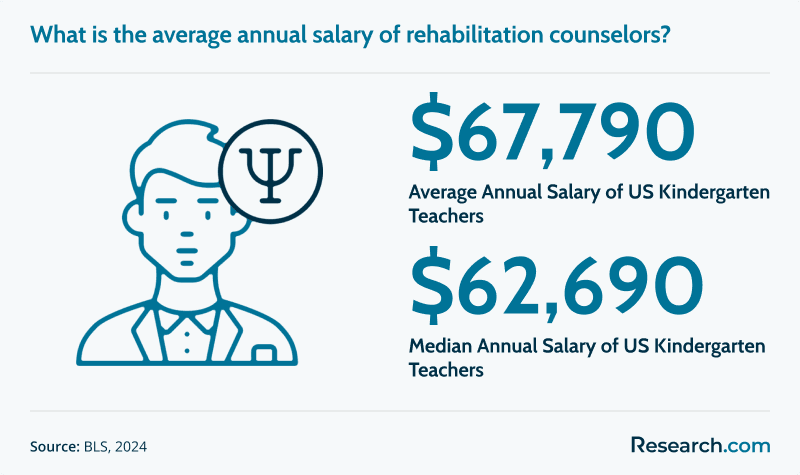
| Salary snapshot | The average annual salary is $67,790, and the median annual salary is $62,690. |
| Labor market snapshot | There are over 11,000 openings for kindergarten teachers in the United States, according to Indeed as of February 2025. |
Key Things You Should Know About Becoming a Kindergarten Teacher
- Kindergarten teachers plan age-appropriate lessons and use stories, songs, art, media, movement, structured games, outdoor exploration, and guided play to help young children learn.
- Zippia reports that 71% of kindergarten teachers have a bachelor's degree, 16% have a master's, 8% earned an associate degree, and 2% obtained a high school diploma.
- The traditional bachelor’s degree pathway generally takes approximately four years, though state rules and individual academic plans can change the timeline.
- There are over 11,000 openings for kindergarten teachers in the United States.
- The average annual salary of kindergarten teachers in the United States is $67,790, while the median annual salary is $62,690.
- The highest average annual salaries are reported in California ($93,510), New York ($91,300), Massachusetts ($88,800), Connecticut ($85,610), and Washington ($85,530).
- What does a kindergarten teacher do?
- How do you become a kindergarten teacher in 2026?
- How long does it take to become a kindergarten teacher?
- Which classroom management strategies work best in kindergarten?
- What should a strong kindergarten curriculum include?
- Which certifications help kindergarten teachers?
- What skills do kindergarten teachers need most?
- What career paths can kindergarten teachers pursue?
- What challenges should new kindergarten teachers expect?
- Do teacher education requirements match today’s classroom needs?
- Can further education improve advancement opportunities?
- Can online graduate degrees help kindergarten teachers move forward?
- How do professional development and mentorship support career growth?
- What is the job outlook for kindergarten teachers?
- How much do kindergarten teachers earn?
- What trends are changing kindergarten teaching?
- How can kindergarten teachers move into administrative roles?
- How can teachers use research to improve instruction?
- How can cross-disciplinary skills expand career options?
- How can interdisciplinary teaching strengthen kindergarten learning?
- Key insights
What are the responsibilities of a kindergarten teacher?
A kindergarten teacher introduces young children to formal school routines while supporting academic, social, emotional, and physical development. The work combines instruction, observation, classroom management, family communication, safety supervision, and individualized support for children who enter school with different levels of readiness.
Kindergarten is not simply a “pre-reading and counting” year. Teachers help children listen, follow directions, share materials, manage emotions, ask questions, solve basic problems, and participate in group learning. A frequently cited learning model from Education Corner discusses retention rates from discussions (50%), demonstrations (30%), and other teaching approaches, but effective kindergarten instruction usually depends on blending multiple methods rather than relying on one format.
| Responsibility | What it looks like in practice | Why it matters |
| Lesson planning | Designing short, developmentally appropriate lessons using stories, songs, drawing, counting activities, centers, games, and hands-on projects. | Young children learn best when instruction is structured, varied, and active. |
| Core academic instruction | Introducing early reading, writing, math, science, social studies, and vocabulary through guided practice and play-based learning. | Kindergarten builds the foundation for later elementary achievement. |
| Social-emotional development | Teaching students how to share, wait, name feelings, solve conflicts, cooperate, and participate in classroom routines. | Children need behavioral and emotional readiness to succeed in group learning environments. |
| Classroom routines and behavior | Setting expectations, using visual reminders, practicing transitions, reinforcing positive behavior, and redirecting unsafe or disruptive actions. | Predictable routines reduce confusion and help children feel secure. |
| Assessment and observation | Tracking progress through informal checks, student work, oral responses, group activities, and developmental observations. | Early identification helps teachers adjust instruction and recommend additional support when needed. |
| Family communication | Sharing progress updates, discussing behavior or learning concerns, and coordinating support between school and home. | Family partnership is especially important when children are beginning formal schooling. |
| Safety and supervision | Monitoring indoor and outdoor activities, teaching hygiene and safety rules, and responding quickly to student needs. | Kindergarten teachers are responsible for both learning and child welfare throughout the school day. |
A master’s degree can support advancement, specialization, or higher placement on some district salary schedules, but it is not generally the entry requirement for kindergarten teachers. According to Zippia, 71% of kindergarten teachers have a bachelor's degree; 16% have a master's; 8% earned an associate degree; and 2% obtained a high school diploma. If you are comparing teaching with unrelated fast-track healthcare routes, remember that programs such as a 1 year PMHNP program online follow completely different licensure and clinical requirements and should not be used as a model for teacher preparation.
How to become a kindergarten teacher for 2027?
The process for becoming a kindergarten teacher usually follows a state-regulated sequence: complete an approved degree program, gain supervised classroom experience, pass required assessments, apply for licensure, and then pursue teaching jobs. The exact rules depend on where you plan to teach, so the state department of education should be your final authority.
- Choose an approved teacher-preparation program. Look for a bachelor’s program in early childhood education, elementary education, or a related field that is recognized for teacher licensure in your state. Do not assume that every education-related degree automatically qualifies you for a kindergarten teaching license.
- Complete coursework in child development and instruction. Typical preparation includes learning theory, early literacy, math instruction, classroom assessment, family engagement, inclusive education, behavior support, and lesson design for young learners.
- Finish supervised fieldwork and student teaching. Most programs require classroom placements where candidates observe, assist, teach lessons, receive feedback, and gradually take on more responsibility under a licensed teacher.
- Pass required certification exams. Many states require exams such as Praxis or state-specific assessments. Candidates may also need a background check and other clearance documents.
- Apply for state licensure or certification. Submit transcripts, test scores, student teaching verification, background check documentation, and any state-specific forms.
- Prepare a school-ready application. A strong application should show your degree, licensure status, field experience, classroom management approach, literacy and math strategies, and ability to work with families.
- Keep learning after you are hired. New teachers often complete induction programs, district training, continuing education, and renewal requirements. Some later pursue graduate study for specialization or leadership.
Career changers should be careful when comparing education pathways. For example, online ABSN programs are designed for nursing preparation, not teacher licensure; the useful lesson is that accelerated formats can exist in some fields, but the requirements, clinical experiences, exams, and licensing bodies are different.
How long does it take to become a kindergarten teacher?
The traditional route usually takes approximately four years because most candidates complete a bachelor’s degree that includes teacher-preparation coursework and student teaching. Student teaching or a similar internship commonly takes one semester, or about 4-6 months, and is usually embedded in the degree program rather than added after graduation.
After completing the degree and fieldwork, candidates generally need a few months to finish testing, background checks, licensure paperwork, and job applications. A master’s degree is not always needed for initial licensure, but it can add 1-2 years of study for teachers who want advanced expertise, salary schedule movement, or leadership opportunities. Some graduate fields offer accelerated formats; for example, online MPP programs may be structured differently from teacher education programs, so candidates should compare format, accreditation, fieldwork, and licensure alignment rather than relying on program length alone.
| Stage | Typical timing | What can speed it up or slow it down |
| Bachelor’s degree | Approximately four years | Transfer credits, part-time enrollment, changed majors, prerequisite gaps, or program sequencing. |
| Student teaching | One semester, often 4-6 months | Placement availability, state rules, school district calendars, and program requirements. |
| Licensure process | A few months after other requirements are complete | Exam scheduling, retakes, background checks, transcript processing, and state review timelines. |
| Optional master’s degree | Additional 1-2 years | Full-time versus part-time study, online format, employer tuition support, and thesis or capstone requirements. |
Before enrolling, contact the state Department of Education in the state where you plan to teach. This is especially important if you study online, attend an out-of-state institution, transfer credits, or plan to move after graduation.
What strategies do effective kindergarten teachers use for classroom management?
Classroom management in kindergarten works best when children know what to expect, feel safe, and receive frequent practice with routines. The goal is not strict control for its own sake; it is to create a learning environment where children can participate, take risks, calm down, and interact respectfully.
- Use simple, visible rules. Kindergarten rules should be short, concrete, and easy to model, such as listening when someone speaks, using walking feet, keeping hands safe, and caring for materials.
- Practice routines before expecting independence. Teachers often rehearse lining up, cleaning up, moving to centers, asking for help, using supplies, and transitioning to the carpet many times before students can do them smoothly.
- Build relationships early. Greeting students, learning their interests, noticing effort, and responding calmly help children trust the teacher and participate more fully.
- Reinforce positive behavior immediately. Specific praise and predictable rewards can help children understand which behaviors support the classroom community.
- Use visual supports. Picture schedules, rule charts, emotion cards, center signs, and illustrated steps make expectations easier for young learners to remember.
- Plan for movement. Short lessons, songs, movement breaks, hands-on centers, and partner activities help reduce restlessness and off-task behavior.
- Make transitions predictable. Songs, timers, call-and-response cues, and consistent clean-up routines help children shift activities with less confusion.
- Arrange the room intentionally. Materials should be reachable, traffic patterns should be clear, and high-energy areas should be separated from quieter learning spaces.
- Model the behavior you expect. Children learn tone, problem-solving language, listening habits, and respectful disagreement by watching adults.
- Stay consistent. Rules and consequences should not change from day to day. Consistency gives children a sense of fairness and security.
If you are planning this career, review teacher certification early childhood expectations because many states connect early childhood credentials with classroom management, child development, assessment, and family engagement competencies.
What are the key elements of a kindergarten curriculum?
A strong kindergarten curriculum balances academic readiness with social, emotional, creative, and physical development. The best programs do not treat play and learning as opposites; they use purposeful play, guided instruction, conversation, movement, and exploration to build skills.
| Curriculum area | Common kindergarten focus | Examples of classroom activities |
| Early literacy and language | Letters, sounds, phonics, vocabulary, listening comprehension, storytelling, early writing, and oral communication. | Read-alouds, shared writing, alphabet games, rhyming, show-and-tell, picture walks, and writing simple words or sentences. |
| Mathematics | Counting, number recognition, patterns, shapes, basic operations, measurement, sorting, and problem-solving. | Counting objects, pattern blocks, calendar activities, number games, shape hunts, and hands-on measurement. |
| Science | Observation, curiosity, plants, animals, weather, the body, health, hygiene, and basic physical science concepts. | Simple experiments, nature walks, class plants, weather charts, sorting natural objects, and discussion of health habits. |
| Social studies | Families, communities, helpers, rules, citizenship, maps, traditions, holidays, and cultural awareness. | Community helper units, classroom jobs, map exploration, family sharing activities, and discussions about fairness and responsibility. |
| Social-emotional learning | Self-regulation, empathy, cooperation, conflict resolution, emotional vocabulary, and problem-solving. | Morning meetings, feelings charts, role-play, cooperative games, and guided conversations after conflicts. |
| Creative arts | Art, music, dramatic play, movement, imagination, fine motor development, and self-expression. | Painting, drawing, singing, dancing, puppets, dramatic play centers, crafting, and storytelling. |
| Physical development | Gross motor skills, fine motor skills, coordination, healthy habits, nutrition, and personal care routines. | Outdoor play, cutting, tracing, coloring, building, movement games, and hygiene practice. |
Teachers who later want to specialize in literacy instruction, reading intervention, or adult literacy may compare advanced options such as masters in reading education online programs, but kindergarten teachers should first confirm that their initial program meets state classroom teaching requirements.
What are the best kindergarten teacher certifications?
The most important credential is usually the state teaching license or certification required for public school employment. Additional certifications can strengthen expertise, support specialized roles, or help educators work in private, childcare, Montessori, or special education settings.
| Credential | Best for | Important caution |
| State Licensure or Teaching License | Teaching kindergarten in public schools. | Requirements vary by state and usually include a bachelor’s degree, approved teacher-preparation program, student teaching, exams, and a background check. |
| Child Development Associate | Early childhood educators working with children from birth to five. | The CDA certification is widely recognized, but it is not the same as a public school teaching license. |
| Certified Childcare Professional | Childcare providers who want additional professional recognition. | It may support childcare employment but may not qualify someone to teach kindergarten in a public school. |
| Early Childhood Special Education Certification | Teachers supporting young children with disabilities or developmental delays. | Often requires additional coursework, exams, and an existing or related teaching credential. |
| National Board Certification, Early Childhood Generalist | Experienced teachers seeking advanced professional recognition. | This is generally an advanced credential, not an entry-level license. |
| Montessori Certification | Educators who want to work in Montessori schools or use Montessori methods. | Check whether the credential is recognized by the schools or programs where you want to work. |
| Certified Kindergarten Teacher through ABCTE | Candidates exploring an alternative route in states that recognize this pathway. | Recognition varies, so verify state acceptance before enrolling. |
What are the most important skills for a kindergarten teacher?
Kindergarten teaching requires more than subject knowledge. Teachers must translate concepts into child-friendly lessons, maintain order without harshness, recognize developmental differences, communicate with families, and respond calmly when children struggle.
- Clear communication. Teachers need to give brief directions, explain ideas in concrete language, listen closely, and use gestures, pictures, modeling, and tone to support understanding.
- Patience. Children develop at different speeds. A teacher may need to repeat directions, reteach routines, and support emotional regulation many times in a day.
- Creativity. Songs, games, puppets, art projects, stories, movement, and imaginative play help make abstract ideas understandable and memorable.
- Classroom management. Teachers must create routines, organize materials, supervise transitions, prevent unsafe behavior, and keep learning moving even when students have short attention spans.
- Organization. Lesson materials, assessments, family communication, student work, behavior notes, and small-group plans all require careful tracking.
- Flexibility. A lesson may need to change because students are tired, a conflict occurs, a concept is harder than expected, or a child needs immediate support.
- Commitment to young learners. Enthusiasm matters because children often mirror the energy, curiosity, and emotional tone of the teacher.
- Time management. Kindergarten teachers must balance whole-group lessons, small groups, centers, transitions, meals, recess, assessments, and family communication within a packed day. These skills also form a foundation for educators who may later review principal certification requirements for leadership roles.
Zippia identified common skills appearing on U.S. kindergarten teacher resumes as classroom management (26.9%), math (13.7%), professional development (7%), language arts (5.4%), social studies (4.4%), classroom environment (4%), and student learning (3.9%).
What are the possible career paths for aspiring kindergarten teachers?
Kindergarten teaching can be a destination career or a starting point for broader work in early childhood education, curriculum, special education, administration, consulting, or teacher leadership. The right path depends on whether you prefer direct classroom work, specialized student support, program leadership, or instructional design.
| Career path | When it makes sense | Possible additional preparation |
| Traditional kindergarten teacher | You want a classroom role focused on early literacy, math, routines, and social-emotional growth. | State teaching license or certification. |
| Preschool teacher | You prefer younger children and play-based early learning settings. | Early childhood credential, CDA, or state-required childcare qualifications. |
| Special education teacher | You want to support children with disabilities, developmental delays, or individualized learning needs. | Special education coursework, endorsement, or certification. |
| Montessori educator | You are drawn to child-led, self-directed, materials-based learning environments. | Montessori certification through a recognized provider. |
| Daycare or preschool director | You want to supervise staff, manage operations, and oversee early childhood programs. | Administrative experience, childcare director credentials, or graduate education. |
| Curriculum developer | You enjoy designing lessons, assessments, instructional materials, and early learning resources. | Experience in classroom instruction, curriculum design, and often graduate-level training. |
| Child development specialist | You want to work with families and children around developmental milestones and early intervention. | Child development, psychology, or specialized early childhood training. |
| Bilingual education teacher | You are fluent in more than one language and want to support multilingual learners. | Bilingual education endorsement or ESL-related preparation, depending on the state. |
| Educational consultant | You have strong experience and want to advise schools, districts, or organizations. | Demonstrated expertise, professional network, and often advanced credentials. |
If you decide you would rather teach older students, compare requirements for secondary education degree online programs. If you want to specialize in disability support, review master degree in special education online programs and confirm how they align with your state’s endorsement rules.
What challenges do kindergarten teachers face?
Kindergarten teachers often manage several pressures at once: wide differences in school readiness, large developmental variation, family communication needs, behavior concerns, documentation requirements, limited classroom resources, and rising expectations around technology, assessment, and individualized support. The work can be rewarding, but it is physically and emotionally demanding.
- Uneven readiness levels. Some children enter school recognizing letters and routines; others may still be learning how to separate from caregivers, hold writing tools, follow directions, or interact with peers.
- Behavior and emotional regulation. Young children may cry, withdraw, refuse tasks, run, hit, shout, or struggle with transitions because they are still developing self-control.
- Time pressure. Teachers must cover academics while also teaching routines, social skills, hygiene, safety, and conflict resolution.
- Family expectations. Parents and guardians may have different beliefs about discipline, readiness, homework, assessment, and communication.
- Resource limitations. Not every classroom has enough aides, supplies, planning time, intervention support, or technology.
- Professional fatigue. Constant supervision, noise, emotional labor, and administrative work can contribute to stress if teachers lack support.
Targeted professional development, coaching, mentoring, and advanced training can help teachers handle these realities more effectively. Educators comparing graduate options may review a cheapest online master's degree in education, but affordability should be evaluated alongside accreditation, licensure relevance, curriculum quality, field expectations, and employer recognition.
Do evolving teacher education requirements align with modern classroom needs?
Teacher preparation requirements are changing because kindergarten classrooms now demand stronger skills in inclusive instruction, early literacy intervention, social-emotional learning, technology use, family partnership, data-informed teaching, and classroom safety. A degree program that was adequate on paper may still fall short if it does not provide enough supervised practice with diverse learners.
Prospective teachers should review state rules before choosing a program, especially if they are enrolling online or outside their home state. State-specific guidance is essential because licensure exams, age bands, fieldwork expectations, reciprocity, and endorsement rules differ. Research.com’s guide to teacher education requirements can help you begin that comparison, but you should verify final requirements with the official state agency.
How Can Further Education Accelerate Career Advancement for Kindergarten Teachers?
Further education can help kindergarten teachers move into roles that require deeper expertise, such as curriculum leadership, instructional coaching, early childhood program administration, education policy, district training, or research-informed practice. It is most valuable when the program matches a clear career goal rather than being pursued only because “more education” sounds beneficial.
For experienced educators interested in doctoral-level preparation, 2 year Ed D programs may appeal to those who want a structured route toward advanced leadership. Before enrolling, compare admission requirements, dissertation or capstone expectations, cost, accreditation, faculty expertise, and whether your employer or state recognizes the credential for advancement.
How can advanced online degrees boost career success for kindergarten teachers?
Advanced online degrees can be useful for working teachers because they may offer flexible scheduling while building skills in leadership, curriculum design, assessment, research, supervision, and educational improvement. They are not automatically worth the cost, however. Teachers should compare total price, time commitment, accreditation, transfer policies, licensure impact, and salary schedule rules before enrolling.
An online doctorate may support educators who want to influence school systems, lead programs, or move into higher-level educational leadership. Options such as the cheapest online doctorate in educational leadership can help teachers compare affordability, but the least expensive option is not always the strongest fit if it lacks relevant coursework, faculty support, or employer recognition.
How Can Professional Development and Mentorship Elevate a Kindergarten Teacher's Career?
Professional development and mentorship can shorten the learning curve for new kindergarten teachers. Workshops may introduce new literacy strategies, behavior supports, assessment tools, inclusive practices, and family engagement methods, while mentors can help teachers solve practical problems that do not always appear in textbooks.
Strong mentorship is especially valuable during the first years of teaching because it provides feedback on lesson pacing, transitions, challenging behavior, parent communication, and student data. Teachers who later want to lead teams, train staff, or move into organizational leadership may explore a doctorate in organizational leadership online, but they should first identify the specific roles they want and whether an education-specific leadership degree would be more appropriate.
What is the job outlook for kindergarten teachers?
According to the United States Bureau of Labor Statistics (BLS), employment of kindergarten teachers is projected to decline by 1% from 2023 to 2033, moving from 122,700 in 2023 to 121,800 by 2023. Even with that projected decline, openings continue because schools need to replace teachers who retire, transfer, or leave the occupation.
Indeed reported over 11,000 openings for kindergarten teachers in the country as of February 2025. From 2023 to 2033, aspirants and job seekers can also expect 106,500 openings for kindergarten and elementary school instructors each year.
The industries employing the most kindergarten teachers are elementary and secondary schools (116,420), childcare services (1,190), religious organizations (320), local government units (190), and civic and social organizations (130).
What is the average salary of a kindergarten teacher?
According to the BLS, kindergarten teachers in the United States earn an average annual salary of $67,790 and a median annual salary of $62,690. That median is higher than the collective median annual salary of all professions in the country, which is $48,060. Salary, however, varies by location, school type, district funding, experience, contract rules, union agreements, and education level.
| Salary category | Reported amount |
| Average annual salary for kindergarten teachers | $67,790 |
| Median annual salary for kindergarten teachers | $62,690 |
| Collective median annual salary of all professions in the country | $48,060 |
Teachers considering graduate study should compare the cost of tuition with the likely salary impact in their district or state. Research.com’s guide to the salary difference for teachers with a master’s can help frame that question, but individual pay outcomes are not guaranteed.
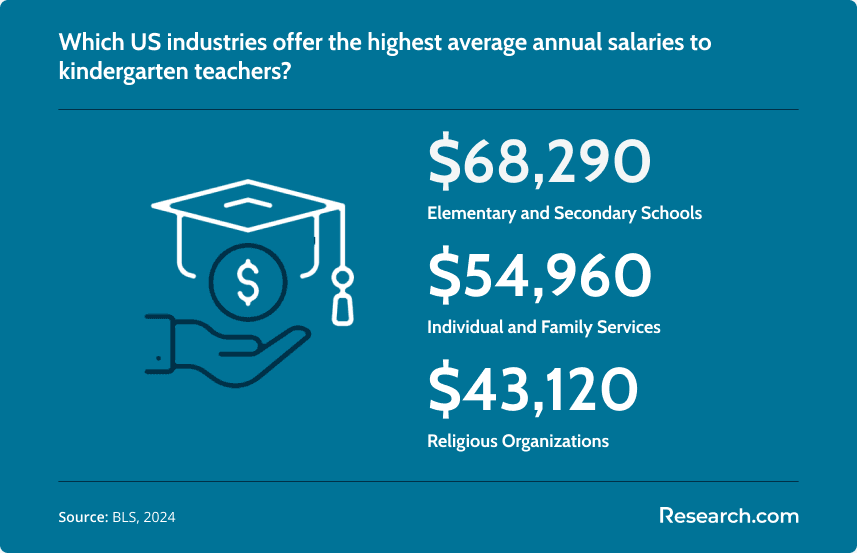
| Highest-paying industries listed | Average annual salary |
| Elementary and secondary schools | $68,290 |
| Individual and family services | $54,960 |
| Religious organizations | $43,120 |
| Local government units | $41,740 |
| Childcare services | $39,470 |
| Highest-paying states listed | Average annual salary |
| California | $93,510 |
| New York | $91,300 |
| Massachusetts | $88,800 |
| Connecticut | $85,610 |
| Washington | $85,530 |
What trends are shaping the future of kindergarten teaching?
Kindergarten teaching is being shaped by stronger attention to social-emotional learning, differentiated instruction, technology-supported communication, outdoor learning, and early intervention. These trends do not replace core teaching skills; they raise the expectations for how teachers plan, document, individualize, and collaborate.
- Social-emotional learning. Schools increasingly emphasize empathy, self-regulation, cooperation, persistence, and responsible decision-making alongside academics.
- Technology integration. Teachers may use digital portfolios, communication platforms, adaptive tools, and classroom devices, but technology must remain age-appropriate and purposeful.
- Personalized instruction. More classrooms use small groups, observation data, and differentiated centers to meet children at different readiness levels.
- Hybrid family engagement. Digital communication can help families track progress, receive reminders, and stay connected when in-person meetings are difficult.
- Nature-based learning. Outdoor play, gardening, nature walks, and environmental observation support movement, curiosity, sensory learning, and science exploration.
- Mindfulness and regulation practices. Breathing exercises, calm corners, sensory tools, and guided reflection can help children build attention and emotional control.
- Gamified learning. Game-like activities can increase motivation when they support clear learning goals rather than distracting from them.
Teachers who enjoy training adults, designing curriculum, or advising schools may eventually explore how to start a career in educational consulting as a way to apply classroom expertise beyond one school.
Is becoming a kindergarten teacher worth it?
Becoming a kindergarten teacher can be worth it for people who want a meaningful classroom career, enjoy working with young children, and are prepared for the emotional, organizational, and regulatory demands of teaching. It may not be the best fit for someone who wants a high degree of daily predictability, minimal paperwork, limited family communication, or quick entry without state credential requirements.
| This path may fit you if... | You may want another path if... |
| You enjoy helping children build early academic and social skills. | You prefer working mostly with adults or older students. |
| You can stay calm during noise, conflict, repetition, and unpredictable behavior. | You want a low-stress environment with limited emotional labor. |
| You are willing to complete degree, fieldwork, exam, and licensure requirements. | You need a career path with very fast entry and minimal credentialing. |
| You value structure, routines, creativity, and family communication. | You dislike planning, documentation, assessment, or parent contact. |
| You are open to continuous professional development. | You want training to end once you earn the first credential. |
How Can Kindergarten Teachers Transition into Administrative Roles?
Kindergarten teachers who want to become administrators should begin by taking on leadership responsibilities before leaving the classroom. Useful steps include mentoring new teachers, leading grade-level teams, joining curriculum committees, supporting family engagement initiatives, helping with school improvement planning, and learning how budgets, compliance, staffing, and evaluation systems work.
An advanced credential can strengthen this transition when it aligns with a clear goal. A master's degree in education administration may help teachers build knowledge in supervision, school law, budgeting, instructional leadership, and organizational decision-making. Candidates should also confirm whether their state requires a separate administrator license.
How Can Kindergarten Teachers Leverage Research to Enhance Classroom Strategies?
Research can help kindergarten teachers move beyond habit and intuition. By reviewing evidence on early literacy, numeracy, behavior supports, play-based learning, multilingual learners, and social-emotional development, teachers can refine lesson plans and select interventions more carefully.
Practical ways to use research include reading practitioner-focused journals, participating in professional learning communities, analyzing student work, comparing intervention results, and using data to adjust small-group instruction. Teachers interested in information organization, literacy resources, and learning materials may also explore library science degree careers to understand adjacent education pathways.
How Can Kindergarten Teachers Leverage Cross-Disciplinary Expertise to Broaden Their Careers?
Kindergarten teachers often develop transferable skills in communication, assessment, child development, curriculum design, behavior support, family engagement, and learning resource selection. When paired with skills in data analysis, information management, instructional technology, or program evaluation, that classroom experience can support movement into curriculum consulting, instructional design, training, early learning program coordination, or educational publishing.
Educators who enjoy organizing learning resources and supporting literacy access may compare job opportunities for library science graduates, especially if they are considering school library, children’s services, or education resource roles.
How Can Kindergarten Teachers Integrate Interdisciplinary Approaches into Their Curricula?
Interdisciplinary kindergarten instruction connects subjects in ways that feel natural to children. A unit on plants, for example, can include science observations, counting seeds, drawing leaves, reading picture books, writing labels, singing movement songs, and discussing how people care for living things.
This approach helps children see relationships across ideas while practicing multiple skills in one meaningful context. Teachers who want broader academic preparation may review best online interdisciplinary studies degree programs, but classroom teachers should still prioritize programs and professional development that directly improve early childhood instruction.
Common mistakes to avoid when preparing for kindergarten teaching
| Mistake | Why it can hurt you | Better approach |
| Choosing a degree without checking licensure alignment. | You may graduate with education credits that do not qualify you for state certification. | Confirm program approval with the state where you plan to teach before enrolling. |
| Looking only at tuition. | Fees, student teaching costs, exam fees, commuting, books, and lost work hours can change the true cost. | Compare total cost of attendance and ask about scholarships, grants, employer support, and payment options. |
| Assuming online programs work in every state. | Online programs may be based in another state and may not meet your local fieldwork or exam requirements. | Ask the program for written confirmation of licensure alignment in your state. |
| Underestimating classroom management. | Strong content knowledge will not compensate for weak routines, unclear expectations, or poor transitions. | Seek programs and mentors that provide substantial supervised practice with young children. |
| Ignoring student teaching quality. | Your placement can strongly influence your confidence, references, and job readiness. | Ask where candidates are placed, how mentors are selected, and how feedback is provided. |
| Assuming salary outcomes are guaranteed. | Pay depends on state, district, contract, experience, and education level. | Review actual district salary schedules and compare them with program cost. |
| Relying only on rankings. | A highly ranked program may not be the best fit for your state, budget, schedule, or licensure goal. | Use rankings as one input, then verify accreditation, outcomes, fieldwork, advising, and licensure pass support. |
Questions to ask before choosing a kindergarten teacher preparation program
- Is the program approved for kindergarten or early childhood teacher licensure in the state where I want to work?
- What exams will I need to pass, and how does the program prepare candidates for them?
- How many hours of classroom fieldwork are required before student teaching?
- Where are student teaching placements located, and who supervises them?
- Does the program support online, hybrid, evening, or part-time learners?
- What is the total estimated cost, including fees, materials, testing, and transportation?
- What percentage of graduates obtain teaching positions?
- Are transfer credits accepted, and how will they affect my timeline?
- Does the program include training in special education, multilingual learners, social-emotional learning, and family engagement?
- Will credits apply toward a future master’s degree or endorsement?
References
- BLS (2024, April 3). 25-2012 Kindergarten Teachers, Except Special Education. BLS occupational employment and wage data
- BLS (2024, August 29). Kindergarten and Elementary School Teachers. BLS Occupational Outlook Handbook
- Loveless, B. (2025, January 4). Understanding the Learning Pyramid. Education Corner
- Zippia (2025, Januart 8). Kindergarten Teacher Education Requirements. Zippia education requirements data
- Zippia (2025, January 8). Kindergarten Teacher skills for your resume and career. Zippia skills data
Key Insights
- The standard path is degree plus licensure. Most public school kindergarten teachers need a bachelor’s degree, supervised student teaching, required exams, and state certification or licensure.
- Program approval matters more than the program title. Before enrolling, confirm that the degree meets the exact kindergarten or early childhood teaching requirements in the state where you plan to work.
- The usual timeline is about four years. Student teaching is typically built into the bachelor’s degree, while licensure paperwork and testing can add several months.
- Kindergarten teaching is both academic and developmental. Teachers support literacy, math, science, social studies, motor skills, classroom routines, self-regulation, and peer relationships.
- Salary varies widely by location and setting. The national average annual salary is $67,790, but the highest listed state average is California at $93,510.
- Job openings remain important even with a projected decline. BLS projects a 1% employment decline from 2023 to 2033, but Indeed listed over 11,000 openings as of February 2025.
- Graduate education should be strategic. A master’s or doctorate can support advancement, but teachers should compare cost, accreditation, salary impact, licensure relevance, and career goals before committing.
- The best candidates prepare for the realities of the classroom. Strong classroom management, family communication, patience, flexibility, and evidence-based instruction are as important as completing the required credential.
Other Things You Should Know About Becoming a Kindergarten Teacher
In 2027, a bachelor's degree in Early Childhood Education or a related field is typically required to become a kindergarten teacher. State-specific certification or licensure is also necessary, which often involves passing relevant exams and background checks. Advanced degrees are not usually required but can be beneficial for career advancement.
Most states require a supervised student-teaching placement of about one semester, or 12 to 16 weeks, before licensure. The placement is usually completed in an accredited teacher-preparation program and must be verified by the state education department or licensing board.
In 2027, to obtain a kindergarten teaching license, candidates must pass exams such as the Praxis Early Childhood Education test, which evaluates knowledge in core areas like reading, writing, and mathematics, as mandated by most states.


