
2027 Best Online Interdisciplinary Studies Degree Programs

Co-Founder and Chief Data Scientist
Many students face a common dilemma: they struggle to fit their diverse interests and career goals into a single, traditional degree program. This often leaves them concerned about future job flexibility and long-term career satisfaction. Fortunately, interdisciplinary studies offer a powerful solution, providing a flexible and comprehensive education that prepares individuals for a dynamic job market.
Our team has over ten years of experience in career planning. We simplify your search for the best online interdisciplinary studies degree programs by using only credible sources. Understanding these programs can significantly enhance your career prospects and adaptability, especially over 657,000 professionals currently thrive in interdisciplinary roles. Read on to discover how an interdisciplinary degree can open new doors for your future success.
What are the benefits of getting an online interdisciplinary studies degree program?
- An online interdisciplinary studies degree opens doors to numerous career opportunities in fields such as business, human resources, marketing, social services, and management. This type of program lets you customize your education, aligning your studies with your interests and the demands of the job market. This prepares you for a wide variety of in-demand roles.
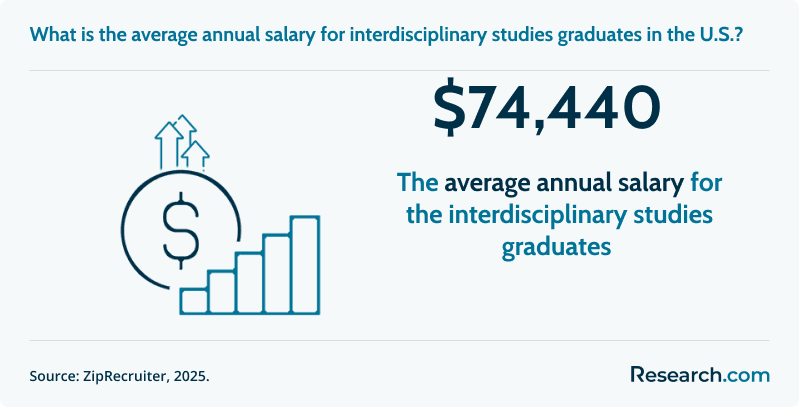
- Graduates with an interdisciplinary studies degree can expect strong earning potential. The average annual salary for these graduates in the U.S. is around $74,440. Many roles offer even higher earning potential as you gain experience and advance in your career.
- You can complete your interdisciplinary studies degree online and at your own pace. This flexibility allows you to balance your studies with work and personal commitments. Plus, you can often apply previous college credits toward your degree. You'll gain a reputable, customizable education that keeps your career options wide open.
What can I expect from an online interdisciplinary studies degree program?
In an online interdisciplinary studies degree program, you’ll complete a flexible core curriculum, typically a mix of general education courses, electives, and focused classes in your chosen study areas. Most programs include a capstone project where you synthesize what you’ve learned, and many require internship or field experience hours to give you hands-on skills.
Tuition generally ranges from $295 to $495 per credit, with total costs varying based on the number of credits and your pace. Classes are delivered online, often as a mix of live (synchronous) sessions and self-paced (asynchronous) coursework, allowing you to study from anywhere while balancing other commitments. You’ll work with advisors to tailor your degree and have support throughout your online journey.
Where can I work with an online interdisciplinary studies degree?
An online interdisciplinary studies degree opens doors to many fields. Graduates work in corporate offices, government agencies, nonprofit groups, and can even launch their own businesses. Roles include management, consulting, project coordination, research, and positions tailored to each person’s areas of study.
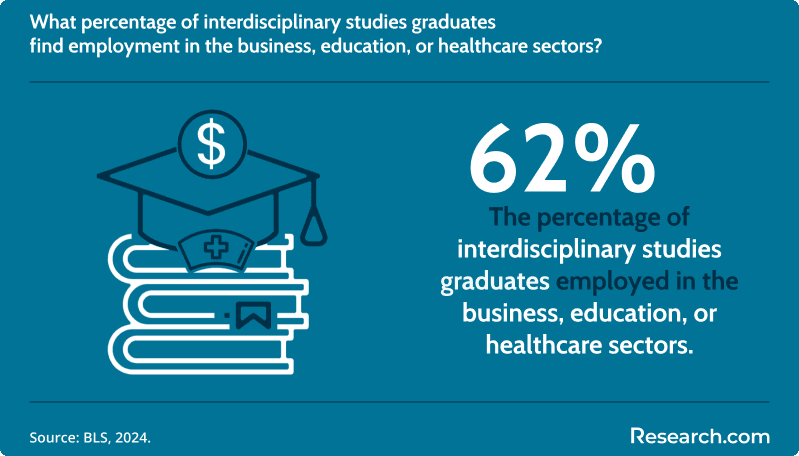
Many also find opportunities in education, technology, healthcare, and creative industries. According to recent data, around 62% of interdisciplinary studies graduates work in business, education, or healthcare sectors.
How much can I make with an online interdisciplinary studies degree?
The average annual salary for professionals with an online interdisciplinary studies degree in the U.S. is about $74,440 as of July 2025. Entry-level graduates can expect salaries ranging from $47,000 to $55,000, while experienced professionals may earn up to $92,000 or more, with the top 10% earning above $115,000.
Salaries vary by industry and location. For example, project managers and human resources managers often see higher salaries, and the highest-paying cities (such as Green River, WY, and San Mateo/San Francisco, CA) can offer 15–20% above the national average.
Those in management or business roles tend to have stronger earning power. Gaining advanced degrees or relevant professional certifications can further boost income potential, helping move into leadership or specialized positions with higher pay.
- List of the Best Online Interdisciplinary Studies Degree Programs for 2027 List of Programs
- How long does it take to complete an online interdisciplinary studies degree program? Completion Time
- How does an online interdisciplinary studies degree program compare to an on-campus program? How does an online interdisciplinary studies degree program compare to an on-campus program?
- What is the average cost of an online interdisciplinary studies degree program? Average Cost
- What are the financial aid options for students enrolling in an online interdisciplinary studies degree program? Financial Aid
- What are the prerequisites for enrolling in an online interdisciplinary studies degree program? Requirements
- What courses are typically in an online interdisciplinary studies degree program? What courses are typically in an online interdisciplinary studies degree program?
- What types of specializations are available in an online interdisciplinary studies degree program? What types of specializations are available in an online interdisciplinary studies degree program?
- How to Choose the Best Online Interdisciplinary Studies Degree Programs How to Choose the Best Online Interdisciplinary Studies Degree Programs
- What career paths are available for graduates of an online interdisciplinary studies degree program? Career Paths
- Is an online interdisciplinary studies degree worth the investment? Is an online interdisciplinary studies degree worth the investment?
- What additional specialization opportunities can further enhance career prospects? What additional specialization opportunities can further enhance career prospects?
- What is the job market for graduates with an online interdisciplinary studies degree? Job Market
- What are the common challenges of pursuing an online interdisciplinary studies degree? What are the common challenges of pursuing an online interdisciplinary studies degree?
Best Online Interdisciplinary Studies Degree Programs for 2027
An online interdisciplinary studies degree is built for students whose goals do not fit neatly inside one traditional major. Instead of studying only business, psychology, communication, technology, humanities, or health, students can combine multiple fields into one bachelor’s degree and shape a program around a career goal, transfer credits, or preparation for graduate school.
This guide is for working adults, transfer students, military-affiliated learners, career changers, and students who want a flexible bachelor’s program without starting over. It explains how online interdisciplinary studies programs work, how to compare schools, what they cost, how long they take, which careers they may support, and when a more specialized degree may be the better choice. Students comparing completion speed across online programs may also want to review options such as the shortest biochemistry online degree if their goals are more science-specific.
Quick Answer: What Is the Best Online Interdisciplinary Studies Degree?
The best online interdisciplinary studies degree is the one that matches your existing credits, career target, preferred learning format, and need for specialization. Strong programs are regionally accredited, accept transfer credits, offer clear advising, let students combine two or more academic areas, and include a capstone, portfolio, internship, or experiential project that helps translate a customized degree into a clear employment or graduate school story.
Students should not choose an interdisciplinary studies program only because it sounds flexible. The degree is most valuable when the course plan is intentional. A student who combines business, communication, and data-focused coursework will have a clearer career direction than a student who selects unrelated electives without a professional purpose.
How Research.com Ranks Online Interdisciplinary Studies Programs
Because a bachelor’s degree can affect long-term debt, career options, and graduate school eligibility, program rankings should be based on transparent information rather than marketing claims. Research.com evaluates programs using reliable education data sources, including the IPEDS database, Peterson's database, the College Scorecard database, and the National Center for Education Statistics. These sources help compare institutions using data related to enrollment, cost, student outcomes, and institutional characteristics. Readers can learn more on Research.com's methodology page.
| Rank | School and Program | Best Fit | Credits | Cost per Credit | Accreditation |
| 1 | Arizona State University - Bachelor of Interdisciplinary Studies | Students who want many concentration options and a structured experiential project | 120 | $561–$661 | Higher Learning Commission (HLC) |
| 2 | Eastern Oregon University - Bachelor of Interdisciplinary Studies | Transfer students who want to build a personalized plan around prior coursework | 180 | $329 | Northwest Commission on Colleges and Universities (NWCCU) |
| 3 | East Tennessee State University - Bachelor of Science in Interdisciplinary Studies | Students who want online, hybrid, or on-ground options with customized academic paths | 120 | $464 (TN residents) | Southern Association of Colleges and Schools Commission on Colleges (SACSCOC) |
| 4 | Georgia State University - Bachelor of Interdisciplinary Studies | Students with 60 or more credit hours who want an Arts and Sciences concentration | 120 | $299 | SACSCOC |
| 5 | Liberty University - Bachelor of Science in Interdisciplinary Studies | Students who prefer 8-week courses and broad transfer credit opportunities | 120 | $390 | SACSCOC |
| 6 | Louisiana State University - Bachelor of Interdisciplinary Studies | Working adults who want to combine three minors in a fully online format | 120 | $445 | SACSCOC |
| 7 | Oklahoma State University - Bachelor of Arts in Interdisciplinary Studies | Oklahoma residents seeking a low listed resident tuition rate and customizable study areas | 120 | $180.55 (Oklahoma residents) | HLC |
| 8 | University of Arkansas - Bachelor of Arts in Interdisciplinary Studies | Students who want advisor-guided degree planning across several disciplines | 120 | $269.75 (in-state); $971.53 (out-of-state) | HLC |
| 9 | University of Central Florida - Bachelor of Arts or Bachelor of Science in Interdisciplinary Studies | Students deciding between BA and BS formats with two or three study areas | 120 | $179.19 (in-state); $715.80 (out-of-state) | SACSCOC |
| 10 | University of Virginia - Bachelor of Interdisciplinary Studies | Working adults who want a liberal arts completion pathway with a capstone project | 120 | $499 | SACSCOC |
1. Arizona State University - Bachelor of Interdisciplinary Studies
The online Bachelor of Interdisciplinary Studies at Arizona State University gives students a structured way to combine two academic disciplines from more than 40 available options. The program is fully online and is designed for learners who want a broad degree without losing academic direction. Coursework emphasizes critical thinking, analytical reasoning, and applied learning, and students complete an experiential learning project that helps connect their selected disciplines to real workplace or community problems. Possible career directions include roles such as Marketing Manager or Human Resources Manager, depending on the student’s chosen areas of study and experience.
- Program length: 4 years
- Cost per credit: $561–$661
- Total credits: 120
- Accreditation: Higher Learning Commission (HLC)
2. Eastern Oregon University - Bachelor of Interdisciplinary Studies
Eastern Oregon University offers an online interdisciplinary studies bachelor’s program for students who want a degree plan tied closely to career goals, previous coursework, or multiple academic interests. Students can combine minors or develop an individualized plan, then demonstrate their learning through a final portfolio. The program may be especially useful for transfer students because of its generous transfer policy and its emphasis on advising and career support. Graduates may pursue opportunities in areas such as business, education, and marketing, depending on their selected coursework.
- Program length: N/A
- Cost per credit: $329
- Total credits: 180
- Accreditation: Northwest Commission on Colleges and Universities (NWCCU)
3. East Tennessee State University - Bachelor of Science in Interdisciplinary Studies
The Bachelor of Science in Interdisciplinary Studies from East Tennessee State University is available in 100% online, hybrid, or on-ground formats. Students help design their curriculum, blending liberal arts study with workplace-relevant skills such as communication, critical thinking, and problem-solving. The program includes three customizable paths, and an internship is optional. Depending on the student’s plan, the degree may support roles such as Corporate Trainer or Social Services Worker.
- Program length: 4 years
- Cost per credit: $464 (TN residents)
- Total credits: 120
- Accreditation: Southern Association of Colleges and Schools Commission on Colleges (SACSCOC)
4. Georgia State University - Bachelor of Interdisciplinary Studies
Georgia State University offers an online Bachelor of Interdisciplinary Studies with a concentration in Arts and Sciences. The program is intended for students who have already completed 60 or more credit hours and want to finish a bachelor’s degree through a flexible curriculum. Students can study across multiple subjects while building communication, problem-solving, and critical thinking skills. An experiential learning requirement, such as an internship or capstone, helps students apply their academic work to professional or community settings.
- Program length: 4 years
- Cost per credit: $299
- Total credits: 120
- Accreditation: SACSCOC
5. Liberty University - Bachelor of Science in Interdisciplinary Studies
Liberty University provides a fully online Bachelor of Science in Interdisciplinary Studies for students who want to combine several subject areas into one degree. The program is designed for learners with varied academic backgrounds, work histories, military experience, or career goals that do not align with a single major. Its 8-week course format may appeal to students who prefer shorter terms. The program also accepts substantial transfer credit, including eligible credit from military service or professional experience.
- Program length: 4 years
- Cost per credit: $390
- Total credits: 120
- Accreditation: SACSCOC
6. Louisiana State University - Bachelor of Interdisciplinary Studies
LSU Online offers a 100% online Bachelor of Interdisciplinary Studies for non-traditional students and working professionals who want a degree with built-in customization. Students combine three minors from areas such as business, IT, and the humanities. The program focuses on transferable skills, including leadership and critical thinking, and courses are taught by experienced faculty.
- Program length: 4 years
- Cost per credit: $445
- Total credits: 120
- Accreditation: SACSCOC
7. Oklahoma State University - Bachelor of Arts in Interdisciplinary Studies
Oklahoma State University offers a fully online Bachelor of Arts in Interdisciplinary Studies for students who want to connect two or three areas of study to a personal or professional goal. The program is designed for busy learners and uses the same faculty quality standards associated with on-campus programs. It may be a strong option for Oklahoma residents seeking the listed resident tuition rate.
- Program length: 4 years
- Cost per credit: $180.55 (Oklahoma residents)
- Total credits: 120
- Accreditation: HLC
8. University of Arkansas - Bachelor of Arts in Interdisciplinary Studies
The online Bachelor of Arts in Interdisciplinary Studies at the University of Arkansas is designed for students whose interests or career plans cross traditional academic boundaries. Students work with advisors to build a personalized degree plan that may draw from several disciplines. The program can support employment goals as well as preparation for graduate study, especially when students choose courses that fit a clear professional direction.
- Program length: 4 years
- Cost per credit: $269.75 (in-state); $971.53 (out-of-state)
- Total credits: 120
- Accreditation: HLC
9. University of Central Florida - Bachelor of Arts or Bachelor of Science in Interdisciplinary Studies
The University of Central Florida offers an online Bachelor of Arts or Bachelor of Science in Interdisciplinary Studies. Students can design a degree by combining two or three academic areas, making the program suitable for learners with specific cross-disciplinary goals. The curriculum includes a capstone experience, with options such as service-learning or internships. The listed program length is 4 days, so applicants should verify the expected completion timeline directly with the university before enrolling.
- Program length: 4 days
- Cost per credit: $179.19 (in-state); $715.80 (out-of-state)
- Total credits: 120
- Accreditation: SACSCOC
10. University of Virginia - Bachelor of Interdisciplinary Studies
The University of Virginia offers an online Bachelor of Interdisciplinary Studies for working adults who want to complete a bachelor’s degree while managing employment and other responsibilities. The program provides a broad liberal arts foundation, allows students to choose a concentration, and includes a two-semester capstone project. Students receive individualized advising and may apply up to 60 transfer credits toward the degree.
- Program length: Typically 3-4 years (max 7 years)
- Cost per credit: $499
- Total credits: 120
- Accreditation: SACSCOC
How Long Does It Take to Complete an Online Interdisciplinary Studies Degree?
Most online interdisciplinary studies bachelor’s degrees take about two to four years to complete, but the actual timeline depends on transfer credits, enrollment status, term length, and the number of required credits remaining. Many programs require around 120 credit hours, although some institutions use a different credit system or list a higher total.
| Student Situation | Likely Timeline | What to Check Before Enrolling |
| First-time college student | Often about three to four years for full-time study | General education requirements, course availability, and whether summer terms are offered |
| Transfer student with substantial credits | May finish faster, depending on accepted credits | Maximum transfer credits, residency requirements, and upper-division credit rules |
| Working adult studying part time | May take longer than a full-time student | Part-time tuition policies, course rotation, and maximum time allowed to finish |
| Student in accelerated terms | May progress faster if courses are offered in roughly seven to eight week formats | Workload, start dates, and whether accelerated pacing affects financial aid |
- Many online bachelor’s programs in interdisciplinary studies require around 120 credit hours, often spread across approximately 40 courses.
- Full-time students commonly complete the degree in about three to four years, which is similar to many campus-based bachelor’s programs.
- Some schools use accelerated terms, flexible course pacing, and multiple annual start dates, which may help motivated students move faster.
- Transfer credits can make the biggest difference. Some institutions allow students to transfer more than 100 credits, but each school decides which credits apply.
Students comparing online timelines should remember that speed is not the only measure of value. A compressed program may help if the credential clearly fits the goal, while a slower part-time plan may be more realistic for students balancing work or caregiving. Learners exploring other accelerated religious or professional pathways can compare these timelines with the shortest MDiv degree online.
Online vs. On-Campus Interdisciplinary Studies Programs: What Changes?
Online and on-campus interdisciplinary studies programs can lead to the same degree, but the learning experience is different. The main differences are schedule flexibility, interaction style, access to campus resources, and how much structure students receive.
| Factor | Online Program | On-Campus Program | Best Choice If... |
| Schedule | Often asynchronous or designed for remote learners | Usually tied to set class meeting times | Choose online if you need flexibility; choose campus if you want a fixed routine. |
| Interaction | Uses discussion boards, video meetings, email, and digital collaboration tools | Offers face-to-face classroom, advising, and peer interaction | Choose campus if in-person networking and immediate classroom discussion matter most. |
| Curriculum | May use the same faculty, standards, and degree requirements as campus programs | May offer more in-person electives, events, or campus-based experiential options | Compare actual course lists rather than assuming one format is stronger. |
| Transfer flexibility | Often designed for adult learners and transfer students | May have transfer pathways but can be less flexible for working students | Online may be better if you already have many credits. |
| Support services | Depends on remote advising, virtual tutoring, online library access, and digital career services | Provides physical access to campus offices, clubs, faculty, and events | Ask how online students receive advising, tutoring, disability services, and career help. |
Online programs are often a practical fit for working adults, parents, military-affiliated students, and transfer students who cannot relocate or commute. On-campus programs may be better for students who want a highly structured environment, in-person faculty access, and a stronger campus community. Hybrid programs can offer a middle ground.
The chart below shows the projection of traditional-aged undergraduate distribution by delivery mode in 2025. This broader shift toward flexible formats is also visible in shorter online credentials, including the shortest graduate certificate in biotechnology online.
How Much Does an Online Interdisciplinary Studies Degree Cost?
The listed tuition for online interdisciplinary studies programs varies widely by school, residency status, and credit requirements. In the programs above, published costs range from $179.19 (in-state) to $971.53 (out-of-state) per credit for selected institutions. Many programs fall around the broader range of about $295 to $495 per credit hour, but students should calculate their own total cost instead of relying on an average.
| Cost Factor | Why It Matters | Question to Ask |
| Total credits | A program requiring around 120 credits will cost more for students entering with no transfer credit than for students near completion. | How many credits will I personally need after transcript evaluation? |
| Transfer credits | Accepted credits reduce the number of courses you must pay for. | Which of my previous credits apply to general education, major, elective, or upper-division requirements? |
| Residency status | Some public universities charge different in-state and out-of-state rates. | Does the online program use a separate online tuition rate or standard residency-based tuition? |
| Fees | Technology, distance learning, graduation, and course fees can increase the final bill. | What is the total program cost after mandatory fees? |
| Pacing | Accelerated study may reduce time away from full-time work, while part-time study may spread payments over a longer period. | Will my course load affect financial aid eligibility or employer tuition assistance? |
| Course selection | A customized degree may involve courses from departments with different fees or materials. | Do any concentrations have additional course costs? |
Students whose career goals are narrow and job-specific should compare an interdisciplinary bachelor’s degree with shorter or more targeted options. For example, someone focused on a healthcare administrative support role may also look at the shortest online medical billing and coding associates degree before committing to a longer bachelor’s pathway.
Financial Aid Options for Online Interdisciplinary Studies Students
Online interdisciplinary studies students may be eligible for many of the same aid options as campus-based students, as long as the institution and program meet aid requirements. Always confirm eligibility with the school’s financial aid office before enrolling.
- Federal financial aid: Eligible students can apply for federal aid, including Pell Grants, Direct Loans, and work-study programs, by filling out the FAFSA form.
- University scholarships: Schools may offer merit, need-based, adult learner, transfer student, or online student scholarships. Eastern Oregon University reports that about 92% of their online students receive financial aid and scholarships.
- Military and veteran benefits: Service members, veterans, and eligible family members may qualify for tuition assistance, GI Bill benefits, institutional military discounts, or scholarships such as the Active Duty Scholarship and Veterans United Foundation Scholarship.
- Transfer credit savings: Prior college credits, eligible training, military learning, or work-related credit can reduce the number of courses required. Some programs accept up to 135 transfer credits.
- Employer tuition assistance: Working adults should ask whether their employer reimburses tuition for degree completion, leadership, business, technology, communication, or public service coursework.
- Payment plans: Some institutions allow students to spread payments across a term, which may help reduce reliance on loans.
Admissions Requirements for Online Interdisciplinary Studies Programs
Admissions requirements vary by school, but online interdisciplinary studies programs often serve adult learners, transfer students, and degree-completion students. Some admit first-time college students, while others expect applicants to have previous college credit.
| Requirement | What It Usually Means | Why It Matters |
| High school diploma or equivalent | Many programs require proof of high school completion, even for transfer applicants. | It establishes baseline undergraduate eligibility. |
| Prior college credit | Some programs are designed primarily for students who already completed college coursework. | It may determine whether you are admitted as a transfer or degree-completion student. |
| Minimum GPA | Schools commonly set cumulative GPA requirements, often around 2.0 to 2.75. | Applicants below the minimum may need conditional admission or additional steps. |
| Official transcripts | Students typically submit transcripts from all previous colleges and sometimes high school. | The school uses these records to evaluate transfer credit and admission eligibility. |
| Program-specific credit rules | Some schools require certain upper-division credits to be completed through the institution. | These rules affect time to graduation and total cost. |
| English proficiency | International students may need TOEFL or equivalent test results. | This confirms readiness for college-level coursework in English. |
| Application and fee | Applicants usually complete an online application and may pay a non-refundable fee. | Some schools waive fees for military-affiliated students or certain applicant groups. |
| Advising consultation | Programs may encourage or require students to meet with an advisor before finalizing a plan. | Advising is especially important because the degree must be academically coherent. |
The following chart illustrates the most prevalent degree types among the working population with interdisciplinary studies backgrounds in 2023.
Common Courses in an Online Interdisciplinary Studies Degree
Coursework varies because interdisciplinary studies programs are intentionally customizable. Still, most programs combine general education, interdisciplinary core courses, electives or concentration courses, and a culminating experience.
- Interdisciplinary foundations: These courses teach students how to connect ideas, methods, and evidence across academic fields rather than treating each subject separately.
- Research and analysis: Students may study research methods, information literacy, analytical reasoning, and evidence-based problem-solving.
- Communication: Writing, presentation, collaboration, and professional communication courses help students explain complex ideas to different audiences.
- General education: Students usually complete coursework in humanities, social sciences, natural sciences, mathematics, and English.
- Concentration or elective courses: These courses form the student’s customized academic focus. Examples may include Food, Commodities, and Cultures; Science, Technology, and Innovation; digital marketing; business; psychology; health; or technology-related subjects.
- Capstone, portfolio, or integrative project: Most programs require a final project that demonstrates how the student’s selected fields connect to a practical or scholarly question.
Popular Specializations in Online Interdisciplinary Studies Programs
The strongest interdisciplinary studies plans combine breadth with a clear purpose. Students should choose specializations that work together, not simply courses that seem interesting. A practical combination might connect business and communication for marketing roles, psychology and health for community wellness work, or technology and management for operations-focused careers.
| Specialization Area | Common Subjects | Career Direction It May Support |
| Business and Management | Accounting, business administration, marketing, management, economics, finance, leadership, entrepreneurship | Operations, sales, marketing, human resources, management support, or entrepreneurship |
| Communication and Media | Communication studies, media, public relations, digital marketing, journalism | Public relations, content strategy, marketing communication, media coordination, or corporate communication |
| Liberal Arts and Humanities | English, philosophy, history, foreign languages, religious studies, classics, literature, art history | Writing, education support, cultural organizations, public service, or graduate study preparation |
| Social Sciences | Psychology, sociology, anthropology, political science, international studies, gender studies, African American studies | Community programs, research support, advocacy, public policy, or human services |
| Education | Elementary or secondary education, educational studies, early childhood education, curriculum design | Training, instructional support, education administration, or preparation for licensure-focused study |
| Health and Wellness | Health sciences, health informatics, public health, gerontology, kinesiology, wellness promotion | Community health, health education, wellness programs, or healthcare administration support |
| Applied Sciences and Technology | Information technology, information systems, computer science, cybersecurity, cloud solutions, operations | Technical support, business technology roles, operations, cybersecurity-adjacent support, or systems coordination |
| Environmental and Natural Sciences | Biology, environmental science, ecology, chemistry, earth science, physics | Sustainability work, environmental outreach, science communication, or graduate preparation |
| Fine Arts and Applied Arts | Studio art, art history, performing arts, digital arts, music, theater, design | Creative industries, arts administration, media production, or design-related roles |
| Professional and Career-Focused Tracks | Administrative sciences, hospitality and tourism, criminal justice, emergency medical services, military studies, technical studies, human resources, social work, community services | Public service, nonprofit work, human resources, administration, hospitality, or community operations |
Students who want advanced leadership or research roles in business may later consider an accelerated online Doctor of Business Administration in Management. Learners who want classroom licensure should compare interdisciplinary education coursework with a fast-track online elementary education degree, because licensure requirements are usually more specific than general interdisciplinary coursework. Students interested in design-focused careers can also compare interdisciplinary arts tracks with the best fashion design programs.
How to Choose the Best Online Interdisciplinary Studies Degree Program
Choosing an interdisciplinary studies program requires more planning than choosing a traditional major because the degree’s value depends heavily on how well the courses fit together. Use the steps below before applying.
1. Verify Accreditation First
Choose an institution with recognized accreditation so the degree is more likely to be accepted by employers, graduate schools, and financial aid agencies. Accreditation is also important if you plan to transfer credits later or pursue a graduate program.
2. Start With a Career Goal, Not a Course Catalog
Before selecting concentrations, write down the type of work you want to do. Then work backward. If you want to work in human resources, a stronger plan may include business, psychology, communication, and employment-related coursework. If you want healthcare administration, health sciences, management, and data or communication courses may fit better.
3. Ask for a Transfer Credit Evaluation Before Committing
Do not assume all previous credits will apply. Ask the school to show which credits count toward general education, major requirements, electives, upper-division requirements, and graduation totals. Transfer policy can change both your cost and your completion timeline.
4. Compare the Capstone or Portfolio Requirement
A capstone, internship, research project, or portfolio can help explain your customized degree to employers. Look for programs that require students to integrate their fields into a final project rather than simply completing disconnected electives.
5. Review Online Learning Format Carefully
Asynchronous courses allow students to complete work on a flexible schedule, while synchronous courses require live attendance. Neither format is automatically better. The right choice depends on your work schedule, learning style, and need for instructor interaction.
6. Confirm Support for Online Students
Ask whether online learners have access to academic advising, tutoring, writing support, library databases, disability services, career coaching, internships, and technical help. A flexible degree without strong advising can leave students with a scattered transcript and unclear career story.
7. Match Specializations to Graduate School Requirements
If you want to pursue graduate study, make sure your interdisciplinary plan includes any prerequisite courses. For example, students exploring doctoral psychology pathways should understand how to get a PsyD in clinical psychology and confirm whether their undergraduate coursework will meet future admissions expectations.
| Question to Ask a School | Why the Answer Matters |
| How many of my credits will transfer into the degree? | This determines how long you will study and how much you will pay. |
| Can I combine the exact academic areas I want? | Not every school offers every concentration online. |
| Will my diploma or transcript say “online”? | Most employers focus on institution and degree, but students should know how credentials appear. |
| Is there a capstone, internship, portfolio, or experiential requirement? | Applied work can help make a broad degree easier to explain to employers. |
| What career services are available to online students? | Customized majors often require strong career positioning. |
| Does this degree meet licensure or certification requirements for my target field? | Many licensed fields require specific programs, supervised hours, exams, or state approval. |
Careers You Can Pursue With an Online Interdisciplinary Studies Degree
Graduates with online interdisciplinary studies degrees can pursue many types of roles, but outcomes depend on the student’s concentrations, work experience, internships, portfolio, location, and additional credentials. The degree is often strongest for roles that value communication, coordination, problem-solving, and the ability to understand more than one field.
Business and Management
- Project Manager: Coordinates timelines, teams, budgets, and deliverables across departments or industries.
- Sales Manager: Oversees sales goals, customer strategy, and team performance.
- Human Resources Specialist or Recruiter: Supports hiring, employee relations, training, onboarding, and workplace policy.
- Marketing Coordinator or Account Executive: Helps plan campaigns, manage client communication, analyze audiences, and coordinate content or outreach.
Education and Training
- Teacher or Educator: May work in educational settings depending on state rules, subject area, and licensure requirements.
- Admissions Counselor or Career Advisor: Helps students understand academic programs, applications, and career planning.
- Curriculum Designer or Trainer: Creates learning materials for schools, employers, nonprofits, or workforce development programs.
Community, Social Services, and Advocacy
- Social Worker: Supports individuals and communities through advocacy, resources, and case-related services, although licensed social work roles usually require specific credentials.
- Counselor or Program Coordinator: Works in community, nonprofit, education, or human services programs. Students who want licensure should compare this degree with fast-track online counselor education programs.
- Nonprofit Administrator: Supports operations, outreach, programming, fundraising, or volunteer coordination.
Creative Arts and Communication
- Journalist or Communication Specialist: Writes, edits, researches, or manages messaging for media, organizations, or public relations teams.
- Media, Design, or Digital Marketing Roles: Works in content production, campaign coordination, social media, brand communication, or digital outreach.
Science, Technology, and Emerging Fields
- IT or Tech-Related Roles: May include IT support, technology operations, digital marketing for technology organizations, or sustainability-related support roles.
- Policy Analyst or Researcher: Studies issues, gathers evidence, and prepares recommendations for government agencies, think tanks, nonprofits, or advocacy groups.
Healthcare and Human Services
- Healthcare Administration: Supports medical office operations, healthcare programs, scheduling systems, records coordination, or community health initiatives.
- Health Educator or Community Outreach Specialist: Promotes wellness, prevention, or public health programs in community and nonprofit settings.
Government, Law, and Public Service
- Public Service or Government Roles: May include administrative, communications, policy support, community engagement, or public relations positions.
- Law or Graduate Study Preparation: The degree can support future study in law, counseling, business, public administration, or other fields if prerequisite coursework is planned carefully.
Entrepreneurship and Self-Designed Careers
- Entrepreneur: Uses cross-disciplinary knowledge to launch a business, consulting practice, creative venture, or community initiative.
- Freelance Roles: Applies writing, research, digital media, project coordination, or consulting skills across contract-based work.
Is an Online Interdisciplinary Studies Degree Worth It?
An online interdisciplinary studies degree can be worth the investment for students who need a flexible bachelor’s completion option, have transfer credits, and can build a coherent academic plan around a career or graduate school goal. It may be less worthwhile for students seeking careers with strict licensure rules or employers that require a specific major.
| This Degree May Be Worth It If... | Consider Another Path If... |
| You have prior credits and want to finish a bachelor’s degree efficiently. | You are starting from zero and already know you want a specialized profession. |
| Your target roles value broad skills such as communication, analysis, leadership, and project coordination. | Your goal is nursing, teaching licensure, engineering, accounting licensure, clinical counseling, or another regulated field. |
| You can combine fields in a way employers will understand. | You are choosing random courses only because they are available or easy. |
| You need online flexibility because of work, family, military service, or location. | You need labs, studios, clinical placements, or in-person networking that the online program does not provide. |
| You plan to use the degree as a bridge to graduate school and have checked prerequisites. | Your intended graduate program requires a specific undergraduate major or coursework you will not complete. |
When evaluating return on investment, compare tuition, fees, transfer credits, time to completion, lost income, employer tuition assistance, and likely career use. Do not assume a broad degree will automatically lead to higher earnings. For some students, a specialized graduate route such as the shortest online EdD programs may align better with advancement goals after they already hold a bachelor’s degree.
Additional Credentials That Can Strengthen an Interdisciplinary Studies Degree
Because interdisciplinary studies is broad, targeted credentials can make the degree more marketable. Students should choose certificates, minors, software skills, or graduate programs that sharpen the career story behind the customized bachelor’s degree.
- Digital analytics or marketing tools: Useful for students combining communication, business, media, or technology.
- Project management training: Helpful for students aiming at operations, nonprofit coordination, business support, or technical project roles.
- Human resources coursework: Valuable for students combining psychology, communication, and business.
- Data, cybersecurity, or IT certificates: Useful when paired with management, business, or public administration coursework.
- Research methods or social science training: Helpful for policy, nonprofit, anthropology, community research, and graduate school preparation.
Students interested in culture, society, research, and human behavior may compare interdisciplinary coursework with online degrees in anthropology, which provide a more focused disciplinary foundation while still supporting cross-cultural and social research skills.
Job Market for Interdisciplinary Studies Graduates
The job market for interdisciplinary studies graduates is broad rather than single-track. That flexibility can be an advantage, but it also means students must clearly explain their skills, concentration areas, projects, internships, and work experience to employers. According to the U.S. Bureau of Labor Statistics field-of-degree resource for interdisciplinary studies, graduates work across multiple occupational categories rather than one narrowly defined profession.
The chart below shows the top-employing occupations for workers with an interdisciplinary studies degree:
Common Challenges in Online Interdisciplinary Studies Programs
Online interdisciplinary studies programs offer flexibility, but they also require strong planning and self-direction. Students should understand the common challenges before enrolling.
| Common Mistake | Why It Creates Problems | Better Approach |
| Choosing the program only because it is flexible | Flexibility without direction can lead to a degree that is hard to explain to employers. | Build the plan around a target role, industry, or graduate school pathway. |
| Ignoring accreditation | Unaccredited or poorly recognized institutions can create problems with transfer credit, financial aid, and employer acceptance. | Verify institutional accreditation before applying. |
| Assuming every online program fits licensure goals | Fields such as teaching, counseling, and social work often require specific approved programs, exams, and supervised experience. | Check state and professional requirements before choosing concentrations. |
| Focusing only on tuition | Fees, transfer credit decisions, course availability, and time to completion can change the real cost. | Request a full cost estimate and transfer evaluation. |
| Taking unrelated electives | A scattered transcript can weaken the degree’s value. | Choose courses that support a clear theme, such as business communication, health administration, or technology management. |
| Underestimating online workload | Asynchronous learning still requires deadlines, writing, research, and consistent study time. | Create a weekly study schedule before the first term begins. |
| Relying only on rankings | A highly ranked program may still be a poor fit for your credits, budget, or career goal. | Use rankings as a starting point, then compare accreditation, cost, curriculum, advising, and outcomes. |
Students may also feel isolated in online courses or struggle to connect multiple disciplines into one coherent academic identity. Regular advising, peer discussion, digital collaboration tools, and a portfolio-based capstone can help. Professionals who want to add a specialized information, research, or library science credential after an interdisciplinary bachelor’s may compare options such as the best affordable MLIS online degrees.
What Graduates Say About Online Interdisciplinary Studies Programs
- : "The online format made it possible for me to keep working full time while finishing my degree. I was able to connect public health and communication in a way that supports the work I do now. The flexibility mattered because I did not have to pause my career to complete my education. — Jessica"
- : "Studying across fields helped me see connections between history and technology that I had not noticed before. Because the online courses gave me room to manage my schedule, I could spend more time thinking through those connections. The experience changed how I approach creative work and problem-solving. — Michael"
- : "I chose this path because I wanted a degree that matched my project management goals. The online tools were easy to use, and I could complete assignments around a demanding schedule. Being able to shape the curriculum made the program feel directly connected to my career plans. — Riley"
References
- 11 jobs for graduates of interdisciplinary studies programs. (2025, June 9). Indeed. Retrieved August 4, 2025, from https://www.indeed.com/career-advice/finding-a-job/interdisciplinary-studies-jobs
- Field of degree: Interdisciplinary studies PRINTER-FRIENDLY Print. (2024, August 29). U.S. Bureau of Labor Statistics. Retrieved August 4, 2025, from https://www.bls.gov/ooh/field-of-degree/interdisciplinary-studies/interdisciplinary-studies-field-of-degree.htm
- Hanson, M. (2024, August 31). Cost of Online Education vs. Traditional Education [2024]: Comparison. Education Data Initiative. https://educationdata.org/cost-of-online-education-vs-traditional-education
- Interdisciplinary Studies | Data USA. (n.d.). Data USA. https://datausa.io/profile/cip/interdisciplinary-studies
- Interdisciplinary Studies salary. (2025). ZipRecruiter. Retrieved August 4, 2025, from https://www.ziprecruiter.com/Salaries/Interdisciplinary-Studies-Salary
Key Insights
- An online interdisciplinary studies degree is best for students who need flexibility and can design a focused academic plan across two or more fields.
- Accreditation, transfer credit acceptance, advising quality, and capstone structure matter more than the program name alone.
- Most bachelor’s programs require around 120 credits, but transfer students may finish faster if previous coursework applies toward degree requirements.
- Published tuition varies by school and residency status; students should calculate total cost after transfer credits, fees, and aid rather than relying only on per-credit rates.
- The degree can support careers in business, communication, education support, public service, healthcare administration, nonprofit work, and technology-adjacent roles, but outcomes depend heavily on concentrations and experience.
- Students pursuing licensed careers should verify requirements before enrolling because interdisciplinary studies programs usually do not replace licensure-specific degrees.
- The strongest graduates leave with a clear story: what fields they combined, what problem they are prepared to solve, and what evidence—such as a portfolio, internship, capstone, or work experience—proves their readiness.
Other Things You Should Know About Online Interdisciplinary Studies Degree Programs
In 2027, the top-rated online interdisciplinary studies degree program is offered by the University of Central Florida. Known for its flexibility and comprehensive curriculum, UCF's program allows students to tailor their studies, integrating multiple disciplines to fit their career goals.
Acceptance rates for online interdisciplinary studies degree programs in 2027 vary widely depending on the institution and the competitiveness of their programs. Generally, online programs offer more flexibility and accessibility, which can result in higher acceptance rates compared to traditional on-campus programs.
Yes. Many online interdisciplinary studies programs require a capstone in the final term, usually worth 3 to 6 credits. Students complete an applied project, portfolio, or research paper approved by a faculty mentor or academic adviser before graduation.


