2027 Online Electrical Engineering Degrees With Strong Math and Technical Training

Co-Founder and Chief Data Scientist
Choosing an online electrical engineering degree is a high-stakes decision because the field is mathematically demanding, lab-intensive, and closely tied to employer trust. The U.S. Bureau of Labor Statistics reports a 2024 median pay of $111,910 for electrical and electronics engineers, making program quality and accreditation especially important.
This guide is for prospective bachelor's and master's students who want flexibility without weak technical training. You will learn how online programs work, what math they require, what they cost, and how to choose one that supports real engineering careers.
Key Things You Should Know
- For U.S. bachelor's programs, ABET accreditation is the clearest quality signal because it affects employer confidence, graduate school options, and future professional engineering licensure eligibility.
- Online electrical engineering degrees can be rigorous, but students should expect calculus, differential equations, circuit theory, signals, embedded systems, programming, and lab work rather than a light technology curriculum.
- BLS data places 2024 median pay for electrical and electronics engineers at $111,910, but outcomes vary by specialization, location, security clearance, experience, and whether the graduate builds strong project evidence.
What is an online electrical engineering degree and how does it compare to campus programs?
An online electrical engineering degree is a college program that teaches students to design, analyze, test, and improve electrical, electronic, and computer-connected systems through mostly remote coursework. At the bachelor's level, it usually prepares students for entry-level engineering or engineering-adjacent roles.
At the master's level, it helps practicing engineers specialize in areas such as power systems, communications, semiconductors, control systems, robotics, signal processing, or embedded systems.
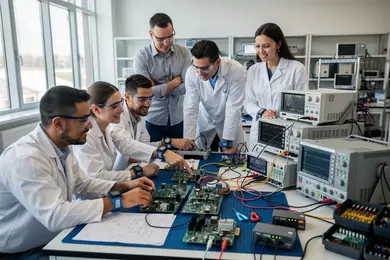
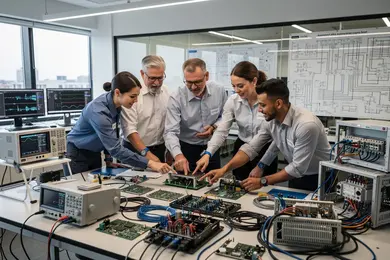
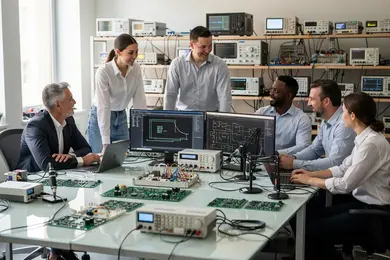
The strongest online programs are not watered-down versions of campus degrees. They use recorded or live lectures, simulation tools, remote labs, mailed lab kits, local proctoring, virtual office hours, and project-based assignments.
Some programs also require short campus residencies or approved local lab experiences. The main trade-off is flexibility versus access: online students gain schedule control but must be more disciplined about labs, teamwork, and faculty interaction.
The table below compares common decision points for students choosing between online and campus electrical engineering programs. Use it to identify which format fits your learning style, work schedule, and career goal:
| Factor | Online electrical engineering degree | Campus electrical engineering degree |
| Best fit | Working adults, military-affiliated students, transfer students, and self-directed learners | Recent high school graduates, students who want daily lab access, and learners who need in-person structure |
| Lab experience | May use remote labs, simulation software, shipped kits, or limited residencies | Usually offers direct access to teaching labs, equipment, and student project spaces |
| Scheduling | Often asynchronous or evening-friendly, especially for master's programs | Typically follows daytime class blocks and fixed lab schedules |
| Networking | Requires intentional use of virtual advising, online teams, conferences, and internships | More spontaneous access to faculty, clubs, labs, and recruiting events |
| Employer perception | Strong when the school is reputable, accredited, and technically rigorous | Strong when the program has recognized faculty, labs, projects, and employer ties |
An online format makes the most sense if you can manage independent study, already have some technical foundation, or need to keep working while studying. A campus format may be better if you need daily academic structure, want extensive hands-on lab access, or plan to join research labs early in your degree.
Are online electrical engineering degrees respected by employers and properly accredited in the U.S.?
Employers generally care less about whether courses were online and more about whether the institution is legitimate, the engineering curriculum is rigorous, and the graduate can solve technical problems. A degree from a regionally accredited university with a serious engineering department is usually more credible than a degree from a school with unclear accreditation, vague lab requirements, or a curriculum that avoids advanced math.
For bachelor's degrees in electrical engineering, ABET accreditation is especially important. ABET evaluates engineering programs against standards for math, science, design, experimentation, ethics, teamwork, and continuous improvement.
If you may eventually pursue Professional Engineer licensure, work in regulated infrastructure, or apply to certain government or defense roles, an ABET-accredited bachelor's program can matter significantly.
Military-affiliated students should also check how a program handles transfer credit, deployment interruptions, tuition assistance, and veteran advising. Students comparing online electrical engineering degrees for veterans should prioritize schools that combine accreditation with strong academic support rather than choosing only by tuition discount.
Before enrolling, verify accreditation directly rather than relying only on marketing language. The most important checks are straightforward but easy to overlook:
- Confirm institutional accreditation through the school's accreditor and the U.S. Department of Education-recognized accreditation system.
- For a bachelor's degree, confirm whether the specific electrical engineering program is ABET-accredited, not just whether the university has other ABET programs.
- Ask whether the transcript or diploma distinguishes online delivery from campus delivery, and whether employers or graduate schools typically see any difference.
- Check whether lab courses, design projects, and capstone requirements are clearly described before you apply.
- If licensure may matter, contact your state engineering board before assuming the degree will meet all requirements.
A major red flag is a program that uses engineering language but awards a technology, applied science, or general studies degree when your goal is to become an electrical engineer. Those paths can be useful, but they may not carry the same weight for engineering design roles or licensure-oriented careers.
What math and technical skills do online electrical engineering programs typically require and develop?
Electrical engineering is one of the more math-heavy engineering fields because electricity, signals, fields, circuits, controls, and communications are modeled quantitatively. A strong online program should not avoid this reality. Students should expect a sequence that moves from foundational calculus into applied modeling, simulation, and design.
At the bachelor's level, math preparation usually begins with calculus readiness. Students who place below calculus may need precalculus or college algebra before starting engineering coursework, which can extend the timeline. At the master's level, schools commonly expect prior coursework in calculus, differential equations, linear systems, circuit analysis, and probability or signals, depending on the specialization.
The list below shows the math and technical areas that most directly affect success in an online electrical engineering program. These are also the areas employers often test indirectly through projects and interviews:
- Calculus and differential equations: Used to model current, voltage, electromagnetic behavior, dynamic systems, and control responses.
- Linear algebra: Important for signal processing, communications, machine learning applications, circuit networks, and state-space control.
- Probability and statistics: Useful in communications, reliability, noise analysis, quality control, and data-driven engineering.
- Circuit analysis: Covers resistive, capacitive, inductive, AC, DC, transient, and frequency-domain behavior.
- Programming: Commonly includes MATLAB, Python, C, C++, Verilog, VHDL, or embedded programming depending on the program.
- Simulation and design tools: May include SPICE-based circuit tools, CAD tools, FPGA tools, power-system software, or digital signal processing environments.
- Technical communication: Includes lab reports, design documentation, test plans, data interpretation, and team-based engineering presentations.
Students should be honest about their math background before applying. If calculus or physics has been difficult, that does not automatically rule out electrical engineering, but it does mean you should look for bridge courses, tutoring, review modules, and accessible faculty office hours. A cheaper or faster program is not a bargain if it leaves you unsupported in the courses that determine whether you can continue.
What core courses and specialized concentrations are offered in online electrical engineering curricula?
Most online electrical engineering curricula combine a common engineering core with electives that shape the student's career direction. The core is important because it builds the analytical base employers expect.
Concentrations are important because electrical engineering is broad, and a student interested in renewable power should not choose the same electives as someone targeting chip design or wireless systems.
The table below summarizes typical curriculum areas and how they connect to career outcomes. Course names vary by school, but reputable programs should make these areas visible in the catalog:
| Curriculum area | Typical courses | Career relevance |
| Engineering foundations | Calculus, physics, chemistry, programming, engineering design | Prepares students for upper-division analysis and design work |
| Electrical core | Circuits, electronics, electromagnetics, digital logic, signals and systems | Supports entry-level electrical, electronics, and systems roles |
| Power and energy | Power systems, electric machines, grid operations, renewable integration | Relevant to utilities, energy firms, manufacturing, transportation, and infrastructure |
| Communications and signal processing | Digital signal processing, wireless systems, information theory, probability | Relevant to telecommunications, aerospace, defense, audio, imaging, and sensor systems |
| Controls and robotics | Feedback control, dynamic systems, robotics, automation | Relevant to manufacturing, autonomous systems, industrial automation, and mechatronics |
| Microelectronics and embedded systems | Semiconductors, VLSI, microcontrollers, FPGA design, real-time systems | Relevant to hardware, consumer electronics, automotive systems, medical devices, and defense |
AI and data-driven engineering are also influencing curricula. Electrical engineering students may now see electives in machine learning for signals, smart grids, autonomous systems, computer vision, and edge computing.
Students who want a more data-centered graduate path may compare engineering analytics options with adjacent programs such as the cheapest data science masters in USA, but they should remember that data science programs usually do not replace the circuit, hardware, and physical-system depth of electrical engineering.
A strong curriculum should end with a design or capstone experience. This matters because employers often want evidence that you can move beyond equations and build, test, debug, document, and improve a system under realistic constraints.
What are the typical admission requirements for online electrical engineering bachelor's and master's programs?
Admission requirements depend on degree level and institutional selectivity. Online bachelor's programs often admit first-year students, transfer students, or degree-completion students.
Online master's programs usually expect an accredited bachelor's degree in electrical engineering or a closely related field, though some schools admit students from physics, computer engineering, mechanical engineering, or applied mathematics if prerequisites are complete.
The table below compares common requirements by level. It can help you identify whether you are ready to apply now or need prerequisite coursework first:
| Requirement | Online bachelor's degree | Online master's degree |
| Prior education | High school diploma, GED, or transfer credits | Bachelor's degree, often in engineering or a related technical field |
| Math readiness | Placement into precalculus or calculus is often expected for direct engineering progress | Calculus, differential equations, linear systems, and circuits are commonly expected |
| Science background | Physics and chemistry may be required or strongly recommended | Prior engineering science coursework is usually expected |
| GPA expectations | Varies widely; transfer admission may depend on college GPA and completed prerequisites | Often includes a minimum undergraduate GPA, with stronger standards for competitive programs |
| Testing | SAT or ACT may be optional depending on the institution | GRE requirements are increasingly optional, but some programs still use them |
| Application materials | Transcripts, application form, placement records, and sometimes essays | Transcripts, resume, statement of purpose, recommendations, and sometimes GRE scores |
Applicants should pay special attention to prerequisite gaps. A master's applicant without signals and systems, for example, may be admitted conditionally but required to take leveling courses. A bachelor's applicant with many transfer credits may still need several semesters if the credits do not match the engineering sequence.
Before applying, ask admissions advisors specific questions that affect time and cost:
- Which math course will I start in, and how does that placement affect my graduation timeline?
- How many of my transfer credits apply to the engineering major rather than only general education?
- Are lab courses fully online, hybrid, or tied to specific dates?
- For a master's program, will I need leveling courses before graduate credits count toward the degree?
- Can I speak with an academic advisor from the engineering department before enrolling?
The common mistake is applying based only on being "admitted" rather than understanding the full prerequisite map. Admission does not always mean you can immediately begin upper-level engineering courses.
How long do online electrical engineering degrees take and how flexible are the schedules?
A traditional bachelor's degree in electrical engineering is usually designed around four years of full-time study, but online students often take longer because they work, transfer in credits, or need prerequisite math. Master's programs commonly take about one to three years depending on credit load, thesis requirements, and whether the student studies full time or part time.
Flexibility varies much more than the word "online" suggests. Some programs are asynchronous, allowing students to watch lectures on their own schedule. Others require live sessions, fixed exam windows, synchronous labs, or short campus visits.
Students comparing online science and engineering formats across fields, including an animal science bachelor degree online, should look closely at lab logistics because the most flexible lecture schedule can still be constrained by hands-on requirements.
The table below outlines common pacing options. The right choice depends on whether your priority is speed, affordability, academic performance, or work-life balance:
| Enrollment pace | Typical fit | Main advantage | Main trade-off |
| Full-time bachelor's | Students who can prioritize school and complete sequenced labs on time | Fastest route through prerequisite chains | Harder to combine with full-time work |
| Part-time bachelor's | Working adults and caregivers | More manageable weekly workload | Longer time to degree and possible course-sequencing delays |
| Accelerated master's | Students with strong preparation and flexible schedules | Quicker specialization | Heavy technical workload in compressed terms |
| Part-time master's | Practicing engineers and technical professionals | Allows immediate workplace application | Requires sustained motivation over multiple years |
For many students, the smartest schedule is not the fastest one. Electrical engineering courses build on each other, and rushing through calculus, circuits, or signals can create problems later. If you are working full time, a part-time plan with consistent progress may produce better learning and stronger grades than an overload that leads to withdrawals.
How much do online electrical engineering programs cost and what financial aid is available?
Costs vary by residency, public versus private institution, transfer credits, fees, lab kits, software, and whether tuition is charged per credit or per term. College Board's 2024 pricing report lists average published tuition and fees of $11,610 for in-state students at public four-year institutions, which gives prospective students a useful benchmark for comparing online public university options. Online programs may reduce commuting and housing costs, but they do not automatically mean low tuition.
When schools publish tuition, calculate total cost rather than focusing only on the per-credit rate. Electrical engineering can include expenses that are less visible on the program homepage.
Financial aid may include federal grants, federal loans, state grants, institutional scholarships, employer tuition assistance, military education benefits, and paid internships or co-ops.
The federal Pell Grant maximum for the 2024-25 award year is $7,395, but eligibility depends on financial need, enrollment status, and program participation in federal aid. Graduate students typically have fewer grant options and may rely more on employer support, assistantships, scholarships, or loans.
Students comparing STEM options should look beyond engineering-only tuition pages. Reviewing a related benchmark such as computer science degree cost can help you see how online technology programs differ in fees, software needs, and credit-transfer policies.
Use the following process before committing financially. It will help you compare programs on real cost instead of advertised affordability:
- Request a degree plan showing exactly which credits you still need after transfer evaluation.
- Multiply required credits by tuition, then add mandatory fees, lab costs, software, and residency expenses.
- Ask whether tuition differs for in-state, out-of-state, military, online, or international students.
- Confirm whether scholarships continue after the first year or require a minimum GPA.
- Compare the total estimated cost against realistic career goals, not the highest salary you see online.
The biggest cost mistake is choosing the lowest advertised tuition without checking whether the program will accept your transfer credits or offer the courses often enough for you to graduate on time.
What entry-level and advanced careers can graduates of online electrical engineering programs pursue?
Graduates of online electrical engineering programs can pursue many of the same paths as campus graduates when the program is rigorous and accredited.
The best opportunities usually go to candidates who can show strong math, design experience, lab competence, coding ability, and project documentation. A transcript matters, but a portfolio of well-explained design work can make a major difference.
The table below shows common career directions and the type of preparation they often require. Job titles vary by employer, and some roles may prefer a master's degree or specialized experience:
| Career path | Typical responsibilities | Helpful preparation |
| Electrical engineer | Designs, tests, and improves electrical systems, components, and equipment | Circuits, electronics, design labs, simulation, and capstone projects |
| Power systems engineer | Works on generation, transmission, distribution, grid reliability, and renewable integration | Power systems, machines, protection, energy markets, and utility experience |
| Electronics engineer | Develops electronic devices, boards, sensors, and control hardware | Analog electronics, digital logic, PCB design, embedded systems, and testing |
| Controls engineer | Designs automation, feedback systems, robotics controls, and industrial processes | Differential equations, control theory, PLCs, robotics, and modeling tools |
| Embedded systems engineer | Builds hardware-software systems for devices, vehicles, instruments, or connected products | C, C++, microcontrollers, real-time systems, digital design, and debugging |
| RF or communications engineer | Works on wireless systems, antennas, signal transmission, and network performance | Electromagnetics, signals, probability, communications theory, and spectrum concepts |
| Test engineer | Creates test plans, validates products, analyzes failures, and documents performance | Measurement, statistics, instrumentation, scripting, and lab reporting |
Entry-level candidates should be open to roles with titles such as test engineer, systems engineer, field applications engineer, hardware engineer, controls engineer, or electrical design engineer. These roles can build practical experience and lead to more specialized engineering work.
For advanced roles, a master's degree can be valuable when it adds depth that a bachelor's degree did not provide. It is especially relevant in signal processing, semiconductors, power electronics, communications, controls, and research-heavy product development.
However, a master's degree is not automatically better than experience; the stronger choice depends on whether the role requires specialized theory, advanced design responsibility, or a credential for promotion.
What salary ranges, job outlook, and industry demand can electrical engineers expect?
Electrical engineering can offer strong earning potential, but salaries vary widely by industry, location, degree level, experience, and technical specialty.
The U.S. Bureau of Labor Statistics reports 2024 median pay of $111,910 for electrical and electronics engineers. Readers should treat that figure as a labor-market midpoint, not a promise for a new graduate or an online student.
The salary table below groups common paths by general earning context rather than guaranteed outcomes. It is meant to help you compare career directions and understand why specialization matters:
| Role category | Typical salary drivers | Notes for online students |
| Entry-level electrical or test engineering | Internships, lab skill, coding ability, location, and industry | Project evidence and practical debugging skills can help offset limited experience |
| Power and utilities | Grid modernization, infrastructure work, licensing, and field experience | ABET accreditation and PE-track planning may be especially useful |
| Electronics and embedded systems | Hardware design, firmware, product testing, and industry demand | Students should build a portfolio with boards, code, schematics, and test results |
| Communications, RF, and signal processing | Advanced math, security-sensitive work, aerospace, defense, and telecom needs | A master's degree can be helpful for more theoretical or research-oriented roles |
| Semiconductors and microelectronics | Device physics, chip design, manufacturing, and specialized tools | Students should look for programs with relevant electives and industry software access |
Demand is being shaped by electrification, grid modernization, renewable energy integration, automation, semiconductor investment, defense systems, transportation technology, and connected devices.
AI is also changing the field, but not by replacing the need for electrical engineers. Instead, it is increasing the value of engineers who can combine physical-system knowledge with modeling, data analysis, automation, and verification.
Students should avoid choosing the degree only because of a median salary figure. The better question is whether you are willing to build the math, lab, and design skills needed for the roles that pay well. In electrical engineering, salary potential is closely tied to technical depth and the ability to solve real system problems.
How can students choose a reputable online electrical engineering program with strong math training?
The best online electrical engineering program is not simply the cheapest, fastest, or highest-ranked option. It is the program that fits your current preparation, career target, budget, schedule, and need for technical credibility. A strong program should make its accreditation, curriculum, faculty access, lab model, transfer policy, and career support easy to verify.
Use the following checklist before applying. Each step helps you reduce the risk of enrolling in a program that looks convenient but does not support your engineering goals:
- Verify institutional accreditation and, for bachelor's programs, confirm whether the electrical engineering program itself is ABET-accredited.
- Review the full math sequence and make sure it includes calculus-based engineering preparation rather than only applied technical math.
- Ask how labs work, including equipment, software, synchronous requirements, safety rules, and any required campus visits.
- Compare concentrations against your target role, such as power, embedded systems, controls, communications, or microelectronics.
- Request a transfer-credit evaluation before making a cost comparison.
- Look for faculty office hours, tutoring, peer study options, and advising specifically for online engineering students.
- Ask for recent career examples, internship support, employer partnerships, capstone formats, and graduate school outcomes.
- Check whether the program supports professional licensure planning if PE licensure may matter in your state or industry.
Several red flags deserve special attention. Be cautious if a school cannot explain accreditation clearly, avoids calculus in an engineering degree, has no meaningful lab plan, offers very limited faculty interaction, or promises specific job or salary outcomes. Also be careful with programs that advertise extreme acceleration without explaining how prerequisite chains and lab courses will work.
A reputable online electrical engineering degree is worth considering if you want engineering-level training and can commit to demanding math and project work. If your main goal is a quick credential, a certificate, electronics technology program, coding bootcamp, or computer science degree may be a better fit.
The right choice depends on whether you want to design and analyze electrical systems at an engineering level or build a narrower technical skill set for a faster career move.
Other Things You Should Know About Electrical Engineering
Possibly, but it depends on the program and state board rules. A bachelor's degree from an ABET-accredited engineering program is commonly the safest route for PE eligibility, but you should confirm requirements with your state licensing board before enrolling.
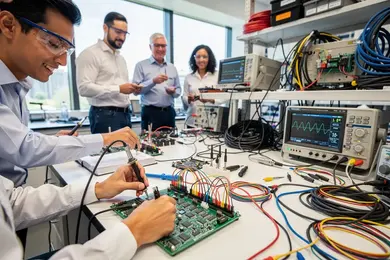
Some programs require mailed lab kits, electronic components, a multimeter, a microcontroller kit, or other tools. Others use remote labs or simulation software. Ask for a complete lab-cost estimate before comparing tuition.
Many 2027 online electrical engineering programs use asynchronous lectures for theory courses, plus scheduled live sessions for problem solving and office hours. Lab-intensive classes often require fixed meeting times, virtual lab access, or short on-campus residencies to meet accreditation and safety requirements.
Yes, many students do, especially in part-time programs. However, full-time work plus engineering coursework can be demanding, particularly during calculus, physics, circuits, and lab-heavy terms. A slower schedule may improve learning and persistence.
References
- Electrical Engineering Careers | How To Become An Electrical Engineer https://www.learnhowtobecome.org/engineering-careers/electrical-engineer/
- Jobs Outlook for Engineers: Salary Shifts in Power, Electrical and Resources https://www.titanrecruitment.com.au/blog/2025/12/jobs-outlook-for-engineers-salary-shifts-in-power-electrical-and-resources
- Online Electrical Engineering Degrees - BSEE, MSEE https://www.onlineengineeringprograms.com/electrical
- National Student Clearinghouse Research Center. (2026, January 15). Final Fall Enrollment Trends. https://nscresearchcenter.org/final-fall-enrollment-trends
- National Society of Professional Engineers. (2025). https://www.nspe.org/career-growth/pe-magazine/issue-1-2025/insights-industry-issues-opportunities