2027 Best Online Bachelor's in Electrical Engineering With Lab Simulation Support

Co-Founder and Chief Data Scientist
Choosing an online electrical engineering degree is really a decision about credibility, lab quality, cost, and career fit. The field matters because the U.S. Bureau of Labor Statistics reports a median annual wage of $118,780 for electrical and electronics engineers in May 2024, reflecting strong demand for skills in power, electronics, automation, chips, and communications.
This guide is for students comparing online bachelor's programs with virtual or remote labs. You'll learn how accreditation, simulations, courses, admissions, cost, and career outcomes affect your best choice.
Key Things You Should Know
- For engineering roles, ABET accreditation is often the most important quality marker because it can affect employer recognition, graduate school options, and the path to Professional Engineer licensure.
- Online electrical engineering bachelor's programs usually take about four years for first-time full-time students, but transfer students may finish faster depending on accepted credits and course sequencing.
- BLS data shows the median annual wage for electrical and electronics engineers was $118,780 in May 2024, but individual outcomes vary by industry, location, experience, clearance requirements, and technical specialization.
What is an online bachelor's in electrical engineering with lab simulation support?
An online bachelor's in electrical engineering is an undergraduate engineering degree that teaches students how to design, analyze, test, and improve electrical systems. Lab simulation support means the program uses digital tools, remote equipment, virtual instruments, or mailed hardware kits to help students complete experiments without attending every lab on campus.
The best fit is usually a student who wants an engineering career but needs flexibility because of work, military service, family obligations, location, or transfer status. It can also fit students who already have community college credits in calculus, physics, programming, or circuits and want to finish a bachelor's degree without relocating.
Electrical engineering is not the same as a general technology degree. Engineering programs are more math-intensive and usually include calculus, differential equations, physics, circuit analysis, electronics, signals, electromagnetics, controls, communications, and senior design. If your goal is mainly software development rather than hardware, circuits, power, or embedded systems, an online computer science degree may be a better match.
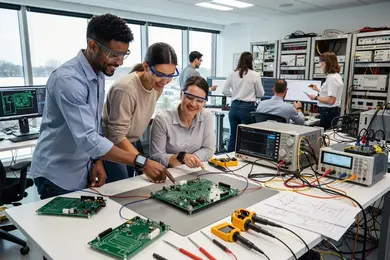
Students should look for programs that make labs visible in the curriculum instead of treating them as an afterthought. A strong online electrical engineering program should explain how students complete hands-on work, whether labs are synchronous or asynchronous, what software licenses are included, whether students need to buy lab kits, and whether any campus visits are required.
Use the following comparison to decide whether this type of degree fits your goal or whether another route may be more practical.
| Student goal | Best-fit path | Why it matters |
| Design electrical systems, circuits, devices, or power equipment | Online bachelor's in electrical engineering | Provides the engineering theory, math, lab work, and design experience employers typically expect. |
| Work in technician roles faster | Associate degree or electrical engineering technology program | May be shorter and more applied, but may not qualify graduates for the same engineering roles. |
| Move into software, apps, cloud, or cybersecurity | Computer science or software engineering degree | Usually places less emphasis on circuits, power systems, electromagnetics, and physical hardware. |
| Advance from engineering technician to engineer | ABET-accredited bachelor's completion program when available | Can strengthen eligibility for engineering positions and long-term licensure pathways. |
Is the program ABET-accredited and regionally accredited?
For this degree, accreditation is not a detail to check at the end; it should be one of the first filters you use. Regional accreditation applies to the institution, while ABET accreditation applies to specific engineering programs. A school can be regionally accredited while a particular electrical engineering program is not ABET-accredited.
ABET accreditation matters because it signals that the program has been reviewed against engineering education standards, including curriculum, faculty, student outcomes, facilities, and continuous improvement. It can also matter for the Fundamentals of Engineering exam, Professional Engineer licensure, employer screening, military education benefits, transfer credit, and graduate admissions. Students comparing accredited online electrical engineering programs should verify the exact program name, campus, and delivery format rather than relying only on a school's general reputation.
Before applying, check accreditation in a precise sequence. This helps you avoid the common mistake of enrolling in a program that sounds like engineering but is classified as engineering technology, applied technology, or a non-ABET program.
- Confirm the institution has recognized regional or institutional accreditation through the U.S. Department of Education or CHEA-recognized sources.
- Search the ABET program database for the exact degree title, such as Bachelor of Science in Electrical Engineering.
- Check whether the accreditation applies to the online format, main campus, extension campus, or a specific program location.
- Ask admissions whether the program meets educational requirements for the FE exam and future PE licensure in your state.
- Save written confirmation from the program advisor if licensure, military benefits, or employer tuition reimbursement are part of your decision.
Be cautious with programs that use vague wording such as "ABET-aligned," "based on ABET standards," or "preparing for ABET review." Those phrases are not the same as current ABET accreditation. If licensure or traditional engineering employment is your goal, the distinction can affect your long-term options.
How do online and campus electrical engineering programs compare?
Online and campus electrical engineering programs can cover similar academic content, but the learning experience differs. The biggest differences are lab delivery, scheduling, access to equipment, peer interaction, and how quickly students can get help when a concept is difficult.
Online learning is strongest for disciplined students who can manage multi-step problem sets, watch lectures carefully, troubleshoot software, and communicate early when they need help. Campus learning is often stronger for students who want regular in-person lab access, direct faculty interaction, engineering clubs, research labs, and structured routines.
Online science and engineering education has become more accepted as virtual labs, remote instrumentation, and cloud-based design tools improve. Students comparing lab-heavy online options across fields may notice similar quality questions in areas such as exercise science degrees online, where schools also need to show how practical skills are taught outside a traditional classroom.
The table below summarizes the practical trade-offs that matter most when comparing online and campus formats.
| Factor | Online electrical engineering | Campus electrical engineering |
| Schedule flexibility | Often better for working adults, military students, parents, and transfer students. | Often better for students who prefer a fixed weekly schedule. |
| Lab experience | Uses simulations, remote labs, mailed kits, virtual instruments, or short residencies. | Uses in-person lab benches, physical equipment, machine shops, and campus facilities. |
| Networking | Requires more intentional effort through virtual teams, faculty outreach, and professional societies. | Often easier through student groups, campus events, research labs, and career fairs. |
| Learning support | Depends heavily on online tutoring, office hours, discussion boards, and response times. | May offer easier access to walk-in help, peer study groups, and physical labs. |
| Best fit | Self-directed students who need flexibility and can handle technical work independently. | Students who learn best through face-to-face instruction and frequent hands-on access. |
A common mistake is assuming online automatically means easier. Electrical engineering is mathematically demanding in any format. The smarter question is not whether online is easier, but whether the program gives you enough structure, feedback, lab access, and academic support to complete difficult technical work.
What courses are included in the electrical engineering curriculum?
An online bachelor's in electrical engineering usually combines general education, advanced math and science, engineering foundations, specialized electrical engineering courses, labs, and a senior design project. The curriculum is designed to move students from theory to application, so course sequencing matters.
Most programs require students to build competence in math and physics before moving into upper-division engineering work. This is why transfer students should ask not only how many credits transfer, but also whether those credits satisfy prerequisites for junior-level engineering courses.
The following table shows common curriculum areas and what students should expect to learn in each one.
| Curriculum area | Common courses | What students learn |
| Math and science foundation | Calculus, differential equations, linear algebra, calculus-based physics. | How to model electrical, mechanical, and physical systems mathematically. |
| Core electrical engineering | Circuit analysis, electronics, digital logic, signals and systems. | How electrical components and systems behave, communicate, and process information. |
| Systems and control | Control systems, embedded systems, microprocessors, robotics fundamentals. | How to design systems that sense, respond, and operate reliably. |
| Power and energy | Power systems, machines, renewable energy, power electronics. | How electricity is generated, transmitted, converted, and used in devices and infrastructure. |
| Communications and electromagnetics | Electromagnetic fields, communication systems, RF fundamentals. | How signals travel through circuits, antennas, cables, and wireless systems. |
| Design and professional practice | Engineering ethics, technical writing, project management, senior capstone. | How to solve open-ended engineering problems with constraints, documentation, and teamwork. |
When reviewing a curriculum, look for evidence of progressive design work. Strong programs do not wait until the final semester to introduce engineering problem-solving. They build design, testing, documentation, teamwork, and safety expectations across multiple courses.
Students should also pay attention to electives. A program with electives in embedded systems, semiconductor devices, electric power, renewable energy, communications, robotics, or machine learning may better support specific career goals. However, a specialized elective list is only useful if courses are offered often enough for online students to graduate on time.
What lab simulation tools do online electrical engineering programs use?
Lab simulation support is one of the most important differences among online electrical engineering programs. A strong program should help students practice measurement, modeling, circuit design, debugging, and engineering judgment, not just watch prerecorded demonstrations.
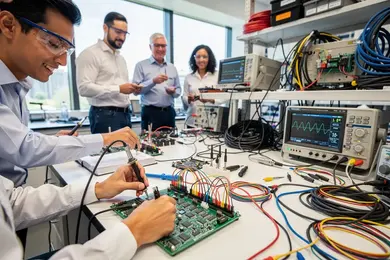
Common tools include circuit simulators, mathematical computing platforms, electronic design automation software, remote-access instruments, cloud lab environments, and physical kits shipped to students. Some programs also require short campus residencies for specialized equipment that is difficult to reproduce at home.
The table below explains common lab delivery methods and what each one is best suited to teach.
| Lab method | Examples of what it supports | Strengths | Limitations to check |
| Circuit simulation | Analog circuits, digital logic, filters, transient response. | Lets students test designs quickly and safely before building them. | May not fully capture real-world noise, tolerances, or measurement errors. |
| Mathematical modeling software | Signals, controls, systems, numerical methods. | Helps students analyze complex systems and visualize behavior. | Requires strong math preparation and software troubleshooting skills. |
| Remote instrumentation | Oscilloscopes, signal generators, test benches, power supplies. | Gives students access to real equipment through an online interface. | May require scheduled time slots and reliable internet access. |
| Mailed hardware kits | Microcontrollers, sensors, breadboards, basic circuits. | Provides hands-on assembly and debugging experience at home. | Students may need to buy replacement parts or meet safety requirements. |
| Short residencies | Advanced labs, capstone testing, specialized equipment. | Can provide deeper hands-on work with faculty supervision. | Travel costs and time away from work can affect affordability. |
Before enrolling, ask direct questions about lab access. These questions can reveal whether a program's online format is well designed or simply a campus program converted into video lectures.
- Which required courses include labs, simulations, remote labs, or hardware kits?
- Are software licenses included in tuition and fees, or do students pay separately?
- Can students complete all lab requirements from home, or are campus visits required?
- What computer specifications are required for simulation and design software?
- How are lab reports graded, and do students receive feedback on engineering reasoning?
- What happens if remote lab equipment is unavailable, a kit component fails, or software does not run correctly?
AI is also changing lab and design work. Students may use AI-assisted coding, automated design checks, and simulation workflows, but programs should still teach fundamentals. Employers need engineers who can verify outputs, understand failure modes, and make defensible technical decisions rather than simply accept software-generated results.
What are the admission requirements for online electrical engineering majors?
Admission requirements vary by school, but electrical engineering programs usually expect stronger math preparation than many other online bachelor's degrees. Some schools admit first-year students directly into engineering, while others require students to complete prerequisites before being fully admitted to the major.
Typical requirements may include a high school diploma or equivalent, transcripts, minimum GPA, college algebra or precalculus readiness, standardized test scores if required, and placement into calculus or a prerequisite math sequence. Transfer applicants may need prior coursework in calculus, physics, chemistry, programming, or introductory engineering.
Because online engineering students often include adults and transfer students, admissions decisions may also consider prior college performance, military training, technical work experience, and completion of an associate degree. However, work experience usually does not replace core math and science prerequisites.
Use the following checklist before you apply so you do not lose time or money on a program that cannot place you at the right level.
- Request an unofficial transfer evaluation before committing, especially if you have community college or military credits.
- Confirm whether you can start in calculus or whether you must complete precalculus first.
- Ask how often upper-division engineering courses are offered online and whether they have strict prerequisites.
- Check whether labs require specific hardware, operating systems, webcams, proctoring tools, or high-speed internet.
- Ask whether the program accepts part-time students and whether part-time pacing affects course availability.
- Confirm whether any campus visits, internships, or proctored exams are required.
A common red flag is a program that advertises fast completion but does not explain prerequisite chains. Electrical engineering courses build on one another, so missing one math or circuits course can delay several later courses. A realistic degree plan is more useful than an optimistic graduation estimate.
How long does the degree take, and what does it cost?
A bachelor's in electrical engineering typically requires about 120 to 130 credits. Full-time first-year students often need about four years, while transfer students may finish sooner if their credits apply directly to the degree plan. Part-time students should expect a longer timeline because engineering courses are sequential and not every course may be offered every term.
Cost varies widely by school type, residency status, transfer credits, technology fees, lab kits, software, and whether campus visits are required. College Board's Trends in College Pricing and Student Aid reported average published tuition and fees of $11,610 for in-state students at public four-year institutions for 2024-25. That figure is useful as a benchmark, but online engineering students should calculate total program cost rather than comparing tuition alone.
Important cost categories may include the following items. Ask schools to provide these in writing so you can compare offers fairly.
- Tuition per credit or per term.
- Mandatory online learning, engineering, technology, or student service fees.
- Lab kits, electronic components, testing equipment, and replacement parts.
- Software licenses that are not included through the school.
- Textbooks, digital homework platforms, and exam proctoring fees.
- Travel, lodging, and missed work time if campus residencies are required.
- Transfer credit limits that may force you to retake similar coursework.
The table below outlines common pacing options and the trade-offs students. should consider.
| Enrollment path | Typical timeline | Best for | Main trade-off |
| Full-time first-year student | About four years | Students who can prioritize school and complete courses in sequence. | Higher short-term workload and potentially higher annual cost. |
| Transfer student | Often shorter, depending on accepted credits | Students with calculus, physics, general education, or engineering prerequisites completed. | Some credits may transfer as electives rather than major requirements. |
| Part-time working adult | Often five or more years | Students balancing employment, military service, or family responsibilities. | Longer time before graduation and possible course availability constraints. |
| Accelerated or year-round plan | Potentially shorter | Highly prepared students with strong math skills and flexible schedules. | Less recovery time between demanding technical courses. |
To evaluate value, compare net price after grants, employer tuition assistance, military benefits, and transfer credits. The lowest tuition rate is not always the lowest total cost if the program requires extra prerequisites, has limited course availability, or lacks strong academic support.
What jobs can you get with an electrical engineering bachelor's degree?
An electrical engineering bachelor's degree can lead to roles in power, electronics, telecommunications, aerospace, defense, automotive systems, semiconductors, robotics, medical devices, manufacturing, and energy. Entry-level job titles vary because some employers use broad titles such as engineer I, systems engineer, test engineer, or design engineer.
Graduates typically work on systems that generate, transmit, process, measure, or control electrical energy and signals. In practice, this may involve designing circuits, testing components, writing embedded code, analyzing failures, preparing technical reports, supporting manufacturing, validating designs, or coordinating with mechanical, software, and quality teams.
The following table summarizes common roles and the type of work associated with each one.
| Role | Typical responsibilities | Helpful strengths |
| Electrical design engineer | Designs circuits, power systems, panels, devices, or electrical subsystems. | Circuit analysis, CAD tools, standards awareness, documentation. |
| Electronics engineer | Develops and tests electronic components, sensors, boards, or communication devices. | Analog and digital electronics, PCB concepts, lab testing. |
| Power engineer | Works on generation, transmission, distribution, protection, or renewable energy systems. | Power systems, safety, grid concepts, regulatory awareness. |
| Controls engineer | Designs automated systems for manufacturing, robotics, processes, or equipment. | Control theory, PLCs, sensors, programming, troubleshooting. |
| Test engineer | Creates test plans, validates systems, collects data, and documents performance. | Measurement, statistics, lab instruments, technical writing. |
| Embedded systems engineer | Works with microcontrollers, firmware, sensors, and hardware-software integration. | Programming, digital logic, electronics, debugging. |
Students interested in AI, analytics, signal processing, or smart infrastructure may later add graduate training or specialized credentials. For example, an engineer who wants to move toward machine learning, data pipelines, or advanced analytics might eventually compare a masters degree in data science online with a graduate program in electrical engineering, computer engineering, or systems engineering.
To improve entry-level readiness, students should build a portfolio that shows evidence of engineering work. Useful portfolio items include capstone documentation, circuit simulations, lab reports, embedded systems projects, power system studies, Git repositories for technical code, and concise explanations of design decisions.
What salary and job outlook do electrical engineers have?
Salary and outlook are two of the main reasons students consider electrical engineering, but the numbers should be used carefully. BLS reported a median annual wage of $118,780 for electrical and electronics engineers in May 2024. This median is not a starting salary and does not guarantee earnings; it reflects the middle point across workers with different experience levels, industries, regions, and responsibilities.
Electrical engineering compensation can vary significantly by specialization. Semiconductor, aerospace, defense, energy, research, and advanced electronics roles may differ from building systems, manufacturing support, or entry-level testing roles. Geographic location, security clearance, overtime practices, union rules, and employer size can also affect pay.
The job outlook is supported by several U.S. trends: grid modernization, electrification, renewable energy integration, electric vehicles, semiconductor investment, factory automation, defense electronics, and demand for connected devices. BLS employment projections also indicate continued openings for electrical and electronics engineers, although hiring conditions can shift with federal investment cycles, interest rates, defense budgets, and technology-sector spending.
When evaluating return on investment, do not compare only salary against tuition. Consider your starting point, transfer credits, opportunity cost, debt level, internship access, employer tuition assistance, and whether the program helps you qualify for the roles you actually want. A lower-cost program with strong accreditation and relevant labs may be a better value than a more expensive program with weak engineering support.
Students should also be realistic about competition. Employers often look for evidence of practical ability, not just a diploma. Internships, co-ops, undergraduate research, project experience, strong lab reports, and familiarity with industry tools can make a meaningful difference in early job searches.
Do online electrical engineering graduates need licensure or certifications?
Not every electrical engineer needs a Professional Engineer license, but licensure can be important for certain roles, especially in power, utilities, public infrastructure, consulting, building systems, and work that involves signing or sealing engineering documents. Requirements vary by state, so students should check the licensing board where they plan to work.
The typical PE pathway includes an engineering degree, passing the Fundamentals of Engineering exam, gaining qualifying supervised experience, and passing the Principles and Practice of Engineering exam. ABET accreditation can be especially important in this pathway because some states make the process easier or more direct for graduates of ABET-accredited engineering programs.
Certifications can also help, but they do not replace a bachelor's degree for engineering roles that require one. The right credential depends on the student's target industry and job function.
| Credential or milestone | Who may need it | Why it matters |
| Fundamentals of Engineering exam | Students or graduates planning a PE pathway. | Often the first formal step toward engineering licensure. |
| Professional Engineer license | Engineers in public-facing, regulated, utility, infrastructure, or consulting roles. | May be required to approve or take legal responsibility for engineering work. |
| Engineer in Training or Engineering Intern status | FE exam passers in many states. | Shows progress toward licensure while gaining experience. |
| Industry software or systems certifications | Students targeting controls, networking, power, or automation roles. | Can demonstrate tool-specific readiness for certain employers. |
| Safety or standards-based training | Engineers working around power, industrial equipment, or regulated systems. | Supports safer practice and compliance awareness. |
Ask programs how graduates are prepared for licensure and whether faculty advisors understand state requirements. If you already know you want to work in power engineering, utilities, public infrastructure, or consulting, this question should be part of your admissions conversation rather than something you research after graduation.
Other Things You Should Know About Electrical Engineering
Most programs require MATLAB, Multisim, NI LabVIEW, or equivalent circuit-analysis software, plus a Windows 10 or 11 laptop with at least 8 GB of RAM. Some courses also require a webcam, microphone, and browser-based access to proctored lab or exam platforms.
Yes, but it is challenging. Many working students take a part-time load because circuits, physics, calculus, and labs require consistent weekly study time. Ask schools for a part-time degree plan before enrolling.
Employers are more likely to focus on accreditation, school reputation, technical skills, projects, internships, and interview performance than on delivery format alone. Make sure the transcript and diploma clearly represent a legitimate engineering degree.
References
- What can you do with an electrical engineering degree? - People of Pacific https://www.pacific.edu/blog/2025/01/24/what-can-you-do-with-an-electrical-engineering-degree/
- ABET https://civil.emu.edu.tr/en/abet
- Explore UM | University of Manitoba - Electrical Engineering (BSc) https://umanitoba.ca/explore/programs-of-study/electrical-engineering-bsc
- Accreditation - ABET https://www.abet.org/accreditation/
- How Long Does it Take to Get a Bachelor’s Degree? https://www.pointloma.edu/resources/accelerated-undergraduate/how-long-does-it-take-get-bachelors-degree
- ABET vs. Regional Accreditation vs. National Accreditation https://talk.collegeconfidential.com/t/abet-vs-regional-accreditation-vs-national-accreditation/2001576
- Online circuit simulator & schematic editor - CircuitLab https://www.circuitlab.com/
- How long does it take to get a bachelor's degree? | edX https://www.edx.org/resources/how-long-does-it-take-to-get-a-bachelors-degree