2027 Online Electrical Engineering Degrees That Help Build Technical Problem-Solving Skills

Co-Founder and Chief Data Scientist
Choosing an online electrical engineering degree is a high-stakes decision because the field is technical, math-heavy, and closely tied to fast-moving industries such as semiconductors, robotics, energy systems, telecommunications, and AI-enabled hardware. The U.S. Bureau of Labor Statistics reported a May 2024 median annual wage of $118,780 for electrical and electronics engineers, making program quality and accreditation especially important.
This guide is for prospective students comparing online options, costs, timelines, and career outcomes so they can decide whether this degree fits their goals and budget.
Key Things You Should Know
- Accreditation matters: students who may pursue professional engineering licensure should prioritize programs with appropriate institutional accreditation and, when relevant, ABET accreditation for the engineering program.
- Cost varies widely: College Board 2024-25 benchmarks list average published tuition and fees of $11,610 for in-state public four-year students and $43,350 for private nonprofit four-year students, before online fees, books, labs, and transfer credits are considered.
- Career demand is solid but not automatic: BLS projections show electrical and electronics engineer employment growing 9% from 2023 to 2033, so graduates still need strong project work, software skills, and industry-aligned specialization.
What is an online electrical engineering degree and how does it build problem-solving skills?
An online electrical engineering degree is a college program that teaches students how to analyze, design, test, and improve electrical and electronic systems through a primarily remote format. Depending on the school, it may lead to a bachelor's degree, a master's degree, or a completion degree for students who already hold an associate degree or significant transfer credit.
The problem-solving value comes from how electrical engineering is taught. Students do not simply memorize formulas; they learn to model a system, identify constraints, run calculations, test assumptions, troubleshoot failures, and communicate a defensible solution. Those habits are useful in circuit design, embedded systems, power generation, robotics, communications, and semiconductor work.
Most programs build technical problem-solving through a sequence of applied learning experiences. These experiences are important because employers often want evidence that graduates can move from theory to working systems.
- Mathematical modeling: Students use calculus, differential equations, probability, and linear systems to describe real electrical behavior.
- Simulation and design: Courses often use tools for circuit simulation, digital logic, signal processing, or control systems before students build or validate a design.
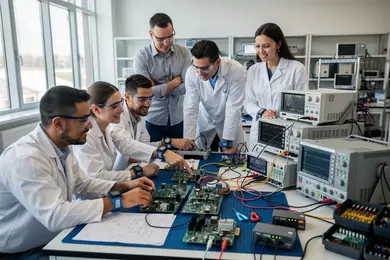
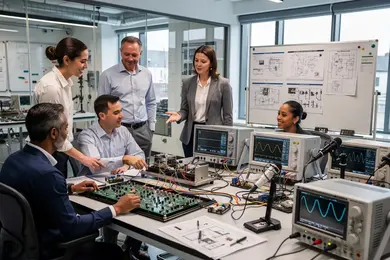
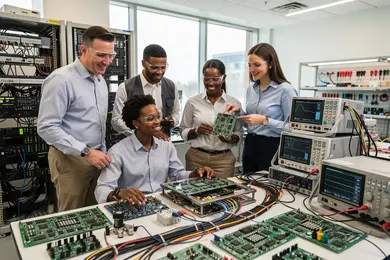
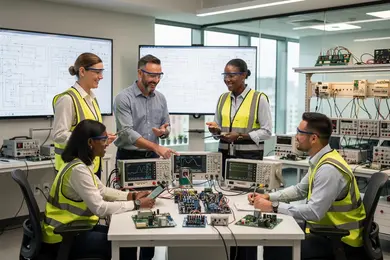
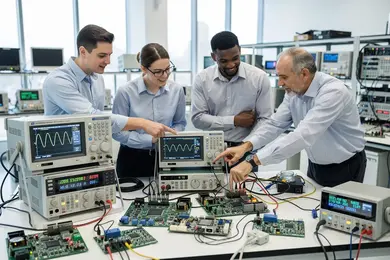
- Lab-based troubleshooting: Online programs may use remote labs, mailed lab kits, virtual instruments, or on-campus intensives to help students test measurements and diagnose errors.
- Capstone projects: Senior or graduate projects require students to define a problem, compare solutions, document trade-offs, and present results.
This degree is usually a strong fit for students who enjoy math, physics, computing, and structured problem-solving. It may be less suitable for students seeking a quick credential, a low-math technical role, or a program with minimal lab expectations.
Are online electrical engineering degrees respected and accredited like campus-based programs?
Online electrical engineering degrees can be respected when they come from properly accredited institutions and offer the same academic rigor expected of engineering programs. Employers typically care less about whether courses were online and more about whether the school is legitimate, the curriculum is technical enough, and the graduate can demonstrate relevant skills.
There are two accreditation layers to understand. Institutional accreditation applies to the college or university as a whole and affects federal financial aid eligibility, transfer credit acceptance, and general academic legitimacy. Programmatic accreditation, especially ABET accreditation for engineering programs, can matter for students who want the clearest path toward engineering licensure or employers that specifically prefer ABET-recognized preparation.
| Accreditation factor | Why it matters | What to verify before applying |
| Institutional accreditation | Confirms that the college meets broad academic and administrative standards. | Check the school's accreditor and federal financial aid eligibility. |
| ABET engineering accreditation | Often important for professional engineering licensure pathways and some employer preferences. | Confirm the exact online program name, degree level, and campus or delivery mode listed by ABET. |
| State authorization | Online programs may not be authorized to enroll students in every state. | Ask whether the school can legally enroll students where you live. |
| Licensure alignment | Professional Engineer requirements vary by state and can include education, exams, supervised experience, and application review. | Contact the relevant state licensing board if PE licensure is part of your goal. |
A common mistake is assuming that online and accredited automatically mean the same thing across all programs. The safest approach is to verify the exact degree, not just the university brand, because engineering accreditation can differ by program, level, and delivery format.
How do online electrical engineering programs compare to traditional on-campus formats?
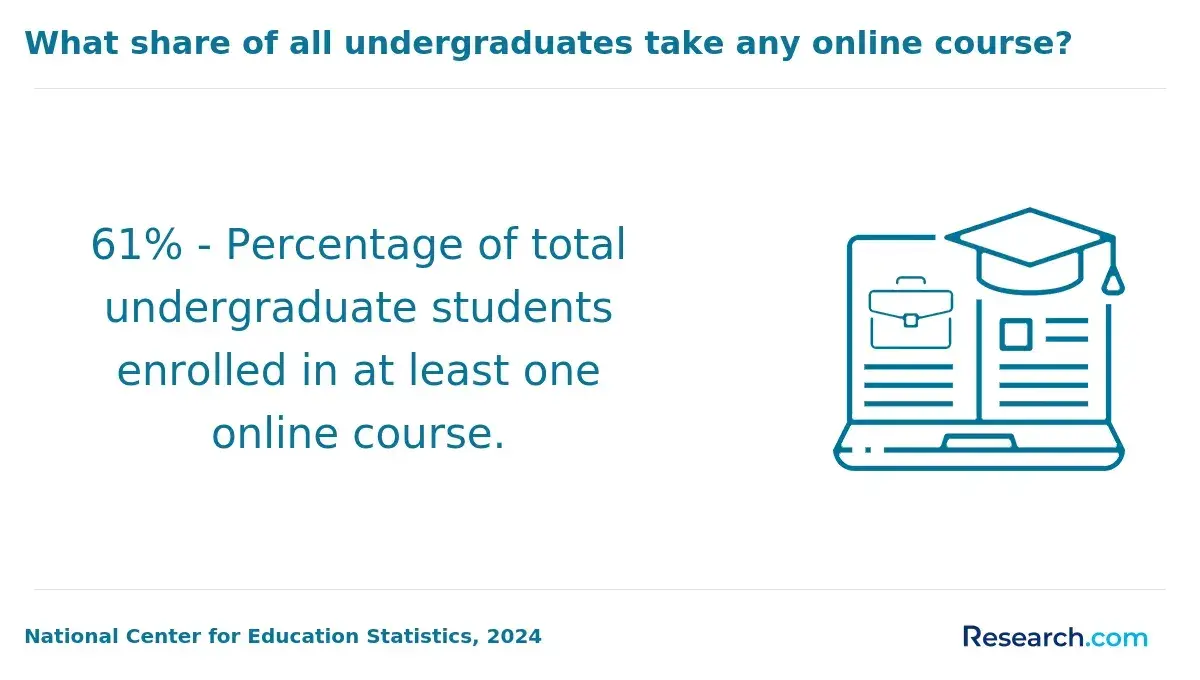
Online and campus-based electrical engineering programs can cover similar academic content, but they differ in scheduling, lab delivery, networking, and student support. The best choice depends on your work schedule, location, need for hands-on facilities, and comfort with independent learning.
The comparison below highlights the practical trade-offs that matter most before enrollment. Students comparing engineering disciplines may also want to review affordability patterns in related fields, such as a cheapest online civil engineering degree, because tuition structure, lab fees, and transfer policies often shape total cost across engineering programs.
| Decision factor | Online electrical engineering degree | On-campus electrical engineering degree |
| Schedule flexibility | Often better for working adults, military students, caregivers, and students far from campus. | Usually better for students who can attend fixed class and lab times. |
| Lab access | May use remote labs, simulation, shipped kits, or short residencies. | Usually provides direct access to campus labs, equipment, and in-person supervision. |
| Peer interaction | Depends heavily on discussion boards, group projects, video meetings, and instructor responsiveness. | Often easier to form study groups, join engineering clubs, and work with faculty in person. |
| Self-management demands | Higher; students must plan assignments, labs, and troubleshooting time independently. | More built-in structure through scheduled meetings and campus routines. |
| Career preparation | Can be strong if the program includes projects, internships, career services, and employer-connected capstones. | Can be strong through labs, research groups, student competitions, and local recruiting. |
Online study makes the most sense when flexibility is essential and the program has credible lab solutions. Campus study may be better when a student wants intensive in-person lab work, direct access to faculty research, or a traditional residential engineering environment.
What courses and technical topics are typically covered in online electrical engineering curricula?
Online electrical engineering curricula typically combine advanced math, physics, computing, circuits, systems, and design. Bachelor's programs usually emphasize broad engineering foundations, while master's programs allow deeper specialization in areas such as power systems, signal processing, controls, communications, microelectronics, or embedded systems.
The table below summarizes common course areas and the problem-solving abilities they tend to develop. This matters because students should choose electives that match their target industry rather than treating all electrical engineering programs as interchangeable.
| Course or topic area | What students learn | Problem-solving skill developed |
| Circuit analysis | Voltage, current, resistance, impedance, transient response, and circuit behavior. | Breaking complex systems into measurable components. |
| Electronics | Diodes, transistors, amplifiers, power electronics, and device-level design. | Diagnosing component behavior and performance constraints. |
| Digital logic and embedded systems | Boolean logic, microcontrollers, hardware interfaces, and firmware concepts. | Designing hardware-software interactions. |
| Signals and systems | Time-domain and frequency-domain analysis, filtering, sampling, and transforms. | Interpreting noisy or incomplete technical information. |
| Control systems | Feedback, stability, sensors, actuators, and system response. | Designing systems that behave predictably under changing conditions. |
| Power systems | Generation, transmission, distribution, machines, and grid reliability. | Evaluating safety, efficiency, and infrastructure trade-offs. |
| Electromagnetics | Fields, waves, transmission lines, antennas, and high-frequency behavior. | Solving spatial and physical design problems. |
| Engineering design or capstone | Requirements, prototypes, testing, documentation, and presentation. | Turning open-ended problems into defensible engineering solutions. |
Current programs increasingly include software, data, and automation because electrical engineers often work with connected devices, sensor data, and intelligent systems. Students who want a stronger analytics path can compare engineering electives with adjacent options such as data science degrees, especially if they are interested in signal analysis, machine learning for sensors, or industrial automation.
What admission requirements and prerequisites do online electrical engineering programs have?
Admission requirements depend on degree level and whether the program is designed for first-time undergraduates, transfer students, or graduate applicants. Electrical engineering is cumulative, so schools often look closely at math, science, and prior engineering coursework.
Prospective students should review prerequisites early because missing math or lab science courses can delay graduation. Common requirements include the following:
- Bachelor's entry: High school diploma or equivalent, transcripts, placement readiness in calculus or pre-calculus, and prior physics or chemistry preparation.
- Transfer or degree-completion entry: College transcripts, minimum GPA, completed calculus sequence, physics with lab, and foundational engineering or computer science courses.
- Master's entry: Bachelor's degree in electrical engineering or a closely related field, transcripts, minimum GPA, prerequisite technical coursework, statement of purpose, and sometimes recommendations or test scores.
- International or out-of-state applicants: Additional documentation, English proficiency if applicable, and confirmation that the program is authorized to enroll students in the applicant's location.
Students without a strong math background should not necessarily rule out the degree, but they should plan a slower start. Taking calculus, physics, and programming before enrolling full time can reduce the risk of struggling in upper-division engineering courses.
How long do online electrical engineering degrees take and what do they cost?
Program length depends on the degree level, transfer credits, course load, and whether the program requires in-person labs or residencies. A traditional bachelor's degree often takes about four years of full-time study, while transfer-friendly online completion programs may take closer to two to three years after prerequisites. Master's programs commonly take one to three years depending on whether the student studies full time or part time.
Cost is harder to compare than sticker tuition because online engineering programs may include technology fees, lab kits, proctoring fees, software, textbooks, and travel for residencies. College Board's 2024-25 tuition benchmarks are useful as a baseline, but online students should calculate total program cost rather than assuming remote study is always cheaper.
- Average published tuition and fees for in-state students at public four-year institutions: $11,610 for 2024-25.
- Average published tuition and fees for out-of-state students at public four-year institutions: $30,780 for 2024-25.
- Average published tuition and fees at private nonprofit four-year institutions: $43,350 for 2024-25.
The table below shows the main cost drivers to compare before applying. It is especially important for electrical engineering because lab delivery and software access can add costs that are not obvious in tuition-only comparisons.
| Cost factor | Why it affects total price | How to evaluate it |
| Transfer credit policy | Accepted credits can reduce both tuition and time to graduation. | Request a preliminary transfer evaluation before enrolling. |
| Online course fees | Some schools charge per-credit technology or distance learning fees. | Ask for a full fee schedule, not just tuition per credit. |
| Lab kits and equipment | Electrical engineering may require circuit boards, meters, components, or specialized software. | Confirm which materials are included and which must be purchased separately. |
| Residency or campus visit requirements | Travel can increase costs for students far from campus. | Ask whether any labs, exams, orientations, or capstones require in-person attendance. |
| Course sequencing | Engineering prerequisites can limit how quickly students progress. | Review a sample degree plan for full-time and part-time schedules. |
To control costs, students should compare net price after aid, transfer credit acceptance, employer tuition assistance, and graduation timeline. The cheapest per-credit program is not always the lowest-cost path if limited course availability extends enrollment.
What careers can graduates of online electrical engineering programs pursue?
Graduates of online electrical engineering programs can pursue roles in industries that design, test, power, automate, connect, or control technology. Career options depend on degree level, internships, specialization, geographic market, and whether the graduate has hands-on project experience.
The table below connects common career paths with the type of work graduates may do. Students interested in more software-heavy roles should compare electrical engineering with an accelerated computer science degree online, since embedded systems, robotics, and automation can sit between hardware and software.
| Career path | Typical responsibilities | Relevant preparation |
| Electrical engineer | Design, test, and improve electrical systems, components, or products. | Circuits, electronics, power, controls, labs, and design projects. |
| Electronics engineer | Work on electronic devices, communications equipment, sensors, or instrumentation. | Electronics, digital systems, signal processing, and testing methods. |
| Power systems engineer | Support generation, transmission, distribution, grid modernization, or renewable integration. | Power systems, machines, protection, energy conversion, and safety standards. |
| Embedded systems engineer | Develop hardware-software systems for devices, vehicles, medical technology, or industrial equipment. | Microcontrollers, programming, digital logic, interfaces, and real-time systems. |
| Controls engineer | Design and tune automated systems used in manufacturing, robotics, aerospace, or process industries. | Control theory, sensors, actuators, programming, and system modeling. |
| Test or validation engineer | Create test plans, analyze failures, validate performance, and document compliance. | Measurement, statistics, instrumentation, circuits, and technical communication. |
| RF or communications engineer | Work with wireless systems, antennas, signal transmission, or high-frequency equipment. | Electromagnetics, signals, communications, and simulation tools. |
Entry-level candidates improve their odds by building a portfolio of lab reports, simulations, GitHub projects when software is involved, capstone documentation, and internship or co-op experience. A degree provides the academic foundation, but employers often use projects and practical experience to judge readiness.
What salary ranges and earning potential do electrical engineers typically have?
Electrical engineering has strong earning potential, but salary depends on role, industry, location, degree level, experience, and security clearance or licensing requirements. The best way to use salary data is as a benchmark, not a promise.
According to the BLS, the median annual wage for electrical and electronics engineers was $118,780 in May 2024. For students, this means the field can offer a meaningful return on education, but only when program cost, time to completion, debt, and job-market fit are considered together.
| Career stage or context | Typical pay position relative to the median | What usually influences earnings |
| Early-career engineering roles | Often below the field median. | Internships, project portfolio, location, industry, and technical interview performance. |
| Mid-career technical roles | Often near or above the field median. | Specialization, design ownership, systems knowledge, and cross-functional experience. |
| Senior or specialized roles | Can exceed the field median. | Power systems expertise, semiconductor experience, RF skills, controls leadership, or advanced credentials. |
| Engineering management or technical leadership | May exceed individual contributor pay, depending on employer and responsibility level. | Leadership ability, project scope, budgeting, compliance, and team management. |
Students should also compare likely earnings against their total education cost. A lower-cost accredited program with strong labs, transfer credit, and employer connections may produce a better personal ROI than a more expensive program with similar outcomes.
What is the job outlook and industry demand for electrical engineers in the U.S.?
Demand for electrical engineers is supported by several U.S. trends: grid modernization, renewable energy integration, electric vehicles, automation, advanced manufacturing, communications infrastructure, defense systems, and domestic semiconductor investment. AI is also changing the field by increasing demand for engineers who can work with sensors, edge devices, robotics, power efficiency, and hardware-software integration.
The BLS projects employment of electrical and electronics engineers to grow 9% from 2023 to 2033, which is faster than the average for all occupations. For students, the key takeaway is that demand exists, but the strongest opportunities usually go to candidates whose coursework and projects match active hiring areas.
Students can position themselves for stronger job prospects by making deliberate specialization choices. The following areas are especially relevant to current employer needs:
- Power and energy systems: Useful for utilities, renewable energy, grid reliability, electric vehicles, and infrastructure modernization.
- Embedded systems and robotics: Valuable for manufacturing automation, medical devices, consumer electronics, aerospace, and connected products.
- Semiconductors and microelectronics: Relevant to chip design support, testing, fabrication, and electronics manufacturing.
- Signal processing and communications: Important for wireless systems, defense, telecommunications, radar, and sensing applications.
- Controls and automation: Useful in industrial systems, process control, autonomous systems, and smart manufacturing.
Because demand varies by region and industry, students should review local job postings before choosing electives. If most nearby employers want power systems or controls experience, a general curriculum without those electives may be less competitive.
How can students evaluate and choose a reputable online electrical engineering program?
Choosing a reputable online electrical engineering program requires more than comparing tuition and rankings. Students should verify accreditation, lab quality, course sequencing, faculty access, career support, and whether the program fits their intended career path.
Use the following process before committing to a program. These steps are designed to reduce avoidable risks such as enrolling in a program that is hard to transfer from, misaligned with licensure, or more expensive than it first appears.
- Confirm institutional accreditation and whether the specific engineering program has ABET accreditation if licensure or employer preference makes that important.
- Ask how labs are delivered, including whether students use remote equipment, simulations, mailed kits, campus residencies, or local proctors.
- Request a full degree plan showing prerequisites, course sequencing, part-time options, and expected graduation timeline.
- Compare total cost after fees, lab materials, software, books, transfer credits, and any required travel.
- Review faculty credentials, student support hours, tutoring availability, and response expectations for online courses.
- Ask for career outcomes that are specific to electrical engineering students, not only schoolwide employment numbers.
- Check whether internships, co-ops, undergraduate research, or industry-sponsored capstones are available to online students.
- Look at recent syllabi or sample projects to confirm that the curriculum includes modern tools and applied design work.
Affordability research should look at net cost and completion risk, not sticker price alone. Students comparing programs across fields can apply the same cost-checking habits used in guides such as the cheapest MLIS degree online: verify fees, transfer policies, aid, and whether the program's outcomes justify the investment.
Watch for red flags such as vague accreditation claims, no clear lab plan, limited access to instructors, unusually aggressive admissions pressure, missing graduation requirements, or career statistics that do not separate engineering students from unrelated majors. A reputable program should be able to explain exactly how online students complete technical labs, receive feedback, and demonstrate engineering competence.
Other Things You Should Know About Electrical Engineering
Yes, at least to some extent. Electrical engineering is not the same as computer science, but many programs use programming for simulations, embedded systems, data analysis, controls, and signal processing. Students who are new to coding should expect to practice regularly.
It is possible, especially in part-time programs, but the workload can be demanding because labs, problem sets, and projects take sustained concentration. Working students should avoid overloading their first term and should ask the school for a realistic weekly time estimate.
Often, yes. Requirements vary, but students may need a reliable computer, engineering software, a webcam for proctored exams, and sometimes lab kits or basic electronics tools. Always ask for the equipment list before enrolling.
Yes. Many ABET-aligned online electrical engineering degrees require a capstone in the final year, usually worth 3 to 4 credit hours. Students complete a design project, submit technical documentation, and present results, which helps demonstrate problem-solving, testing, and system integration skills.
References
- How to Evaluate If an Engineering Program Is a Good Fit - Your College-Bound Kid https://yourcollegeboundkid.com/2023/03/10/how-to-evaluate-if-an-engineering-program-is-a-good-fit/
- Job Outlook: Electrical Engineering | Progressive https://www.progressiverecruitment.com/en-us/knowledge-hub/industry-insights/job-outlook-electrical-engineering/
- What Can You Do with an Electrical Engineering Degree | HAN https://www.hanuniversity.com/en/programs/bachelor/electrical-and-electronic-engineering/fulltime/careers/
- Online Electrical Engineering Degrees - BSEE, MSEE https://www.onlineengineeringprograms.com/electrical
- Online Electrical Engineering Degree | Programs And Career Options https://www.learnhowtobecome.org/best-online-bachelors-in-electrical-engineering-degree-programs/
- Learn electrical engineering | edX https://www.edx.org/learn/electrical-engineering
- Electrical Engineer Salary in AU (July, 2026) – SEEK https://au.seek.com/career-advice/role/electrical-engineer/salary