2027 Best Online Bachelor's in Electrical Engineering for Working Adults

Co-Founder and Chief Data Scientist
Choosing an online bachelor's in electrical engineering is a high-stakes decision because the degree must fit your work schedule, budget, and career goals while still meeting employer expectations. The Bureau of Labor Statistics reports that electrical and electronics engineers had a median annual pay of $118,780 in 2024, making program quality and accreditation especially important.
This guide is for working adults comparing flexible degree options. You'll learn how online programs work, which schools offer accredited options, what they cost, and how to choose a program that supports your next career move.
Key Things You Should Know
- For working adults, the best online electrical engineering bachelor's programs are typically ABET-accredited, transfer-friendly, and built around asynchronous coursework, virtual labs, or lab kits that reduce campus travel.
- College Board reported average published tuition and fees of $11,610 for in-state public four-year colleges and $43,350 for private nonprofit four-year colleges in 2024-25, before aid.
- The labor market is favorable but not automatic: BLS data shows median 2024 pay of $118,780 for electrical and electronics engineers, with employment projected to grow 9% from 2024 to 2034.
What makes an online bachelor's in electrical engineering a good fit for working adults?
An online bachelor's in electrical engineering is a four-year undergraduate degree focused on circuits, electronics, power systems, signal processing, electromagnetics, controls, digital systems, and engineering design. For working adults, the strongest programs are not simply "online"; they are structured so students can keep employment while steadily completing math-heavy, lab-based coursework.
The degree tends to be a good fit if you want to move into engineering roles, formalize technical experience gained in the military or industry, or qualify for jobs that require an engineering bachelor's rather than a technician credential. It is less ideal if you want a short credential, dislike advanced math, or need a program with no scheduled exams, group projects, or lab deadlines.
Working adults should look closely at the academic design, not just the delivery format. The features below usually matter most because they determine whether the program is realistic alongside a full-time job:
- ABET accreditation: This is the clearest signal that an engineering program has been reviewed against discipline-specific quality standards and is often preferred for engineering employment and licensure pathways.
- Flexible scheduling: Asynchronous lectures help, but exams, labs, office hours, and team projects may still occur on fixed schedules.
- Transfer-credit pathways: Adults with community college, military, or prior university credit may shorten the degree if the school accepts calculus, physics, programming, and general education courses.
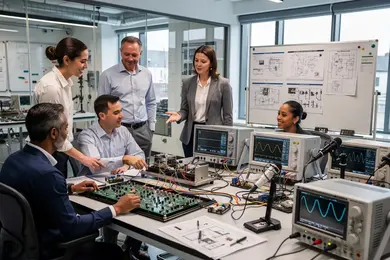
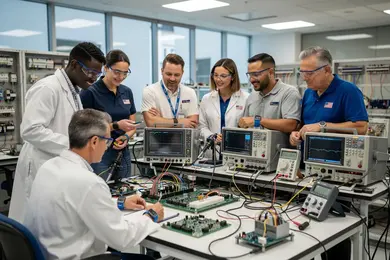
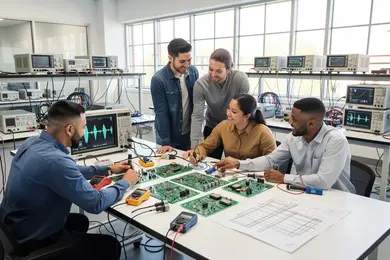
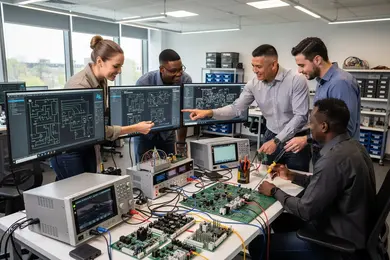
- Remote lab support: Strong online programs use simulation tools, mailed lab kits, virtual instruments, or carefully designed at-home experiments rather than removing hands-on learning.
- Career alignment: A program should match your target area, such as power, embedded systems, controls, electronics, renewable energy, semiconductors, robotics, or communications.
The best fit is usually a program that balances flexibility with rigor. If a school promises an easy engineering degree, that is a warning sign; electrical engineering is demanding because employers expect graduates to solve quantitative, safety-sensitive, and systems-level problems.
How do online electrical engineering bachelor's programs compare to on-campus degrees?
Online and on-campus electrical engineering degrees can lead to similar outcomes when the online program is properly accredited, academically equivalent, and supported by strong faculty access. The biggest differences are not usually the diploma wording; they are the learning environment, lab format, pacing, networking, and how much self-direction the student needs.
The table below compares practical differences that matter for working adults deciding between online and campus-based study. Use it to identify which format better matches your schedule, learning style, and career needs:
| Factor | Online bachelor's in electrical engineering | On-campus bachelor's in electrical engineering | Best fit |
| Schedule | Often includes asynchronous lectures, recorded materials, and remote assignments | Requires regular attendance at set class and lab times | Online is usually better for full-time workers |
| Labs | May use mailed kits, simulations, remote lab platforms, or limited in-person requirements | Uses physical campus labs with direct equipment access | Campus may be better for students who learn best through supervised hands-on lab work |
| Peer interaction | Discussion boards, video meetings, team projects, and online tutoring | More informal study groups, clubs, and faculty contact | Campus may offer easier networking; online requires more initiative |
| Career access | May support remote students through virtual career services and employer partnerships | May offer local internships, research labs, and in-person recruiting | Depends on employer access, location, and the student's prior experience |
| Self-management | Requires strong time management and independent problem-solving | Provides more daily structure and physical separation from home/work life | Online is best for disciplined learners with predictable study time |
For many working adults, the online route is more practical because it avoids relocation and commuting. However, students who need extensive tutoring, frequent in-person faculty interaction, or access to specialized equipment may find a campus program more supportive. The better choice is the one you can complete successfully, not simply the one that appears faster or cheaper.

Which accredited schools offer fully online electrical engineering bachelor's programs?
Fully online electrical engineering bachelor's degrees are less common than online business, information technology, or management degrees because engineering requires advanced mathematics, supervised design work, and lab experiences.
Still, several U.S. institutions offer online electrical engineering programs that are designed for remote learners and should be on a working adult's shortlist.
The table below highlights examples of accredited schools that have offered online bachelor's-level electrical engineering options. Program names, delivery rules, state authorization, and lab requirements can change, so confirm details directly with the institution before applying:
| School | Online program type | Accreditation note | Why working adults consider it |
| Arizona State University | Online Bachelor of Science in Engineering in Electrical Engineering | Designed as an ABET-accredited engineering pathway | Known for large-scale online delivery, structured course sequences, and broad student support |
| University of North Dakota | Online Bachelor of Science in Electrical Engineering | ABET-accredited engineering program | Appeals to students seeking a public university program with remote engineering coursework |
| Florida International University | Online Bachelor of Science in Electrical Engineering | ABET-accredited engineering program | Useful for students who want an online engineering option from a large public research university |
| Stony Brook University | Online Bachelor of Science in Electrical Engineering, often structured for transfer students | ABET-accredited engineering program | May fit students who have already completed lower-division math, science, and general education coursework |
When comparing these schools, avoid assuming that "online" means every activity is self-paced or that no campus visit is ever required. Ask admissions staff specifically about proctored exams, synchronous sessions, lab kits, required software, summer terms, transfer-credit limits, and whether the online program has the same accreditation status as the campus version.
What admissions requirements do online electrical engineering bachelor's programs typically have?
Admissions requirements for online electrical engineering bachelor's programs vary, but they are usually more math- and science-focused than general online degree programs. Some schools admit first-year students, while others operate as degree-completion programs for students who already have college credit.
Before applying, working adults should compare the academic and administrative requirements below. These items affect not only whether you are admitted but also how long the degree will take:
- High school diploma or equivalent: First-year applicants usually need transcripts showing college-preparatory math and science readiness.
- College transcripts: Transfer applicants must submit transcripts from every prior institution, even if the coursework is old or incomplete.
- Calculus readiness: Many programs expect placement into calculus or completion of prerequisite algebra, trigonometry, and precalculus courses.
- Physics preparation: Calculus-based physics is often required early in the engineering sequence, so weak physics preparation can delay progress.
- Programming or computing exposure: Some programs require or recommend introductory programming, especially for embedded systems, controls, or signal processing coursework.
- Minimum GPA: Schools may set separate GPA standards for admission to the university and admission to the engineering major.
- Technology requirements: Students may need a computer capable of running engineering software, a stable internet connection, webcam access, and sometimes lab equipment or kits.
A common mistake is applying before confirming whether previous credits will count toward the engineering major. General education credits are helpful, but the largest time savings usually come from transferable calculus, differential equations, physics, chemistry, programming, and lower-division engineering courses.
How long does it take to complete an online electrical engineering bachelor's while working?
A bachelor's in electrical engineering typically requires about 120 to 130 credits, depending on the school and state general education rules. A full-time student starting from scratch may finish in about four years, but working adults often take longer because engineering courses are sequential and difficult to overload.
The table below gives a realistic planning view for adult learners. It is not a guarantee; actual time depends on transfer credits, math placement, course availability, and how many credits you can handle while working:
| Student situation | Typical pace | Likely planning range | Key trade-off |
| No prior college credit | Full-time or near full-time | About four to five years | Fastest path, but difficult with demanding work or family responsibilities |
| No prior college credit | Part-time | Often five to seven years | More manageable weekly workload, but longer time before career transition |
| Associate degree with strong math and science transfer | Part-time to full-time | Often two to four years | Can be efficient if prerequisites align with the engineering curriculum |
| Some college credit but missing calculus or physics | Part-time | Highly variable | Math sequencing may become the main bottleneck |
For working adults, the smartest pacing strategy is often to take fewer credits during calculus, physics, circuits, electronics, and electromagnetics terms. These courses build on one another, and failing or withdrawing from one prerequisite can delay multiple future courses. Accelerating is useful only when it does not damage comprehension, GPA, or long-term persistence.
What core courses and specializations are included in online electrical engineering curricula?
Online electrical engineering curricula usually mirror campus programs because the degree must build the same engineering foundation. Students start with calculus, physics, programming, and introductory engineering before moving into circuits, electronics, systems, and senior design.
The core areas below are important because they signal whether a program prepares you for broad electrical engineering roles rather than only a narrow technical support position:
- Mathematics: Calculus, differential equations, linear algebra, probability, and numerical methods support modeling and engineering analysis.
- Physical science: Calculus-based physics and sometimes chemistry provide the foundation for circuits, electromagnetics, materials, and devices.
- Circuits and electronics: Students learn analog circuits, digital logic, semiconductor devices, instrumentation, and microelectronics.
- Signals and systems: Coursework covers signal processing, communications, feedback systems, and frequency-domain analysis.
- Power and energy: Students may study electric machines, power systems, renewable integration, power electronics, and grid reliability.
- Controls and embedded systems: These courses connect electrical engineering to robotics, automation, aerospace, manufacturing, and smart devices.
- Engineering design: Senior projects require students to define a problem, build or simulate a solution, test performance, and communicate results.
Specializations vary by school, but common options include power systems, electronics, communications, embedded systems, control systems, signal processing, photonics, semiconductor devices, and renewable energy.
Students interested in software-heavy areas such as embedded systems, AI hardware, robotics, or automation may also compare electrical engineering with online degrees in computer science to see which curriculum better matches their target jobs.
How much do online electrical engineering bachelor's programs cost, and what aid is available?
Costs for online electrical engineering bachelor's programs depend on tuition rate, residency status, transfer credits, fees, books, software, lab kits, and time to completion.
College Board's 2024-25 data reported average published tuition and fees of $11,610 for in-state students at public four-year institutions and $43,350 at private nonprofit four-year institutions. Online students may pay different rates, but the comparison shows why public tuition, transfer credit, and employer aid can substantially affect total cost.
Electrical engineering programs may also carry costs that general online degrees do not. These commonly include:
- Engineering software access or licensing fees.
- Lab kits, components, measurement tools, or shipping costs.
- Proctored exam fees.
- Textbooks and digital homework platforms.
- Technology upgrades for simulation and design software.
- Course repeat costs if prerequisite-heavy classes are not passed on the first attempt.
Working adults should calculate the full cost of attendance, not just tuition. A lower per-credit rate may be less valuable if the school accepts fewer transfer credits, requires more repeated prerequisites, or has fees that are not obvious on the tuition page.
Financial aid options may include federal grants, federal student loans, state aid, institutional scholarships, military education benefits, employer tuition assistance, and payment plans. If you are comparing engineering fields more broadly, reviewing affordability in a related area such as an environmental engineering degree online can also help you understand how engineering tuition structures differ by institution and specialty.
To reduce cost, ask each school for a degree audit before enrolling, prioritize transferable community college prerequisites when approved by the engineering department, and confirm whether employer tuition assistance applies to part-time online enrollment. The cheapest program is not always the best value, but unnecessary credits are almost always expensive.
What entry-level careers can you pursue with an online electrical engineering bachelor's?
An online bachelor's in electrical engineering can support entry-level roles in industries such as utilities, electronics, aerospace, defense, telecommunications, manufacturing, automotive systems, energy, medical devices, robotics, and semiconductors. Job titles vary because employers use "engineer," "associate engineer," "design engineer," and "systems engineer" differently.
The table below summarizes common early-career paths and what the work usually involves. Use it to connect coursework with practical job options before choosing electives or projects:
| Entry-level role | Typical responsibilities | Helpful coursework or experience |
| Electrical engineer | Designs, tests, documents, and improves electrical systems or components | Circuits, electronics, electromagnetics, senior design |
| Power systems engineer | Supports generation, transmission, distribution, grid analysis, or renewable energy integration | Power systems, machines, power electronics, energy systems |
| Controls engineer | Develops or maintains automated systems used in manufacturing, robotics, or industrial equipment | Control systems, programming, embedded systems, instrumentation |
| Electronics design engineer | Works with circuit boards, sensors, test equipment, and electronic products | Analog electronics, digital design, PCB projects, lab experience |
| Test engineer | Builds test procedures, analyzes performance data, and validates product reliability | Instrumentation, statistics, circuits, technical documentation |
| Embedded systems engineer | Works where hardware and software meet, often involving microcontrollers or connected devices | Programming, digital logic, microprocessors, real-time systems |
Students who want to work mostly in software engineering, cloud computing, cybersecurity, or app development may be better served by a computer science bachelor degree online. Electrical engineering is strongest when you want to understand and design physical systems, electronics, signals, controls, power, and hardware-connected technologies.
What salary ranges and job outlook can graduates in electrical engineering expect?
Salary potential is one reason many working adults consider electrical engineering, but pay varies by industry, location, clearance requirements, internships, technical specialty, and prior experience. The Bureau of Labor Statistics reported median annual pay of $118,780 for electrical and electronics engineers in 2024. That figure should be used as a labor-market benchmark, not as an expected starting salary for every graduate.
The employment outlook is also favorable. BLS projects employment for electrical and electronics engineers to grow 9% from 2024 to 2034, which is faster than the average for all occupations. For students, this suggests continued demand in areas tied to electrification, advanced manufacturing, semiconductors, automation, defense systems, communications, and energy infrastructure.
The table below shows how career direction can affect salary context and job search strategy. It does not predict individual earnings, but it helps you compare how different roles may position you in the market:
| Career direction | Salary context | Outlook considerations |
| Power and energy | Often tied to utilities, infrastructure, grid modernization, and renewable energy projects | Demand may be influenced by energy investment, regional utility hiring, and public infrastructure work |
| Electronics and hardware | Can vary widely by product sector, from consumer electronics to defense and medical devices | Portfolio projects, lab skill, and testing experience can matter for entry-level hiring |
| Controls and automation | Often connected to manufacturing, robotics, industrial systems, and process control | Employers may value PLCs, programming, instrumentation, and hands-on troubleshooting |
| Embedded systems | May overlap with software compensation patterns when roles require strong programming | C, C++, Python, microcontrollers, and real-time systems can improve competitiveness |
| Communications and signal processing | Can be strong in aerospace, defense, telecom, and advanced sensing applications | Some roles may prefer graduate coursework or security clearance eligibility |
AI and automation are changing the work rather than eliminating the need for engineers. Tools can assist with simulation, code generation, documentation, and design iteration, but employers still need engineers who understand constraints, safety, validation, hardware behavior, and trade-offs. Students should graduate with both theoretical knowledge and evidence of practical project work.
How can working adults evaluate and choose a reputable online electrical engineering program?
Choosing a reputable online electrical engineering program requires more than scanning rankings. For working adults, the best program is the one that is accredited, affordable after transfer and aid, realistic with your schedule, and aligned with your target engineering role.
Use the following steps to compare programs before you apply or enroll. This process helps you avoid costly surprises after admission:
- Verify ABET accreditation for the exact program and delivery format: Do not assume a university's campus engineering program and online program share the same status.
- Request a written transfer-credit evaluation: Ask how prior calculus, physics, programming, engineering, military, and technical courses apply to the major.
- Map the prerequisite chain: Identify which courses must be taken in sequence and how often each is offered online.
- Ask how labs work: Confirm whether labs use kits, simulations, remote instruments, local proctors, or any required campus attendance.
- Calculate total cost to completion: Include tuition, fees, repeated courses, books, software, lab kits, and the number of credits you still need.
- Review student support for online engineering learners: Look for tutoring, faculty office hours, advising, career services, disability services, and technical support.
- Compare outcomes carefully: Ask about internship access, employer partnerships, FE exam support, graduate school placement, and job-search resources without expecting guaranteed results.
Several red flags should slow your decision. Be cautious if a program avoids clear answers about accreditation, advertises unrealistic completion times, minimizes the difficulty of calculus and physics, refuses to provide a transfer audit, or gives vague information about labs.
Also be careful with programs that market engineering titles but actually award an electrical engineering technology degree, which can be valuable but may lead to different career and licensure pathways.
If your long-term goal involves analytics, AI, smart grids, autonomous systems, or advanced engineering management, you may eventually compare graduate options such as a master of data science online. For the bachelor's decision, however, focus first on building a rigorous engineering foundation that employers and graduate programs will recognize.
Other Things You Should Know About Electrical Engineering
Admission requirements typically include a high school diploma or GED, previous coursework in math and science, and standardized test scores. Some programs may also require professional experience in a related field, particularly for working adults looking to enhance their skills.
Typical course schedules for online electrical engineering programs designed for working adults offer flexibility, with classes often in the evenings or weekends. Programs may also provide asynchronous coursework, allowing students to learn at their own pace around a full-time job schedule.
Most programs require high school or transfer coursework in algebra, trigonometry, pre-calculus, and physics before admission or early in the degree. Some schools also expect calculus readiness and a minimum GPA, often 2.5 to 3.0, because upper-level engineering courses build directly on those foundations.
References
- Online Electrical Engineering Degree | Programs And Career Options https://www.learnhowtobecome.org/best-online-bachelors-in-electrical-engineering-degree-programs/
- 2025 Most Affordable Bachelor's in Engineering Online https://www.onlineu.com/most-affordable-colleges/engineering-degrees
- Inside the Best Online Bachelor's in Electrical Engineering Degrees https://www.onlinecolleges.me/engineering-degrees/bachelors/electrical-engineering/
- Electrical Engineering Salaries: Knowing Fact from Myth https://floridapoly.edu/news/electrical-engineering-salaries-knowing-fact-from-myth/