2027 Online Electrical Engineering Degrees With Real-World Applied Engineering Projects

Co-Founder and Chief Data Scientist
Choosing an online electrical engineering degree is harder when you need proof that the program teaches real engineering, not just theory. The stakes are rising: the U.S. Bureau of Labor Statistics projects electrical and electronics engineering employment to grow 9% from 2023 to 2033, faster than the average for all occupations.
This guide is for working adults, transfer students, military learners, and career changers comparing flexible programs. You will learn how online labs work, what accreditation matters, what projects to expect, and how to judge cost, career fit, and return on investment.
Key Things You Should Know
- For U.S. engineering licensure and employer credibility, prioritize programs with institutional accreditation and, when available for the specific degree, ABET accreditation in electrical engineering.
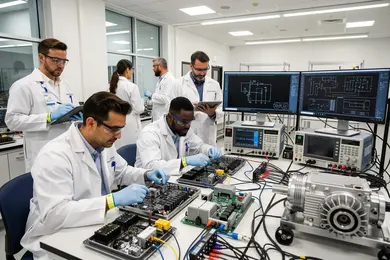
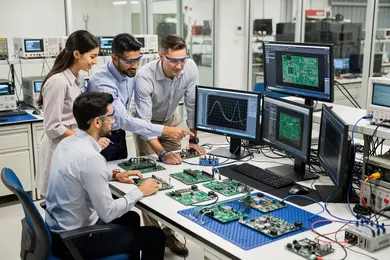
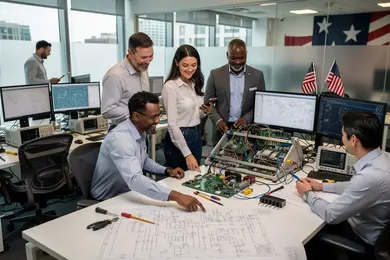
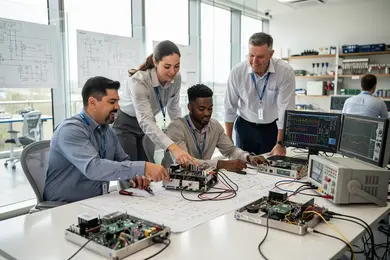
- Online electrical engineering programs can include real applied work through mailed lab kits, simulation platforms, remote instruments, industry-sponsored design projects, and required capstones.
- BLS data shows electrical engineers had a May 2024 median annual wage of $111,910, but outcomes vary by industry, location, degree level, internships, licensure, and project experience.
What is an online electrical engineering degree with applied engineering projects?
An online electrical engineering degree is a college program that teaches the design, analysis, testing, and improvement of electrical and electronic systems through mostly distance-based coursework. "Applied engineering projects" means students do more than solve textbook problems; they build, simulate, test, troubleshoot, document, and present engineering solutions connected to real technical constraints.
At the bachelor's level, this usually means foundational engineering science, math, circuits, electronics, power, signals, controls, embedded systems, and a senior design project. At the master's level, it may mean advanced technical electives, design assignments, research-style projects, or industry-aligned capstones. The best fit depends on whether you need an entry path into engineering, advancement into a specialized role, or preparation for professional licensure.
This degree is not the same as every online technical program that includes electronics. Electrical engineering is usually more math-intensive and design-focused than technician training, and it differs from adjacent applied fields such as an exercise science online degree, which may use technology and measurement systems but prepares students for health, performance, or wellness-related careers rather than electrical system design.
Online electrical engineering with applied projects is usually a strong option for students who want flexibility but still need evidence of practical ability. It may not be ideal for students who dislike advanced math, need constant in-person lab access, or want a short, low-intensity credential instead of a rigorous engineering degree.
How do online electrical engineering programs compare to campus-based programs for hands-on learning?
Online and campus-based programs can cover similar engineering theory, but the hands-on experience is delivered differently. The key question is not whether the program is online; it is whether students are required to complete measured, supervised, and documented engineering work.
The table below compares common learning formats so you can evaluate whether an online program's lab model matches your learning style and career goals.
| Learning area | Online electrical engineering programs | Campus-based electrical engineering programs | Decision point for students |
| Circuit labs | May use mailed kits, home oscilloscopes, breadboards, data acquisition tools, or remote lab access. | Usually uses university lab benches, shared instruments, and in-person supervision. | Online can work well if the program clearly specifies required equipment and lab validation methods. |
| Simulation | Often uses SPICE tools, MATLAB, Simulink, Python, HDL tools, or cloud-based software. | Uses similar tools, often paired with in-person labs. | Simulation-heavy programs are useful, but they should not fully replace physical measurement work. |
| Team projects | Often handled through video meetings, Git repositories, shared documentation, and virtual presentations. | Often handled through in-person design studios or lab meetings. | Online teamwork can mirror distributed engineering teams if communication expectations are strong. |
| Faculty feedback | May rely on recorded demos, lab reports, synchronous check-ins, and instructor review. | May include immediate in-person observation and troubleshooting. | Ask how often students receive direct technical feedback, not just grades. |
| Capstone design | Can involve remote prototyping, employer-based projects, simulations, or hybrid campus visits. | Often involves physical prototypes and campus design reviews. | Look for projects with constraints, testing, documentation, and presentation requirements. |
Campus programs may offer easier access to specialized facilities, but online programs can be highly practical when they are intentionally designed. Remote instrumentation, lower-cost microcontroller kits, cloud simulation, and collaborative design tools have made it more realistic for online students to build a portfolio of technical work.
A common mistake is assuming that "online" automatically means "less hands-on." A better approach is to ask for recent syllabi, lab equipment lists, capstone examples, and assessment rubrics. If a school cannot clearly explain how students complete labs, test designs, and demonstrate competency, treat that as a red flag.
Are online electrical engineering degrees respected by employers and professional engineering boards?
Employers generally care about whether the degree comes from a recognized institution, whether the curriculum matches the role, and whether the candidate can demonstrate engineering capability. For many hiring managers, the online format matters less than accreditation, project quality, internships, technical interviews, and evidence that the student completed rigorous math and engineering work.
Professional engineering boards are more rule-bound. Licensure requirements vary by state, but many boards look closely at whether the engineering degree is from an ABET-accredited program or whether the applicant has an acceptable alternative combination of education and experience. Students who want to become licensed Professional Engineers should verify requirements with the state board where they expect to practice before enrolling.
Online degrees can be respected when students graduate with credible evidence of applied skill. Strong evidence may include the following elements, especially for early-career applicants who do not yet have years of engineering experience:
- A senior design or graduate capstone with a clear problem statement, constraints, testing results, and technical documentation.
- Lab reports showing measurement, troubleshooting, uncertainty, safety awareness, and design iteration.
- Software and hardware artifacts such as schematics, code repositories, simulation files, PCB layouts, or control models.
- Internship, co-op, military, technician, maker-space, or employer-based engineering experience connected to electrical systems.
- Faculty or industry references who can speak to the student's technical communication and problem-solving ability.
The main risk is not the online label itself; it is enrolling in a program that lacks recognized accreditation, offers minimal project work, or does not align with licensure and employer expectations. If your target role involves public infrastructure, power systems, consulting engineering, or regulated work, confirm licensing implications before committing.
What accreditation should online electrical engineering programs have in the United States?
Accreditation is one of the most important checks before enrolling because it affects credit transfer, graduate school options, federal financial aid eligibility, employer trust, and in some cases engineering licensure. In the United States, students should first confirm institutional accreditation, then check whether the specific electrical engineering program has programmatic accreditation.
The table below explains the major accreditation layers and why each one matters for an online electrical engineering student.
| Accreditation type | What to check | Why it matters |
| Institutional accreditation | The college or university is accredited by an agency recognized by the U.S. Department of Education or CHEA. | Supports federal aid eligibility, transfer review, employer recognition, and graduate school consideration. |
| ABET accreditation | The specific electrical engineering bachelor's program is accredited by ABET's Engineering Accreditation Commission when applicable. | Often important for engineering licensure, public-sector roles, and employers that screen for accredited engineering degrees. |
| State authorization | The school is authorized to enroll online students in your state. | Helps avoid enrollment problems and may affect complaint processes or professional requirements. |
| Professional licensure alignment | The program discloses whether it meets educational requirements for engineering licensure in specific states. | Critical for students who plan to pursue the FE exam, PE licensure, or regulated engineering practice. |
To reduce risk, verify accreditation through official databases rather than relying only on marketing pages. Use this sequence before applying:
- Search the institution in the U.S. Department of Education's recognized accreditation database.
- Search the exact program name in ABET's accredited program database if you need an accredited engineering degree.
- Ask admissions whether the online version and campus version share the same accreditation status, curriculum, and diploma wording.
- Contact your state engineering board if licensure is part of your long-term plan.
- Confirm whether credits will transfer into or out of the program if your plans change.
A major red flag is vague language such as "aligned with ABET standards" or "designed around engineering outcomes" when the program is not actually ABET-accredited. Those statements may describe curriculum goals, but they are not the same as formal accreditation.
What real-world project work and lab experiences do online electrical engineering students complete?
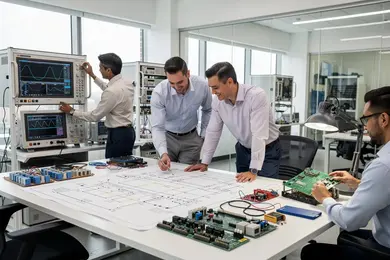
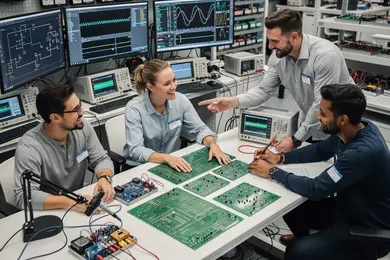
Applied project work in online electrical engineering usually combines physical labs, simulation, documentation, and design reviews. A strong program should require students to make engineering decisions under constraints rather than simply watch demonstrations or submit multiple-choice lab quizzes.
Students may encounter the following project and lab formats. These experiences matter because they help build the portfolio and technical judgment employers look for in entry-level or advancement candidates.
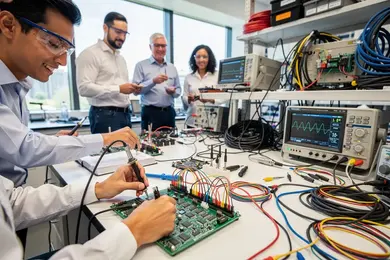
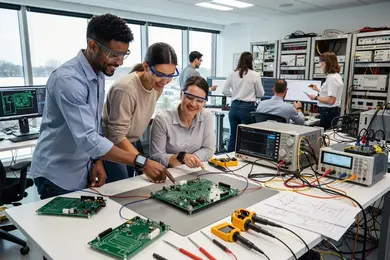
- Home electronics labs using breadboards, meters, microcontrollers, sensors, power supplies, and signal measurement tools.
- Remote labs where students control real instruments or hardware through a web interface.
- Simulation projects involving circuit behavior, signal processing, control systems, electromagnetics, or power flow analysis.
- Embedded systems projects using C, Python, VHDL, Verilog, or microcontroller development environments.
- Power and energy projects involving renewable integration, motor control, distribution systems, or protection concepts.
- Communication systems projects involving modulation, filtering, antennas, wireless links, or digital signal processing.
- Senior design or capstone projects with requirements, budgets, design alternatives, prototypes, testing, documentation, and final presentations.
Current engineering trends are changing these projects. More programs now incorporate AI-assisted design workflows, digital twins, grid modernization, electric vehicle systems, cybersecurity for connected devices, and semiconductor-related topics. Students should not expect AI tools to replace engineering fundamentals; instead, they should learn how to validate AI-assisted outputs through calculations, simulation, measurement, and peer review.
Before enrolling, ask the program for examples of recent capstone projects. Good examples should show a problem, technical constraints, design trade-offs, testing outcomes, and what the student or team built or analyzed. Weak examples often sound like research summaries without measurable design work.
What courses and specializations are typically offered in online electrical engineering curricula?
Electrical engineering curricula are built around math, physics, circuits, systems, and design. Online programs may vary in emphasis, but a credible degree should move from foundational analysis to increasingly complex design and application.
The table below summarizes common curriculum areas and how they connect to applied engineering work.
| Curriculum area | Typical topics | Applied connection |
| Mathematics and science | Calculus, differential equations, linear algebra, physics, probability. | Supports circuit analysis, signals, controls, electromagnetics, and modeling. |
| Circuits and electronics | DC and AC circuits, analog electronics, digital logic, semiconductor devices. | Prepares students to design, test, and troubleshoot electronic systems. |
| Signals and systems | Fourier analysis, filters, sampling, communication theory, digital signal processing. | Connects to audio, radar, wireless, imaging, and sensor systems. |
| Power and energy | Electric machines, power electronics, distribution, renewable energy integration. | Connects to utilities, electric vehicles, manufacturing, and grid modernization. |
| Controls and robotics | Feedback systems, state-space models, automation, mechatronics. | Connects to robotics, aerospace, industrial automation, and autonomous systems. |
| Computer and embedded systems | Microprocessors, firmware, HDL, FPGA, real-time systems. | Connects to devices, IoT systems, defense electronics, and product development. |
Specializations are especially important for students who already know their target industry. A power systems concentration can support utility or renewable energy roles, while embedded systems can support hardware-product, aerospace, automotive, or defense work. Students interested in modeling, AI, sensors, or intelligent systems may also compare engineering electives with a data science degree online to decide whether they want to design electrical systems, analyze data products, or combine both skill sets.
A practical way to evaluate a curriculum is to map each course to a career skill. If a program lists advanced topics but does not include labs, design projects, software tools, or assessment details, ask for syllabi before assuming it will build applied competence.
What are the admission requirements and prerequisite math and science skills for these programs?
Admission requirements depend on degree level. Bachelor's programs may admit first-year students, transfer students, or students with prior associate degrees. Master's programs usually expect a bachelor's degree in electrical engineering, computer engineering, or a closely related engineering or physical science field, though some offer bridge coursework for applicants missing prerequisites.
The academic readiness requirement is substantial. Electrical engineering relies heavily on calculus-based physics, differential equations, linear algebra, programming, and abstract problem-solving. Students who have been away from math for several years can still succeed, but they should plan for review time before the first technical term.
Most applicants should prepare for these common requirements and expectations:
- High school diploma, GED, associate degree, or prior college credit for undergraduate admission.
- Completed or placement-ready college algebra, trigonometry, pre-calculus, or calculus depending on entry level.
- Calculus-based physics readiness for full engineering programs.
- Prior programming exposure, often in Python, C, C++, MATLAB, or another technical language.
- Official transcripts, transfer credit evaluation, and minimum GPA review.
- For graduate programs, a bachelor's degree, prerequisite engineering coursework, statement of purpose, resume, and sometimes recommendations.
- English proficiency documentation for applicants whose prior education was not in English.
If you are missing prerequisites, do not automatically rule out the degree. Community college courses, university bridge programs, nondegree prerequisites, and employer tuition support can help you build readiness. However, avoid programs that rush students into upper-division engineering courses without verifying math and physics preparation; that can lead to repeated courses, higher costs, and slower completion.
How long do online electrical engineering degrees take, and what do they cost to complete?
Time to completion depends on degree level, transfer credits, course load, lab sequencing, and whether the program uses traditional semesters or accelerated terms. A full bachelor's degree commonly takes about four years of full-time study, while transfer-friendly degree-completion pathways may take about two years if prerequisites are already complete. Master's programs often take one to three years depending on part-time or full-time enrollment.
Cost is harder to compare because online students may pay tuition, distance-learning fees, lab kit costs, software fees, textbooks, proctoring fees, and travel costs for any required residencies. College Board's 2024 Trends in College Pricing reported average published tuition and fees of $11,610 for in-state students at public four-year institutions and $43,350 at private nonprofit four-year institutions for 2024-25. Those figures are not engineering-specific, but they show why comparing total cost-not just per-credit tuition-is essential.
The table below shows the main cost and time variables that can change the real price of an online electrical engineering degree.
| Factor | Why it matters | What to ask the school |
| Transfer credits | Accepted credits can reduce both tuition and time. | How many technical, math, and general education credits will apply to the degree plan? |
| Lab requirements | Kits, instruments, components, or residencies can add costs. | What equipment must students buy, and what is included in tuition? |
| Course sequencing | Engineering prerequisites may be offered only once or twice per year. | Can part-time students complete courses without delaying prerequisites? |
| Residency or campus visits | Travel and lodging may affect affordability. | Are any in-person labs, exams, or design reviews required? |
| Financial aid and employer benefits | Aid can reduce out-of-pocket cost, but borrowing increases long-term repayment obligations. | What grants, scholarships, military benefits, and tuition reimbursement options apply? |
Students comparing online education investments across fields should be careful not to assume that a lower-cost program has a better return. For example, a masters of library science may have a different tuition structure, labor market, credentialing pathway, and employer base than electrical engineering, so ROI depends on career goal, not just sticker price.
Use this cost-check process before enrolling:
- Request a personalized degree audit showing remaining credits after transfer evaluation.
- Calculate total tuition using the exact number of credits you still need.
- Add required fees, lab equipment, software, textbooks, residency travel, and exam costs.
- Ask whether tuition is locked, cohort-based, or subject to annual increases.
- Compare estimated cost against likely career scenarios rather than a single optimistic salary figure.
A common mistake is choosing the cheapest advertised tuition without checking accreditation, lab quality, course availability, and transfer rules. A slightly higher-cost program may be the better value if it shortens completion time, has stronger project work, or aligns better with licensure and employer expectations.
What careers can graduates of online electrical engineering programs pursue, and in which industries?
Graduates of online electrical engineering programs can pursue many of the same technical roles as campus graduates if the degree, skills, and project portfolio match employer expectations. Career entry may be strongest when students combine coursework with internships, co-ops, military technical experience, technician work, undergraduate research, or employer-sponsored projects.
The table below connects common career paths with the work graduates may perform and the industries that often hire electrical engineering talent.
| Career path | Typical responsibilities | Industries where the role appears |
| Electrical design engineer | Designs, analyzes, and tests electrical systems, circuits, or components. | Manufacturing, aerospace, defense, consumer electronics, industrial systems. |
| Power systems engineer | Works on generation, transmission, distribution, protection, or renewable integration. | Utilities, energy, infrastructure, consulting engineering, public agencies. |
| Controls engineer | Designs automation, feedback, motion control, and industrial control systems. | Manufacturing, robotics, automotive, aerospace, process industries. |
| Embedded systems engineer | Develops firmware, device interfaces, real-time systems, or hardware-software integration. | IoT, medical devices, defense electronics, automotive, telecommunications. |
| Test engineer | Creates test plans, validates performance, analyzes failures, and improves quality. | Electronics manufacturing, semiconductors, aerospace, hardware products. |
| Applications engineer | Helps customers apply technical products, troubleshoot systems, and adapt designs. | Semiconductors, automation, energy technology, instrumentation. |
Electrical engineering also overlaps with environmental systems, especially in renewable energy, water infrastructure, monitoring equipment, grid resilience, and emissions-control technology. Students drawn to energy and sustainability may compare an electrical engineering path with an online environmental engineering degree science and engineering to decide whether they want to focus more on electrical systems or environmental infrastructure.
To improve career readiness, students should build proof of skill throughout the program rather than waiting until graduation. Prioritize projects that show design thinking, measurement, documentation, teamwork, and the ability to explain trade-offs to technical and nontechnical audiences.
What is the salary outlook and long-term demand for electrical engineers in the U.S.?
The salary outlook for electrical engineering is strong compared with many occupations, but it is not uniform. According to the U.S. Bureau of Labor Statistics, the median annual wage for electrical engineers was $111,910 in May 2024. This median should be treated as a labor-market benchmark, not a personal prediction, because compensation varies by location, industry, employer, security clearance, degree level, licensure, and experience.
Demand is supported by several U.S. trends: grid modernization, electric vehicles, semiconductor investment, automation, renewable energy integration, aerospace and defense systems, connected devices, and data-center power needs. The same BLS employment projection showing 9% growth for electrical and electronics engineers from 2023 to 2033 suggests continued need for professionals who can design and maintain complex electrical and electronic systems.
Students evaluating ROI should think beyond starting salary. A stronger long-term path often comes from combining the degree with a marketable specialization, documented projects, internships, and communication skills. For example, power systems, embedded systems, controls, RF, semiconductors, and hardware test engineering may lead to different job markets even though they sit under the broader electrical engineering umbrella.
The most realistic way to judge salary potential is to compare job postings in your target region with your program's curriculum. Look for repeated requirements such as circuit design, MATLAB, Python, PCB layout, PLCs, FPGA, power systems software, AutoCAD Electrical, laboratory instrumentation, or FE exam eligibility. If the program's projects and tools do not match the jobs you want, choose different electives or a different school.
Other Things You Should Know About Electrical Engineering
Yes, many 2027 online electrical engineering programs are designed to accommodate full-time work schedules. They offer flexible course structures, allowing students to complete coursework at their own pace. Some programs also offer asynchronous classes, enabling students to study at times that suit them best.
Often, yes. Programs may require a computer that can run engineering software, reliable internet, lab kits, a multimeter, microcontroller boards, or other tools. Always request the required equipment list before enrolling so you can budget accurately.
Yes. ABET-accredited online electrical engineering programs usually require supervised laboratory work, and many use remote lab kits, live simulations, or approved campus intensives. Programs commonly specify a minimum of 12 to 18 lab credits, with final projects documented under faculty oversight.
References
- Job market for electrical engineers: no cause for concern https://pcim.mesago.com/nuernberg/en/pcim-insights/pcim-magazine/job-market-for-electrical-engineers-no-cause-for-concern.html
- 9 Engineering Jobs to Pursue with an Engineering Degree https://www.pointloma.edu/resources/undergraduate-studies/9-engineering-jobs-pursue-engineering-degree
- Science Prerequisites https://www.ualberta.ca/en/science/programs/bachelor-of-science/admission-to-science/index1.html
- Find Programs - ABET https://www.abet.org/accreditation/find-programs/
- Despite a sluggish job market, studying electrical engineering offers good prospects https://www.vde.com/en/press/press-releases/electrical-engineering-job-market-studies
- Electrical Engineer Salary in the United States 2026 | Cake https://www.cake.me/resources/industry-job-overview/electrical-engineer-salary
- Online Electrical Engineering Degrees - BSEE, MSEE https://www.onlineengineeringprograms.com/electrical