2027 Best Online Bachelor's in Electrical Engineering With Monthly Start Options

Co-Founder and Chief Data Scientist
Choosing an online electrical engineering bachelor's with monthly start options is harder than it sounds because true monthly starts are uncommon in ABET-accredited engineering programs. The payoff can be significant: the U. S. Bureau of Labor Statistics reports a 2024 median pay of $118,780 for electrical and electronics engineers.
This guide is for working adults, transfer students, military learners, and career changers who need flexibility without weakening career options. You'll learn how to compare accreditation, schedules, labs, costs, admissions, and outcomes before committing to a program.
Key Things You Should Know
- True monthly starts are more common in institutionally accredited online universities than in ABET-accredited bachelor's programs in electrical engineering, so students should verify both start frequency and programmatic accreditation before applying.
- The strongest online electrical engineering options usually use multiple start dates, accelerated sessions, or rolling admissions rather than a new engineering cohort every month.
- For cost planning, College Board's 2024 pricing data lists average 2024-2025 tuition and fees at $11,610 for in-state public four-year students and $43,350 at private nonprofit four-year institutions, before housing, books, fees, transfer credits, or online course charges.
What are the best accredited online bachelor's in electrical engineering with monthly start dates?
The best answer depends on what you mean by "accredited." For electrical engineering, the most important distinction is between institutional accreditation, which applies to the college or university, and ABET accreditation, which applies to specific engineering programs and is often preferred by employers, graduate schools, and state engineering boards.
Students searching for monthly start dates should know that fully online, ABET-accredited bachelor's degrees in electrical engineering rarely operate on a true monthly-start model. Many reputable programs instead offer several start windows per year, shorter course sessions, or rolling admissions. The table below summarizes how common online options typically compare for students who want both flexibility and engineering credibility.
| Program type | Best fit | Start-date pattern | Accreditation priority | Main trade-off |
| Online ABET-accredited B.S. or B.S.E. in Electrical Engineering | Students seeking traditional engineering roles, graduate study, or possible PE licensure later | Usually multiple annual starts, not every month | ABET Engineering Accreditation Commission plus institutional accreditation | Less scheduling flexibility but stronger alignment with engineering expectations |
| Online electrical engineering degree completion program | Transfer students with completed calculus, physics, and lower-division engineering courses | Often semester or term-based | ABET status of the specific bachelor's program | Efficient for transfer students but restrictive for first-year applicants |
| Online electrical engineering technology bachelor's | Students interested in applied electronics, manufacturing, automation, or technical operations | More likely to offer frequent starts | ETAC of ABET if available, plus institutional accreditation | May not qualify for the same engineering roles as an electrical engineering degree |
| Institutionally accredited monthly-start engineering-related program | Working adults who need immediate entry and can accept a less traditional engineering pathway | May offer monthly or near-monthly starts | Institutional accreditation first; verify programmatic status separately | Convenient schedule may come with weaker ABET alignment |
If your goal is to become an electrical engineer, prioritize ABET-accredited electrical engineering programs even if you must wait for the next term. If your goal is a faster start in electronics, controls support, technical sales, field service, or operations, an accredited engineering technology or engineering-related program with monthly starts may still be useful, but you should confirm how employers in your target field view the credential.
A practical shortlist should include programs that clearly publish their accreditation status, online lab expectations, transfer-credit rules, tuition, start dates, and engineering course sequence. Be cautious with any school that advertises "electrical engineering" broadly but does not identify whether the exact online bachelor's program is ABET-accredited.
How do online electrical engineering bachelor's degrees with monthly starts work day to day?
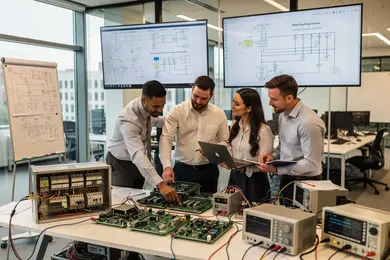
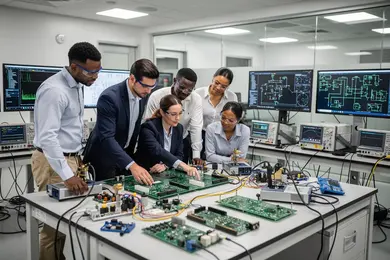
Online electrical engineering programs usually combine asynchronous coursework, scheduled problem-solving sessions, simulation software, virtual labs, mailed lab kits, and sometimes required in-person lab intensives. Monthly-start programs may begin general education or foundational courses every few weeks, while advanced engineering courses often follow a fixed sequence because prerequisites matter.
The daily rhythm is more structured than many online degrees because electrical engineering is math-heavy and cumulative. A student may watch recorded lectures, solve circuit-analysis problems, complete MATLAB or SPICE simulations, submit lab reports, and meet with instructors or teammates for design projects.
For students comparing flexible STEM degrees, the key issue is whether the format supports the hands-on work required in engineering. Some online programs are built around frequent small assignments rather than a few large exams, which can help working adults stay on pace, but the workload is still substantial.
Expect the following weekly commitments in a serious online electrical engineering bachelor's program:
- Reading, lecture review, and problem sets in calculus, physics, circuits, electronics, signals, or systems courses
- Lab work using simulation software, breadboards, instruments, or school-provided experiment kits
- Discussion boards, virtual office hours, or live review sessions for complex technical topics
- Team-based design work, especially in upper-division courses and senior capstone projects
- Proctored exams or identity-verified assessments, particularly in math, physics, and engineering fundamentals
The main advantage of monthly or frequent starts is speed of entry. The main limitation is sequencing: even if the university starts courses every month, you may still need to wait for specific engineering courses to open after completing prerequisites.

What admissions requirements apply to online electrical engineering programs with frequent start dates?
Admissions requirements vary widely, but electrical engineering is rarely an open-ended "start anytime" major. Schools must confirm that students can handle calculus-based physics, advanced math, and technical problem-solving. Transfer students may also need course-by-course evaluations because engineering prerequisites are tightly sequenced.
The table below outlines common admissions requirements and why each one matters for an online electrical engineering student.
| Requirement | What schools may ask for | Why it matters |
| High school diploma or equivalent | Official transcripts or GED documentation | Confirms baseline eligibility for bachelor's admission |
| Math readiness | Placement scores, prior precalculus, trigonometry, or calculus | Determines whether you can enter the engineering sequence immediately |
| Science preparation | Physics and sometimes chemistry coursework | Supports success in circuits, electromagnetics, and systems courses |
| Transfer credits | College transcripts, syllabi, lab descriptions, and credit evaluations | Can reduce time and cost if credits match engineering prerequisites |
| Technology access | Computer specifications, software compatibility, webcam, and stable internet | Online engineering courses often require simulation tools and proctored assessments |
| English proficiency | Scores or documentation for applicants educated outside English-language systems | Technical communication and lab reporting are essential parts of engineering study |
Before applying, ask admissions staff whether the next monthly start applies to the electrical engineering major itself or only to general education courses. This distinction can affect your real graduation timeline.
Applicants can improve their odds of a smooth start by preparing the following items early:
- Collect transcripts from every prior college, including community colleges and military education records.
- Request a preliminary transfer evaluation before paying deposits or registering for classes.
- Ask whether calculus, physics, and programming courses must be completed before upper-division engineering admission.
- Confirm whether online students need to travel for labs, exams, orientation, or capstone presentations.
- Check whether the program offers tutoring in calculus, physics, circuits, and programming during evening or weekend hours.
A common mistake is assuming that fast admission equals fast progress. In engineering, placement into the right math level often has more impact on graduation speed than the advertised start date.
How can you verify accreditation and program quality for online electrical engineering degrees?
Accreditation should be verified at two levels. First, confirm that the institution is accredited by a recognized institutional accreditor. Second, confirm whether the specific electrical engineering bachelor's program is accredited by ABET's Engineering Accreditation Commission. Do not assume that accreditation of the campus program automatically applies to the online version unless the school states that the same program and curriculum are covered.
Accreditation matters because it can affect transfer credit, graduate school eligibility, employer screening, tuition reimbursement, and future professional licensure. The same principle applies across professional degrees; for example, someone comparing a library science degree online would also need to match the program's accreditation to the expectations of that profession.
Use this checklist to evaluate quality before enrolling:
- Confirm institutional accreditation through the school's official accreditation page and recognized accreditation databases.
- Verify ABET status for the exact program name, degree level, and delivery format.
- Review whether the curriculum includes calculus-based engineering science, lab work, design projects, and a senior capstone.
- Ask whether online students have access to faculty office hours, tutoring, engineering software, and career services.
- Check whether graduates are eligible to pursue the Fundamentals of Engineering exam in your state, if licensure may matter to you later.
- Request outcome information such as retention, graduation, transfer-credit acceptance, internship support, and employer partnerships.
Red flags include vague accreditation language, missing lab details, unclear tuition and fees, pressure to enroll immediately, and degree names that sound like electrical engineering but are actually technology, electronics, or general studies programs. Those alternatives can be legitimate, but they should be chosen knowingly.
What courses and concentrations are typically offered in an online electrical engineering bachelor's?
An online bachelor's in electrical engineering usually begins with math, physics, programming, and engineering fundamentals before moving into circuits, electronics, signals, power, communications, and embedded systems. The curriculum is cumulative, so falling behind in calculus or circuit analysis can make later courses much harder.
The table below shows common course areas and the skills they are meant to develop.
| Course area | Typical topics | Career relevance |
| Mathematics | Calculus, differential equations, linear algebra, probability | Supports modeling, signal processing, control systems, and electromagnetics |
| Physics and engineering science | Mechanics, electricity and magnetism, materials, measurement | Builds the scientific foundation for engineering design |
| Circuits and electronics | DC and AC circuits, analog electronics, digital logic, semiconductor devices | Prepares students for hardware design, testing, troubleshooting, and product development |
| Signals and systems | Frequency response, transforms, filtering, communications principles | Relevant to telecommunications, audio systems, radar, controls, and data acquisition |
| Power and energy | Power systems, machines, renewable energy, grid fundamentals | Useful for utilities, energy companies, manufacturing, and infrastructure roles |
| Embedded systems and controls | Microcontrollers, feedback systems, robotics, instrumentation | Supports automation, aerospace, automotive, medical device, and industrial applications |
| Engineering design | Technical communication, ethics, project management, senior capstone | Demonstrates the ability to solve open-ended engineering problems |
Concentrations are not always available online, but when they are, they can help you align the degree with a target industry. Common options include power systems, communications, embedded systems, microelectronics, renewable energy, robotics, and control systems.
Choose a concentration based on the work you want to do, not just the course titles. Power systems may fit students interested in utilities and energy infrastructure, while embedded systems may be better for students drawn to hardware-software integration, automation, or smart devices.
How do online electrical engineering programs compare to campus-based degrees in outcomes and rigor?
A well-designed online electrical engineering program can be academically rigorous, especially when it uses the same curriculum, faculty standards, labs, and ABET outcomes as the campus version. The difference is not necessarily the difficulty level; it is the delivery model and the amount of independence required.
The comparison below helps clarify when online or campus-based study may be the better fit.
| Factor | Online electrical engineering | Campus-based electrical engineering |
| Schedule flexibility | Better for working adults, military students, caregivers, and geographically limited learners | Better for students who can attend scheduled classes and labs in person |
| Labs and equipment | May use kits, simulations, remote labs, or limited residencies | Usually provides direct access to campus labs and equipment |
| Peer interaction | Often virtual and project-based | More spontaneous collaboration through labs, clubs, and study groups |
| Internship access | Depends heavily on location, employer network, and student initiative | May benefit from campus recruiting and local employer relationships |
| Self-management | Requires strong time management and independent study habits | Provides more built-in structure through class schedules and campus resources |
| Credential perception | Strongest when the program is ABET-accredited and transcript language matches the campus degree | Generally familiar to employers, especially from established engineering schools |
Online study makes the most sense if you need flexibility and can create a consistent weekly routine. Campus study may be better if you want daily access to labs, research groups, student design teams, and face-to-face faculty interaction.
Employers typically care about your technical competence, project portfolio, internship experience, communication skills, and whether the degree meets the requirements of the role. For competitive engineering positions, online students should be especially intentional about building projects, documenting lab work, and pursuing internships or co-ops where possible.
How long do online electrical engineering bachelor's degrees take and what do they cost?
A full bachelor's degree in electrical engineering usually requires about 120 to 128 credits. First-time students often need around four years of full-time study, while part-time learners may take longer. Transfer students with completed calculus, physics, general education, and lower-division engineering credits may finish sooner, but engineering course sequencing can limit how much acceleration is possible.
Cost varies by public or private status, residency rules, transfer credits, online fees, lab kits, textbooks, software, and whether the student studies full time or part time.
College Board's 2024 pricing data places average 2024-2025 published tuition and fees at $11,610 for in-state students at public four-year institutions and $43,350 at private nonprofit four-year institutions. Those figures are broad benchmarks, not program-specific quotes, but they show why transfer planning and financial aid matter.
The table below summarizes common timeline and cost factors for online electrical engineering students.
| Student profile | Typical timeline | Cost factor to watch | Best strategy |
| First-time full-time student | About four years | Total tuition across all credits | Choose a program with strong advising and a clear course map |
| Part-time working adult | Often five to six years or more | Longer enrollment period and possible fee accumulation | Take enough credits each term to maintain momentum without overloading |
| Community college transfer student | Often two to three years after transfer, depending on prerequisites | Credits that do not apply to engineering requirements | Confirm transfer equivalency before enrolling |
| Student needing math remediation | May add one or more terms | Extra courses before calculus sequence | Complete placement preparation before starting |
| Military or employer-supported learner | Varies by deployment, work schedule, and transfer credit | Benefit limits and course-load requirements | Coordinate start dates with benefit rules and academic sequencing |
When comparing engineering costs, look beyond electrical engineering alone. Reviewing adjacent program cost guides, such as mechanical engineering degree online cost, can help you see how tuition, lab fees, transfer credits, and public-versus-private pricing affect the overall return on investment.
To reduce total cost, students should complete transferable math and science prerequisites at an accredited community college when appropriate, apply for federal aid, ask about employer tuition assistance, compare per-credit and flat-rate tuition, and avoid retaking courses because of poor transfer planning.
What entry-level careers can you pursue with an online bachelor's in electrical engineering?
An online bachelor's in electrical engineering can prepare graduates for technical roles in energy, electronics, manufacturing, aerospace, telecommunications, automation, defense, transportation, and computing-adjacent industries. The exact job options depend on accreditation, internships, projects, location, security clearance eligibility, and the technical focus of the curriculum.
The table below summarizes common entry-level paths and the type of work associated with each one.
| Entry-level role | Typical responsibilities | Helpful preparation |
| Electrical engineer | Design, test, analyze, or improve electrical systems and components | ABET-accredited degree, circuits, electronics, design projects, internships |
| Electronics engineer | Work on electronic devices, embedded systems, sensors, or communications hardware | Digital systems, microcontrollers, signal processing, lab experience |
| Power systems engineer | Support generation, transmission, distribution, or renewable energy systems | Power courses, energy systems projects, utility or grid-related internship |
| Controls engineer | Develop or maintain automation, robotics, instrumentation, and feedback systems | Controls, programming, PLC exposure, MATLAB or similar tools |
| Test engineer | Create test plans, collect data, troubleshoot failures, and document results | Measurement, lab reporting, statistics, quality systems |
| Field applications engineer | Help customers implement technical products or systems | Communication skills, product knowledge, electronics fundamentals |
| Systems engineer | Coordinate technical requirements across hardware, software, and operations teams | Project experience, documentation, broad engineering fundamentals |
Current technology trends make project evidence more important. Employers increasingly value experience with embedded systems, automation, electrification, power electronics, renewable energy integration, sensors, and data-informed engineering workflows.
Students interested in advanced research or data-heavy technical leadership may later compare graduate paths, including an online data science PhD, but most entry-level engineering roles begin with strong undergraduate fundamentals and applied project work.
To strengthen employability while studying online, build a portfolio that includes circuit designs, simulations, lab reports, code repositories, capstone documentation, and clear explanations of engineering decisions. Internships, co-ops, undergraduate research, and industry certifications in software or tools can also help offset the reduced in-person networking of an online program.
What salary ranges and job outlook can electrical engineering graduates expect nationwide?
Electrical engineering can lead to strong earnings, but salary depends on role, industry, location, experience, clearance requirements, graduate education, and technical specialization. The U.S. Bureau of Labor Statistics reported a 2024 median annual wage of $118,780 for electrical and electronics engineers. This median is a national midpoint, so it should be used as a planning benchmark rather than a guaranteed outcome for new graduates.
The BLS also projects 9% employment growth for electrical and electronics engineers from 2023 to 2033, which is faster than the average for all occupations. For students, this suggests continued demand, especially in areas tied to electrification, automation, communications, semiconductor systems, defense, renewable energy, and infrastructure modernization.
The table below explains how salary context often varies by path rather than giving a single expected paycheck.
| Career factor | How it can affect salary | What students can do |
| Industry | Defense, semiconductors, energy, aerospace, and advanced manufacturing may pay differently | Target electives and projects toward industries that hire in your region |
| Location | High-cost metro areas may offer higher pay but also higher living expenses | Compare compensation with cost of living and remote-work expectations |
| Experience | Internships, co-ops, and capstone projects can improve entry-level competitiveness | Start building applied experience before the senior year |
| Accreditation and licensure path | ABET alignment may matter for certain employers and future PE licensure | Check state board and employer requirements early |
| Technical specialization | Power, controls, embedded systems, RF, and electronics design can lead to different job markets | Choose electives based on target roles, not only personal interest |
Artificial intelligence and automation are changing engineering workflows, but they are not removing the need for engineers who understand physical systems, safety constraints, testing, and design trade-offs. Graduates who can combine electrical engineering fundamentals with programming, data analysis, simulation, and communication skills may be better positioned for evolving roles.
How should you choose an online electrical engineering program that fits your goals and schedule?
Start by deciding whether your primary goal is to become an electrical engineer, move into an applied technical role, finish a bachelor's quickly, or use the degree as a step toward graduate study. The right program is the one that matches your career target, accreditation needs, schedule, budget, and academic preparation.
Use the following decision process before applying:
- Define your target role, such as electrical engineer, controls engineer, power systems engineer, electronics technologist, or technical manager.
- Check whether that role commonly expects an ABET-accredited electrical engineering degree or accepts engineering technology or related credentials.
- Verify whether the advertised monthly start date applies to the engineering major, not only general education courses.
- Ask for a complete course sequence showing prerequisites, lab requirements, and the earliest realistic graduation date.
- Request a written transfer-credit evaluation and identify any credits that will not apply to the degree.
- Compare total cost, including tuition, fees, software, lab kits, books, exam proctoring, and travel.
- Review student support, including evening tutoring, faculty access, career services, internship support, and technical help desk hours.
- Confirm whether online students complete the same capstone, labs, and program outcomes as campus students.
Students comparing flexible online degrees should also be honest about academic fit. Electrical engineering is more math-intensive than many online majors; someone who mainly wants a health, wellness, or coaching pathway might be better served by alternatives such as online exercise science programs, while someone who wants hardware, power, electronics, or automation should stay focused on engineering credentials.
Common mistakes include choosing the fastest start date over the strongest program fit, ignoring ABET accreditation, underestimating lab requirements, assuming all transfer credits will count, and comparing only tuition instead of total cost. A better approach is to ask each school for written answers and compare them side by side before enrolling.
If you need a simple rule, use this: choose an ABET-accredited online electrical engineering program if you want the broadest traditional engineering pathway; choose a monthly-start engineering technology or related program only if you understand the career differences and it matches your target jobs.
Other Things You Should Know About Electrical Engineering
Usually, yes. Many programs require a capable computer, reliable internet, a webcam for proctored exams, engineering software, and sometimes lab kits or basic electronics tools. Always ask for the technology list before enrolling.
Yes, but the course load must be realistic. Many working adults study part time because calculus, physics, circuits, labs, and design projects require consistent weekly attention.
No. Electrical engineering is usually more theory- and design-focused, while electrical engineering technology is more applied and implementation-focused. Both can be valuable, but they may lead to different job titles and licensure options.
Yes. Most monthly start programs require an official transfer-credit evaluation before admission is finalized, especially for calculus, physics, and general education courses. Schools usually ask for transcripts from every college attended and may accept up to 60 semester credits toward the 120-credit bachelor’s degree.
References
- What Can You Do with an Electrical Engineering Degree | HAN https://www.hanuniversity.com/en/programs/bachelor/electrical-and-electronic-engineering/fulltime/careers/
- Despite a sluggish job market, studying electrical engineering offers good prospects https://www.vde.com/en/press/press-releases/electrical-engineering-job-market-studies
- Inside the Best Online Bachelor's in Electrical Engineering Degrees https://www.onlinecolleges.me/engineering-degrees/bachelors/electrical-engineering/
- Find Programs - ABET https://www.abet.org/accreditation/find-programs/