
2027 How to Become a Marriage and Family Therapist (LMFT)

Co-Founder and Chief Data Scientist
Becoming a licensed marriage and family therapist is a structured career path: you need graduate-level clinical training, supervised experience, a licensing exam, and state approval before you can practice independently. The decision matters because LMFTs work with high-stakes relationship, behavioral, and mental health concerns affecting individuals, couples, children, and families. This guide explains the full path to licensure, how long it usually takes, what programs cost, how online and campus programs compare, what to check before enrolling, and how to think about career options, salary, specialization, and long-term growth.
Quick Answer: How do you become an LMFT?
To become a licensed marriage and family therapist, you generally earn a master's degree in marriage and family therapy or a closely related field, complete supervised clinical training, pass the required licensing exam, satisfy your state board's rules, and complete continuing education after licensure. Requirements vary by state, so the most important first step is confirming that any program you choose meets the licensing standards where you plan to practice.
Key Things You Should Know About Becoming a Marriage and Family Therapist
- A master's degree is the usual minimum credential. Most LMFTs complete graduate training in marriage and family therapy, counseling, or a related mental health discipline with coursework in family systems, ethics, assessment, diagnosis, and clinical practice.
- Licensure is state-regulated. After graduation, candidates typically complete supervised post-degree clinical hours, pass an exam, and submit documentation to the state licensing board.
- Continuing education is part of the profession. LMFTs must keep their knowledge current through approved CE hours in areas such as ethics, clinical methods, supervision, telehealth, trauma, and other practice topics.
- The labor market outlook is favorable. Marriage and family therapist employment is projected to grow 14.9% from 2022 to 2032, with about 10,600 new jobs by 2032.
- LMFTs work in many settings. Common employers include private practices, outpatient clinics, hospitals, schools, government agencies, substance use treatment centers, and community mental health organizations.
- How do you become a licensed marriage and family therapist?
- What education do you need to become an LMFT?
- How long does an MFT graduate program take?
- How much does MFT education cost, and what aid is available?Program length considerations
- What licensing requirements do marriage and family therapists meet?
- What continuing education is required for LMFTs?
- What specializations can LMFTs pursue?
- Can you earn a marriage and family therapy degree online?
- How do online and campus-based MFT programs compare?
- What jobs can MFT graduates pursue?
- What is the job market for marriage and family therapists?
- How should you choose a marriage and family therapy program?
- What trends are shaping marriage and family therapy?
- Can addiction treatment training strengthen an LMFT practice?
- Can a psychology bachelor's degree help prepare you for LMFT training?
- How can teletherapy platforms support LMFT practice?Undergraduate preparationAddiction treatment integrationField trendsProgram selectionJob outlook
- Can forensic psychology training be useful for LMFTs?
- Can child and adolescent psychology training expand an LMFT practice?
- Can dual degree programs broaden LMFT expertise?
- Can substance abuse counseling training improve LMFT services?
- Which online MFT master's programs may offer strong value?
- Can an accelerated master's in psychology support an LMFT career?
- How can you check whether an online psychology degree is legitimate?
- Can accelerated clinical mental health counseling programs help LMFTs?
- Should LMFTs add interdisciplinary certifications?
- What else can you do with an MFT degree?
- How can an online master's in psychology complement LMFT training?
- How are LMFTs different from other mental health professionals?Psychology graduate study for LMFTs
- Can accelerated doctoral psychology programs help LMFTs advance?
- Are online CACREP-accredited counseling programs useful for LMFT career growth?CACREP-accredited counseling optionsAccelerated doctoral studyOnline psychology master's optionsKey insights
How do you become a licensed marriage and family therapist?
The LMFT path combines academic preparation, supervised practice, examination, and state licensure. The exact sequence can differ by jurisdiction, but the core steps are similar across the United States.
- Complete a relevant bachelor's degree. Many future LMFTs major in psychology, sociology, social work, counseling, human development, or another behavioral science field. These majors are not always mandatory for admission, but they can make graduate coursework easier to handle.
- Earn a graduate degree in marriage and family therapy or a related field. A master's degree in MFT is the most direct route. Graduate study covers family systems theory, diagnosis, ethics, clinical skills, diversity, research, and supervised client work.
- Complete required clinical training. MFT students complete practicum or internship experiences during graduate school. After graduation, many states also require supervised post-degree clinical hours before independent licensure.
- Pass the required licensing examination. Many states use the Marriage and Family Therapist National Examination administered through the Association of Marital and Family Therapy Regulatory Boards, while some states add a separate law or ethics exam.
- Apply through your state licensing board. Applicants generally submit transcripts, supervised experience verification, exam results, fees, background information, and other state-specific documentation.
- Maintain the license. Once licensed, LMFTs complete continuing education and renew their license according to state board timelines.
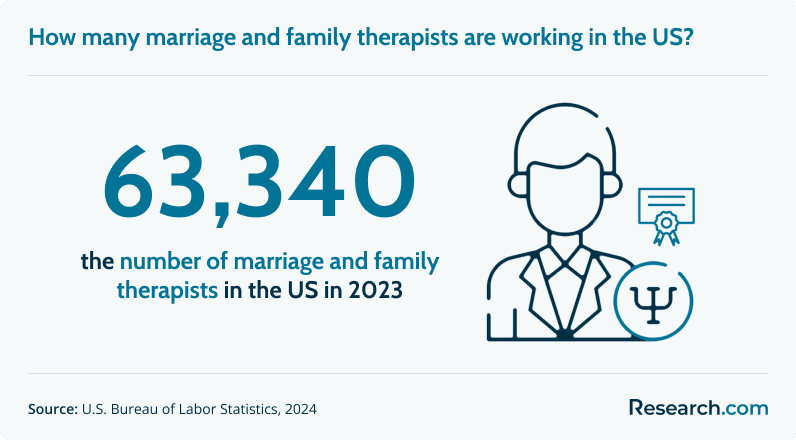
In 2023, there were around 63,340 marriage and family therapists working in the US. Women represented about 77.5% of the population in the previous year.
Typical LMFT Pathway at a Glance
| Stage | What You Do | Decision Point |
| Bachelor's preparation | Build a foundation in psychology, human development, research, communication, and social systems. | Choose courses and experiences that support graduate admission and clinical readiness. |
| Graduate degree | Complete an MFT or related master's program with clinical training. | Confirm that the program satisfies your intended state's licensure education requirements. |
| Supervised clinical experience | Provide therapy services under qualified supervision. | Track hours carefully and verify that your supervisor meets state board rules. |
| Licensing exam | Prepare for and pass the required national or state exam. | Ask your program how it supports exam preparation. |
| Independent licensure | Submit your application and documentation to the state board. | Do not assume requirements are identical across states, especially if you may relocate. |
What are the minimum educational requirements to become a marriage and family therapist?
The standard entry-level education for independent LMFT practice is a master's degree. The most direct option is a master's in marriage and family therapy, although some states may accept related counseling, psychology, or mental health degrees if the curriculum meets MFT-specific requirements. Students who already have a graduate degree may also consider targeted graduate certificate options in marriage and family therapy to strengthen a specific area of preparation, but a certificate alone usually does not replace the degree and supervised training required for licensure.
What you typically study in an MFT program
- Family systems and relational theory: Courses teach students to understand individual distress within relationship patterns, family structures, culture, communication, and life transitions.
- Clinical assessment and diagnosis: Students learn how to evaluate client concerns, identify risk factors, develop treatment plans, and document care appropriately.
- Ethics and law: Programs cover confidentiality, mandated reporting, boundaries, informed consent, telehealth standards, and professional responsibility.
- Human development and psychopathology: Coursework examines development across the lifespan and the mental health conditions LMFTs may encounter in practice.
- Research and evidence-based practice: Students learn to evaluate clinical research and apply appropriate interventions rather than relying only on personal intuition.
- Practicum and internship: Supervised clinical work gives students experience with real clients before graduation.
- Capstone, thesis, or applied project: Some programs require a final research or clinical project to demonstrate graduate-level competence.
What to look for beyond the course catalog
A good MFT program should do more than list required courses. It should explain how students are placed in clinical settings, who supervises them, how licensure preparation is handled, and whether graduates can meet state board requirements. Strong programs also connect students with faculty mentors, alumni, professional organizations such as the American Association for Marriage and Family Therapy, and career support services.
In 2023, the top industries employing LMFTs were physician's offices, with 20,920 workers, and individual and family services, with 20,370 workers. The chart below provides additional employment context.
How long does it typically take to complete a graduate program in marriage and family therapy?
Most MFT master's programs take about two to three years, although the timeline depends on program format, course load, clinical placement structure, transfer credit policy, and whether the student enrolls full time or part time. Students comparing undergraduate majors and graduate pathways should remember that the degree is only one part of the timeline; supervised post-degree experience and licensing can add additional time before independent practice.
| Program Type | Typical Completion Time | Best Fit | Important Caution |
| Traditional MFT master's program | Two to three years | Students who want a standard graduate pace with coursework, practicum, internship, and faculty support. | Part-time enrollment can extend the timeline. |
| Direct-entry or related-background program | About 18 months to two years | Students with relevant undergraduate preparation in psychology, social work, counseling, or a related field. | Admission may require prerequisite coursework or strong academic preparation. |
| Accelerated MFT or therapy-focused pathway | Sometimes as quickly as one year | Highly prepared students who can handle an intensive schedule and clinical expectations. | Fast completion does not eliminate state clinical-hour and exam requirements. Review options carefully if you are researching the fastest way to become a licensed therapist. |
Before choosing a shorter program, ask whether it includes the clinical experiences your state requires. A fast academic schedule is only useful if it still supports licensure. Students who need flexibility can also compare online master's degree programs in counseling, but they should verify whether the curriculum is appropriate for LMFT licensure or a different counseling license.
What are the education costs and financial aid options for LMFT students?
The cost of a master's degree in marriage and family therapy varies by institution, residency status, delivery format, location, fees, and clinical placement expenses. Tuition for a master's program in Marriage and Family Therapy ranges from $20,000 to $70,000 for the full program. Students should compare the total cost of attendance, not just the advertised per-credit tuition.
Common MFT education costs
| Cost Category | What It May Include | Why It Matters |
| Tuition | Graduate credits required for the degree. | This is usually the largest cost, but fees and clinical expenses can change the total price substantially. |
| Books and materials | Textbooks, software, assessment materials, and digital learning tools. | Books and materials can add $500 to $1,000 per year. |
| Clinical supervision or placement-related fees | Fees tied to practicum, internship, supervision, liability insurance, background checks, or site requirements. | Clinical supervision costs can range from $500 to $2,000 depending on state and program requirements. |
| Travel or residency expenses | Campus visits, local clinical placement travel, or required intensives. | Online programs may still require in-person clinical work. |
| Licensing and exam costs | Exam registration, application fees, fingerprinting or background checks, and renewal costs. | These expenses often occur near graduation or during supervised practice. |
Financial aid options for MFT students
- Federal student aid: Graduate students can submit the FAFSA to determine federal loan eligibility and other possible aid.
- Scholarships and grants: Universities, professional associations, and mental health organizations may offer awards for graduate students preparing for behavioral health careers.
- Assistantships or work-study: Some schools provide campus employment or graduate assistant roles, although availability varies by institution.
- Employer tuition assistance: Students already working in healthcare, education, social services, or behavioral health should ask whether their employer offers reimbursement or tuition support.
- Lower-cost program options: Flexible students can compare affordable online MFT programs, but cost savings should not outweigh accreditation, licensure fit, clinical placement quality, and graduation support.
How to compare true program cost
- Request a full cost estimate from each school, including fees.
- Ask whether clinical supervision is included in tuition or billed separately.
- Confirm whether you must travel for campus intensives or placement activities.
- Compare program length, because an inexpensive per-credit rate may not mean the lowest total cost.
- Estimate lost wages if the program requires daytime clinical hours or full-time enrollment.
What are the licensing requirements to become a marriage and family therapist?
LMFT licensure is controlled by state boards. Most states require a qualifying graduate degree, supervised clinical experience, a passing examination score, an application, and ongoing professional education. Because states can change rules, candidates should always verify requirements directly with the licensing board where they plan to practice.
- Qualifying education: Your graduate coursework must satisfy the state's required content areas. Common areas include family therapy theory, ethics, diagnosis, assessment, human development, diversity, and clinical practice.
- Supervised clinical experience: Candidates complete supervised work with clients under a qualified professional. The number and type of hours vary by state.
- Licensing exam: Many states require the Marriage and Family Therapist National Examination. Some also require a state-specific law or ethics exam. California, for example, requires the California Marriage and Family Therapist Law and Ethics Examination in addition to other requirements.
- Application documentation: Applicants generally submit official transcripts, supervised-hour verification, exam results, and other materials required by the state board.
- Professional competence: State boards may evaluate background information, ethics history, and other professional standards. The occupation also requires a broad set of clinical, communication, and problem-solving skills.
Questions to ask your state board before enrolling
- Does this program's accreditation or curriculum meet LMFT education requirements in this state?
- How many supervised clinical hours are required before licensure?
- Who is allowed to supervise LMFT candidates?
- Are teletherapy hours accepted for training or supervision?
- Is there a separate law, ethics, or jurisprudence exam?
- What happens if I complete my degree in one state but want to practice in another?
What are the continuing education requirements for maintaining LMFT licensure?
Licensed marriage and family therapists must complete continuing education to renew their credentials. State rules differ, but CE requirements typically define the number of hours, approved topics, renewal cycle, and acceptable providers.
- Required hours: CE requirements often fall between 20 and 40 hours per year.
- Required content: Boards may require specific topics such as ethics, law, cultural competence, supervision, trauma, domestic violence, telehealth, or mandated reporting.
- Renewal timing: CE may be due annually or biennially depending on the state.
- Documentation: LMFTs should keep certificates and records in case of audit.
Continuing education is not just a licensing formality. It helps clinicians adapt to new ethical standards, treatment methods, telehealth expectations, evidence-based interventions, and client needs.
What are some common specializations within the field of marriage and family therapy?
Marriage and family therapy is broad enough to support many practice niches. Specialization can help an LMFT build deeper competence, clarify referral sources, and serve specific client populations.
| Specialization | What LMFTs Focus On | When It May Be a Good Fit |
| Couples therapy | Communication, conflict, intimacy, trust, separation decisions, and relationship repair. | You are drawn to relational work with partners and want to address patterns between people. |
| Family therapy | Family roles, conflict, parenting, blended families, caregiving, and multigenerational patterns. | You want to work with more than one family member and think systemically. |
| Child and adolescent therapy | Developmental, emotional, behavioral, and school-related concerns involving young clients and families. | You enjoy youth-focused work and may later explore advanced study such as a PhD in developmental psychology. |
| Substance abuse counseling | Addiction, relapse prevention, family impact, recovery support, and co-occurring mental health concerns. | You want to combine family systems work with addiction treatment; some students also compare online addiction counseling degree options. |
| Trauma therapy | Trauma responses, relationship safety, emotional regulation, grief, and recovery. | You want to support clients affected by abuse, violence, loss, or adverse life events. |
| Premarital counseling | Communication, expectations, finances, family-of-origin patterns, conflict style, and commitment. | You want to help couples prepare for marriage or long-term partnership. |
| Divorce mediation support | Co-parenting, communication, parenting plans, and lower-conflict separation processes. | You are comfortable working near the intersection of family transition and legal stressors. |
| Gerontological counseling | Aging, caregiving, grief, chronic illness, family roles, and end-of-life concerns. | You want to work with older adults and their families. |
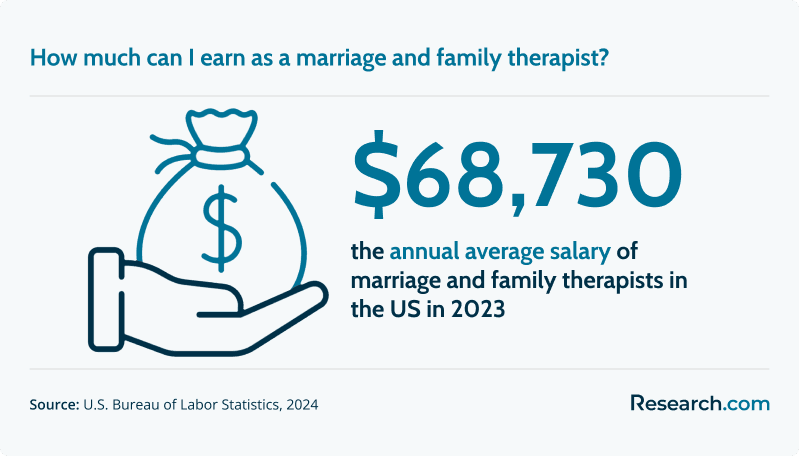
In 2023, LMFTs across specializations had an average annual salary of $68,730.
Can you earn a marriage and family therapy degree online?
Yes. Many universities offer online or hybrid MFT programs that combine remote coursework with in-person clinical training. Online study can help working adults, caregivers, military-connected students, and learners far from a campus complete graduate coursework with more flexibility. However, online does not mean entirely virtual. Clinical practicum and internship experiences usually occur with real clients through approved sites and supervisors.
Students comparing online options should distinguish between marriage and family therapy, counseling, and psychology degrees. Online master's degree programs in counseling can be useful for some mental health careers, but they may lead to a different license than LMFT. For counseling programs, CACREP accreditation can be important; for MFT programs, students should also check whether the program is recognized by the appropriate MFT accrediting or licensing standards in their state. If cost is a major concern, you can compare the cheapest CACREP accredited programs online while still verifying license alignment.
Online MFT program checklist
- Is the institution regionally accredited?
- Does the program meet LMFT education requirements in your state?
- Does the school help arrange clinical placements, or must you find your own site?
- Are there required campus visits, residencies, or synchronous class sessions?
- What are the graduation, exam preparation, and job placement supports?
- Will the program still work if you move to another state before licensure?
How do the online marriage and family therapist programs compare to an on-campus program?
Online and on-campus MFT programs can both prepare students for clinical careers when they meet licensing standards. The better choice depends on your schedule, learning style, location, finances, and need for in-person support.
| Factor | Online MFT Program | On-Campus MFT Program |
| Flexibility | Often better for students balancing work, caregiving, or distance from campus. | Usually follows a more fixed class and campus schedule. |
| Faculty and peer interaction | May rely on video meetings, discussion boards, and virtual advising. | Offers more spontaneous in-person interaction and campus community. |
| Clinical training | Typically completed in person through approved local sites or program-arranged placements. | May use established local placement relationships near the campus. |
| Cost | May reduce relocation or commuting costs, but fees and placement expenses still matter. | May involve relocation, commuting, campus fees, or higher living expenses. |
| Best for | Self-directed learners who need location flexibility and can manage deadlines independently. | Students who want face-to-face mentoring, local networks, and a campus-based experience. |
| Risk to check | Licensure fit and clinical placement support can vary widely. | Less flexibility can create challenges for working students. |
If you are comparing broader psychology options and wondering how much an online psychology degree costs, the average range is around $50,000 to $88,000. Remember that psychology, counseling, and MFT programs may lead to different credentials, so cost comparisons should include licensure outcomes.
What career paths are available for graduates of marriage and family therapy programs?
MFT graduates most commonly pursue clinical roles, but the setting and client population can vary considerably. Licensure status matters: some roles require full independent licensure, while others may be available to associates, interns, or supervised clinicians depending on state law and employer policy.
- Private practice: Licensed LMFTs may provide therapy to individuals, couples, and families through solo or group practices.
- Mental health clinics: Clinics employ LMFTs to deliver outpatient therapy, assessments, and treatment planning, often alongside psychologists, counselors, social workers, and professionals with advanced preparation such as a doctor of behavioral health.
- Hospitals and healthcare systems: LMFTs may support patients and families coping with illness, crisis, grief, trauma, or behavioral health concerns.
- Schools and youth-serving organizations: Some LMFTs work with students, families, and staff, although school-based roles may have additional credential requirements.
- Government agencies: Public agencies may hire LMFTs to serve veterans, families, foster youth, people involved in social services, or other community populations.
- Substance use treatment centers: LMFTs with addiction training can support recovery, relapse prevention, family education, and co-occurring mental health treatment.
- Community mental health centers: These settings often serve clients with complex needs and can provide strong experience for early-career clinicians.
- Higher education or training roles: Some experienced LMFTs teach, supervise, conduct research, or contribute to program administration.
Salary should be one factor in career planning, not the only one. The highest-paying industry for LMFTs in 2023 was Home Health Care Services, where LMFTs earned $122,120 on average. However, only around 60 LMFTs were employed in that industry in the same year, so it should not be treated as a large or easy-to-enter employment market.
What is the job market for marriage and family therapists?
The national outlook for marriage and family therapists is positive, but local opportunities can vary by region, employer type, insurance environment, state funding, and population needs. Demand may be stronger in communities with limited access to behavioral health care, growing outpatient services, or high need for family-focused mental health support.
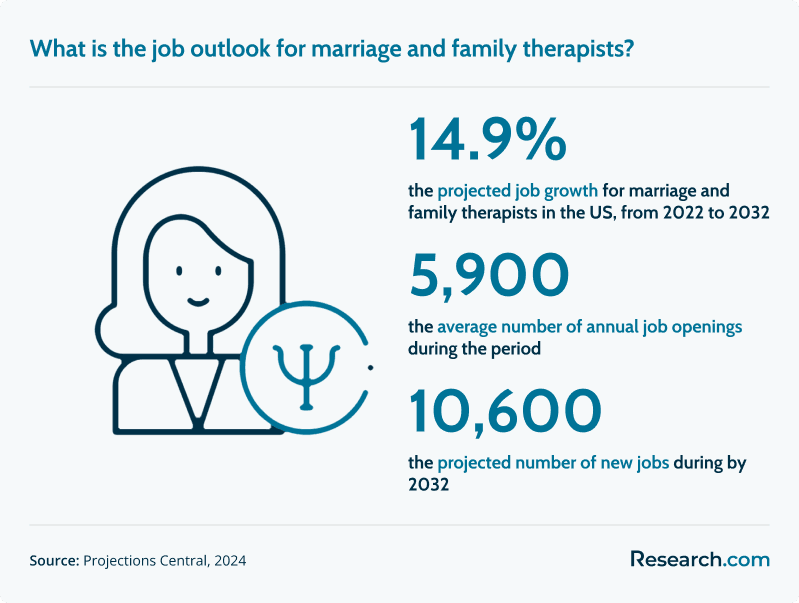
National projections show job growth of 14.9% from 2022 to 2032. That equals an average of 5,900 annual job openings during the period and about 10,600 new LMFT jobs by 2032.
How to improve your job prospects as an LMFT
- Choose a program that meets licensure requirements in your target state.
- Build strong clinical documentation and assessment skills during practicum.
- Gain experience with high-need populations, such as youth, families in crisis, trauma survivors, or clients with co-occurring substance use concerns.
- Learn teletherapy ethics, privacy expectations, and state practice rules.
- Network through supervisors, placement sites, alumni, and professional associations.
- Track supervised hours carefully to avoid delays in licensure.
How to choose the right marriage and family therapy program?
The best MFT program is not necessarily the cheapest, fastest, or highest-ranked option. It is the program that prepares you for licensure in your state, fits your budget, provides credible clinical training, and supports the type of clients or settings you want to serve.
1. Start with licensure alignment
Before applying, confirm that the curriculum satisfies your intended state's LMFT education requirements. Look for recognized accreditation, but do not rely on accreditation alone. Ask the admissions office for a written explanation of how the program supports LMFT licensure in your state.
2. Compare accreditation carefully
Marriage and family therapy programs and counseling programs may be reviewed by different accrediting bodies. CACREP is commonly associated with counseling programs, while MFT-specific pathways may follow other standards. If you are comparing counseling-oriented programs, CACREP can matter; if your goal is LMFT licensure, verify MFT-specific acceptance with the state board.
3. Evaluate clinical placement support
Clinical training is where a program's quality becomes visible. Ask whether the school finds placements, approves student-found sites, maintains local partnerships, provides supervision, and helps students solve placement delays. Online students should be especially direct about this question.
4. Look at format and schedule honestly
Online programs can be convenient, but they require independence and reliable time management. Campus programs offer more face-to-face support but may require relocation or commuting. Hybrid programs can be a practical middle ground. If you are exploring entry routes into counseling more broadly, you can also review options described in easier counseling degree pathways, while remembering that easier does not always mean appropriate for LMFT licensure.
5. Compare cost against outcomes
Review tuition, fees, books, supervision costs, travel, technology, and time away from work. Then compare those costs with program completion support, clinical placement quality, exam preparation, and employment connections.
6. Ask about specialization and faculty expertise
If you want to work with couples, youth, trauma, addiction, military families, or older adults, check whether the program offers relevant coursework, practicum sites, and faculty mentorship.
Questions to ask before enrolling
- What license does this program primarily prepare students for?
- Does it meet LMFT requirements in my state?
- How are practicum and internship placements arranged?
- Who supervises students, and what are their credentials?
- What support is available for exam preparation?
- What is the total estimated program cost?
- Can I complete the program while working?
- What happens if I move states before becoming licensed?
Common mistakes to avoid
| Mistake | Why It Can Hurt You | Better Approach |
| Choosing a program without checking state licensure rules | You may graduate and still lack required coursework or clinical hours. | Confirm requirements with the state board before applying. |
| Focusing only on tuition | Fees, supervision, travel, and delayed graduation can raise the real cost. | Compare total cost of attendance and completion support. |
| Assuming all online programs meet local requirements | Online programs can serve students across states, but licensure rules are local. | Get written confirmation from the school and verify with your board. |
| Ignoring clinical placement quality | Poor placement support can delay graduation or weaken preparation. | Ask detailed questions about sites, supervisors, and placement timelines. |
| Assuming salary outcomes are guaranteed | Pay varies by location, setting, experience, licensure status, and specialization. | Use salary data as a planning tool, not a promise. |
What are the emerging trends in Marriage and Family Therapy?
Marriage and family therapy continues to change as client needs, technology, workforce shortages, and healthcare delivery models evolve. Current and future LMFTs should pay attention to trends that affect how care is provided and what skills employers value.
- Teletherapy and virtual counseling: Remote care has become a regular part of mental health service delivery. LMFTs need to understand privacy rules, state practice restrictions, informed consent, emergency planning, and how to build rapport through digital platforms.
- Cultural responsiveness: Therapists increasingly work with clients from varied racial, ethnic, religious, gender, socioeconomic, and family backgrounds. Cultural competence now requires attention to both personal identity and systemic stressors that affect relationships and mental health.
- Trauma-informed practice: Many family and relationship concerns are shaped by trauma. LMFTs benefit from understanding safety, stabilization, emotional regulation, family impact, and evidence-informed trauma interventions.
- Substance use and co-occurring disorders: Addiction can affect partners, parents, children, and family systems. LMFTs who understand substance use treatment and referral networks can serve clients more comprehensively.
- Shorter and flexible routes into behavioral health work: Because demand for mental health services is high, some students compare accelerated or alternate pathways. If you are still deciding which counseling role to pursue, review the fastest way to become a counselor and compare it with the LMFT route before committing.
What do LMFTs often value about the profession?
Many LMFTs are drawn to the field because it combines clinical skill with relational impact. The work can be emotionally demanding, but clinicians often find meaning in helping couples repair communication, supporting families through conflict, and helping clients understand how relationships affect mental health.
- Family therapy can be deeply rewarding because progress is often visible in the way people speak to each other, solve problems, and rebuild trust. Kylie
- The profession can offer flexibility, especially for clinicians who eventually move into private practice, but that flexibility usually comes after training, supervision, and licensure. Crystal
- LMFTs contribute to community well-being by helping people manage distress, strengthen relationships, and navigate complex life transitions. Jennifer
Can Accelerated Doctoral Programs in Psychology Enhance My LMFT Career?
Accelerated doctoral study may be useful for LMFTs who want deeper training in assessment, research, advanced clinical theory, supervision, or leadership. It is not required for standard LMFT practice, so the decision should be tied to a clear goal: teaching, program leadership, specialized clinical work, research, or expanded interdisciplinary expertise. If you are comparing options, review programs such as 2 year PsyD programs and confirm how the credential would affect your actual career path, scope, cost, and time commitment.
Are Online CACREP-accredited Counseling Programs Beneficial for Advancing My LMFT Career?
Online CACREP-accredited counseling programs can be useful for professionals pursuing counseling credentials or broadening their mental health training. For an LMFT goal, however, CACREP should be considered in context because counseling and marriage and family therapy can lead to different licenses. The practical question is not simply whether a program is accredited, but whether it supports the license and state requirements you need. Students comparing flexible counseling options can review CACREP-accredited counseling programs while also checking MFT-specific licensure rules.
Can I integrate addiction treatment into my LMFT practice?
Yes, addiction-informed training can strengthen an LMFT practice, especially because substance use often affects communication, trust, parenting, finances, safety, and family roles. LMFTs should pursue appropriate coursework, supervision, consultation, and referral relationships rather than assuming general therapy training is enough for all addiction-related cases. If this area interests you, explore addiction recovery careers to understand related roles and treatment settings.
Can an Undergraduate Psychology Degree Accelerate My LMFT Journey?
A psychology bachelor's degree can make the transition into MFT graduate study smoother because it introduces human behavior, research methods, development, abnormal psychology, and communication concepts. It does not replace a master's degree or licensure requirements, but it can strengthen graduate applications and readiness. Students who need flexibility may compare an accelerated psychology bachelor's degree online as an early step toward later clinical training.
How can teletherapy platforms enhance my LMFT practice?
Teletherapy platforms can help LMFTs reach clients who face transportation, mobility, scheduling, or geographic barriers. They can also support hybrid practice models and improve continuity of care. Clinicians must still follow state licensure rules, privacy regulations, emergency protocols, and ethical standards for remote therapy. LMFTs interested in advanced digital and evidence-based practice may also compare PsyD programs that include broader clinical training.
Can integrating forensic psychology insights enhance my LMFT practice?
Forensic psychology knowledge can be useful when family therapy intersects with legal issues such as custody disputes, domestic violence, court involvement, risk assessment, or mandated treatment. LMFTs should be careful not to practice outside their competence or blur clinical and forensic roles. Additional study, such as the cheapest masters in forensic psychology degree online, may help clinicians understand legal contexts more clearly, but scope, ethics, and role boundaries remain essential.
Can specialized training in child and adolescent psychology broaden my LMFT practice?
Child and adolescent training can make an LMFT more effective with families navigating developmental, behavioral, school, parenting, and identity-related concerns. This training is especially valuable for clinicians who want to work with children, teens, caregivers, schools, pediatric providers, or family court-related situations. Students seeking deeper preparation can compare affordable child and adolescent psychology masters programs online.
Are Dual Degree Programs an Effective Way to Expand My LMFT Expertise?
Dual degree programs can broaden expertise, but they are only worth the extra cost and time when they support a defined career goal. A combined pathway may help clinicians interested in advanced assessment, psychology practice, research, or leadership. Options such as joint masters and PsyD programs should be evaluated for accreditation, licensure outcomes, clinical training, and whether both degrees are truly necessary.
Can integrating substance abuse counseling training enhance my LMFT practice?
Substance abuse counseling training can help LMFTs assess addiction-related dynamics, support families in recovery, collaborate with treatment providers, and recognize co-occurring mental health concerns. This can be especially useful in community mental health, private practice, residential treatment, and outpatient care. A master's degree in substance abuse counseling may be one route, though many clinicians may also build competence through certificates, supervised experience, and continuing education.
Which online marriage and family therapy masters programs offer the best value?
The best-value online MFT program is one that combines reasonable cost with licensure alignment, credible accreditation, strong clinical placement support, experienced faculty, and clear student services. A low price is not enough if the program does not prepare you for your state's requirements. Students comparing options can review online marriage and family therapy masters programs and then verify each program directly with the relevant licensing board.
Can an Accelerated Master's in Psychology Propel My LMFT Career?
An accelerated master's in psychology can strengthen clinical knowledge, research literacy, and understanding of behavior, but it may not meet LMFT licensure requirements unless the curriculum includes the required MFT coursework and supervised clinical components. If your goal is LMFT licensure, check fit before enrolling. If your goal is broader psychology training, an accelerated master's in psychology may be worth comparing.
How Can I Verify the Legitimacy of an Online Psychology Degree?
To evaluate an online psychology degree, confirm institutional accreditation, review the curriculum, check faculty credentials, ask about student outcomes, and identify whether the degree leads to the license or career you want. Be cautious with programs that make vague promises about licensure or do not clearly disclose costs and requirements. A practical checklist is available in what to look for in an online psychology degree.
Can Accelerated Clinical Mental Health Counseling Graduate Programs Online Enhance My LMFT Career?
Accelerated clinical mental health counseling programs can help LMFTs or aspiring therapists build broader counseling competencies, but they may prepare students for a counseling license rather than an LMFT license. The value depends on your objective: changing licensure tracks, adding counseling knowledge, or expanding interdisciplinary skills. Review accelerated clinical mental health counseling graduate programs online with licensure outcomes in mind.
Should I pursue additional certifications for interdisciplinary expertise?
Additional certifications can be useful when they support a real client need or career direction. LMFTs may pursue training in trauma, addiction, play therapy, supervision, telehealth, behavioral intervention, or other specialties. For example, BCBA certification online can add behavioral expertise, but clinicians should confirm whether the credential fits their scope, clients, and state rules.
What else can you do with a degree in marriage and family therapy?
An MFT degree is most directly connected to therapy roles, but graduates may also work in related areas such as case management, family services, behavioral health administration, education, advocacy, program coordination, and community support, depending on licensure status and employer requirements. If you are comparing broader counseling career options, review what you can do with a counseling degree.
How Can a Masters in Psychology Online Degree Enhance My LMFT Practice?
An online master's in psychology can add depth in assessment, research methods, behavioral science, and psychological theory. It may complement an LMFT background, but it should not be confused with an MFT licensure program unless it meets state requirements for that license. Compare masters in psychology online programs based on career purpose, accreditation, cost, and practical outcomes.
How do LMFT roles differ from other mental health professions?
LMFTs are distinguished by their systemic and relational focus. They assess how relationships, family patterns, communication, roles, culture, and life transitions affect mental health. Other mental health professionals may focus more heavily on individual diagnosis, psychological testing, case management, or broad counseling concerns, depending on their license and training.
| Profession | Common Focus | How It Differs From LMFT Work |
| LMFT | Relationships, families, couples, and systemic patterns. | Uses relational and family-systems frameworks as a central clinical lens. |
| Licensed professional counselor | Individual and group counseling for mental health, life transitions, and emotional concerns. | May be less specifically focused on family systems depending on training. |
| Clinical social worker | Mental health treatment, case management, systems advocacy, and social supports. | Often integrates clinical care with social services and resource navigation. |
| Psychologist | Assessment, diagnosis, therapy, research, and psychological testing depending on license and training. | May involve doctoral-level testing and assessment responsibilities. |
| Behavior analyst | Behavioral assessment and intervention using applied behavior analysis. | LMFTs interested in behavioral methods may explore applied behavior analysis schools, but ABA and MFT are distinct fields. |
Key Insights
- Becoming an LMFT usually requires a master's degree, supervised clinical experience, a licensing exam, and state approval before independent practice.
- Do not choose an MFT program until you confirm that it meets licensure requirements in the state where you plan to work.
- Program cost should be evaluated as total cost, including tuition, fees, books, supervision, travel, and time away from work. Tuition for a master's program in Marriage and Family Therapy ranges from $20,000 to $70,000.
- Online MFT programs can be a strong option for flexible learners, but clinical training is still hands-on and must satisfy state requirements.
- The LMFT job outlook is positive, with projected growth of 14.9% from 2022 to 2032 and about 10,600 new jobs by 2032.
- In 2023, there were 63,340 marriage and family therapists working in the United States, and the annual average salary was $68,730.
- Specialization can improve career focus, but it should be built through appropriate training, supervision, and ethical scope of practice.
- The smartest next step is to identify your target state, review that licensing board's LMFT requirements, and compare programs based on licensure fit, clinical placement quality, cost, and career support.
References:
- Projections Central. (2024). Long-term occupational projections (2022-2032). Retrieved August 26, 2024, from Projections Central.
- U.S. Bureau of Labor Statistics. (2024). Marriage and family therapists. Retrieved August 26, 2024, from BLS.
- U.S. Bureau of Labor Statistics. (2024). Occupational employment and wages, May 2023 - 21-1013 Marriage and family therapists. Retrieved August 26, 2024, from BLS.
Other Things You Need to Know About How to Become a Marriage and Family Therapist (LMFT)
To become an LMFT in 2027, you must pass the Association of Marital and Family Therapy Regulatory Boards (AMFTRB) national exam. Some states might require additional state-specific exams. Verify with your state's licensing board for exact requirements.
State LMFT licenses are approved by each state’s counseling or behavioral health board, such as the Board of Behavioral Sciences in California or the Board of Allied Mental Health and Human Services in Massachusetts. These boards set education, supervision, and exam rules and issue the license after all requirements are met.
In 2027, aspiring LMFTs typically need 3,000 hours of supervised experience, which must include direct client contact and supervision by a licensed professional. These requirements are overseen by state licensing boards and must be completed after earning a relevant graduate degree.


