
2027 How to Become a Licensed Therapist (LPC) in Houston, TX

Co-Founder and Chief Data Scientist
Becoming a Licensed Professional Counselor (LPC) in Houston is a state-regulated career path that requires graduate education, supervised clinical experience, examinations, and ongoing renewal. It is also a practical response to a local access problem: Houston has 36.9 mental health professionals per 10,000 residents, compared with the national average of 58.3.
This guide is for students, career changers, LPC associates, and counselors considering Houston as a place to train or practice. It explains the education requirements, Texas licensure process, supervision rules, local graduate programs, practicum options, salary expectations, employers, certifications, and career decisions that matter before you invest time and tuition.
Quick Answer: Key Things to Know About Becoming an LPC in Houston
- To become an LPC in Houston, you must meet Texas LPC requirements: complete a qualifying graduate counseling degree, pass required exams, complete supervised post-graduate experience, submit fingerprints, and apply through the Texas licensing process.
- Houston can be a strong location for LPCs because it offers hospitals, community health agencies, private practices, school-linked services, nonprofit providers, and integrated healthcare settings.
- LPCs in Houston typically earn between $50,000 and $65,000 annually, with experienced counselors in private practice, hospitals, or corporate wellness settings sometimes exceeding $70,000.
- Do not confuse LPC salary data with Licensed Professional Nurse or LPN figures. The approximately $48,000 annual salary sometimes cited for LPNs is not the best benchmark for Licensed Professional Counselor earnings.
- Major Houston healthcare employers mentioned in local career discussions include Texas Children’s Hospital, Houston Methodist Hospital, Memorial Hermann Health System, and Harris County Psychiatric Center, but LPC openings vary by department, funding, and licensure level.
- What education do you need to become an LPC in Houston?
- How do you apply for counselor licensure in Houston?
- Which Houston-area schools offer LPC-track counseling programs?
- Where can counseling students complete practicum or internship experience in Houston?
- How much do LPCs make in Houston?
- What supervision is required for LPC associates in Houston?
- Which additional certifications can help LPCs grow in Houston?
- What renewal and continuing education rules apply to Houston LPCs?
- Can LPCs move into related careers in Houston?
- Is Houston a good city for LPCs?
- Can LPCs add BCBA expertise in Houston?
- How competitive is Houston’s LPC job market?
- Which counseling associations serve Houston professionals?
- Which employers commonly hire LPCs in Houston?
- Where can LPCs find mentorship and professional development in Houston?
How the LPC Path Works in Houston
Houston does not issue its own counselor license. LPC licensure is controlled at the Texas state level, so Houston candidates follow Texas rules while completing education, supervision, exams, and employment in local settings. In practice, this means your school, supervisor, exam preparation, and clinical placements must all support Texas LPC eligibility.
| Stage | What you do | Why it matters |
| Graduate education | Complete a master’s degree in counseling or a closely related field from an accredited institution. | This is the academic foundation required before post-graduate supervised practice. |
| Practicum or internship | Gain supervised clinical exposure as part of the graduate program. | You begin applying counseling theory, ethics, assessment, and documentation skills with real clients or client-like cases. |
| Licensure application | Submit required materials, fees, fingerprints, and exam documentation to the Texas licensing authority. | Texas must verify that you meet legal and professional requirements. |
| Supervised post-graduate experience | Complete at least 3,000 hours of supervised clinical experience over a minimum of 18 months. | This is the bridge between graduate training and independent LPC practice. |
| Independent practice | After full licensure, work in approved counseling roles or build a private practice. | Full LPC status expands autonomy, job options, and long-term career flexibility. |
What are the educational requirements for becoming an LPC in Houston?
Houston LPC candidates need a graduate-level counseling education that satisfies Texas requirements. The most direct route is a master’s degree in counseling, clinical mental health counseling, or a closely related field from an accredited institution. Before enrolling, students should confirm that the curriculum is designed for Texas LPC eligibility rather than assuming that any psychology or human services degree will qualify.
- Complete a master’s degree in counseling or a closely related discipline from an accredited school.
- Look for coursework in human development, counseling theories, ethics, assessment, group counseling, career development, multicultural counseling, and clinical methods.
- Confirm that the program includes supervised practicum or internship experiences that meet graduate training expectations.
- Plan for at least 3,000 hours of post-graduate supervised clinical experience after the degree.
- Ask whether online, hybrid, or campus-based formats meet Texas LPC rules before choosing a flexible program.
- Consider Houston-based programs as well as Texas institutions such as Texas A&M University or Baylor University if the curriculum supports statewide licensure eligibility.
| Program factor | What to verify before enrolling | Why it affects LPC licensure |
| Accreditation | Whether the institution and counseling program meet recognized standards. | Accreditation can affect licensure eligibility, transferability, employer trust, and exam readiness. |
| Curriculum fit | Whether required counseling content areas are included. | A program that lacks required coursework may delay or complicate licensing. |
| Clinical training | How practicum and internship placements are arranged. | Strong placement support can make it easier to build supervised skills in Houston settings. |
| Format | Whether online or hybrid coursework is accepted for the pathway you plan to follow. | Convenience should not come at the cost of licensure compliance. |
| Faculty and advising | Whether advisors understand Texas LPC requirements. | Good advising helps prevent avoidable mistakes with coursework, forms, and supervision planning. |
How do you apply for licensure as a counselor in Houston?
Houston applicants apply through the Texas counselor licensing system, not through a city agency. The Texas Behavioral Health Executive Council and the Texas State Board of Examiners of Professional Counselors oversee the process for LPC candidates. Because licensing rules are detailed, applicants should use official state instructions and keep copies of every form, transcript, exam result, and supervision record.
The typical application path includes the following steps:
- Complete a qualifying graduate counseling degree and gather official academic documentation.
- Submit the LPC application, required documentation, and fees to the Texas State Board of Examiners of Professional Counselors.
- Pass either the National Counselor Examination (NCE) or the National Clinical Mental Health Counseling Examination (NCMHCE), both of which are accepted under Texas rules.
- Complete the Texas Jurisprudence Exam, which tests Texas-specific counseling laws, rules, and ethical obligations.
- Provide fingerprints and complete the required criminal background check through the Texas Department of Public Safety process.
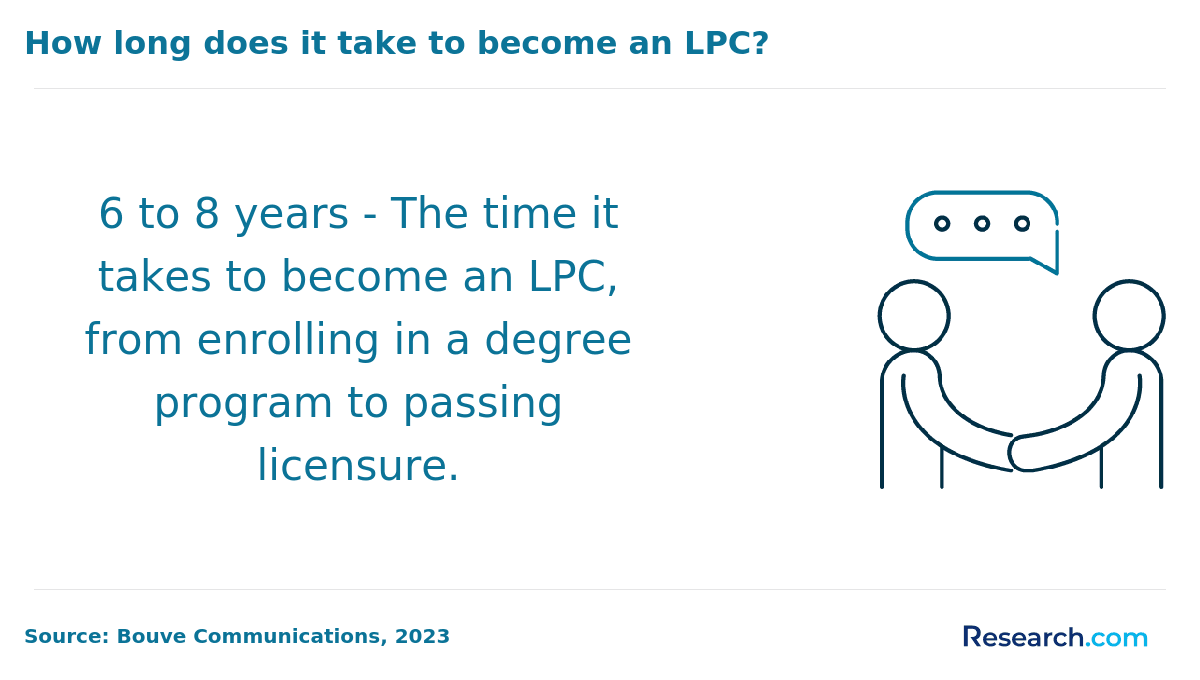
- Complete at least 3,000 hours of supervised experience over a minimum of 18 months with a board-approved supervisor.
Documentation is one of the most important parts of the Texas LPC process. Candidates should track supervision dates, client contact, supervision meetings, setting information, and supervisor approvals carefully. Missing or inconsistent records can slow an application even when the clinical work itself was completed.
If you are comparing counseling specialties, it may also help to review related career guides, including Research.com’s overview of Christian counselor career paths.
| Requirement | Decision tip |
| NCE or NCMHCE | Ask your graduate program which exam its students most commonly prepare for and what support is available. |
| Texas Jurisprudence Exam | Do not treat this as a formality; it focuses on Texas-specific legal and ethical practice. |
| Fingerprinting and background check | Complete this early enough to avoid delaying application review. |
| Supervised experience | Choose a supervisor who understands Texas LPC documentation and is available consistently. |
Which schools in Houston offer programs for aspiring LPCs?
Houston-area students have several options for graduate counseling education, but the right choice depends on more than the school name. You should compare accreditation, clinical placement support, faculty expertise, schedule format, tuition, exam preparation, and whether the program is explicitly designed for Texas LPC licensure.
- The University of Houston: Offers a Master of Arts in Counseling with coursework in human development, counseling theory, ethics, and professional practice. The program is described as CACREP-accredited, which signals alignment with national counseling education standards.
- Texas Woman’s University (Denton): Provides a Master’s in Clinical Mental Health Counseling with training in assessment, intervention, and multicultural counseling. The program is also described as CACREP-accredited.
- Houston Baptist University: Offers a Master of Arts in Counseling that combines core counseling preparation with a Christian counseling perspective. Students interested in faith-integrated training may also compare broader Christian counseling degree programs.
| Question to ask a school | Why it matters |
| Does the program meet Texas LPC educational requirements? | This is the first filter. If the program does not support licensure, it may not be the right investment. |
| Who arranges practicum and internship placements? | Some programs offer strong placement networks; others expect students to find sites independently. |
| What percentage of students pursue LPC licensure? | A program with many LPC-track students is more likely to understand the process well. |
| Is telehealth training included? | Digital service delivery is increasingly relevant in counseling practice, especially for access-focused work. |
| How does the program support exam preparation? | Structured review can help students plan for the NCE or NCMHCE. |
Before committing, request the program’s current licensure disclosure, ask whether requirements have changed, and confirm the answer with the Texas licensing board if anything is unclear.
Are there internship or practicum opportunities for counseling students in Houston?
Yes. Houston’s large healthcare, nonprofit, community mental health, and school-linked service network gives counseling students multiple types of clinical training environments. Practicum and internship placements help students practice intake skills, treatment planning, crisis response, documentation, ethical decision-making, and culturally responsive counseling under supervision.
- Houston Counseling Center may expose students to individual counseling, group work, intake assessment, documentation, trauma-related concerns, and mood disorder treatment.
- Legacy Community Health can offer experience with underserved communities, psychoeducational services, crisis support, and collaboration with other healthcare professionals.
- Center for Success and Independence emphasizes substance abuse treatment, relapse prevention groups, prevention education, and outreach-focused care.
-
: "
“Navigating the balance between intense client needs and my own learning curve was both challenging and rewarding.”
"
That reflection from a Houston therapist captures why practicum quality matters. The goal is not only to “get hours.” A strong placement should help you build clinical judgment, learn when to consult, understand professional boundaries, and develop confidence with Houston’s diverse client populations.
| Placement type | Best fit for students interested in | Potential trade-off |
| Community mental health | High-need populations, crisis work, case coordination, public service | Caseloads and documentation demands can be intense. |
| Hospital or integrated care | Behavioral health in medical settings, interdisciplinary teams, chronic illness support | Roles may be more structured and require comfort with fast-paced systems. |
| Private practice group | Outpatient therapy, client retention, specialty niches, business exposure | Training quality depends heavily on the supervisor and practice model. |
| Substance abuse program | Addiction treatment, relapse prevention, group counseling, recovery support | Students need strong boundaries and comfort with complex co-occurring needs. |
How much do LPCs make in Houston?
Licensed Professional Counselors in Houston typically earn between $50,000 and $65,000 annually, depending on experience, setting, client population, funding source, and specialization. Entry-level counselors and those in community mental health roles often start closer to the lower end of that range. More experienced LPCs in private practice, hospitals, or corporate wellness roles may earn more than $70,000.
Salary should be evaluated alongside benefits, supervision support, caseload expectations, administrative workload, schedule flexibility, and reimbursement model. A role with a higher advertised salary may involve heavy productivity requirements, evening appointments, or unpaid administrative time. A lower-paying agency role may offer better supervision, training, loan-related benefits, or exposure to complex clinical work.
| Factor | How it can affect Houston LPC earnings |
| Licensure level | Fully licensed LPCs generally have more autonomy and stronger earning options than associates still completing supervision. |
| Work setting | Hospitals, private practices, nonprofits, schools, and community agencies use different pay structures. |
| Specialization | Trauma, substance abuse, family systems, behavioral health integration, and other focused skills can improve marketability. |
| Client volume | Private practice income often depends on caseload size, payer mix, cancellations, and business expenses. |
| Benefits | Health insurance, retirement contributions, paid time off, and continuing education support can significantly change total compensation. |
What are the supervision requirements for LPCs in Houston?
After completing the graduate degree, Texas LPC candidates must complete at least 3,000 hours of supervised clinical work. The supervised experience must last at least 18 months and cannot exceed 48 months. This period is designed to help new counselors move from academic preparation to competent, ethical, independent practice.
Supervision must be provided by an LPC with an active license who meets the board’s supervisor qualifications. Supervised experience can take place in community mental health agencies, private clinics, hospitals, educational settings, and other counseling environments that provide appropriate clinical work.
Good supervision is more than a signature on a form. It should include regular review of clinical cases, ethics, documentation, risk management, cultural factors, treatment planning, and counselor development. Candidates should ask potential supervisors how often they meet, how they handle emergencies, what documentation they require, and whether they have experience guiding associates through Texas licensure.
| Supervision issue | What to clarify before you start |
| Approval status | Confirm the supervisor meets Texas board requirements. |
| Timeline | Make sure the plan can satisfy the minimum 18 months and stay within the 48-month limit. |
| Hours tracking | Use a consistent log from the beginning and keep backup copies. |
| Clinical fit | Choose a setting that builds the skills you want to use after full licensure. |
| Telehealth or virtual supervision | Confirm current Texas rules before relying on digital supervision models. |
Are additional certifications beneficial for LPC career growth in Houston?
Additional credentials can help Houston LPCs clarify a specialty, compete for focused roles, and serve clients with more complex needs. Certifications are not a substitute for LPC licensure, but they can strengthen a counselor’s profile when they align with the clients, employers, and settings the counselor wants to pursue.
| Career interest | Possible specialization direction | Why it may help in Houston |
| Substance abuse treatment | Addiction counseling and relapse prevention training | Useful for agencies, recovery programs, hospitals, and dual-diagnosis settings. Research.com also explains how to become a substance abuse counselor. |
| Trauma care | Trauma-informed counseling approaches | Relevant for community mental health, crisis work, hospital-linked care, and clients with complex histories. |
| Family and relationship counseling | Family systems or couples-focused training | Helpful for LPCs who want to serve families, couples, or blended household systems. |
| Behavioral intervention | BCBA-related education or behavior analysis preparation | May support work with behavioral challenges, developmental needs, and interdisciplinary teams. |
What are the licensure renewal and continuing education requirements for LPCs in Houston?
LPCs practicing in Houston must follow Texas renewal and continuing education requirements. Continuing education helps counselors stay current on ethics, clinical practice, state rules, documentation, and emerging service models. Because renewal rules can change, LPCs should check official board guidance before each renewal period rather than relying on outdated summaries.
Continuing education should be chosen strategically. A counselor who works with trauma survivors, for example, should not only complete the minimum requirement but also seek training that improves assessment, stabilization, referral decisions, and long-term care planning. Counselors comparing related licensure paths can also review Research.com’s guide on how to become a marriage and family therapist in Houston.
Can LPCs Diversify Their Careers into Related Fields in Houston?
Yes. LPCs can build careers beyond traditional one-on-one outpatient therapy. Houston’s education, healthcare, nonprofit, corporate wellness, and community service sectors create opportunities for counselors who want to combine clinical skills with leadership, training, advocacy, program design, or student support.
Some LPCs move toward school-linked mental health, behavioral health administration, counselor education, employee assistance programs, consulting, or interdisciplinary community work. Counselors interested in education roles may find it useful to compare credential requirements, including Research.com’s overview of the cheapest way to become a teacher in Houston.
| If you want... | Consider this direction | Ask yourself |
| More clinical depth | Specialized therapy training, supervision, or advanced clinical roles | Which client population do I want to serve best? |
| More predictable hours | School-linked services, agencies, hospitals, or employee wellness programs | Am I willing to trade some autonomy for structure? |
| Business ownership | Private practice or group practice leadership | Do I understand billing, marketing, risk management, and documentation? |
| Broader community impact | Program management, nonprofit leadership, advocacy, training | Do I want to spend less time in direct therapy and more time building systems? |
Is Houston a good place to work as an LPC?
Houston can be a good place to work as an LPC, especially for counselors who want exposure to diverse populations, healthcare collaboration, and a wide range of clinical settings. It is not automatically the best fit for every counselor, however. The right answer depends on your specialty, income goals, tolerance for administrative demands, and preferred client population.
- Strong need for services: Houston’s mental health workforce level of 36.9 professionals per 10,000 residents, compared with the national average of 58.3, points to a meaningful local access gap.
- Diverse client populations: Counselors with multicultural competence, bilingual skills, or experience with underserved communities may find many ways to contribute.
- Large healthcare ecosystem: The Texas Medical Center and major hospital systems create opportunities in integrated behavioral health and multidisciplinary care.
- Affordability challenges for clients: Economic inequality can make private-pay therapy inaccessible for some residents, increasing the importance of community-based and sliding-scale services.
- Regulatory complexity: Texas licensing, supervision, continuing education, and reimbursement rules require careful attention.
-
: "
“Navigating the licensing maze was daunting at first, but the city’s cultural richness and the Texas Medical Center’s network opened doors I hadn’t imagined. It can be tough balancing affordable care with business needs, yet the community’s resilience keeps me inspired.”
"
Can LPCs Expand Their Expertise with BCBA Certification in Houston?
LPCs who want to work more deeply with behavioral intervention may consider BCBA-related training. This path is especially relevant for professionals interested in behavior analysis, developmental needs, structured intervention plans, or interdisciplinary treatment teams.
BCBA certification is a separate credential path with its own educational, supervised experience, and examination expectations. LPCs should not assume their counseling license automatically satisfies those requirements. Before investing in coursework, review the relevant BCBA certification requirements in Houston and compare them with your current degree, supervised experience, and career goals.
How competitive is the job market for LPCs in Houston?
The Houston LPC market is both opportunity-rich and competitive. Demand is supported by population growth, greater public awareness of mental health, and the city’s extensive healthcare infrastructure. At the same time, more counseling graduates are entering the field, which can make desirable roles in private practice groups, specialty clinics, and hospital settings more selective.
Licensure matters. Fully licensed LPCs generally have stronger job security and more earning potential than unlicensed counselors. Candidates who bring specialized skills, strong documentation habits, bilingual ability, crisis experience, telehealth readiness, or training in high-need areas may be better positioned.
- Houston’s healthcare and community service networks create varied LPC job options.
- Competition can be higher for private practice and specialized clinical roles.
- Associates should prioritize high-quality supervision, not only salary.
- Specialization can improve career mobility when it matches employer needs.
- Students comparing entry points may also explore flexible counseling degree programs, while still verifying licensure alignment.
Are there counseling associations in Houston?
Yes. Counseling associations can help Houston LPCs stay informed, meet colleagues, find continuing education, understand advocacy issues, and build referral networks. Membership is especially useful for students and LPC associates who are still learning how the profession works outside the classroom.
- Texas Counseling Association (TCA): Supports counselors across Texas, including Houston-area professionals, through advocacy, conferences, workshops, and professional resources.
- Houston Association for Marriage and Family Therapy (HAMFT): Offers local training, events, and peer connection for professionals interested in family systems and relationship-focused work.
- American Psychological Association (APA) — Texas Psychological Association Division: Provides access to broader behavioral health research, regional events, publications, and policy discussions relevant to mental health professionals.
- Houston LPC Association: A local professional community for LPCs and related counseling professionals in the Houston area.
Students considering school-based counseling routes may also compare cost-conscious options such as affordable online school counseling programs, while confirming whether a program fits their intended license or certification path.
Which are the most popular employers of LPCs in Houston?
LPCs in Houston work for hospitals, psychiatric facilities, community clinics, nonprofit agencies, private practices, universities, school-linked programs, and telehealth organizations. The best employer depends on whether you value supervision, pay, benefits, autonomy, clinical complexity, schedule control, or long-term advancement.
- Memorial Hermann Health System: LPC roles may involve hospital-based behavioral health, individual or group therapy, crisis intervention, care coordination, and collaboration with psychiatrists, social workers, and medical teams.
- Harris County Psychiatric Center: LPCs may work in inpatient or outpatient settings with assessment, trauma-informed care, substance abuse concerns, treatment planning, and services for underserved populations.
- Houston Methodist Hospital: Counselors may support patients dealing with behavioral health concerns related to chronic illness, care transitions, psychoeducation, and community resource navigation.
- Texas Children’s Hospital: LPC-relevant opportunities may involve child, adolescent, family, or medical-adjacent behavioral health services, depending on department needs and qualifications.
| Employer type | Advantages | Possible drawbacks |
| Hospital system | Team-based care, benefits, exposure to complex cases | May involve fast-paced workflows and detailed documentation requirements. |
| Community agency | Mission-driven work, diverse clients, strong early-career learning | Pay may be lower and caseloads may be demanding. |
| Private practice | Autonomy, specialty development, flexible service models | Income may depend on referrals, billing, cancellations, and business skills. |
| Telehealth provider | Flexible delivery and wider client reach | Requires careful attention to ethics, privacy, state rules, and clinical fit. |
Are there mentorship or professional development programs for LPCs in Houston?
Houston LPCs can find mentorship through supervisors, professional associations, graduate school alumni networks, private practice groups, hospital training departments, and continuing education workshops. For LPC associates, the supervisor relationship is the most important form of structured mentorship because it directly affects clinical growth and licensure progress.
Professional development should be chosen with a plan. New counselors may need training in documentation, diagnosis, crisis response, ethics, and treatment planning. Mid-career LPCs may benefit from niche clinical training, supervision training, practice management, leadership development, or telehealth compliance. Those still exploring the broader field can review Research.com’s guide on how to become a mental health counselor in Houston.
What LPCs in Houston Say About Their Careers
- “Earning my LPC in Houston helped me serve a community where mental health access truly matters. After graduating from the University of Houston, I began working with a local nonprofit, and the work has pushed me clinically while reminding me why counseling matters.” —Manny
- “Houston gave me access to professional development I did not expect, especially through healthcare partnerships and trauma-informed training. Moving from graduate to practicing counselor took patience, but the city’s resources helped me build confidence.” —Jarren
- “After more than 20 years in counseling, I still find Houston professionally energizing. Private practice near the Medical Center keeps me connected to complex client needs, and the demand for therapy has made the later stage of my career feel stable and meaningful.” —Liza
Common Mistakes to Avoid When Becoming an LPC in Houston
| Mistake | Better approach |
| Choosing a graduate program without checking LPC alignment | Ask the program and the Texas licensing board whether the curriculum supports LPC eligibility. |
| Assuming all online counseling degrees qualify | Verify accreditation, practicum structure, state disclosures, and Texas-specific requirements. |
| Waiting too long to plan supervision | Start identifying qualified supervisors before graduation or early in the associate stage. |
| Tracking hours informally | Use organized logs and keep documentation updated throughout the 3,000-hour requirement. |
| Evaluating jobs by salary only | Compare supervision quality, benefits, caseload, documentation burden, training, and advancement. |
| Ignoring renewal rules | Monitor Texas continuing education and renewal requirements before deadlines approach. |
Key Insights
- Houston follows Texas LPC licensure rules, so candidates must plan around state requirements rather than city-specific licensing.
- The core path is graduate counseling education, required examinations, background review, Texas jurisprudence testing, and at least 3,000 hours of supervised experience over a minimum of 18 months.
- Houston’s mental health workforce shortage makes LPC work meaningful, but job quality varies widely by employer, supervision, caseload, and funding model.
- LPCs in Houston typically earn between $50,000 and $65,000 annually, while experienced counselors in certain settings may exceed $70,000.
- The best graduate program is not simply the most convenient one. Accreditation, Texas licensure alignment, practicum support, and exam preparation should drive the decision.
- Additional certifications can help, but only when they match a clear career goal such as substance abuse counseling, trauma care, family systems, or behavior analysis.
- Before accepting a job or supervision placement, ask about documentation expectations, clinical support, emergency procedures, productivity requirements, and how hours will be verified.
Related Articles for Nearby Cities
- 2027 How to Become a Licensed Therapist (LPC) in Austin, TX
- 2027 How to Become a Licensed Therapist (LPC) in Corpus Christi, TX
- 2027 How to Become a Licensed Therapist (LPC) in San Antonio, TX
- 2027 How to Become an LPC in Dallas, TX: Counselor License Requirements
- 2027 How to Become a Licensed Therapist (LPC) in Arlington, VA
- 2027 How to Become a Licensed Therapist (LPC) in Garland, TX
- 2027 How to Become a Licensed Therapist (LPC) in Irving, TX
- 2027 How to Become a Licensed Therapist (LPC) in Fort Worth, TX
- 2027 How to Become a Licensed Therapist (LPC) in Plano, TX
- 2027 How to Become a Licensed Therapist (LPC) in Laredo, TX
References:
- Texas Administrative Code: https://texreg.sos.state.tx.us/public/readtac$ext.TacPage
- LPC Supervision | Houston, TX | 77401 | 77265 | 77005 — Wilson Counseling - Houston, TX: https://www.wilsoncounseling.org/lpc-supervision
- How to Become a LPC Supervisor in Texas - Kate Walker Training: https://katewalkertraining.com/how-to-become-a-lpc-supervisor-in-texas/
- How Many Hours of Supervision Does an LPC Associate Need?: https://lpcsupervisiontexas.com/supervision-hours-texas/
- Counseling License Requirements In Texas | Psychology.org: https://www.psychology.org/counseling/licensure/texas/
- LPC Supervision Expectations - The Counselor's Mentor: https://thecounselorsmentor.com/lpc-supervision-expectations
- Supervision for LPC Associates — Catalyst Counseling-Houston, Texas: https://www.catalyst-counseling.com/which/lpcsupervision
- LPC Supervision Requirements For All 50 States Learn Now | Ethics Demystified: https://ethicsdemystified.com/lpc-supervision-requirements/
- Home - Texas Counseling Association: https://hca.txca.org/
- Houston LPC Association - Home: https://hlpca.wildapricot.org/
Other Things You Should Know About Becoming a Licensed Therapist (LPC) in Houston
A comprehensive criminal background check is required for LPC licensure in Houston, TX, in 2027. This process involves fingerprinting and review by the Texas Department of Public Safety. Applicants must not have any disqualifying criminal history to obtain a license.
The Texas Behavioral Health Executive Council, working with the Texas State Board of Examiners of Professional Counselors, issues LPC licenses for Houston applicants. Candidates must meet Texas education, exam, and supervised-practice rules before the council can approve licensure.
To maintain an LPC license in Houston, TX, in 2027, professionals must complete 24 hours of continuing education every two years, including 6 hours in ethics. This requirement is regulated by the Texas State Board of Examiners of Professional Counselors.


