
2027 Best Online CAHME-Accredited MHA Programs

Co-Founder and Chief Data Scientist
The market for hospital management solutions is projected to grow by 17.7% each year, creating a massive demand for skilled leaders. The challenge is choosing the right credential—one that hiring managers instantly recognize as the mark of an executive. Making the wrong choice can be a costly mistake in both time and money.
That’s why our career planning experts, with over 10 years of experience, created this guide. Think of career advancement as a credentialing ladder. While some professionals start with certifications or explore No-GRE options, this guide focuses on the pinnacle. We'll explore the top CAHME-accredited online MHA programs and give you the clear advice you need to make a confident decision.
What are the benefits of getting an online CAHME-accredited MHA?
- It prepares you for high-impact leadership roles managing hospitals, clinics, and health systems to improve patient care delivery.
- The degree gives you access to significant earning potential, with medical and health services managers earning a median salary of over $117,000.
- You gain these career advantages through a flexible online format designed for working professionals, allowing you to advance your education without pausing your career.
What can I expect from an online CAHME-accredited MHA?
You can expect a challenging, graduate-level curriculum that dives deep into the business of healthcare. Core subjects will include finance, strategic planning, health policy, and operations management, all taught through the lens of the modern healthcare system.
Many people worry that "online" means you're on your own, just watching recorded lectures. That isn't the case with high-quality programs. The best CAHME-accredited online MHA programs use a cohort model, where you move through the curriculum with the same group of peers.
This structure is designed to build a strong professional network. You'll engage in live, scheduled virtual classes, work on collaborative team projects, and interact directly with faculty who are often leaders in the field. It’s an engaging and demanding academic experience designed for aspiring executives.
Where can I work with an online CAHME-accredited MHA?
According to the U.S. Bureau of Labor Statistics, the largest employers of medical and health services managers are concentrated in these key sectors:
- Hospitals (state, local, and private): The primary employer, accounting for 30% of all healthcare management positions.
- Offices of physicians: A significant sector that employs 12% of managers in the field.
- Nursing and residential care facilities: A growing area of need, employing 9% of healthcare managers.
- Government: Federal, state, and local health agencies account for 7% of these leadership roles.
- Outpatient care centers: Another key growth area, also employing 7% of the field's managers.
Beyond these core employers, graduates are highly sought after in related industries such as management consulting, health insurance, and the rapidly expanding health-tech sector.
How much can I make with an online CAHME-accredited MHA?
Based on 2024 data, here is the typical salary progression you can work toward:
- Manager-Level Roles: After graduation, you can compete for management positions where the median salary is $117,960 per year.
- Director-Level Roles: With experience, you can advance to senior positions like Director of Hospital Operations, where top earners command salaries over $162,000.
- Executive-Level Leadership: The MHA is the key to C-suite track roles, where the top 10% of leaders in the field earn more than $216,750 annually.
- List of the Best Online CAHME-Accredited MHA Programs for 2027 List of Programs
- How long does it take to complete an online CAHME-accredited MHA program? Completion Time
- How does an online CAHME-accredited MHA program compare to an on-campus program? How does an online CAHME-accredited MHA program compare to an on-campus program?
- What is the average cost of an online CAHME-accredited MHA program? Program Cost
- What are the financial aid options for students enrolling in an online CAHME-accredited MHA program? Financial Aid
- What are the prerequisites for enrolling in an online CAHME-accredited MHA program? What are the prerequisites for enrolling in an online CAHME-accredited MHA program?
- What courses are typically in an online CAHME-accredited MHA program? What courses are typically in an online CAHME-accredited MHA program?
- What types of specializations are available in an online CAHME-accredited MHA program? What types of specializations are available in an online CAHME-accredited MHA program?
- What supplemental certifications can further enhance your healthcare administration career? What supplemental certifications can further enhance your healthcare administration career?
- How to Choose the Best Online CAHME-Accredited MHA Program How to Choose the Best Online CAHME-Accredited MHA Program
- What career paths are available for graduates of an online CAHME-accredited MHA program? Career Paths
- What is the job market for graduates of an online CAHME-accredited MHA program? Job Market
Best Online CAHME-Accredited MHA Programs for 2027
Choosing an online Master of Health Administration is not just a school-selection decision. It is a career strategy decision that can affect your access to healthcare leadership roles, your professional network, your cost of attendance, and the credibility of your graduate credential. For many working professionals, the most important quality marker is CAHME accreditation, because it signals that a health administration program has been reviewed against specialized standards for healthcare management education.
This guide is for clinicians moving into administration, healthcare managers seeking promotion, business professionals entering the healthcare sector, and students comparing online MHA options. You will learn what CAHME accreditation means, how online programs compare, how much programs cost, how long they take, what admissions committees look for, and how to choose a program that fits your goals. If you are also comparing related pathways, such as online healthcare administration programs at HBCUs, use CAHME status as one of your key quality checks.
Quick Answer: Is an Online CAHME-Accredited MHA Worth Considering?
An online CAHME-accredited MHA can be a strong option if you want to move into healthcare management, director-level operations, health systems strategy, quality improvement, or executive leadership without leaving your current job. CAHME accreditation is especially important because it confirms that the program meets a recognized standard for graduate healthcare management education. However, the best choice depends on your budget, schedule, experience level, career target, and whether you can meet any residency or immersion requirements.
| Best fit | Why it may work | What to verify before enrolling |
| Working healthcare professionals | Online delivery can make graduate study possible while maintaining employment. | Check weekly workload, cohort schedule, residency requirements, and employer tuition reimbursement rules. |
| Clinicians moving into leadership | The MHA builds finance, operations, policy, and management skills not usually covered in clinical training. | Confirm whether the curriculum includes leadership, strategy, quality, and healthcare finance coursework. |
| Managers seeking director-level roles | CAHME-accredited programs are designed around healthcare administration competencies. | Ask about alumni outcomes, career support for online students, and access to executive mentors. |
| Students seeking the lowest-cost option | Some online programs have significantly lower cost per credit than others. | Compare total tuition, fees, technology costs, travel costs, and required credits, not just cost per credit. |
How We Rank Online CAHME-Accredited MHA Programs
Because a graduate degree can require a substantial financial commitment, program rankings should be based on transparent information rather than marketing claims. Research.com evaluates schools using data from established education sources, including the IPEDS database, Peterson's database, the College Scorecard database, and The National Center for Education Statistics.
These sources help support comparisons across schools, costs, completion requirements, and institutional information. To understand how Research.com develops rankings and evaluates programs, review our ranking methodology.
Online CAHME-Accredited MHA Programs to Compare
The programs below represent online or online/hybrid MHA options with CAHME accreditation information stated by the institutions or program descriptions. One important note: Sacred Heart University is listed with a status of currently seeking CAHME candidacy, which is not the same as full CAHME accreditation. Students should verify current accreditation status directly with the school and CAHME before applying.
| School | Program | Length | Credits | Cost per credit | CAHME status listed |
| The George Washington University | Online Master of Health Administration | 2 to 4 years | 45 | $1,945 | CAHME-accredited |
| New York University - Wagner | Online Master of Health Administration | 28 months, part-time | 45 | $2,491 | CAHME-accredited |
| Walden University | Master of Healthcare Administration | 18 months | 53 | $535 | CAHME-accredited |
| Texas State University | Master of Healthcare Administration – Executive Track Online | 12 months | 40 | $499 | CAHME-accredited |
| George Mason University | MHA in Health Systems Management | 30 months | 42 | $895 | CAHME-accredited |
| Seton Hall University | Master of Healthcare Administration – Online/Hybrid | 2 years | 42 | $1,530 | CAHME-accredited |
| Sacred Heart University | Master of Health Administration | 2 years | 37 | $725 | Currently seeking CAHME candidacy |
| Universities of Wisconsin | Master of Healthcare Administration | 2 years | 33 to 39 | $650 | CAHME-accredited |
| Duquesne University | Master's in Health Administration | 16 months | 42 | $1,673 | CAHME-accredited |
| Pennsylvania State University | Master of Health Administration in Health Policy and Administration | 7 semesters | 49 | $1,037 | CAHME-accredited |
1. The George Washington University - Online Master of Health Administration
The George Washington University offers an online MHA designed for professionals preparing for senior healthcare leadership in complex systems. The program combines online coursework with four required immersion experiences, including one held on the Washington, D.C., campus, giving students structured opportunities to meet faculty, peers, and healthcare leaders in person.
- Program length: 2 to 4 years
- Required credits to graduate: 45
- Cost per credit: $1,945
- Accreditation: Commission on Accreditation of Healthcare Management Education (CAHME)
2. New York University - Wagner - Online Master of Health Administration
New York University delivers an online MHA through NYU Wagner for students seeking leadership preparation grounded in ethics, evidence-informed decision-making, and the realities of the U.S. healthcare system. The program is structured for part-time learners and includes a brief intensive immersion in New York City.
- Program length: 28 months (Part-time)
- Required credits to graduate: 45
- Cost per credit: $2,491
- Accreditation: Commission on Accreditation of Healthcare Management Education (CAHME)
3. Walden University - Master of Healthcare Administration
Walden University offers a competency-based MHA format for students who want healthcare business training that can be applied in current roles. The curriculum aligns with National Center for Healthcare Leadership (NCHL) standards and covers areas such as healthcare finance, operations, quality, and management.
- Program length: 18 months
- Required credits to graduate: 53
- Cost per credit: $535
- Accreditation: Commission on Accreditation of Healthcare Management Education (CAHME)
4. Texas State University - Master of Healthcare Administration – Executive Track Online
Texas State University offers an accelerated online executive track for professionals who can manage a demanding pace. The 12-month curriculum includes Lean Six Sigma Certification training and coursework in financial performance, data use, process improvement, and healthcare management decision-making.
- Program length: 12 months
- Required credits to graduate: 40
- Cost per credit: $499
- Accreditation: Commission on Accreditation of Healthcare Management Education (CAHME)
5. George Mason University - Master of Health Administration in Health Systems Management
George Mason University structures its MHA in Health Systems Management around strategic leadership, healthcare business skills, and field-based application. Students choose a concentration and complete a capstone practicum focused on a complex organizational issue.
- Program length: 30 months
- Concentrations: Healthcare Quality; and Executive Concentration
- Required credits to graduate: 42
- Cost per credit: $895
- Accreditation: Commission on Accreditation of Healthcare Management Education (CAHME)
6. Seton Hall University - Master of Healthcare Administration – Online/Hybrid
Seton Hall University combines asynchronous online learning with three required three-day residencies. The full-time, 21-month format is designed for aspiring and current healthcare professionals who want a structured leadership curriculum with periodic in-person engagement.
- Program length: 2 years
- Required credits to graduate: 42
- Cost per credit: $1,530
- Accreditation: Commission on Accreditation of Healthcare Management Education (CAHME)
7. Sacred Heart University - Master of Health Administration
Sacred Heart University offers an interdisciplinary MHA for students from clinical and non-clinical backgrounds. Courses are delivered asynchronously in 8-week terms and emphasize economics, strategy, policy, and practical management skills for healthcare organizations.
- Program length: 2 years
- Required credits to graduate: 37
- Cost per credit: $725
- Accreditation: Currently seeking candidacy with the Commission on Accreditation of Healthcare Management Education (CAHME)
8. Universities of Wisconsin - Master of Healthcare Administration
The Universities of Wisconsin system offers an online MHA built around healthcare business fundamentals. Students may pursue a standard online path or an executive option intended for experienced leaders with advanced degrees, depending on their background and goals.
- Program length: 2 years
- Required credits to graduate: 33 to 39
- Cost per credit: $650
- Accreditation: Commission on Accreditation of Healthcare Management Education (CAHME)
9. Duquesne University - Master's in Health Administration
Duquesne University offers a fully online CAHME-accredited MHA and reports a 100% job placement rate for its graduates. Students can tailor the degree through concentrations in data analytics, compliance, risk management, and population health.
- Program length: 16 months
- Concentrations: Health Informatics and Data Analytics; Healthcare Compliance and Risk Management; and Population Health
- Required credits to graduate: 42
- Cost per credit: $1,673
- Accreditation: Commission on Accreditation of Healthcare Management Education (CAHME)
10. Pennsylvania State University - Master of Health Administration in Health Policy and Administration
Pennsylvania State University offers an online MHA in Health Policy and Administration for working professionals seeking a graduate business foundation in healthcare. The 28-month curriculum emphasizes ethical leadership, critical thinking, management, and a practical understanding of the U.S. healthcare system.
- Program length: 7 semesters
- Required credits to graduate: 49
- Cost per credit: $1,037
- Accreditation: Commission on Accreditation of Healthcare Management Education (CAHME)
How Long Does an Online CAHME-Accredited MHA Take?
Most online MHA programs take about two years for full-time students. Part-time students, especially those working full time, often need three to four years. Program length depends on required credits, course sequence, cohort structure, residency requirements, and whether the school offers an accelerated or executive format.
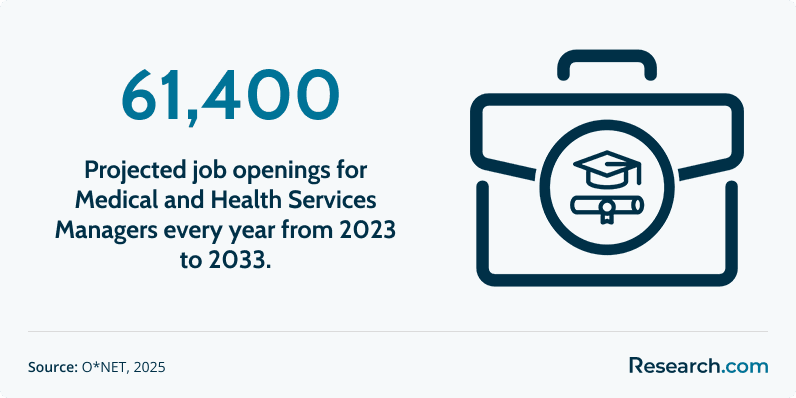
Many strong online MHA programs are not fully self-paced. Instead, they use a cohort model in which students move through courses with the same peer group. That structure can make scheduling less flexible, but it can also strengthen networking, group learning, and professional accountability. This matters in a field where 61,400 management jobs are projected to open each year.
When an Accelerated MHA Makes Sense
An accelerated MHA can be attractive if you want to finish quickly and can handle a concentrated workload. Some accelerated online MHA programs can be completed in 12 to 18 months, but speed usually comes with trade-offs: heavier weekly reading, tighter project deadlines, fewer academic breaks, and less room for unexpected work or family demands.
| Program pace | Typical learner | Main advantage | Main risk |
| Accelerated | Professionals with flexible schedules or strong employer support | Faster completion and quicker return to career mobility | Workload may be difficult to sustain while working full time |
| Full-time standard | Students who can commit consistent weekly study time | Balanced pace with steady progress | May still be demanding alongside leadership responsibilities |
| Part-time | Working professionals with family, travel, or unpredictable schedules | More manageable workload over time | Longer time before graduation and potential tuition changes |
Online vs. On-Campus CAHME-Accredited MHA Programs
For accredited programs, the most important difference is delivery format, not academic standard. CAHME evaluates program quality, competencies, and educational outcomes across formats. That means an online CAHME-accredited MHA should be assessed by the same core quality question as a campus program: does it prepare students for healthcare management leadership?
The Commission on Accreditation of Healthcare Management Education (CAHME) is the specialized accreditor for healthcare management education. For students, CAHME accreditation can help separate programs with field-specific external review from programs that may be regionally accredited but not professionally accredited in healthcare management.
| Factor | Online CAHME-accredited MHA | On-campus CAHME-accredited MHA |
| Flexibility | Usually better for working professionals and students outside the school’s region | Better for students who want frequent face-to-face interaction |
| Networking | Often national or multi-state, especially in cohort programs | Often stronger in the local or regional healthcare market |
| Residencies | May include short campus visits, immersions, or executive sessions | Typically integrated into regular campus attendance |
| Employer perception | Strong when the program is accredited, rigorous, and tied to a reputable institution | Strong when the program has recognized faculty, alumni, and employer relationships |
| Best for | Professionals who cannot relocate or pause employment | Students who want daily campus access and local networking |
How Online MHA Networking Works
Online networking is different from campus networking, but it can still be valuable. Cohorts often include nurses, health IT professionals, practice managers, public health workers, and business professionals from multiple regions. That mix can expose students to leadership problems across hospitals, clinics, payers, long-term care, consulting, and public agencies.
Students with clinical and graduate business backgrounds may also compare healthcare administration roles with career paths for MSN MBA nurses. The key is to choose an online program that does more than stream lectures. Look for structured group work, live discussions, faculty access, alumni events, executive residencies, and career services built for distance learners.
How Much Does an Online CAHME-Accredited MHA Cost?
Total tuition for an online CAHME-accredited MHA typically ranges from about $20,000 to over $112,000, with an average total program cost of around $52,000. The wide range exists because programs differ in credit requirements, institutional pricing, residency costs, fees, and whether tuition is charged by credit, term, or program.
Do not compare programs by cost per credit alone. A lower per-credit price can still lead to a higher total cost if the program requires more credits or has substantial fees. Ask each school for a full cost sheet that includes tuition, university fees, technology charges, books, residency travel, lodging, and any graduation or administrative fees.
How to Evaluate ROI Without Overstating Salary Outcomes
An MHA can support advancement into higher-responsibility roles, but no degree guarantees a specific salary, title, or promotion. Your return on investment depends on your current experience, employer, location, leadership track record, and ability to move into roles with greater budget, staff, and operational responsibility. Comparing graduate credentials across fields, such as reviewing EdD salary information, can help illustrate why specialized graduate education is often evaluated as a long-term career investment rather than a short-term expense.
One relevant benchmark is the Director of Hospital Operations role. The average salary for this role is over $107,000, with the top 25% of directors earning over $135,000 and the highest earners making over $162,000. Use figures like these as context, not as promises. The stronger question is whether the program can help you compete for the next level of healthcare leadership in your market.
The chart below provides additional salary context for this type of leadership role.
Financial Aid and Funding Options for Online MHA Students
Graduate healthcare administration students commonly combine several funding sources. The best approach is to start early, ask direct questions, and compare net cost after aid rather than published tuition alone.
- Federal and private loans: Students who want to be considered for federal aid should begin with the Free Application for Federal Student Aid (FAFSA). Private loans may also be available, but terms and borrower protections differ.
- Scholarships and grants: Universities, professional associations, and healthcare organizations may offer awards for graduate students pursuing healthcare administration or related fields.
- Employer tuition reimbursement: Healthcare employers may help fund graduate education when the degree supports leadership development or workforce planning. Ask whether reimbursement is paid upfront or after course completion, whether grades matter, and whether you must stay with the employer for a set period.
Some students also use shorter credentials to build skills before or during an MHA. For example, healthcare management certification programs may provide focused training in a smaller time frame, while affordable online medical billing and coding courses can help professionals strengthen revenue cycle or administrative knowledge.
| Funding source | Best use | Question to ask |
| FAFSA-based aid | Determining eligibility for federal student aid | Is the program eligible for federal aid for online graduate students? |
| Employer reimbursement | Reducing out-of-pocket cost for working professionals | What grades, service commitments, or annual limits apply? |
| Scholarships | Lowering total borrowing | Are awards available for online MHA students, part-time students, or healthcare employees? |
| Private loans | Filling remaining funding gaps | What is the interest rate, repayment term, and total repayment cost? |
Admissions Requirements for Online CAHME-Accredited MHA Programs
Most MHA admissions committees review more than grades. They usually consider your academic preparation, healthcare or management experience, leadership potential, communication skills, recommendations, and career goals. Applicants from clinical, business, public health, social service, technology, and nonprofit backgrounds may all be competitive if they can explain why healthcare administration is the right next step.
Common application requirements include:
- A bachelor’s degree from an accredited institution. The degree does not always need to be in healthcare. Applicants from social work, for example, may already understand systems of care and professional credentialing issues such as the difference between an MSW and an LCSW.
- A minimum undergraduate GPA, often around 3.0, though strong professional experience may help offset a weaker academic record.
- Relevant work experience, commonly two to three years, particularly for executive or professional-track programs.
- Letters of recommendation from supervisors, mentors, faculty members, or executives who can address your leadership readiness.
- A personal statement explaining your career goals, your interest in healthcare management, and why the program fits your plans.
Many strong programs have waived the GRE requirement. If a program is test-optional or does not require the GRE, your resume, essays, recommendations, and interview may carry more weight.
Typical Courses in an Online CAHME-Accredited MHA Curriculum
A CAHME-accredited MHA is built around healthcare leadership competencies rather than clinical practice. That distinction matters. Unlike clinical graduate programs, including the fastest online master's programs in clinical mental health counseling, an MHA focuses on managing healthcare organizations, improving operations, using data, leading teams, and making strategic decisions.
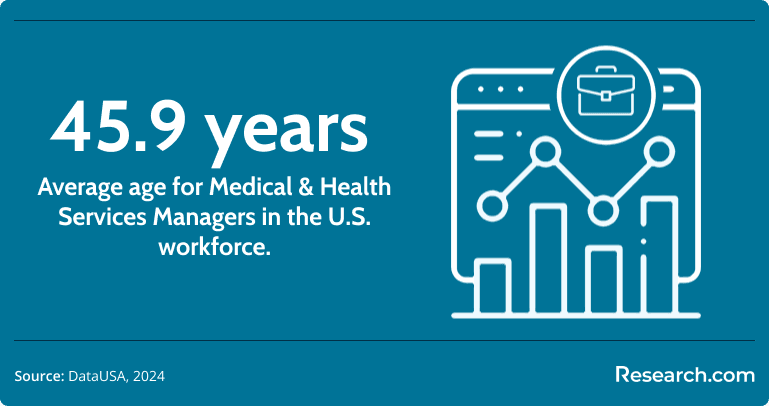
The curriculum is often designed for experienced professionals. In the medical and health services management workforce, the average age is 45.9 years, which reflects the fact that many students enter or advance in this field after building work experience.
| Course area | What students learn | Why it matters in healthcare leadership |
| Healthcare finance | Budgeting, financial analysis, reimbursement, and investment decisions | Leaders must understand financial trade-offs while maintaining quality and access. |
| Health policy and law | Regulation, compliance, policy change, and legal risk | Healthcare decisions are shaped by federal, state, payer, and organizational rules. |
| Strategic planning | Market analysis, organizational goals, growth planning, and implementation | Executives need to position organizations for long-term sustainability. |
| Operations management | Process improvement, staffing, quality, capacity, and supply chain concepts | Operational decisions affect patient experience, staff workload, and cost control. |
| Health informatics | Data systems, performance measurement, technology use, and analytics | Healthcare organizations increasingly rely on data to improve outcomes and efficiency. |
Common MHA Specializations and When to Choose Them
A specialization should not be chosen because it sounds impressive. It should connect directly to the roles, industries, and problems you want to work on. The right specialization can signal deeper preparation for a specific leadership lane, while the wrong one may add little value to your career plan.
| Specialization | Best for students interested in | Why it can be valuable |
| Health Informatics and Data Analytics | Health IT, reporting, analytics, digital transformation, and data-informed strategy | Healthcare leaders increasingly need to turn operational and clinical data into usable decisions. |
| Population Health Management | Community health, value-based care, care coordination, and prevention-focused systems | This track supports work focused on improving outcomes across defined patient groups. |
| Healthcare Finance | Budget leadership, reimbursement strategy, financial planning, and executive finance roles | Financial fluency is essential for leaders responsible for sustainability and resource allocation. |
| Senior Services | Long-term care, aging services, assisted living, and service delivery for older adults | This focus can be relevant for professionals preparing to lead organizations serving aging populations. |
Specialization decisions resemble credential decisions in other fields: the value depends on the role you are targeting. For example, professionals in behavioral health may need to understand types of ABA certification online before selecting a credential path. In the same way, MHA students should choose concentrations that match employer needs, not just personal curiosity.
Supplemental Certifications That Can Strengthen an MHA Career Path
An MHA provides broad leadership preparation, but targeted certifications can add job-specific skills. Depending on your career goal, a supplemental credential may help you demonstrate knowledge in compliance, revenue cycle, healthcare quality, analytics, project management, coding, or operations improvement.
Certifications are most useful when they fill a clear gap. A clinician moving into operations may benefit from finance or quality training. A health IT professional may benefit from strategy or compliance credentials. A practice manager may strengthen billing, coding, or revenue cycle knowledge through short-format coursework before taking on larger administrative responsibilities.
How to Choose the Best Online CAHME-Accredited MHA Program for You
The best online MHA is not automatically the highest-ranked or most expensive program. It is the program that fits your professional goal, budget, schedule, learning style, and leadership trajectory. Start with CAHME status, then evaluate the practical factors that determine whether you can complete the program and use it effectively.
- Verify CAHME status directly. Confirm whether the program is fully accredited, in candidacy, or not accredited. Do this through the school and CAHME.
- Calculate the full cost. Include tuition, required credits, fees, books, residencies, travel, lodging, and lost work time if applicable.
- Match the format to your life. Decide whether you can manage synchronous sessions, group projects, residencies, and accelerated terms.
- Review faculty experience. Look for instructors with healthcare leadership, policy, operations, finance, or executive backgrounds that align with your goals.
- Ask about online student career services. Confirm that online students receive resume help, interview preparation, employer connections, and career coaching.
- Investigate alumni outcomes. Ask where graduates work, what roles they hold, and whether alumni are active in your region or target sector.
- Evaluate the capstone or practicum. A strong applied project can help you solve a real organizational problem and demonstrate leadership ability.
Questions to Ask Admissions Before You Apply
| Question | Why it matters |
| Is the program fully CAHME-accredited right now? | Candidacy and full accreditation are not the same status. |
| Are online students eligible for the same career services as campus students? | Career support can affect your ability to translate the degree into advancement. |
| How many residencies, immersions, or campus visits are required? | Travel can increase cost and affect scheduling. |
| What is the weekly time commitment? | Working professionals need a realistic workload estimate before enrolling. |
| Can I speak with current students or alumni? | Student and alumni perspectives can reveal workload, faculty access, and networking quality. |
| Does the program require healthcare experience? | Some programs are built for experienced professionals, while others admit career changers. |
Common Mistakes to Avoid
| Mistake | Better approach |
| Choosing a program based only on rankings | Use rankings as a starting point, then compare accreditation, cost, format, outcomes, and fit. |
| Assuming all online MHA programs are CAHME-accredited | Check accreditation status before applying and again before enrolling. |
| Looking only at cost per credit | Compare total program cost, including fees and required credits. |
| Ignoring residency requirements | Confirm travel expectations, timing, and added expenses. |
| Assuming the degree guarantees a promotion | Use the degree alongside experience, networking, measurable achievements, and leadership development. |
| Choosing a specialization too early | Connect the specialization to real job postings, employer demand, and your long-term leadership path. |
Career Paths for Graduates of Online CAHME-Accredited MHA Programs
An MHA is designed to support progression into healthcare management and executive leadership. Graduates may begin in department-level management, move into director-level responsibilities, and eventually compete for executive roles. The timeline depends on previous experience, organization size, performance, location, and available opportunities.
| Career stage | Example roles | Typical focus |
| Manager-level roles | Clinical Manager, Health Information Manager, Practice Manager | Managing teams, workflows, budgets, compliance, and service delivery within a department or practice. |
| Director-level roles | Director of Operations, Director of Nursing, Quality Improvement Director | Leading multiple teams or functions, improving performance, managing strategy execution, and reporting to senior leadership. |
| Executive and C-suite roles | Chief Operating Officer, Chief Executive Officer, Vice President of Strategy | Setting organizational direction, overseeing enterprise-level performance, and leading complex healthcare systems. |
Some graduates later pursue a terminal degree to move into teaching, research, consulting, or high-level system leadership. For example, professionals interested in behavioral health systems may compare MHA progression with a fast-track online doctorate in behavioral health leadership. The chart below provides a demographic view of professionals in director-level clinical leadership roles.
Job Market Outlook for MHA Graduates
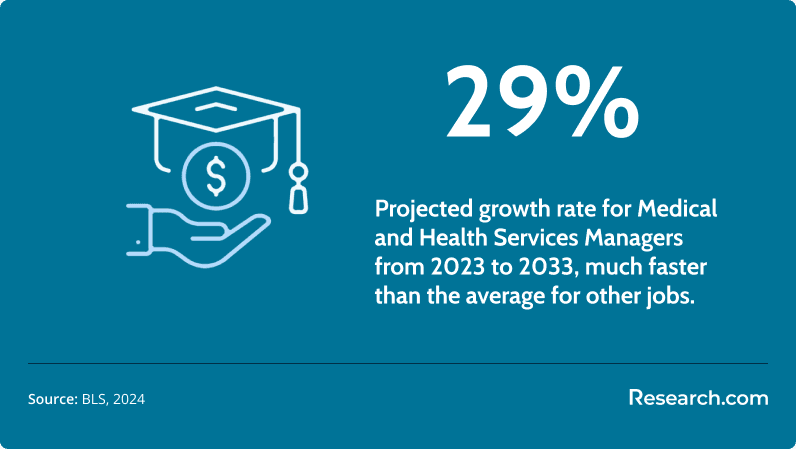
The job market for medical and health services managers is strong compared with many occupations. The U.S. Bureau of Labor Statistics projects employment for medical and health services managers to grow by 29% through 2033. That projection reflects sustained demand for professionals who can manage healthcare delivery, staffing, compliance, cost pressures, and quality improvement.
The field is also expected to add an estimated 160,600 new management positions over the next decade. For graduates of CAHME-accredited online MHA programs, this demand can create opportunities in hospitals, outpatient care, physician groups, long-term care, public health organizations, consulting, health technology, and government settings. Competition will still vary by market and role, especially for executive positions.
Current Trends Affecting Healthcare Administration Careers
- Data-driven management: Healthcare leaders are increasingly expected to use analytics to improve operations, quality, staffing, and patient outcomes.
- Value-based care: Organizations continue to focus on quality, cost control, and outcomes rather than volume alone.
- Workforce pressure: Leaders must manage staffing challenges, retention, burnout, and interdisciplinary teams.
- Digital health and AI: Administrators need enough technology fluency to evaluate tools, manage implementation, protect data, and align systems with patient care goals.
- Regulatory complexity: Compliance, reimbursement, privacy, and policy changes remain central to healthcare leadership decisions.
The long-term need for healthcare leadership is tied to structural issues: an aging population, growing service demand, pressure to improve access, and the continuing challenge of balancing quality and cost. MHA graduates are trained for these management problems, but career success still depends on experience, judgment, communication, and measurable results.
Graduate Perspectives on Online CAHME-Accredited MHA Programs
- Rhiannon: "I had years of clinical experience as a Director of Rehab Services, but I needed stronger business knowledge to move into broader leadership. The online MHA allowed me to keep leading my team while learning finance, operations, and executive communication. The finance courses were challenging, but they helped me explain the value of our services in leadership meetings. Within six months of finishing the program, I moved into a Vice President of Patient Care Services role."
- Kael: "My background was in health IT, and I wanted to become the kind of leader who could connect technology decisions to organizational strategy. The online MHA made it possible to continue working while applying lessons in analytics and operations immediately. My project proposals became stronger, and my supervisor noticed the difference. Before graduation, I was already leading a new implementation team."
- Elara: "I knew the technical side of my work, but presenting to executives was difficult for me. The program pushed us to work in teams, defend strategic plans, and communicate decisions clearly. That practice changed how I showed up in leadership settings. I left the program with more confidence and a stronger executive presence."
References
- Data USA. (n.d.). Medical & health services managers. Retrieved September 4, 2025, from https://datausa.io/profile/soc/medical-health-services-managers
- O*NET OnLine. (n.d.). 11-9111.00 - Medical and Health Services Managers. Retrieved September 4, 2025, from https://www.onetonline.org/link/summary/11-9111.00
- Straits Research. (2024, May). Hospital management solutions market. Retrieved September 4, 2025, from https://straitsresearch.com/report/hospital-management-solutions-market
- U.S. Bureau of Labor Statistics. (2024, April 17). Medical and Health Services Managers. Occupational Outlook Handbook. Retrieved September 4, 2025, from https://www.bls.gov/ooh/management/medical-and-health-services-managers.htm
- U.S. Bureau of Labor Statistics. (2024, April). Occupational Employment and Wages, May 2023: 11-9111 Medical and Health Services Managers. Occupational Employment Statistics. Retrieved September 4, 2025, from https://www.bls.gov/oes/2023/may/oes119111.htm
- Zippia. (n.d.). Clinical director demographics and statistics in the US. Retrieved September 4, 2025, from https://www.zippia.com/clinical-director-jobs/demographics/
- Zippia. (n.d.). Director of clinical operations salary. Retrieved September 4, 2025, from https://www.zippia.com/salaries/director-of-clinical-operations/
- ZipRecruiter. (n.d.). Director of hospital operations salary. Retrieved September 4, 2025, from https://www.ziprecruiter.com/Salaries/Director-Of-Hospital-Operations-Salary
Key Insights
- CAHME accreditation is the central quality signal. If you are comparing online MHA programs, verify whether the program is fully CAHME-accredited, in candidacy, or not accredited before applying.
- Online does not mean less rigorous. CAHME-accredited online programs can offer the same leadership-focused competencies as campus programs, but delivery format, networking, and residency expectations differ.
- Cost varies widely. Total tuition commonly ranges from about $20,000 to over $112,000, so compare total program cost rather than cost per credit alone.
- Program pace matters. Accelerated formats can shorten completion time to 12 to 18 months, but they require a realistic look at work, family, and study capacity.
- The best MHA is goal-specific. Choose a program based on accreditation, curriculum, faculty, alumni network, career services, specialization fit, and total cost—not rankings alone.
- Career outcomes depend on more than the degree. An MHA can support advancement into healthcare management and executive roles, but experience, leadership results, networking, and market conditions also shape opportunities.
Other Things You Should Know About Online CAHME-Accredited MHA Programs
Admission requirements typically include a bachelor's degree, GRE or GMAT scores, and professional experience. Each program has specific criteria, such as a minimum GPA and prerequisites, which candidates must meet. Check individual program pages for detailed requirements for 2027.
CAHME, the Commission on Accreditation of Healthcare Management Education, is the main accrediting body for U.S. MHA programs. To keep accreditation, programs must meet CAHME standards for curriculum, faculty qualifications, student support, and required administrative competencies.


