
2027 Healthcare Management vs. Healthcare Administration Degree Programs: Explaining the Difference

Co-Founder and Chief Data Scientist
Choosing between a healthcare management degree and a healthcare administration degree can shape the kind of healthcare leader you become. Both programs prepare students for non-clinical leadership roles, but they do not emphasize the same work. Healthcare management is usually broader and more business-focused, while healthcare administration is more closely tied to facility operations, staff coordination, compliance, and patient service delivery.
This guide is for students, working healthcare employees, career changers, and professionals comparing leadership degrees in healthcare. You will learn how the two fields differ in coursework, job titles, work settings, salary potential, certifications, advancement options, accreditation, and return on investment so you can choose the path that fits your goals instead of relying on similar-sounding program names.
Quick Answer: Healthcare Management vs. Healthcare Administration
A healthcare management degree is usually the better fit if you want to work on organizational strategy, finance, policy, business growth, consulting, or executive leadership. A healthcare administration degree is usually the better fit if you want to manage healthcare facilities, departments, staff schedules, patient services, compliance processes, and daily operations. Both can lead to leadership careers, and both may fall under the broader Bureau of Labor Statistics category of medical and health services managers, but the day-to-day focus can be very different.
Key Things You Should Know About Healthcare Management Degree vs. Healthcare Administration Degree
- Salary Differences: Healthcare management positions often connect to executive, finance, consulting, and system-level roles, which can produce higher earnings. Healthcare administration roles often provide strong but more moderate salaries in facility, department, and operations leadership.
- Job Market & Outlook: Both paths benefit from growth in healthcare leadership. Management roles are important for organizations that need strategic and financial leaders, while administration roles remain essential as hospitals, clinics, and long-term care facilities need skilled operational leaders.
- Work Settings: Healthcare managers may work in hospitals, corporate healthcare offices, insurance organizations, consulting firms, government agencies, or health systems. Healthcare administrators more often work in hospitals, clinics, medical offices, nursing homes, rehabilitation centers, and long-term care facilities.
- Responsibilities: Managers usually focus on financial planning, organizational strategy, policy implementation, and business performance. Administrators more often oversee staffing, patient services, facility workflows, compliance, and day-to-day coordination.
- Career Opportunities: Healthcare management can lead toward roles such as CEO, CFO, director of operations, policy analyst, or healthcare consultant. Healthcare administration can lead toward roles such as hospital administrator, medical office manager, clinical supervisor, department head, or nursing home administrator.
- Education requirements for healthcare management and healthcare administration
- Professional roles and day-to-day responsibilities
- Which healthcare leadership degree should you choose?
- Salary and job outlook for 2027
- Common challenges in healthcare leadership
- Certifications that can strengthen your credentials
- Skills healthcare management degree holders need
- Return on investment for healthcare leadership degrees
- Why accreditation matters
- Networking and continuing educationProgram quality checklist
- Cost-effective ways to enter healthcare leadership
- Interdisciplinary specialization in healthcare leadership
- The value of interdisciplinary education
- Supplementary certifications for career growth
- Using clinical credentials in leadership roles
- Skills healthcare administration degree holders need
- Advancement paths for healthcare management graduates
- Advancement paths for healthcare administration graduates
Healthcare Management vs. Healthcare Administration: Educational Requirements
Both healthcare management and healthcare administration programs teach students how healthcare organizations operate, but their academic emphasis is not identical. Healthcare management programs tend to build stronger business, finance, strategy, and organizational leadership foundations. Healthcare administration programs tend to focus more on healthcare operations, patient services, facility management, compliance, and the coordination of clinical and non-clinical teams.
The right education level depends on the role you want. Entry-level coordinator or office management roles may be accessible with an associate or bachelor’s degree, while director, executive, and senior administrator roles commonly favor candidates with graduate education, specialized experience, or both.
Degree Levels
Students can find associate, bachelor’s, master’s, and doctoral options in both fields. A bachelor’s degree is commonly the baseline for many leadership-track roles, while a master’s degree is often more competitive for senior-level positions, large healthcare systems, consulting work, or executive roles.
Healthcare Management Degrees
Healthcare management degrees emphasize the business side of healthcare organizations. Students may study healthcare finance, organizational behavior, strategic planning, policy analysis, operations strategy, quality improvement, and leadership. Common options include a Bachelor of Healthcare Management (BHM), a management-focused Master of Healthcare Administration (MHA), or an MBA with a healthcare concentration.
Healthcare Administration Degrees
Healthcare administration degrees focus on running healthcare facilities, departments, programs, and patient service systems. Coursework often covers healthcare law, medical ethics, regulatory compliance, staff supervision, facility operations, health information systems, and patient care coordination. Common credentials include a Bachelor of Healthcare Administration (BHA), an MHA, a health services administration degree, or a traditional or online public health degree for students interested in broader population health and policy work.
Coursework Comparison
| Area of Study | Healthcare Management Degree | Healthcare Administration Degree |
| Primary academic focus | Business strategy, finance, leadership, policy, and organizational performance | Facility operations, patient services, compliance, staffing, and healthcare delivery workflows |
| Common courses | Healthcare finance, strategic planning, policy analysis, organizational leadership, healthcare economics | Healthcare law, facility operations, medical ethics, staff management, patient services administration |
| Best fit for students who want | System-level decision-making, executive leadership, consulting, or finance-oriented healthcare work | Hands-on operational leadership in hospitals, clinics, long-term care, or medical offices |
| Graduate study options | MHA, MBA with healthcare specialization, Doctor of Healthcare Administration (DHA) | MHA, MPH, DHA, health services administration graduate programs |
Certifications and Licensure
Professional credentials can help experienced healthcare leaders show specialized expertise. Healthcare managers may pursue credentials such as Certified Healthcare Financial Professional (CHFP) or Fellow of the American College of Healthcare Executives (FACHE). Healthcare administrators who manage nursing homes or long-term care facilities may need state licensure, such as a Licensed Nursing Home Administrator (LNHA) credential, depending on the state and role.
Internships and Practical Experience
Many programs include or strongly recommend internships, practicums, administrative residencies, or fieldwork. These experiences matter because employers often want evidence that graduates can apply classroom knowledge in hospitals, clinics, health systems, insurance organizations, public health agencies, or healthcare business settings.
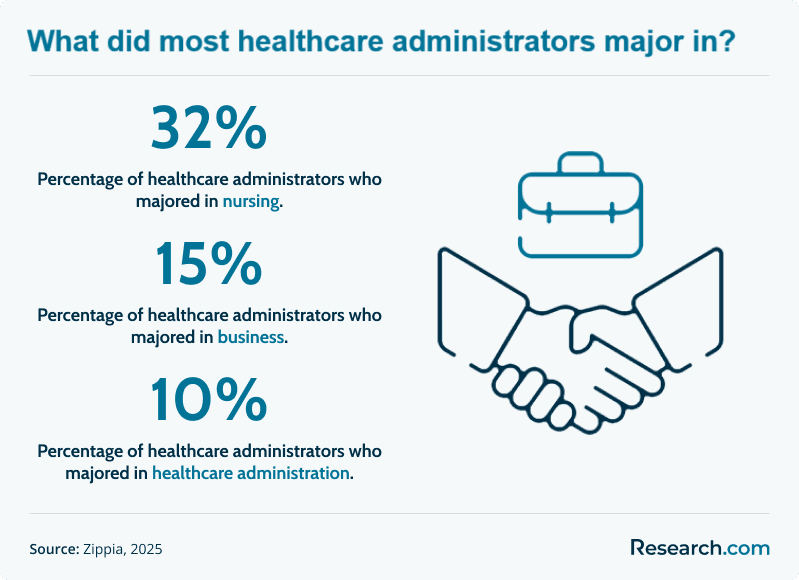
The image below shows the most common majors for healthcare administrators:
Healthcare Management vs. Healthcare Administration: Professional Roles
Before choosing a program, compare the actual work you want to do. A healthcare administration degree may prepare you for roles that keep a facility or department functioning day to day. A healthcare management degree may prepare you for roles that guide business direction, financial performance, organizational growth, and long-range planning.
Healthcare Management Roles
Healthcare managers usually operate at a broader strategic level. They may analyze budgets, evaluate service lines, develop policies, lead organizational change, advise executives, or help healthcare organizations improve performance. Their work is less likely to involve daily scheduling or direct patient service coordination and more likely to involve planning, finance, analytics, and leadership across departments or systems.
Common job titles include:
- Chief Executive Officer (CEO)
- Chief Financial Officer (CFO)
- Healthcare Consultant
- Director of Operations
- Policy Analyst
- Healthcare Project Manager
Healthcare Administration Roles
Healthcare administrators usually focus on making sure a facility, department, clinic, or practice runs effectively. They may coordinate staff, oversee patient flow, manage compliance tasks, support quality improvement, handle scheduling challenges, and communicate with clinicians, patients, vendors, insurers, and regulatory agencies.
Common job titles include:
- Hospital Administrator
- Nursing Home Administrator
- Medical Office Manager
- Clinical Supervisor
- Health Services Coordinator
- Department Head, such as HR, compliance, or patient services leader
Role Comparison
| Career Factor | Healthcare Management | Healthcare Administration |
| Main work focus | Strategy, business performance, finance, policy, and organizational direction | Daily operations, staffing, patient services, compliance, and facility coordination |
| Typical leadership level | Often senior, executive, consulting, or system-level | Often department, facility, clinic, or operational leadership |
| Common work settings | Hospitals, health systems, corporate healthcare offices, insurers, consulting firms, government agencies | Hospitals, clinics, medical practices, nursing homes, rehabilitation centers, long-term care facilities |
| Best suited for | People who enjoy analysis, planning, finance, policy, and organizational change | People who enjoy staff leadership, workflow improvement, compliance, and direct operational problem-solving |
Leadership Levels
Healthcare managers often move into senior roles that influence the direction of an entire healthcare organization, health system, payer, or consulting practice. Healthcare administrators often lead specific facilities, departments, service lines, or patient-facing operations. In larger organizations, both paths can overlap, and experienced administrators may advance into executive operations roles.
Work Focus
Healthcare managers spend more time on financial planning, policy development, competitive positioning, organizational performance, and healthcare market trends. Healthcare administrators spend more time on staff coordination, regulatory procedures, patient service quality, scheduling, facility workflows, and daily operating decisions.
Both degree paths can lead to meaningful leadership roles, but the better choice depends on whether you want to influence healthcare from a strategic business level or from a hands-on operational level. The salary comparison below shows how compensation can differ by role.
Healthcare Management vs. Healthcare Administration: Which degree is right for you?
The best degree is the one that matches the kind of problems you want to solve. If you would rather analyze budgets, plan growth, improve organizational performance, and guide high-level decisions, healthcare management may fit better. If you would rather lead teams, improve patient service workflows, coordinate departments, and keep healthcare facilities operating smoothly, healthcare administration may be the more practical choice.
Choose Healthcare Management If You Want To:
- Work on long-term strategy, business operations, financial planning, or organizational performance.
- Build a career in corporate healthcare, hospital systems, insurance organizations, consulting firms, or government agencies.
- Move toward executive titles such as CEO, CFO, COO, director of operations, or healthcare consultant.
- Analyze market trends, policy changes, reimbursement issues, performance metrics, or expansion plans.
Choose Healthcare Administration If You Want To:
- Lead healthcare staff, manage patient service processes, and supervise facility or department operations.
- Work in hospitals, clinics, physician practices, long-term care facilities, rehabilitation centers, or medical offices.
- Pursue roles such as hospital administrator, department head, clinical supervisor, medical office manager, or health services coordinator.
- Handle scheduling, compliance, patient satisfaction, staff performance, and daily operational challenges.
Decision Guide
| If Your Priority Is... | Stronger Fit | Why |
| Executive leadership | Healthcare management | Management programs usually place more emphasis on strategy, finance, policy, and organization-wide leadership. |
| Running a clinic, department, or facility | Healthcare administration | Administration programs are more directly tied to operations, staffing, compliance, and patient service delivery. |
| Finance, budgeting, and revenue strategy | Healthcare management | Management coursework often includes deeper business and financial decision-making. |
| Staff supervision and patient service improvement | Healthcare administration | Administration roles often require close coordination with clinical teams and frontline operations. |
| Flexibility across healthcare business roles | Healthcare management | The business-focused curriculum can transfer into consulting, policy, insurance, operations, and executive planning. |
| Licensure-linked long-term care leadership | Healthcare administration | Some administrator roles, especially nursing home leadership, may require state-specific licensure. |
The distinction is similar to other business education decisions: the degree title matters less than the curriculum, career outcomes, and skill set. Just as students compare focus areas when choosing between BBA and BS degrees, healthcare leadership students should compare whether a program leans toward business strategy or operational administration.
Healthcare Management vs. Healthcare Administration: Salary and Job Outlook for 2027
Healthcare leadership remains a strong career category because healthcare organizations need people who can manage people, budgets, compliance, facilities, technology, and service quality. The U.S. Bureau of Labor Statistics groups many roles in both fields under medical and health services managers, which includes professionals who plan, direct, and coordinate medical and health services.
Job Outlook
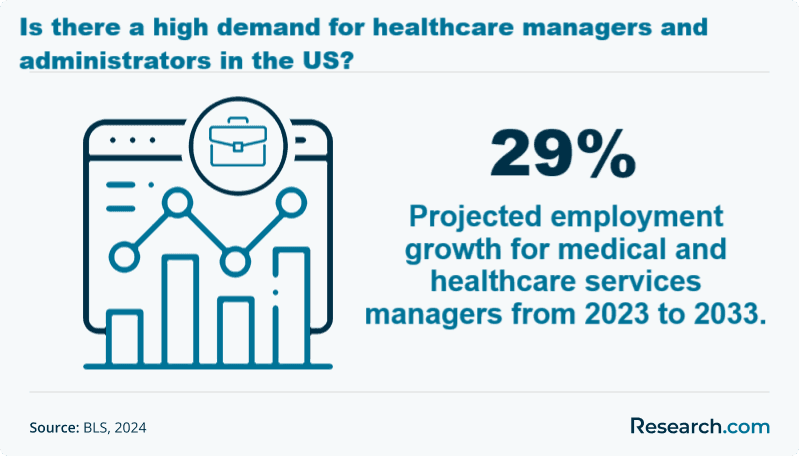
- The U.S. Bureau of Labor Statistics (BLS) projects a 29% increase in employment for medical and health services managers from 2023 to 2033, which is much faster than the national average for all occupations and includes leadership pathways related to careers with a bachelor's degree in management.
- Growth is linked to an aging population, expansion of healthcare services, changing regulations, and the need for leaders who can manage complex medical organizations.
- Potential employers include hospitals, private healthcare networks, insurance companies, government agencies, pharmaceutical firms, long-term care organizations, and outpatient care providers.
Salary Expectations
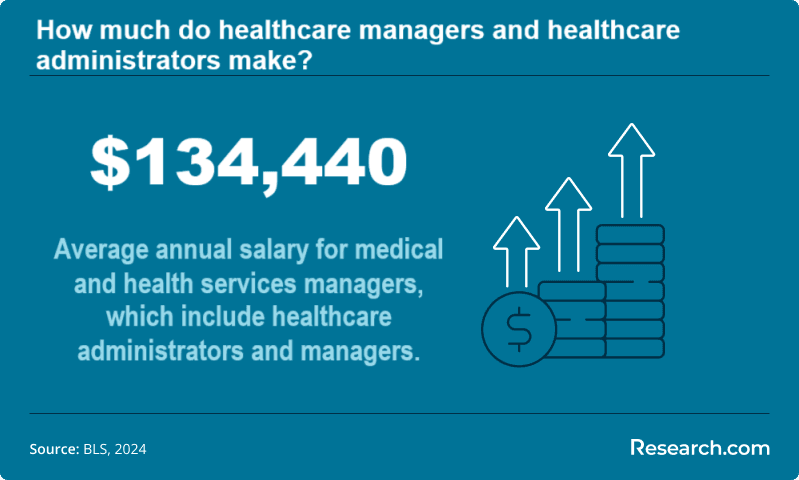
- The average annual salary for medical and health services managers is $134,440.
- According to Nurse.Org, healthcare information officers make an average of $159,500 per year, hospital CEOs make an average of $161,600, hospital chief financial officers make an average of $123,600, hospital administrators make an average of $119,700, and nursing home administrators make an average of $122,000.
Who Typically Earns More?
Healthcare management roles often have higher salary ceilings because they can lead to executive, finance, consulting, and organization-wide leadership positions. Healthcare managers generally earn $80,000 to $120,000, while administrators generally earn $60,000 to $90,000 annually. Actual pay depends on education, experience, employer type, facility size, geography, certifications, and the scope of responsibility.
| Role or Category | Salary Figure Stated | Important Context |
| Medical and health services managers | $134,440 average annual salary | This broad BLS category can include both healthcare management and healthcare administration roles. |
| Healthcare information officers | $159,500 average per year | Technology, informatics, and data leadership can affect compensation. |
| Hospital CEOs | $161,600 average per year | Executive roles usually require substantial leadership experience. |
| Hospital chief financial officers | $123,600 average per year | Finance-focused healthcare leadership may align more closely with healthcare management preparation. |
| Hospital administrators | $119,700 average per year | Administration roles vary widely by hospital size and responsibility level. |
| Nursing home administrators | $122,000 average per year | Some long-term care roles may require state licensure. |
The image below shows the annual average salary of medical and health services managers:
Healthcare Management vs. Healthcare Administration: Common Challenges
Healthcare leadership can be rewarding, but both management and administration roles involve pressure, regulation, and complex decision-making. The challenges differ by level of responsibility. Managers may focus more on strategy, financial performance, and long-term risk. Administrators may focus more on staffing, daily workflows, compliance execution, and patient-facing operations, which are often reflected in a typical healthcare administrator job description.
Shared Challenges
- Regulatory and Compliance Pressure: Leaders must understand healthcare laws, accreditation standards, privacy obligations, and Health Insurance Portability and Accountability Act of 1996 (HIPAA) requirements.
- Staffing and Workforce Strain: Recruiting, retaining, scheduling, and supporting healthcare workers can be difficult, especially when teams face burnout or labor shortages.
- Technology and Data Security: Leaders must help organizations adopt electronic health records (EHR), telemedicine tools, analytics systems, and AI-enabled solutions while protecting patient data.
- Budget Limits: Healthcare leaders must control costs without weakening patient care, staff support, compliance, or quality improvement.
- Crisis and Risk Management: Public health emergencies, cyber incidents, supply disruptions, staffing crises, and patient safety issues require fast and responsible decision-making.
- High-Stress Environments: Leaders are often accountable for operational performance, patient satisfaction, employee morale, financial targets, and regulatory outcomes at the same time.
Challenges More Common in Healthcare Management
- Long-Term Planning: Managers must anticipate policy shifts, reimbursement changes, market competition, service demand, and expansion opportunities.
- Financial and Revenue Cycle Pressure: Cost control, payer relationships, profitability, reimbursement processes, and resource allocation can be central to the role.
Challenges More Common in Healthcare Administration
- Daily Operations: Administrators often manage patient flow, department coordination, staff conflicts, scheduling problems, and service delays.
- Frontline Communication: Administrators interact frequently with clinical teams, patients, families, and support staff, which requires strong conflict resolution and communication skills.
Common Mistakes to Avoid
| Mistake | Why It Can Hurt You | Better Approach |
| Choosing only by degree title | Programs with similar names can have very different curricula. | Compare courses, internships, faculty background, career outcomes, and employer connections. |
| Ignoring accreditation | Employers and graduate schools may question program quality. | Verify institutional accreditation and relevant program-level recognition before enrolling. |
| Focusing only on tuition | Fees, books, travel, lost work hours, and delayed graduation can change total cost. | Calculate total program cost and compare it with realistic career goals. |
| Assuming online programs meet every requirement | Some roles, especially licensure-linked positions, may have state-specific requirements. | Ask whether the program meets requirements in the state where you plan to work. |
| Relying only on rankings | A highly ranked school may not be the best fit for your schedule, budget, location, or specialty. | Use rankings as one factor, not the only factor. |
| Expecting guaranteed salary outcomes | Pay varies by location, experience, employer, credentials, and leadership scope. | Research local job postings and compare required qualifications before committing. |
Healthcare Management vs. Healthcare Administration: What certifications can you get to boost your credentials?
Professional credentials can help healthcare leaders show expertise beyond the degree. They may support advancement, help with specialization, and demonstrate commitment to the field. However, certifications do not replace experience, and their value depends on the role you want, the employer’s expectations, and whether the credential is recognized in your target sector. Students comparing healthcare certifications should look closely at eligibility rules, exam requirements, renewal requirements, and industry recognition.
Certifications for Healthcare Management Professionals
Examples of professional certifications for healthcare managers include:
- Fellow of the American College of Healthcare Executives (FACHE): A respected credential for experienced healthcare executives who want to demonstrate advanced leadership and management capability.
- Certified Healthcare Financial Professional (CHFP): Offered by the Healthcare Financial Management Association (HFMA), this credential is suited to professionals focused on healthcare finance, revenue cycle work, and financial operations.
- Certified Medical Manager (CMM): Offered by the Professional Association of Health Care Office Management (PAHCOM), this credential can be useful for professionals managing small and mid-sized medical practices.
- Lean Six Sigma Certification with a Healthcare Focus: This can help leaders show skills in process improvement, workflow efficiency, cost reduction, and operational quality.
Certifications for Healthcare Administration Professionals
Examples of professional certifications for healthcare administrators include:
- Certified Healthcare Administrator (CHA): A broad credential that can support professionals involved in healthcare facility leadership and operations.
- Certified Professional in Healthcare Quality (CPHQ): A strong option for administrators working in quality improvement, patient safety, compliance, or performance measurement.
- Certified Medical Practice Executive (CMPE): Offered by the Medical Group Management Association (MGMA), this credential is designed for leaders in physician practice management.
- Licensed Nursing Home Administrator (LNHA): A credential required in many states for professionals who manage nursing homes or long-term care facilities.
Shared Certifications Beneficial for Both Fields
- Project Management Professional (PMP): Useful for leaders who manage healthcare implementation projects, facility changes, technology rollouts, or performance improvement initiatives.
- Health Information Management (HIM) Certifications: Credentials such as Registered Health Information Administrator (RHIA) can be valuable for professionals working with medical records, health data, informatics, and compliance.
- Certified Professional in Healthcare Risk Management (CPHRM): Helpful for leaders responsible for patient safety, risk assessment, compliance strategy, and organizational risk reduction.
Certifications can improve credibility, but they do not automatically increase pay. Experience, employer type, geographic market, leadership responsibility, and work setting still matter. For example, location can affect pay, and these states are considered the highest paying for medical and health services managers:
What skills are essential for healthcare management degree holders?
Healthcare management professionals need business judgment, analytical thinking, leadership ability, and a working knowledge of healthcare systems. Their work often involves guiding organizations through financial constraints, regulatory expectations, market shifts, technology adoption, and quality improvement. Students asking what can you do with a master's degree in healthcare administration will often find that many advanced roles require the same combination of strategic, financial, operational, and people-management skills.
- Leadership and Decision-Making: Managers must set priorities, guide teams, evaluate trade-offs, and make decisions that affect services, budgets, employees, and patients.
- Financial and Business Acumen: Budgeting, healthcare economics, revenue cycle awareness, and financial analysis are important for improving efficiency and sustainability.
- Strategic Planning and Policy Development: Managers need to understand industry trends, healthcare policy, payer dynamics, organizational goals, and long-term operational strategy.
- Regulatory and Compliance Knowledge: Familiarity with healthcare law, privacy rules, HIPAA, accreditation expectations, and ethical standards helps leaders reduce organizational risk.
- Data Analysis and Technology Proficiency: Healthcare analytics, EHR systems, dashboards, informatics tools, and performance metrics help managers make evidence-informed decisions.
- Communication and Collaboration: Managers must translate complex decisions for executives, clinicians, staff, board members, vendors, and community stakeholders.
- Problem-Solving and Crisis Management: Effective managers respond to staffing problems, budget constraints, operational disruptions, quality issues, and emergency situations without losing sight of patient care.
What is the return on investment for pursuing healthcare leadership degrees?
The return on investment for a healthcare management or healthcare administration degree depends on program cost, completion time, transfer credit, work schedule, employer tuition support, local job demand, and the type of role you are targeting. A lower-cost program is not automatically the best value if it lacks accreditation, weakens your licensure options, or provides limited career support. A more expensive program is not automatically worth it if it does not improve your access to higher-responsibility roles.
When comparing ROI, estimate tuition and fees, books, technology expenses, transportation or residency costs, and the income you may lose if you reduce work hours. Then compare those costs with realistic job postings in your region. Some learners may also build useful healthcare experience through shorter, lower-cost training first, such as medical billing and coding classes online, before committing to a full leadership degree.
Is accreditation essential for healthcare leadership programs?
Accreditation is one of the first quality checks students should complete. Institutional accreditation helps confirm that a school meets recognized academic standards. Program quality also matters because employers may look for graduates who understand healthcare law, compliance, finance, operations, ethics, data systems, and leadership practice. If a program lacks appropriate recognition, credits may be harder to transfer, graduate admission may be more difficult, and employer confidence may be lower.
Before enrolling, ask whether the school is institutionally accredited, whether the healthcare leadership program has relevant external recognition, how often the curriculum is reviewed, whether internships or practicums are available, and whether the program supports students in the state where they plan to work. Students comparing healthcare education options can also use related program research, such as ultrasound technician school online, to see how accreditation, hands-on requirements, and employer expectations can differ across healthcare fields.
Is professional networking and continuous learning vital for career advancement?
Healthcare leadership careers depend heavily on relationships, credibility, and current knowledge. Regulations change, technology changes, reimbursement models change, and employer expectations change. Networking through professional associations, alumni groups, conferences, mentors, internships, and employer-sponsored committees can help students and professionals learn about roles that may not be visible through job boards alone.
Continuous learning also matters. A healthcare administrator may benefit from stronger coding, data, compliance, or revenue cycle knowledge, while a healthcare manager may need deeper finance, analytics, policy, or project management preparation. For example, a billing and coding online degree may be useful for professionals who want to understand documentation, claims, and revenue cycle operations more deeply.
What is a cost-effective pathway to launching a healthcare leadership career?
Not every student needs to begin with an advanced degree. Some professionals enter healthcare through administrative assistant, medical assistant, billing, coding, records, scheduling, or coordinator roles and then move into leadership after gaining practical experience. This route can help you learn how healthcare teams function, understand patient care workflows, and decide whether management or administration is the better long-term path.
A cost-conscious strategy is to start with an affordable credential, gain healthcare work experience, use employer tuition assistance if available, and then pursue a bachelor’s or master’s degree when your career target is clearer. For students who want a practical entry point, researching the cheapest way to become a medical assistant can be one way to begin building healthcare experience before moving toward leadership.
Is pursuing interdisciplinary specialization beneficial for healthcare leadership?
Interdisciplinary specialization can be valuable when it supports a clear career goal. Healthcare leaders who understand clinical practice, pharmacy, public health, informatics, finance, or analytics may communicate more effectively with specialized teams and make better-informed operational decisions. However, students should avoid adding credentials only because they sound impressive. Each credential should connect to the role they want.
For example, a clinical specialization may be useful for someone who wants to lead pharmacy operations, medication safety initiatives, or clinical service strategy. In that context, researching the quickest PharmD program may make sense. For most general healthcare management or administration roles, however, targeted leadership, finance, operations, compliance, or analytics training may be more directly relevant.
What role does interdisciplinary education play in healthcare leadership?
Healthcare organizations do not operate in separate silos. Leaders often need to understand clinical workflows, business constraints, staffing realities, patient safety expectations, compliance obligations, data systems, and community health needs. Interdisciplinary education can help future leaders connect those areas instead of making decisions from a narrow administrative viewpoint.
Courses in biology, public health, informatics, finance, data analytics, ethics, and organizational behavior can strengthen decision-making when they are connected to healthcare leadership goals. Some students explore broader science foundations through options such as the most affordable online biology degree programs, but the best choice depends on whether that science background supports the student’s intended leadership path.
How can supplementary certifications boost my healthcare leadership career?
Supplementary certifications can fill skill gaps that a degree program may not cover in depth. They can be especially useful in areas such as quality improvement, risk management, project management, health informatics, revenue cycle operations, compliance, or data analytics. The strongest credentials are those recognized by employers in your target role and backed by meaningful requirements.
Before choosing a credential, review job postings and see which certifications employers actually request. Also check eligibility rules, exam format, renewal fees, continuing education requirements, and whether the certification aligns with management or administration. Professionals who want to broaden their healthcare knowledge can compare online medical certification programs as part of a larger career plan.
How can integrating clinical credentials enhance healthcare leadership?
Clinical credentials can strengthen healthcare leadership when the role requires direct understanding of patient care, clinical workflows, provider communication, or specialized service lines. Leaders with clinical insight may be better prepared to evaluate patient safety issues, coordinate with medical teams, and make operational changes that are realistic for frontline staff.
That said, clinical credentials are not required for every healthcare management or administration career. They can be expensive and time-consuming, so students should only pursue them when the credential supports a specific goal. For leaders interested in pharmacy-related operations or clinical strategy, researching options such as the cheapest online PharmD degree programs may help clarify whether additional clinical education is worth the investment.
What skills are essential for healthcare administration degree holders?
Healthcare administrators need strong organizational, communication, compliance, and people-management skills. Their work is often closer to the daily functioning of a facility, department, or medical office, so they must be able to coordinate teams, solve problems quickly, support patient services, and keep operations aligned with regulatory expectations.
- Leadership and Team Management: Administrators guide staff, coordinate departments, set expectations, monitor performance, and support a productive work environment.
- Healthcare Operations and Facility Management: They need to understand patient flow, scheduling, resource allocation, clinical workflows, and service delivery processes.
- Regulatory and Compliance Knowledge: Administrators help facilities follow HIPAA rules, accreditation standards, healthcare policies, documentation requirements, and ethical obligations.
- Interpersonal and Communication Skills: Strong communication is necessary when working with clinicians, patients, families, insurers, vendors, and regulators.
- Problem-Solving and Conflict Resolution: Administrators often address staffing disputes, service delays, patient complaints, workflow breakdowns, and urgent operational issues.
- Budgeting and Financial Oversight: Department-level budgeting, cost control, resource planning, and financial reporting may be part of the role.
- Medical Technology and Record Management: Familiarity with EHR systems, patient management platforms, scheduling tools, and healthcare IT systems is increasingly important.
What are the career advancement opportunities for healthcare management degree holders?
A healthcare management degree online or on campus can support advancement into strategic, executive, consulting, finance, policy, and operations leadership roles. Progression usually depends on experience, education level, employer size, leadership results, and specialized knowledge.
- Entry-Level Positions: Graduates may begin as healthcare project managers, department supervisors, operations assistants, financial analysts, or administrative coordinators.
- Mid-Level Roles: With experience, professionals may move into operations management, policy analysis, revenue cycle leadership, senior financial management, or service line management.
- Executive Leadership: Senior professionals may pursue CEO, CFO, COO, vice president, or system-level director roles in hospitals, health systems, insurance organizations, or healthcare companies.
- Consulting and Entrepreneurship: Some healthcare managers advise organizations on strategy, efficiency, financial planning, compliance, or performance improvement.
- Certifications for Advancement: Credentials such as FACHE or CHFP can strengthen a resume when they match the candidate’s experience and career direction.
- Graduate Education: Many healthcare managers pursue an MHA, MBA with a healthcare focus, or DHA for senior roles. Healthcare MBA jobs may offer higher compensation potential, but they also typically require broader responsibility and stronger leadership experience.
The image below shows how in demand medical and healthcare services managers -- which include healthcare administrators and managers -- are in the United States.
What are the career advancement opportunities for healthcare administration degree holders?
A healthcare administration degree online or on campus can lead to advancement in hospitals, clinics, long-term care facilities, physician practices, rehabilitation centers, and other healthcare settings. Growth often comes from combining operational experience with advanced education, strong performance, and role-specific credentials.
- Entry-Level Positions: Graduates may start as medical office managers, healthcare coordinators, patient services supervisors, department assistants, or administrative supervisors.
- Mid-Level Roles: Experienced professionals may become hospital administrators, clinical operations managers, health services directors, compliance managers, or department heads.
- Senior Leadership and Executive Roles: Advanced administrators may pursue CAO, COO, vice president of operations, or senior facility leadership positions.
- Long-Term Care and Specialized Facility Management: Administrators may specialize in nursing homes, outpatient centers, rehabilitation facilities, or long-term care organizations, sometimes requiring LNHA licensure.
- Consulting and Policy Work: Some professionals move into compliance consulting, healthcare operations advising, policy analysis, or regulatory support roles.
- Advanced Education: Many administrators pursue an MHA, MPH, or DHA to qualify for higher-responsibility roles and broader leadership opportunities.
Here’s What Graduates Have to Say About Their Healthcare Management Degree and Healthcare Administration Degree
- My healthcare management program helped me understand the financial and strategic decisions behind hospital operations. It gave me the confidence to pursue leadership roles where business decisions can still improve patient care. Josie
- Healthcare administration prepared me for the practical side of leading a medical team. The coursework connected directly to staffing, compliance, patient satisfaction, and the real pressures of running a busy facility. Mark
- The management degree gave me a bridge between business problem-solving and healthcare service improvement. I now work in a role where efficiency, access, and patient outcomes all matter. Ellen
Questions to Ask Before Choosing a Program
- What roles do graduates actually get? Ask for recent graduate outcomes by job title, employer type, and degree level.
- Does the curriculum lean toward strategy or operations? Review required courses instead of relying only on the program name.
- Is the school accredited? Confirm institutional accreditation and any relevant program-level recognition.
- Will the program support licensure if you want long-term care leadership? Nursing home administrator requirements can be state-specific.
- Does the program include field experience? Internships, practicums, and residencies can help you build relevant experience before graduation.
- What is the total cost? Include tuition, fees, technology, books, travel, and lost income from reduced work hours.
- Can you transfer credits? Transfer policies can affect cost and time to completion.
- Does online study fit your learning style? Online programs can be flexible, but students still need time for projects, group work, exams, and possible field requirements.
- Are faculty connected to healthcare employers? Instructors with current industry experience may provide more practical insight.
- Which certifications align with the degree? Choose credentials that match your target role rather than collecting unrelated certificates.
References
- Brusie, C.. (2025, January 2). 10 Highest Paying Healthcare Administration Jobs 2025. Nurse.org.
- United States Bureau of Labor Statistics. (2024, April 3). Occupational Employment and Wage Statistics: 11-9111 Medical and Health Services Managers. BLS.
- United States Bureau of Labor Statistics. (2024, April 3). Occupational Employment and Wage Statistics | May 2023 National Occupational Employment and Wage Estimates. BLS.
- United States Bureau of Labor Statistics. (2024, August 29). Occupational Outlook Handbook: Healthcare Occupations. BLS.
- United States Bureau of Labor Statistics. (2024, August 29). Occupational Outlook Handbook: Medical and Health Services Managers. BLS.
Key Insights
- Healthcare management is more strategic; healthcare administration is more operational. Management degrees usually emphasize finance, planning, policy, and executive decision-making, while administration degrees focus more on facility operations, staff supervision, compliance, and patient services.
- Both degrees can lead to strong healthcare leadership careers. The BLS projects 29% employment growth for medical and health services managers from 2023 to 2033, and many roles in both fields fall within this broader category.
- Salary depends on role scope, not just the degree name. Executive, finance, consulting, and system-level roles often have higher earning potential, while facility and department administration roles can still offer strong compensation and advancement.
- Accreditation, experience, and field placement matter. A relevant curriculum, practical experience, and recognized institutional quality can be more important than choosing the program with the most impressive title.
- Licensure can affect administration careers. Students interested in nursing home or long-term care leadership should check state requirements before enrolling.
- The best choice comes from your preferred work style. Choose healthcare management if you want to shape strategy and business performance. Choose healthcare administration if you want to lead people, workflows, facilities, and patient service operations directly.
Other Things You Should Know About the Differences Between a Healthcare Management Degree and a Healthcare Administration Degree
Admission requirements typically include a bachelor's degree from an accredited institution, a minimum GPA of 3.0, and relevant work experience for advanced programs. Some may also require GRE scores or specific prerequisite coursework for 2027 programs.
The course structure for healthcare management programs often focuses on leadership, strategic planning, and finance, while administration programs emphasize operations, human resources, and policy. Typically, healthcare management courses include more management theory and strategic workshops, reflecting different practical applications in 2027.
No. In the United States, both program types are typically evaluated by institutional accreditors such as regional accreditors, while some schools also seek specialized business accreditation like ACBSP or AACSB for management-focused degrees. Healthcare administration programs may also align with CAHME standards in graduate settings.


