
2027 Most Affordable Online Medical Assistant Programs

Co-Founder and Chief Data Scientist
Choosing an online medical assistant program is usually a cost-and-time decision: you want training that is affordable, flexible, and respected by employers, but you also need enough hands-on preparation to qualify for externships, certification exams, and entry-level healthcare roles. Medical assisting remains a practical pathway into healthcare because it can lead to patient-facing and administrative work without requiring a long degree program.
This guide explains what online medical assistant programs include, how much they cost, how long they take, how online and campus formats compare, and which affordable programs are worth reviewing for 2027. It also covers certification, financial aid, accreditation, career outcomes, common mistakes, and the questions to ask before enrolling.
Quick Answer: Are Online Medical Assistant Programs Worth Considering?
Yes, online medical assistant programs can be a strong option if the program is accredited, includes required in-person clinical training, prepares students for certification exams, and fits your budget. Students usually study medical terminology, anatomy, patient care, clinical procedures, billing, records management, and healthcare office administration. Many programs are flexible, but most clinical skills still require labs, practicums, or externships at approved healthcare sites.
- Medical assistants are among occupations that require a postsecondary nondegree qualification, and BLS identified around 119,800 new jobs for medical assistants from 2023 to 2033.
- Online medical assistant program tuition commonly falls around $3,600 to $9,000, although costs vary by school, credential type, state residency, and fees.
- Program length can range from 6 months to 2 years, depending on whether you choose a certificate, diploma, or associate degree.
- Accreditation matters because it can affect certification eligibility, clinical placement quality, employer confidence, and transfer options.
What Can I Expect From Online Medical Assistant Programs?
Online medical assistant programs combine healthcare theory, administrative training, and clinical skill development. The classroom portion may be delivered through recorded lectures, live virtual sessions, digital assignments, discussion boards, simulations, and online exams. However, programs that prepare students for clinical work usually require some in-person training through campus labs, local skills sessions, externships, or practicums.
- You can expect courses in medical terminology, anatomy, physiology, patient intake, clinical procedures, healthcare administration, billing, coding basics, insurance processing, and electronic health records.
- Accredited programs may prepare students for certification exams such as the Certified Medical Assistant (CMA), Registered Medical Assistant (RMA), Certified Clinical Medical Assistant (CCMA), or related credentials.
- Some programs are self-paced, while others use fixed weekly deadlines or cohort schedules.
- Students should verify whether clinical placements are arranged by the school or whether they must secure their own local site.
- Online programs are convenient, but they still require strong time management, reliable internet access, and comfort using learning platforms and healthcare software.
| Program Feature | What It Means for Students | What to Verify Before Enrolling |
| Online coursework | Academic content is completed remotely through a learning platform. | Ask whether classes are asynchronous, live, self-paced, or deadline-based. |
| Clinical labs | Hands-on skills may require scheduled in-person sessions. | Confirm location, frequency, travel requirements, and lab fees. |
| Externship or practicum | Students gain supervised experience in a healthcare setting. | Find out whether the school places students or only provides guidance. |
| Certification preparation | The curriculum may align with CMA, RMA, CCMA, CMAA, CPT, or CET exams. | Ask which exam the program prepares for and whether graduates are eligible. |
| Accreditation | Accreditation signals that the institution or program meets recognized standards. | Check institutional accreditation and, when relevant, programmatic accreditation such as CAAHEP. |
Where Can Graduates Work After Medical Assistant Training?
Medical assistants work in many healthcare environments because their training covers both patient support and office operations. The exact duties vary by employer, state rules, certification, and workplace type.
- Hospitals: Medical assistants may support outpatient departments, specialty units, emergency-related intake processes, or administrative teams.
- Clinics: In physician offices and outpatient clinics, they often prepare exam rooms, document patient information, take vital signs, and assist with routine procedures.
- Private practices: Smaller practices may rely on medical assistants for a broad mix of front-office, patient-care, records, and insurance tasks.
- Urgent care centers: Medical assistants help with check-ins, basic clinical support, minor treatments, and follow-up documentation.
How Much Can I Make With Medical Assistant Training?
The average pay for medical assistants in 2023 was $42,000. The lowest 10% earned less than $33,500, while the highest 10% earned more than $56,480. Pay can differ by state, employer type, experience, certification, shift, and whether the role is primarily clinical or administrative.
According to BLS, average pay in the top industries where medical assistants worked was:
- Outpatient care centers: $46,090
- Hospitals; state, local, and private: $44,350
- Offices of physicians: $40,670
- Offices of other health practitioners: $36,480
For a more detailed earnings comparison, review Research.com’s guide to medical assistant salary by state.
- Most Affordable Online Medical Assistant Programs for 2027
- How Long Does It Take to Complete an Online Medical Assistant Program?
- Online vs. On-Campus Medical Assistant Programs
- Average Cost of Online Medical Assistant Programs
- Financial Aid Options for Medical Assistant Students
- Admission Requirements and Prerequisites
- Common Medical Assistant Courses
- Medical Assistant Specializations
- How to Choose the Best Online Medical Assistant Program
- Career Paths After Medical Assistant Training
- Medical Assistant Job Market
- How Certification Can Improve Your Medical Assistant Career
- How an Associate Degree Can Affect Medical Assistant Pay
- Certifications That Complement Medical Assistant Programs
- How to Compare Affordability and Quality
- Why Accreditation Matters
- Challenges in Online Medical Assistant Programs
- Steps to Move Into Advanced Healthcare Roles
- Using Accelerated Online Degrees for Career Growth
- How IT Skills Can Support Medical Assisting
- Return on Investment for Online Medical Assistant Programs
- Technology Specializations and Career Scope
- Bioinformatics and Medical Assisting
- Digital Tools in Online Medical Assistant Education
- Future Trends in Online Medical Assistant Education
10 Most Affordable Online Medical Assistant Programs for 2027
How We Ranked Schools
To identify affordable online medical assistant options, Research.com reviewed data from recognized education and workforce sources, including the IPEDS database, Peterson's Distance Learning Licensed Data Set, College Scorecard database, and the National Center for Education Statistics.
For more detail on how Research.com evaluates schools and programs, see our research methodology section.
| School and Program | Program Length | Tuition or Cost | Credits or Units | Accreditation |
| Lakewood University Administrative Medical Assistant Certificate | 16 weeks | $7,400 | No information available | Distance Education Accrediting Commission (DEAC) |
| Santa Monica College Office Technology for Health and Wellness | No information available | No information available | 33-36 | Accrediting Commission for Community and Junior Colleges (ACCJC) |
| University of Providence Medical Assistant Certificate | 10 months | $9,315 | 16 | Commission on Accreditation of Allied Health Education Programs (CAAHEP) |
| Mercy College of Health Sciences Medical Assistant Certificate | 1 year | $3,643 per semester | No information available | Higher Learning Commission (HLC) |
| Henry Ford College Medical Assistant Certificate or Degree | 1 year; 2 years | $4,500; $9,500 | 36; 67 | HLC |
| Keiser University AS in Medical Assisting Science | No information available | No information available | 60 | Southern Association of Colleges and Schools Commission on Colleges (SACSCOC) |
| Panola College Medical Assistant Certificate | 3 semesters | $7,591 | No information available | SACSCOC |
| Northwood Technical College Medical Assistant Diploma | 1 year | $5,662 | 32 | CAAHEP |
| Amarillo College Medical Assisting Certificate | No information available | No information available | No information available | SACSCOC |
| Western Texas College Medical Assistant Certificate or Degree | No information available | $69-$161 per hour | 18 semester hours | SACSCOC |
1. Lakewood University Administrative Medical Assistant Certificate
Lakewood University offers an Administrative Medical Assistant certificate that emphasizes healthcare office operations, billing, insurance, medical records, and professional communication. The program includes books, instructor support, and a success coach, making it a structured option for students who want an administrative rather than heavily clinical pathway.
- Program Length: 16 weeks
- Track/Concentration: No information available
- Tuition: $7,400
- Required Units: No information available
- Accreditation: Distance Education Accrediting Commission (DEAC)
2. Santa Monica College, Office Technology for Health and Wellness
Santa Monica College provides Office Technology certificates and degrees with healthcare-focused options. The curriculum is designed for students interested in clerical, records, billing, coding, terminology, and software tasks used in medical office environments.
- Program Length: No information available
- Tracks/Concentrations: Medical Administrative Assistance, Medical Coding and Billing, and more
- Tuition: No information available
- Required Units: 33-36
- Accreditation: Accrediting Commission for Community and Junior Colleges (ACCJC)
3. University of Providence Medical Assistant Certificate
The University of Providence offers a medical assistant certificate that combines online coursework with in-person skills labs in California, Oregon, and Montana. The program includes a practicum and is designed to build both administrative and clinical readiness for certification exams.
- Program Length: 10 months
- Track/Concentration: No information available
- Final Cost: $9,315
- Required Credits: 16
- Accreditation: Commission on Accreditation of Allied Health Education Programs (CAAHEP)
4. Mercy College of Health Sciences Medical Assistant Certificate
Mercy College offers a fully online Medical Assistant Certificate with two six-hour skills labs and 160 clinical practicum hours. The program runs for three semesters divided into two 7-8 week terms and reports a 93% exam pass rate from 2018-2022.
- Program Length: 1 year
- Track/Concentration: No information available
- Tuition Per Semester: $3,643
- Required Units: No information available
- Accreditation: Higher Learning Commission (HLC)
5. Henry Ford College Medical Assistant Certificate/Degree
Henry Ford College offers Medical Assistant training for students preparing for clinical and administrative healthcare roles in clinics, physicians' offices, and related settings. Faculty arrange externships through clinical agencies across Metro Detroit.
- Program Length: 1 year (Certificate of Achievement); 2 years (Associate in Applied Science Degree)
- Track/Concentration: No information available
- Tuition: $4,500 (Certificate of Achievement); $9,500 (Associate in Applied Science Degree)
- Required Credits: 36 (Certificate of Achievement); 67 (Associate in Applied Science Degree)
- Accreditation: HLC
6. Keiser University AS in Medical Assisting Science
Keiser University offers an AS in Medical Assisting Science through five campuses and an online division. The curriculum prepares students for clinical responsibilities such as collecting patient information, assisting during exams, and measuring vital signs.
- Program Length: No information available
- Track/Concentration: No information available
- Tuition: No information available
- Required Units: 60
- Accreditation: Southern Association of Colleges and Schools Commission on Colleges (SACSCOC)
7. Panola College Medical Assistant Certificate
Panola College offers a medical assisting program with coursework, practicums, and externship components requiring 112 and 224 hours, respectively. The program is intended to prepare students for CMAA, CCMA, and CPT exams, with classes scheduled on certain days and clinical training completed in healthcare settings.
- Program Length: 3 semesters
- Track/Concentration: No information available
- Estimated Total Cost: $7,591
- Required Units: No information available
- Accreditation: SACSCOC
8. Northwood Technical College Medical Assistant Diploma
Northwood Technical College offers a Medical Assistant Diploma that blends online and onsite instruction with clinical, administrative, laboratory, and externship training. Coursework includes medical terminology, anatomy, patient care, and office management.
- Program Length: 1 year
- Track/Concentration: No information available
- Estimated Tuition: $5,662
- Required Credits: 32
- Accreditation: CAAHEP
9. Amarillo College Medical Assisting Certificate
The medical assisting program at Amarillo College was established in 2014 and has consistently reported high exam pass rates. The program includes both clinical and administrative training for students preparing for medical assistant roles.
- Program Length: No information available
- Track/Concentration: No information available
- Tuition: No information available
- Required Units: No information available
- Accreditation: SACSCOC
10. Western Texas College Medical Assistant Certificate/Degree
Western Texas College offers certificate and degree options in medical assisting. Graduates may take the RMA exam through American Medical Technologists after completing the program.
- Program Length: No information available
- Tracks/Concentrations: Medical/Clinical Assistant, Medical Administrative Assistant, Associate of Applied Science
- Tuition Per Hour: $69-$161
- Required Semester Hours: 18
- Accreditation: SACSCOC
How Long Does It Take to Complete Online Medical Assistant Programs?
Completion time depends on the credential, schedule, clinical requirements, and whether the student studies full time or part time. Some healthcare employers may train entry-level workers on the job, but many students choose formal vocational training to become more competitive and certification-ready.
Certificate programs are typically the quickest route. Some students finish certificate training in 3 to 9 months, while many accelerated medical assistant programs take less than a year. Associate degree programs usually take longer because they include general education courses and broader healthcare training.
| Path | Typical Timeframe | Best For | Trade-Off |
| Certificate | 3 to 9 months | Students who want the fastest path into entry-level medical assistant work. | May offer fewer general education credits for transfer. |
| Diploma | Often less than 1 year to 1 year | Students who want focused training with clinical and administrative coverage. | May still require scheduled labs or externships. |
| Associate degree | Up to 2 years | Students who want broader preparation and possible future transfer options. | Usually costs more and takes longer than a certificate. |
How Does an Online Medical Assistant Program Compare to an On-Campus Program?
According to NCES data, 26% of students were exclusively enrolled in online courses in 2022. Online medical assistant programs serve students who need flexibility, but they are not entirely hands-off or fully virtual when clinical training is required.
| Factor | Online Program | On-Campus Program | Which Should You Choose? |
| Schedule | Often more flexible, especially for lectures and assignments. | Usually follows fixed class and lab times. | Choose online if you work or have family responsibilities; choose campus if you need structure. |
| Hands-on training | May use local externships, short campus labs, or approved clinical sites. | Labs and skills practice are typically built into campus schedules. | Choose the format that gives you realistic access to clinical practice. |
| Instructor access | Communication may happen through email, video meetings, discussion boards, and office hours. | Students often get direct in-person interaction. | Ask how quickly instructors respond and how skills are evaluated. |
| Cost considerations | May reduce commuting and housing costs. | May involve transportation, parking, or relocation costs. | Compare total cost, not tuition alone. |
| Learning style | Best for independent learners who can manage deadlines. | Better for students who prefer face-to-face accountability. | Be honest about your study habits before choosing. |
What Is the Average Cost of Online Medical Assistant Programs?
DataUSA’s 2022 study reported that medical assistant programs cost $4,119 on average at in-state public institutions and $17,397 at out-of-state private institutions. Online options, including some fast track programs, may reduce expenses tied to commuting or housing, but students should still budget for books, technology, uniforms, health screenings, background checks, labs, externship travel, and certification exams.
Certification can add to the total cost. For example, the certified clinical medical assistant exam administered by the National Healthcareer Association includes a $155 fee.
| Cost Category | Why It Matters | Question to Ask the School |
| Tuition | This is the largest visible cost, but it may not include fees. | Is tuition charged per credit, per course, per semester, or as a flat program cost? |
| Books and supplies | Some programs include materials, while others charge separately. | Are textbooks, scrubs, lab kits, and software included? |
| Clinical requirements | Externships may involve travel, health documents, and background checks. | What out-of-pocket costs are tied to clinical placement? |
| Certification exams | Exam fees can affect the real cost of becoming job-ready. | Does the program fee include certification exam vouchers? |
| Lost work time | Labs and externships may require daytime availability. | Can clinical hours be scheduled around work obligations? |
What Financial Aid Options Are Available for Online Medical Assistant Students?
Statista’s Spring 2023 report found that affordability was a major reason students selected online programs, with 77% naming it as one of their top factors. Even lower-cost medical assistant programs can still create financial pressure, so students should review school-based aid, federal aid eligibility, employer tuition support, payment plans, scholarships, and certification fee assistance.
- Indian Health Service Scholarship: This scholarship can cover full tuition and fees for a year for eligible healthcare students. Members of a federally recognized American Indian tribe or Alaska Native village may qualify.
- Maxine Williams Scholarship: This award provides $1,000 to multiple applicants each year. Students must be nominated by their program director after completing at least one term in an accredited medical assisting program.
- 180 Medical College Scholarship: This scholarship is open to full-time American residents who are under a physician’s care for spinal cord injury, ostomy, neurogenic bladder, and related conditions. Seven $1,000 grants are awarded yearly.
- American Medical Technologists Student Scholarship: AMTIE applicants must be seniors at or graduates of an accredited high school, enrolled in an accredited medical assistant program, and able to demonstrate financial need. Five $500 grants are awarded per year.
If you are comparing healthcare with other helping professions, Research.com also explains how to become a child psychologist, although that path typically requires a much longer education route than medical assisting.
What Are the Prerequisites for Enrolling in Online Medical Assistant Programs?
Admission requirements vary by school, but most programs want evidence that students are ready for healthcare coursework and clinical placement. Requirements may be stricter when a program includes externships in hospitals, clinics, or physician offices.
- High school diploma or GED: Most programs require proof of high school completion or an equivalent credential.
- Basic math and science readiness: Some schools expect prior coursework or placement readiness in biology, math, anatomy, or related subjects.
- Minimum GPA: Certain programs may review high school or college GPA before admission.
- Background check: Clinical sites may require students to pass a criminal background screening before placement.
- Immunization records: Healthcare programs, including some affordable online RN to BSN programs, often require current immunization documentation before clinical work.
What Courses Are Typically Included in Medical Assistant Programs?
Medical assistant training is designed to prepare students for both front-office and patient-care responsibilities. The strongest programs connect online theory with supervised practice so graduates can enter clinical environments with confidence.
- Medical terminology: Students learn the vocabulary, abbreviations, prefixes, suffixes, and documentation language used in healthcare settings.
- Anatomy and physiology: This course explains body systems and functions so students can better understand patient conditions, tests, and procedures.
- Clinical procedures: Students may practice vital signs, injections, EKG preparation, specimen handling, exam room setup, and assisting providers.
- Medical office administration: Coursework covers scheduling, phone communication, records management, billing basics, coding basics, and insurance workflows.
- Medical law and ethics: Students study patient privacy, informed consent, professional boundaries, documentation standards, and legal responsibilities.
Students who later want to move into advanced mental health practice may research affordable online PMHNP programs, but these programs require a different and more advanced nursing pathway.
What Types of Specializations Are Available in Medical Assistant Programs?
Some medical assistant programs let students emphasize a specific work setting or function. Specialization can be useful if you already know the type of healthcare environment you want, but it should not replace broad training in both clinical and administrative fundamentals.
- Clinical medical assisting: Focuses on direct patient support, including injections, lab-related tasks, vital signs, and procedure assistance.
- Administrative medical assisting: Emphasizes scheduling, billing, coding basics, records management, insurance forms, and medical office operations.
- Pediatric medical assisting: Prepares students to support care for children and communicate with young patients and families.
- Geriatric medical assisting: Centers on assisting older adults and understanding common age-related healthcare needs.
- OB-GYN medical assisting: Introduces students to women’s health workflows, prenatal support, reproductive health visits, and routine examination assistance.
Students drawn to administrative work may also compare the best medical coding schools online, since billing and coding credentials can complement medical office experience.
Health, nursing, and medicine are among the most obtained studies by online learners.
How to Choose the Best Online Medical Assistant Program
The best online medical assistant program is not always the cheapest or fastest one. A good choice should be affordable, accredited, transparent about clinical requirements, aligned with certification eligibility, and realistic for your schedule.
- Check accreditation first: Verify institutional accreditation and, when relevant, programmatic accreditation through recognized agencies such as CAAHEP.
- Review the curriculum: Confirm that the program teaches both clinical and administrative skills, not only office procedures or only basic patient care.
- Ask about externships: Find out whether the school secures clinical placements or expects students to locate their own site.
- Compare support services: Look for academic advising, tutoring, technology support, certification exam guidance, and career services.
- Confirm certification alignment: Ask which exam the program prepares students for, such as CMA, RMA, CCMA, or CMAA.
- Evaluate future options: If you may later enter nursing, compare transfer policies and related routes such as fast-track LPN programs online.
| Question to Ask | Why It Matters |
| Is the school accredited, and by whom? | Accreditation affects credibility, aid eligibility, and sometimes certification or transfer options. |
| Does the program include a practicum or externship? | Hands-on training is essential for clinical confidence and employer readiness. |
| Who arranges clinical placement? | Students may face delays if they must find their own site without school support. |
| Which certification exam will I be eligible for? | Not every program prepares students for the same credential. |
| What is the full cost after fees? | Books, labs, exams, uniforms, and background checks can change affordability. |
| What are the graduation, exam pass, and placement outcomes? | Outcomes help you judge whether the program delivers value beyond low tuition. |
What Career Paths Are Available for Graduates of Medical Assistant Programs?
Medical assistant graduates can pursue clinical, administrative, and specialty support roles. Some positions require additional certification or experience, so students should match their training to the job descriptions used by local employers.
- Certified Medical Assistant: CMAs support providers and patients by taking vital signs, preparing rooms, documenting information, and assisting with routine procedures.
- Administrative Medical Assistant: These professionals handle scheduling, patient records, insurance communication, billing support, and front-office workflow.
- Phlebotomy Technician: With additional training or certification, medical assistants may specialize in blood collection and specimen handling.
- EKG Technician: Medical assistants who build EKG skills may support cardiac testing in hospitals, cardiology offices, and outpatient centers.
- Medical Office Manager: Experienced medical assistants may move into supervisory roles that involve staffing, scheduling, workflow coordination, and patient service management.
If your long-term goal involves therapy or rehabilitation, you may eventually compare fields such as speech-language pathology. Research.com’s overview of highest-paying SLP jobs can help you understand how far that path differs from medical assisting in education and licensure requirements.
What Is the Job Market for Graduates With Medical Assistant Training?
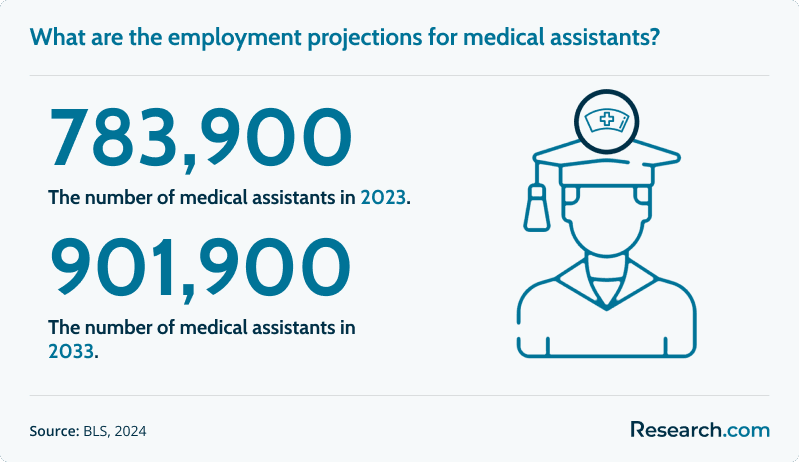
Medical assistant programs are often discussed among online degrees that pay well because they can lead to healthcare employment without a long academic timeline. Employment for medical assistants is projected to grow by 15% through 2033, much faster than the average for all occupations.
Job openings are expected to come from both growth and replacement needs as workers change occupations or leave the labor force. The aging baby-boom population is also increasing demand for healthcare services, which can expand the need for medical assistants in primary care and outpatient settings.
How Can Certification Boost My Career in Medical Assisting?
Certification can help medical assistant graduates show employers that they meet a recognized standard in clinical and administrative skills. It may improve competitiveness for jobs, support advancement into specialized responsibilities, and demonstrate professional commitment. Certification does not guarantee employment or a specific salary, but many healthcare employers prefer or require it.
For a step-by-step credentialing overview, see Research.com’s guide on how to become a certified medical assistant.
How Does an Associate Degree Impact My Medical Assistant Salary?
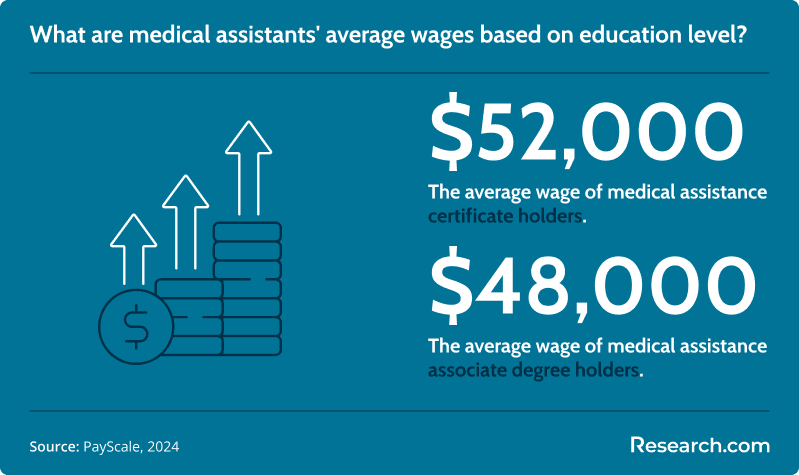
An associate degree may strengthen a medical assistant’s background by adding general education, broader healthcare coursework, and more time for skill development. It can also help students who may later transfer into nursing, healthcare administration, or allied health programs. However, the degree takes longer than a certificate, and higher earnings are not automatic.
Before choosing the associate route, compare the added tuition and time against local employer requirements and salary patterns. Research.com’s medical assistant salary by state resource can help you evaluate regional earnings.
What Are the Top Certifications to Complement an Online Medical Assistant Program?
Additional certifications can make a medical assistant more versatile, especially in clinics that need staff who can perform both patient-care and office tasks. Choose credentials based on the jobs you want, not just the number of letters after your name.
| Certification | Best Fit | Career Value |
| Certified Medical Assistant (CMA) | Students seeking a broad and widely recognized medical assistant credential. | Validates both administrative and clinical knowledge. |
| Registered Medical Assistant (RMA) | Graduates whose employers recognize American Medical Technologists credentials. | Can support clinical or administrative medical assistant roles. |
| Certified Clinical Medical Assistant (CCMA) | Students focused on direct patient-care responsibilities. | Emphasizes clinical tasks such as taking blood pressure, assisting with procedures, and lab-related duties. |
| Certified Phlebotomy Technician (CPT) | Medical assistants who want blood collection skills. | Can expand opportunities in labs, clinics, hospitals, and diagnostic settings. |
| Certified EKG Technician (CET) | Students interested in cardiac testing support. | Shows competency in EKG-related procedures. |
| Medical billing and coding certification | Administrative medical assistants who want more back-office specialization. | Can support insurance, claims, coding, and records-focused roles. |
| CPR and first aid certification | Nearly all patient-facing healthcare workers. | Provides emergency-response preparation that many employers expect. |
If speed is your main priority, compare options in Research.com’s guide to the fastest medical assistant programs.
How Can I Effectively Compare Affordability and Quality in Online Medical Assistant Programs?
Affordability should be measured by total cost and outcomes, not advertised tuition alone. A program with a low sticker price may become expensive if certification fees, clinical travel, supplies, or repeated courses are not included. A higher-cost program may be worthwhile if it has strong externship support, transparent outcomes, and certification preparation.
Use a side-by-side cost worksheet and include tuition, fees, materials, uniforms, health records, technology, certification exams, and lost work hours. Research.com’s medical assistant program cost guide can help you organize those comparisons.
Is Accreditation Essential for Evaluating Online Medical Assistant Programs?
Yes. Accreditation is one of the first filters students should use when evaluating online medical assistant programs. It helps confirm that the school or program has been reviewed against recognized standards. In some cases, accreditation can affect certification exam eligibility, transfer opportunities, financial aid access, and employer confidence.
Students should verify accreditation directly through the accreditor or school catalog rather than relying only on marketing pages. If you are exploring other healthcare education routes, Research.com also compares options such as affordable online doctorate in pharmacy programs, but pharmacy requires a very different level of education than medical assisting.
What Challenges Might I Encounter in Online Medical Assistant Programs?
Online medical assistant programs can be convenient, but they require planning. Students may struggle if they underestimate the hands-on components, assume the school will arrange every clinical detail, or choose a program without enough instructor support.
- Clinical placement delays: Externships may depend on site availability, background checks, immunizations, and scheduling.
- Limited in-person practice: Online students need to confirm how they will practice and be evaluated on clinical skills.
- Technology demands: Students must manage learning platforms, video tools, digital assignments, and healthcare software practice.
- Time management pressure: Flexible programs still require consistent study time and deadline tracking.
- Certification confusion: Not every online program leads to the same exam eligibility.
Students who want more administrative technical training can also review short options such as 4-week online medical coding and billing courses, but they should verify whether those courses meet their career goals.
How to Transition Into Advanced Healthcare Roles After Completing a Medical Assistant Program
Medical assisting can be a practical starting point for healthcare careers because it exposes workers to patient care, documentation, scheduling, provider workflows, and clinical environments. To move beyond entry-level medical assisting, you will usually need additional credentials, education, or specialized experience.
- Choose a direction: Decide whether you prefer direct patient care, administration, lab work, imaging, health technology, or leadership.
- Add targeted certifications: Credentials such as CMAA, CCMA, CPT, or CET can strengthen your qualifications for specific roles. Research.com’s list of quick medical certifications can help you compare short healthcare credentials.
- Build experience in a specialty setting: Work in departments such as pediatrics, dermatology, cardiology, OB-GYN, or urgent care to develop focused skills.
- Continue your education when needed: Roles such as registered nurse, medical technologist, physician assistant, and healthcare manager require additional formal education.
- Use mentors and supervisors: Ask experienced healthcare professionals which credentials are valued in your local job market.
Advanced Roles Medical Assistants May Consider
- Registered Nurse: A common next step for medical assistants who want broader patient-care responsibilities.
- Medical and Health Services Manager: A possible goal for those interested in operations, scheduling, compliance, and leadership.
- Diagnostic Medical Sonographer: A specialized imaging career requiring additional education and training.
- Physician Assistant: A graduate-level clinical pathway that requires extensive prerequisites and advanced education.
Advancing Your Healthcare Career With Accelerated Online Degrees
After gaining experience as a medical assistant, some professionals pursue healthcare administration or related degrees to move toward supervisory, operations, or management roles. Accelerated programs may be attractive to working adults, but students should make sure speed does not come at the expense of accreditation, transfer value, or manageable workload.
If leadership is your goal, compare accelerated healthcare administration degree online options and ask whether prior healthcare experience, transfer credits, or certifications can shorten your timeline.
How Can an IT Background Complement My Medical Assisting Skills?
Medical assistants increasingly work with electronic health records, scheduling systems, patient portals, billing platforms, and digital documentation tools. IT knowledge can make you more comfortable with these systems and may help you move toward health information, clinical informatics support, or healthcare operations roles.
Students who want a technology-heavy path can research an accelerated computer science degree, although that route is much broader than the technical skills required for medical assisting.
How Do Interactive Digital Tools Enhance Online Medical Assistant Programs?
Digital tools can make online medical assistant training more interactive. Programs may use virtual simulations, video demonstrations, skills checklists, electronic health record practice, quiz systems, and video feedback to help students build confidence before in-person labs or externships.
However, digital tools cannot fully replace supervised hands-on practice. Students should ask how virtual activities connect to real clinical skill assessments. Those interested in deeper technical development may compare adjacent fields such as affordable online software engineering degrees, but software engineering is a separate career path from medical assisting.
What Future Trends Are Shaping Online Medical Assistant Education?
Online medical assistant education is being influenced by digital health records, telehealth workflows, simulation tools, patient data systems, and employer expectations for flexible clinical and administrative skills. Programs that stay current may include more practice with electronic documentation, remote communication, healthcare software, and technology-supported patient intake.
Students should not assume every online program teaches these skills well. Review syllabi and ask whether telehealth, EHR, privacy, and digital communication are included. Professionals who later want to specialize in healthcare data may explore accelerated online master's in health informatics programs, which are designed for more advanced study.
What Is the Return on Investment for Online Medical Assistant Programs?
ROI depends on the total price of training, how quickly you finish, whether you pass certification exams, your local wages, and how soon you obtain employment. A low-cost program can still be a poor investment if it lacks accreditation, clinical placement support, or certification alignment. A more expensive program may be reasonable if it has strong outcomes and reduces barriers to employment.
To evaluate ROI, compare program cost against the average pay for medical assistants in 2023, which was $42,000, and include extra costs such as certification fees and future training. If you are considering administrative add-ons, compare related expenses such as medical billing and coding classes cost.
How Can Advanced Technological Specializations Broaden Your Career Scope?
Medical assistants who develop technology and data skills may be better prepared for roles involving electronic records, workflow improvement, patient information systems, and healthcare operations. These skills are especially useful in larger clinics, hospitals, and outpatient networks that rely on accurate documentation and coordinated digital systems.
For students interested in healthcare data at a much higher level, Research.com’s guide to online bioinformatics master's programs explains a more advanced interdisciplinary pathway.
How Can Bioinformatics Elevate My Medical Assisting Career?
Bioinformatics is not a standard requirement for medical assistants, but understanding healthcare data can be useful for professionals who plan to move into informatics, research support, health data management, or advanced interdisciplinary roles. Medical assisting can provide practical clinical exposure, while bioinformatics requires additional education in data, biology, and computing.
If this direction interests you, compare affordable online master's in bioinformatics programs after confirming the prerequisites and career outcomes.
Common Mistakes to Avoid When Choosing an Online Medical Assistant Program
| Mistake | Why It Can Hurt You | Better Approach |
| Choosing only by lowest tuition | Cheap programs may exclude fees, books, exams, or clinical costs. | Compare the full cost of attendance and certification expenses. |
| Ignoring accreditation | Unaccredited options may limit certification eligibility or employer acceptance. | Verify accreditation through official accreditor databases. |
| Assuming online means no in-person work | Clinical skills usually require labs, practicums, or externships. | Ask exactly where, when, and how hands-on training is completed. |
| Not checking certification alignment | You may finish training and discover you are not eligible for your preferred exam. | Ask which certification exam graduates can take. |
| Overlooking local employer preferences | Employers in your area may prefer specific credentials or clinical experience. | Review job postings and speak with local clinics before enrolling. |
| Relying only on rankings | A ranked program may not fit your state, schedule, budget, or externship needs. | Use rankings as a shortlist, then verify details directly with each school. |
Key Insights
- Online medical assistant programs can be worthwhile when they are accredited, clinically structured, certification-aligned, and transparent about total costs.
- Program timelines vary widely: certificate programs may take 3 to 9 months, while associate degree options can take up to 2 years.
- DataUSA reported average medical assistant program costs of $4,119 at in-state public institutions and $17,397 at out-of-state private institutions.
- In 2022, 26% of students enrolled exclusively in online courses, showing that online learning is now a common education format.
- Medical assistants earned an average pay of $42,000 in 2023, but pay varies by industry, location, certification, and experience.
- BLS projects medical assistant employment to grow by 15% through 2033, with 901,900 medical assistants expected by 2033.
- Health, nursing, and medicine accounted for 19% of online students’ study fields, reflecting continued interest in online healthcare education.
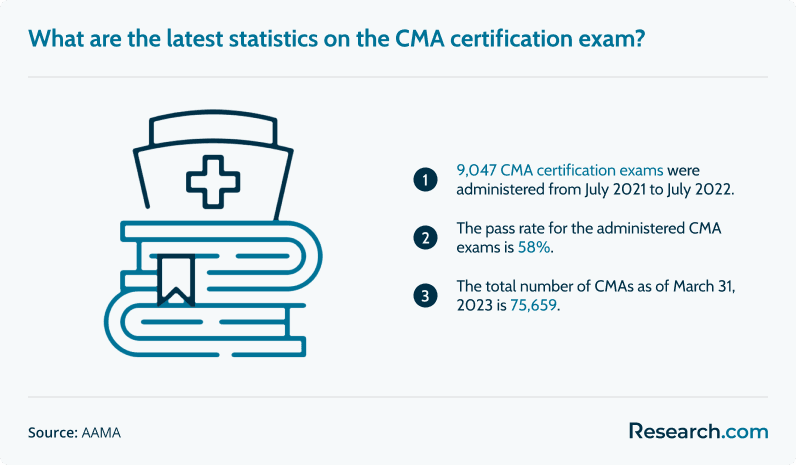
- The CMA exam pass rate is 58%, so students should choose programs with strong exam preparation and support.
- The best program is not simply the cheapest; it is the one that balances affordability, accreditation, externship access, certification readiness, and fit with your schedule.
References
- Bureau of Labor Statistics. (2024, August). Education level and projected openings, 2023-33. Retrieved October 2, 2024, from BLS.
- Bureau of Labor Statistics. (2024, August 29). Medical Assistants: Pay. Retrieved October 2, 2024, from BLS.
- DataUSA. (2022). Medical Assistant. Retrieved October 2, 2024, from DataUSA.
- Indeed. (2022, November 29). FAQ: How Long Does It Take To Become a Medical Assistant? Retrieved October 2, 2024, from Indeed.
- Korhonen, V. (2024, July 5). Reasons for online college selection among students in the U.S. 2023. Retrieved October 2, 2024, from Statista.
Other Things You Should Know About Online Medical Assistant Programs
Most affordable online medical assistant programs in 2027 require a high school diploma or GED. Some programs might also request a background check or specific prerequisite courses in subjects like biology. It's best to check individual program requirements for detailed information.
Yes. Most accredited online medical assistant programs require applicants to have a high school diploma or GED, and some also ask for a minimum GPA, background check, and proof of immunizations before clinical training starts. Program admissions offices publish these requirements on their official websites.


