
2027 Best Accelerated Online Master’s in Health Informatics Programs

Co-Founder and Chief Data Scientist
As a specialist in career and education planning, I frequently assist professionals aiming for rapid advancement in fields that intersect with technology and societal progress. The pursuit of the fastest online Master's degree in Health Informatics is a popular goal, yet the process is fraught with challenges.
The digital landscape is cluttered with programs making bold claims about completion times, making it difficult to discern credible, accredited options from those that are merely well-marketed. The critical task is to evaluate a program's true value and rigor beyond its advertised speed.
My purpose is to provide expert clarity, helping you identify a genuinely accelerated program that upholds academic standards and meets your career objectives.
What are the benefits of getting a qualification from the fastest online Master’s in Health Informatics programs?
- Accelerated Career Advancement: An advanced degree in health informatics can quickly qualify you for leadership roles such as Health Informatics Manager, Clinical Analyst, Health IT Project Manager, or Chief Medical Information Officer.
- Increased Earning Potential: A bachelor's degree holder might start earning around $60,000, professionals with a master's degree can command salaries for management and senior analyst positions that average from $90,000 to well over $130,000 annually.
- Flexible Learning: The accelerated online format provides the convenience of earning a graduate degree on a condensed timeline, allowing you to balance advanced education with your current career.
What can I expect from the fastest online Master’s in Health Informatics programs?
- Focused Advanced Topics: Expect an intensive curriculum centered on key areas like data analytics, electronic health records (EHRs), clinical decision support systems, health data security, and project management.
- Structured Curriculum: Delivery typically combines recorded lectures, live online seminars, practical application projects, and often a capstone or practicum experience.
- Applied Strategic Knowledge: Emphasis is placed on solving real-world healthcare challenges through data-driven insights, technology implementation, and the strategic application of information systems.
- Condensed Timeline: Programs are designed to be completed quickly, often in 12-24 months, through year-round, intensive 7- or 8-week course formats.
Where can I work with an online Master’s in Health Informatics degree?
- Hospitals and Health Systems: Secure positions as data analysts, EHR implementation specialists, or health IT managers.
- Technology Companies and Startups: Work for vendors developing EHR systems, data analytics platforms, and telehealth solutions.
- Consulting Firms: Advise healthcare organizations on technology implementation, workflow optimization, and data strategy.
- Public Health Organizations: Manage health data and information systems for government agencies at the local, state, and federal levels.
- Pharmaceutical and Biotech Companies: Support clinical research and data management through informatics expertise.
- Insurance Companies: Analyze health data to improve care quality, manage costs, and assess risk.
How much can I earn with an online Master's in Health Informatics degree?
- Analyst-Level Roles: Health Informatics Analysts and Clinical Analysts typically earn between $70,000 and $95,000.
- Manager-Level Roles: Health IT Project Managers and Informatics Managers earn $95,000-$125,000+, with salaries varying by the size and complexity of the organization.
- Director-Level Roles: Directors of Health Informatics and Chief Medical Information Officers earn $130,000+, often exceeding $180,000 based on the healthcare system and location.
- Best Accelerated Online Master's in Health Informatics Programs for 2027 List of Programs
- What is the average cost of an online Master's degree in Health Informatics? Average Cost
- What are the financial aid options for an online Master's degree in Health Informatics? Financial Aid
- What are the prerequisites for enrolling in an online Master's degree in Health Informatics? Prerequisites
- What courses are typically in an online Master's degree in Health Informatics? What courses are typically in an online Master's degree in Health Informatics?
- What types of specializations are available for Master's degree in Health Informatics graduates? What types of specializations are available for Master's degree in Health Informatics graduates?
- How do you choose the best online Master's degree in Health Informatics? How do you choose the best online Master's degree in Health Informatics?
- What career paths are available for graduates of online Master's degree in Health Informatics programs? Career Paths
- How much can I earn with an online Master's degree in Health Informatics? Salary
- What is the job market like for graduates with an online Master's degree in Health Informatics? Job Market
- What are some current and future trends in health informatics? What are some current and future trends in health informatics?
- What challenges might I encounter in an online Master's in Health Informatics program? What challenges might I encounter in an online Master's in Health Informatics program?
- How do I verify the accreditation and quality of online Master's in Health Informatics programs? How do I verify the accreditation and quality of online Master's in Health Informatics programs?
- How does the long-term return on investment compare for online Master's in Health Informatics programs? How does the long-term return on investment compare for online Master's in Health Informatics programs?
- What career development support is available in online Master’s in Health Informatics programs? What career development support is available in online Master’s in Health Informatics programs?
Best Accelerated Online Master's in Health Informatics Programs for 2027
Choosing an accelerated online master’s in health informatics is not just about finding the shortest program. The better question is whether a program can help you build usable skills in clinical data, electronic health records, analytics, healthcare operations, privacy, and technology implementation without forcing you to pause your career. This guide is for clinicians, healthcare administrators, IT professionals, data analysts, and career changers who want a faster graduate pathway into health informatics roles.
Health informatics matters because healthcare organizations now depend on digital records, patient portals, analytics tools, remote care platforms, and secure data exchange. A strong program should teach you how healthcare works, how data moves through systems, how technology affects patient care, and how to lead informatics projects responsibly. If you are more interested in computational biology, genomics, or scientific data, compare this path with an accelerated online bioinformatics master’s degree before applying.
Quick answer: What is the best accelerated online master’s in health informatics?
The best accelerated online master’s in health informatics depends on your background and goal. Duke University is one of the fastest options listed here at 12 months and uses a cohort-based clinical informatics model. Vanderbilt University offers a 21-month applied clinical informatics program with a 240-hour practicum. George Mason University and the University of Illinois, Chicago offer CAHIIM-accredited online options with analytics and management-focused pathways. Applicants should compare accreditation, practicum structure, total cost, online flexibility, concentrations, and whether the curriculum fits clinical, data, public health, or leadership goals.
How Research.com evaluates schools
Graduate education is a major investment, so our ranking approach emphasizes transparent data, academic quality, and decision usefulness. Our methodology draws from recognized education and institutional data sources, including:
- IPEDS database
- Peterson's database, including its Distance Learning Licensed Data Set
- College Scorecard database
- National Center for Education Statistics
Accelerated online master’s in health informatics programs at a glance
| School | Program length | Credits or courses | Concentrations or tracks | Accreditation listed |
| Duke University | 12 months | 38 credits, cohort-based, full-time | No formal tracks; multidisciplinary curriculum | Southern Association of Colleges and Schools Commission on Colleges (SACSCOC) |
| Johns Hopkins University | 1-3 years (part-time) | Not explicitly stated; typical master’s credit load applies | No formal tracks; electives allow customization | Middle States Commission on Higher Education (MSCHE); Commission on Accreditation for Health Informatics and Information Management Education (CAHIIM) |
| Northwestern University | Variable (typically 18–24 months) | 12 courses | Clinical Informatics, Health Technology Informatics, Health Administration Informatics | Higher Learning Commission (HLC) |
| University of North Carolina at Chapel Hill | 18–24 months (full-time or part-time) | 35 | Clinical Informatics, Public Health Informatics | Southern Association of Colleges and Schools Commission on Colleges (SACSCOC) |
| University of Texas Health Science Center at Houston | 12–24 months (full-time or part-time) | 39 | Research Track, Applied Biomedical Informatics Track | Commission on Accreditation for Health Informatics and Information Management Education (CAHIIM) |
| Vanderbilt University | 21 months | 36 | No formal tracks; comprehensive clinical informatics curriculum | Commission on Accreditation for Health Informatics and Information Management Education (CAHIIM) |
| George Mason University | 22–28 months | 36 | Health Data Analytics, Health Informatics Management | Commission on Accreditation for Health Informatics and Information Management Education (CAHIIM) |
| Arizona State University | Approximately 15 months (10 courses, 7.5 weeks each) | 30 | No formal tracks; broad health informatics focus | Higher Learning Commission (HLC) |
| University of Illinois, Chicago | Up to 30 months (accelerated options may be available) | 38 | Health Data Science, Consumer and Mobile Health, Leadership | Commission on Accreditation for Health Informatics and Information Management Education (CAHIIM) |
| Logan University | 1 year (accelerated option) | 36 | Healthcare Leadership, Data Analytics, Applied Informatics | Higher Learning Commission (HLC) |
1. Duke University
The Duke University Master of Management in Clinical Informatics (MMCi) is built for professionals who want to lead technology-enabled change in healthcare. Offered through the Duke University School of Medicine, the program combines clinical informatics, healthcare leadership, data-driven decision-making, and business management in an intensive one-year format.
The degree runs from August to August and blends online learning with on-campus components. Students move through the curriculum in a full-time cohort and complete three courses in each twelve-week academic term, along with an ethics course. Team-based coursework places students in groups of four to five, which helps simulate the collaboration required in healthcare IT, clinical operations, and informatics leadership roles.
The 15 required courses leave no room for electives, so this is best for students who want a structured, comprehensive clinical informatics curriculum rather than a highly customizable degree. Topics include managerial accounting, health care finance, AI in healthcare, and digital health strategy.
A required practicum gives students direct experience with healthcare systems and informatics problems. Prior practicum work has included projects such as an EHR data needs assessment and timing guidelines for patient transfers. Career coaching, networking events, and employer connections are also integrated into the program.
- Program Length: 12 months
- Tracks/Concentrations: No formal tracks; multidisciplinary curriculum
- Tuition Cost: Tuition with scholarship $60,012, 12 months; Tuition without scholarship $70,312.00
- Required Credits to Graduate: 38 credits, cohort-based, full-time
- Accreditation: Southern Association of Colleges and Schools Commission on Colleges (SACSCOC)
2. Johns Hopkins University
The online Master of Science in Applied Health Sciences Informatics at Johns Hopkins University is designed for students who want practical informatics preparation for clinical, research, or public health environments. The program emphasizes how information technology can be applied to improve healthcare delivery, public health work, and organizational decision-making.
Students complete core courses, electives, a student seminar, and Grand Rounds. The curriculum introduces central concepts through courses such as Introduction to Biomedical Informatics, Applied Clinical Informatics, and Database Querying in Health.
The program ends with a faculty-supervised, student-designed capstone project. This 200-hour experience allows students to apply informatics competencies to a professional problem, making it especially useful for working professionals who want a portfolio-ready project tied to real healthcare needs.
- Program Length: 1-3 years (part-time)
- Tracks/Concentrations: No formal tracks; electives allow customization
- Tuition Cost: $13,870/year
- Required Credits to Graduate: Not explicitly stated; typical master’s credit load applies
- Accreditation: Middle States Commission on Higher Education (MSCHE); Commission on Accreditation for Health Informatics and Information Management Education (CAHIIM)
3. Northwestern University
Northwestern University offers an online Master’s in Health Informatics through a program connected with the Feinberg School of Medicine. The curriculum is designed for students who want to work where healthcare, information systems, data, and organizational leadership meet.
Students complete required and core coursework, then choose three electives aligned with a specialization. The available areas are Clinical Informatics, Health Technology Informatics, and Health Administration Informatics. This makes the program suitable for applicants with different backgrounds, including clinicians, administrators, and technology professionals.
The capstone requires each student to develop an independent applied project. Students may use a challenge from their own workplace, partner with a sponsor organization, or build a solution around a case-study problem. The online classroom is led by instructors with professional experience in health informatics and related fields.
- Program Length: Variable (typically 18–24 months)
- Tracks/Concentrations: Clinical Informatics, Health Technology Informatics, Health Administration Informatics
- Tuition Cost: Estimated total $63,132 (in-state and out-of-state)
- Required Credits to Graduate: 12 courses
- Accreditation: Higher Learning Commission (HLC)
4. University of North Carolina at Chapel Hill
The Master of Professional Science in Biomedical and Health Informatics at the University of North Carolina at Chapel Hill is a 35-credit, non-thesis program offered online or on campus. It is interdisciplinary by design and prepares students to work with healthcare systems, health data, informatics tools, and large-scale projects.
Students choose between Clinical Informatics and Public Health Informatics. The curriculum includes informatics foundations, database systems, healthcare systems, a practicum, and a capstone project. Faculty expertise spans information science, public health, medicine, and related areas.
This program may work well for professionals who want flexibility but still need applied experience. Graduates can pursue roles in healthcare IT, public health agencies, research organizations, and informatics project environments.
- Program Length: 18–24 months (full-time or part-time)
- Tracks/Concentrations: Clinical Informatics, Public Health Informatics
- Tuition Cost: $10,552 (in-state); $28,278 (out-of-state)
- Required Credits to Graduate: 35
- Accreditation: Southern Association of Colleges and Schools Commission on Colleges (SACSCOC)
5. University of Texas
The McWilliams School of Biomedical Informatics at the University of Texas Health Science Center at Houston offers a Master of Science in Biomedical Informatics with two online tracks: Research Track and Applied Biomedical Informatics Track. Students may enroll full-time or part-time.
The research track focuses on how health data is captured, processed, interpreted, and turned into knowledge that can support clinical decision-making. The applied track is aimed at students who want to solve practical healthcare problems using data, technology, and informatics strategy.
Both tracks require a practicum. Students work in a professional setting under a preceptor, develop a project proposal with faculty guidance, and complete a capstone report. This structure is valuable for students who want evidence of applied competency in addition to coursework.
- Program Length: 12–24 months (full-time or part-time)
- Tracks/Concentrations: Research Track, Applied Biomedical Informatics Track
- Tuition Cost: Resident: $6,240; Non-Resident: $20,832
- Required Credits to Graduate: 39
- Accreditation: Commission on Accreditation for Health Informatics and Information Management Education (CAHIIM)
6. Vanderbilt University
The online Master of Science in Applied Clinical Informatics (MS-ACI) at Vanderbilt University is designed for working professionals who want to advance into clinical informatics roles while remaining employed. The program can be completed in 21 months and connects students with Vanderbilt University Medical Center HealthIT and clinical informatics faculty.
During the first year, students take three courses each semester through a mix of synchronous and asynchronous learning. The second year shifts toward capstone work, where students plan, implement, and evaluate a clinical informatics solution.
The practicum begins in the first semester and requires 240 hours. Students work in interdisciplinary teams on significant informatics challenges and may complete the experience at Vanderbilt or at their home institution. In the final nine months, students lead an initiative in their own workplace, making this program especially relevant for healthcare professionals who already have access to clinical or operational problems.
- Program Length: 21 months
- Tracks/Concentrations: No formal tracks; comprehensive clinical informatics curriculum
- Tuition Cost: Year 1 tuition: $54,180; Year 2 tuition: $15,482
- Required Credits to Graduate: 36
- Accreditation: Commission on Accreditation for Health Informatics and Information Management Education (CAHIIM)
7. George Mason University
George Mason University offers a 100% online Master of Science in Health Informatics through Virginia’s first and only College of Public Health. The program is designed for clinicians, administrators, IT professionals, data-focused applicants, and career changers who want a bridge between healthcare and technology.
Students choose either Health Data Analytics or Health Informatics Management. The analytics concentration emphasizes data science and machine learning, while the management concentration focuses on health information systems, implementation, and leadership. Core courses cover areas such as Introduction to Health Informatics and Health Care Databases.
Online students learn from the same faculty who teach on campus, including health informaticians, data science experts, and health services researchers. Graduates from the analytics path often work with healthcare providers or government agencies, while management graduates may pursue IT leadership, project management, or consulting roles.
- Program Length: 22–28 months
- Tracks/Concentrations: Health Data Analytics, Health Informatics Management
- Tuition Cost: $800 per credit hour (in-state and out-of-state)
- Required Credits to Graduate: 36
- Accreditation: Commission on Accreditation for Health Informatics and Information Management Education (CAHIIM)
8. Arizona State University
Arizona State University offers an online Master of Advanced Study in health informatics focused on data-driven healthcare, health technology, and information sciences. The program emphasizes applied learning, workflow improvement, dashboards, and data visualization in clinical settings.
Students build a foundation through core courses in data analysis, leadership, database modeling, and health informatics principles. Courses include Fundamentals of Health Informatics, Health Informatics Database Modeling and Applications, and Leadership and Professionalism.
The program may appeal to students who want a shorter online structure and a broad informatics foundation rather than a formally tracked curriculum. Faculty research includes big data and technology-supported health improvement, and the College of Health Solutions maintains partnerships with major healthcare systems such as the Mayo Clinic and Banner Health.
- Program Length: Approximately 15 months (10 courses, 7.5 weeks each)
- Tracks/Concentrations: No formal tracks; broad health informatics focus
- Tuition Cost: Resident: $11,790/AY; Non-resident: $23,488/AY
- Required Credits to Graduate: 30
- Accreditation: Higher Learning Commission (HLC)
9. University of Illinois, Chicago
The University of Illinois, Chicago offers a 100% online Master of Science in Health Informatics focused on digital health, data science, population-level informatics, and healthcare project management. The program is asynchronous and can be completed in 30 months.
Students can specialize in Health Data Science, Consumer and Mobile Health, or Leadership. The curriculum emphasizes strategic thinking, applied problem-solving, experiential learning, predictive analytics, and the use of data to address complex healthcare challenges.
Core courses include Informatics and Population Health, Ethics & Legal Issues in Health Informatics, and Health Information Systems Analysis & Design. This program may be a strong fit for students who want CAHIIM accreditation and a choice among analytics, consumer health, and leadership pathways.
- Program Length: Up to 30 months (accelerated options may be available)
- Tracks/Concentrations: Health Data Science, Consumer and Mobile Health, Leadership
- Tuition Cost: $750/credit hour
- Required Credits to Graduate: 38
- Accreditation: Commission on Accreditation for Health Informatics and Information Management Education (CAHIIM)
10. Logan University
Logan University offers a 100% online Master of Science in Health Informatics for students interested in health data, systems management, business, and information technology. Beginning in August 2025, the program is moving to a 7-week course format, allowing new full-time students to complete the degree in just one year.
The curriculum was developed with input from health informatics professionals and potential employers. Courses address topics such as information systems management, consumer health informatics, and project management. Students may tailor the program through one of three tracks: healthcare leadership, data analytics, or applied informatics.
This option may be especially attractive to students who want an accelerated online structure and a practical curriculum connected to health informatics industry expectations.
- Program Length: 1 year (accelerated option)
- Tracks/Concentrations: Healthcare Leadership, Data Analytics, Applied Informatics
- Tuition Cost: Not stated in the supplied program details
- Required Credits to Graduate: 36
- Accreditation: Higher Learning Commission (HLC)
What is the average cost of an online Master's degree in Health Informatics?
The cost of an online master’s in health informatics depends on the school type, residency rules, program length, credit requirements, and whether the program charges extra technology or distance learning fees. Programs in this guide list tuition figures ranging from lower public university resident rates to private university totals above $60,000. Shorter certificate pathways, such as the fastest online graduate certificate nursing informatics programs, may cost less but usually do not replace a full master’s degree for roles that prefer graduate-level breadth.
| Cost factor | Why it matters | Question to ask before enrolling |
| Credits required | Most online health informatics master’s programs require between 30 to 48 credit hours. | Is tuition charged per credit, per course, per term, or as a flat program rate? |
| Residency status | Public universities may charge different rates for in-state and out-of-state students. | Does the online program use a separate tuition rate for all distance learners? |
| Private university tuition | Private universities often have less residency-based variation, but total prices can be higher. | Is the listed tuition the full program cost or only one academic year? |
| Fees and materials | Technology fees, application fees, textbooks, software, and course materials can raise the final cost. | What mandatory fees are not included in published tuition? |
| Time to completion | An accelerated format can reduce time away from career advancement, but it may require a heavier weekly workload. | Can I realistically manage the pace while working? |
Demand for informatics expertise is tied to the digital infrastructure now embedded in healthcare. As of 2023, over 96% of non-federal acute care hospitals have adopted a certified electronic health record (EHR) system, creating large volumes of clinical and operational data that need careful management, analysis, and protection.
What financial aid options are available for an online Master's degree in Health Informatics?
Students in online health informatics master’s programs may be able to combine several funding sources. Before borrowing, compare total tuition, employer benefits, scholarship deadlines, and the likely career value of the credential. Reviewing expected health informatics salary ranges can also help you decide how much debt is reasonable for your target role.
- Federal Student Aid: Eligible students can complete the Free Application for Federal Student Aid (FAFSA) to be considered for federal loans and grants.
- Employer Tuition Assistance: Healthcare systems, insurers, technology companies, and public agencies may offer tuition reimbursement for employees building skills in informatics, analytics, or health IT.
- Scholarships and Grants: Professional groups such as the American Medical Informatics Association (AMIA) and the Healthcare Information and Management Systems Society (HIMSS) may offer scholarship opportunities for informatics students.
- State-Specific Aid: Some states provide grants or loan forgiveness options for residents pursuing education connected to healthcare, technology, or other workforce needs.
Financial aid should be evaluated alongside program outcomes. A lower-cost program is not automatically the best choice if it lacks the specialization, practicum, faculty access, or employer connections you need. Likewise, a higher-cost program should be justified by clear academic fit, career support, and practical experience.
According to the Office of the National Coordinator for Health Information Technology, patient use of health IT has continued to grow. Data from 2025 show that 90% of individuals view their test results online. Other digital behaviors are also common: 80% view clinical notes, 79% securely message providers, and 77% make appointments using online platforms, as shown below.
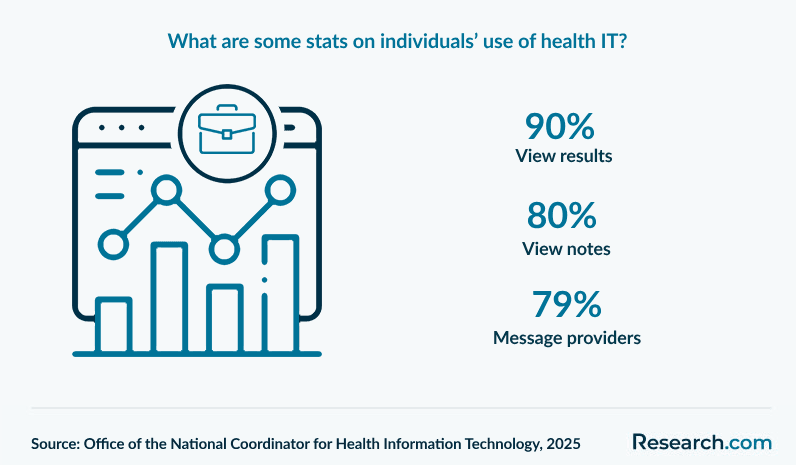
These adoption levels show why informatics professionals need more than technical skills. They must understand patient access, privacy, user experience, workflow design, and the real-world effects of digital tools on care delivery.
What are the prerequisites for an online Master's degree in Health Informatics?
Admission requirements vary, but most online master’s in health informatics programs expect applicants to show academic readiness, professional focus, and some connection to healthcare, technology, data, or management. Applicants with prior healthcare credentials, including those from fast track online certified nursing assistant certificate programs, should ask whether their background can strengthen the application or help them waive introductory coursework.
- Bachelor's Degree: Most programs require a bachelor’s degree from a regionally accredited institution. Preferred backgrounds often include healthcare, computer science, business, information systems, public health, or a related field.
- Minimum GPA: Many schools look for an undergraduate GPA around 3.0 on a 4.0 scale.
- Professional Experience: Programs with clinical informatics, leadership, or management emphasis may prefer one to three years of relevant experience in healthcare, IT, analytics, administration, or research.
- Application Materials: Common requirements include official transcripts, a resume, recommendation letters, and a statement of purpose explaining career goals and fit.
- Standardized Test Scores: Many programs are test-optional, but some may still request GRE or GMAT scores.
| Applicant background | Strengths to highlight | Possible gaps to address |
| Clinician or allied health professional | Workflow knowledge, patient care experience, EHR exposure | Data analytics, programming, database concepts |
| IT or software professional | Systems thinking, security, databases, implementation experience | Healthcare operations, clinical terminology, privacy rules |
| Healthcare administrator | Process improvement, compliance, project coordination | Technical analytics tools, data governance, system design |
| Career changer | Transferable problem-solving, communication, project skills | Healthcare context, informatics vocabulary, applied experience |
What courses are typically included in an online Master's degree in Health Informatics?
Online health informatics master’s programs usually combine healthcare context, information systems, analytics, privacy, leadership, and applied project work. Like other accelerated graduate options, including fastest online communication management degree programs, the workload can be compressed, so applicants should review weekly expectations before enrolling.
- Foundations of Health Informatics: Introduces the history, terminology, systems, stakeholders, and social impact of informatics in healthcare.
- Electronic Health Records and Clinical Systems: Covers how EHRs and clinical information systems are designed, implemented, maintained, optimized, and evaluated.
- Health Data Analytics and Visualization: Teaches students to analyze health data, identify patterns, and communicate findings through dashboards, reports, and visual tools.
- Clinical Decision Support Systems: Examines tools that deliver patient-specific information and evidence-based guidance to clinicians at the point of care.
- Healthcare Data Security and Privacy: Focuses on protecting health information and understanding requirements such as HIPAA.
- Project Management in Healthcare IT: Prepares students to plan, implement, monitor, and evaluate complex technology projects in healthcare settings.
- Leadership and Change Management in Healthcare: Explores how to guide organizations through technology adoption, workflow redesign, and stakeholder resistance.
What specializations are available in Master's degree in Health Informatics programs?
Specializations help you align your degree with a specific job market. A clinical informatics path is different from a health data science path, and a public health informatics path is different from a UX or compliance-focused pathway. Choose based on the problems you want to solve, not only on the title of the concentration.
| Specialization | Best fit for | Typical focus |
| Health Data Science/Analytics | Students who want to work with large datasets, reporting, dashboards, predictive analytics, or machine learning | Data analysis, visualization, outcomes measurement, population trends, operational improvement |
| Clinical Informatics | Clinicians, clinical analysts, and healthcare professionals improving care workflows | EHR optimization, decision support, patient safety, clinical workflow design |
| Public Health Informatics | Students interested in agencies, surveillance, prevention, and health policy | Disease tracking, public health data systems, prevention programs, health promotion |
| User Experience in Healthcare | Students interested in how clinicians and patients interact with digital tools | The User Experience (UX) of health IT systems, usability, patient-facing tools, clinician efficiency |
| Consumer Health Informatics | Students focused on patient portals, apps, engagement tools, and self-management technologies | Patient access, health literacy, personal health data, mobile health tools |
| Nursing Informatics | Nurses who want to improve clinical systems and care quality through informatics | Nursing workflows, documentation, patient safety, EHR improvement; the easiest nursing informatics online programs may be useful for nurses comparing entry requirements |
| Health IT Project Management | Professionals who want to lead software, EHR, analytics, or infrastructure projects | Implementation planning, stakeholder coordination, budgets, vendor management, evaluation |
| Telehealth and Remote Monitoring | Students interested in virtual care and home-based digital monitoring | Remote care platforms, patient-generated data, monitoring workflows, access and equity issues |
| Regulatory and Compliance Informatics | Students drawn to legal, ethical, governance, and risk management work | HIPAA, FDA guidelines, data governance, privacy, compliance documentation |
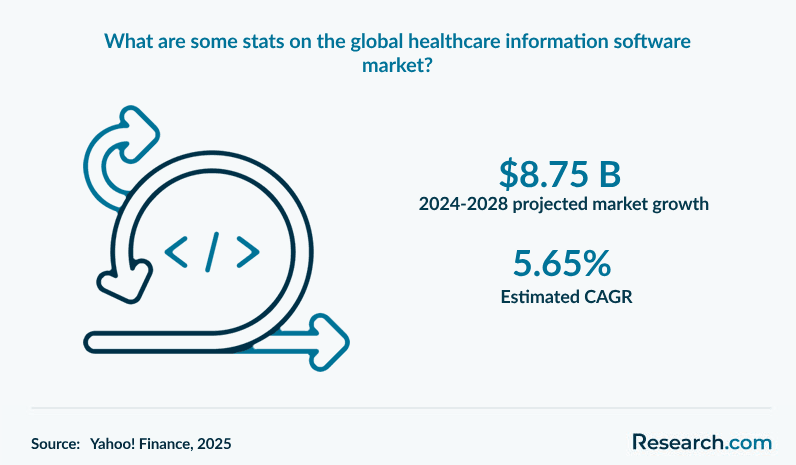
Market demand is also being shaped by healthcare software growth. According to a report cited by Yahoo! Finance, the global healthcare information software market is expected to grow by USD 8.75 billion between 2024 and 2028, with a compound annual growth rate (CAGR) of nearly 5.65%, as shown below. The report links this expansion to electronic health record adoption and increased use of advanced technologies such as AI in healthcare.
How do you choose the best online Master's degree in Health Informatics?
The best program is the one that fits your career goal, schedule, budget, and preferred learning format. Do not choose solely by speed. An accelerated program that lacks the right practicum, accreditation, or concentration can be a poor fit even if it saves time.
| Decision factor | What to check | Why it matters |
| Accreditation | Confirm institutional accreditation and, when relevant, CAHIIM programmatic accreditation. | Accreditation affects transferability, employer trust, financial aid eligibility, and quality assurance. |
| Curriculum fit | Review required courses, electives, and concentration options. | A data-heavy program may not fit a clinical leadership goal, and a clinical program may not provide enough analytics depth. |
| Practicum or capstone | Ask whether projects can be completed at your workplace or require an external site. | Applied projects can become portfolio evidence for employers. |
| Online format | Compare synchronous, asynchronous, hybrid, cohort-based, and self-paced requirements. | The format determines how well the program fits your work and family schedule. |
| Faculty expertise | Look for faculty with healthcare, informatics, analytics, public health, or clinical systems experience. | Informatics is applied; instructors with field experience can connect theory to practice. |
| Career services | Ask about career coaching, alumni networks, employer partnerships, and project placement support. | Career support is especially important for students changing fields. |
| Total cost | Calculate tuition, fees, books, software, travel, and lost income if course load affects work hours. | The cheapest tuition is not always the lowest total cost, and the most expensive option is not always the best ROI. |
Who should choose an accelerated online health informatics master’s?
- Working clinicians who want to move into clinical informatics, EHR optimization, decision support, or quality improvement roles.
- Healthcare administrators who want stronger analytics, systems, and digital transformation skills.
- IT professionals who want to transition into healthcare technology, data governance, or health systems implementation.
- Data analysts who want to specialize in healthcare datasets, clinical operations, population health, or patient outcomes.
- Professionals who can manage a demanding schedule and prefer finishing faster over spreading courses across more terms.
Who should consider a different path?
- Students who need extensive clinical licensure preparation; health informatics degrees generally do not replace clinical degrees or licenses.
- Applicants seeking entry-level healthcare exposure who may be better served by a certificate, associate degree, or introductory healthcare credential first.
- Students who want genomics, computational biology, or lab-based research as their main focus rather than healthcare systems and clinical data.
- Professionals who cannot commit consistent weekly study time; accelerated formats can be difficult to recover from if you fall behind.
What career paths are available for online Master's degree in Health Informatics graduates?
Graduates can work across hospitals, health systems, insurance organizations, government agencies, consulting firms, health technology vendors, research organizations, and public health settings. The right role depends on your prior experience, technical depth, clinical knowledge, and chosen concentration.
| Career path | What the role typically does | Best preparation |
| Health Informatics Specialist | Manages, interprets, and improves the use of health data and health information systems. | Broad informatics curriculum, EHR knowledge, analytics, privacy |
| Clinical Analyst | Supports, evaluates, and optimizes clinical systems used in hospitals and clinics. | Clinical informatics, EHR coursework, workflow analysis |
| Health IT Project Manager | Coordinates technology implementations for hospitals, vendors, consulting firms, or healthcare organizations. | Project management, stakeholder communication, health IT systems |
| Data Scientist, Healthcare | Uses statistical, analytical, and machine learning methods to extract insights from complex health datasets. | Health data science, programming, data visualization, machine learning |
| Chief Medical Information Officer (CMIO) | Leads technology strategy at the intersection of clinical care and IT. | Clinical background, leadership experience, informatics strategy |
| Health Data Analyst | Uses large datasets to identify patterns, support decisions, and improve clinical or operational outcomes. | Analytics, dashboards, database querying, reporting |
| Clinical Informatics Specialist | What is a clinical informatics specialist? This professional helps integrate informatics tools into clinical workflows to improve care delivery. | Clinical systems, workflow design, communication, EHR optimization |
| Public Health Informatician | Applies data systems and technology to disease tracking, prevention, and health policy work. | Public health informatics, surveillance systems, population health |
| Healthcare UX Designer | Designs user-centered health IT tools for clinicians, patients, and care teams. | UX, usability, human factors, health communication |
| Health Information Manager | Oversees patient data systems, accuracy, privacy, compliance, and information governance. | Health information management, privacy, compliance, data quality |
| Pharmacy Informaticist | A pharmacy informaticist manages medication-related systems and improves pharmacy technology workflows. | Pharmacy systems, medication data, clinical informatics |
| Consumer Health Technology Specialist | Develops or supports tools that help patients manage health information and digital care interactions. | Consumer health informatics, mobile health, patient engagement |
| Biomedical Informatics Researcher | Uses data science methods to support biological, clinical, or medical research. | Biomedical informatics, research methods, analytics |
| Imaging Informatics Coordinator | Manages digital imaging systems and improves radiology workflows. | Imaging systems, clinical workflows, health IT operations |
| Global Health Informatics Advisor | Implements informatics solutions in international or underserved healthcare settings. | Public health, implementation science, informatics systems |
According to the BLS, state, local, and private hospitals employ 47% of health information technologists and medical registrars. Offices of physicians account for 9% of jobs, management of companies and enterprises account for 7%, professional, scientific, and technical services account for 6%, and administrative and support services employ 4%, as shown below.
This employment pattern shows that hospitals remain the largest setting for these professionals, but opportunities also exist in physician groups, consulting, technical services, and business environments. Across settings, the work is typically computer-intensive and often office-based.
How much can I earn with an online Master's degree in Health Informatics?
Earning potential with an online master’s in health informatics depends on role, location, prior experience, technical skill level, management responsibility, and industry. A master’s degree can strengthen qualifications, but it does not guarantee a specific salary. For broader role comparisons, review health informatics careers.
Salary data cited from 2025 PayScale figures show a wide range across informatics-adjacent roles. Analyst and supervisory positions often begin in the mid-$50,000s, including clinical systems analyst at $55,534 and patient access supervisor at $56,826.
Several developer and analyst roles fall in the $61,000 to $67,000 range, including data engineer at $61,612 and data analyst at $64,565. Specialist and consultant roles rise higher, including information technology (IT) consultant at $71,601, data scientist at $74,077, and applications analyst for software at $81,879.
More senior or managerial positions show stronger compensation. A senior business analyst earns $80,655, and a project manager for information technology earns $96,664 on average. Higher-level roles include senior data analyst at $103,157, informatics nurse at $108,485, and senior data scientist at $114,088.
The highest figures in the cited data appear in executive and specialized roles, including chief information officer (CIO) at $136,987, senior product manager at $139,199, and system integration engineer at $162,600.
The pattern is clear: salaries tend to rise with seniority, technical specialization, management scope, and strategic responsibility. Students seeking higher compensation should evaluate whether a program builds advanced analytics, leadership, system integration, or clinical informatics expertise aligned with their target role.
What is the job market like for graduates with an online Master's degree in Health Informatics?
The job market for health informatics graduates is supported by healthcare’s continued reliance on digital data, clinical systems, analytics, privacy controls, and technology-enabled care. Graduates may pursue roles in health systems, vendors, insurers, consulting firms, public health agencies, research organizations, and government settings.
- Government Sector Projections: The U.S. Bureau of Labor Statistics projects that employment for Medical and Health Services Managers, a category that includes many health informatics professionals, will grow by 28% between 2022 and 2032, much faster than the average for all occupations. This represents approximately 144,700 new jobs over the decade.
- High-Demand Specializations: Employers often look for strength in data analytics, cybersecurity, clinical informatics, workflow improvement, and system implementation.
- Private Sector Growth: Telehealth, wearable technology, personalized medicine, and healthcare software expansion continue to create roles outside traditional hospital settings.
- Broad Applicability: Health informatics skills apply across hospitals, clinics, insurance companies, pharmaceutical firms, government agencies, and public health organizations.
According to the U.S. Bureau of Labor Statistics for 2025, the median pay for health information technologists and medical registrars was $67,310 per year, or $32.36 per hour, in 2024. In 2023, there were 39,100 jobs in this field. The projected growth rate is 16% between 2023 and 2033, much faster than the average for all occupations, as shown below.
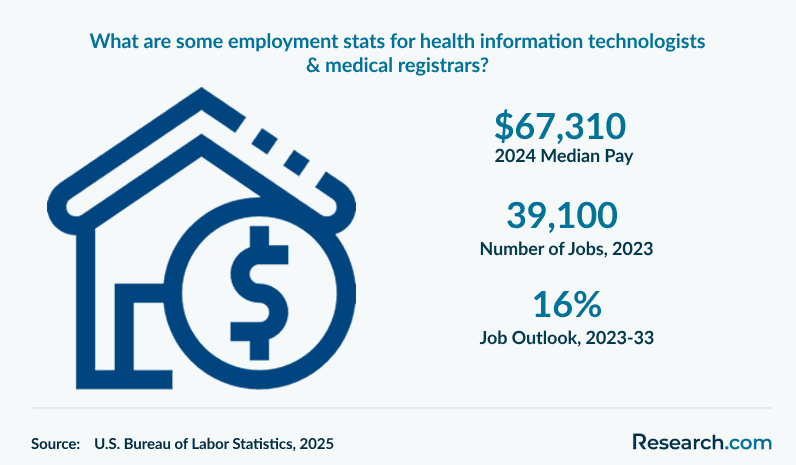
This projected growth is expected to add 6,400 jobs during that decade. The BLS also notes that the typical entry-level education for this occupation can be an associate's degree with no prior work experience, which means master’s graduates may need to differentiate themselves through advanced analytics, leadership, system design, or specialized informatics experience. Students interested in biological and computational data may also compare this field with earning a bioinformatics degree online.
How do I verify the accreditation and quality of online Master's in Health Informatics programs?
Start by confirming institutional accreditation through official school and accreditor sources. Then check whether the health informatics program itself has programmatic accreditation, such as CAHIIM, when that standard is relevant to your goals. Institutional accreditation is important for financial aid eligibility and general academic recognition; programmatic accreditation can signal alignment with field-specific expectations.
- Search the school’s accreditation page and verify the accreditor directly rather than relying only on marketing materials.
- Confirm whether the online program has the same accreditation and curriculum as the campus version, if both exist.
- Ask whether credits are transferable and whether the degree title on the transcript differs for online students.
- Review faculty backgrounds, practicum requirements, capstone expectations, and student support services.
- Compare costs and curriculum with related programs, including affordable online healthcare administration degrees, if your goal is healthcare leadership rather than informatics specialization.
What challenges might I encounter in an online Master's in Health Informatics program?
Online health informatics programs can be flexible, but they are not automatically easy. Students may struggle with self-discipline, condensed coursework, limited in-person networking, technical requirements, group projects across time zones, and the challenge of applying abstract informatics concepts without workplace access to healthcare systems.
| Common challenge | Why it happens | How to reduce the risk |
| Falling behind in accelerated courses | Short terms leave less time to recover from missed assignments. | Block study time before the term starts and review weekly workload expectations. |
| Limited networking | Online students may have fewer informal peer and faculty interactions. | Choose programs with live sessions, group projects, alumni events, and career communities. |
| Technical barriers | Courses may require analytics software, database tools, dashboards, or secure platforms. | Ask about required software, support hours, and minimum technology requirements. |
| Weak applied experience | Some programs rely heavily on coursework without meaningful projects. | Prioritize practicum, capstone, or employer-sponsored project options. |
| Misjudging total cost | Fees, software, travel, books, and time away from work may be overlooked. | Request a full cost breakdown and compare it with other healthcare training options, such as the cheapest online schools for medical billing and coding, if your goals are more entry-level or administrative. |
What are some current and future trends in health informatics?
Health informatics is changing as healthcare organizations adopt more data-driven tools, integrate digital care into routine practice, and face stronger expectations around privacy, security, interoperability, and measurable outcomes.
- Artificial Intelligence and Machine Learning: AI is being used for predictive analytics, diagnostic imaging support, workflow automation, and personalized treatment recommendations, but it also raises questions about bias, validation, transparency, and clinical oversight.
- Telehealth and Remote Patient Monitoring: Virtual care and remote monitoring create new streams of data that must be integrated into clinical workflows safely and usefully.
- Interoperability and Data Exchange: Healthcare organizations continue working toward secure, seamless sharing of information across EHR systems, providers, and care settings.
- Genomics and Personalized Medicine: Informatics supports the management and analysis of large-scale genomic data used to tailor treatments. Students interested in this direction may also explore careers in bioinformatics.
- Cybersecurity in Healthcare: As more health records and care tools become digital, protecting patient data remains a core priority.
- Patient-Generated Health Data (PGHD): Wearables, mobile apps, and home monitoring devices create opportunities to improve care, but they also complicate data quality, privacy, and clinical workflow.
- Natural Language Processing (NLP): NLP is being used to extract insights from unstructured notes, support documentation, improve decision support, and track outcomes.
- Cloud-Based Health IT Infrastructure: Cloud systems can support scalable storage, collaboration, and analytics across healthcare organizations, but they require strong governance and security planning.
Here's What Graduates Say About Their Online Master’s in Health Informatics Programs
- Kumar: "The accelerated structure let me finish the degree in 12 months while keeping my full-time job. Applied case studies and data projects helped me feel prepared to move into a clinical data analyst position."
- Nyobi: "Faculty support made a major difference, and the coursework on AI and predictive modeling felt directly connected to where healthcare is heading. I came away with skills that I could connect to patient outcomes, not just technology."
- Sven: "I was worried about balancing graduate school with family responsibilities, but the online format and student support helped me stay on track. I now lead informatics projects in my hospital and use what I learned in meaningful daily work."
How does the long-term return on investment compare for online Master's in Health Informatics programs?
Return on investment should be judged by more than starting salary. A careful ROI review should include tuition, fees, program length, financial aid, employer reimbursement, your current income, likely career path, and whether the program builds skills employers actually request. Leadership potential, technical specialization, and practical project experience can matter as much as the degree title.
To evaluate ROI, compare the cost of the program against the roles you realistically qualify for after graduation. A clinician moving into informatics may see a different payoff than a career changer with no healthcare experience. A data analyst seeking healthcare specialization may prioritize analytics depth, while an administrator may value leadership and implementation coursework. If cost is your main concern, compare options with affordable health information management online programs to see whether a related credential better fits your budget and goals.
What career development support is available in online Master’s in Health Informatics programs?
Career support can be especially important in online programs because students may not have the same informal networking opportunities as campus learners. Strong programs often provide career coaching, resume help, interview preparation, alumni access, employer events, project-based networking, and guidance for capstone or practicum placement.
- Ask whether career services are available to online students or only campus students.
- Find out whether the program has healthcare employer partnerships or alumni working in informatics roles.
- Request examples of capstone projects, practicum sites, or employer-sponsored projects.
- Ask whether students receive help translating clinical, IT, or administrative experience into informatics job applications.
- Compare career support across adjacent healthcare programs, including medical billing and coding online schools, if you are still deciding which healthcare education path fits your career stage.
Common mistakes to avoid when choosing an online Master’s in Health Informatics
| Mistake | Why it can hurt you | Better approach |
| Choosing only the fastest program | A short timeline may mean heavier workloads or fewer electives. | Compare speed with curriculum depth, practicum quality, and career fit. |
| Ignoring accreditation | Accreditation affects institutional credibility and may affect financial aid or employer acceptance. | Verify institutional accreditation and programmatic accreditation when relevant. |
| Looking only at tuition | Fees, books, software, travel, and time demands can change the real cost. | Calculate the full cost of attendance and ask for a fee breakdown. |
| Assuming all online programs are flexible | Some programs require live sessions, campus visits, team meetings, or fixed cohort schedules. | Review synchronous requirements, practicum rules, and term calendars. |
| Choosing a concentration by title alone | “Analytics,” “clinical,” and “management” can mean different things at different schools. | Read course descriptions and capstone examples before applying. |
| Expecting the degree to guarantee a salary | Compensation depends on experience, role, location, employer, and technical skills. | Match the program to target job postings and build a portfolio of applied projects. |
| Overlooking admissions fit | Some programs expect healthcare or IT experience and may move quickly through foundational material. | Ask advisors whether your background is competitive and whether bridge coursework is available. |
Key Insights
- An accelerated online master’s in health informatics is best for students who already have a clear direction, such as clinical informatics, health data analytics, public health informatics, health IT leadership, or digital health implementation.
- Speed should not be the only deciding factor. Compare accreditation, practicum requirements, course format, faculty expertise, career services, and concentration fit before applying.
- Program costs vary widely. Public resident tuition, private university pricing, credit requirements, and added fees can significantly change the final price.
- CAHIIM accreditation appears in several programs listed here and may be useful for students who want a field-specific quality signal.
- Health informatics salaries rise with specialization, leadership, and technical depth. A master’s degree can help, but salary outcomes are not guaranteed.
- The job market is supported by widespread EHR adoption, patient use of digital tools, demand for analytics, telehealth growth, cybersecurity needs, and healthcare software expansion.
- Applicants should ask programs direct questions about online flexibility, capstone support, practicum placement, employer connections, and whether graduates enter the roles they are targeting.
References:
- Office of the National Coordinator for Health Information Technology. (2025). QuickStat #69: Trends in individuals' use of health IT, 2012–2024. HealthIT.gov.
- PayScale. (2024, August). Master of Science (MS), Health Informatics Salary. PayScale.
- U.S. Bureau of Labor Statistics. (2024, September 6). Health information technologists and medical registrars. In Occupational Outlook Handbook. U.S. Bureau of Labor Statistics.
- Yahoo Finance. (2024, August). Healthcare Information Software Market size is set to grow by USD 8.75 billion from 2024–2028, according to Technavio. Yahoo Finance.
Other Things You Should Know About Accelerated Online Master's Degree in Health Informatics Programs
Most accelerated online master’s in health informatics programs require a final capstone, practicum, or applied project in the last 3 to 6 credits. Many schools also require 100 to 200 supervised field hours, completed with an approved healthcare or IT site before graduation.
Admission requirements for these programs typically include a bachelor's degree, preferably in a related field, a minimum GPA, and relevant professional experience. Additionally, applicants may need to submit GRE scores, letters of recommendation, a personal statement, and proof of English proficiency for non-native speakers.


