
2027 Most Affordable Online Biochemistry Degree Programs

Co-Founder and Chief Data Scientist
Choosing an online biochemistry degree is not just a question of convenience. For many students, the real decision is whether an online program can deliver enough laboratory training, scientific depth, employer credibility, and affordability to justify the investment.
That question matters more now because online science programs have changed. Many schools now combine virtual lab platforms, mailed lab kits, electronic lab notebooks, short campus residencies, and approved local practicums to help students build applied skills without relocating. For working adults, transfer students, military learners, and pre-health students, this can make biochemistry more accessible than a traditional campus pathway.
This guide explains what to expect from online biochemistry degree programs, how long they take, what they cost, which schools offer affordable options, how employers view the credential, and what career paths may follow. It is designed to help you compare programs carefully instead of choosing based on tuition or rankings alone.
Quick Answer: Is an Online Biochemistry Degree Worth Considering?
An online biochemistry degree can be a practical choice if the program is regionally accredited, includes meaningful lab experience, publishes clear tuition and fee information, and aligns with your career goals. It is especially useful for students who need schedule flexibility but still want preparation for laboratory, biotechnology, diagnostics, environmental, regulatory, or graduate-study pathways.
However, students should be cautious. Not every online science degree provides the same level of hands-on training, research access, or graduate-school preparation. Before enrolling, confirm the program’s accreditation, lab requirements, transfer policies, total cost, and whether its courses meet prerequisites for any professional program you may pursue later.
What are the benefits of getting an online biochemistry degree?
- Biochemistry graduates can pursue roles in laboratories, production settings, regulatory teams, technical communication, pharmaceuticals, diagnostics, environmental testing, and biotechnology.
- As of April 2025, biochemists and biophysicists have a median annual wage of $103,650, while the highest 10% earn more than $168,900.
- Online biochemistry degree programs may offer full-time, part-time, transfer-friendly, and accelerated options, giving students more ways to fit coursework around work, caregiving, or military responsibilities.
What can I expect from an online biochemistry degree?
An online biochemistry degree usually combines digital science coursework with structured lab experiences. The best programs do not remove laboratory learning; they redesign it through simulations, mailed materials, short residencies, approved local lab work, or workplace-based projects.
- Core science coursework: Students typically study general chemistry, organic chemistry, molecular biology, metabolism, enzyme function, analytical chemistry, and biochemistry through recorded lectures, live sessions, assignments, quizzes, and instructor feedback.
- Laboratory delivery: Programs may use virtual simulations first, then add mailed experiment kits, remote instrument exercises, or brief in-person sessions for techniques such as chromatography, spectroscopy, protein assays, and experimental documentation.
- Data and computation: Many curricula now include statistical analysis, coding exposure, molecular visualization, electronic lab notebooks, and bioinformatics tools because employers increasingly expect scientists to interpret data, not just generate it.
- Assessment and academic support: Students should expect proctored exams, lab reports, group discussion, virtual office hours, tutoring, advising, and structured deadlines that keep online learning from becoming fully self-directed.
- Capstone or practicum work: Strong programs often end with a research project, industry practicum, workplace-based project, or faculty-supervised capstone that lets students connect theory to applied problems.
The strongest online programs are not easier versions of campus degrees. They are flexible science degrees that still require discipline, math readiness, lab safety awareness, and consistent weekly study time.
Where can I work with an online biochemistry degree?
Biochemistry is useful because it sits between chemistry, biology, medicine, and data analysis. Graduates may begin in technician, analyst, associate, coordinator, or quality roles and then move into more specialized positions after gaining experience or additional credentials.
| Work setting | Typical responsibilities | Why biochemistry fits |
| Pharmaceutical quality control | Test raw materials, check finished products, document batch results, and support compliance procedures. | Students use knowledge of analytical chemistry, molecular interactions, and laboratory documentation. |
| Clinical diagnostics | Run assays, process samples, support molecular testing, and prepare results for review. | Coursework in enzymes, proteins, molecular biology, and lab methods applies directly to diagnostic workflows. |
| Industrial fermentation | Support microbial production of enzymes, biofuels, additives, or related products and help troubleshoot scale-up problems. | Biochemistry explains metabolism, microbial pathways, and reaction conditions. |
| Environmental testing | Analyze soil, air, or water samples and help organizations meet environmental standards. | Students apply toxicology, chemistry, sampling, and data interpretation skills. |
| Forensic toxicology | Identify metabolites, chemicals, or biological evidence while maintaining strict documentation. | Analytical chemistry and chain-of-custody practices are central to this work. |
| Regulatory affairs | Organize scientific evidence for submissions, reports, labeling, or compliance files. | Graduates translate experimental data into clear, defensible documentation. |
| Patent and technical support | Assist attorneys or research teams with biotechnology and chemical invention documentation. | Biochemistry knowledge helps interpret scientific novelty and technical claims. |
| Science communication | Create grant materials, technical manuals, educational content, or investor-facing explanations. | Graduates can explain molecular concepts accurately to non-specialists. |
Entry-level outcomes vary by region, employer, internship access, and whether the role requires licensure, certification, or graduate education. Students should review job postings in their target area before choosing electives or specializations.
How much can I make with an online biochemistry degree?
Salary outcomes depend on job title, industry, location, experience, degree level, and whether the role requires advanced training. An online degree does not create a separate salary category; employers generally evaluate the institution, accreditation, coursework, lab preparation, skills, and relevant experience.
According to the most recent U.S. Bureau of Labor Statistics data cited in this guide, these related occupations show the following median annual wages:
| Occupation | Median annual salary | Important context |
| Biochemists and Biophysicists | $103,650 | The highest 10% earn over $168,900. Research-focused roles often require graduate-level preparation or substantial laboratory experience. |
| Clinical Laboratory Technologists and Technicians | $61,890 | These roles can be accessible to graduates interested in diagnostics, testing, and laboratory operations, though requirements vary by employer and state. |
| Environmental Scientists and Specialists | $80,060 | Biochemistry skills may support work in contaminant analysis, environmental monitoring, remediation, and compliance. |
| Life, Physical, and Social Science Occupations | $78,980 | This broad category includes many scientific roles in research, applied science, laboratory analysis, and data-centered work. |
Students focused on return on investment should compare total program cost against realistic entry-level roles, not only the highest-paying advanced research positions. Lower tuition can improve financial flexibility, but salaries are never guaranteed.
- List of Online Biochemistry Degree Programs for 2027
- How long does it take to complete an online biochemistry degree?
- How do online biochemistry programs compare to on-campus programs?
- What is the average cost of online biochemistry degree programs?
- What are the financial aid options for students enrolling in an online biochemistry degree program?
- What are the prerequisites for enrolling in online biochemistry degree programs?
- What courses are typically in online biochemistry degree programs?
- What types of specializations are available in online biochemistry degree programs?
- Do online biochemistry degree programs offer comprehensive student support services?
- Are online biochemistry degree programs accredited and credible?
- How to choose the best online biochemistry degree programs?
- What are employers looking for in online biochemistry graduates?
- What career paths are available for graduates of online biochemistry degree programs?
- What is the job market for graduates of online biochemistry degree programs?
- What additional education pathways can complement an online biochemistry degree?
List of Online Biochemistry Degree Programs for 2027
How do we rank schools?
This list focuses on affordable online pathways that can support biochemistry-focused study. To identify stronger options, I considered accreditation, program structure, lab delivery, cost transparency, pacing flexibility, and relevance to careers or further education. You can review our methodology for more detail on how Research.com evaluates programs.
Affordability received special attention. Programs with lower published tuition, clear fee information, financial aid access, and formats that help students progress efficiently were prioritized. Time to completion, available concentrations, transfer pathways, and student support also shaped the selection.
Program information and supporting data were reviewed using verified U.S.-based sources, including the Integrated Postsecondary Education Data System (IPEDS), Peterson’s Distance Learning database, the U.S. Department of Education’s College Scorecard, and the National Center for Education Statistics (NCES).
1. Minot State University
Minot State University offers an online Bachelor of Arts in Chemistry that allows students to shape their studies toward biochemistry-related interests through three flexible tracks, including the region’s only Medicinal Plant Chemistry option. Coursework is asynchronous, while virtual lab tools and short campus sessions help students practice chromatographic and spectroscopic methods.
The program is notable for its capped tuition approach and an average per-credit price that remains below many national benchmarks.
- Program Length: 4 years full-time. Transfer students may finish in 2–3 years.
- Tracks/concentrations: Professional Chemistry, General Chemistry, and Medicinal Plant Chemistry.
- Cost per Credit: Approximately $383 (tuition + mandatory fees, 2025-26 schedule).
- Required Credits to Graduate: 120
- Accreditation: Higher Learning Commission (HLC)
2. Mayville State University
Mayville State University provides an online Bachelor of Science in Chemistry with a biochemistry emphasis. Students complete asynchronous classes, use mailed lab kits, and attend a short summer residency for applied laboratory practice. Small cohorts and faculty-guided research opportunities add structure to the online experience.
Its low distance-learning tuition and absence of residency-related tuition increases make it a strong option for cost-conscious students.
- Program Length: 4 years full-time, 2-3 years for qualified transfer students.
- Tracks/concentrations: General Chemistry, Biochemistry emphasis, and Chemistry Education option.
- Cost per Credit: Approximately $337 (distance tuition, 2025-26 schedule).
- Required Credits to Graduate: 120
- Accreditation: HLC
3. Dickinson State University
Dickinson State University offers an online Bachelor of Science in Chemistry with a Biochemistry emphasis. DSU Live synchronous lectures, interactive virtual laboratories, and a faculty-led research seminar give students a structured route into applied chemical and biochemical study.
The program’s low combined tuition and fee structure makes it appealing for students who want hands-on preparation without a high price tag.
- Program Length: 4 years full-time with accelerated options for qualified transfer students.
- Tracks/concentrations: General Chemistry, Biochemistry emphasis, Chemistry Education options.
- Cost per Credit: $259 tuition plus $68.68 mandatory fees.
- Required Credits to Graduate: 120
- Accreditation: HLC
4. University of Florida Online
The University of Florida Online offers a Bachelor of Science in Microbiology and Cell Science that includes a substantial foundation in biochemistry. Students use asynchronous coursework, virtual labs, built-in lab kits, and optional in-person intensives to develop molecular and cellular science skills.
As part of a major research university, this program combines broad scientific training with one of the lowest listed in-state tuition rates in this guide.
- Program Length: 4 years full-time. Transfer pathways may shorten completion.
- Tracks/concentrations: Cellular and Molecular Biology, Environmental Microbiology, and Biotechnology.
- Cost per Credit: $129 in-state tuition plus $17.26 mandatory fees.
- Required Credits to Graduate: 120
- Accreditation: Southern Association of Colleges and Schools Commission on Colleges (SACSCOC)
5. Eastern Oregon University
Eastern Oregon University’s online Bachelor of Science in Biology includes a biochemistry emphasis supported by asynchronous courses, virtual lab cohorts, mailed kits, and optional regional immersions. Open educational resources and relatively low material fees help reduce student expenses.
This option may fit students who want biology-centered preparation with biochemical depth and limited relocation requirements.
- Program Length: 4 years full-time with accelerated completion for transfer students.
- Tracks/concentrations: Biology core with Biochemistry emphasis.
- Cost per Credit: $296 quarter credit tuition plus $25 material fee.
- Required Credits to Graduate: 180 quarter credits (equivalent to 120 semester credits).
- Accreditation: Northwest Commission on Colleges and Universities (NWCCU)
6. Fort Hays State University
Fort Hays State University Virtual College offers an online Bachelor of Science in Biological Sciences with a Biochemistry option. The program uses asynchronous delivery, interactive simulations, optional summer intensives, and small online cohorts to support research-oriented learning.
A flat online tuition model and open educational resources can help students limit both tuition and textbook expenses.
- Program Length: 4 years full-time, with accelerated tracks for qualified transfer students.
- Tracks/concentrations: Biochemistry option within Biological Sciences.
- Cost per Credit: $256.50 undergraduate online rate.
- Required Credits to Graduate: 120
- Accreditation: HLC
7. Georgia Southwestern State University
Georgia Southwestern State University offers an online Bachelor of Science in Chemistry with a biochemistry track. Students complete asynchronous courses and virtual labs, with optional campus sessions available for additional hands-on practice.
The program’s locked-in, low-cost tuition and smaller cohort model can benefit working students who need both affordability and faculty access.
- Program Length: 4 years full-time, with accelerated pathways for qualified transfer students.
- Tracks/concentrations: Biochemistry, Forensics, and Professional Chemistry.
- Cost per Credit: $174 tuition (2025-26 rate).
- Required Credits to Graduate: 120
- Accreditation: SACSCOC
8. Arkansas State University
Arkansas State University delivers an online Bachelor of Science in Chemistry with a Biochemistry concentration. Eight-week terms, multiple start dates, asynchronous coursework, virtual simulations, and optional in-person intensives make the program flexible for students balancing school with other obligations.
Its flat tuition structure and research-focused cohorts create an accessible route into advanced chemistry and biochemistry study.
- Program Length: 4 years full-time and accelerated options for transfer students.
- Tracks/concentrations: Biochemistry, Forensics, and Professional Chemistry.
- Cost per Credit: $242 tuition plus $40 online fee.
- Required Credits to Graduate: 120
- Accreditation: SACSCOC
9. University of Tennessee at Martin
The University of Tennessee at Martin offers an online Bachelor of Science in Chemistry with a Biochemistry concentration. Students use online coursework, virtual lab activities, mailed kits, optional on-campus workshops, and faculty-supported research experiences.
The program’s flat-rate tuition and remote-first design may appeal to students looking for a structured but cost-aware path into biochemical science.
- Program Length: 4 years full-time and accelerated pathways for transfer students.
- Tracks/concentrations: Biochemistry;], General Chemistry, Forensics, and Professional Chemistry.
- Cost per Credit: $434 online undergraduate rate.
- Required Credits to Graduate: 120
- Accreditation: SACSCOC
10. University of Illinois Springfield
The University of Illinois Springfield offers a fully online Bachelor of Science in Biochemistry that follows American Chemical Society guidelines. Students complete cloud-based lab work, real-time discussions, and a faculty-mentored research project either on campus or at an approved external site.
Its locked-in tuition and flat per-credit model make it one of the more affordable biochemistry-focused options within the University of Illinois system.
- Program Length: 4 years full-time with accelerated for qualified transfer students.
- Tracks/concentrations: Open electives allow pre-health, environmental, or computational focus areas, but no formal tracks.
- Cost per Credit: $368 tuition plus approximately $30 online support fee.
- Required Credits to Graduate: 120
- Accreditation: HLC
How long does it take to complete an online biochemistry degree?
Completion time depends on credit requirements, course load, transfer credits, lab scheduling, and whether the school uses traditional semesters, shorter terms, or competency-based pacing. Most bachelor’s programs require 120 credits, though quarter-credit systems may list the equivalent differently.
| Pathway | Typical timeline | Best fit |
| Standard full-time track | About 4 years | Students beginning college with few or no transfer credits. |
| Accelerated cohort | About 30 months | Learners who can handle heavier loads, year-round study, and roughly 30 or more weekly study hours. |
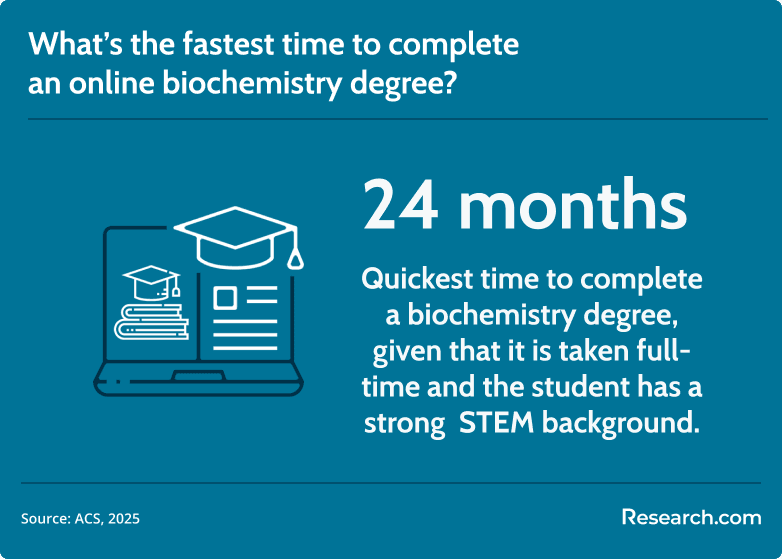
| Competency-based option | Often 24 to 36 months for prepared STEM learners | Students with strong prior knowledge who can move quickly after proving mastery. |
| Part-time plan | Roughly 5 or 6 years | Working adults, caregivers, or students who need a lighter semester schedule. |
| Transfer or bridge route | Often 18 to 24 months after credit evaluation | Students entering with an associate degree or substantial lower-division science coursework. |
Short lab intensives may add travel days or one to two weeks in a given year, but they are often scheduled during breaks to reduce disruption. Students who plan to continue into graduate biotechnology study may also want to compare bachelor’s requirements with later questions such as is it worth it to get a masters in biotech.
How do online biochemistry programs compare to on-campus programs?
Online and on-campus biochemistry programs can lead to comparable credentials when they are offered by accredited institutions and meet the same academic standards. The main differences are not usually the course titles; they are the lab format, schedule, campus access, networking experience, and total cost.
Online programs in many technical fields are now designed for students who need flexibility without giving up structured training. That same principle appears in unrelated programs such as the cheapest online animation degree, where delivery format changes but technical expectations still matter.
| Factor | Online biochemistry program | On-campus biochemistry program |
| Course delivery | Recorded lectures, live sessions, discussion boards, digital assignments, and online exams. | Scheduled classroom lectures, in-person discussions, and campus-based testing. |
| Lab experience | Virtual labs, mailed kits, remote tools, local placements, and short residencies. | Regular in-person laboratory sessions using campus facilities and equipment. |
| Faculty access | Video meetings, email, discussion forums, shared lab notebooks, and scheduled advising. | Office hours, research meetings, informal conversations, and campus advising. |
| Research exposure | May require more planning through approved sites, virtual projects, or limited residencies. | Often easier to access through faculty labs, seminars, and campus assistantships. |
| Schedule flexibility | Usually stronger, especially in asynchronous or part-time formats. | More fixed due to lecture, lab, and campus attendance schedules. |
| Cost considerations | May reduce commuting, relocation, and housing costs, though lab kits and travel can add expenses. | May include campus fees, housing, commuting, and more frequent facility use costs. |
When online makes sense
An online program may be the better fit if you need to stay employed, live far from a campus, already have transfer credits, or can attend occasional lab residencies. It can also work well if you are comfortable learning independently and using digital tools.
When campus may be better
A campus program may be stronger if you want weekly bench work, frequent faculty research involvement, pre-med advising on site, or easier access to student organizations, seminars, and research assistant roles.
The right format depends on your learning style, career target, and tolerance for travel. Do not assume online is automatically weaker or cheaper; compare the actual curriculum, lab hours, and total program cost.
What is the average cost of online biochemistry degree programs?
Online biochemistry tuition varies widely by residency status, public or private control, fee structure, and pacing model. The examples in this guide fall into several pricing bands:
- Low-cost public option: $129 per credit for in-state learners, which places a 120-credit degree near $15,500 before books, lab kits, and other fees.
- Regional value option: $174 per credit for online undergraduates, keeping tuition around $20,900 for a 120-credit program.
- Midrange completion pathway: $431–$450 per credit for upper-division coursework, bringing 120 credits to roughly $52,000 to $54,000.
- Subscription pricing model: $3,825 per six-month term, with a three-year pace totaling about $22,950 in tuition.
- Nonresident premium: $553 per credit for out-of-state students, which can push tuition close to $66,000.
Students should also budget for laboratory expenses. Mailed kits and short residencies can add $200–$400 per laboratory course. Technology fees, proctoring fees, student service fees, travel, lodging, and course materials may also affect the final price.
| Cost category | Why it matters | Question to ask |
| Tuition | This is the largest published cost, but it rarely reflects the full amount paid. | Is tuition charged per credit, per term, or through a subscription model? |
| Lab kits and materials | Science programs may require equipment, chemicals, safety items, or specialized software. | How much should I expect to pay per lab course? |
| Residency travel | Short intensives can require transportation, lodging, meals, and time away from work. | How many residencies are required, and where are they held? |
| Fees | Online support, technology, proctoring, and student service fees can change affordability. | Are all mandatory fees listed before enrollment? |
| Transfer credits | Accepted credits can reduce both time and tuition. | How many credits will the school accept toward the major and general education requirements? |
Affordability should be evaluated alongside career goals. If you are estimating long-term value, compare program cost with likely outcomes and related career data, including questions such as “How much do biologists make?”
What are the financial aid options for students enrolling in an online biochemistry degree program?
Most students reduce costs by combining several aid sources rather than depending on one award. Eligibility depends on enrollment status, accreditation, citizenship or residency rules, financial need, academic performance, employer policies, and military status.
- Federal grants: Students who complete the FAFSA may qualify for need-based Pell Grants of up to $7,395 for the 2025–26 award year. Grants generally do not need to be repaid.
- Federal student loans: Direct Subsidized and Unsubsidized Loans can cover remaining costs after grants and scholarships. Repayment obligations should be reviewed carefully before borrowing.
- Federal Work-Study: Eligible students can earn wages through approved part-time jobs, including roles related to tutoring, community service, or laboratory support.
- Institutional scholarships: Universities may offer awards for STEM students, transfer students, high-achieving applicants, or students with financial need.
- Departmental and research support: Some science departments provide stipends, research opportunities, or small awards tied to faculty projects and short residencies.
- STEM-specific funding: External opportunities such as the National Science Foundation’s Research Experiences for Undergraduates can support summer research and related costs.
- Employer tuition assistance: Hospitals, biotech employers, public laboratories, and related organizations may reimburse up to $5,250 per year for job-related coursework.
- Military and veterans benefits: Eligible active-duty, reservist, and veteran students may use GI Bill benefits or Tuition Assistance for accredited online programs.
- Tax credits: The American Opportunity Tax Credit and Lifetime Learning Credit may provide up to $2,500 in annual tax savings for qualified education expenses.
Financial aid is common across many career-focused online programs. For example, students researching the cheapest online electrician certification also need to compare aid, fees, and credential value before enrolling.
Before choosing a program, ask the financial aid office for a net price estimate that includes tuition, fees, lab materials, residency travel, books, and expected aid.
The chart below compares the job growth rate of biochemists and biophysicists with other fast growing STEM fields from 2022 to 2032.
What are the prerequisites for enrolling in online biochemistry degree programs?
Admissions requirements differ by school, but online biochemistry programs commonly expect students to be ready for college-level science, math, technology use, and lab safety. Transfer and degree-completion programs may have additional prerequisites before students can begin upper-division coursework.
- Science preparation: Many programs expect high school or college coursework in chemistry and biology with labs. Physics may be recommended, especially for students planning graduate or professional school.
- Math readiness: Precalculus or higher is often expected. Some schools use placement testing to assess algebra, logarithms, rates, and calculus readiness.
- General education credits: Degree-completion students may need 30–60 lower-division credits in writing, humanities, social sciences, and foundational sciences.
- Placement or proficiency evidence: ACT or SAT requirements may be optional for adult learners, but math and chemistry placement exams can still apply. Non-native English speakers may need TOEFL iBT 79 or IELTS 6.0.
- Technology access: Students may need a laptop with at least 8 GB RAM, reliable broadband, webcam access, and the ability to run tools such as PyMOL and R.
- Lab safety requirements: Programs may require online safety training, liability forms, approved home lab kits, on-site intensives, and proof of tetanus vaccination.
- Background checks for placements: Clinical, forensic, or patient-facing practicums may require background screening or drug testing before students can work with restricted samples or evidence. Students later considering online PharmD programs may encounter similar compliance expectations.
At minimum, applicants usually need a high school diploma or equivalent and strong performance in math and science. Some healthcare-focused certificates, including affordable online PMHNP certificate programs, also require applicants to demonstrate readiness for advanced health-related coursework.
If you lack one or more prerequisites, ask whether the school offers bridge courses, community college transfer options, or conditional admission.
What courses are typically in online biochemistry degree programs?
Online biochemistry curricula generally move from broad chemistry and biology foundations into molecular systems, quantitative analysis, and applied laboratory work. The exact sequence depends on whether the degree is housed in chemistry, biology, microbiology, or biochemistry.
| Course area | What students learn | Common online lab approach |
| General Chemistry | Atomic structure, bonding, thermodynamics, equilibrium, and chemical reactions. | At-home titration, calorimetry kits, simulations, and digital problem solving. |
| Organic Chemistry with Lab | Reaction mechanisms, stereochemistry, functional groups, and synthesis. | Mailed microscale kits, spectroscopy exercises, and virtual experiments. |
| Quantitative Analysis | Stoichiometry, precision, equilibrium, calibration, and statistical treatment of data. | Spreadsheet modeling, remote instrument simulations, and lab reports. |
| Biochemistry I and II | Protein structure, enzyme kinetics, metabolism, bioenergetics, and molecular interactions. | Molecular visualization tools, case studies, problem sets, and applied lab modules. |
| Molecular Biology | DNA replication, transcription, gene regulation, PCR principles, and genetic analysis. | Virtual PCR modules, simulations, and optional in-person cloning activities. |
| Physical Chemistry for Life Sciences | Kinetics, thermodynamics, and quantum concepts applied to biological systems. | Modeling assignments and computational exercises. |
| Bioinformatics and Statistics | R or Python basics, sequence alignment, structural prediction, and multivariate data interpretation. | Cloud-based data sets, coding notebooks, and analysis projects. |
| Capstone or Research Practicum | Experimental design, data interpretation, scientific writing, and oral presentation. | Approved workplace projects, partner labs, campus residencies, or faculty-supervised research. |
Electives in regulatory affairs, environmental toxicology, entrepreneurship, biotechnology, or pre-health topics typically help students customize the final 12–15 credits toward a career goal.
What types of specializations are available in online biochemistry degree programs?
Specializations help students focus their electives and capstone work. They do not always appear as formal transcript concentrations, so students should confirm how the school documents the area of focus.
- Clinical biochemistry: Covers diagnostic testing, biomarkers, assay validation, and quality control in hospital and reference laboratory environments.
- Biotechnology and drug discovery: Focuses on recombinant proteins, cell culture concepts, screening methods, and early-stage pharmaceutical development.
- Bioinformatics: Combines biological data with coding, statistics, sequence analysis, and structural prediction for students interested in careers in bioinformatics.
- Environmental and toxicological chemistry: Examines pollutants, detoxification pathways, sampling protocols, soil testing, water analysis, and regulatory science.
- Food and nutritional biochemistry: Studies metabolism, nutrient testing, functional foods, flavor chemistry, and food safety methods.
- Forensic molecular science: Covers DNA profiling, metabolite identification, toxicology, documentation, and chain-of-custody practices.
- Medical biochemistry or pre-health: Emphasizes physiology, metabolic disease, pharmacology fundamentals, and prerequisites for health professional programs.
Many programs use 12–18 elective credits to create these focus areas, often ending with a capstone, internship, or practicum that lets students demonstrate targeted skills.
The graph below compares the different industries with the highest annual mean wage for biochemists and biophysicists.
Do online biochemistry degree programs offer comprehensive student support services?
Student support is especially important in online science programs because students must manage difficult coursework, lab logistics, technology requirements, and long-term career planning from a distance. Strong programs provide academic advising, tutoring in chemistry and math, technical help, library access, disability services, research guidance, and career support.
Look for support that is specific to science students, not just general online advising. Useful services include virtual lab troubleshooting, office hours with faculty, peer study groups, electronic lab notebook guidance, internship placement help, graduate-school advising, and resume review for laboratory roles. Similar support expectations apply in other technical online degrees, including the best online game development degree programs, where students also need feedback, portfolio support, and career preparation.
Are online biochemistry degree programs accredited and credible?
Credibility begins with accreditation. Students should verify that the institution is accredited by a recognized regional accreditor because accreditation affects federal financial aid eligibility, credit transfer, graduate-school recognition, and employer confidence.
Program-level quality also matters. For biochemistry, review whether the curriculum includes appropriate chemistry and biology depth, whether lab experiences are documented clearly, and whether courses align with graduate or professional school prerequisites. Some programs may follow American Chemical Society expectations, while others may be housed in biology, microbiology, or chemistry departments with different emphases.
Students comparing options can also review Research.com’s related guide to an online biochemistry bachelor's degree for broader program context and quality considerations.
How to choose the best online biochemistry degree programs?
The best online biochemistry program is not automatically the cheapest or the highest ranked. It is the program that fits your budget, schedule, academic preparation, lab needs, and career goal.
| Selection factor | What to verify | Why it matters |
| Regional accreditation | Confirm the school is accredited by a recognized accreditor. | Accreditation supports aid eligibility, transferability, and graduate-school recognition. |
| Curriculum alignment | Check whether coursework covers core biochemistry, chemistry, biology, math, and lab expectations. | Missing prerequisites can delay graduate, professional, or clinical pathways. |
| Lab structure | Ask how many virtual labs, mailed kits, local placements, and in-person residencies are required. | Employers and graduate programs value documented laboratory competence. |
| ACS alignment | Review whether the curriculum follows American Chemical Society guidelines where relevant. | ACS-aligned coursework can indicate appropriate breadth in chemistry training. |
| Total cost | Compare tuition, fees, books, lab kits, residency travel, and technology expenses. | The lowest tuition may not be the lowest total cost. |
| Transfer policy | Request a written transfer evaluation before enrolling. | Accepted credits can shorten the program and lower tuition. |
| Faculty engagement | Look for research-active faculty and mentoring access for online students. | Research support can improve graduate-school and job competitiveness. |
| Industry connections | Ask about internships, practicums, local lab approvals, and employer partnerships. | Applied experience can make the degree more useful after graduation. |
| Outcome data | Review retention, graduation, placement, graduate admission, and alumni data when available. | Transparent outcomes help you judge risk before committing. |
Questions to ask before you enroll
- Will this program meet prerequisites for the graduate, medical, pharmacy, laboratory, or professional pathway I may pursue later?
- How many hands-on lab experiences are required, and where do they occur?
- Are lab kits, travel, software, and proctoring fees included in the published price?
- Can I complete practicums near where I live, or must I travel to campus?
- How many transfer credits will count toward the major, not just electives?
- What career services are available specifically for online science students?
- Do graduates enter jobs, graduate school, professional school, or certification pathways?
What are employers looking for in online biochemistry graduates?
Employers generally care less about whether courses were online and more about whether graduates can do the work. They look for evidence of laboratory competence, careful documentation, data analysis ability, safety awareness, communication skills, and familiarity with quality systems or regulated environments.
- Technical lab skills: Employers may expect experience with pipetting, chromatography, spectroscopy, assay development, sample preparation, and lab safety procedures.
- Data fluency: Graduates who can use spreadsheets, statistics, R, Python, or bioinformatics tools may be more competitive for hybrid lab-data roles.
- Documentation habits: Accurate lab notebooks, standard operating procedures, chain-of-custody records, and quality-control documentation matter in many settings.
- Communication: Scientists must explain results clearly to supervisors, cross-functional teams, regulators, clinicians, or nontechnical audiences.
- Adaptability: Employers value graduates who can move between bench work, data analysis, quality assurance, and regulatory documentation.
Students who want to pair biochemical knowledge with healthcare data systems may consider complementary study in areas such as fast health informatics masters programs online, especially if they are targeting clinical research, diagnostics, or digital health roles.
What career paths are available for graduates of online biochemistry degree programs?
Biochemistry graduates can pursue laboratory, research, regulatory, environmental, pharmaceutical, and data-centered roles. The same broad scientific problem-solving skills also appear in related applied science pathways, including affordable geosciences degree online programs.
- Biomedical Research Scientist: Designs and tests therapeutic approaches in academic or private laboratories. This field is projected to grow 9% from 2023 to 2033 as investment in life-saving drugs rises.
- Clinical Laboratory Analyst: Performs enzyme assays, molecular testing, sample processing, and quality checks in hospitals or reference labs. Demand for this career is expected to expand 5% over the decade.
- Environmental Scientist: Monitors contaminants, supports remediation plans, and helps organizations comply with environmental rules. This path has a 7% growth forecast and may overlap with environmental biologist education requirements.
- Pharmaceutical Quality Assurance Specialist: Reviews materials, processes, documentation, and testing results to help keep production aligned with FDA expectations.
- Bioinformatics Associate: Uses Python, R, databases, and genomic or protein data to support precision medicine, biotechnology, or agricultural research.
- Food and Nutritional Chemist: Tests nutrients, verifies labels, studies functional ingredients, and supports food safety or product development.
- Forensic Laboratory Technician: Analyzes biological fluids, trace chemicals, and related evidence under strict documentation requirements.
- Regulatory Affairs Coordinator: Organizes scientific evidence for EPA or FDA submissions and helps companies meet approval or compliance requirements.
Some advanced research, leadership, clinical, or faculty roles may require graduate education. Students should identify likely job titles early and use electives, internships, and capstones to build evidence of relevant skills.
The chart below shows the projected percent change in employment for biochemists and biophysicists in the next decade.
What is the job market for graduates of online biochemistry degree programs?
The job market for biochemistry graduates is promising but not uniform. Opportunities differ by region, industry, hiring cycle, degree level, and whether the candidate has hands-on lab experience, data skills, or specialized training.
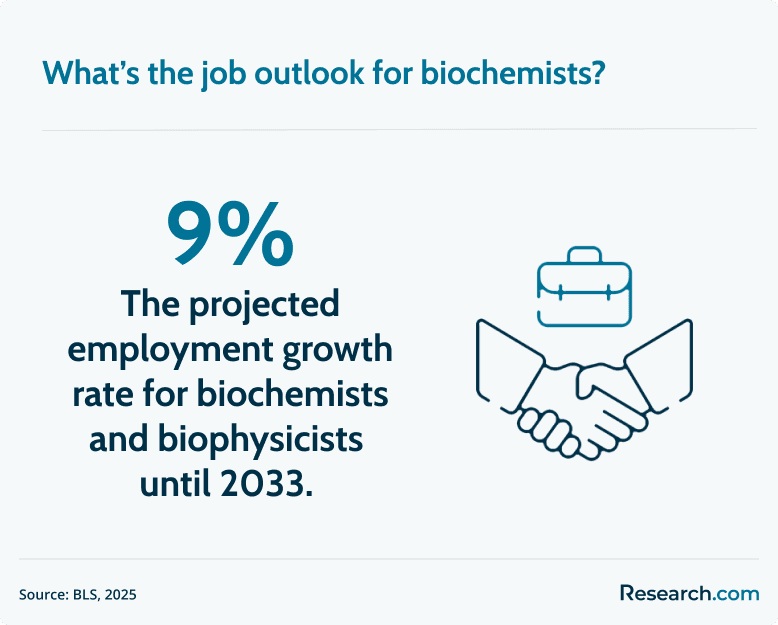
- Growth in core roles: Employment for biochemists and biophysicists is projected to increase 9% from 2023 to 2033, compared with a 4% outlook for all occupations.
- Openings across science fields: Life, physical, and social science occupations are expected to need about 148,400 new hires each year due to growth and replacement needs.
- Life-science employment strength: National employment in life-science sectors reached about 2.1 million workers in October 2024, supported by biotechnology hubs such as Boston, San Diego, and North Carolina’s Research Triangle.
- Short-term hiring changes: Job Openings and Labor Turnover Survey data showed pharmaceutical and medicine manufacturing vacancies dipping during early 2025, which suggests applicants may face periods of tighter competition even when long-term demand remains positive.
- Advantage for blended skills: Graduates who combine molecular science with coding, quality systems, regulatory writing, or documentation can be more competitive for hybrid roles. This is also relevant for students reviewing pharmaceutical scientist education requirements.
Students should not rely only on national projections. Review job postings in your target region, note required instruments or software, and choose coursework or internships that match those requirements.
What additional education pathways can complement an online biochemistry degree?
A biochemistry degree can pair well with advanced study in biotechnology, bioinformatics, pharmacy, medicine, public health, environmental science, regulatory affairs, data science, business, or engineering management. The right add-on depends on whether you want to work at the bench, manage projects, analyze data, enter healthcare, or lead scientific teams.
| Complementary pathway | Best for students interested in | Potential value |
| Bioinformatics or data science | Genomics, protein modeling, computational biology, and precision medicine. | Adds coding and analytics skills to molecular science training. |
| Pharmacy, medicine, or other health professions | Clinical practice, drug mechanisms, patient care, or professional licensure. | Uses biochemistry as a strong science foundation for professional study. |
| Regulatory affairs or quality assurance | FDA, EPA, compliance, validation, documentation, and manufacturing oversight. | Supports roles in regulated laboratories and life-science companies. |
| Environmental science | Pollution analysis, toxicology, remediation, and sustainability work. | Connects molecular knowledge with applied environmental problem solving. |
| Engineering management or business | Project leadership, biotech operations, product development, and cross-functional management. | Can help scientists move from technical work into leadership roles. |
For graduates aiming to lead technical teams, a business-oriented science pathway such as the cheapest online masters in engineering management may complement biochemical training with project, operations, and management skills.
Common Mistakes to Avoid When Choosing an Online Biochemistry Degree
- Choosing based only on tuition: Low tuition helps, but fees, lab kits, travel, transfer limits, and delayed graduation can change the real cost.
- Ignoring accreditation: Without recognized accreditation, you may lose access to federal aid, transfer options, and graduate-school recognition.
- Assuming all online labs are equivalent: Some programs offer robust residencies and practicums, while others rely heavily on simulations. Ask for details.
- Forgetting professional-school prerequisites: Pre-med, pharmacy, dental, veterinary, and graduate programs may require specific lab courses or in-person experiences.
- Not checking state or employer requirements: Clinical laboratory, forensic, and regulated roles may have location-specific requirements.
- Overlooking transfer-credit rules: A school may accept credits as electives but not apply them toward the science major.
- Relying only on rankings: Rankings are a starting point, not a substitute for checking curriculum, labs, faculty, cost, and outcomes.
- Assuming salary outcomes are guaranteed: Median wage data describes occupations, not guaranteed earnings for every graduate.
Here’s What Graduates Have to Say About Online Biochemistry Degree Programs
- "The online format let me plan coursework around my children’s routines, which made finishing possible. The degree helped me qualify for the environmental testing position I hold now." –Aimee
- "Because the program connected concepts with applied work, I felt more prepared in interviews. Soon after graduation, I applied to a PharmD program and was accepted." –Elliot
- "Studying online helped me avoid thousands in extra tuition costs, and I finished without debt. I now earn more in molecular biology than I did in my previous roles." –Ashmit
Key Insights
- An online biochemistry degree can be credible when it is regionally accredited, includes real lab preparation, and provides a curriculum aligned with your career or graduate-school plans.
- A full-time student starting from scratch can typically complete a 120-credit online biochemistry bachelor’s degree in about four years, while transfer students may finish faster after a formal credit review.
- Affordable options in this guide start at $129 per credit for in-state students, but total cost should include fees, lab kits, travel, technology, and transfer-credit limits.
- Students should compare lab formats carefully. Virtual simulations can support learning, but employers and graduate programs often value documented wet-lab, practicum, or research experience.
- Biochemists and biophysicists earn a median salary of $103,650, with the top 10% earning over $168,900, but many bachelor’s graduates begin in technician, analyst, quality, or associate roles before advancing.
- Employment for biochemists and biophysicists is projected to grow 9% from 2023 to 2033, and graduates with both molecular science and data or quality-system skills may have stronger options.
- The best program choice depends on more than price. Accreditation, lab intensity, faculty access, transfer policy, support services, and career outcomes should all shape the final decision.
References:
- American Chemical Society. (2025). Curriculum guidelines: Two-year college programs. Retrieved June 6, 2025, from https://www.acs.org/education/policies/two-year-college/guidelines/curriculum.html
- Bureau of Labor Statistics. (2025). Biochemists and Biophysicists. Occupational Outlook Handbook. https://www.bls.gov/ooh/life-physical-and-social-science/biochemists-and-biophysicists.htm
- Bureau of Labor Statistics. (2025). Clinical Laboratory Technologists and Technicians. Occupational Outlook Handbook. https://www.bls.gov/ooh/healthcare/clinical-laboratory-technologists-and-technicians.htm
- Bureau of Labor Statistics. (2025). Environmental Scientists and Specialists. Occupational Outlook Handbook. https://www.bls.gov/ooh/life-physical-and-social-science/environmental-scientists-and-specialists.htm
- Bureau of Labor Statistics. (2025). Life, Physical, and Social Science Occupations. Occupational Outlook Handbook. https://www.bls.gov/ooh/life-physical-and-social-science/home.htm
- Georgia Southwestern State University. (2025). Undergraduate tuition and fee schedule effective Fall 2025 [PDF]. https://www.gsw.edu/student-account/files/tuition-and-fee-schedule-fy26-undergrad.pdf
- National Science Foundation. (2025). Research Experiences for Undergraduates (REU). https://www.nsf.gov/funding/initiatives/reu
- San Diego State University Global Campus. (2025). Tuition. https://globalcampus.sdsu.edu/tuition/'
- University of Florida Online. (2025). Tuition & fees. https://ufonline.ufl.edu/tuition/tuition-fees/
- U.S. Department of Education, Federal Student Aid. (2025). Federal Pell Grants. https://studentaid.gov/understand-aid/types/grants/pell
- U.S. Department of Education, Federal Student Aid. (2025). Work-Study Jobs. https://studentaid.gov/understand-aid/types/work-study
- Western Governors University. (2025). Online degrees and programs. https://www.wgu.edu/online-degree-programs.html
Other Things You Should Know About Online Biochemistry Degree Programs
Yes. Most accredited online biochemistry programs require at least one in-person laboratory or lab-intensive component, often completed through short campus residencies, approved local labs, or hybrid courses. Schools usually specify the lab credit hours separately, commonly 4 to 8 credits, to meet major requirements.
Yes, many online biochemistry degree programs in 2027 have optional or required internships. These practical experiences are arranged in partnership with institutions or companies and typically occur during the latter part of the program to provide real-world experience.
Online biochemistry degrees in 2027 typically require 120–130 credit hours for completion. This includes coursework in general chemistry, organic chemistry, molecular biology, and lab-based classes. The credit hour requirement is pivotal for graduation within a standard timeframe.


