2027 Fastest Online Space Studies Degree Programs

Co-Founder and Chief Data Scientist
Want a $134,830 median aerospace-engineer paycheck faster? This section ranks the 10 fastest, fully online U.S. bachelor’s programs tied to space (aerospace, planetary science, space systems, data).
You’ll see which schools slash time with accelerated terms and generous transfer credits, plus what roles they unlock, what those roles pay, and how hot the market is. Read it to graduate sooner, spend less on extras, and hit a space-sector job market that’s heating up.
What are the benefits of completing the fastest online space studies degree program?
- Median aerospace engineer salary: $134,830 (May 2024, BLS); graduate sooner to earn earlier and compound raises faster.
- Data scientist jobs—core to space analytics—will grow 36% from 2023–2033 (BLS); demand stays hot.
- Career paths: aerospace engineer, mission operations specialist, remote-sensing/GIS analyst, space systems engineer, space policy analyst.
What can I expect from the fastest online space studies degree program?
Expect a sprint, not a stroll: compressed 7.5–9-week terms (ASU Online; Embry-Riddle Worldwide), frequent or monthly starts (APUS), and heavy use of simulation labs, CAD, MATLAB/Python, and remote capstones. You’ll juggle aerospace/EE fundamentals, orbital mechanics, data pipelines, and safety/regulatory coursework—entirely online, asynchronous with proctored exams. The payoff? You finish sooner and hit a market growing for aerospace engineers and data pros.
Where can I work with an online space studies degree program?
Space-adjacent grads land in the same places as traditional aerospace/EE/data pros: designing hardware, writing flight software, crunching mission data, or managing launch operations. Most hires cluster where space manufacturing, defense contracts, and R&D dollars live.
Top employing industries (Aerospace Engineers, BLS May 2023):
- Aerospace product & parts manufacturing – 26,400 jobs
- Architectural/engineering services – 10,200
- Federal government (exec. branch) – 9,530
- Scientific R&D services – 5,770
- Instrument manufacturing (nav/measuring/control) – 3,740.
Where are the jobs? BLS shows the biggest headcounts here:
- California – 11,130
- Texas – 6,250
- Washington – 5,430
- Alabama – 4,950
- Colorado – 3,760.
How much can I make with an online space studies degree program?
BLS puts the mean annual wage for aerospace engineers at $134,330 (May 2023). Here’s what six major salary trackers say (annual U.S. averages):
- Zippia: $100,401
- Salary.com: $112,376
- ZipRecruiter: $108,638
- Indeed: $108,268
- PayScale: $95,505
- Glassdoor: $118,247 average total pay.
- Fastest Online Space Studies Degree Programs for 2027 List of Programs
- How long does it take to complete the fastest online space studies degree program? Program Duration
- How does an online space studies degree compare to an on-campus program? Online vs Campus
- What is the average cost of the fastest online space studies degree program? Program Cost
- What are the financial aid options for students enrolling in the fastest online space studies degree program? Financial Aid
- What are the prerequisites for enrolling in the fastest online space studies degree program? Admission Requirements
- What courses are typically in the fastest online space studies degree program? What courses are typically in the fastest online space studies degree program?
- What types of specializations are available in the fastest online space studies degree programs? What types of specializations are available in the fastest online space studies degree programs?
- How do you choose the best among the fastest online space studies degree program? How do you choose the best among the fastest online space studies degree program?
- What career paths are available for graduates of the fastest online space studies degree programs? What career paths are available for graduates of the fastest online space studies degree programs?
- What is the job market like for graduates of online space studies degree programs? Job Outlook
- How do online space studies programs foster industry partnerships and practical engagement? How do online space studies programs foster industry partnerships and practical engagement?
- How can online space studies degrees be combined with advanced interdisciplinary studies? How can online space studies degrees be combined with advanced interdisciplinary studies?
Fastest Online Space Studies Degree Programs for 2027
If you want a space-related bachelor’s degree but do not want to spend four full years on campus, the fastest online space studies programs can help you move sooner into aerospace, mission operations, satellite data, geospatial analysis, meteorology, or space policy roles. The main decision is not simply which program sounds exciting. You need to compare acceleration options, transfer-credit limits, accreditation, course format, total cost, and whether the curriculum matches the job you actually want.
This guide focuses on fully online, U.S.-accredited bachelor’s programs connected to space science, aerospace systems, space operations, astronomical and planetary science, GIS, remote sensing, and data-for-space pathways. It explains how quickly students can realistically finish, what each program is best for, how online study compares with campus study, what costs to expect, and how to choose without sacrificing academic quality. If you are also comparing adjacent accelerated STEM fields, Research.com’s guide to accelerated online geography degree programs can provide a useful point of comparison.
Quick answer: What is the fastest online space studies degree path?
The fastest path is usually a fully online bachelor’s program with short academic terms, frequent start dates, and a generous transfer-credit policy. Students who already have an associate degree, military training, prior college coursework, or credit for prior learning may be able to finish in about 2–3 years. Students starting with no credits should usually plan for closer to a standard four-year timeline, even in an accelerated format.
For space-focused online bachelor’s programs, the strongest acceleration features include 7.5-week, 8-week, 9-week, or 11-week terms; year-round enrollment; multiple annual start dates; and transfer-credit caps that can reduce the number of credits taken at the degree-granting university.
How these programs were selected and compared
Our comparison emphasizes speed, but not at the expense of legitimacy. Programs were evaluated for online availability, institutional accreditation, accelerated term structure, transfer-credit flexibility, space-related curriculum depth, student support, and practical learning opportunities such as virtual labs, capstones, remote simulations, or industry-relevant projects. Research.com ranking practices use research-backed data and published methodologies. Data sources considered include IPEDS, Peterson's database, and College Scorecard databases.
| Rank | School and Program | Best For | Fast-Track Features | Typical Accelerated Timeline |
| 1 | American Public University System – B.S. in Space Studies | Broad space studies, astronomy, policy, and operations | 8-week courses, monthly starts, up to 90 transfer credits | As little as 1.5–3 years depending on prior credits |
| 2 | Embry-Riddle Aeronautical University Worldwide – B.S. in Space Operations | Mission operations, satellite systems, and launch support | 9-week terms, up to 10 start dates per year, acceleration options | Under 4 years; around 3 years with transfer credits |
| 3 | Florida Institute of Technology Online – B.A. in Aviation Management, Space Studies | Commercial space, aerospace business, and launch logistics | 8-week terms, six start dates per year, year-round course taking | About 3 years or less with transfer or continuous enrollment |
| 4 | Arizona State University Online – B.S. in Astronomical and Planetary Sciences | Astronomy, planetary science, and research-oriented study | 7.5-week courses, six start dates per year, summer study | About 3 years with year-round enrollment or transfer credits |
| 5 | University of Arizona Online – B.S. in Geographic Information Systems Technology | Satellite imagery, GIS, remote sensing, and spatial data | 7.5-week courses, six start dates per year | About 3 years with continuous study or transfer credits |
| 6 | Boise State University Online – B.A.S. in Interdisciplinary Professional Studies, Space Studies | Degree completion for transfer students seeking a custom space emphasis | Transfer-friendly structure and year-round course planning | About 2 years for prepared transfer students |
| 7 | Capitol Technology University – B.S. in Astronautical and Space Engineering | Space engineering, spacecraft design, propulsion, and mission systems | 8-week online course cycles and multiple intakes | About 3 years with year-round enrollment and transfer credits |
| 8 | University of North Dakota – B.S. in Aerospace Engineering | Aerospace engineering with spacecraft and propulsion foundations | Online delivery, summer terms, up to 64 transfer credits | About 3–4 years with transfer and year-round study |
| 9 | Oregon State University Ecampus – B.S. in Geography and Geospatial Science | Remote sensing, satellite data, cartography, and spatial analysis | 11-week quarters and four start terms per year | About 3 to 3.5 years with full year-round loads |
| 10 | Mississippi State University – B.S. in Geosciences, Broadcast and Operational Meteorology | Satellite meteorology, forecasting, and Earth observation | Online coursework, summer terms, and transfer-credit planning | About 3.5 years with summer courses or prior credits |
1. American Public University System – B.S. in Space Studies
American Public University System offers a fully online Bachelor of Science in Space Studies for students who want a broad undergraduate foundation in astronomy, planetary science, spacecraft operations, and the space sector. The program requires 120 credits and is especially appealing to adult learners, military students, and transfer students because courses run in 8-week sessions with monthly start dates.
APUS allows students to transfer in up to 90 credits, which can sharply reduce time to completion for those with prior coursework, military training, or approved learning experience. The curriculum also includes virtual lab work using a remote 24-inch telescope and analog astronaut mission experiences. Students who want to compare cost and curriculum with other aerospace options can review Research.com’s coverage of affordable online aerospace engineering-related programs.
- Program length: 4 years full-time for 120 credits; accelerated completion in about 3 years or less may be possible with transfer credit.
- Tracks or concentrations: Astronomy, Aerospace Science, Space Policy, Astrobiology, and Space Entrepreneurship.
- Course format: 100% online with 8-week classes and monthly starts.
- Cost per credit: $350 standard; $250 military rate for 2025–26.
- Accreditation: Higher Learning Commission (HLC).
2. Embry-Riddle Aeronautical University Worldwide – B.S. in Space Operations
Embry-Riddle Aeronautical University Worldwide offers an online Bachelor of Science in Space Operations designed for students interested in mission control, satellite operations, launch coordination, and space systems support. The degree includes a required minor, such as Space Policy, Systems Engineering, or Human Factors, which helps students broaden their employment options.
Embry-Riddle Worldwide uses 9-week terms and offers up to 10 start dates per year. That calendar gives motivated students more chances to begin, continue, and stack coursework without waiting for a traditional fall or spring semester. The program also includes a capstone experience centered on space mission planning, which is important for students who need portfolio-ready evidence of applied skills.
- Program length: 4 years full-time; 2–3 years may be possible with transfer credits.
- Tracks or concentrations: Space Operations core plus a required minor such as Systems Engineering, Space Policy, or Human Factors.
- Course format: 100% online with 9-week terms, up to 10 start terms per year, and an option to accelerate.
- Cost per credit: $522 for civilian students; $250 for military students.
- Accreditation: SACSCOC.
3. Florida Institute of Technology Online – B.A. in Aviation Management, Space Studies
Florida Institute of Technology offers an online Bachelor of Arts in Aviation Management with a Space Studies focus. This option is better suited to students who want the business, logistics, management, and regulatory side of aerospace and commercial space rather than a heavily engineering-based curriculum.
The program uses 8-week terms and six annual start dates, allowing students to continue through the year instead of waiting for long semester cycles. Coursework blends aviation management, orbital systems, spaceflight logistics, and launch regulations. For students aiming at commercial space operations, aerospace administration, or launch-sector support roles, this program can be more directly relevant than a pure astronomy degree.
- Program length: 4 years full-time; 2–3 years may be possible with transfer or year-round study.
- Tracks or concentrations: Space Studies specialization within Aviation Management.
- Course format: 100% online with 8-week courses and six start dates per year.
- Cost per credit: $510 undergraduate rate for 2025–26.
- Accreditation: SACSCOC.
4. Arizona State University Online – B.S. in Astronomical and Planetary Sciences
Arizona State University Online offers a Bachelor of Science in Astronomical and Planetary Sciences through its School of Earth and Space Exploration. Students study topics such as stellar evolution, planetary geology, and astrophysics while using virtual labs and real telescope data for applied learning.
ASU Online’s 7.5-week courses are organized into two sessions per semester, with six start dates per year. Students who take courses back-to-back and include summer study may be able to finish in about 3 years. Elective options can help students lean toward astrophysics, planetary geology, or space instrumentation.
- Program length: 4 years full-time; approximately 3 years with year-round enrollment or transfer credits.
- Tracks or concentrations: Elective focus areas in Astrophysics, Planetary Geology, and Space Instrumentation.
- Course format: 100% online with 7.5-week accelerated classes and six start dates per year.
- Cost per credit: $561–$661 for undergraduate online study in 2025–26.
- Accreditation: Higher Learning Commission (HLC).
5. University of Arizona Online – B.S. in Geographic Information Systems Technology
University of Arizona Online offers a Bachelor of Science in Geographic Information Systems Technology. While this is not a traditional astronomy or aerospace degree, it is highly relevant to space-related work involving satellite imagery, remote sensing, Earth observation, geospatial analysis, and spatial data science.
The program is delivered in accelerated 7.5-week terms with six annual start dates across Fall A/B, Spring A/B, and Summer sessions. Students learn cartographic design, GIS analysis, and satellite-derived data workflows. This is a strong option for learners who want to work with the data produced by satellites rather than the vehicles that carry them.
- Program length: 4 years full-time; about 3 years with continuous enrollment or transfer credits.
- Tracks or concentrations: Electives in Remote Sensing, Geospatial Analysis, and Spatial Data Science.
- Course format: 100% online with 7.5-week courses and six start dates per year.
- Cost per credit: $525 online undergraduate rate for 2025–26.
- Accreditation: HLC.
6. Boise State University Online – B.A.S. in Interdisciplinary Professional Studies, Space Studies
Boise State University Online offers a Bachelor of Applied Science in Interdisciplinary Professional Studies that can be shaped around a Space Studies emphasis. This degree-completion structure is especially useful for students who already hold an associate degree or have a large number of transferable credits.
Students can build an individualized course plan using subjects such as physics, remote sensing, aerospace policy, and related technical or professional fields. Because the program is transfer-friendly, many students may finish in 2–3 years when they enter with prior credit and study year-round.
- Program length: 4 years full-time; about 2 years for transfer students completing upper-division requirements.
- Tracks or concentrations: Individualized Space Studies emphasis within a multidisciplinary curriculum.
- Course format: 100% online, with acceleration supported through full course loads, summer enrollment, and tailored advising.
- Cost per credit: $375 uniform online rate for 2025–26.
- Accreditation: Northwest Commission on Colleges and Universities (NWCCU).
7. Capitol Technology University – B.S. in Astronautical and Space Engineering
Capitol Technology University offers an online Bachelor of Science in Astronautical and Space Engineering for students who want an engineering-centered space curriculum. Coursework covers spacecraft design, propulsion, orbital mechanics, mission operations, avionics, satellite communications, and related systems.
The program follows a four-year structure, but online 8-week course cycles and multiple intake points can help prepared students move faster, particularly if they enter with transfer credits. Students should pay close attention to engineering accreditation expectations, especially if they plan to pursue engineering licensure, graduate engineering study, or roles where programmatic accreditation matters.
- Program length: 4 years full-time; about 3 years with year-round enrollment and transfer credits.
- Tracks or concentrations: Astronautical and Space Engineering core with electives in Propulsion, Satellite Communications, and Mission Operations.
- Course format: 100% online; likely 8-week course cycles with multiple intakes.
- Cost per credit: $450 undergraduate online rate for 2025–26.
- Accreditation: Middle States Commission on Higher Education (MSCHE).
8. University of North Dakota – B.S. in Aerospace Engineering
University of North Dakota offers a fully online Bachelor of Science in Aerospace Engineering that includes aerodynamics, propulsion, orbital mechanics, and spacecraft design. The 128-credit program uses asynchronous lectures, interactive simulations, and virtual labs, while senior capstone projects focus on team-based aerospace system design using CAD and mission-planning software.
UND’s online calendar follows fall, spring, and summer terms. Students may transfer up to 64 credits toward the 128-credit requirement, making this a practical option for those who already have substantial college coursework and want an engineering route into aerospace or space systems.
- Program length: 4–5 years standard; approximately 3–4 years with transfer credits and year-round study.
- Course format: 100% online with semester terms, asynchronous content, and scheduled lab simulations.
- Transfer credits: Up to 64 credits toward the 128-credit requirement.
- Accreditation: Higher Learning Commission (HLC).
9. Oregon State University Ecampus – B.S. in Geography and Geospatial Science
Oregon State University Ecampus offers a fully online Bachelor of Science in Geography and Geospatial Science for students interested in GIS, satellite imagery, remote sensing, spatial analysis, and Earth systems. Although the degree is grounded in geography and environmental science, the skill set overlaps strongly with satellite-based monitoring and planetary surface analysis.
OSU operates on an 11-week quarter system with four start terms per year. The 180 quarter-credit program is equivalent to 120 semester credits. Students who enroll in all four quarters and maintain full loads may be able to finish in about 3 to 3.5 years.
- Program length: 4 years full-time for 180 quarter credits; about 3 years with year-round four-quarter enrollment.
- Tracks or concentrations: Elective clusters in Remote Sensing, Spatial Analysis, and Cartography.
- Course format: 100% online with 11-week quarter terms and four start dates per year.
- Cost per credit: $350 flat online rate for 2025–26.
- Accreditation: NWCCU.
10. Mississippi State University – B.S. in Geosciences, Broadcast and Operational Meteorology
Mississippi State University offers an online Bachelor of Science in Geosciences with a concentration in Broadcast and Operational Meteorology. The degree focuses on atmospheric science, forecasting, Doppler radar, weather modeling, and satellite meteorology, including work with GOES weather satellite data.
This is not a traditional space studies degree, but it is relevant to Earth observation, remote sensing, satellite data interpretation, severe weather monitoring, and operational forecasting. The program follows a standard academic calendar, though students may accelerate through summer coursework and transfer credits. The degree requires 124 credits, slightly above the common 120-credit bachelor’s structure.
- Program length: 4 years full-time for 124 credits; about 3.5 years with summer courses or prior credits.
- Tracks or concentrations: Broadcast Meteorology or Operational Meteorology.
- Course format: 100% online with an optional in-person summer internship; traditional semesters with summer acceleration available.
- Cost per credit: $385 distance education undergraduate rate.
- Accreditation: SACSCOC.
How long does the fastest online space studies degree take?
The fastest online space studies bachelor’s programs usually take 2–3 years for students who transfer a substantial number of credits and enroll continuously. Students entering with no prior credit should expect closer to 4 years, even if the program uses short terms.
Completion speed depends on two main factors: how many credits you bring in and how many terms you can complete each year. APUS allows up to 90 transfer credits and offers monthly starts. Embry-Riddle Worldwide uses 9-week terms with up to 10 start dates a year. ASU Online uses 7.5-week sessions. These structures allow students to take more academic blocks in a year than a traditional 15-week semester calendar. Students exploring APUS transfer pathways may also review transfer partnership information.
Online enrollment is now a mainstream part of higher education. NCES reports that 53.2% of U.S. college students took distance-education courses in fall 2023. That demand helps explain why more institutions now offer shorter terms, rolling starts, and online student support. Similar acceleration patterns also appear in accelerated social sciences online degree options.
| Student Profile | Likely Time to Finish | Why the Timeline Changes |
| First-time college student with no credits | About 4 years | Must complete nearly the full 120-credit or higher degree requirement. |
| Student with 30–60 transfer credits | About 2.5–3.5 years | Short terms and summer enrollment can reduce the remaining calendar time. |
| Student with an associate degree or close to 90 transferable credits | About 1.5–2.5 years | Only upper-division, major, and residency requirements may remain. |
| Working adult studying part time | Often 4 years or longer | Acceleration is limited if the student can only manage one or two courses per term. |
Online vs. on-campus space studies programs: Which format is better?
An online space studies degree can be a strong option when the institution is properly accredited, the curriculum is rigorous, and the student can build practical experience through projects, labs, internships, or capstones. The delivery format alone should not be the deciding factor. Employers are more likely to care about the school’s accreditation, reputation, technical curriculum, and evidence of skills than whether every class met in a physical classroom.
According to NCES data, 53.2% of students took distance-education courses in fall 2023. Online study is now common across many disciplines, including STEM fields such as space systems, geospatial science, and online computer science degree pathways.
The biggest differences are practical. Online programs often use shorter academic sessions, asynchronous lectures, virtual labs, remote simulations, proctored exams, and digital collaboration platforms. Campus programs may provide easier access to physical labs, makerspaces, faculty research groups, and in-person networking. ASU’s academic calendar, for example, shows how shorter sessions can structure the pace of online learning; students can review ASU academic calendar information for context.
| Factor | Online Space Studies Degree | On-Campus Space Studies Degree |
| Speed | Often faster because of 7.5-week, 8-week, 9-week, or year-round formats. | Usually follows 15-week semesters unless the school offers summer acceleration. |
| Flexibility | Best for working adults, military students, caregivers, and students outside major aerospace hubs. | Best for students who can relocate and attend classes during scheduled times. |
| Labs and projects | Uses virtual labs, simulations, remote instruments, and online capstones. | May offer physical labs, wind tunnels, machine shops, observatories, or makerspaces. |
| Networking | Requires intentional use of virtual events, internships, online teams, and faculty outreach. | Offers more informal in-person networking, student organizations, and campus recruiting. |
| Cost | Can reduce commuting, relocation, and campus housing costs. | May include added campus fees, housing, transportation, and relocation expenses. |
| Best fit | Self-directed students who can manage deadlines and technology independently. | Students who need face-to-face structure and hands-on campus resources. |
How much does a fast online space studies degree cost?
Cost varies widely by school type, transfer credits, tuition rate, fees, and pace. In 2024–25, the average full-time undergraduate budget, including tuition, fees, and living costs, is $29,910 at public four-year in-state colleges and $62,990 at private nonprofits. For fully online study, the average total price of an online bachelor’s was $51,841 in 2024; public in-state online programs averaged $40,926 and private online programs averaged $62,756, with a mean $333 per credit hour.
Some affordable online colleges charged under $200 per credit in 2023, which was far below the roughly $1,000 per-credit average at four-year campuses. However, students should not compare tuition alone. Online learners may also pay technology fees, proctoring fees, software costs, textbook or digital material charges, and graduation fees.
A fast-track, fully online, space-related bachelor’s program will often fall in the mid-$40k to low-$60k range before financial aid. Students can pay less if they transfer credits, use prior-learning assessment, receive employer tuition support, qualify for military benefits, or select a lower-cost public online option. Similar savings strategies apply in accelerated online geosciences degree programs.
| Cost Factor | Why It Matters | Question to Ask |
| Per-credit tuition | The largest direct cost for most online students. | Is the rate the same for in-state and out-of-state online students? |
| Transfer credits | Every accepted credit can reduce both time and tuition. | How many credits can I transfer, and how many must be taken at this university? |
| Online fees | Technology, proctoring, and platform costs can add up. | What required fees are charged each term or each course? |
| Course materials | STEM software, digital labs, and textbooks may be costly. | Are materials included, open-access, or billed separately? |
| Pace of study | Finishing faster may reduce opportunity costs but can increase short-term course load. | Can I realistically handle the accelerated schedule while working? |
What financial aid can online space studies students use?
Online space studies students at eligible accredited institutions can generally use the same major aid categories available to other undergraduate students. That includes federal grants, federal loans, state aid, institutional scholarships, employer tuition benefits, veterans benefits, and private scholarships. In 2019–20, 74% of undergraduates received some type of aid, and average federal grant aid rose to $11,610 in 2023–24. The maximum Pell Grant is $7,395 for 2024–25, according to federal student aid information and NCES reporting through NCES.
Students in space studies, aerospace, GIS, meteorology, STEM, or computer science degree pathways should start with the FAFSA and then compare net price, not sticker price.
- Federal Pell Grants: Need-based aid that does not need to be repaid.
- Federal Supplemental Educational Opportunity Grant: Additional need-based grant funding at participating schools.
- Federal Work-Study: Paid work opportunities, which may include remote or institution-approved roles.
- Direct Subsidized and Unsubsidized Loans: Federal loans with regulated terms and borrower protections.
- State grants and scholarships: Funding that may depend on residency, income, major, or enrollment status.
- Institutional scholarships: Merit-based or need-based awards from the university.
- Employer tuition assistance: A valuable option for working adults in aerospace, defense, technology, or government-related roles.
- Veterans benefits: GI Bill, Yellow Ribbon, and related military education benefits where applicable.
- Private STEM scholarships: Awards from organizations such as NASA Space Grant Consortium or AIAA.
- Credit for prior learning: Not financial aid, but it can lower total tuition by reducing required credits.
Before borrowing, prioritize grants, scholarships, employer support, military benefits, and transfer-credit savings. Private loans should usually be the last option because they may carry fewer protections than federal loans.
What admissions requirements should applicants expect?
Admissions requirements vary by institution, but most online space studies bachelor’s programs expect applicants to show college readiness in math, science, writing, and technology. Engineering-heavy programs usually require stronger preparation than policy, operations, or GIS-oriented programs. In 2019, 85% of U.S. high school graduates completed Algebra II, but only 35% completed biology, chemistry, and physics, which illustrates why many students need to check STEM readiness before enrolling.
Applicants comparing space studies with a traditional math degree should pay close attention to calculus placement, lab science background, and programming expectations.
- High school diploma or GED plus official transcripts.
- Minimum GPA that may range from 2.0 at APUS to about 3.0 in required competencies at some schools.
- Four years of math, often through Algebra II or precalculus for stronger STEM pathways.
- Three lab sciences, commonly including physics, chemistry, and biology.
- Readiness for college algebra or calculus; APUS requires MATH 111/112.
- No unresolved math or science deficiencies at some institutions.
- Ability to participate in required online sessions, virtual labs, discussions, or group projects.
- English composition readiness and, for technical programs, basic programming familiarity.
Who should consider a fast online space studies program?
- Students with prior college credits who want to finish a bachelor’s degree faster.
- Military-affiliated learners with training that may transfer into credit.
- Working adults who need flexible online scheduling.
- Students interested in satellite data, mission operations, GIS, meteorology, space policy, or aerospace systems.
- Self-directed learners who can manage compressed deadlines without frequent in-person reminders.
Who may be better served by another route?
- Students who need extensive hands-on physical lab access every week.
- Students seeking a highly specialized engineering license path without confirming programmatic accreditation.
- Students who struggle with independent learning or compressed courses.
- Students whose career goal requires graduate-level physics, astronomy, or engineering research experience and who need in-person faculty lab access.
What courses are common in online space studies degrees?
Online space studies curricula typically combine science, engineering concepts, data analysis, policy, and applied systems work. The exact course mix depends on whether the program emphasizes space science, astronautical engineering, mission operations, GIS, or meteorology. Students comparing these degrees with an engineering major should look carefully at the level of calculus, physics, design, and lab requirements.
Examples from program catalogs such as American Public University System’s space studies curriculum and UND aerospace-related course information show that many programs blend technical foundations with applied space-sector topics.
| Course Area | What Students Learn | Career Relevance |
| Spacecraft Systems Engineering | Satellite and probe subsystems, systems integration, testing, and reliability. | Useful for spacecraft design, systems engineering, and payload integration. |
| Rocket Propulsion and Launch Vehicles | Thrust, propellants, staging, launch performance, and design tradeoffs. | Relevant to launch operations, propulsion support, and aerospace engineering roles. |
| Remote Sensing and GIS | Satellite imagery, spectral analysis, mapping, and geospatial workflows. | Supports GIS analyst, Earth observation, and satellite data roles. |
| Space Law and Policy | Treaties, licensing, export controls, ITAR issues, and commercial space regulation. | Important for government, compliance, commercial space, and policy work. |
| Space Flight and Operations | Mission planning, ground operations, crew operations, risk, and anomaly response. | Prepares students for mission operations and flight support positions. |
| Observational Astronomy and Astrophysics | Telescope use, photometry, spectroscopy, and analysis of celestial objects. | Useful for research support, observatory, and science-track roles. |
| Data Analysis and Scientific Programming | Python, R, MATLAB, or related tools for datasets, instruments, and modeling. | Critical for telemetry, remote sensing, and space analytics. |
| Capstone or Independent Study | Mission design, research, engineering, or applied analysis project. | Creates portfolio evidence for employers and graduate programs. |
What specializations are available in fast online space studies programs?
Space studies is not one narrow major. Online programs often let students focus on science, operations, engineering, data, policy, or Earth observation. Choosing the right specialization matters because a student targeting satellite imagery roles needs a different portfolio than a student targeting launch operations or spacecraft design.
| Specialization | Focus | Best For |
| Space Science, Astronomy, and Planetary Science | Planetary geology, spectroscopy, mission science, astronomy, and astrophysics. | Students interested in research support, observatories, planetary science, or graduate study. |
| Space Operations and Mission Control | Mission planning, safety, human factors, training, ground systems, and command workflows. | Students aiming for operations support, flight dynamics, or mission control environments. |
| Astronautical and Space Engineering | Spacecraft systems, propulsion, avionics, orbital mechanics, and ground systems. | Students seeking technical engineering or systems roles in aerospace. |
| Remote Sensing and GIS Technology | Satellite imaging, spatial analysis, geospatial databases, and hazard mapping. | Students targeting GIS, Earth observation, environmental monitoring, or defense analytics. |
| Broadcast and Operational Meteorology | Weather forecasting, radar, satellite meteorology, climate communication, and severe weather. | Students interested in forecasting, media meteorology, or operational weather analysis. |
| Space Policy, Economy, and National Security | Treaties, licensing, commercial space markets, national security, and regulation. | Students interested in policy, government, compliance, or commercial space administration. |
| Space Systems and Software Engineering | Flight software, autonomy, mission analytics, and payload data pipelines. | Students who may later pursue advanced computing study such as a master software engineering online. |
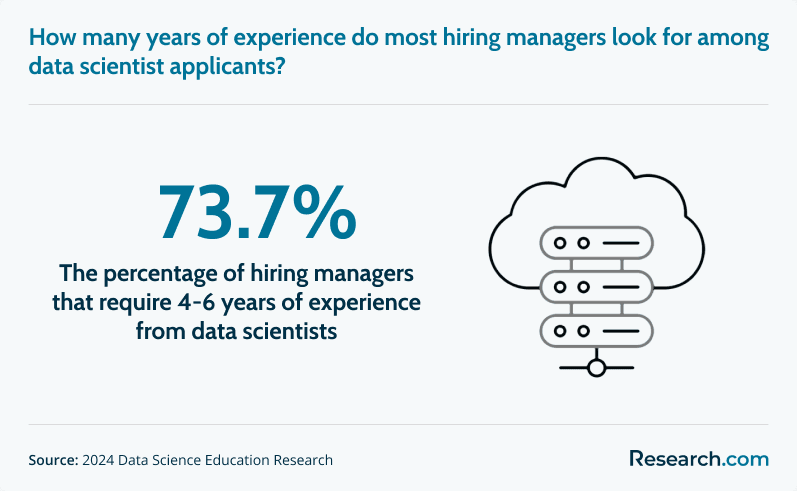
The data-heavy specializations are increasingly valuable because space work produces large volumes of telemetry, imagery, sensor, and modeling data. The graphic below notes that 73.7% of hiring managers want 4–6 years of data-science experience. Students can respond by building project portfolios in remote sensing, GIS, mission analytics, and scientific programming before graduation.
How to choose the best fast online space studies degree
The best accelerated program is not always the shortest one. A degree is worth more when it is accredited, affordable, aligned with your career goal, and realistic for your schedule. Use the checklist below before enrolling.
- Verify accreditation first. Confirm institutional accreditation through recognized sources. Without accreditation, you may lose access to federal aid, transfer credit, graduate school options, or employer recognition.
- Check whether the program is truly 100% online. Some programs advertise online coursework but still require labs, practicums, or campus visits.
- Match the curriculum to your target role. Space operations, engineering, GIS, astronomy, meteorology, and policy have different course requirements and job outcomes.
- Ask for a transfer-credit evaluation before committing. A school’s maximum transfer policy does not guarantee all your credits will apply to the degree.
- Calculate total cost, not just tuition. Include technology fees, proctoring, materials, software, textbooks, graduation fees, and any travel.
- Look for applied work. Strong programs include virtual labs, simulations, research projects, capstones, internships, or employer-linked projects.
- Review faculty and industry connections. Faculty experience with NASA, DoD, aerospace contractors, GIS firms, or research labs can strengthen mentoring and project quality.
- Confirm student support. Online STEM students should have access to tutoring, advising, library help, career services, technical support, and ADA accommodations.
- Evaluate assessment style. Some students perform better with projects and portfolios; others are comfortable with proctored exams and timed tests.
- For engineering tracks, ask about programmatic accreditation. If licensure, graduate engineering study, or certain engineering employers matter to you, confirm whether ABET or another relevant programmatic standard applies.
| Common Mistake | Why It Can Hurt You | Better Approach |
| Choosing the shortest program without checking accreditation | Credits, aid, employment recognition, and graduate options may be limited. | Verify accreditation before comparing speed. |
| Looking only at tuition | Fees, software, proctoring, and materials can change the real price. | Request a full cost breakdown and estimated net price. |
| Assuming all online engineering degrees meet licensure expectations | Some engineering pathways require specific programmatic accreditation or state rules. | Ask the department and licensing board before enrolling. |
| Ignoring transfer-credit rules | You may be admitted but still need to repeat courses. | Get a written transfer evaluation before starting. |
| Taking too many accelerated courses at once | Short terms can become overwhelming, especially in calculus, physics, or programming. | Start with a manageable load and increase only after proving your pace. |
| Relying only on rankings | A highly ranked school may not fit your career target, budget, or schedule. | Use rankings as one data point, not the final decision. |
BLS engineering employment data show why concentration choice matters. Many roles sit within broader civil, industrial, mechanical, electrical, aerospace, or related engineering categories. Students considering cross-disciplinary options may also compare these programs with accelerated electrical engineering degree online offerings.
What jobs can graduates pursue with an online space studies degree?
Graduates typically start in analyst, technician, operations, engineering support, GIS, meteorology, or junior technical roles rather than senior mission leadership positions. Career outcomes depend heavily on specialization, internships, security clearance eligibility, technical portfolio, location, and whether the degree is science-, data-, operations-, or engineering-focused.
BLS data show that aerospace engineers need a bachelor’s degree and have projected 6% growth through 2033. Data-science roles that support space analytics are growing 35%, and physicists and astronomers are projected to grow 7%. Students should review the BLS Occupational Outlook Handbook for aerospace engineers when evaluating labor-market expectations.
| Career Path | Typical Entry Point | What the Role Involves | Helpful Specialization |
| Space Data or GIS Technician | Entry level | Cleans, maps, and analyzes satellite imagery or mission datasets. | Remote sensing, GIS, data analysis. |
| Telemetry Analyst | Entry level | Monitors sensor streams, flags anomalies, and supports mission teams. | Mission analytics, programming, operations. |
| Junior Aerospace or Software Engineer | Entry to early career | Supports flight code, sensors, power systems, modeling, or subsystem work. | Engineering, software, systems. |
| Mission Operations Specialist | Entry to early career | Assists with mission procedures, command scripts, schedules, and ground operations. | Space operations, human factors, systems. |
| Flight Dynamics Engineer | Early to mid-career | Works on trajectories, orbital mechanics, maneuver planning, and launch windows. | Astrodynamics, mathematics, aerospace engineering. |
| Systems or Payload Integration Engineer | Mid-career | Coordinates hardware, software, testing, schedules, and subsystem interfaces. | Systems engineering, spacecraft design. |
| Project or Program Manager | Mid- to senior-level | Manages budgets, timelines, suppliers, teams, and technical risk. | Operations, engineering, policy, management. |
| Mission Director, Chief Engineer, or Principal Investigator | Senior-level | Leads mission strategy, technical decisions, funding, and go/no-go authority. | Advanced technical specialization, graduate study, leadership experience. |
Students who want to move toward software, AI, or data-intensive leadership may later consider advanced computing options, including an online masters in computer science without CS undergrad.
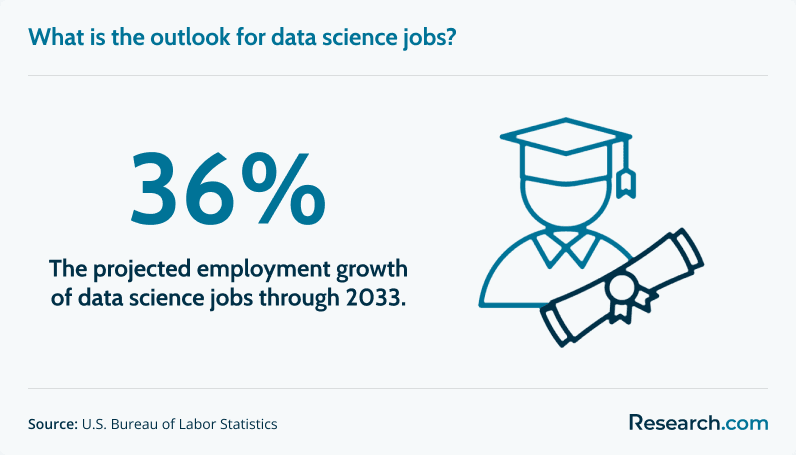
The image below highlights BLS’s 36% projected growth for data science jobs through 2033. Because satellite missions, telescopes, weather systems, and planetary science projects all generate large datasets, data literacy can improve a graduate’s flexibility across the space economy.
What is the job market like for online space studies graduates?
The job market is specialized, but not limited to one employer type. Graduates may work in aerospace manufacturing, engineering services, federal agencies, research laboratories, defense contractors, GIS firms, weather organizations, satellite companies, and commercial space businesses. The strongest candidates usually combine domain knowledge with practical skills in programming, data analysis, systems thinking, GIS, simulation, or engineering design.
BLS reports 68,900 U.S. aerospace engineer jobs in 2023, with 6% growth and about 4,200 openings per year projected through 2033. Data scientists, whose skills are important for telescope, satellite, and probe datasets, account for 202,900 jobs, with 35% growth and 20,800 openings annually. Physicists and astronomers represent 23,500 jobs, with 7% growth and about 1,600 openings.
Aerospace employment is concentrated in locations where spacecraft, aircraft, satellites, and defense systems are designed, built, launched, tested, or analyzed. Aerospace product and parts manufacturing accounts for 40% of aerospace engineer jobs. Major employment states include California, Texas, Washington, Alabama, and Colorado, reflecting contractor hubs, government facilities, research centers, and operations sites. Students should understand that fully remote study does not always mean fully remote employment; internships and jobs may still cluster near aerospace regions.
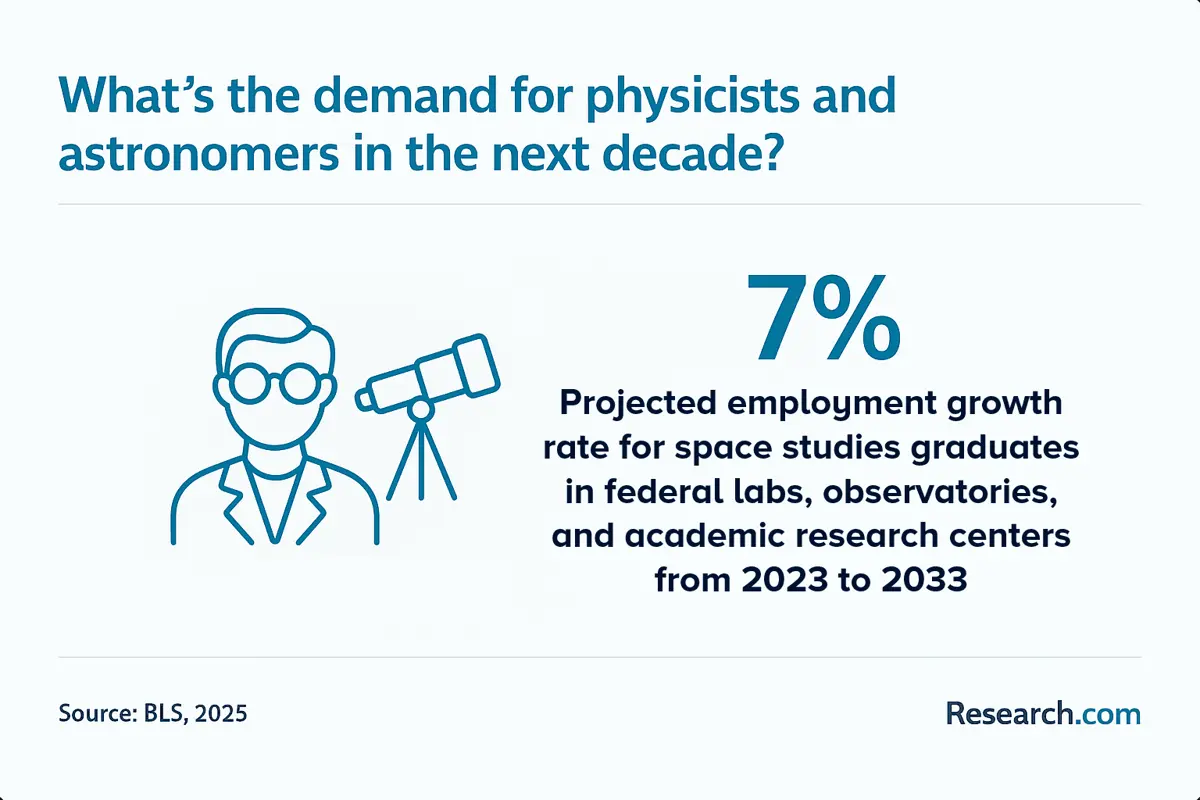
The image below shows BLS’s 7% growth forecast for physicists and astronomers through 2033. This research-oriented labor market is smaller than data science or engineering, but it remains relevant for students focused on astronomy, planetary science, observatories, and federal-lab work.
How do online space studies programs build industry experience?
The strongest online space studies programs use more than recorded lectures. They connect students with applied projects, simulation tools, virtual labs, capstone teams, guest speakers, and, when available, internships with aerospace companies, government agencies, research groups, or technology employers. These experiences matter because space-sector employers often want proof that a graduate can work with systems, data, technical documentation, collaborative design, or mission-style problem solving.
Prospective students should ask whether the program offers employer-connected capstones, virtual mission simulations, remote telescope access, GIS datasets, software used in industry, project reviews with practitioners, or career support for NASA, DoD, commercial launch, aerospace manufacturing, GIS, weather, and satellite-related roles. Students comparing broader engineering affordability may also review Research.com’s guide to the cheapest engineering colleges.
Can an online space studies degree be combined with other fields?
Yes. Space studies is naturally interdisciplinary. Many graduates strengthen their career options by combining space knowledge with software engineering, cybersecurity, data science, electrical engineering, GIS, policy, national security, business, meteorology, or health and environmental analytics. This strategy can be especially useful for students who want to work with satellite-derived health, climate, disaster-response, agriculture, or public-safety data.
For example, a student with a foundation in space systems and data analysis could later pursue graduate study in analytics, cybersecurity, software, or informatics. Some professionals may explore an accelerated masters health informatics degree online to apply technical and data skills across health technology, geospatial health monitoring, or emerging interdisciplinary data roles.
What graduates say about accelerated online space studies programs
- Soraya: "I began as a telemetry technician working through satellite data and moved into a flight dynamics role 18 months later. Data-scientist roles are growing 36% through 2033, so I focused hard on Python, orbital math, and project work. The compressed terms were demanding, but the no-commute format made the pace possible."
- Keiran: "The FAFSA helped me access a $7,395 Pell Grant, and I layered other aid before paying for proctored exams out of pocket. Two 7.5-week sessions each semester kept me moving without completely overloading me. Online team projects also gave me portfolio samples and real classmates to stay connected with."
- Aveline: "I completed 60 credits in 27 months while working mission-operations nights. Seeing BLS report a $134,830 median for aerospace engineers made the faster timeline feel worth it because graduating earlier meant entering the field earlier. Remote labs, Slack-based capstones, and no relocation costs made the online route work for me."
References
- American Public University System. Bachelor of Science in Space Studies.
- Arizona State University. B.S. in Astronomical and Planetary Sciences.
- Boise State University. Online Interdisciplinary Professional Studies.
- Capitol Technology University. B.S. in Astronautical and Space Engineering.
- College Board. Trends in College Pricing and Student Aid 2024.
- College Values Online. Average Cost of an Online Undergraduate Degree.
- Embry-Riddle Aeronautical University. B.S. in Space Operations.
- Federal Student Aid. Pell Grant Guidance.
- Florida Institute of Technology. B.A. in Aviation Management.
- Glassdoor. Aerospace Engineer Salaries in the U.S..
- Indeed. Aeronautical Engineer Salary Data.
- Mississippi State University. Broadcast and Operational Meteorology Program.
- National Center for Education Statistics. NCES Press Release.
- Oregon State University Ecampus. Online B.S. in Geography and Geospatial Science.
- PayScale. Aerospace Engineer Salary Research.
- Salary.com. Aerospace Engineer Salary Information.
- U.S. Bureau of Labor Statistics. Aerospace Engineers Occupational Outlook Handbook.
- U.S. Bureau of Labor Statistics. Data Scientists Occupational Outlook Handbook.
- U.S. Bureau of Labor Statistics. Occupational Employment and Wages, 17-2011 Aerospace Engineers, May 2023.
- U.S. Department of Labor. Find Your Place in Space.
- University of Arizona. Online B.S. in Geographic Information Systems Technology.
- University of North Dakota. B.S. in Aerospace Engineering.
- ZipRecruiter. Aerospace Engineer Salary Data.
- Zippia. Aerospace Engineer Jobs and Salary Data.
Key Insights
- The fastest online space studies degrees usually require short terms, year-round enrollment, and a strong transfer-credit strategy; speed comes mostly from credits already earned and continuous course taking.
- Students with substantial prior credit may finish in about 2–3 years, while first-time college students should generally plan for closer to 4 years.
- Space studies is a broad category. Engineering, mission operations, astronomy, GIS, meteorology, policy, and space data programs can lead to different jobs, so curriculum fit matters more than the program title.
- Accreditation is nonnegotiable. For engineering-focused programs, students should also ask whether programmatic accreditation is important for their career or licensure goals.
- Online programs can be respected when they are accredited and rigorous, but students must intentionally build experience through projects, internships, portfolios, simulations, and technical tools.
- Cost should be evaluated by net price, not tuition alone. Transfer credits, Pell Grants, employer reimbursement, military benefits, and scholarships can substantially change affordability.
- Data skills are increasingly valuable in space-related careers because satellites, telescopes, weather systems, and missions all generate large datasets that need analysis, modeling, and visualization.
Other Things You Should Know About the Fastest Online Space Studies Degree Programs
To enroll in the fastest online space studies degree programs in 2027, candidates typically need a high school diploma or equivalent. Some programs may require prior coursework in physics or mathematics. Admission criteria can vary, so checking specific program requirements is advisable.
Admission requirements for 2027's fastest online space studies programs typically include a high school diploma or equivalent, letters of recommendation, and a personal statement. Many programs also require proficiency in math and physics and may need prerequisite coursework in these areas.
Yes. Schools like APUS let undergrads use a fully remote 24-inch research telescope and process original images. Virtual astronomy labs can simulate spectrometry, photometry and orbital mechanics. Expect simulation software instead of wind tunnels, but outcomes are measured the same way—reports, code, and capstones.
In 2027, top online space studies programs include virtual lab experiences and remote telescope access, enabling students to engage in hands-on learning. Institutions like the University of North Dakota and Arizona State University offer these resources, ensuring that online students gain practical skills essential for space studies careers.