
2027 Most Affordable Online Applied Sciences Degree Programs

Co-Founder and Chief Data Scientist
An online applied sciences degree is often considered by students who want a practical, career-focused science or technology credential without leaving work, relocating, or paying for a traditional campus experience. The decision is not just “Which school is cheapest?” A better question is: which accredited online program gives you the right technical training, accepts the most transfer credit, fits your schedule, and leads toward the roles you actually want?
This guide is designed for working adults, community college graduates, military-affiliated learners, career changers, and students comparing affordable online applied sciences degree programs for 2027. You will learn what these programs cover, how long they take, what they cost, which schools offer low-cost options, what careers may follow, and how to avoid expensive mistakes when choosing a program.
Quick Answer: Is an Online Applied Sciences Degree Worth Considering?
An online applied sciences degree can be a strong option if you want a flexible, technical bachelor’s degree tied to fields such as engineering technology, data analysis, environmental science, healthcare technology, cybersecurity, operations, or technical management. The best value usually comes from accredited programs that accept transfer credits from an associate degree, charge transparent online tuition, and offer a specialization aligned with your career goal.
It is not the right fit for every student. If your target career requires intensive in-person labs, a specific professional license, or an ABET-accredited engineering degree, you should confirm those requirements before enrolling. Online format alone does not guarantee lower total cost, faster completion, or better job outcomes.
What are the benefits of getting an online applied sciences degree?
- Career-focused training: Applied sciences programs emphasize practical problem-solving, technical systems, data use, scientific methods, and workplace applications rather than theory alone.
- Flexible access: Online delivery can help students continue working while completing a degree, which may reduce commuting, relocation, and lost-income costs.
- Broad employment relevance: Graduates may pursue opportunities in engineering, data analysis, environmental science, healthcare, information technology, quality assurance, and operations.
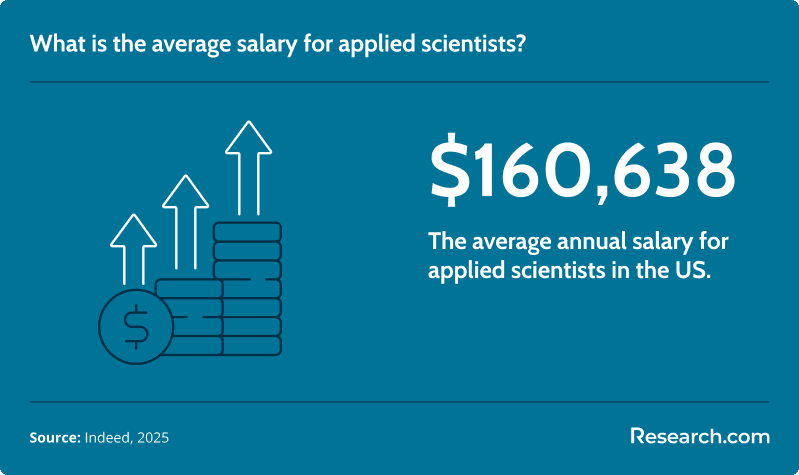
- Potentially strong earning outcomes: According to Indeed, applied scientists in the US earn an average salary of $160,638 per year. Actual pay depends heavily on role, employer, location, experience, and specialization.
What can I expect from an online applied sciences degree?
An online applied sciences degree is built around using scientific and technical knowledge to solve real workplace problems. Depending on the concentration, students may study biology, chemistry, physics, computer science, mathematics, engineering technology, health information, environmental systems, cybersecurity, data analysis, or operations management.
Most programs combine general education, technical coursework, applied projects, and a capstone or internship requirement. Online students may complete simulations, virtual labs, software-based assignments, case studies, team projects, and locally arranged field experiences. Some programs are fully online, while others may require short residencies, supervised placements, or in-person testing.
The biggest advantage for many students is flexibility. However, flexibility does not mean easier coursework. Strong online programs still require consistent weekly time, independent study habits, comfort with technology, and the ability to communicate clearly with instructors and classmates.
Where can I work with an applied sciences degree?
Applied sciences graduates can work in settings where technical knowledge, data interpretation, laboratory methods, process improvement, or systems thinking are needed. Common employers include private companies, hospitals and healthcare technology firms, manufacturers, pharmaceutical companies, public health departments, utility providers, environmental organizations, government agencies, defense contractors, and research institutions.
Possible job titles vary by specialization. Students with a data-focused track may move toward analytics or statistics roles. Those with technology management backgrounds may pursue supervisory or operations positions. Environmental, health, engineering, or biotechnology tracks may lead to lab, field, compliance, technical support, or quality assurance roles.
| Applied sciences focus | Common work settings | Examples of related roles |
| Engineering and industrial technology | Manufacturing, utilities, defense, transportation, technical services | Engineering technician, process analyst, quality assurance specialist, technical operations coordinator |
| Data science and analytics | Technology companies, government agencies, healthcare systems, research organizations | Data analyst, statistical assistant, reporting analyst, research support specialist |
| Environmental and biological sciences | Environmental consulting firms, public agencies, laboratories, nonprofits | Lab technician, environmental technician, research assistant, compliance support specialist |
| Healthcare and health information | Hospitals, insurance organizations, health technology companies, medical offices | Health information specialist, clinical data coordinator, systems support analyst |
| Cybersecurity and applied computing | IT departments, defense organizations, public agencies, cloud and software firms | Cyber operations analyst, IT specialist, systems support professional |
How much can I make with an applied sciences degree?
Income depends on the job title, industry, technical specialization, region, credentials, and experience level. Entry-level laboratory technician or quality analyst positions commonly pay less than advanced analytics, engineering, cybersecurity, or applied research roles. The degree can support upward mobility, but salary is never guaranteed by the credential alone.
For broad planning, entry-level roles such as laboratory technicians or quality analysts typically offer salaries ranging from $50,000 to $70,000 annually. Mid-level positions like data scientists or process engineers can earn between $80,000 and $120,000 per year. Applied scientists themselves earn an average of $160,638 per year in the US, according to Indeed.
Students should compare program cost against realistic target roles, not the highest salary figure they see online. A low-cost program with strong transfer credit and a relevant concentration may produce a better return than a higher-priced program with limited career alignment.
- Most Affordable Online Applied Sciences Degree Programs for 2027
- How long does it take to complete an online applied sciences degree?
- How does an online applied sciences degree compare to an on-campus program?
- What is the average cost of an online applied sciences degree program?
- What are the financial aid options for online applied sciences students?
- What are the prerequisites for enrolling in an online applied sciences degree program?
- What courses are typically included in an online applied sciences degree?
- What types of specializations are available in online applied sciences degree programs?
- What is the long-term return on investment for an online applied sciences degree?
- How are emerging technologies used in online applied sciences curricula?
- What advanced education options can strengthen an applied sciences career?
- What trends are changing online applied sciences education?
- How do you choose the most affordable online applied sciences degree program?
- What career paths are available for graduates?
- What is the job market like for online applied sciences graduates?Key Insights
Most Affordable Online Applied Sciences Degree Programs for 2027
How do we rank schools?
Affordability matters, but a low tuition rate is only useful if the program is credible, transferable, and aligned with the student’s career plans. Research.com’s ranking of the most affordable online applied sciences degree programs for 2027 considers affordability, academic quality, online flexibility, student accessibility, and program relevance.
To compile this list, Research.com reviewed data from the IPEDS database, Peterson’s database, including the Distance Learning Licensed Data Set, the College Scorecard database, and the National Center for Education Statistics. More information is available in our ranking methodology.
The schools below represent 10 affordable online applied sciences options for 2027. Students should verify current tuition, transfer rules, fees, and program availability directly with each institution before applying.
| Rank | School | Example online applied sciences-related program | Cost information listed | Best fit |
| 1 | Cochise County Community College District | Bachelor of Applied Science in Leadership, Management, and Operations | $95 (in-state), $255 (out-of-state) | Transfer students, military-affiliated learners, operations-focused professionals |
| 2 | American Public University System (APUS) | Bachelor of Applied Science in Technical Management and other specializations | $350 (standard), $250 (military) | Working adults, military students, learners needing monthly starts |
| 3 | University of Arizona | Bachelor of Applied Science with concentrations including Cyber Operations and Applied Computing | $525 | Transfer students seeking cyber, computing, or justice-related pathways |
| 4 | Columbia Southern University (CSU) | Bachelor of Science in Environmental Management and related degrees | $245 | Adult learners interested in environmental management or safety |
| 5 | Fort Hays State University | Bachelor of Applied Science with emphasis areas | $226 | AAS graduates and students with prior technical training |
| 6 | Southern Illinois University (SIU)—Carbondale | Bachelor of Science in Applied Engineering | $305 | Technical professionals seeking applied engineering advancement |
| 7 | Oregon Institute of Technology | Bachelor of Applied Science in Technology and Management | $289 | Technical workers moving toward management roles |
| 8 | Northern Arizona University (NAU) | Online Bachelor of Applied Science with multiple emphases | $444 | Community college graduates seeking structured transfer pathways |
| 9 | Southeast Missouri State University | Bachelor of Science in Technology Management | $350 | Students with technical associate degrees or military training |
| 10 | Western Governors University (WGU) | Bachelor of Science in Health Information Management and IT Management | $3,625 per 6-month term (estimated at ~$150/credit hour equivalent) | Self-paced learners who can progress quickly through competency-based coursework |
1. Cochise County Community College District
Cochise College offers a Bachelor of Applied Science in Leadership, Management, and Operations for students who have completed an Associate of Applied Science (AAS) degree or comparable technical preparation. The online, asynchronous format is designed for adults balancing school with work, military responsibilities, or operational careers. Its concentrations connect closely with public safety, intelligence, and military pathways.
- Program Length: Two years (for transfer students)
- Tracks/Concentrations: Intelligence Operations Studies, Fire Science Technology, Law Enforcement, Military Intelligence Systems Technician
- Cost per Credit: $95 (in-state), $255 (out-of-state)
- Required Credits to Graduate: 120 (with transfer credits applied)
- Accreditation: Higher Learning Commission (HLC)
2. American Public University System (APUS)
APUS provides a Bachelor of Applied Science in Technical Management and related specializations. Its online programs have served working adults and military personnel since the early 2000s. Monthly course starts and a fully online structure make the school a practical option for students who need predictable scheduling and military-friendly tuition policies.
- Program Length: Four years (full-time)
- Tracks/Concentrations: Technical Management, Information Technology, Homeland Security
- Cost per Credit: $350 (standard), $250 (military)
- Required Credits to Graduate: 120
- Accreditation: HLC
3. University of Arizona
The University of Arizona Online offers Bachelor of Applied Science options with concentrations such as Cyber Operations and Applied Computing. These programs are especially relevant for students entering with associate degrees, military backgrounds, or technical experience. Courses may include asynchronous and synchronous elements, and the Cyber Operations program is designated by the National Security Agency as a Center of Academic Excellence. Online students are not charged an out-of-state tuition differential.
- Program Length: Two to three years (for transfer students)
- Tracks/Concentrations: Cyber Operations, Applied Computing, Administration of Justice
- Cost per Credit: $525
- Required Credits to Graduate: 120 (with transfer credits applied)
- Accreditation: HLC
4. Columbia Southern University (CSU)
CSU offers applied science-related online degrees, including a Bachelor of Science in Environmental Management. As a fully online institution, CSU is structured for adult learners who need open enrollment, flexible coursework, and career-relevant training in fields such as environmental management and occupational safety.
- Program Length: Four years (full-time)
- Tracks/Concentrations: Environmental Management, Occupational Safety & Health
- Cost per Credit: $245
- Required Credits to Graduate: 120
- Accreditation: Distance Education Accrediting Commission
5. Fort Hays State University
Fort Hays State University offers an online Bachelor of Applied Science built for students bringing in an AAS degree or substantial technical coursework. The asynchronous format supports students who need control over when they study. The university’s transfer-friendly approach can help students avoid retaking courses and reduce both cost and completion time.
- Program Length: Two to four years (depending on transfer credits)
- Tracks/Concentrations: Business, Technology Leadership, Information Networking
- Cost per Credit: $226
- Required Credits to Graduate: 120
- Accreditation: HLC
6. Southern Illinois University (SIU)—Carbondale
SIU offers a Bachelor of Science in Applied Engineering online for students with technical experience or prior applied sciences coursework. The curriculum emphasizes real-world technical problem-solving, project-based learning, and preparation for engineering and industrial environments. Most courses are asynchronous, which can help working adults stay enrolled while employed.
- Program Length: Two to three years (for transfer students)
- Tracks/Concentrations: Applied Engineering, Industrial Technology
- Cost per Credit: $305
- Required Credits to Graduate: 120
- Accreditation: HLC
7. Oregon Institute of Technology
Oregon Tech offers a Bachelor of Applied Science in Technology and Management for students who want to connect technical expertise with leadership and business skills. The program is well suited to working professionals who already operate in technical environments and want a credential that supports supervisory or management progression.
- Program Length: Two to four years
- Tracks/Concentrations: Technology and Management
- Cost per Credit: $289
- Required Credits to Graduate: 180 quarter credits
- Accreditation: Northwest Commission on Colleges and Universities (NWCCU)
8. Northern Arizona University (NAU)
NAU provides an online Bachelor of Applied Science with emphasis areas such as Emergency Management and Technology Management. The program serves both new and transfer students, but it is especially useful for community college graduates looking for a clear route into a bachelor’s degree. Multiple start dates and online delivery add flexibility for students managing work or family obligations.
- Program Length: Two to four years
- Tracks/Concentrations: Emergency Management, Justice Studies, Technology Management
- Cost per Credit: $444
- Required Credits to Graduate: 120
- Accreditation: HLC
9. Southeast Missouri State University
Southeast Missouri State offers a Bachelor of Science in Technology Management for students with technical associate degrees, prior technical coursework, or military training. The program develops management and technical decision-making skills for industrial and technical workplaces, with most coursework offered asynchronously.
- Program Length: Two to four years
- Tracks/Concentrations: Technology Management
- Cost per Credit: $350
- Required Credits to Graduate: 120
- Accreditation: HLC
10. Western Governors University (WGU)
WGU offers applied science-related bachelor’s options such as Health Information Management and IT Management. Its competency-based model allows students to move through material once they demonstrate mastery, which can benefit disciplined learners with previous knowledge or work experience. The flat-rate term structure may be cost-effective for students who can complete courses quickly.
- Program Length: Varies (competency-based)
- Tracks/Concentrations: Health Information, IT Management
- Cost per Credit: $3,625 per 6-month term (estimated at ~$150/credit hour equivalent)
- Required Credits to Graduate: 120
- Accreditation: NWCCU
How long does it take to complete an online applied sciences degree?
A full bachelor’s degree in applied sciences usually takes four years for full-time students starting without college credit. However, many online applied sciences programs are completion degrees, meaning they are designed for students who already hold an associate degree, technical credential, or military training. In those cases, completion may take as little as two years.
Your timeline depends on transfer credits, course load, term structure, prerequisite requirements, and whether you attend full time or part time. Students comparing nearby scientific fields may also review online geoscience and geology degree programs to see whether prior math, environmental science, or lab coursework could apply across disciplines.
Healthcare students sometimes look for accelerated options such as the most affordable EMT to RN online bridge programs. Applied sciences programs can also be efficient when they accept technical credits, but students should confirm exactly how credits transfer before enrolling.
| Student situation | Typical completion range | What to check before applying |
| First-time bachelor’s student | Four years (full-time) | General education requirements, math/science prerequisites, online course availability |
| AAS or technical associate degree holder | Two to four years | Maximum transfer credits, articulation agreements, accepted technical courses |
| Military-affiliated student | Varies by accepted training | Military credit evaluation, tuition rates, veteran services, deployment flexibility |
| Working adult attending part time | Longer than full-time enrollment | Course rotation, term length, academic advising, leave policies |
| Competency-based learner | Varies (competency-based) | Flat-rate terms, pace requirements, assessment format, prior knowledge fit |
How does an online applied sciences degree compare to an on-campus program?
Curriculum and accreditation
In a properly accredited online program, the degree requirements should be comparable to the campus version. Students are expected to meet the same academic standards, complete similar learning outcomes, and earn the same credential. Always verify institutional accreditation and, when relevant, programmatic accreditation tied to your target career.
Flexibility and access
Online programs usually offer more scheduling flexibility than campus programs. Asynchronous courses are especially useful for students who work irregular hours, care for family members, serve in the military, or live far from a university. Students interested in life sciences careers can also compare related expectations through our guide to becoming a biologist.
Hands-on learning and networking
The trade-off is that some online programs provide fewer spontaneous networking opportunities and fewer in-person lab experiences. Strong programs address this with virtual labs, local internships, remote simulations, faculty office hours, group projects, and career services for online learners.
| Factor | Online applied sciences degree | On-campus applied sciences degree |
| Schedule | Often asynchronous or hybrid, easier to fit around work | Usually set class times and location-based attendance |
| Cost considerations | May reduce commuting and relocation costs, but fees vary | May include housing, transportation, and campus-based costs |
| Lab access | May use virtual labs, simulations, kits, or local placements | Often provides direct access to campus labs and equipment |
| Networking | Requires intentional participation in online events and projects | More built-in face-to-face interaction |
| Best for | Working adults, transfer students, remote learners | Students needing intensive labs, campus resources, or structured daily routines |
What is the average cost of an online applied sciences degree program?
Cost varies widely by institution type, residency status, transfer credits, fees, books, technology requirements, and how long you remain enrolled. According to Data USA:
- Median In-State Public Tuition: $8,982
- Median Out-of-State Private Tuition: $34,680
Using those benchmarks, the median out-of-state public tuition likely falls between $15,000 to $20,000, while the median in-state private tuition may hover around $28,000 to $32,000. Students should treat these as planning estimates and request a full cost breakdown from each school.
Do not compare programs by tuition alone. A school with a higher per-credit price may cost less overall if it accepts more transfer credits. A low advertised tuition can become more expensive if mandatory fees, repeated prerequisites, or limited course availability extend your enrollment. Students considering environmental or wildlife-related paths can also review our guide on how to become a wildlife biologist for broader degree planning context.
| Cost factor | Why it matters | Question to ask the school |
| Cost per credit | It determines the base tuition, but not the full bill | Is the rate the same for online, in-state, and out-of-state students? |
| Transfer credit | Accepted credits can shorten the program and reduce cost | How many credits from my transcript will apply to the degree? |
| Technology or online fees | Extra fees can change the affordability ranking | Are online, lab, software, or graduation fees required? |
| Course availability | Delayed courses can add terms and living expenses | Are required courses offered every term? |
| Books and software | Applied science programs may require specialized tools | What software, lab kits, or equipment will I need? |
What are the financial aid options for students enrolling in an online applied sciences degree program?
Online students in accredited degree programs may qualify for many of the same aid options as campus students. Eligibility depends on the institution, enrollment status, citizenship or residency requirements, academic progress, and aid rules.
- Federal financial aid: Students should begin with the FAFSA to determine eligibility for federal grants, loans, and work-study options where available.
- State grants and scholarships: Some states support residents attending public institutions or pursuing workforce-related programs.
- Institutional scholarships: Schools may offer awards for online learners, transfer students, adult students, STEM majors, or military-affiliated students.
- Employer tuition assistance: Working students should ask whether their employer reimburses tuition for job-related coursework or degrees.
- Military and veteran benefits: Active-duty service members and veterans may be eligible for GI Bill benefits or Yellow Ribbon support.
Students pursuing specialized science careers may also search for targeted scholarships. For example, those exploring aquatic or environmental pathways can review our guide on how to become an aquatic biologist and look for funding tied to conservation, water systems, or environmental research.
If your main goal is a shorter healthcare credential rather than a bachelor’s degree, compare alternatives carefully. Lower-cost options such as affordable online CNA programs may be useful for entry-level healthcare work, while an applied sciences bachelor’s degree is typically a broader and larger academic investment.
What are the prerequisites for enrolling in an online applied sciences degree program?
Admissions requirements differ by school and by whether the program is designed for first-year students or degree-completion students. Most applicants should expect to provide academic records and meet minimum academic standards before being admitted.
- High school diploma or GED: First-year applicants usually need proof of secondary completion.
- Official transcripts: Schools commonly request high school transcripts and transcripts from any prior colleges.
- Minimum GPA: Many programs set a threshold, usually around 2.0–2.5.
- Prerequisite coursework: Some concentrations require prior math, biology, chemistry, physics, computing, or technical courses.
- Standardized test scores: ACT/SAT requirements may be optional, especially for adult learners or transfer applicants.
According to Data USA, 4,418 applied science degrees were awarded in 2023. Students interested in sustainability, ecology, or public-sector science roles may find it useful to review environmental scientist education requirements before choosing electives or prerequisites.
The chart below identifies institutions that awarded the highest number of applied science degrees in 2023.
What courses are typically in an online applied sciences degree program?
Applied sciences curricula vary because the field is intentionally broad. A program in cyber operations will look very different from one in environmental management or technology leadership. Still, most online applied sciences degrees combine general education, quantitative reasoning, technical communication, specialized coursework, and an applied capstone.
Common core courses
- Introduction to Applied Sciences
- Technical Writing and Communication
- Applied Mathematics or Statistics
- Scientific Computing or Data Analysis
Common specialization courses
- Environmental Systems
- Principles of Engineering Technology
- Biotechnology Applications
- Applied Physics or Chemistry
Capstone, practicum, or internship
Many programs end with a senior project, internship, applied research assignment, lab practicum, or workplace-based capstone. This requirement is important because it gives students evidence of applied skills they can discuss with employers.
What types of specializations are available in online applied sciences degree programs?
Specialization choice is one of the most important decisions in an applied sciences program. The degree title may be broad, but the concentration determines the technical tools, industries, and job categories you are most likely to pursue.
Engineering and technology
Engineering and technology tracks focus on technical systems, production environments, design support, and applied problem-solving. Examples include:
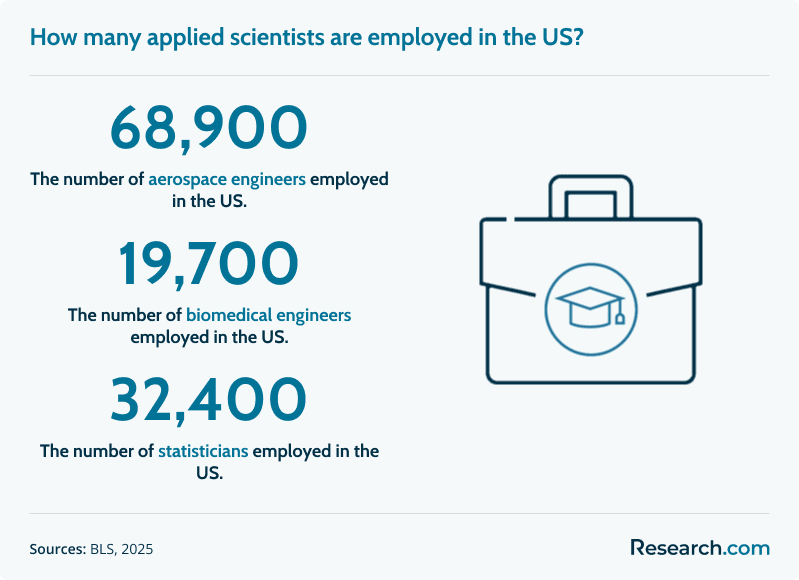
- Aerospace Engineering: A pathway for students interested in aviation, space, defense, and advanced transportation. There were approximately 68,900 aerospace engineers employed in 2023.
- Biomedical Engineering: A field connecting healthcare needs with engineering design, medical devices, and technology development, with 19,700 professionals employed in 2023.
Data science and analytics
Data-focused applied sciences tracks prepare students to collect, clean, model, interpret, and communicate information for decision-making.
- Applied Statistics or Data Science: This option can support analytics roles in business, research, healthcare, government, and technology. In 2023, the US employed 32,400 statisticians.
- Geographic Information Systems (GIS): GIS uses spatial data and mapping tools for urban planning, environmental management, logistics, public safety, and defense.
Environmental and biological sciences
Environmental and life science tracks are suited to students interested in sustainability, ecosystems, lab methods, biotechnology, or applied research.
- Environmental Technology: This concentration applies scientific principles to pollution control, resource management, compliance, and environmental operations.
- Applied Biotechnology: Coursework may cover techniques used in agriculture, pharmaceuticals, bioengineering, and product development.
Students drawn to computing-heavy applied science careers may compare these options with affordable online artificial intelligence degree programs, especially if they want a curriculum centered on machine learning, modeling, and advanced computing.
| Specialization | Choose it if you want to work with... | Be careful if... |
| Cyber operations or applied computing | Networks, systems, security tools, data, and software environments | You need a program with specific industry certifications or security designations |
| Technology management | Technical teams, operations, process improvement, and leadership | You want a heavily laboratory-based science degree |
| Environmental management | Compliance, safety, sustainability, environmental systems, and field operations | Your target role requires specific state credentials or field experience |
| Health information management | Healthcare data, records systems, compliance, and health technology | You want direct patient-care licensure rather than administrative or systems work |
| Applied engineering or industrial technology | Manufacturing, technical systems, production, quality, and equipment processes | You specifically need a traditional engineering licensure pathway |
What is the long-term return on investment for an online applied sciences degree?
The return on investment depends on total cost, transfer credit, financial aid, time to completion, current employment, and the salary range of your target occupation. A student who transfers an associate degree into a low-cost completion program may see a very different ROI than a student who pays for all 120 credits without aid.
To evaluate ROI, compare your likely total program cost with realistic career outcomes in your chosen specialization. Data-heavy fields may lead students to consider graduate pathways such as an online data science master’s degree, but a graduate credential should be pursued only when it clearly supports your intended role or promotion path.
| ROI factor | Why it affects value | How to evaluate it |
| Transfer credits | Fewer remaining credits can reduce tuition and time | Request an official transfer evaluation before committing |
| Specialization | Career outcomes differ widely across applied sciences fields | Match the concentration to actual job descriptions you want |
| Employer support | Tuition assistance can reduce out-of-pocket cost | Ask HR about reimbursement rules before enrollment |
| Program format | Flexible scheduling can help you keep earning while studying | Confirm weekly workload, synchronous requirements, and term pace |
| Career services | Internships, resume help, and employer connections can support job mobility | Ask for online-student career support details, not general promises |
How are emerging technologies integrated into online applied sciences curricula?
Online applied sciences programs increasingly use digital tools to approximate workplace technologies and applied lab environments. Depending on the field, students may work with remote simulations, data analytics platforms, cloud-based tools, virtual labs, cybersecurity environments, GIS software, or project management systems.
Technology integration should be practical, not just trendy. A strong curriculum shows students how tools are used in real workflows: analyzing data, modeling systems, documenting results, collaborating on technical projects, and solving operational problems. Students seeking technology-heavy options may also compare accelerated online technology degree programs if speed and technical skill development are priorities.
What advanced education opportunities can elevate your applied sciences career?
Some applied sciences graduates enter the workforce directly, while others pursue graduate study, industry certifications, or specialized training. The right next step depends on the role. A technical manager may benefit from leadership credentials, a data-focused graduate may pursue analytics or statistics training, and a life sciences graduate may choose biotechnology, bioinformatics, environmental science, or public health.
Students interested in combining biological science with computing can compare affordable online master’s in bioinformatics programs. Before enrolling in any advanced program, review prerequisites, employer demand, hands-on requirements, and whether the credential is necessary for your target position.
What emerging trends are shaping online applied sciences education?
Several trends are changing how online applied sciences programs are designed. Employers increasingly value evidence of practical skills, not just completed coursework. As a result, programs are placing more emphasis on capstones, portfolios, simulations, industry projects, and stackable credentials.
Technology is also reshaping delivery. Cloud-based labs, virtual simulations, data platforms, AI-supported analytics, and remote collaboration tools can make online coursework more job-relevant when used well. Some students may also combine a degree with certification programs for careers that pay well, but certifications should be chosen based on employer requirements in the student’s specific field.
How do you choose the most affordable online applied sciences degree program?
The best affordable program is the one that minimizes total cost while still meeting your academic, career, transfer, and scheduling needs. A cheap program that does not accept your credits, lacks your specialization, or fails to meet employer expectations can become expensive in the long run.
- Verify accreditation first: Confirm institutional accreditation and any programmatic accreditation relevant to your field.
- Calculate total cost, not just tuition: Include fees, books, software, lab kits, transfer-credit losses, and the number of terms required.
- Ask for a transfer evaluation: Do this before enrolling if you have an associate degree, military training, technical certificates, or prior college credits.
- Match the specialization to job postings: Review real job descriptions and confirm the curriculum teaches the tools and skills employers request.
- Check the delivery format: Asynchronous courses may suit working adults, while synchronous courses can provide more structure.
- Review student support: Online students should have access to advising, tutoring, library services, career coaching, and technical support.
Questions to ask before enrolling
| Question | Why it matters |
| How many of my credits will transfer into the major, not just electives? | Credits that transfer only as electives may not shorten the degree. |
| Are all required courses available online every year? | Limited course rotation can delay graduation. |
| Does this program require labs, internships, practicums, or campus visits? | Hidden in-person requirements can create travel or scheduling issues. |
| What fees are charged in addition to tuition? | Technology, lab, software, and graduation fees can raise total cost. |
| What career services are available specifically to online students? | Online learners need accessible resume help, job search support, and employer connections. |
| Does this degree meet requirements for my intended credential, license, or graduate program? | Some careers require specific accreditation, coursework, or supervised experience. |
Common mistakes to avoid
| Mistake | Better approach |
| Choosing the school with the lowest posted tuition | Compare total program cost after transfer credits and fees. |
| Assuming every online program is fully online | Ask about labs, residencies, exams, internships, and fieldwork. |
| Ignoring accreditation | Confirm accreditation before applying or submitting financial aid documents. |
| Selecting a concentration without checking job postings | Use employer requirements to guide your specialization choice. |
| Assuming salary outcomes are guaranteed | Research role-specific salaries by location, experience, and industry. |
| Waiting until the final term to plan for employment | Build a portfolio, seek internships, and use career services early. |
What career paths are available for graduates of online applied sciences degree programs?
Graduates may pursue careers in research support, engineering technology, data analysis, environmental operations, health information, cybersecurity, technical management, and quality assurance. Indeed reports that applied scientists earn an average salary of $160,638 annually, but this figure should not be used as a guaranteed outcome for all applied sciences graduates.
According to BLS:
- Aerospace Engineers: Median annual wage was $134,830 in May 2024.
- Bioengineers and Biomedical Engineers: Median annual wage was $106,950 in May 2024.
- Statisticians: Median annual wage was $103,300 in May 2024.
Students interested in mapping, spatial analytics, or environmental data can review our geospatial analyst salary and career guide. Those leaning toward direct clinical support roles may compare bachelor’s pathways with lower-cost options such as the most affordable online associate’s in surgical tech programs.
| Career direction | Useful applied sciences preparation | Typical next step |
| Engineering or industrial technology | Applied engineering, industrial technology, quality systems, process improvement | Build technical project experience and consider industry credentials |
| Data analytics or statistics | Applied statistics, data science, programming, visualization, research methods | Create a project portfolio using real datasets |
| Environmental science or sustainability | Environmental systems, compliance, field methods, GIS, technical reporting | Seek internships, agency experience, or field-based projects |
| Healthcare technology or health information | Health data systems, compliance, records management, IT tools | Confirm whether certifications are expected by employers |
| Cybersecurity or applied computing | Networks, systems, security principles, applied computing, cloud tools | Develop hands-on labs and consider recognized certifications |
What is the job market like for graduates with an online applied sciences degree?
The employment outlook depends on the exact occupation, but several applied sciences-related fields have positive projected growth. Demand is influenced by technology adoption, data-driven decision-making, infrastructure needs, healthcare innovation, environmental challenges, and advanced manufacturing.
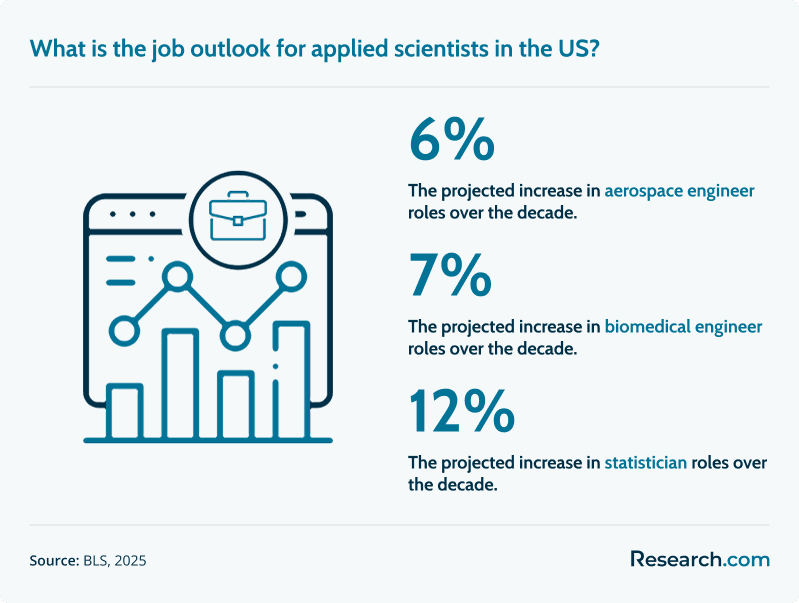
Based on BLS projections from 2023 to 2033:
- Aerospace engineer jobs are expected to grow by 6%.
- Bioengineer and biomedical engineer roles will see a 7% growth rate.
- Statistician positions are projected to grow by a strong 12%.
These projections suggest healthy demand in selected applied science areas, but competition, required skills, location, and experience still matter. Students can strengthen job prospects by choosing a focused concentration, completing applied projects, building a portfolio, pursuing internships, and learning tools used in their target industry.
Here’s What Graduates Have to Say About Their Online Applied Sciences Degree
-
: "
Studying online let me keep my full-time job while I finished my degree. I did not need to move, commute, or put my career on hold. The online tools were straightforward, and I received steady support from instructors and classmates. The program helped me build technical knowledge, but it also improved my time management and professional communication. I now hold a leadership role that was out of reach before. Maria
"
-
: "
I was unsure about returning to school online, but the coursework connected directly to what I was already doing at work. I could apply new concepts almost immediately. The format gave me enough flexibility to manage school, family, and employment at the same time. Finishing the degree improved my confidence and helped me move into a promotion. Dante
"
-
: "
The online format made it possible for me to complete the degree I had started years earlier. My associate degree credits transferred, so I did not have to repeat as much coursework. Even without meeting instructors in person, I found them responsive and knowledgeable. The classes focused on practical skills, and being able to study from anywhere was the difference-maker. Lena
"
Key Insights
- An online applied sciences degree is best for students who want practical technical training, flexible scheduling, and a pathway into fields such as technology management, applied engineering, data analytics, environmental management, health information, or cybersecurity.
- The cheapest advertised tuition is not always the best value. Compare total cost after transfer credits, required fees, course availability, and time to completion.
- All ranked institutions offer fully online applied science degree programs designed for flexibility and working professionals.
- Tuition rates range from $95 to $525 per credit, depending on residency status and institution.
- Several universities, such as Fort Hays State and University of Arizona, provide generous transfer credit policies for associate degree holders.
- Many programs include tracks in high-demand fields such as Cyber Operations, Environmental Management, and Technology Leadership.
- Competency-based learning, as seen at WGU, allows for accelerated degree completion.
- Institutions like APUS and Cochise College cater strongly to military-affiliated students, offering specialized support and lower tuition rates.
- Before enrolling, verify accreditation, ask for an official transfer evaluation, confirm whether any in-person requirements exist, and make sure the specialization matches your intended career.
- Salary and job growth vary by occupation. BLS data shows projected growth from 2023 to 2033 of 6% for aerospace engineers, 7% for bioengineers and biomedical engineers, and 12% for statisticians.
References:
- BLS. (2025, April 18). Aerospace engineers. BLS.
- BLS. (2025, April 18). Bioengineers and biomedical engineers. BLS.
- BLS. (2025, April 18). Mathematicians and statisticians. BLS.
- Data USA. (n.d.). Applied Sciences. Data USA.
- Indeed. (2025). Applied scientist salary in United States. Indeed.
Other Things You Should Know About the Most Affordable Online Applied Sciences Degree Programs
Most online applied sciences degrees use a hybrid format for labs. Lectures are online, but laboratory courses usually require at least one campus residency, a partner site, or a mailed home kit. Programs often list 1 to 3 lab credits per course and specify the required format in the catalog.
In 2027, online applied sciences degree programs should be accredited by recognized bodies like ABET (Accreditation Board for Engineering and Technology) to ensure educational quality and facilitate credit transfer or further studies. Proper accreditation can also enhance employment opportunities post-graduation.


