
2027 Most Affordable Online Natural Sciences Degree Programs

Co-Founder and Chief Data Scientist
Choosing an affordable online natural sciences degree is not just a tuition decision. You need to know whether the program has credible accreditation, whether online labs will prepare you for scientific work, whether credits will transfer, and whether the degree matches your career goal. This guide is for students comparing online natural sciences programs, especially those interested in environmental science, biology, health science, water resources, laboratory work, conservation, or graduate study.
Natural sciences remain a strong academic pathway for students who want to understand living systems, ecosystems, matter, energy, and the physical world. According to the most recent education data, more than 820,000 degrees have been awarded in the STEM field in the past couple of years. That demand reflects the continued value of science training, but it also means students should compare programs carefully instead of choosing the first low-cost option they find.
Below, you will find the most affordable online natural sciences degree programs for 2027, along with cost factors, program expectations, career paths, admissions requirements, online-versus-campus trade-offs, and practical questions to ask before enrolling.
Quick Answer: What Is the Best Affordable Online Natural Sciences Degree?
The best affordable online natural sciences degree is one that combines low tuition, recognized accreditation, strong science coursework, credible lab experiences, transfer-friendly policies, and career support. For students seeking the lowest overall price, public colleges, community college transfer pathways, tuition-free models, and military tuition rates may offer the strongest value. For students seeking environmental or water-focused careers, bachelor’s programs in environmental science, natural resources, water resources management, or environmental management may be a better fit than a general natural sciences degree.
Before choosing a program, confirm three things: the school’s accreditation status, whether the science labs are accepted for your transfer or career goals, and the total cost after fees, books, technology requirements, and lab kits.
What are the benefits of getting an online degree in natural science?
- Flexible access to science education: Online natural sciences programs make it easier for working adults, parents, military students, and career changers to complete coursework without relocating or commuting. According to the Education Data Initiative, about 59% of online students choose virtual learning for its flexibility.
- Lower-cost entry into STEM: An online associate's degree in natural sciences can be a more affordable first step than starting at a 4-year university. Average tuition at community colleges is around $3,900 per year, compared to $10,900 at public universities.
- Broad scientific foundation: Students usually study biology, chemistry, environmental studies, physics, mathematics, and scientific reasoning, which can support transfer into a bachelor’s program or entry-level technical roles.
- Career and transfer options: Graduates may pursue laboratory assistant, environmental technician, field data, quality control, or research support roles, while others use the degree to continue into biology, environmental science, health science, geoscience, or related bachelor’s programs.
What can I expect from an online degree in natural science?
An online natural sciences degree gives students a structured introduction to the major scientific disciplines, usually including biology, chemistry, physics, environmental science, earth science, statistics, and general education. Associate programs often take about two years, while bachelor’s programs commonly require about four years for full-time students.
The online format does not mean the program is entirely theoretical. Many schools use virtual labs, digital simulations, video demonstrations, mailed lab kits, local field assignments, research projects, or supervised internships to help students apply scientific methods. The quality of these experiences varies widely, so students should ask how labs are delivered, whether they are synchronous or asynchronous, and whether they meet transfer or employer expectations.
Students should also understand the difference between a general natural sciences degree and a specialized science degree. A general degree may work well for transfer, teaching preparation, or broad STEM exploration. A specialized degree in environmental science, natural resources, health science, water resources, or biology may be more useful for students with a defined career path.
| Degree level | Typical length | Best for | Important caution |
| Associate degree | About two years | Students seeking lower-cost transfer credits or entry-level technical work | Some science careers require a bachelor’s degree or higher |
| Bachelor’s degree | About four years | Students pursuing environmental, laboratory, research support, health science, or natural resources careers | Lab quality, internships, and specialization options matter more than format alone |
| Graduate pathway | Varies by program | Students planning advanced work in research, healthcare, data, policy, or management | Prerequisites can be strict, especially in chemistry, biology, statistics, or lab sciences |
Some graduates move directly into technician, assistant, or field support positions. Others transfer into a four-year degree or prepare for graduate programs that require stronger research, laboratory, or quantitative training.
Where can I work with an online associate's degree in natural science?
An online associate’s degree in natural science can qualify graduates for support roles in several science-related settings. The exact job title depends on the courses completed, lab experience, local employer requirements, and whether the student has additional certifications or field experience.
- Medical and clinical laboratories: Graduates may assist with specimen handling, testing support, equipment preparation, or data documentation. The US Bureau of Labor Statistics (BLS) reports that medical lab technologists and technicians have a median annual wage of about $57,800.
- Environmental agencies and conservation organizations: Students interested in sustainability, conservation, water quality, or pollution monitoring may seek technician or assistant roles. Environmental science technicians earn a median annual salary of around $48,000.
- Research institutions and universities: Research aides help scientific teams prepare materials, record data, maintain lab spaces, and support experiments. Salaries vary but generally range between $35,000 and $50,000 annually, depending on location and employer.
- Pharmaceutical and biotech companies: Associate degree holders may support lab operations, quality control, sample preparation, or documentation in biotech and pharmaceutical settings. Lab technicians in pharma earn an average of $55,000 per year.
How much can I make with an online degree in natural science?
Pay depends on the occupation, location, employer, degree level, lab or field experience, and specialization. An online degree from an accredited school is generally evaluated by employers based on the school, curriculum, skills, and experience rather than the delivery format alone.
- Biological technicians earn a median of $52,000 annually while working in laboratories, biotech, and research settings.
- Environmental science and protection technicians report a median wage of $49,490 per year, often working for government agencies, consulting firms, and field-based employers.
- Environmental engineering technologists and technicians earn $58,890 annually while assisting engineers with pollution control, waste management, remediation, and environmental compliance projects.
- Environmental scientists and specialists, who often hold at least a bachelor’s degree, represent a common advancement path, with a median salary of $80,060 per year.
- Most Affordable Online Natural Sciences Degree Programs for 2027
- How long does it take to complete an online degree in natural sciences?
- How does an online degree in natural sciences compare to an on-campus program?
- What is the average cost of an online degree in natural sciences?
- What are the financial aid options for students enrolling in an online degree in natural sciences?
- What are the prerequisites for enrolling in an online natural sciences degree program?
- What courses are typically in an online natural sciences degree program?
- What types of specializations are available for an online natural sciences degree program?
- What challenges do you face in an online natural science degree program?
- How do you choose the best online associate’s degree in a natural sciences program?
- How do online natural science programs ensure academic quality and credibility?
- How can an online natural sciences degree serve as a springboard for advanced studies?
- What career paths are available for graduates of an online degree in natural sciences?
- What is the job market for graduates with an online degree in natural sciences?
- How do online natural science programs integrate research and industry partnerships to enhance career readiness?
- Key insights for choosing an affordable online natural sciences degree
2027 Most Affordable Online Natural Sciences Degree Programs
How do we rank schools?
Affordability is important, but it should not be the only measure of value. Our team reviewed cost and academic quality using information from trusted education data sources, including the IPEDS database, College Scorecard, Peterson’s Database, and the National Center for Education Statistics (NCES).
For additional detail on how Research.com evaluates schools and programs, review our methodology page.
| Rank | School and program | Cost per credit | Total credits | Accreditation |
| 1 | Florida Gateway College – Bachelor of Applied Science in Water Resources Management | $264 | 121 | SACSCOC regionally accredited |
| 2 | Columbia Southern University – Bachelor of Science in Environmental Management | $270 | 120 | DEAC nationally accredited |
| 3 | University of West Alabama – Bachelor of Science in Environmental Sciences | $325 | 123 | SACSCOC regionally accredited |
| 4 | Southern New Hampshire University – Bachelor of Science in Environmental Science | $330 | 120 | NECHE regionally accredited |
| 5 | Weber State University – Bachelor of Science in Environmental Sciences | $300–$350 | 120 | NWCCU regionally accredited |
| 6 | Fort Hays State University – Bachelor of Science in Natural Sciences | $257 | 120 | HLC regionally accredited |
| 7 | Appalachian State University – Bachelor of Science in Environmental Science | $177 | 120 | SACSCOC regionally accredited |
| 8 | Oregon State University Ecampus – Bachelor of Science in Natural Resources | $331 (Oregon resident); $492 (non-resident) | 180 | NWCCU regionally accredited |
| 9 | American Public University System – Bachelor of Science in Environmental Science | $350 (civilians); $250 (military) | 120 | HLC regionally accredited |
| 10 | University of the People – Bachelor of Science in Health Science | $0 tuition; $120 course assessment fee | 120 | DEAC nationally accredited |
1. Florida Gateway College – Bachelor of Applied Science in Water Resources Management
Florida Gateway College offers a fully online program focused on water systems, conservation, management, and applied science. Its connection to Florida's 2+2 articulation pathway can help students who already hold an associate degree continue toward a bachelor’s credential with a clearer transfer route.
- Program length: 4 years
- Cost per credit: $264
- Total credits required: 121
- Accreditation: SACSCOC regionally accredited
2. Columbia Southern University – Bachelor of Science in Environmental Management
Columbia Southern University offers a fully online environmental management program designed for adult learners. The program includes free textbooks and may appeal to students who want an applied curriculum connected to workplace environmental responsibilities. Graduates report median earnings of $65,600, placing them in the top 2% nationally for value.
- Program length: 4 years
- Cost per credit: $270
- Total credits: 120
- Accreditation: DEAC nationally accredited
3. University of West Alabama – Bachelor of Science in Environmental Sciences
The University of West Alabama program is a strong option for students bringing prior college credit, since it enables up to 90 transfer credits. The 12-credit internship is especially important for online science students because it adds applied experience that can strengthen a resume.
- Program length: 4 years
- Cost per credit: $325
- Total credits: 123
- Accreditation: SACSCOC regionally accredited
4. Southern New Hampshire University – Bachelor of Science in Environmental Science
Southern New Hampshire University uses flexible 8-week terms and supports online science learning through mailed lab kits and experiential opportunities. Students who need frequent start dates or a highly structured online platform may find this model practical.
- Program length: 4 years
- Cost per credit: $330
- Total credits: 120
- Accreditation: NECHE regionally accredited
5. Weber State University – Bachelor of Science in Environmental Sciences
Weber State University provides a fully online environmental sciences pathway supported by the Division of Online and Continuing Education. It may fit students seeking a public university option with an environmental science focus.
- Program length: 4 years
- Cost per credit: $300–$350
- Total credits: 120
- Accreditation: NWCCU regionally accredited
6. Fort Hays State University – Bachelor of Science in Natural Sciences
Fort Hays State University offers an online natural sciences program with coursework in biological and aquatic sciences. Its online learning history and internship support can be useful for students who want a broader science degree rather than a narrow environmental track.
- Program length: 4 years
- Cost per credit: $257
- Total credits: 120
- Accreditation: HLC regionally accredited
7. Appalachian State University – Bachelor of Science in Environmental Science
Appalachian State University offers an online environmental science program with career-oriented features, including paid field internships with professional liability coverage. The program reports that 94% of its graduates successfully find related jobs.
- Program length: 4 years
- Cost per credit: $177
- Total Credits: 120
- Accreditation: SACSCOC regionally accredited
8. Oregon State University Ecampus – Bachelor of Science in Natural Resources
Oregon State University Ecampus offers a BS in Natural Resources with a 2+2 transfer pathway through many community college partnerships. This can help students complete lower-division courses locally before finishing the bachelor’s degree online.
Ranked among the top 10 online bachelor's programs by U.S. News & World Report, the program includes applied learning through required internships or research projects in areas such as forestry, ecology, and land management. Students also benefit from OSU’s College of Forestry and College of Agricultural Sciences.
- Program length: 4 years
- Cost per credit: $331 (Oregon resident); $492 (non-resident)
- Total credits: 180
- Accreditation: NWCCU regionally accredited
9. American Public University System – Bachelor of Science in Environmental Science
American Public University System offers an accessible online environmental science program for civilian and military students. Its year-round tuition structure and military rate may be especially relevant for service members, veterans, and adult learners comparing predictable costs.
- Program length: 4 years
- Cost per credit: $350 (civilians); $250 (military)
- Total credits: 120
- Accreditation: HLC regionally accredited
10. University of the People – Bachelor of Science in Health Science
University of the People offers a tuition-free health science degree model with a course assessment fee. This program may fit students seeking a low-cost, globally accessible path into health-oriented science coursework.
- Program length: 4 years
- Cost per credit: $0 tuition; $120 course assessment fee
- Total credits: 120
- Accreditation: DEAC nationally accredited
How long does it take to complete an online degree in natural sciences?
A full-time bachelor’s degree in natural sciences generally takes about four years and commonly includes around 120 to 125 credit hours. Students complete science courses, math requirements, general education classes, electives, and sometimes internships, capstones, or research projects.
Completion time can change significantly. Students with transfer credits may finish faster, while part-time students balancing work or family responsibilities may need longer. According to the National Center for Education Statistics, the average time to complete a bachelor’s degree in the U.S. is about 52 months or 4.3 years.
Students who plan to continue into graduate or professional healthcare education should map prerequisites early. For example, those considering future nursing education pathways may want to compare options such as the cheapest master’s in nursing education online after completing a bachelor’s degree.
How does an online degree in natural sciences compare to an on-campus program?
Online and on-campus natural sciences programs can both be credible, but they serve different types of students. Online programs are usually better for learners who need schedule flexibility and can stay organized without daily in-person structure. Campus programs may be better for students who want frequent face-to-face lab access, fieldwork, faculty interaction, and peer collaboration.
| Factor | Online natural sciences degree | On-campus natural sciences degree |
| Schedule | More flexible, often built for working students | More fixed, with scheduled labs and class meetings |
| Cost | May reduce commuting, housing, and campus-related expenses | May cost more when housing and living expenses are included |
| Lab experience | Uses virtual labs, simulations, home kits, local assignments, or internships | Provides direct access to campus labs, equipment, and field stations |
| Best fit | Self-directed students who need flexibility | Students who learn best through in-person structure and hands-on supervision |
| Employer perception | Strongest when the school is accredited and the program includes applied work | Often familiar to employers, especially for lab-intensive science training |
Cost differences can be significant. The average cost of an online degree is around $40,000, compared to over $85,000 for an on-campus degree when you include living expenses. However, students should not compare tuition alone. Lab fees, technology fees, textbooks, field experiences, travel, and proctoring costs can change the real price.
Employer views of online degrees have improved. A study from the University of the Cumberlands reported that 83% of executives see online degrees from accredited institutions as just as credible as traditional ones. Still, science students should prioritize programs with practical lab experiences, internships, and clear learning outcomes, especially if they want technical jobs after graduation.
Students comparing broader career outcomes may also want to review online degrees that pay well. Those interested in academic leadership or college-level roles can explore the cheapest online PhD programs in higher education as a possible long-term pathway.
What is the average cost of an online degree in natural sciences?
The cost depends on degree level, school type, residency status, transfer credits, and fees. For an online associate’s degree in natural sciences, in-state students typically pay $8,000–$13,000 for the full program. Some community colleges charge $2,768 in-state at the lower end. Out-of-state tuition can be much higher, often ranging from $15,000 to $32,000, with the top end at around $31,935.
Tuition is only one part of the total cost. Online science students may also pay for textbooks, lab kits, software, technology fees, proctored exams, internet upgrades, local fieldwork travel, or internship-related costs. Some online programs save students money by eliminating housing and commuting expenses, but others charge specialized online or course materials fees.
| Cost item | Why it matters | Question to ask |
| Tuition per credit | Determines the base price of the program | Is the rate different for in-state, out-of-state, military, or online students? |
| Required credits | A lower per-credit cost can still be expensive if the program requires more credits | How many credits are required to graduate? |
| Transfer credits | Accepted credits can reduce both time and cost | How many prior credits can I transfer into the program? |
| Lab costs | Science courses may require kits, materials, or local experiences | Are lab kits, simulations, or field assignments included in tuition? |
| Fees | Technology, distance learning, graduation, and proctoring fees can add up | What is the full estimated cost of attendance? |
Students trying to reduce upfront costs can also compare online colleges with free applications before submitting multiple applications.
What are the financial aid options for students enrolling in an online degree in natural sciences?
Online natural sciences students at eligible accredited institutions may qualify for many of the same aid options as campus students. The most important first step is completing the Free Application for Federal Student Aid (FAFSA), which schools use to determine eligibility for federal grants, loans, and work-study.
For the 2024–2025 academic year, the maximum Federal Pell Grant award is $7,395. Pell Grants do not have to be repaid if students meet program and enrollment requirements.
- Federal grants: Need-based grants can reduce out-of-pocket costs for eligible students.
- Federal student loans: Loans can help cover remaining costs, but students should borrow carefully and compare projected earnings.
- State grants and scholarships: Many states provide aid to residents attending accredited colleges, including online programs.
- Institutional scholarships: Colleges may offer merit-based, need-based, transfer, adult learner, military, or program-specific awards.
- Private scholarships: Professional associations, nonprofits, foundations, and local organizations may support students in STEM, environmental studies, healthcare, or conservation.
- Employer tuition assistance: Some students reduce costs by using workplace tuition reimbursement or education benefits.
Before enrolling, ask the financial aid office whether your program, enrollment status, and course load meet aid requirements. Some aid depends on taking enough credits each term or enrolling in a degree-seeking program.
What are the prerequisites for enrolling in an online natural sciences degree program?
Admission requirements vary by school and degree level. Associate programs are often more open-access, while bachelor’s programs may require specific high school coursework, transfer credits, or placement standards.
For an online associate’s degree in natural science, applicants typically need a high school diploma or equivalent, such as a GED. Many schools require a minimum cumulative GPA, often around 2.0. Some may also review standardized test scores, placement exams, or college readiness indicators.
For example, Louisiana State University Alexandria (LSUA) requires either an ACT composite score of 20 or higher or a high school core GPA of at least 2.0 for admission.
Students should expect science and math coursework to move quickly. A background in algebra, biology, chemistry, or related high school science can make the transition easier. Non-native English speakers may need TOEFL or IELTS scores, depending on the school.
Students who want a short healthcare credential alongside or before a science degree can compare affordable online phlebotomy technician certification programs as a practical add-on for entry-level healthcare exposure.
What courses are typically in an online natural sciences degree program?
Online natural sciences programs usually combine foundational science, mathematics, communication, and general education courses. The exact curriculum depends on whether the program is general natural sciences, environmental science, health science, biology, natural resources, or another specialization.
- General Biology I & II: Covers cells, genetics, evolution, ecology, organisms, and biological systems, often with virtual or kit-based labs.
- General Chemistry I & II: Introduces atomic structure, bonding, reactions, stoichiometry, solutions, and laboratory methods.
- Physics I & II: Explores motion, forces, energy, waves, electricity, and magnetism through algebra-based or calculus-based formats.
- Earth Science or Geology: Examines minerals, rocks, plate tectonics, Earth systems, weathering, and sometimes virtual fieldwork.
- Statistics: Builds skills in probability, data interpretation, scientific measurement, and evidence-based reasoning.
- Environmental Science: Studies ecosystems, sustainability, human environmental impact, natural resources, and conservation challenges.
Depending on the program, students may also take English Composition, Social Science, Microbiology, Organic Chemistry, Anatomy and Physiology, Astronomy, Computer Science, or Programming for Scientists.
What types of specializations are available for an online natural sciences degree program?
Specializations help students connect broad science training to a specific career or transfer goal. The best choice depends on whether you want laboratory work, environmental fieldwork, healthcare preparation, conservation, research support, or future graduate study.
| Specialization | What it emphasizes | Good fit for |
| Biology | Life science, genetics, ecology, cell biology, organisms, and lab methods | Students interested in lab roles, medical preparation, veterinary paths, or graduate science study |
| Chemistry | Chemical reactions, analysis, lab procedures, organic chemistry, and materials | Students considering lab technician roles, quality control, pharmacy prerequisites, or research support |
| Environmental science | Conservation, climate, ecology, sustainability, pollution, and natural resource systems | Students interested in fieldwork, environmental monitoring, government agencies, or nonprofits |
| Health science | Biology, anatomy, public health, healthcare systems, and applied science | Students exploring health science careers, pre-nursing, healthcare technology, or public health |
| Natural resources | Land, water, forestry, wildlife, ecology, and resource management | Students interested in conservation, land management, forestry, or environmental policy support |
According to the National Center for Education Statistics (NCES), biological and biomedical sciences consistently account for approximately 7% of all bachelor's degrees awarded in the US. That popularity helps explain why biology remains one of the most common tracks within natural sciences programs.
What challenges do you face in an online natural science degree program?
Online science programs can be demanding because students must manage complex material without the daily structure of a campus classroom. Biology, chemistry, physics, statistics, and environmental science require steady study habits, problem-solving practice, and comfort with scientific terminology.
- Limited in-person lab access: Virtual labs and kits can be useful, but students who need extensive wet-lab experience should confirm whether the program offers local labs, fieldwork, internships, or research placements.
- Time management pressure: Flexible courses still have deadlines. Students often underestimate the weekly time required for lab reports, problem sets, readings, and exams.
- Technology requirements: Simulations, proctoring tools, data analysis software, and video-based labs may require reliable internet and updated hardware.
- Less spontaneous collaboration: Online students need to be intentional about joining discussion boards, study groups, virtual office hours, and tutoring sessions.
- Transfer uncertainty: Not every online science course transfers the same way, especially if a future bachelor’s or graduate program requires specific lab formats.
Students can reduce these challenges by using academic advising early, testing required technology before classes begin, building a weekly study schedule, and asking how online labs are documented on transcripts. Learners who want stronger comfort with interactive digital tools may also explore a game design degree online to understand how technology-driven learning environments work.
How do you choose the best online natural science degree program?
The best program is the one that fits your goal, not simply the one with the lowest tuition. According to the NCES, about 40% of undergraduate students took at least one online course in 2020, showing that online learning is now common. But science programs require extra scrutiny because labs, transfer credits, and career preparation vary by institution.
Use this checklist before applying
- Verify accreditation: Confirm institutional accreditation through a recognized accreditor. Regional accreditation is often especially important for credit transfer and graduate admission.
- Review lab delivery: Ask whether science labs use home kits, simulations, local sites, fieldwork, or in-person intensives.
- Check transfer policies: If you plan to continue to a bachelor’s or graduate program, confirm transfer equivalency before enrolling.
- Compare total cost: Include tuition, fees, books, technology, labs, and graduation costs.
- Match the specialization to your goal: Environmental science, biology, health science, chemistry, and natural resources can lead to different next steps.
- Evaluate student support: Look for tutoring, advising, career services, library access, disability services, internship help, and faculty availability.
- Ask about career outcomes: Request information about internships, graduate school placement, employer connections, and alumni roles.
If your interests are strongly focused on life sciences, compare natural sciences programs with the top biological science degree programs to see whether a dedicated biology major would be more useful.
Common mistakes to avoid
| Mistake | Why it can hurt you | Better approach |
| Choosing only by lowest tuition | A low sticker price may hide fees or weak lab support | Compare total cost and academic fit |
| Ignoring accreditation | Credits may not transfer, and employers may question the credential | Verify the school’s accreditation before applying |
| Assuming all online labs are accepted | Some future programs require specific lab formats | Ask transfer schools or graduate programs what they accept |
| Skipping career services | Online students may miss internships and employer connections | Choose programs with advising, internship support, and job search help |
| Overlooking math readiness | Science majors often require statistics, algebra, or calculus-based work | Complete placement testing and refresh math skills before enrolling |
How do online natural science programs ensure academic quality and credibility?
Credible online natural science programs use the same core quality signals that matter in campus programs: recognized accreditation, qualified faculty, measurable learning outcomes, academic integrity policies, meaningful assessments, and transparent student support. Science programs should also show how they evaluate lab skills, data analysis, research writing, and applied scientific reasoning.
Many online programs use digital proctoring, plagiarism detection, structured lab reports, supervised projects, faculty-reviewed assignments, and capstone experiences to maintain academic standards. Strong programs also update curricula based on employer needs, transfer requirements, scientific developments, and student outcomes.
Students planning to move into technical leadership may eventually combine science training with management education. One possible pathway is an affordable graduate option such as a cheap online masters in engineering management, particularly for those working in science-heavy industries.
How can an online natural sciences degree serve as a springboard for advanced studies?
An online natural sciences degree can prepare students for advanced study if it includes the right prerequisites, lab courses, writing experience, statistics, and research preparation. This is especially important for students considering graduate programs in biology, environmental science, public health, health informatics, data science, geoscience, education, or healthcare-related fields.
Students should plan backward from the graduate program they want. Some advanced programs require specific courses such as organic chemistry, microbiology, anatomy and physiology, calculus, research methods, or statistics. Others require laboratory documentation, fieldwork, professional recommendations, or a minimum GPA.
Students interested in the connection between healthcare and technology may consider the accelerated online masters of health informatics after completing a suitable bachelor’s degree. This type of pathway can build on scientific knowledge while adding data analytics, digital health, and leadership skills.
What career paths are available for graduates of an online degree in natural sciences?
Career options depend heavily on degree level. An associate degree usually supports entry-level technical or assistant roles. A bachelor’s degree can open more specialized positions, especially when paired with internships, fieldwork, lab experience, or a focused concentration.
| Career path | Typical degree expectation | Common responsibilities |
| Laboratory technician or assistant | Associate or bachelor’s degree, depending on employer | Prepare samples, maintain equipment, record data, support testing, and follow safety procedures |
| Environmental science technician | Associate or bachelor’s degree | Collect field samples, monitor environmental conditions, document data, and support compliance work |
| Research aide | Associate or bachelor’s degree | Assist faculty, scientists, or research teams with experiments, records, and lab organization |
| Natural resources or conservation support | Associate or bachelor’s degree | Support land, wildlife, forestry, water, or conservation projects |
| Environmental scientist | Often at least a bachelor’s degree | Study environmental problems, analyze data, prepare reports, and recommend solutions |
Students interested in becoming an environmental scientist should pay close attention to bachelor’s-level coursework, field experience, and environmental data skills. Students who want earth science or resource-focused careers may also compare top geoscience and geology online degree programs.
What is the job market for graduates with an online degree in natural science?
The job market is strongest for graduates who can connect classroom science to practical skills: sampling, lab technique, data analysis, environmental monitoring, documentation, compliance, or research support. Employers often care less about whether the degree was online and more about whether the institution is accredited and whether the student can demonstrate applied competence.
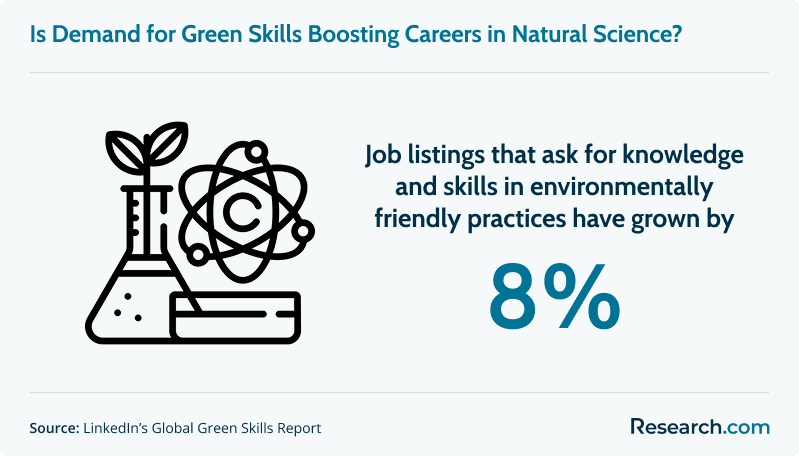
Nationally, employer demand for sustainability and environmental science skills is growing. Job postings requiring green skills have increased by 8% annually over the past five years, while talent supply has only risen by 6%, pointing to a skills gap. This can benefit students trained in environmental, biological, or earth sciences.
Some regions offer stronger opportunities for specific technician roles. For example, forest and conservation technicians in Northern New Hampshire show a location quotient of 5.20, meaning employment in that role is over five times more concentrated in the region than the national average. Students interested in natural resources should research regional demand before choosing a program or internship.
The broader green economy also continues to influence science careers. According to the International Labour Organization, the transition to green economies could create 24 million new jobs globally by 2030, with environmental science and technician roles playing an important part in water quality, conservation, and environmental monitoring.
Some students pair science training with community, nonprofit, or policy-oriented study. For example, affordable religious studies programs online may support broader work in community education, nonprofit outreach, ethics, or public service when combined thoughtfully with environmental or health science training.
Here's What Graduates Have to Say About Their Natural Sciences Degree
-
: "
"Studying Natural Sciences online gave me the flexibility to continue working part-time in a lab while diving deep into topics like molecular biology and environmental systems. The virtual simulations were surprisingly hands-on, and the discussion forums helped me connect with classmates around the world who shared niche research interests." – Joanna
"
-
: "
"What stood out to me was how the program integrated physics, chemistry, and earth sciences in a way that made me see the connections clearly. Even though I was thousands of miles away from campus, I never felt disconnected thanks to live seminars, weekly one-on-ones with my advisor, and access to digital lab kits." – Natalie
"
-
: "
"I loved being able to study at my own pace, which gave me time to fully grasp complex topics like quantum mechanics and data modeling. The online format didn’t just work, it thrived, with interactive tools and case studies that pushed me to think critically and apply theory to real-world scenarios." – Anika
"
How do online natural science programs integrate research and industry partnerships to enhance career readiness?
Strong online natural science programs do more than assign readings and exams. They connect students to applied projects, supervised research, virtual laboratories, faculty-guided independent studies, internships, field assignments, and industry-relevant case work. These experiences help students practice the habits employers value: accurate documentation, evidence-based reasoning, data interpretation, technical communication, and safe scientific procedures.
Research and industry partnerships are especially valuable for online students because they help replace some of the informal networking and lab exposure that campus students may receive more naturally. Students should ask whether partnerships lead to internships, capstones, employer projects, research assistant opportunities, field placements, or portfolio work.
Students who want deeper preparation in laboratory and molecular science may eventually progress toward a biochemistry bachelors degree online, which can strengthen research methods and technical science preparation.
Key Insights
- Affordability should be measured by total cost, not tuition alone. Compare per-credit rates, required credits, online fees, lab costs, books, transfer credits, and financial aid before deciding.
- Accreditation is non-negotiable. It affects transfer credit, graduate admission, employer credibility, and eligibility for federal aid.
- Online science degrees can be credible, but lab design matters. Ask whether labs use simulations, kits, local placements, fieldwork, or internships, and confirm that the format fits your future goals.
- Degree level changes career options. Associate degrees can support entry-level technician and assistant roles, while bachelor’s degrees are usually stronger for environmental science, natural resources, health science, and advancement pathways.
- Specialization should follow your career goal. Biology, chemistry, environmental science, health science, and natural resources prepare students for different jobs and graduate programs.
- Natural science careers can be financially competitive. Natural science careers offer competitive compensation. In the United States, the average annual salary for natural sciences professionals is approximately $93,206, with variations depending on specialization and experience.
- The broader science labor market remains relevant. Employment in life, physical, and social science occupations is projected to increase by 7.4%, aligning with the average growth rate across all sectors.
- Graduate study can expand options. An online natural sciences degree can lead to advanced study in environmental science, health informatics, public health, geoscience, biology, or technical management when prerequisites are planned early.
- Leadership roles are a longer-term possibility. Leading employers in the natural sciences include research institutions, pharmaceutical companies, and government agencies. Notably, natural sciences managers held about 100,100 jobs in 2023, with the largest employers being research and development in the physical, engineering, and life sciences sectors.
- An associate degree can still be useful. An associate degree in natural sciences can lead to various entry-level positions such as laboratory technician, environmental assistant, or research aide. These roles provide a solid foundation for further education and career advancement in specialized areas.
References
- Amity Online. Online vs. campus-based courses: What are the differences? https://amityonline.com/blog/online-vs-campus-based-courses-what-are-the-differences
- Built In. Aerospace Engineer salaries in the U.S. https://builtin.com/salaries/us/aerospace-engineer
- Cal Coast University. AS Associate of Science General Studies Degree Online. https://www.calcoast.edu/as-associate-of-science-general-studies-degree-online.html
- Careers at Rutgers University Newark. 8 high-paying science careers and steps to find your ideal fit. https://careers.newark.rutgers.edu/blog/2024/10/11/8-high-paying-science-careers-and-steps-to-find-your-ideal-fit/
- CareerOneStop and BLS occupation information for Natural Sciences Managers. https://www.bls.gov/ooh/management/natural-sciences-managers.htm
- Drug Discovery Trends. Pharma and biotech salary review: Who’s earning the most in 2024? https://www.drugdiscoverytrends.com/pharma-and-biotech-salary-review-whos-earning-the-most-in-2024/
- Glassdoor. Pharmaceutical lab technician salaries. https://www.glassdoor.com/Salaries/pharmaceutical-lab-technician-salary-SRCH_KO0,28.htm
- Glassdoor. Biomedical scientist salaries. https://www.glassdoor.com/Salaries/biomedical-scientist-salary-SRCH_KO0%2C20.htm
- Intelligent. Best free online associate’s degree. https://www.intelligent.com/best-online-associate-degrees/best-free-online-associates-degree/
- Investopedia. Which companies pay for your college? https://www.investopedia.com/companies-pay-college-6829220
- Nature. Virtual labs are booming — but how effective are they? https://www.nature.com/articles/d41586-018-07111-8
Other Things You Should Know About Affordable Online Natural Sciences Degree Programs
Most programs require at least 1 to 2 laboratory science courses, such as biology, chemistry, or physics, with a separate lab component. Online students usually complete simulations, home kits, or approved in-person labs to satisfy degree requirements and regional accreditation standards.
Students need a reliable internet connection, a computer with updated operating systems, and specific software tools like statistical analysis programs. Some courses may require additional tools like virtual lab software to engage in interactive simulations and experiments.
In 2027, students can access various financial aid options such as federal grants, scholarships specifically for STEM fields, and low-interest student loans. Some universities also offer work-study programs and payment plans to make these affordable programs even more accessible.


