2027 Most Affordable Online Religious Studies Degree Programs

Co-Founder and Chief Data Scientist
Choosing an online religious studies degree is not only a faith decision; it is also an academic, financial, and career decision. The right program can help you study Scripture, theology, ethics, philosophy, and world religions while building practical skills for ministry, education, counseling-adjacent work, nonprofit leadership, chaplaincy, writing, and public service.
The field remains relevant because religion continues to influence personal identity, civic life, health conversations, education, and community leadership. A 2025 Pew Research Center study reports that 83% of Americans believe in God or a universal spirit (Smith et al., 2025). At the same time, religious affiliation and attendance patterns are changing, which means future religious leaders and service professionals need stronger cultural awareness, ethical judgment, and communication skills.
This guide is designed for students comparing affordable online religious studies degree programs. You will find ranked program options, cost and time expectations, admissions requirements, salary information, career paths, accreditation checks, financial aid strategies, common mistakes to avoid, and questions to ask before enrolling.
Quick Answer: Is an Affordable Online Religious Studies Degree Worth It?
An affordable online religious studies degree can be worth it if your goals involve ministry, faith-based education, chaplaincy preparation, nonprofit service, theological study, or work that requires strong ethical reasoning and cultural literacy. It is usually not the fastest route to high earnings unless you combine the degree with graduate study, counseling licensure, nonprofit leadership experience, education credentials, or another professional specialization.
| Decision Factor | What to Know Before Enrolling |
| Best fit | Students interested in ministry, theology, biblical studies, interfaith work, religious education, nonprofit service, or graduate theological training. |
| Typical length | Most bachelor’s programs take 4 years and require about 120 to 128 credits, though transfer students may finish faster. |
| Cost range in this guide | Listed programs show per-credit tuition ranging from $294.75 to $800, depending on the school, residency status, and enrollment format. |
| Salary reality | Clergy earn an annual salary of $67,160 according to the U.S. Bureau of Labor Statistics, but pay varies widely by employer, location, credentials, and role. |
| Main caution | Check accreditation, transfer policies, theology or denominational alignment, and whether the degree supports any licensure or graduate goals you have. |
What are the benefits of getting into an online religious studies degree program?
- Students develop transferable abilities in research, writing, interpretation, public speaking, intercultural communication, ethical analysis, and critical thinking.
- Online formats make it easier to study biblical texts, theology, world religions, ministry leadership, philosophy, and ethics while balancing employment, family responsibilities, or church service.
- Many graduates pursue clergy roles, often summarized as earning around $60,000. Those who later qualify for counseling or social work licensure and certification may reach around $75,000, depending on role and requirements.
What can I expect from an affordable online religious studies degree program?
An online religious studies degree usually combines a liberal arts education with focused study in theology, biblical interpretation, ethics, ministry, church history, philosophy, and comparative religion. Some programs are broadly academic, while others are explicitly Christian, Catholic, evangelical, Baptist, or ministry-focused. Before applying, students should look carefully at the curriculum and the school’s faith commitments.
| Program Feature | Why It Matters | Questions to Ask |
| Flexible online delivery | Asynchronous or short-term courses can help working adults, parents, and ministry volunteers keep progressing. | Are classes fully asynchronous, live, or a mix of both? Are there any required campus visits? |
| Interdisciplinary coursework | Strong programs connect religion with history, ethics, philosophy, culture, language, leadership, and social issues. | Does the curriculum support ministry, graduate school, counseling preparation, nonprofit work, or teaching goals? |
| Affordability | Online programs may reduce housing, commuting, and campus-related costs, but total price still depends on tuition, fees, books, and transfer credits. | What is the total estimated cost to graduate, not just the advertised per-credit tuition? |
| Faith or denominational orientation | A program’s theological framework may affect course content, faculty expectations, ministry preparation, and fit. | Does the school’s statement of faith align with your beliefs and professional goals? |
| Accreditation | Accreditation affects financial aid eligibility, transferability, graduate admission, and employer recognition. | Is the institution regionally, nationally, or theologically accredited by a recognized accreditor? |
Where can I work with a religious studies degree?
A religious studies degree can lead to work in explicitly religious organizations as well as roles where cultural understanding, ethics, communication, and spiritual care are valuable. The exact opportunities depend on your denomination, experience, graduate education, licensure, and willingness to work in faith-based or secular settings.
- Religious organizations: Graduates may serve as clergy members, youth ministers, religious educators, pastoral staff, ministry coordinators, or outreach leaders in churches, synagogues, mosques, temples, or other faith communities.
- Hospitals: Chaplaincy roles involve spiritual and emotional support for patients, families, and healthcare workers. Advanced chaplaincy positions may require clinical pastoral education or certification.
- Home health care services: Some graduates support patients and families facing illness, disability, grief, or end-of-life decisions through listening, prayer, reflection, and spiritual care.
- Educational institutions: Graduates may work in campus ministry, religious education, curriculum support, private schools, seminaries, or ethics and social studies settings, depending on teaching requirements.
- Nursing care facilities: Long-term care communities often need professionals who can provide worship services, grief support, one-on-one spiritual care, and family support.
- Nonprofit organizations: Religious studies graduates can contribute to social justice, humanitarian aid, community development, refugee support, youth services, fundraising, advocacy, and volunteer coordination.
How much can I make with a religious studies degree?
Salary outcomes vary significantly because religious studies graduates enter many different fields. According to the U.S. Bureau of Labor Statistics, graduates who become clergy members earn an annual salary of $67,160. Reported pay ranges from $37,140 in the 10th percentile to $99,720 in the 90th percentile.
Other religious occupations may pay from $29,120 to $106,530 per year, depending on the job title, employer type, location, years of experience, credentials, and level of responsibility. A bachelor’s degree alone does not guarantee a specific salary; the strongest earnings often come from combining religious studies with leadership experience, counseling credentials, graduate theological education, nonprofit management, or specialized chaplaincy training.
Salary Difference by Type of Employer
Employer setting can make a major difference in religious worker pay. Some organizations have large budgets, government funding, or specialized service needs, while others depend heavily on donations, congregation size, grants, or part-time staffing models.
| Employer or Industry | Annual Wage for Clergy Members |
| Child Care Services | $109,930 |
| Federal Executive Branch | $96,230 |
| Grantmaking and Giving Services | $93,630 |
| Civic and Social Organizations | $86,270 |
| Outpatient Care Centers | $77,160 |
Salary Difference by Location
Geography also affects earnings. Clergy members in states with high living costs, large metropolitan areas, or well-funded religious institutions may see stronger compensation than those in smaller congregations or lower-cost regions. California is one example where wages can be higher because of cost-of-living pressures and the presence of large population centers.
Urban areas may also create more opportunities to combine ministry with chaplaincy, education, nonprofit leadership, counseling-adjacent roles, or community outreach, which can increase earning potential for graduates with the right experience and credentials.
Salary Difference by Credentials
Additional education, licensure, certification, and supervised experience can influence long-term income. For example, a clergy member who earns licensure as a marriage and family therapist can earn as much as $72,720. Those who become licensed substance abuse and mental health counselors can earn $65,100 annually.
This is important for students who want to blend theological training with mental health, family support, addiction recovery, grief care, or community counseling. However, counseling and social work roles often have strict state licensure rules, so students should verify requirements before assuming a religious studies degree will qualify them directly.
The best financial plan is to connect your academic path to a specific career target. Ministry, chaplaincy, counseling, nonprofit leadership, and education can all require different credentials after the bachelor’s degree.
- Most Affordable Online Religious Studies Degree Programs for 2027
- How long does it take to complete an affordable online religious studies degree program?
- How does an online religious studies degree program compare to an on-campus program?
- What is the average cost of an affordable online religious studies degree program?
- What are the financial aid options for students enrolling in an online religious studies degree program?
- What are the prerequisites for enrolling in an online religious studies degree program?
- How can you verify the accreditation of an affordable online religious studies degree program?
- How do affordable online religious studies degree programs support student success?
- What networking and mentorship opportunities are available in online religious studies degree programs?
- Is an Online Religious Studies Degree a Competitive Investment Compared to Other Fields?
- What complementary certifications can bolster my career alongside a religious studies degree?
- What courses are typically in an affordable online religious studies degree program?
- What types of specializations are available in online religious studies degree programs?
- How to choose the best affordable online religious studies degree programs?
- What career paths are available for graduates of online religious studies degree programs?
- What is the job market for graduates with a religious studies degree?
Most Affordable Online Religious Studies Degree Programs
How do we rank schools?
Affordability matters, but students should not choose a religious studies program by price alone. Research.com prepared this ranking using a careful methodology to help learners compare lower-cost online options alongside accreditation, curriculum, and student fit.
The ranking draws on data from the Integrated Postsecondary Education Data System, Peterson’s database and its Distance Learning Licensed Data Set, College Scorecard, and the National Center for Education Statistics (NCES). These sources help students evaluate programs with more confidence instead of relying only on school marketing claims.
1. Eastern New Mexico University
Eastern New Mexico University offers an online Bachelor of Applied Arts and Sciences (BAAS) with a Religion concentration for students who want to connect prior technical or applied study with religious and ethical learning. Coursework introduces students to the Hebrew Bible, the New Testament, Christian history, world religions, and broader questions of moral and spiritual development.
This program is designed for students who already hold an AAS degree or at least 30 credit hours in a career-technical field from a CHEA-recognized institution. It can be a practical option for transfer students who want to complete a bachelor’s degree while adding religious studies to their academic background.
- Program Length: 4 years
- Tracks/Concentrations: Greek, Hebrew
- Cost per Credit: $294.75 (in-state); $377.25 (out-of-state)
- Required Credits to Graduate: 120
- Accreditation: Higher Learning Commission (HLC)
2. Carolina College of Biblical Studies
Carolina College of Biblical Studies provides a BA in Biblical Studies that expands on the school’s associate-level work by examining individual biblical books in greater depth. Students may shape the degree through minors such as apologetics, biblical counseling, or leadership.
The program emphasizes biblical knowledge, spiritual formation, leadership development, communication, research, and critical thinking. It is best suited for students seeking ministry preparation or a Bible-centered undergraduate education.
- Program Length: 4 years
- Tracks/Concentrations: N/A
- Cost per Credit: $295–$800
- Required Credits to Graduate: 120
- Accreditation: Association of Biblical Higher Education (ABHE)
3. Louisiana State University of Alexandria
LSU Alexandria offers a fully online BA in Religious Studies focused on major belief systems, sacred writings, spiritual traditions, and the role of religion across cultures. Students build research, writing, collaboration, communication, empathy, and intercultural awareness.
The flexible online format may appeal to working students, adult learners, and those who want a broader academic study of religion rather than a single-denomination ministry program.
- Program Length: 4 years
- Tracks/Concentrations: N/A
- Cost per Credit: $340
- Required Credits to Graduate: 120
- Accreditation: Southern Association of Colleges and Schools Commission on Colleges (SACSCOC)
4. Liberty University
Liberty University delivers a fully online BS in Religion - Biblical & Theological Studies for students preparing for leadership in church, family, mission, and faith-based settings. The program uses flexible eight-week courses that can help students move through requirements while managing other responsibilities.
Students study biblical structure, major genres in the Old and New Testaments, theological interpretation, and systematic approaches to Scripture. The program is a strong fit for students who want a Christian theological foundation for ministry or further study.
- Program Length: 4 years
- Tracks/Concentrations: Biblical & Theological Studies
- Cost per Credit: $390 (full-time), $455 (part-time)
- Required Credits to Graduate: 120
- Accreditation: SACSCOC
5. Holy Apostles College & Seminary
Holy Apostles College & Seminary offers a 100% online BA in Theology for students seeking a Catholic liberal arts education in a remote format. Small classes and year-round access can make the program attractive for learners who want close faculty interaction.
Coursework covers Scripture, Catholic doctrine, evangelization, moral theology, theological writing, and Church tradition. The program supports students pursuing theological understanding, spiritual growth, ministry service, or further Catholic education.
- Program Length: 4 years
- Tracks/Concentrations: Catechism
- Cost per Credit: $395
- Required Credits to Graduate: 120
- Accreditation: New England Commission of Higher Education (NECHE), Association of Theological Schools (ATS)
6. Spurgeon College
Spurgeon College, the undergraduate college of Midwestern Baptist Theological Seminary, offers an online Biblical Studies program centered on Scripture, theology, interpretation, and ministry preparation. Students study biblical Hebrew and Greek as part of their academic formation.
The program trains students to interpret Scripture through historically informed and hermeneutical methods while developing the ability to communicate biblical teaching clearly. It may serve students preparing for church ministry, missions, denominational work, or graduate theological study.
- Program Length: 4 years
- Tracks/Concentrations: Hebrew, Greek
- Cost per Credit: $400–$475
- Required Credits to Graduate: 120
- Accreditations: HLC, ABHE
7. Moody Bible Institute
Moody Bible Institute offers an online BS in Biblical Studies for students who want to apply Scripture in ministry, church service, missions, and everyday life. The online structure supports learners balancing family, work, and church commitments.
Students develop skills in biblical interpretation, research, communication, ancient cultural context, and historical geography. Graduates may pursue roles as pastors, missionaries, lay leaders, or seminary students.
- Program Length: 4 years
- Tracks/Concentrations: Old Testament and New Testament
- Cost per Credit: $411
- Required Credits to Graduate: 120
- Accreditation: HLC, ABHE
8. Nelson University
Formerly Southwestern Assemblies of God University, Nelson University provides an online BA in Religion and Philosophy for students who want to examine religious traditions alongside major philosophical ideas. The flexible format can work well for students with employment, family, or ministry obligations.
The curriculum develops research, writing, analysis, ethical reasoning, theological reflection, and comparative understanding of belief systems.
- Program Length: 4 years
- Tracks/Concentrations: Bible, Philosophy, Religion, Theology
- Cost per Credit: $445–$800
- Required Credits to Graduate: 120
- Accreditation: SACSCOC
9. Calvary University
Calvary University offers a BS/BA in Pastoral Ministry for students preparing for Christian ministry roles. The program combines academic study, biblical formation, historical awareness, cultural understanding, and character development.
Students gain preparation for churches, missions, discipleship, and other ministry settings where pastoral leadership and practical service are central.
- Program Length: 4 years
- Tracks/Concentrations: (BS only) Generational Discipleship, Discipleship Ministry in Local Church, Family Living
- Cost per Credit: $470
- Required Credits to Graduate: 126
- Accreditation: HLC, ABHE
10. Carolina University
Carolina University, formerly Piedmont International University, offers an online BA in Biblical Studies for students preparing for ministry, missions, evangelism, church planting, student ministry, or graduate study.
The curriculum gives students a broad grasp of biblical content, major events, historical settings, and key figures while strengthening teaching, preaching, communication, and leadership skills.
- Program Length: 4 years
- Tracks/Concentrations: Evangelism, Bible Doctrine
- Cost per Credit: $525
- Required Credits to Graduate: 120
- Accreditation: Transnational Association of Christian Colleges and Schools Accreditation Commission (TRACS)
How long does it take to complete an affordable online religious studies degree program?
Most online bachelor’s degrees in religious studies take 4 years for full-time students. Programs commonly require 120 to 128 credit hours, including general education, religious studies core courses, electives, and sometimes ministry practica or language study.
Some students finish faster by transferring previous college credits, entering degree-completion programs, or enrolling in accelerated terms. Others take longer because they study part time, continue working in ministry, care for family, or add courses in Greek, Hebrew, philosophy, counseling, or ethics.
Students preparing for ordained ministry, chaplaincy, Christian education, or graduate theology should check whether their denomination, employer, or future seminary expects specific coursework. Those planning to pursue a theology degree may want to strengthen their academic record with language, theology, philosophy, and writing-intensive courses.
Educational expectations vary in the field. The available data show that 27% of clergy members hold a bachelor’s degree, while 36% earn a master’s degree. That means students who want long-term ministry or chaplaincy advancement should consider whether graduate school may eventually be part of their plan.
This chart shows the educational level of clergy members.
How does an online religious studies degree program compare to an on-campus program?
Online and campus-based religious studies programs can cover similar academic content, but the learning experience is different. The right format depends on your schedule, learning style, need for local community, ministry responsibilities, and career goals.
| Comparison Area | Online Religious Studies Degree | On-Campus Religious Studies Degree |
| Schedule | Often more flexible, especially when courses are asynchronous or offered in shorter terms. | Usually follows set class times and campus calendars. |
| Community | Built through discussion boards, video meetings, group projects, virtual chapel, and online mentoring. | Built through in-person classes, chapel, student groups, ministry events, and campus life. |
| Faculty access | Available through email, learning platforms, video calls, and virtual office hours. | Available through class meetings, office hours, campus advising, and informal conversations. |
| Networking | Can connect students across regions, denominations, ministries, and professional backgrounds. | Often stronger for local internships, nearby churches, campus ministries, and in-person relationships. |
| Best for | Working adults, transfer students, parents, active ministry workers, and students far from campus. | Students who want residential formation, in-person worship, campus mentorship, and daily peer interaction. |
Online programs can still support rigorous theological study, spiritual formation, research, and discussion. They may also help students build networks that support ministry, graduate school, and spiritual counseling career opportunities. However, students who need face-to-face mentoring or a residential faith community may prefer an on-campus option.
What is the average cost of an affordable online religious studies degree program?
The total cost of an online religious studies degree depends on tuition, fees, books, technology requirements, transfer credits, residency status, course load, and financial aid. Public four-year institutions charge around $11,610 for in-state tuition and fees, while tuition and fees at private nonprofit universities cost $43,350 (Ma et al., 2024).
Seminary and Bible college pricing varies widely. Some schools offer ministry discounts or lower online tuition, while others charge rates closer to private university tuition. Because published tuition does not always show the full cost, students should request a total program estimate before enrolling.
| Cost Item | Why Students Should Check It |
| Per-credit tuition | This is the number most schools advertise, but it does not always include fees. |
| Required credits | A 126-credit program can cost more than a 120-credit program even when tuition looks similar. |
| Online fees | Technology, distance learning, graduation, and course fees can raise the final bill. |
| Books and materials | Biblical studies and theology courses may require multiple texts, commentaries, or digital resources. |
| Transfer credits | Accepted credits can reduce both time and cost, especially for adult learners and degree-completion students. |
| Housing and commuting | Online students may save on campus housing, transportation, meal plans, and relocation expenses. |
Some online students may also receive flat-rate tuition, in-state pricing, scholarships, grants, payment plans, or ministry-related discounts. Students comparing other lower-cost education paths in career-focused fields may also review an affordable associate's degree in respiratory care therapy online.
Affordability should never be separated from value. A low-cost program is only a strong choice if it has appropriate accreditation, a curriculum that fits your goals, qualified faculty, and enough advising, library, career, and technology support to help you finish.
What are the financial aid options for students enrolling in an online religious studies degree program?
Students in online religious studies programs may qualify for several forms of financial aid. The most useful strategy is to begin early, submit required forms on time, and ask each school about aid that applies specifically to online learners, ministry students, transfer students, or adult learners.
- Scholarships: Colleges, churches, denominations, private donors, and faith-based nonprofits may offer merit-based or need-based awards for theology, ministry, biblical studies, or religious education students.
- Work-study programs: Eligible students may hold part-time jobs that help cover education expenses. Some positions may be connected to campus services, ministries, or student support offices.
- Tuition reimbursement and employer assistance: Students already working for churches, schools, ministries, nonprofits, or mission organizations should ask whether their employer helps pay for job-related education. Learners considering other affordable helping professions may also compare cheapest online school psychology programs.
Before borrowing, ask the financial aid office for a net price estimate, graduation requirements, annual loan limits, scholarship renewal rules, and whether dropping below full-time enrollment changes your aid eligibility.
What are the prerequisites for enrolling in an online religious studies degree program?
Admission requirements vary by school, but most online bachelor’s programs in religious studies ask applicants to show that they are academically ready for college-level reading, writing, research, and theological discussion.
- High school diploma or GED: Applicants typically submit official transcripts or equivalent documentation proving secondary school completion.
- Minimum GPA: Many programs expect a cumulative GPA of at least 2.0 to 2.5, though stronger grades may help with admission or scholarships.
- Standardized test scores: Some schools may request SAT or ACT scores, but many online programs now use test-optional admissions policies.
- Personal statement or essay: Applicants may need to explain why they want to study religion, theology, ministry, or biblical studies and how the degree connects to their goals.
- Letters of recommendation: Some programs ask for recommendations from teachers, employers, mentors, pastors, or religious leaders who can speak to the applicant’s character and readiness.
Students comparing related service-oriented fields, such as the top addiction counseling degrees online, should note that admission requirements may look similar at the undergraduate level, but licensure pathways can differ significantly after graduation.
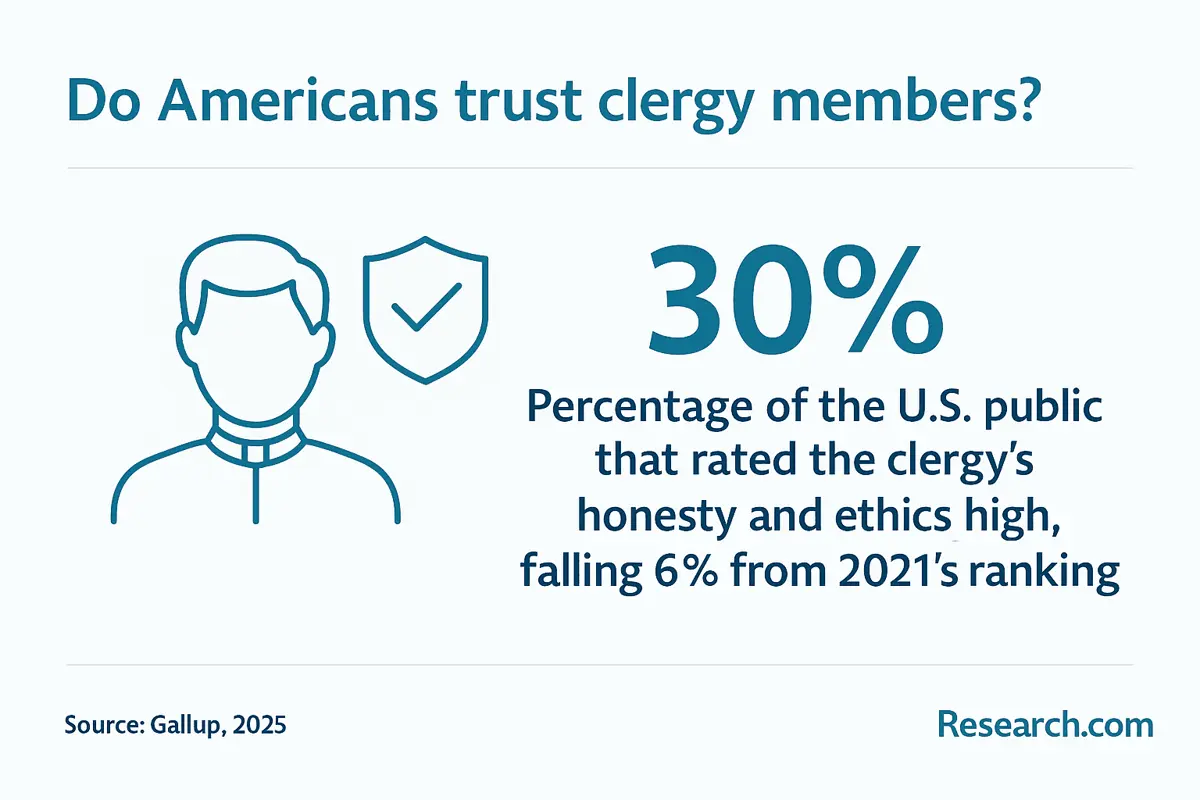
A recent Gallup poll found that clergy members remain among the more trusted professionals in the U.S., with 30% of respondents rating their ethical standards as high and 42% rating them as average.
Still, public trust has declined by six percentage points since 2021. That decline may reflect broader religious disaffiliation, institutional scrutiny, and changing expectations for religious leaders. For future clergy, educators, and ministry professionals, academic preparation and ethical accountability matter.
How can you verify the accreditation of an affordable online religious studies degree program?
Accreditation is one of the most important checks before enrolling. It can affect federal financial aid eligibility, credit transfer, graduate school admission, employer recognition, and confidence that the institution meets outside quality standards.
- Search for the institution in official accreditation directories connected to recognized accreditors.
- Confirm whether the school has regional, national, theological, or programmatic accreditation.
- Check whether the accreditor is recognized by the Council for Higher Education Accreditation (CHEA) or a relevant government agency.
- Ask the admissions office whether online students receive the same accredited degree as campus students.
- If you plan to transfer, attend seminary, pursue chaplaincy, or seek licensure later, ask the receiving institution or licensing body whether the credits will be accepted.
Students who want a broader view of accreditation and quality indicators in online education can also compare standards used in education degree online programs.
How do affordable online religious studies degree programs support student success?
Strong online programs do more than upload readings. They provide academic advising, accessible faculty, technology support, library resources, writing help, career guidance, spiritual formation opportunities, and clear communication about degree requirements.
| Support Service | Why It Helps Online Religious Studies Students |
| Academic advising | Helps students plan courses, apply transfer credits, stay on schedule, and prepare for graduate or ministry goals. |
| Online library access | Supports research in theology, biblical studies, church history, philosophy, ethics, and world religions. |
| Writing support | Improves sermon manuscripts, essays, exegesis papers, research projects, and theological arguments. |
| Career services | Can help students explore ministry, nonprofit work, education, chaplaincy preparation, and graduate school options. |
| Technical support | Reduces disruptions in online courses, video discussions, exams, and learning management systems. |
| Spiritual formation resources | May include chapel access, prayer groups, mentorship, ministry reflection, or pastoral guidance. |
Support quality can vary, even among affordable programs. Ask whether services are available to online students during evenings or weekends and whether career advising includes faith-based and secular career paths. Students comparing support models across online education may also look at the cheapest online master's degree in early childhood education.
What networking and mentorship opportunities are available in online religious studies degree programs?
Networking is especially important in religious studies because many jobs are relationship-driven. Ministry, chaplaincy, nonprofit leadership, missions, and religious education often depend on referrals, denominational connections, volunteer experience, supervised practice, and trusted mentors.
- Faculty mentorship: Professors can guide students in theology, ministry practice, graduate school preparation, research, and vocational discernment.
- Virtual alumni events: Alumni panels can show how graduates use the degree in churches, nonprofits, schools, missions, writing, and community organizations.
- Discussion forums and cohort groups: Online peer interaction can build support across denominations, regions, and ministry contexts.
- Webinars and guest lectures: Sessions with pastors, chaplains, nonprofit leaders, scholars, and counselors can help students connect coursework to real work.
- Local ministry placement: Some online students complete practicums or volunteer work in their own churches or communities.
Students who later move into advanced educational leadership may explore options such as EdD online fast track programs, but that path usually requires careful planning beyond the bachelor’s degree.
Is an Online Religious Studies Degree a Competitive Investment Compared to Other Fields?
An online religious studies degree is a strong investment when it directly supports your calling, career plan, or graduate study goals. It is less competitive as a purely financial investment if your main priority is entering a high-paying technical field immediately after graduation.
| Choose Religious Studies If... | Consider Another Field If... |
| You want ministry, theology, biblical studies, nonprofit service, chaplaincy preparation, religious education, or ethical leadership. | You want a degree primarily for quantitative, technical, engineering, or data-heavy roles. |
| You value cultural literacy, communication, writing, interpretation, and community impact. | You need a credential that leads directly to a licensed occupation with clear entry-level requirements. |
| You are open to pairing the degree with graduate study, certifications, licensure, or nonprofit experience. | You want the fastest possible path to a field with standardized compensation and credentialing. |
Students whose goals are more analytical or quantitative may want to compare this path with the fastest online bachelor's in mathematics degree. The better choice depends on your career target, values, income expectations, and willingness to pursue additional credentials.
What complementary certifications can bolster my career alongside a religious studies degree?
A religious studies degree can become more career-flexible when paired with credentials that add practical, regulated, or specialized skills. The right add-on depends on the role you want.
- Pastoral counseling training: Useful for ministry roles involving grief, marriage support, crisis care, or spiritual guidance, though it does not replace state counseling licensure.
- Clinical pastoral education: Often important for chaplaincy roles in hospitals, hospice, prisons, universities, and military settings.
- Nonprofit management: Helpful for students interested in fundraising, grant writing, volunteer coordination, program development, and community outreach.
- Interfaith leadership: Valuable for chaplaincy, community relations, campus ministry, and public service roles that serve diverse populations.
- Library, archives, or information credentials: Useful for students interested in religious publishing, theological libraries, historical collections, or community archiving. Students considering this route may compare cheap online MLIS degree programs.
What courses are typically in an affordable online religious studies degree program?
Coursework varies by school and faith tradition, but most programs combine foundational theology or religious studies with research, writing, interpretation, and practical application.
- Logic and Reason: Students learn how to evaluate arguments, identify weak reasoning, and build clear claims, which is essential for theology, apologetics, ethics, and public teaching.
- Philosophy: This course introduces major philosophical questions about knowledge, reality, morality, human nature, and the relationship between faith and reason.
- World Religions: Students examine major religious traditions, beliefs, rituals, texts, histories, and cultural influence to build interfaith understanding.
- Contemporary Theology: This course explores modern theological movements, debates, and questions shaping religious life today.
- Church History: Students study major events, leaders, councils, conflicts, reforms, and doctrinal developments in Christian history.
- Theology and Apologetics: Learners practice explaining, analyzing, and defending theological beliefs using Scripture, tradition, history, and reasoned argument.
- Sermon Preparation: Students develop skills in biblical interpretation, message structure, public speaking, audience awareness, and practical application.
These courses may also support future specialized study, including becoming a Christian counselor, although counseling careers typically require additional education, supervised experience, and licensure.
What types of specializations are available in online religious studies degree programs?
Specializations help students align the degree with a specific vocation. Some programs offer formal concentrations, while others allow students to focus through electives, minors, language courses, or ministry practica.
Students comparing career-focused online programs outside religious studies may also review affordable online surgical tech certification programs, which are designed for direct preparation in clinical settings.
Biblical Studies
Biblical studies focuses on the Old and New Testaments, interpretation, historical context, theology, and application. The area remains important for many Christian students; Pew Research Center reported in 2025 that 59% of Christians say the Bible is extremely or very important to them.
This specialization is a strong fit for students interested in preaching, teaching, seminary, Bible translation support, discipleship, or church education.
Christian Ministry
Christian ministry programs emphasize pastoral leadership, discipleship, worship planning, church administration, preaching, outreach, and care for congregations. This track is best for students who plan to serve directly in churches or ministry organizations.
Greek Theology
Greek theology explores Christian doctrine in relation to Greek language, Greco-Roman culture, early Christian writings, and philosophical influences on theological development. Students may study how early church debates shaped later doctrine and worship.
Hebrew Theology
Hebrew theology focuses on themes rooted in the Hebrew Bible, including covenant, law, prophecy, justice, worship, wisdom, and divine action. It may also introduce Jewish theological perspectives and their influence on Christian thought.
Pastoral Counseling
Pastoral counseling blends spiritual care with basic helping skills such as active listening, empathy, grief support, crisis response, and faith-informed guidance. It can be useful preparation for ministry support roles, but students who want licensed counseling careers must verify state requirements.
This chart reveals the share of Americans who believe the Bible is relevant.
How to choose the best affordable online religious studies degree programs?
The best affordable religious studies program is the one that fits your theology, budget, schedule, academic needs, and career plan. A low price is helpful, but it should not outweigh accreditation, curriculum quality, faculty expertise, student support, and long-term usefulness.
Students exploring other specialized online pathways in healthcare may also compare affordable women's health nurse practitioner programs online, but religious studies students should focus first on whether a program supports their ministry or service goals.
Program Selection Checklist
| What to Evaluate | Why It Matters | Red Flag |
| Accreditation | Supports financial aid, transfer, graduate admission, and credibility. | The school cannot clearly name its accreditor or accreditation status. |
| Curriculum | Determines whether you receive broad religious study, biblical training, ministry practice, or theological depth. | The program title sounds relevant, but required courses do not match your goals. |
| Faculty credentials | Qualified faculty can strengthen theological depth, research quality, and ministry preparation. | Faculty profiles are missing or do not show relevant academic or ministry experience. |
| Faith alignment | Denominational or doctrinal fit can matter for ministry, ordination, and personal formation. | The school’s statement of faith conflicts with your beliefs or vocational plans. |
| Transfer policy | Accepted credits can reduce both cost and time to graduation. | The school gives vague answers about which prior credits will apply. |
| Student support | Online learners need advising, library access, writing help, technology support, and career guidance. | Services are designed mainly for campus students. |
| Career alignment | Some roles require graduate study, certification, ordination, or licensure beyond the bachelor’s degree. | The program implies guaranteed career outcomes or licensure without explaining requirements. |
Common Mistakes to Avoid
- Choosing the cheapest option without checking accreditation.
- Assuming any online religious studies degree will meet ordination, chaplaincy, teaching, or counseling requirements.
- Ignoring transfer credit policies and paying for courses you may not need.
- Comparing only per-credit tuition instead of total program cost.
- Overlooking whether the program’s theology or denomination matches your beliefs and future ministry context.
- Assuming salary outcomes are guaranteed after graduation.
- Relying only on rankings instead of speaking with admissions, financial aid, faculty, and current students.
What career paths are available for graduates of online religious studies degree programs?
Religious studies graduates can pursue careers that combine communication, ethics, cultural understanding, leadership, service, and spiritual care. Some roles are directly tied to ministry, while others require additional training in counseling, education, nonprofit management, writing, or wellness.
- Nonprofit Program Directors ($78,196): These professionals oversee mission-driven initiatives in areas such as poverty relief, education, justice, youth services, and community development.
- Missionary Workers ($67,359): Missionaries may serve locally or internationally through evangelism, education, humanitarian aid, community development, or church support.
- Spiritual Life Coaches ($66,452): These practitioners help clients explore purpose, personal growth, healing, and values from a faith-based or spiritually informed perspective. This overlaps with the spiritual psychology career path.
- Religious Education Coordinators ($65,040): These workers design curricula, lead classes, train volunteers, and manage faith formation programs in churches, schools, or community organizations.
- Bereavement Counselors ($62,532): These professionals support individuals and families through grief, often in hospice, funeral, healthcare, or community care settings.
- Chaplains ($58,807): Chaplains provide spiritual care in hospitals, prisons, universities, military settings, hospice organizations, and other institutions serving people from varied backgrounds.
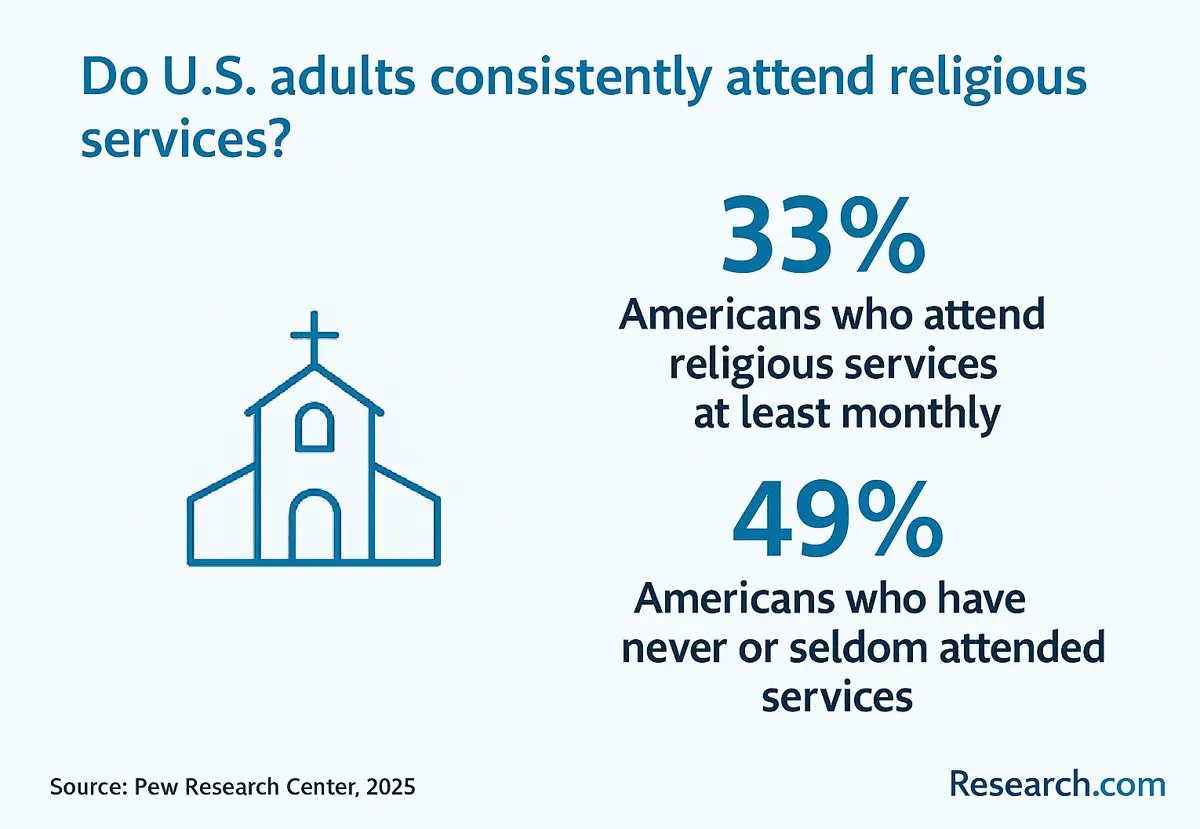
- Wellness and Spirituality Managers ($50,590): These professionals create workplace or community programs that support emotional, spiritual, and reflective well-being. Pew Research Center reported in 2025 that only 33% of Americans attend religious services regularly, which helps explain why some organizations are building broader wellness and reflection spaces.
- Religious Writers or Editors ($50,519): Writers and editors produce books, articles, devotionals, curriculum, newsletters, media content, and commentary for religious or values-focused audiences.
These careers show that religious studies can lead beyond the pulpit, but many paths become stronger with internships, volunteer work, supervised ministry, graduate study, or professional certification.
What is the job market for graduates with a religious studies degree?
The religious studies job market is changing rather than disappearing. Traditional ministry remains important, but graduates may also find opportunities in chaplaincy, nonprofit work, education, publishing, community service, wellness, cultural analysis, and interfaith settings.
The U.S. Bureau of Labor Statistics projects a 2.4% employment increase for all religious workers from 2023 to 2033. That projection equals about 50,100 annual job openings across the decade, with openings tied to retirements, replacement needs, community services, and continued demand for spiritual and ethical support.
The strongest candidates are often those who pair religious knowledge with practical experience. Examples include youth ministry experience, nonprofit volunteer leadership, hospital chaplaincy preparation, writing portfolios, public speaking, counseling-related training, or graduate theological education.
Broader wellness trends also matter. A McKinsey survey (Coe et al., 2024) found that Gen Z sees a strong connection between spiritual health and overall health. Gen Zers with good spiritual health also report good mental health (63%), social health (64%), and physical health (68%).
At the same time, religious affiliation is lower among younger adults. Pew Research Center reported in 2025 that only 15% of adults aged 18 to 29 are religiously affiliated, while 28% are not affiliated with any religion. This creates challenges for traditional congregational ministry but may increase the importance of interfaith, non-denominational, and culturally sensitive spiritual care.
Graduates who can communicate across beliefs, serve diverse communities, and connect spiritual questions with real human needs may find meaningful work in both faith-based and secular organizations.
This chart displays the job growth of religious workers.
Key Insights
- An affordable online religious studies degree is best for students pursuing ministry, theology, religious education, chaplaincy preparation, nonprofit service, writing, or ethically focused leadership.
- Most programs take 4 years and require 120 to 128 credits, but transfer credits and accelerated formats can shorten the timeline.
- Clergy earn an annual salary of $67,160 according to the U.S. Bureau of Labor Statistics, but earnings depend heavily on employer type, location, credentials, and responsibilities.
- Accreditation should be checked before cost. It affects aid, transfer, graduate school, and credibility with employers or ministry organizations.
- Online programs can be academically rigorous, but students should confirm the level of faculty access, mentoring, library support, and community formation available to distance learners.
- Career flexibility improves when religious studies is paired with practical experience, chaplaincy training, nonprofit management, counseling-related credentials, education pathways, or graduate theological study.
- The religious landscape is shifting. Graduates who can work across denominations, cultures, and levels of religious affiliation will be better positioned for evolving ministry and service roles.
References:
- Career One Stop. (2025). Clergy. Occupational Profile. Retrieved June 9, 2025, from https://www.careeronestop.org/Toolkit/Careers/Occupations/occupation-profile.aspx?keyword=Clergy&location=US&onetcode=21-2011.00
- Ma, J., Pender, M., & Oster, M. (2024). Trends in College Pricing and Student Aid 2024. https://research.collegeboard.org/media/pdf/Trends-in-College-Pricing-and-Student-Aid-2024-ADA.pdf
- Smith, G. A., Cooperman, A., Alper, B.A., Mohamed, B., Rotolo, C., Tevington, P., Nortey, J., Kallo, A., Diamant, J., & Fahmy, D. (2025, February 26). Decline of Christianity in the U.S. Has Slowed, May Have Leveled Off: Findings from the 2023-24 Religious Landscape Study. Pew Research Center. https://www.pewresearch.org/religion/2025/02/26/decline-of-christianity-in-the-us-has-slowed-may-have-leveled-off
- U.S. Bureau of Labor Statistics. (2024). Clergy [Interactive data]. May 2024 OEWS Profiles, Occupational Employment and Wage Statistics (OEWS) Profiles. Retrieved June 9, 2025, from https://data.bls.gov/oesprofile
- U.S. Bureau of Labor Statistics. (2025b, April 18). Occupational projections, 2023–33, and worker characteristics, 2023 (Numbers in thousands). Employment Projections. https://www.bls.gov/emp/tables/occupational-projections-and-characteristics.htm
- ZipRecruiter. (2025, June 2). Wellness Manager Salary. Retrieved June 9, 2025, from https://www.ziprecruiter.com/Salaries/Wellness-Manager-Salary#Yearly
Other Things You Should Know About Affordable Online Religious Studies Degree Programs
No. Most online religious studies programs require only a high school diploma or transfer coursework for admission. Theology, Hebrew, or Greek courses are usually optional concentration choices, not entry requirements. Some upper-division programs expect 60 transferable credits before junior-level study begins.
Typical admission requirements for affordable online religious studies degree programs in 2027 include a high school diploma or equivalent, a minimum GPA of 2.0, and submission of application forms, transcripts, and recommendation letters. Some programs may also require a personal statement or an interview.
Some of the most affordable online religious studies degree programs in 2027 include Liberty University, University of Central Florida, and American Public University System. These programs offer comprehensive religious studies education at competitive tuition rates, making them accessible to students seeking budget-friendly options.