2027 Best Online Divinity (MDiv) Degree Programs

Co-Founder and Chief Data Scientist
As a career planning and education expert, I know that finding the ideal online Master of Divinity program can be a complex and often confusing process. With so many options available in the USA, prospective students often face a daunting task of sorting through conflicting information, marketing claims, and varying accreditation standards. This can make a clear decision seem out of reach.
My goal is to simplify this journey for you, providing clear, reliable insights to help you identify a program that aligns with your professional aspirations and personal calling, ensuring you make a confident and well-informed choice.
What are the benefits of getting an online Master of Divinity (MDiv) degree?
- Career Advancement: An MDiv is often the standard professional degree for ordination and licensing in many denominations, opening doors to senior pastoral roles and leadership positions in chaplaincy and nonprofit organizations.
- Earning Potential: With an online Master of Divinity (MDiv) degree, salaries range from $35,000 for entry-level ministry roles to $160,000 for senior leadership positions in large churches or nonprofits.
- Flexible Learning: The online format provides the convenience of studying from anywhere, allowing you to balance a rigorous academic program with current ministry commitments, family life, or other professional obligations.
What can I expect from an online Master of Divinity (MDiv) degree program?
- Comprehensive Curriculum: Expect a robust curriculum that provides a deep foundation in biblical studies, theology, church history, and practical ministry skills.
- Structured Curriculum: Program delivery typically combines asynchronous video lectures, synchronous online class sessions, discussion forums, and field education requirements like a supervised internship.
- Integrated Formation: Emphasis is placed on spiritual formation and leadership development, helping students to integrate their academic learning with their personal faith journey.
- Collaborative Learning Environment: Online programs often use technology to foster a sense of community, allowing you to connect with experienced faculty and a diverse cohort of peers from various denominations and locations.
- Hands-On Experience: Many programs require a field education or internship component, giving you practical, supervised experience in a church, hospital, or other ministry setting.
Where can I work with an online Master of Divinity (MDiv) degree?
- Local Church Leadership: The most traditional path, serving in roles such as senior pastor, associate pastor, youth minister, or worship leader in a local congregation.
- Chaplaincy: Provide spiritual and emotional care in diverse settings including hospitals, the military, prisons, colleges, and corporations.
- Nonprofit Sector: Lead and manage faith-based nonprofit organizations in roles like executive director, program manager, or development officer.
- Education and Academia: Teach at the high school level, in Christian colleges, or, with further education, become a theology professor or researcher.
- Social Work and Advocacy: Use a strong ethical and theological foundation to work in community organizing, social services, or human rights advocacy.
- Counseling: With specialized training, you can become a pastoral counselor, integrating psychological principles with a theological framework to help individuals and families.
How much can I make with an online Master of Divinity (MDiv) degree?
- Entry-Level Ministry: New graduates in roles like youth pastor or assistant pastor can typically expect to earn between $35,000 and $55,000 annually, depending on the church's size and location.
- Experienced Ministry & Chaplaincy: With several years of experience, a senior pastor at a small-to-medium-sized church or a hospice/healthcare chaplain can earn in the range of $60,000 to $90,000.
- Senior Leadership Roles: Highly experienced senior pastors at large churches or executive directors of significant nonprofits can command salaries well over $100,000 annually, with some earning in the $120,000 to $160,000 range.
- Best Online Divinity (MDiv) Degree Programs for 2027 List of Programs
- What is the average cost of an online Master of Divinity degree? Program Cost
- What are the financial aid options for an online Master of Divinity degree? Financial Aid
- What are the prerequisites for enrolling in an online Master of Divinity degree program? What are the prerequisites for enrolling in an online Master of Divinity degree program?
- What courses are typically in an online Master of Divinity degree program? What courses are typically in an online Master of Divinity degree program?
- What types of specializations are available for Master of Divinity graduates? Specializations
- How do you choose the best online Master of Divinity degree program? How do you choose the best online Master of Divinity degree program?
- What career paths are available for graduates of online Master of Divinity degree programs? Career Paths
- How much can I earn with an online Master of Divinity degree? Salaries
- What is the job market for graduates with an online Master of Divinity degree? Job Market
- What are some current and future trends in theology and ministry? Trends
- What common challenges do online Master of Divinity students face? challenges
- How do I evaluate the quality of an online Master of Divinity program? How do I evaluate the quality of an online Master of Divinity program?
Best Online Master of Divinity (MDiv) Degree Programs for 2027
Choosing an online Master of Divinity program is not just a graduate school decision. For many students, it affects ordination preparation, ministry formation, chaplaincy eligibility, denominational relationships, family finances, and long-term career options. The right MDiv can prepare you for pastoral ministry, hospital or military chaplaincy, nonprofit leadership, missions, doctoral study, or faith-based counseling and care. The wrong fit can leave you with unnecessary debt, missing field education, or a credential that does not meet your church body’s expectations.
This guide is written for prospective seminary students comparing online and hybrid MDiv programs. It explains how programs differ, what they cost, what admissions committees usually require, how to evaluate accreditation and theological alignment, and what career outcomes are realistic after graduation.
Quick answer: What is the best online MDiv program?
The best online Master of Divinity program is the one that matches your ministry goal, theological tradition, schedule, and budget. Students pursuing ordination should start with denominational requirements. Students aiming for chaplaincy should prioritize ATS accreditation, supervised field education, and chaplaincy-focused coursework. Students preparing for doctoral study should look closely at biblical languages, research expectations, faculty expertise, and thesis or advanced academic options.
Based on available program details, the schools below stand out for flexible online or hybrid formats, recognized accreditation, ministry training, specialization options, and practical formation opportunities.
How we evaluated schools
Because an MDiv requires a major commitment of time, tuition, and spiritual formation, our ranking process emphasizes transparency and decision usefulness. Our ranking methodology draws from recognized education data sources and program-level research, including:
- IPEDS database
- Peterson's database, including the Distance Learning Licensed Data Set
- College Scorecard database
- National Center for Education Statistics
For MDiv programs specifically, students should also review institutional accreditation, Association of Theological Schools recognition, denominational fit, field education requirements, online format, tuition structure, and whether the curriculum supports ordination, chaplaincy, nonprofit leadership, or doctoral preparation.
Best online and hybrid MDiv programs at a glance
| School | Format | Credits | Program length | Tuition information | Best fit |
| Bethel University | Fully online | 78 | 4 to 4.5 years | $1,090/credit | Students seeking online ministry preparation with spiritual formation and cohort support |
| Biola University | Online, campus, or hybrid | 79-81 | 3 to 5 years | $704 per credit | Students who want several ministry concentrations and evangelical theological training |
| Candler School of Theology at Emory University | Residential or hybrid | 72 | 3 to 4 years (maximum 6 years) | $27,500/academic year | Students seeking a rigorous academic MDiv with contextual education |
| George Fox University | Hybrid | 72 credits | Typically 4 years | $47,376 plus $1,600 per BridgeWeek intensive (subject to change) | Students who want cohort-based formation and periodic in-person intensives |
| Harding University | Hybrid | 75 credits | 4 years (typical) | Not listed in the provided program data | Ministers and missionaries seeking advanced theological and ministry preparation |
| Liberty University | Online | 72, 75, 90, or 93 credit options | Varies, around 3-4 years depending on credit plan and pace | $545/credit | Students who want flexible 8-week courses and multiple credit-plan options |
| Moody Bible Institute | Online | 72 credits | typically around 3-4 years | $565/credit | Students focused on biblical preaching, ministry leadership, and biblical languages |
| Asbury Theological Seminary | Online or flexible seminary format | 96 | 3 to 4 years | Approximately $24,000 over three years | Students seeking a Wesleyan-holiness foundation and broad ministry preparation |
| Regent University | Online | 72 | Typically 3-4 years | $565/credit | Students balancing ministry, work, and theological formation |
| Southeastern University | Online with face-to-face interaction options | 72 | Varies by track and acceleration option; typically 3-5 years | $545/credit | Students seeking Pentecostal ministry preparation, chaplaincy, or pastoral care tracks |
1. Bethel University
Bethel University offers a fully online Master of Divinity for students preparing for pastoral leadership, teaching, chaplaincy, or future seminary doctoral study. The program combines biblical and theological coursework with spiritual and personal formation, which is especially important for students who need more than academic content from an online seminary experience.
The degree is designed to support students preparing for ordination within their own denomination while also developing ministry skills for churches, missions, nonprofit organizations, and other ministry settings. Internship experiences help students connect coursework with supervised practice.
Bethel may be a strong option for students who want a structured online MDiv with community, faculty connection, and formation-oriented learning. Students should confirm any denomination-specific ordination requirements before enrolling.
- Program Length: 4 to 4.5 years
- Tracks/Concentrations: None explicitly separated beyond the Sem Together cohort option
- Tuition Cost: $1,090/credit
- Required Credits to Graduate: 78
- Accreditation: Higher Learning Commission (HLC), Association of Theological Schools (ATS)
2. Biola University, Talbot School of Theology
Biola University offers the Master of Divinity through Talbot School of Theology in on-campus, fully online, and hybrid formats. This flexibility makes the program useful for students who want a traditional seminary curriculum but need different delivery options because of work, family, or ministry obligations.
The program emphasizes biblical studies, theology, ministry leadership, and personal spiritual formation. Students study Scripture, core Christian doctrine, and practical ministry while selecting a concentration aligned with their vocational direction.
Biola is especially relevant for students who want a concentration-based MDiv. Options include pastoral ministry, evangelism and discipleship, missions, pastoral care, and spiritual formation, which can help students build a more targeted ministry résumé.
- Program Length: 3 to 5 years
- Tracks/Concentrations: Evangelism and Discipleship, Messianic Jewish Studies, Missions and Intercultural Studies, Pastoral and General Ministries, Pastoral Care and Counseling, Spiritual Formation
- Tuition Cost: $704 per credit
- Required Credits to Graduate: 79-81
- Accreditation: Western Association of Schools and Colleges Senior College and University Commission (WSCUC), Association of Theological Schools (ATS)
3. Candler School of Theology at Emory University
Emory University offers the Master of Divinity through Candler School of Theology in residential and hybrid formats. The hybrid pathway is built around mostly online coursework with brief in-person intensives, making it a fit for students who want an academically rigorous seminary experience without relocating full time.
The curriculum includes biblical studies, historical studies, systematic theology, and practical theology. Candler also places strong emphasis on contextual education, allowing students to connect classroom learning with supervised ministry in real settings.
First-year MDiv students serve in clinical or social ministry settings, while second-year students move into ecclesial contexts. Faculty-led reflection groups help students process those experiences theologically and professionally. Students interested in dual degrees or certificates should compare those options early because they can affect timeline and cost.
- Program Length: 3 to 4 years (maximum 6 years)
- Tracks/Concentrations: No formal concentrations, but various dual degrees and certificates available
- Tuition Cost: $27,500/academic year
- Required Credits to Graduate: 72
- Accreditation: Southern Association of Colleges and Schools Commission on Colleges (SACSCOC), Association of Theological Schools (ATS)
4. George Fox University, Portland Seminary
Portland Seminary at George Fox University offers a hybrid Master of Divinity that blends online learning with three annual BridgeWeek intensives in Portland. The program uses a cohort model during the first two years, which can help online students build peer relationships and accountability.
The curriculum is centered on Christian heritage, theology, spiritual formation, and ministry practice. Students engage Scripture, theology, psychology, and social-cultural analysis as they prepare for ministry in changing congregational and community contexts.
George Fox may be a good match for students who want structured formation and periodic in-person learning. Its chaplaincy specialization is particularly relevant for students who feel called to support people during crisis, transition, grief, or institutional care.
- Program Length: Typically 4 years
- Tracks/Concentrations: Chaplaincy specialization available
- Tuition Cost: $47,376 plus $1,600 per BridgeWeek intensive (subject to change)
- Required Credits to Graduate: 72 credits
- Accreditation: Association of Theological Schools (ATS), Northwest Commission on Colleges and Universities (NWCCU)
5. Harding University
Harding University offers a hybrid Master of Divinity primarily for ministers and missionaries who want deeper preparation in Scripture, theology, church history, and ministry practice. The format can work well for students already serving in ministry who cannot step away from their current responsibilities.
The program includes supervised ministry experience, which is essential for students preparing for preaching, chaplaincy, missions, or congregational leadership. Faculty bring academic and ministry experience into the classroom, and students can use theological library resources that include over 150,000 books and 25,000 periodicals, along with expanding digital collections.
Harding may be most appropriate for students who value a ministry-focused hybrid program and want access to substantial theological research resources while remaining connected to their existing ministry context.
- Program Length: 4 years (typical)
- Tracks/Concentrations: Through electives
- Tuition Cost: Not listed in the provided program data
- Required Credits to Graduate: 75 credits
- Accreditation: Association of Theological Schools (ATS), Higher Learning Commission (HLC)
6. Liberty University
Liberty University offers an online Master of Divinity with coursework in ministry writing, research, apologetics, Old and New Testament studies, biblical languages, church history, theology, and evangelism. The program is built for students preparing for professional Christian ministry who need a highly flexible online structure.
Courses use a flexible 8-week format, and students may transfer in up to 50% of the degree total. Liberty also offers several credit-plan options, which can be helpful for students with different ordination, academic, or ministry goals.
This program may be a fit for students who want specialization options, online pacing flexibility, and a large school-of-divinity environment. Students should compare the 72, 75, 90, and 93 credit options carefully because credit load affects cost, time to completion, and alignment with future goals.
- Program Length: Varies, around 3-4 years depending on credit plan and pace
- Tracks/Concentrations: Multiple specialized areas of study
- Tuition Cost: $545/credit
- Required Credits to Graduate: 72, 75, 90, or 93 credit options
- Accreditation: Southern Association of Colleges and Schools Commission on Colleges (SACSCOC), Association of Theological Schools (ATS)
7. Moody Bible Institute
Moody Bible Institute offers an online Master of Divinity for students seeking advanced biblical knowledge, preaching preparation, and ministry leadership training. The curriculum includes Hebrew, Greek, biblical and systematic theology, pastoral practices, church history, ministry leadership, and narrative preaching.
Moody’s program is especially relevant for students who want to strengthen biblical interpretation and preaching while preparing for full-time ministry leadership. Faculty mentorship and online student support services are part of the academic experience.
Students can choose from several concentrations, including biblical languages, biblical preaching, ministry leadership, nonprofit administration and leadership, and interdisciplinary study. This makes the program useful for students who want a ministry degree with a clear academic or leadership emphasis.
- Program Length: typically around 3-4 years
- Tracks/Concentrations: MDiv in Biblical Languages, MDiv in Biblical Preaching, MDiv in Biblical Spiritual Formation and Discipleship, MDiv in Interdisciplinary Studies, MDiv in Ministry Leadership, MDiv in Nonprofit Administration and Leadership
- Tuition Cost: $565/credit
- Required Credits to Graduate: 72 credits
- Accreditation: Higher Learning Commission (HLC), Association of Theological Schools (ATS)
8. Asbury Theological Seminary
Asbury Theological Seminary offers a 96-credit hour Master of Divinity with a biblical and theological foundation shaped by Wesleyan-holiness traditions. The program includes ministry skill development through internships and immersion experiences.
Students can customize the degree with a specialization by completing five specified courses in an area such as Anglican Studies, Christian Leadership, Church Planting, or Youth Ministry. Students interested in academic advancement can also explore the dual M.Div. and Master of Theology (Th.M.) option, which is designed to save time and support doctoral preparation.
Asbury also offers advanced standing for students with a prior religion major or minor, allowing up to 18 credits toward the M.Div. The seminary provides scholarships to over 80% of its students, which can make total cost a key reason to compare this program closely.
- Program Length: 3 to 4 years
- Tracks/Concentrations: Multiple specializations available
- Total Tuition Cost: Approximately $24,000 over three years
- Required Credits to Graduate: 96
- Accreditation: Association of Theological Schools (ATS), Southern Association of Colleges and Schools Commission on Colleges (SACSCOC)
9. Regent University
Regent University offers an online Master of Divinity in Theology & Ministry for students preparing for full-time ministry and other Christian leadership roles. The program draws on elements of other master’s programs to build a broad foundation in theology, biblical interpretation, Christian history, and leadership.
Regent’s online MDiv includes eight-week course sessions and capstone options such as a master’s thesis or spiritual formation portfolio. Students can also choose a concentration and may pursue the M.Div. as part of a dual degree.
This program may be useful for students who need a flexible online pathway while balancing ministry, employment, and family responsibilities. Students who intend to use the degree for ordination or ministry licensure should verify requirements with their denomination or licensing body.
- Program Length: Typically 3-4 years
- Tracks/Concentrations: Pastoral ministry and intercultural ministry themes
- Tuition Cost: $565/credit
- Required Credits to Graduate: 72
- Accreditation: Association of Theological Schools (ATS)
10. Southeastern University
Southeastern University offers a Master of Divinity for students preparing for pastoral ministry, missions, chaplaincy, doctoral study, or ordination-related education. The curriculum includes biblical languages, systematic theology, Pentecostalism, spirituality, and ministry leadership.
The program combines online learning with opportunities for face-to-face interaction in on-campus classes. This can be valuable for students who want online flexibility but still benefit from direct faculty and peer engagement.
Southeastern offers tracks in Chaplaincy & Leadership and Pastoral Care & Counseling. Qualified students may also use advanced standing for prior degrees or documented ministry experience, and accelerated program paths are available for eligible students.
- Program Length: Varies by track and acceleration option; typically 3-5 years
- Tracks/Concentrations: Chaplaincy & Leadership, Pastoral Care & Counseling
- Tuition Cost: $545/credit
- Required Credits to Graduate: 72
- Accreditation: Association of Theological Schools (ATS), Southern Association of Colleges and Schools Commission on Colleges (SACSCOC)
What is the average cost of an online Master of Divinity degree?
Online MDiv costs vary because seminaries use different credit requirements, tuition models, scholarship policies, residency expectations, and fee structures. A student in a 72-credit program paying per credit will face a different total price than a student in a 96-credit program with large institutional scholarships.
As a broad planning benchmark, total program costs for an MDiv often range from as low as $20,000 to over $100,000. Per-credit tuition commonly ranges from $300 to over $1,000 per credit, and many MDiv programs require between 72 and 90 credit hours to complete. Some programs exceed that range, such as 96-credit options.
Do not evaluate an MDiv by tuition alone. A lower sticker price can become less attractive if the program has required intensives, technology fees, limited scholarships, or poor transfer-credit policies. Likewise, a higher tuition rate may be offset by substantial grants, denominational support, or advanced standing.
| Cost factor | Why it matters | What to ask before applying |
| Required credits | A 72-credit program and a 96-credit program can have very different total costs even with similar tuition rates. | How many credits are required for my intended track or ordination path? |
| Per-credit tuition | Many schools charge by the credit, so small rate differences multiply across the full degree. | Is the listed rate fixed for online students, or can it change each year? |
| Residencies or intensives | Hybrid programs may require travel, lodging, meals, and missed work time. | How many in-person sessions are required, and what costs are not included in tuition? |
| Books and technology | Online students may pay for digital resources, course platforms, books, and software. | Are electronic textbooks included for any courses? |
| Scholarships and grants | Institutional aid can significantly reduce out-of-pocket cost. | What percentage of MDiv students receive aid, and is it renewable? |
| Transfer credit or advanced standing | Prior graduate work, religion coursework, or ministry experience may shorten the program at some schools. | How many credits can I transfer or receive through advanced standing? |
Students comparing online graduate costs should avoid assuming that unrelated programs price themselves the same way. For example, an online nurse administrator graduate certificate may use a shorter credit structure and different aid rules than a seminary degree.
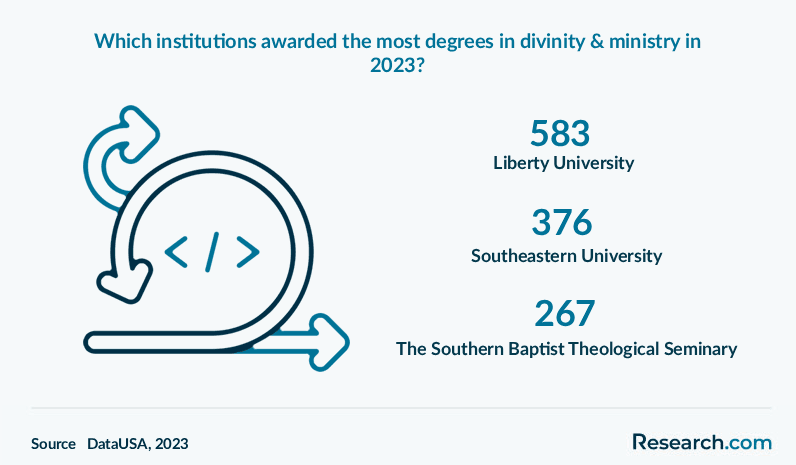
DataUSA reported that Liberty University awarded the highest number of divinity and ministry degrees in 2023, with 583. Southeastern University followed with 376, and The Southern Baptist Theological Seminary ranked third with 267 degrees. This indicates that a relatively small group of institutions awards a large share of divinity and ministry credentials.
What financial aid options are available for an online Master of Divinity degree?
Most MDiv students should build a funding plan from several sources rather than relying on one scholarship or one loan. Seminary aid may include institutional scholarships, denominational support, congregational assistance, federal loans, work-study, employer help, fellowships, assistantships, or tuition waivers.
Graduate students may apply for federal aid by completing the Free Application for Federal Student Aid (FAFSA). Federal loan options may include Direct Unsubsidized Loans and Graduate PLUS Loans. Private loans are available from some lenders, but students should usually compare federal and institutional aid first because private borrowing can have less flexible terms.
| Aid type | Best for | Important caution |
| Institutional scholarships | Students applying to seminaries with merit-based, need-based, or ministry-focused awards | Confirm whether the scholarship renews automatically or requires GPA, enrollment, or ministry conditions. |
| Denominational scholarships | Students affiliated with a church body that supports seminary education | Some awards require endorsement, ordination candidacy, or service commitments. |
| Church or community grants | Students with strong congregational support or a clear ministry calling | Local aid may be informal, one-time, or dependent on annual budgets. |
| Federal student loans | Graduate students who need predictable borrowing options | Borrow only after estimating total debt across the full MDiv. |
| Federal Work-Study | Students with financial need who can balance part-time work with coursework | Availability depends on the institution and student eligibility. |
| Fellowships or assistantships | Students at universities that offer research, teaching, or ministry-related roles | These awards may be competitive and may require on-campus or scheduled responsibilities. |
| Employer tuition assistance | Students already working for churches, nonprofits, schools, or ministry organizations | Ask whether assistance creates a service obligation after graduation. |
| Tuition waivers | Students who qualify under institution-specific criteria | Eligibility varies widely and may not apply to all online programs. |
Financial aid rules differ across educational formats. Shorter training options, such as online dog obedience classes, should not be used as a model for graduate seminary financing because MDiv students are dealing with a professional graduate degree, accreditation requirements, and federal aid rules.
Contact financial aid offices early, request a complete cost-of-attendance estimate, and ask how aid changes if you study part time, pause enrollment, transfer credits, or switch tracks.
What are the prerequisites for enrolling in an online Master of Divinity program?
Most online MDiv programs require a bachelor’s degree, official transcripts, recommendations, and a written statement explaining the applicant’s faith background, ministry experience, vocational goals, and readiness for graduate theological study. Admissions standards differ, but many schools look for applicants who show academic ability, maturity, spiritual commitment, and a realistic understanding of ministry.
Like other graduate pathways, including a counseling psychology degree online, an MDiv application usually evaluates both academic preparation and professional fit. Seminary admissions often places additional emphasis on calling, character, church involvement, and leadership potential.
| Common requirement | What it shows | How to prepare |
| Bachelor's degree | You have completed undergraduate preparation, often from a regionally accredited institution. | Request transcripts early and confirm whether your degree field affects prerequisites. |
| Minimum GPA | You can handle graduate-level reading, writing, and research. | If your GPA is lower, ask whether conditional admission is available. |
| Official transcripts | The school can verify previous coursework and degree completion. | Send transcripts from every college or university attended. |
| Letters of recommendation | Faculty, pastors, supervisors, or ministry leaders can speak to your readiness. | Choose recommenders who know your character, academic ability, and ministry gifts. |
| Personal statement or essay | You can explain your calling, goals, and reasons for pursuing an MDiv. | Be specific about your intended ministry path and why the program fits. |
| Spiritual autobiography | The admissions team can understand your faith formation and background. | Reflect honestly on growth, challenges, service, and vocational direction. |
| Ministry experience | You have exposure to church, nonprofit, missions, teaching, or care settings. | Document volunteer and paid roles, leadership responsibilities, and supervised service. |
| Writing sample | You can write clearly about complex theological or academic topics. | Submit polished work that demonstrates research, structure, and argumentation. |
| Interview | The school can assess fit, communication, and motivation. | Be ready to discuss your ministry goals, theological interests, and time-management plan. |
Applicants interested in pastoral care or faith-based helping roles may also explore whether Christian counseling certification would complement, but not replace, an MDiv or any required licensure pathway.
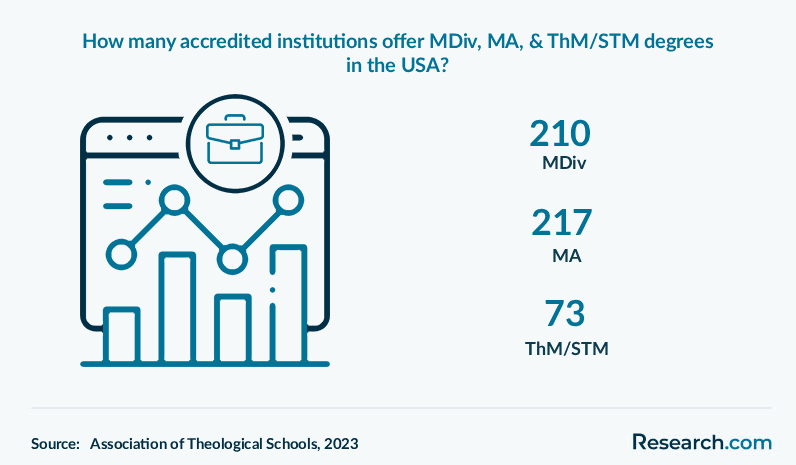
Association of Theological Schools enrollment data showed small changes in accredited degree programs from 2022-2023 to 2023-2024. Master of Divinity programs decreased from 214 to 210, and Master of Arts programs declined from 221 to 217. Master of Theology/Sacred Theology programs increased from 68 to 73. Professional doctorates such as the DMin increased from 147 to 148, while PhD/ThD programs grew from 54 to 60.
These figures suggest that traditional professional and general theological master’s programs remain relatively stable, while advanced academic and professional doctoral programs show modest growth.
What courses are typically included in an online Master of Divinity program?
An online MDiv is usually broader and more practice-oriented than a general theology master’s degree. It combines biblical interpretation, theological study, ministry leadership, preaching, pastoral care, ethics, spiritual formation, and field education. While programs differ by tradition and emphasis, most include coursework in the following areas.
| Course area | What students study | Why it matters for ministry |
| Biblical studies | Old Testament, New Testament, hermeneutics, exegesis, Hebrew, and Greek | Prepares students to interpret Scripture responsibly and teach it clearly. |
| Systematic theology | Major Christian doctrines and theological frameworks | Helps future leaders explain belief, doctrine, and faith practice with clarity. |
| Church history | Christian movements, traditions, controversies, and key historical figures | Gives ministers context for denominational identity and theological development. |
| Practical theology | Worship, preaching, ministry leadership, pastoral practice, and congregational life | Connects theology to daily ministry responsibilities. |
| Pastoral counseling | Spiritual care, crisis support, family systems, grief, and referral awareness | Prepares students to support people while recognizing the limits of pastoral care. |
| Missiology and evangelism | Missions history, intercultural ministry, outreach, and global contexts | Supports local and international ministry in diverse communities. |
| Ethics and public theology | Moral reasoning, social issues, culture, politics, and public witness | Equips leaders to address complex questions with theological depth. |
| Spiritual formation | Prayer, discipleship, spiritual disciplines, reflection, and personal formation | Helps students develop the character and habits needed for sustainable ministry. |
| Homiletics | Sermon preparation, delivery, biblical preaching, and audience engagement | Builds one of the core skills needed for pastoral and teaching roles. |
| Field education or internship | Supervised ministry in churches, hospitals, nonprofits, missions, or community settings | Allows students to practice ministry under supervision and receive feedback. |
Students comparing MDiv coursework with adjacent fields should note that some content overlaps with theology degree programs, but the MDiv typically places more emphasis on professional ministry preparation. Other education-focused programs, such as early childhood education programs, also combine theory and field experience, but the MDiv applies that model to theological leadership and spiritual care.
What specializations are available in Master of Divinity programs?
Specializations help MDiv students aim their coursework toward a specific ministry setting. Not every school offers formal concentrations, and some use electives, certificates, or tracks instead. Before choosing a specialization, confirm that it matches your intended career, denomination, chaplaincy board, or doctoral goal.
| Specialization | Best for | Decision note |
| Chaplaincy | Students preparing for hospitals, military settings, prisons, hospice, or other institutional care | Ask whether the program supports supervised clinical or chaplaincy-related preparation. |
| Youth and family ministry | Students called to children, youth, family discipleship, or next-generation ministry | Look for coursework in development, family systems, teaching, and safeguarding. |
| Christian education | Students who want to design and lead church or school-based learning programs | Review whether the curriculum includes teaching methods and curriculum development. |
| Pastoral counseling | Students focused on spiritual care, grief, crisis response, and faith-informed support | An online Christian counseling degree may offer deeper counseling preparation, but licensure rules vary by state and profession. |
| Missions and intercultural studies | Students preparing for missionary work, global ministry, or cross-cultural leadership | Prioritize intercultural communication, language awareness, and contextual theology. |
| Urban ministry | Students serving city churches, community organizations, or justice-oriented ministries | Look for field placements in urban contexts rather than only classroom theory. |
| Worship arts | Students leading music, liturgy, creative arts, or worship planning | Balance artistic training with theological grounding and pastoral leadership. |
| Theology and the arts | Students interested in literature, film, visual arts, music, and theological interpretation | This can be useful for teaching, cultural engagement, writing, or creative ministry. |
| Nonprofit leadership | Students preparing for faith-based administration, fundraising, program management, or executive roles | Choose programs with management, finance, communications, and leadership coursework. |
| Biblical languages and studies | Students considering teaching, doctoral study, translation, or advanced biblical scholarship | Make sure the program includes enough Hebrew, Greek, exegesis, and research preparation. |
| Church planting | Students planning to start new churches or revitalize existing congregations | Look for practical training in leadership, community engagement, fundraising, and discipleship systems. |
How do you choose the best online Master of Divinity program?
Start with your destination, not the ranking. An MDiv for ordination, chaplaincy, academic study, missions, or nonprofit leadership may require different courses, field placements, endorsements, or faculty mentorship. A well-known school is not automatically the right school if it does not fit your calling, tradition, and practical constraints.
| Factor | Why it matters | Questions to ask |
| Accreditation | Accreditation affects transferability, employer recognition, federal aid access, and some ministry pathways. | Is the institution accredited, and does the seminary hold ATS accreditation? |
| Theological and denominational alignment | Seminary is formative, not just informational. The school’s tradition will shape your training. | Does this program satisfy my denomination’s ordination or credentialing requirements? |
| Curriculum | Course requirements determine whether you receive enough biblical, theological, pastoral, and practical preparation. | Are languages, preaching, pastoral care, field education, and formation required? |
| Online format | Asynchronous, synchronous, and hybrid models affect your weekly schedule and community experience. | Are classes live, self-paced, cohort-based, or built around intensives? |
| Field education | Ministry skills develop through supervised practice, not online lectures alone. | Can I complete internships near my home, and who supervises them? |
| Faculty access | Mentorship matters in theological education, especially for preaching, pastoral care, and vocational discernment. | How do online students interact with professors outside class? |
| Student support | Online MDiv students need library access, writing support, spiritual formation, advising, and career guidance. | What services are available remotely? |
| Cost and aid | Ministry compensation can vary, so debt should be evaluated conservatively. | What is my estimated total cost after scholarships, fees, and travel? |
| Reputation and outcomes | Alumni placements can show whether the program has credibility in your desired field. | Where do graduates serve, and what placement data is available? |
| Technology | A strong online platform reduces friction and supports participation. | What learning management system is used, and what tech support is available? |
Students should confirm that any online school they consider is properly accredited. A broader overview of recognized distance-learning institutions is available through Research.com’s guide to accredited online universities.
Who should choose an online MDiv?
- Working adults who cannot relocate for seminary
- Current ministers who want graduate theological training while continuing to serve
- Students with family responsibilities who need flexible scheduling
- Prospective chaplains who can complete supervised experience near their community
- Students whose denomination accepts online or hybrid seminary coursework
Who may be better served by a campus-based or hybrid program?
- Students who need intensive face-to-face formation, preaching labs, or pastoral mentoring
- Students whose denomination prefers or requires residential seminary education
- Students who learn best through in-person discussion and daily community life
- Students seeking extensive campus-based field placements or research assistantships
- Students who want stronger access to chapel, worship, and residential formation rhythms
What career paths are available with an online Master of Divinity?
The MDiv is a professional ministry degree, but graduates work in more than congregational pastor roles. Career options depend on denomination, experience, specialization, location, licensing or endorsement requirements, and whether the graduate pursues further education.
| Career path | Typical responsibilities | Important requirement or consideration |
| Senior pastor or associate pastor | Preaching, teaching, pastoral care, leadership, discipleship, worship oversight, and administration | Ordination or denominational credentialing may be required. |
| Chaplain | Providing spiritual care in hospitals, military settings, hospice, prisons, schools, or corporate environments | Endorsement, supervised experience, or additional chaplaincy requirements may apply. |
| Nonprofit leader | Program direction, fundraising, community partnerships, staff leadership, and mission strategy | Management, finance, communication, and grant-writing skills can improve readiness. |
| Christian education director | Curriculum planning, teaching, volunteer development, discipleship systems, and educational programming | Teaching experience and curriculum design skills are valuable. |
| Missionary or global ministry worker | Cross-cultural ministry, education, relief work, church planting, evangelism, and community development | Language preparation and intercultural training are important. |
| Pastoral counselor or spiritual care provider | Faith-informed guidance, grief support, premarital support, crisis care, and referrals | Do not assume an MDiv qualifies you for state-licensed counseling practice. |
| Academic or research role | Teaching, writing, research, theological scholarship, or seminary instruction | Doctoral education is typically required for many faculty roles. |
| Community activism or social service leadership | Advocacy, outreach, organizing, public theology, and community development | Some students pair theological training with social work or nonprofit credentials. |
| Military chaplain | Spiritual and emotional support for service members and families | Military and denominational requirements must be checked before enrolling. |
How much can you earn with a Master of Divinity degree?
MDiv salaries vary widely because graduates enter churches, hospitals, schools, nonprofits, missions organizations, chaplaincy programs, and academic pathways with different pay structures. Compensation may also include housing allowances, benefits, part-time arrangements, or denominational support.
General salary estimates in the source data place many MDiv-related roles somewhere in the $50,000 to $65,000 range, though actual earnings differ substantially by job title, location, organization size, and experience. Senior pastors at larger churches can earn well over $100,000 annually. Chaplains in healthcare or military settings can earn between $55,000 and $90,000, with top earners exceeding that range. Youth and associate pastor roles often fall from $35,000 to $50,000. Experienced nonprofit directors can earn upwards of $70,000 or more. Academic roles that require a doctorate can range from $60,000 to over $100,000, depending on the institution.
PayScale 2025 salary figures show a clear spread across ministry, nonprofit, communications, and chaplaincy roles. Youth minister averaged $45,084, and youth pastor averaged $46,989. Community outreach coordinator averaged $47,101. Associate pastors averaged $56,051, while general pastors averaged $56,163. Director of communications averaged $57,905, hospice chaplains averaged $59,162, content managers averaged $59,814, and worship pastors averaged $60,745.
Other PayScale figures show higher averages for roles with broader responsibility. General chaplains averaged $61,956, hospital chaplains averaged $63,109, nonprofit program managers averaged $63,698, executive pastors averaged $64,787, and pastor, ministry roles averaged $67,694. Senior pastors averaged $70,105, nonprofit program directors averaged $70,775, nonprofit directors of development averaged $71,461, major gifts officers averaged $72,717, lead pastors averaged $74,292, and executive directors averaged $79,457.
For comparison, a social worker with a clinical social work masters degree earns around $63,000 per year. That comparison is useful only as a general benchmark because licensure, job duties, and labor markets differ between social work and ministry.
The overall pattern is straightforward: roles with more organizational leadership, fundraising responsibility, specialized chaplaincy work, or executive oversight tend to pay more than entry-level ministry and youth roles. However, salary outcomes are never guaranteed, and students should evaluate debt carefully before enrolling.
What is the job market for Master of Divinity graduates?
The job market for MDiv graduates is mixed. Traditional congregational ministry remains a core pathway, but opportunities also exist in chaplaincy, nonprofit leadership, education, missions, community outreach, pastoral care, and faith-based administration. Students should expect outcomes to vary by denomination, region, experience, and the strength of their professional network.
- Chaplaincy remains an important pathway: Hospitals, military settings, hospice programs, prisons, and other institutions need trained spiritual care providers, though requirements can include endorsement and supervised experience.
- Church leadership is changing: Congregations still need pastors and ministry leaders, but candidates may need digital communication skills, administrative ability, and flexibility with hybrid worship and community engagement.
- Nonprofit work can broaden options: Faith-based nonprofits often value theological formation, leadership skills, communication, and service experience. Students also interested in social services may compare this path with an online degree in social work.
- Smaller churches may have more openings but lower compensation: These roles can provide meaningful leadership experience, but financial planning matters.
- Specialized ministries create targeted demand: Urban ministry, campus ministry, intercultural ministry, and pastoral care roles may reward students who choose relevant electives and internships.
- Transferable skills matter: Writing, public speaking, conflict resolution, ethical reasoning, leadership, and empathy can apply beyond church employment.
According to the Bureau of Labor Statistics, U.S. Department of Labor, there were 393,190 people employed with a theology degree, compared with 62,187,580 total employed workers across all fields. The median annual wage for those with a theology degree was $45,300, below the median annual wage of $66,000 for workers in all fields. The 2024 report also showed that 18% of theology degree holders were employed part-time, compared with 14% of workers in all fields.
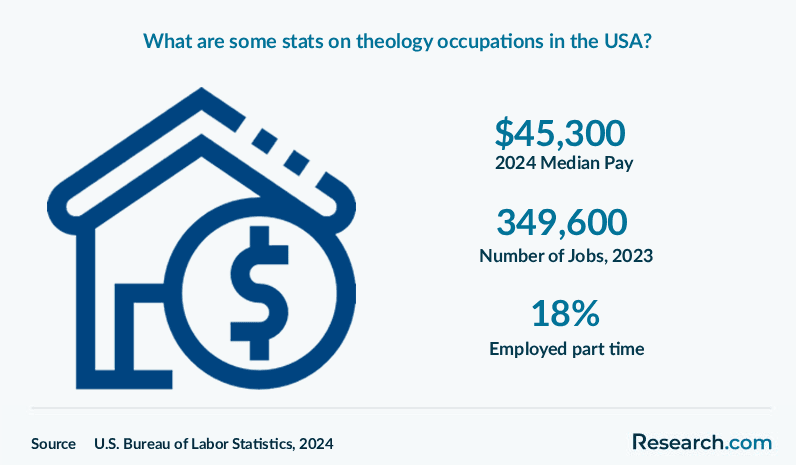
These figures show why prospective MDiv students should evaluate return on investment carefully. Many graduates pursue ministry for vocational and spiritual reasons, but the financial landscape can be different from higher-paying professional fields.
What current and future trends are shaping theology and ministry?
Online MDiv students are preparing for a ministry environment that is more digital, more pluralistic, more interdisciplinary, and often less tied to traditional denominational patterns. Programs that prepare students only for one older model of church leadership may not be enough.
| Trend | What it means for MDiv students |
| Digital and hybrid ministry | Future leaders need to understand online worship, digital discipleship, livestream communication, and pastoral care across virtual and in-person spaces. |
| AI and ministry administration | AI tools may assist with research, communication, scheduling, and content workflows, but ministers must use them ethically and preserve human judgment in pastoral care. |
| Greater attention to social issues | Public theology, racial justice, poverty, environmental stewardship, and community advocacy are increasingly part of ministry conversations. |
| Declining denominational attachment | Leaders may serve people with weaker denominational identity or mixed religious backgrounds, requiring clear teaching and pastoral sensitivity. |
| Growth in chaplaincy and pastoral care | Spiritual support is increasingly provided outside the local church, especially in healthcare, crisis, hospice, and institutional settings. |
| Holistic well-being | Ministry often intersects with mental health, family stress, financial pressure, grief, loneliness, and community fragmentation. |
| Interdisciplinary theology | Students benefit from programs that engage psychology, sociology, the arts, science, ethics, and cultural studies. |
| Global Christianity | Cross-cultural awareness is essential as Christian leadership and theological influence continue to be shaped by global communities. |
| Renewed interest in spiritual formation | Students need personal practices, reflection, mentorship, and accountability, not only academic knowledge. |
Gallup polling reported that approximately three in four Americans identified with a specific religious faith in 2023. The majority, 68%, identified as Christian, including 33% Protestant, 22% Catholic, and 13% another Christian denomination. Non-Christian faiths accounted for 7%, including Jewish at 2%, Muslim at 1%, and Buddhist at 1%. Another 22% reported no religious preference, and 3% did not answer the question.
For MDiv students, these patterns point to a practical conclusion: ministry preparation now requires theological depth, cultural awareness, digital fluency, and the ability to serve people both inside and outside traditional church structures.
What common challenges do online Master of Divinity students face?
Online MDiv programs can make seminary possible for students who cannot relocate, but they also require discipline and intentional community-building. The academic load is demanding, and many students are already working, parenting, serving in ministry, or caring for others.
| Challenge | Why it happens | Better strategy |
| Time pressure | MDiv coursework involves heavy reading, writing, ministry practice, and reflection. | Plan weekly study blocks before the term starts and avoid overloading credits while serving full time. |
| Isolation | Online students may miss informal hallway conversations, chapel rhythms, and campus community. | Join cohort groups, attend intensives when possible, schedule faculty meetings, and build peer accountability. |
| Weak field experience | Some students focus on coursework but delay supervised ministry practice. | Ask early how internships are arranged and whether local ministry sites qualify. |
| Unclear ordination alignment | Not every denomination accepts every online or hybrid program in the same way. | Get written guidance from your denomination before enrolling. |
| Debt concerns | Ministry salaries can vary, and some roles are part time or modestly compensated. | Compare net cost after scholarships and avoid borrowing based only on hoped-for future income. |
| Technology fatigue | Online learning can involve long hours of reading, video meetings, discussion boards, and digital submissions. | Use a structured workspace, take breaks, and choose programs with strong technical support. |
When comparing online program affordability across fields, lists such as the most affordable MLIS online degrees can offer a general reminder to look at total cost rather than tuition alone, but MDiv students should still focus on seminary-specific factors such as ATS accreditation, formation, field education, and denominational requirements.
How do you evaluate the quality of an online Master of Divinity program?
Program quality depends on more than whether classes are online. A strong online MDiv should provide academic rigor, spiritual formation, faculty access, supervised practice, library resources, writing support, and clear vocational preparation. It should also be honest about outcomes and requirements.
Use this quality checklist before applying
- Confirm accreditation: Check institutional accreditation and whether the seminary is accredited by the Association of Theological Schools.
- Review the curriculum: Make sure the program includes biblical studies, theology, church history, preaching, pastoral care, formation, and field education.
- Ask about faculty engagement: Online students should have access to mentoring, office hours, feedback, and academic advising.
- Evaluate field education: Determine whether internships can be completed locally and what supervision standards apply.
- Check ordination or chaplaincy compatibility: Do not assume the degree meets requirements without written confirmation.
- Compare net cost: Request a full aid package and estimate fees, books, technology, intensives, and travel.
- Look for outcome transparency: Ask where graduates serve, whether placement support exists, and how the school tracks career outcomes.
- Test student support: Online students need reliable library access, technical help, writing assistance, and spiritual formation opportunities.
Students can also learn how outcome thinking differs across professional degrees by reviewing career-focused guides such as master of library science jobs, but the best MDiv evaluation should be grounded in ministry formation, theological alignment, and practical readiness.
What graduates say about online Master of Divinity programs
- : "The online MDiv allowed me to keep serving in ministry while studying after my workday ended. I expected convenience, but I did not expect the level of connection I found with professors and classmates. The program gave my family flexibility and gave me a stronger foundation for leadership. — Finn"
- : "I was unsure whether an online seminary program could prepare me well, but the chaplaincy coursework and field education changed my mind. The training was demanding, practical, and deeply formative. I entered hospital ministry with much more confidence. — Evangeline"
- : "Affordability mattered to me because I did not want seminary debt to limit my ministry options. Studying online gave me access to strong faculty and resources without relocating, and the experience reshaped both my theology and my sense of calling. — Alistair"
Key Insights
- The best online MDiv depends on your ministry goal. Ordination, chaplaincy, nonprofit leadership, missions, and doctoral study each require different program strengths.
- Accreditation and denominational fit should come before convenience. A flexible online format is valuable only if the credential meets your church, employer, or chaplaincy expectations.
- Total cost matters more than tuition rate. Compare credits, fees, scholarships, intensives, transfer policies, and advanced standing before estimating affordability.
- Field education is essential. Online students should verify how internships, supervised ministry, contextual education, and local placements work.
- Salary outcomes vary widely. Ministry roles can be meaningful but may not offer the same financial return as other graduate professional degrees, so debt should be managed carefully.
- Hybrid and online ministry skills are now part of professional preparation. Future leaders need theological depth, digital communication ability, cultural awareness, and pastoral judgment.
- Do not choose by ranking alone. The right MDiv is the one that forms you well, fits your theology, supports your calling, and prepares you for the actual ministry context you plan to enter.
References:
- Bureau of Labor Statistics, U.S. Department of Labor. (2024, August 29). Field of degree: Theology. Occupational Outlook Handbook. Bureau of Labor Statistics.
- Data USA. (2023). Divinity & Ministry [Data set]. Data USA.
- Gallup. (2025, March 26). How Religious Are Americans? Gallup News.
- PayScale. (2025). Master of Divinity (MDiv) degree salary. PayScale.
Other Things You Should Know About Online Master of Divinity Degrees
The best online MDiv programs in 2027 typically require around 72 to 90 credit hours to graduate. These credit hours often include core theology courses, electives, and practical ministry experience, ensuring a comprehensive theological education.
A strong online MDiv program should hold accreditation from the Association of Theological Schools (ATS); some schools also carry regional institutional accreditation. ATS accreditation is the key marker for theological quality and is often required for later doctoral study, ordination review, and transfer of graduate credits.