2027 Most Affordable Online Christian Ministry Degree Programs

Co-Founder and Chief Data Scientist
Choosing an online Christian ministry degree is not just a tuition decision. You are weighing cost, theological fit, accreditation, flexibility, practical ministry preparation, and whether the degree will help you serve in the setting you feel called to enter. For many students, the challenge is that Christian colleges describe tuition, fees, transfer credits, ministry concentrations, and accreditation in different ways, which makes “affordable” difficult to define.
This guide is designed for prospective ministry students, adult learners already serving in churches, career changers, and students comparing online Christian colleges. You will learn how affordable online Christian ministry degrees work, what they cost, what careers they can support, how to compare programs, and what questions to ask before enrolling.
Quick answer: Is an affordable online Christian ministry degree worth it?
An affordable online Christian ministry degree can be worth it if the program is accredited, aligns with your theological convictions, offers practical ministry experience, and fits your budget without excessive borrowing. It is most useful for students pursuing church leadership, youth ministry, missions, chaplaincy preparation, nonprofit ministry, Christian education, or future graduate theological study. It is less suitable if your target role requires a specific license, denominational ordination path, or graduate-level credential that the program does not support.
What are the benefits of getting an affordable online Christian Ministry degree?
- Broader ministry options: A Christian ministry degree can prepare students for pastoral support, youth ministry, missions, chaplaincy pathways, religious education, worship leadership, and faith-based nonprofit work.
- Practical income planning: Ministry pay varies by church size, denomination, location, role, and experience. Associate-level roles may fall around $30,000 to $45,000 annually, while bachelor's degree holders may see salaries from $40,000 to $70,000 or more depending on the position and organization.
- Study while serving: Online programs can make it possible to continue working, caring for family, volunteering, or serving in a local church while completing coursework.
- Lower relocation costs: Students usually do not need to move to a campus, which may reduce transportation, housing, and opportunity costs.
- Immediate application: Many students can apply lessons in preaching, discipleship, leadership, counseling, and church administration directly in their current ministry context.
What can I expect from an affordable online Christian Ministry degree program?
Affordable online Christian ministry programs usually combine Bible, theology, leadership, communication, and applied ministry training. The best programs do more than teach doctrine; they help students practice ministry skills through projects, practicums, internships, mentorship, or supervised service.
| Program feature | What it usually means | Why it matters |
| Biblical and theological foundation | Courses in Old Testament, New Testament, Christian doctrine, hermeneutics, and church history | Builds the interpretive and theological base needed for preaching, teaching, discipleship, and leadership |
| Applied ministry coursework | Training in homiletics, pastoral care, leadership, discipleship, missions, and church administration | Helps students move from academic knowledge to real ministry practice |
| Online course delivery | Recorded lectures, readings, discussion boards, written assignments, exams, and sometimes live sessions | Determines how well the program fits your work schedule, family responsibilities, and learning style |
| Program length | Associate degrees often take two years; bachelor's degrees usually require four years of full-time study; some accelerated formats are available | Affects total cost, graduation timeline, and how quickly you can move into a ministry role |
| Student support | Digital libraries, advising, faculty access, writing help, career services, and ministry mentoring | Online students often need strong support systems to stay on track and complete the degree |
Where can I work with an affordable online Christian Ministry degree?
Graduates most often serve in churches, parachurch organizations, Christian schools, mission agencies, and faith-based nonprofits. Some roles may require additional credentials, ordination, graduate study, denominational approval, or clinical training.
- Churches and congregations: Common roles include pastor, associate pastor, youth minister, children's minister, worship leader, ministry assistant, discipleship coordinator, and church administrator.
- Mission organizations: Graduates may work in domestic or international missions, evangelism, discipleship, church planting, humanitarian outreach, or community development.
- Faith-based nonprofits: Ministry graduates can support organizations focused on poverty relief, addiction recovery, family services, refugee care, community outreach, and social services.
- Christian education settings: Some graduates teach or coordinate religious education in Christian schools, churches, or colleges, though teaching positions may require additional degrees or certification.
- Chaplaincy settings: Hospitals, hospice organizations, correctional facilities, military settings, and corporate environments may hire chaplains, but many chaplaincy roles require graduate theological education and supervised clinical training.
How much can I make with an affordable online Christian Ministry degree?
Ministry compensation should be evaluated carefully because salary is only one part of the package. Housing allowances, health insurance, retirement contributions, continuing education funds, and parsonage arrangements may substantially change the total value of a position.
- Entry-level ministry roles: Youth ministers, ministry assistants, and similar roles typically start in the $35,000 to $50,000 range.
- Experienced ministry roles: Pastors, directors, and ministry leaders with a bachelor's degree and experience may earn from $50,000 to $75,000+.
- Senior and specialized leadership: Senior pastors at larger churches and specialized chaplains can earn well above $80,000.
- Most Affordable Online Christian Ministry Degree Programs for 2027
- How to choose the right online Christian ministry degree
- Admissions requirements and application steps
- Skills taught in online Christian ministry programs
- Career options after an online Christian ministry degree
- Program costs and ways to pay
- Salary expectations after a Christian ministry degree
- Online vs. campus Christian ministry programs
- How to verify accreditation and academic quality
- How to evaluate long-term degree value
- Advanced academic pathways for ministry leaders
- Challenges online ministry graduates may face
- How Christian ministry degrees compare with other affordable online programs
- Subspecialties and focused ministry paths
- Job market for Christian ministry graduates
- Current ministry trends and future outlook
Most Affordable Online Christian Ministry Degree Programs for 2027
How do we rank schools?
Affordability matters, but it should not be the only measure of quality. Our ranking approach considers cost alongside institutional credibility, online availability, program information, and student-relevant data. You can review our full methodology for more detail.
Sources used in our evaluation include the IPEDS database, Peterson's database including its Distance Learning Licensed Data Set, the College Scorecard database, and the National Center for Education Statistics.
The following programs are among our top affordable online Christian ministry degree options:
| School | Online program | Tuition listed | Credits listed | Accreditation listed |
| Central Christian College of Kansas | Bachelor of Science in Ministry Leadership | $864/Course ($288/Credit) | 120 | Higher Learning Commission (HLC) |
| City Vision University | Bachelor’s in Christian Ministry & Leadership | $800/course | 120 | Distance Education Accrediting Commission (DEAC) |
| Colorado Christian University | Bachelor of Arts in Christian Ministry | $494 per credit hour | 120 | Higher Learning Commission (HLC) |
| Grace Christian University | Bachelor of Science in Leadership & Ministry | $470 per credit hour (2024–25) | 120 | Higher Learning Commission (HLC) |
| Liberty University | Bachelor of Science in Religion with Christian Ministries specialization | Undergraduate Full Time: $390/credit; Undergraduate Part Time: $455/credit; Military Undergraduate: $250/credit | 120 | Southern Association of Colleges and Schools Commission on Colleges (SACSCOC) |
| Mount Vernon Nazarene University | Bachelor of Arts in Christian Ministry | $276 per credit hour (with Ministry scholarship) | 37 credit hours | Higher Learning Commission (HLC) |
| Northwest University | Online Bachelor of Arts in Ministry Leadership | $425/credit hour | 120 | Northwest Commission on Colleges and Universities (NWCCU) |
| Point University | Associate of Arts in Christian Ministries | $425/credit hour | 138 | Southern Association of Colleges and Schools Commission on Colleges (SACSCOC) |
| Saint Leo University | Bachelor's Degree in Religion | $14,315/semester | 120 | Southern Association of Colleges and Schools Commission on Colleges (SACSCOC) |
| Toccoa Falls College | Bachelor of Science in Ministry Leadership | $390/credit hour | 126 | Southern Association of Colleges and Schools Commission on Colleges (SACSCOC) |
1. Central Christian College of Kansas
Central Christian College of Kansas offers a fully online Bachelor of Science in Ministry Leadership for students preparing for church leadership, missions, or service in Christian organizations. The program blends biblical studies, theology, spiritual formation, and leadership training for ministry settings.
Students study topics such as Old and New Testament, Christian doctrine, leadership, and spiritual development. The online format may appeal to adult learners who need to balance coursework with family, employment, or existing ministry responsibilities. The college’s Free Methodist affiliation informs its emphasis on servant leadership, faith formation, and academic preparation.
Graduates may pursue pastoral ministry, youth leadership, missions, or additional theological education. The program is also designed for students who value faculty support and a Christian learning environment.
- Program Length: Typically 4 years (full-time)
- Tracks/Concentrations: Ministry Leadership
- Tuition Cost: $864/Course ($288/Credit)
- Required Credits to Graduate: 120
- Accreditation: Higher Learning Commission (HLC)
2. City Vision University
City Vision University provides a fully online Bachelor’s in Christian Ministry & Leadership built around affordability and flexibility. The program supports preparation for church leadership, urban missions, counseling ministry, and nonprofit management.
Coursework includes biblical theology, church administration, vocation and calling, and social entrepreneurship. Classes are offered in accelerated eight-week sessions, and full-time students can finish in under four years. Students may select Urban Missions, Ministry Management, Counseling Ministry, or a Diversified Concentration. The university accepts up to 90 transfer credits, which can shorten completion time and reduce total cost for eligible students.
The program is structured for adult learners through asynchronous courses and no application fee. City Vision also offers tuition discounts for military and nonprofit workers, along with institutional scholarships.
- Program Length: 4 years (full-time)
- Tracks/Concentrations: Urban Missions, Ministry Management, Counseling Ministry, Diversified Concentration
- Tuition Cost: $800/course
- Required Credits to Graduate: 120
- Accreditation: Distance Education Accrediting Commission (DEAC)
3. Colorado Christian University
Colorado Christian University offers an online Bachelor of Arts in Christian Ministry focused on Scripture, ministry practice, worship, ethics, preaching, and teaching. The program is designed for working adults who need a flexible route to a ministry-focused bachelor's degree.
Students take courses one at a time in focused five-week blocks, which can make scheduling easier for learners with employment or family commitments. The university also has a transfer credit policy intended to help eligible students complete the degree more efficiently. A dual-degree option allows certain undergraduate courses to apply toward a Master of Arts in Executive Leadership in Christian Ministry.
Small class sizes and access to faculty with ministry experience are key features for students who want personal instruction and field-informed teaching.
- Program Length: Typically 4 years (full-time)
- Tracks/Concentrations: Christian Ministry
- Tuition Cost: $494 per credit hour
- Required Credits to Graduate: 120
- Accreditation: Higher Learning Commission (HLC)
4. Grace Christian University
Grace Christian University offers a fully online Bachelor of Science in Leadership & Ministry for students preparing for ministry service. The program emphasizes biblical doctrine, scriptural ministry philosophy, character formation, and applied leadership.
Courses are delivered one at a time in five-week blocks, allowing students to study from any location and manage one subject at a time. The curriculum combines theological grounding with practical ministry experience.
Graduates may pursue roles such as pastor, chaplain, missionary, counselor, or non-profit manager. The university also emphasizes instructor support and community among online learners.
- Program Length: Typically 4 years (full-time)
- Tracks/Concentrations: Leadership & Ministry
- Tuition Cost: $470 per credit hour (2024–25)
- Required Credits to Graduate: 120
- Accreditation: Higher Learning Commission (HLC)
5. Liberty University
Liberty University offers a fully online Bachelor of Science in Religion with a Christian Ministries specialization. The program is intended for students preparing for church-based service and ministries that require biblical knowledge and practical leadership skills.
Courses use an eight-week format with no set login times. Students learn from faculty who bring ministry experience into subjects related to Scripture, apologetics, Christian history, and global studies.
The Christian ministries specialization allows students to focus on biblical leadership and teaching Scripture. Liberty allows students to transfer in up to 75% of the total credits required, and the program includes a capstone course that helps students integrate learning for ministry work or future divinity study.
- Program Length: Typically 3.5–4 years (full-time)
- Tracks/Concentrations: Christian Ministries, Biblical and Educational Studies, Youth Ministries, and more
- Tuition Cost: Undergraduate Full Time: $390/credit; Undergraduate Part Time: $455/credit; Military Undergraduate: $250/credit
- Required Credits to Graduate: 120
- Accreditation: Southern Association of Colleges and Schools Commission on Colleges (SACSCOC)
6. Mount Vernon Nazarene University
Mount Vernon Nazarene University offers an online Bachelor of Arts in Christian Ministry for adults preparing for contemporary ministry leadership. The program is built around biblical, theological, pastoral, and leadership preparation.
The fully online format is open to students from a range of ages and educational backgrounds. Coursework develops leadership, communication, counseling, education, pastoral care, and proclamation skills. Students also work on interpreting Scripture and applying it to human needs, evangelism, and moral formation.
The degree can support preparation for lead pastor, associate pastor, youth pastor, or children’s pastor roles. The program also helps students clarify personal ministry goals and develop a plan for service.
- Program Length: Approximately 23 months (ministry core only)
- Tracks/Concentrations: Christian Ministry core, ordination concentration optional
- Tuition Cost: $276 per credit hour (with Ministry scholarship)
- Required Credits to Graduate: 37 credit hours
- Accreditation: Higher Learning Commission (HLC)
7. Northwest University
Northwest University offers an Online Bachelor of Arts in Ministry Leadership for students called to church leadership or ministry in non-church environments. The program provides a broad ministry foundation and can also prepare students for future graduate study.
The curriculum includes general education, Bible, theology, and practical ministry coursework. Faith integration is built into courses so students can connect academic learning with their Christian commitments.
Students develop biblical interpretation, worship leadership, pastoral care, organizational leadership, and interpersonal communication skills. Faculty support is also part of the program’s learning environment.
- Program Length: Typically 4 years (full-time)
- Tracks/Concentrations: Ministry Leadership
- Tuition Cost: $425/credit hour
- Required Credits to Graduate: 120
- Accreditation: Northwest Commission on Colleges and Universities (NWCCU)
8. Point University
Point University offers a fully online Associate of Arts in Christian Ministries. The associate degree provides a liberal arts foundation and introductory preparation for Christian service.
The program is designed as a pathway into Point University’s Bachelor of Science in Christian Ministries. Students study New Testament ministry concepts and learn to connect theological ideas from Scripture with current issues.
The department includes internship experiences in selected ministry fields under supervision from both the university and a field mentor. Online students also receive customized course schedules from academic advisors to support degree planning.
- Program Length: 2 years (Associate's degree)
- Tracks/Concentrations: Christian Ministries
- Tuition Cost: $425/credit hour
- Required Credits to Graduate: 138
- Accreditation: Southern Association of Colleges and Schools Commission on Colleges (SACSCOC)
9. Saint Leo University
Saint Leo University offers a Bachelor's Degree in Religion for students from different faith backgrounds who want to study religion, theology, and the human experience. The program can be completed fully online or through selected education centers.
Students build skills in theological understanding, critical thinking, research methodology, writing, and oral presentation. The degree can support careers inside and outside traditional church contexts.
Experiential options include internships with local parishes and a pre-hospital chaplaincy program. Students may also participate in co-curricular opportunities such as the student chaplain program and service trips. The program can provide a foundation for ministry, law, teaching, social work, and related fields.
- Program Length: Typically 4 years (full-time)
- Tracks/Concentrations: Religion
- Tuition Cost: $14,315/semester
- Required Credits to Graduate: 120
- Accreditation: Southern Association of Colleges and Schools Commission on Colleges (SACSCOC)
10. Toccoa Falls College
Toccoa Falls College offers a fully online Bachelor of Science in Ministry Leadership for students preparing for disciple-making ministries. The program develops communication, ethical reasoning, critical evaluation, and ministry leadership skills.
Students may choose a general pathway or customize their studies through concentrations such as Pastoral Ministries, Youth Ministries, or Church Planting. The 126-hour program includes 69 hours of general education, a 30-hour Bible and theology core, and 42 hours in major-specific coursework.
Courses such as Foundations of Discipleship, Emotionally Healthy Leaders, and Cultural Competence support the program’s leadership focus. Graduates may pursue work as pastors, church directors, non-profit ministry leaders, or human services professionals.
- Program Length: Typically 4 years (full-time)
- Tracks/Concentrations: Ministry Leadership
- Tuition Cost: $390/credit hour
- Required Credits to Graduate: 126
- Accreditation: Southern Association of Colleges and Schools Commission on Colleges (SACSCOC)
How do I choose the best online Christian ministry degree program for my specific needs and career goals?
The best online Christian ministry degree is the one that matches your calling, doctrinal commitments, budget, schedule, and next career step. A low tuition rate is helpful, but it is not enough if the program lacks accreditation, does not fit your denomination, or offers little supervised ministry experience.
| Decision factor | What to check | Why it affects your choice |
| Accreditation | Confirm institutional accreditation and understand whether the program has theological or ministry-related accreditation where relevant | Accreditation can affect transfer credits, graduate school admission, employer recognition, and financial aid eligibility |
| Theological fit | Review doctrinal statements, denominational affiliation, faculty backgrounds, and required theology courses | A ministry degree should prepare you to serve within the tradition or church context you intend to enter |
| Concentrations | Look for focused tracks such as youth ministry, pastoral ministry, missions, counseling ministry, worship, or nonprofit leadership | Specialization helps align coursework with your target role |
| Practical training | Ask about internships, practicums, field mentors, supervised ministry projects, and local church partnerships | Churches and ministries often value experience as much as classroom preparation |
| Transfer policy | Request an official transfer evaluation before enrolling | Accepted credits can reduce cost and shorten time to graduation |
| Total cost | Compare tuition, fees, textbooks, technology costs, graduation fees, and payment plans | The cheapest advertised rate may not be the lowest total cost |
- Verify accreditation: Start with institutional accreditation. If you are comparing institutional types, Research.com’s guide to nationally accredited online colleges can help you understand how accreditation categories differ.
- Compare doctrine before price: A lower-cost program may not be the right fit if its theological commitments differ from your intended church or denomination.
- Review faculty experience: Look for instructors who combine academic preparation with real ministry leadership, pastoral care, missions, counseling, or nonprofit experience.
- Ask about supervised practice: A strong program should help you connect coursework to real people, communities, and ministry responsibilities.
- Check career support: Ask whether the school provides resume help, ministry placement support, alumni connections, chaplaincy guidance, or denominational advising.
A strong fit should leave you with a clear answer to three questions: Does this program teach the theology I can serve from? Can I afford it? Will it help me gain the experience and credentials needed for my next ministry step?
What are the prerequisites and application process for online Christian ministry degree programs?
Admissions requirements vary by school, but undergraduate online Christian ministry programs usually evaluate academic readiness, personal motivation, and ministry fit. Some colleges use standard undergraduate admissions criteria, while faith-based institutions may also ask for references, a testimony, or a statement about your calling.
- High school diploma or GED: Undergraduate applicants typically need proof of high school completion or an equivalent credential.
- Official transcripts: Schools usually require transcripts from high school and any colleges previously attended. Many undergraduate programs list a minimum GPA, often between 2.0 and 2.5.
- Personal statement: Applicants may be asked to describe their faith background, ministry goals, testimony, or reason for pursuing a Christian ministry degree.
- Recommendations: Two to three references from pastors, mentors, teachers, or ministry leaders may be required to speak to character, maturity, and readiness for service.
- Online application: Students submit an institutional application with academic, contact, and background information.
- Application fee: Some schools charge a non-refundable fee, while others waive it for online or adult learners.
| Application step | Best action | Common mistake to avoid |
| Request program information | Ask for tuition, fees, course format, transfer rules, and internship requirements in writing | Relying only on a marketing page |
| Send transcripts | Submit all prior college records for a transfer review | Assuming credits will transfer automatically |
| Write the essay | Be specific about your ministry goals, experience, and theological commitments | Submitting a generic personal statement |
| Choose references | Ask people who know your character and service history well | Choosing references only because of title or status |
| Review aid options | Complete financial aid steps before enrollment deadlines | Waiting until the first bill arrives |
Students comparing ministry-adjacent fields can also review requirements for Christian counseling programs online, since many faith-based programs ask for similar academic records, essays, and references.
What essential skills will I learn in a top online Christian ministry degree program?
A quality online Christian ministry degree should develop theological understanding, spiritual maturity, communication ability, and practical leadership. The goal is not only to know Christian doctrine but to serve people and organizations with wisdom, humility, and competence.
- Biblical interpretation and theological reasoning: Students learn to read the Old and New Testaments responsibly, understand doctrine, and connect Scripture to ministry decisions.
- Pastoral care and basic counseling: Programs often introduce spiritual guidance, crisis care, family ministry, and referral practices. Students interested in deeper preparation can compare online Christian counseling degree options.
- Preaching, teaching, and communication: Homiletics, public speaking, writing, and teaching courses help students communicate clearly in sermons, classes, small groups, and digital settings.
- Leadership and administration: Students build skills in volunteer coordination, ethical leadership, planning, church operations, team development, and organizational communication.
- Missions and cross-cultural ministry: Coursework may address evangelism, cultural sensitivity, global missions, urban ministry, and service across diverse communities.
- Spiritual formation and discipleship: Students learn habits and frameworks for personal spiritual growth and for helping others mature in faith.
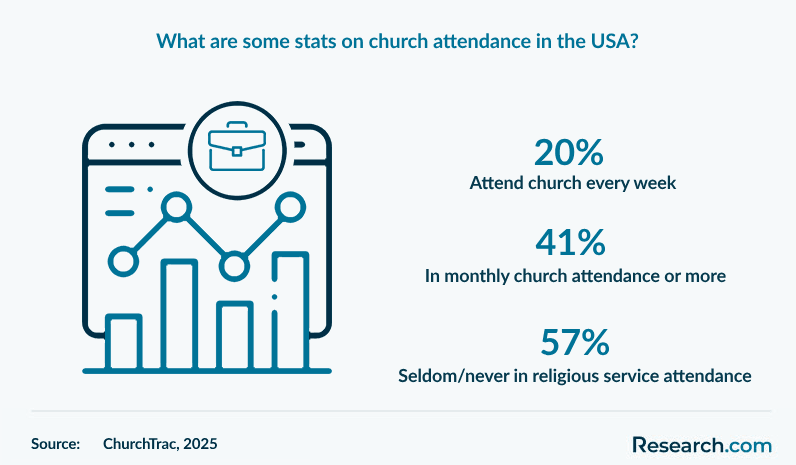
These abilities matter because many churches are trying to serve communities where regular attendance is not the norm. According to 2025 data from ChurchTrac, 20% of people attend church every week. When less frequent attendance is included, 41% attend church services on a monthly basis or more often. A larger share, 57%, seldom or never attend religious services at all.
That context changes what ministry preparation requires. Graduates need to communicate well with committed members, occasional attenders, and people who are largely disconnected from church life. Practical strategy is also valuable in other online fields; for example, students comparing applied professional training can review the cheapest online master's degree in supply chain management to see how another discipline frames operational problem-solving.
The graphic below summarizes the ChurchTrac attendance figures and illustrates the gap between weekly participation and the larger population that is seldom engaged with religious services.
What are some career prospects after completing an online Christian ministry degree program?
An online Christian ministry degree can support several service-focused career paths, but job requirements differ widely. Some churches hire based on calling, experience, and theological fit; others require a bachelor's degree, seminary training, ordination, or denominational approval.
| Career path | Typical responsibilities | Additional preparation to check |
| Pastor or associate pastor | Preaching, teaching, pastoral care, leadership, discipleship, and congregational oversight | Ordination, denominational requirements, graduate theological study |
| Youth minister | Student discipleship, events, small groups, parent communication, volunteer leadership | Child safety training, ministry experience, background checks |
| Missions coordinator | Mission partnerships, outreach planning, volunteer teams, cross-cultural service | Language study, intercultural training, fundraising experience |
| Chaplain | Spiritual care in hospitals, military, hospice, corrections, or institutional settings | Graduate theological education, clinical training, certification requirements |
| Faith-based nonprofit staff | Program management, community outreach, fundraising, volunteer coordination | Nonprofit administration, grant writing, social service experience |
| Christian education director | Curriculum planning, teacher training, discipleship programs, small groups | Education coursework, teaching experience, church leadership experience |
- Pastor or associate pastor: Leads preaching, teaching, pastoral care, and spiritual formation within a congregation.
- Youth minister: Designs programs for middle school and high school students, often including discipleship, retreats, outreach, and volunteer training.
- Missionary or missions coordinator: Serves in domestic or international contexts through evangelism, church planting, community service, or humanitarian work.
- Chaplain: Offers spiritual support in settings such as healthcare, military service, corrections, hospice, or corporate life.
- Nonprofit director or staff member: Works in faith-based organizations focused on social services, relief, development, advocacy, or community care.
- Christian education director: Coordinates educational ministries such as Sunday school, small groups, discipleship classes, and leadership training.
- Graduate study: Some graduates move into seminary, divinity programs, or specialized graduate degrees. For example, Christian counseling masters programs may fit students who want deeper preparation in faith-based counseling.
How much do online Christian ministry degree programs cost and what financing options are available?
Online Christian ministry degree costs depend on tuition rate, credit requirements, transfer credits, fees, textbooks, and whether you qualify for scholarships or discounts. The advertised per-credit price is only the starting point; total cost should be calculated using your likely remaining credits and all required fees.
- Tuition range: An online bachelor's degree in Christian ministry can range from approximately $300 to over $600 per credit hour, with private universities often charging more than public institutions or some Bible colleges.
- Additional expenses: Ask about technology fees, online course fees, books, graduation fees, background checks for internships, and ministry placement costs.
- Federal financial aid: Students in accredited programs may qualify for Pell Grants and Direct Stafford Loans by completing the Free Application for Federal Student Aid (FAFSA).
- Institutional scholarships: Christian colleges may offer awards based on academic merit, financial need, ministry intent, military status, nonprofit work, or denominational connection.
- Church and denominational support: Some congregations, districts, conferences, or denominations provide scholarships or tuition assistance for students preparing for ministry.
- Payment plans: Monthly tuition plans may reduce the need to borrow, although students should still verify fees and deadlines.
| Cost question | Why to ask it |
| How many of my transfer credits will apply to the major, not just electives? | Transfer credits only reduce cost if they count toward actual degree requirements. |
| Are tuition discounts guaranteed for every term? | Some discounts depend on enrollment status, employer type, military status, or scholarship renewal rules. |
| What fees are charged in addition to tuition? | Technology, online, graduation, and course-specific fees can raise total cost. |
| Does the program require internships or practicums that create extra expenses? | Travel, background checks, supervision, and scheduling can affect affordability. |
| What happens if I need to study part time? | Part-time enrollment can change tuition, aid eligibility, timeline, and loan planning. |
Students asking “How much does Christian counseling cost?” should use the same approach: compare total program cost, accreditation, practicum requirements, and whether the credential supports the intended career path.
How much can you earn after obtaining an online Christian ministry degree qualification?
Christian ministry salaries vary because churches and ministries differ in size, budget, region, denomination, benefits, and expectations. A ministry degree can improve preparation and credibility, but it does not guarantee a specific salary.
- Entry-level and support positions: Youth pastor and ministry assistant roles commonly range from approximately $35,000 to $50,000 annually.
- Pastoral and mid-level leadership: Lead pastors of small to mid-sized churches, chaplains, and nonprofit program managers may earn between $50,000 and $75,000 per year.
- Senior leadership: Senior pastors at larger churches and directors of established nonprofit organizations can earn salaries ranging from $75,000 to over $100,000.
- Location matters: Urban areas may pay more because of higher living costs, while rural congregations may offer lower cash salaries but sometimes include housing support.
- Denominational structures differ: Some denominations use standardized salary guidelines, while independent churches may negotiate compensation individually.
- Benefits can be significant: Housing allowances, parsonages, health insurance, retirement contributions, and continuing education support should be included when comparing offers.
According to 2025 data from Payscale.com, ministry compensation tends to rise with leadership scope and specialization. An executive pastor earns an average of $65,000, while both a lead pastor and senior pastor have a national average salary of $64,342. Specialized roles such as campus pastor, discipleship pastor, and teaching pastor are around $54,000 annually.
Administrative and associate roles fall near the middle of the range. A church business administrator earns about $52,000, and an associate pastor averages $48,634. Youth and children’s ministry positions are lower in the reported pay scale, with a youth pastor earning around $40,428 and a children’s minister averaging $35,568. A general minister earns approximately $41,756, while a chaplain has an average salary of $56,000.
The pattern is similar to career ladder changes in other fields: additional responsibility and specialization often affect pay. For comparison, students exploring healthcare advancement pathways may review affordable dental assistant to dental hygienist programs online to see how credential progression can influence career options.
The graph below presents the Payscale.com salary data and shows how executive, senior, specialized, administrative, and age-group ministry roles differ in average compensation.
What are the key benefits of online versus in-person Christian ministry degree programs?
Online and campus-based ministry degrees can both be effective, but they serve different student needs. Online programs are often best for adults who are already working, serving, or raising families. Campus programs may be better for students who want daily in-person community, residential chapel life, and face-to-face mentoring.
| Format | Best for | Potential drawback |
| Online Christian ministry degree | Working adults, current church volunteers, parents, military students, and learners who cannot relocate | Requires self-discipline and intentional relationship-building |
| Campus Christian ministry degree | Students who want residential community, in-person chapel, local ministry placements, and frequent faculty interaction | May require relocation, commuting, and higher living costs |
| Hybrid ministry degree | Students who want online flexibility plus occasional in-person intensives | Travel requirements may add cost and scheduling pressure |
- Flexibility: Asynchronous online courses allow many students to study around work, family, and ministry commitments.
- Reduced relocation burden: Online students can often stay in their local church and community while completing the degree.
- Broader program access: Students can compare institutions outside their region and choose a program with the right theological and ministry focus.
- Immediate practice: Students already serving in a church can apply lessons in preaching, discipleship, leadership, or pastoral care right away.
- Digital ministry preparation: Online learning can build comfort with remote communication tools that many churches now use for teaching, outreach, and administration.
- Independent learning skills: Time management, written communication, and self-direction are important for both online learning and ministry leadership.
Flexible online formats are also important in other career-change fields. For example, affordable direct entry MSN programs online serve learners who need a structured but flexible route into a new profession.
How Can I Verify the Accreditation and Quality of an Online Christian Ministry Degree Program?
Accreditation is one of the most important checks before enrolling. Confirm that the college or university holds recognized institutional accreditation, then ask whether the ministry program has any additional theological, Bible college, or denominational recognition that matters for your goals.
- Check institutional accreditation: Use official accreditor and government-recognized databases rather than relying only on a school’s website.
- Ask about transfer acceptance: If you may later pursue seminary or graduate school, ask whether graduates have been accepted into the types of programs you are considering.
- Review curriculum depth: A credible ministry degree should include Bible, theology, leadership, communication, ethics, and applied ministry work.
- Evaluate faculty credentials: Look for a mix of academic preparation and practical ministry experience.
- Assess online support: Advising, library access, tutoring, ministry mentoring, and technical help are especially important for distance learners.
- Compare with other online education options: Reviewing education degree programs online can help you see how online programs in another teaching-focused field present accreditation, fieldwork, and student support.
How Can I Evaluate the Long-Term Value of My Online Christian Ministry Degree?
The long-term value of a Christian ministry degree includes both financial and vocational factors. You should compare tuition and borrowing against career outcomes, but also consider spiritual formation, community impact, ministry readiness, and whether the degree supports your calling.
| Value factor | How to evaluate it |
| Career alignment | Confirm that the degree supports the roles you want, such as pastor, youth minister, missionary, chaplain, or nonprofit leader. |
| Credential mobility | Ask whether credits transfer and whether graduates enter seminaries, graduate programs, or denominational credentialing pathways. |
| Total debt | Estimate your full cost after grants, scholarships, transfer credits, and employer or church support. |
| Practical experience | Look for internships, ministry projects, field mentors, and supervised service opportunities. |
| Personal fit | Consider theological alignment, faculty approach, chapel or spiritual formation opportunities, and student community. |
Students who want an external affordability comparison can review programs in other service fields, such as cheapest early childhood education master's degrees online, to see how online programs balance cost, career preparation, and credential expectations.
What advanced academic pathways can further enhance my ministry leadership?
Many ministry graduates continue into advanced study to prepare for senior leadership, teaching, counseling, chaplaincy, or doctoral-level work. The right next credential depends on the role you want.
- Master of Divinity: Often used for pastoral leadership, preaching, chaplaincy preparation, and ordination pathways.
- Master of Arts in Christian Ministry or Theology: Useful for students who want deeper theological or ministry leadership preparation without necessarily completing a full divinity curriculum.
- Christian counseling graduate programs: A fit for students interested in pastoral counseling or faith-based care, though licensure requirements must be checked carefully.
- Doctoral leadership programs: Ministry leaders interested in education, administration, or organizational leadership may compare options such as accelerated online EdD degree programs.
- Certificates and continuing education: Shorter credentials in chaplaincy, trauma care, nonprofit leadership, preaching, or spiritual direction may strengthen targeted skills.
What challenges do online Christian ministry degree graduates face and how can they overcome them?
Online ministry graduates can be well prepared, but they may need to be intentional about networking, mentoring, and gaining field experience. Churches often want evidence of spiritual maturity, relational ability, and practical service, not only completed coursework.
| Common challenge | Why it happens | Better strategy |
| Limited in-person networking | Online students may not naturally build campus-based ministry relationships | Join local ministry networks, denominational meetings, internships, and mentoring groups |
| Insufficient practical experience | Some students focus heavily on coursework and delay service opportunities | Serve consistently in a church, nonprofit, or supervised ministry setting while enrolled |
| Technology gaps | Digital teaching, streaming, communication, and administration are increasingly common | Build skills in online communication, digital discipleship, and basic church technology tools |
| Unclear credential requirements | Ordination, chaplaincy, and counseling pathways differ by organization | Ask target employers or denominations what credentials they require before choosing electives |
| Weak analytical planning | Ministry leadership often involves budgets, systems, data, and strategy | Develop problem-solving skills through leadership, administration, and quantitative coursework; students interested in analytical online study can compare the fastest online bachelor's degree in mathematics |
How Does the Value of an Online Christian Ministry Degree Compare to Other Affordable Online Programs?
An online Christian ministry degree is different from many affordable online programs because its value is tied to service, theological formation, leadership, and community impact. Technical, business, or healthcare programs may have more standardized job titles and licensure pathways, while ministry careers often depend on denomination, calling, experience, references, and church fit.
- Choose Christian ministry if: You want to serve in churches, missions, chaplaincy pathways, Christian education, or faith-based nonprofits.
- Consider another field if: You need a credential with a clearer corporate or technical labor-market pathway.
- Compare transferable skills: Ministry degrees can build communication, leadership, ethics, nonprofit awareness, and counseling-adjacent skills, but they may not replace specialized professional credentials.
- Benchmark affordability: Students comparing service and information-focused fields can review options such as cheap online MLIS programs to see how costs and career outcomes differ across disciplines.
What subspecialties and career paths are available for online Christian ministry degree graduates?
Christian ministry degrees often allow students to focus on a particular area of service. Choosing a subspecialty can make your preparation more relevant and help employers or church leaders understand your strengths.
Pastoral and church leadership
- Senior pastor: Provides preaching, vision, pastoral care, leadership, and overall spiritual direction for a congregation.
- Youth or children's pastor: Focuses on discipleship, teaching, events, family engagement, and volunteer leadership for younger age groups.
- Worship arts director: Coordinates music, worship planning, creative teams, and service elements that support congregational worship.
Counseling and care
- Pastoral counselor: Offers spiritual guidance, prayer support, basic counseling, and referrals when clinical care is needed.
- Hospital or hospice chaplain: Provides spiritual and emotional support to patients, families, and staff in healthcare settings.
- Drug and alcohol counselor: Students interested in addiction support should check credential requirements carefully. Related preparation can be found through accredited online colleges for drug and alcohol counseling.
Missions and outreach
- Missions pastor: Leads mission strategy, partnerships, short-term teams, global outreach, and local service initiatives.
- Community outreach coordinator: Organizes programs that address needs in the local community and connect service with ministry mission.
Education and discipleship
- Christian education director: Designs or manages curriculum, small groups, Sunday school, discipleship pathways, and leadership development.
Specialization is valuable in many professions. For comparison, an affordable online nurse educator post graduate certificate helps healthcare professionals focus on teaching roles, while ministry concentrations help students prepare for specific forms of service.
Based on a 2023 annual survey from Christian Standard, weekly onsite and online worship attendance differs sharply by church size. Megachurches, defined as having over 2,000 people, reported combined in-person and online weekly attendance averaging 6,424. Emerging megachurches with between 1,000 and 1,999 attendees averaged 1,430.
Large churches with 500-999 attendees averaged 712 people, while medium churches with 250-499 attendees averaged 370. Smaller congregations reported lower attendance, with small churches of 100-249 attendees averaging 162 people and very small churches of up to 99 attendees averaging 55.
The graphic below shows how attendance scales from very small churches to megachurches, which can influence staffing structures, specialization opportunities, and leadership responsibilities.
What is the job market like for online Christian ministry degree program graduates?
The ministry job market does not operate exactly like a corporate hiring market. Openings are shaped by church budgets, congregational needs, denominational networks, retirements, growth patterns, and community priorities. Degrees help, but ministry experience, references, theological fit, and character are also central.
- Ongoing need for pastoral leadership: Churches continue to need pastors and pastoral staff, though competition may be stronger in desirable regions or larger congregations.
- Specialized ministry roles: Youth ministry, children's ministry, worship arts, discipleship, technology, and pastoral care can create targeted opportunities.
- Chaplaincy beyond churches: Hospitals, military settings, hospice organizations, correctional facilities, and corporations may need spiritual care professionals, often with additional credentials.
- Faith-based nonprofit employment: Relief, development, community outreach, and social service organizations can be strong options for ministry graduates with leadership and administrative skills.
- Bivocational ministry: Some smaller churches rely on pastors who hold another job while serving the congregation.
- Networking matters: Internships, volunteer work, denominational meetings, mentoring, and alumni relationships can be critical for finding ministry openings.
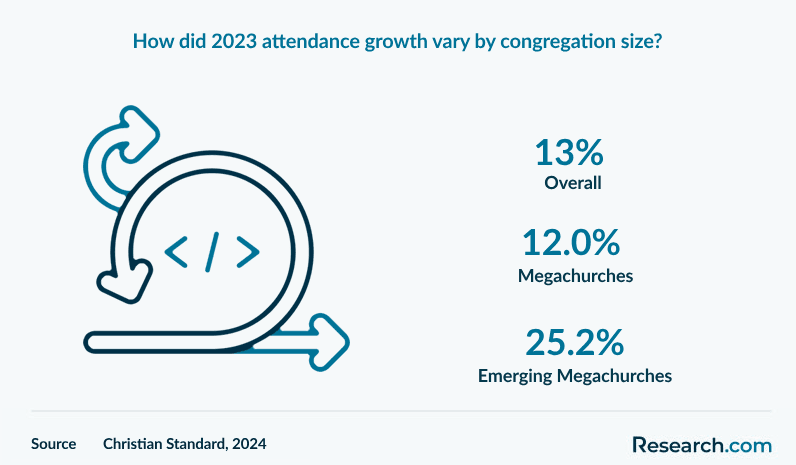
According to the 2023 annual survey from Christian Standard, churches reported overall attendance growth of 13% from 2022 to 2023, but growth varied by size. Emerging megachurches reported the highest growth rate at 25.2%. Large churches grew by 14.4%, megachurches by 12.0%, and medium churches by 11.6%.
Small churches reported 8.5% attendance growth, while very small churches grew by 9.0%. The graph below shows these differences and highlights how emerging megachurches outpaced other church-size categories during the survey period.
What are the current industry trends and future outlook for online Christian ministry degree program graduates?
Christian ministry is changing as churches respond to digital communication, shifting attendance patterns, mental health needs, cultural diversity, and new organizational models. Graduates who combine theological depth with adaptability will be better positioned for future ministry opportunities.
- Digital ministry and online engagement: Churches increasingly use online worship, social media, livestreaming, digital small groups, and remote communication.
- Bivocational and co-vocational leadership: More ministry leaders may combine church service with another occupation, especially in smaller congregations.
- Mental health awareness: Congregations are paying more attention to anxiety, grief, trauma, addiction, and family stress, increasing the need for pastoral care training and referral wisdom.
- Community outreach and social service: Churches and Christian nonprofits continue to address poverty, food insecurity, disaster relief, family support, and local community needs.
- Intercultural ministry: Ministry leaders need cross-cultural communication skills to serve increasingly diverse communities.
- Micro-church and house church models: Smaller and more flexible church structures can create leadership opportunities outside traditional staffing patterns.
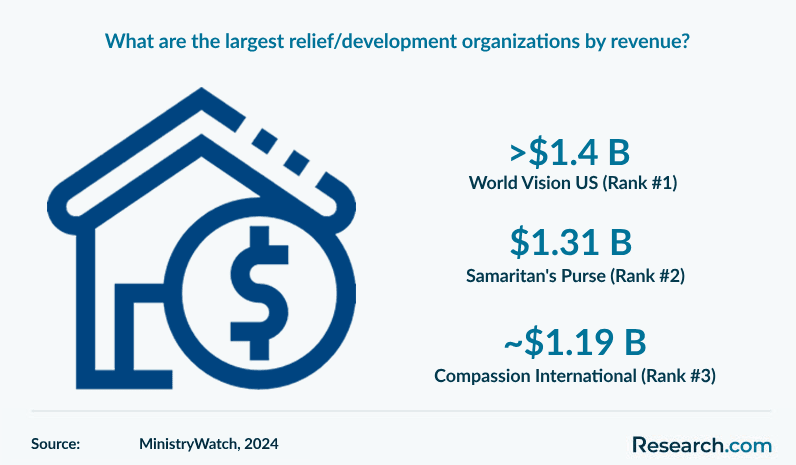
Relief and development ministries also show the scale of faith-based service. Based on the 2023 list of the 50 largest relief and development organizations from MinistryWatch, World Vision US ranked number one with revenue of more than $1.4 billion. Samaritan's Purse moved into the second position with over $1.31 billion, slightly ahead of Compassion International at approximately $1.19 billion.
Below that top tier, MAP International reported about $625.7 million in revenue, and Food For The Poor held the fifth spot with $491.3 million. Convoy of Hope reported $435.6 million, Mercy Corps reported $423.5 million, and Feed The Children reported $387.7 million. Mercy Ships moved from the 19th position last year to number nine with revenue of nearly $212.7 million, while ChildFund rounded out the top ten with approximately $199.6 million.
The graphic below shows the financial scale of leading relief and development organizations and illustrates how Christian service can extend far beyond local church staffing.
Questions to ask before enrolling in an online Christian ministry degree
- Is the institution accredited, and by whom? Verify accreditation through official sources before applying.
- Does the theology match the church or denomination I plan to serve? Review doctrinal statements, course descriptions, and faculty perspectives.
- Will this degree meet ordination or ministry credential requirements? Ask your denomination, church network, or target employer directly.
- How much will I pay after transfer credits, scholarships, and fees? Request a written cost estimate based on your transcript evaluation.
- Does the program include supervised ministry experience? Practical training can be essential for hiring and confidence.
- Can I complete coursework around my current responsibilities? Confirm whether courses are asynchronous, synchronous, accelerated, or term-based.
- What support do online students receive? Ask about advising, library access, ministry mentoring, tutoring, and technical support.
- What do graduates do after completing the program? Request information about alumni outcomes, graduate school admission, and ministry placement support.
Common mistakes to avoid when choosing an affordable online Christian ministry degree
| Mistake | Why it can hurt you | Better approach |
| Choosing only by the lowest tuition rate | A low rate may hide fees, weak support, poor fit, or limited transfer value | Compare total cost, accreditation, curriculum, faculty, and practical training |
| Ignoring theological alignment | The degree may not prepare you for the denomination or church tradition you want to serve | Review doctrine, required theology courses, chapel culture, and denominational ties |
| Assuming online means easier | Online programs require discipline, writing, time management, and self-direction | Create a weekly study plan before classes begin |
| Skipping accreditation checks | Unrecognized credentials can limit transfer, graduate school, financial aid, and employer acceptance | Verify accreditation before submitting enrollment deposits |
| Overlooking ordination or chaplaincy requirements | Some roles require seminary, clinical training, endorsement, or denominational approval | Contact the relevant credentialing body before selecting a program |
| Borrowing without a salary plan | Ministry salaries can be modest, especially in smaller churches | Estimate monthly loan payments against realistic compensation and benefits |
Here's What Graduates Say About Their Online Christian Ministry Degree Programs
-
: "
I needed a Christian ministry program that was affordable without feeling bare-bones. Studying online helped me keep serving at church and caring for my family, and the faculty mentoring gave me confidence for local ministry. Victor
"
-
: "
The program gave me stronger theological grounding and practical ministry tools at a price I could manage. I was able to keep working while studying, and the online Christian community helped me stay connected. Larry
"
-
: "
Enrolling helped me grow spiritually and as a leader. The courses were organized, the online platform was manageable, and I finished with a clearer sense of how to step into ministry service. Ike
"
Key Insights
- Affordability is more than tuition: Compare tuition, fees, transfer credits, scholarships, course length, and required internships before deciding which program is truly lowest cost.
- Accreditation should be verified early: Institutional accreditation can affect aid eligibility, credit transfer, graduate study, and employer confidence.
- Theological fit matters: A Christian ministry degree should align with the denomination, church tradition, or ministry context where you hope to serve.
- Practical experience is essential: Internships, supervised ministry, mentoring, and local church involvement can make an online degree more valuable.
- Career outcomes vary widely: Ministry salaries depend on role, church size, location, denomination, benefits, and leadership scope.
- Current attendance patterns create both challenges and opportunities: According to 2025 ChurchTrac data, 20% of people attend church weekly, 41% attend monthly or more, and 57% seldom or never attend services.
- Leadership scope influences pay: Payscale.com 2025 data reports an executive pastor average of $65,000, lead pastor and senior pastor averages of $64,342, and a children’s minister average of $35,568.
- Church size affects ministry roles: Christian Standard’s 2023 survey reported average weekly attendance of 6,424 at megachurches and 55 at very small churches.
- Growth patterns are uneven: The same 2023 survey reported overall attendance growth of 13%, with emerging megachurches growing fastest at 25.2% and small churches growing at 8.5%.
- Faith-based service extends beyond churches: MinistryWatch data shows large Christian relief organizations operating at major scale, including World Vision US with over $1.4 billion in revenue, Samaritan's Purse with over $1.31 billion, and Compassion International with $1.19 billion.
References:
- Christian Standard. (2024, May). 2023 Annual Survey Fast Facts. Christian Standard.
- ChurchTrac. (2025, March 11). The state of church attendance: Trends and statistics [2025]. ChurchTrac.
- MinistryWatch. (2025, February 4). 50 Largest Relief and Development Ministries – 2025. MinistryWatch.
- PayScale. (2024, July 31). Average Salary for Christian Church Employees. PayScale.
- PayScale. (2023, December 20). Bachelor of Arts (BA), Christian Ministry Degree. PayScale.
- PayScale. (2025, February 28). Bachelor of Religious Education (BREd / BRE) Salary. PayScale.
- PayScale. (2025, February 28). Pastor, Ministry Salary in 2025. PayScale.
- PayScale. (2023, July 31). Master of Arts (MA), Christian Ministry Salary. PayScale.
- Undershepherd. (2025, April 30). Pastor Salary by Church Size [2025 Salary Guide]. Undershepherd.
- Warren Cole Smith. (2023, February 2). 50 largest relief and development organizations–2023. MinistryWatch.
- ZipRecruiter. (2025, January 1). Christian Ministry Salary: Hourly Rate June 2025 USA. ZipRecruiter.
Other Things You Should Know About the Most Affordable Online Christian Ministry Degree Programs
Most online Christian ministry bachelor’s degrees require 120 semester credit hours, including general education, Bible and theology courses, and ministry practica. Some accelerated programs accept up to 90 transfer credits, which can shorten completion time and lower total tuition costs.
The Association for Biblical Higher Education and the Commission on Accrediting of the Association of Theological Schools are among the key accrediting bodies recognizing affordable online Christian ministry degree programs in 2027, ensuring quality and standardization across educational offerings.