2027 Most Affordable Online Direct Entry MSN Programs for Non-Nurses

Co-Founder and Chief Data Scientist
If you already have a bachelor’s degree in another field and want to become a registered nurse without earning a separate BSN first, an online direct entry MSN program can shorten the path. These programs are built for career changers: they combine pre-licensure nursing education, NCLEX-RN preparation, clinical training, and graduate-level nursing coursework in one accelerated plan.
The key decision is not simply whether an online direct entry MSN is “worth it.” You need to know whether the program is accredited, whether it can place you in approved clinical sites, whether it fits your state licensure goals, and whether the total cost makes sense compared with your likely career path. This guide explains how these programs work, what they cost, how long they take, which schools are listed as affordable options, and how to compare programs before applying.
Quick answer: What is an online direct entry MSN for non-nurses?
An online direct entry Master of Science in Nursing is a graduate nursing pathway for students who hold a non-nursing bachelor’s degree. Most programs are not fully online because nursing requires labs, simulations, and supervised clinical rotations. Instead, they usually use a hybrid model: online didactic coursework plus required in-person experiences. Graduates typically become eligible to take the NCLEX-RN and may also complete graduate preparation for roles such as Clinical Nurse Leader, Nurse Educator, Nurse Administrator, or, depending on the program, an advanced practice specialty.
What are the benefits of getting an online direct entry MSN program?
- A faster route into nursing for bachelor’s-prepared career changers: Instead of completing a second undergraduate nursing degree before graduate study, students can enter a structured pathway that builds RN-level competencies and master’s-level nursing knowledge in one program.
- Access to advanced nursing directions: Depending on the curriculum and state requirements, graduates may move toward roles such as Family Nurse Practitioner (FNP), Psychiatric-Mental Health Nurse Practitioner (PMHNP), Clinical Nurse Leader (CNL), Nurse Educator, or Nurse Administrator.
- Higher earning potential than many entry-level RN pathways: Salary depends on specialty, employer, experience, and location, but MSN-prepared nurses in advanced roles can earn more than traditional RN roles. Nurse Practitioner salaries are commonly cited in the $100,000 to over $130,000 annual range in the U.S., with higher earnings possible in some specialties and markets.
- Flexible coursework with required hands-on training: The online or hybrid format may allow students to complete theory courses from home while still meeting required labs, simulations, and clinical rotations in person.
- Preparation for healthcare leadership: The MSN component often includes leadership, evidence-based practice, quality improvement, policy, and systems-focused coursework that can support advancement beyond bedside entry-level roles.
What can I expect from an affordable online direct entry MSN program?
An affordable online direct entry MSN program is usually an intensive hybrid graduate program for students who already completed a bachelor’s degree outside nursing. The first phase typically covers the nursing foundations needed for RN licensure, including health assessment, pharmacology, pathophysiology, medical-surgical nursing, mental health nursing, maternal-newborn care, pediatrics, community health, simulation, and supervised clinical practice.
After or alongside the pre-licensure sequence, students complete graduate-level MSN coursework. Depending on the school, the graduate focus may be generalist nursing practice, Clinical Nurse Leader preparation, leadership, education, informatics, or a pathway toward advanced practice. The program should prepare students for the NCLEX-RN exam, but applicants must verify licensure eligibility in the state where they plan to practice.
| Program feature | What it usually means for students | What to verify before enrolling |
| Online coursework | Lectures, discussions, assignments, exams, and some group work may be completed remotely. | Whether classes are asynchronous, live online, or a mix of both. |
| In-person labs and simulations | Students practice hands-on skills before entering clinical settings. | How often you must travel to campus and how long each intensive lasts. |
| Clinical rotations | Students complete supervised patient-care experiences in approved healthcare sites. | Whether the school places students or expects students to secure sites independently. |
| NCLEX-RN preparation | The pre-licensure curriculum should prepare graduates for RN licensure testing. | Recent NCLEX-RN pass rates and state board approval. |
| MSN-level coursework | Graduate courses may focus on leadership, evidence-based practice, education, informatics, or advanced clinical preparation. | Whether the degree leads to the exact role you want or requires a post-master’s certificate afterward. |
Where can I work with an affordable online direct entry MSN program?
Graduates can work in many healthcare settings, but the exact jobs available depend on licensure, certification, specialization, clinical experience, and state scope-of-practice rules. A direct entry MSN can lead to RN employment first, followed by advancement into graduate-prepared roles as experience and credentials build.
- Hospitals and health systems: Graduates may work in medical-surgical units, emergency departments, intensive care, oncology, cardiology, women’s health, pediatrics, quality improvement, or leadership roles. Some direct entry MSN graduates pursue Clinical Nurse Leader responsibilities after meeting certification requirements.
- Outpatient and ambulatory care: Physician offices, urgent care centers, specialty clinics, and community health centers hire nurses and advanced practice nurses to support primary and specialty care.
- Long-term care and rehabilitation: Skilled nursing facilities, rehabilitation centers, and assisted living organizations may need MSN-prepared nurses for care coordination, leadership, staff education, and adult-gerontology-focused care.
- Academic and training settings: Graduates with an education focus may teach in universities, community colleges, vocational nursing programs, hospitals, or continuing education departments.
- Public health organizations: Local, state, and federal health agencies employ nurses in prevention, population health, health promotion, case management, and community-based programs.
- Specialized employers: Home healthcare agencies, research organizations, pharmaceutical companies, correctional facilities, legal consulting firms, and healthcare technology companies may value MSN-level clinical, leadership, and analytical skills.
How much can I make with an online direct entry MSN program?
Earnings vary widely because “direct entry MSN graduate” is not a single job title. Pay depends on whether you work as a registered nurse, Clinical Nurse Leader, Nurse Educator, Nurse Administrator, Nurse Practitioner, or another advanced role. Location, specialty, shift differentials, union contracts, employer type, and experience also matter.
A starting salary for an MSN-prepared nurse might be around $70,000 - $77,000 annually. Graduates who move into Advanced Practice Registered Nurse roles, including Nurse Practitioner roles, may see higher earnings. The average annual salary for a Nurse Practitioner in the U.S. is approximately $120,000 to $130,000, with top earners reaching $150,000 to over $180,000 depending on specialty and geography.
Clinical Nurse Leaders commonly earn an average of $90,000 - $95,000, with a range often between $71,000 and $133,500. Nurse Educators can expect to earn an average of around $102,000 annually. These figures should be treated as planning benchmarks, not guarantees, because outcomes depend on the role secured after graduation and licensure.
| Career direction | Typical role focus | Salary information stated in this guide |
| Registered Nurse with MSN preparation | Direct patient care, care coordination, leadership potential, transition into specialty practice | Starting salary might be around $70,000 - $77,000 annually |
| Nurse Practitioner | Assessment, diagnosis, treatment, prescribing where authorized, primary or specialty care | Approximately $120,000 to $130,000 on average, with top earners reaching $150,000 to over $180,000 |
| Clinical Nurse Leader | Care coordination, outcomes management, quality improvement, risk reduction | Average of $90,000 - $95,000, often ranging between $71,000 and $133,500 |
| Nurse Educator | Teaching, curriculum support, clinical education, staff development | Average of around $102,000 annually |
- Most Affordable Online Direct Entry MSN Programs for Non-Nurses for 2027
- How long does it take to complete an affordable online direct entry MSN program for non-nurses?
- How does an affordable online direct entry MSN program for non-nurses compare to an on-campus program?
- What is the average cost of an affordable online direct entry MSN program for non-nurses?
- What are the financial aid options for students enrolling in an affordable online direct entry MSN program for non-nurses?
- What are the prerequisites for enrolling in an affordable online direct entry MSN program for non-nurses?
- What courses are typically in an affordable online direct entry MSN program for non-nurses?
- What types of specializations are available in affordable online direct entry MSN programs for non-nurses?
- How does accreditation affect program quality, licensure, and employment?
- What challenges should students expect in an online direct entry MSN program?
- How do you choose the best and most affordable online direct entry MSN program for non-nurses?
- What career paths are available for graduates of an affordable online direct entry MSN program for non-nurses?
- What is the job market like for graduates with an affordable online direct entry MSN program for non-nurses?
- Do online direct entry MSN programs offer career support and job placement assistance?
- What is the long-term return on investment of an affordable online direct entry MSN program for non-nurses?
- What final questions should you ask before applying?
List of Most Affordable Online Direct Entry MSN Programs for Non-Nurses for 2027
How do we rank schools?
Choosing a direct entry MSN program is a high-stakes decision because the degree affects your finances, licensure path, clinical training, and first nursing roles. Research.com evaluates programs using a transparent methodology designed to help prospective students compare schools with relevant data rather than marketing claims alone.
The ranking process uses information from sources such as the Integrated Postsecondary Education Data System (IPEDS), Peterson's databases including their Distance Learning Licensed Data Set, and the College Scorecard database from the National Center for Education Statistics. Students should still confirm current tuition, clinical placement policies, state authorization, accreditation, and licensure eligibility directly with each school before applying.
1. The University of Alabama at Birmingham (UAB)
The University of Alabama at Birmingham offers an MSN - Direct Entry Program for non-nursing majors. The pathway is designed to prepare students to become MSN-prepared Registered Nurses through a hybrid format that includes 100% online didactic classes and required on-campus intensives for skills practice and simulation. The program is designed for Alabama residents, though UAB also assists with clinical placements in other states. Graduates may pursue advanced nursing roles, post-master’s certificates, or future specializations depending on their goals.
- Program Length: 20-24 months
- Tracks/Concentrations: MSN - Direct Entry Program for non-nursing majors
- Cost per Credit: $702 per online credit hour
- Required Credits to Graduate: 60-77 credits
- Accreditation: Commission on Collegiate Nursing Education (CCNE)
2. University of South Carolina (USC)
The University of South Carolina College of Nursing offers a Prelicensure Entry-Level MSN for students who already hold a non-nursing baccalaureate degree. The program prepares students for NCLEX-RN eligibility while developing leadership skills for future nursing roles. The curriculum combines online didactic coursework with required in-person clinical practicums.
- Program Length: 2 years
- Tracks/Concentrations: Prelicensure Entry-Level MSN/Master's Entry to Practice Nursing (MEPN)
- Cost per Credit: $44,455 (total program cost)
- Required Credits to Graduate: 68 credit hours
- Accreditation: Commission on Collegiate Nursing Education (CCNE).
3. Ohio State University
The Ohio State University offers an Accelerated Direct-Entry Master of Science in Nursing program for applicants with a bachelor’s degree in a field other than nursing. The program combines rigorous coursework with clinical experience and may draw on resources connected to the Ohio State University Wexner Medical Center. The format is typically hybrid, with online coursework, required campus-based components, and in-person clinical rotations.
- Program Length: 2 years
- Tracks/Concentrations: Accelerated Direct-Entry Master of Science in Nursing (MSN)
- Cost per Credit: $972.50 per credit hour
- Required Credits to Graduate: 75 credit hours
- Accreditation: Commission on Collegiate Nursing Education (CCNE).
4. Marquette University
Marquette University offers a Direct Entry MSN program for non-nurses who want to use a previous bachelor’s degree to move into graduate nursing preparation. Students complete online coursework along with required on-site skills labs, simulations, and clinical rotations. The core program prepares graduates for RN licensure and a generalist MSN, while additional specialization may require post-master’s certificates in areas such as nurse practitioner, nursing administration, or nurse midwife preparation.
- Program Name: Direct Entry MSN program
- Program Length: 2 years
- Tracks/Concentrations: Direct Entry MSN Program
- Cost per Credit: $1,390 - $2,100 per credit
- Required Credits to Graduate: 75 credit hours
- Accreditation: Commission on Collegiate Nursing Education (CCNE)
5. Herzing University
Herzing University offers a Master of Science in Nursing Direct Entry degree for students from non-nursing academic backgrounds. The 60-77 credit program includes 100% online didactic classes with both on-demand and real-time learning, plus hybrid labs and simulations at designated campus locations. The curriculum covers foundational nursing concepts, prepares students for the NCLEX-RN, and may allow credit transfer into a future Doctor of Nursing Practice program.
- Program Length: 20-24 months
- Tracks/Concentrations: Master of Science in Nursing (MSN) Direct Entry
- Cost per Credit: $735
- Required Credits to Graduate: 60-77 credits
- Accreditation: Commission on Collegiate Nursing Education (CCNE)
6. Rush University
Rush University offers a Generalist Entry Master of Science in Nursing program for non-nurses with a Clinical Nurse Leader focus. The program uses a hybrid format, with nearly half of courses delivered online asynchronously and the remaining requirements completed through in-person learning and clinical experiences, primarily at Rush and other Chicago-area facilities. Students may complete the program in 2 years full-time or 3 years part-time, and graduates are prepared for both the NCLEX-RN and Clinical Nurse Leader certification.
- Program Name: Generalist Entry Master of Science in Nursing (MSN) for Non-Nurses: Clinical Nurse Leader
- Program Length: 2 years (full-time) or 3 years (part-time).
- Tracks/Concentrations: Generalist Entry Master of Science in Nursing (MSN) for Non-Nurses: Clinical Nurse Leader
- Cost per Credit: $1,120 per credit hour
- Required Credits to Graduate: 70 credits hours
- Accreditation: Commission on Collegiate Nursing Education (CCNE)
7. University of West Florida (UWF)
The University of West Florida offers an Entry into Practice Direct Entry Master of Science in Nursing program for students with non-nursing bachelor’s degrees. The full-time, five-semester program includes face-to-face, hybrid, and online course delivery and provides over 600 clinical hours across multiple specialties. The DEMSN prepares students for RN licensure and a generalist MSN, while FNP, Nurse Educator, and Nurse Leader options are available as separate online MSN programs.
- Program Length: 2 years
- Tracks/Concentrations: Entry into Practice (Direct Entry) Master of Science in Nursing (DEMSN)
- Cost per Credit: $418.77
- Required Credits to Graduate: 69 credit hours.
- Accreditation: Commission on Collegiate Nursing Education (CCNE)
8. Elmhurst University
Elmhurst University offers an online Direct Entry Master’s in Nursing program for non-nurses who want to earn an MSN and prepare for the NCLEX-RN and Clinical Nurse Leader certification exam in 20 months. Coursework is 100% online, while students complete clinicals as close as possible to their local area and attend one required on-campus residency. The program is designed as a full-time commitment and is highly intensive.
- Program Length: 20 months
- Tracks/Concentrations: Online Direct Entry Master's in Nursing (MENP) program
- Cost per Credit: $1,000 per credit
- Required Credits to Graduate: 71 credit hours.
- Accreditation: Commission on Collegiate Nursing Education (CCNE).
How long does it take to complete an affordable online direct entry MSN program for non-nurses?
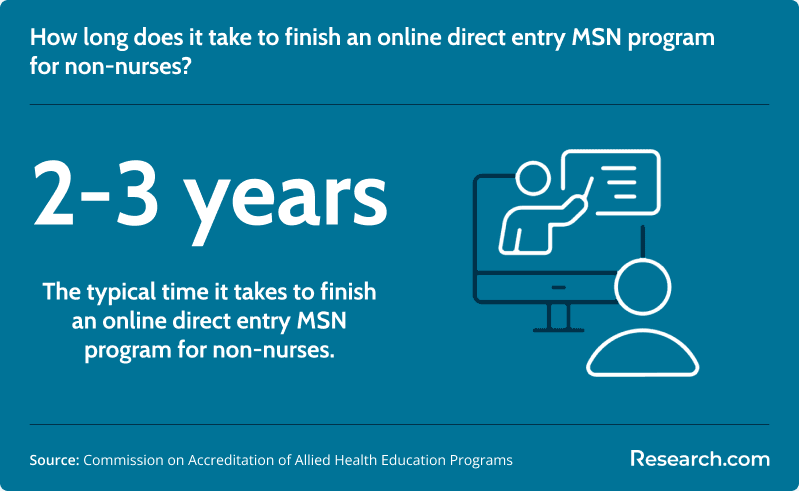
Most affordable online direct entry MSN programs are accelerated and full-time. Typical completion time ranges from 20 months to 3 years, although a few part-time formats may take longer. The timeline is shaped by prerequisites, credit load, clinical availability, campus residency requirements, and whether the program includes only generalist MSN preparation or a more specialized pathway.
| Factor | How it affects completion time | What students should ask |
| Full-time or part-time format | Full-time programs move faster but can make outside work difficult. Part-time options reduce weekly load but extend graduation. | Can I realistically work while enrolled? |
| Required credits | Programs listed here range from 60-77 credits, 68 credit hours, 69 credit hours, 70 credits hours, 71 credit hours, and 75 credit hours. | How many credits are clinical, lab, online, and graduate-level? |
| Prerequisite completion | Missing science or statistics prerequisites can delay admission or add cost before the core program begins. | Can prerequisites be completed online or at a community college? |
| Clinical placement timing | Clinical site availability can affect when students progress through required rotations. | Does the school guarantee placement support in my state? |
| Campus intensives | Residencies and skills labs may require travel and time away from work or family. | How many trips are required and how far in advance are dates released? |
How does an affordable online direct entry MSN program for non-nurses compare to an on-campus program?
Online and on-campus direct entry MSN programs can both prepare students for RN licensure and graduate nursing roles, but the experience is different. The online option is usually best described as hybrid because nursing students must complete in-person labs, simulations, and clinical rotations. The on-campus option usually offers more face-to-face structure but less flexibility.
| Comparison point | Online or hybrid direct entry MSN | On-campus direct entry MSN |
| Best fit | Students who need remote coursework and can manage independent study. | Students who prefer daily structure, in-person faculty access, and campus community. |
| Flexibility | Greater flexibility for didactic coursework, especially when classes are asynchronous. | Less flexible because classes, labs, and clinicals usually follow a fixed campus schedule. |
| Hands-on training | Still required through campus intensives, simulations, and clinical rotations. | Integrated more frequently into the weekly campus experience. |
| Clinical placement | Can be convenient if local placements are available, but students must confirm school support. | May be smoother when the school has established relationships with nearby hospitals and clinics. |
| Cost considerations | May reduce commuting, parking, and relocation costs, although travel for intensives can still be significant. | May require housing, transportation, campus fees, and relocation expenses. |
| Networking | Often built through online cohorts, virtual meetings, clinical sites, and residency periods. | Often easier through daily contact with peers, faculty, labs, and local clinical partners. |
Students comparing online graduate programs should look beyond tuition alone. Similar cost questions arise in other online fields, such as the cheapest educational policy degree online, where out-of-state tuition, fees, and virtual learning costs can change the total price. Nursing adds another layer because clinicals, licensure eligibility, supplies, and campus travel can materially affect affordability.
Online direct entry MSN programs are not the same as post-licensure nursing certificates. For example, affordable online FNP graduate certificate programs are generally for nurses who already hold graduate preparation and want an additional specialty credential, while direct entry MSN programs are designed for non-nurses entering the profession.
For individuals considering an advanced nursing degree, understanding potential earning power is part of the decision. The following chart shows median annual wage information for selected MSN-level professions and can help frame the financial upside of graduate nursing preparation.
What is the average cost of an affordable online direct entry MSN program for non-nurses?
There is no single reliable “average” cost because direct entry MSN programs vary by school type, residency status, credit load, fees, and clinical requirements. Total tuition can range from approximately $18,000 to over $100,000. Public universities, especially for in-state residents, may fall between $18,000 and $45,000.
Direct entry MSN programs are often more expensive than many post-licensure MSN pathways because they include both pre-licensure nursing education and graduate coursework. Students comparing options may also want to review the cheapest online MSN programs, but they should remember that traditional online MSN programs usually assume the student is already a licensed RN.
| Cost category | Why it matters | Questions to ask |
| Tuition | Usually the largest cost and may be charged per credit or as a total program amount. | Is the rate different for online, in-state, out-of-state, or international students? |
| University fees | Technology, lab, simulation, clinical, and program fees can add thousands. | Can the school provide a full estimated cost of attendance? |
| Books and supplies | Nursing students often need textbooks, software, uniforms, stethoscopes, and clinical equipment. | Which supplies are required in the first term? |
| Travel and lodging | Hybrid programs may require on-campus residencies or intensives. | How many campus visits are required and where do they occur? |
| Clinical expenses | Transportation, health screenings, background checks, drug testing, and documentation systems may be required. | Are clinical placement costs included in tuition? |
| Licensure and certification | NCLEX-RN, state licensure, and advanced certification fees are often paid separately. | What costs are expected after graduation? |
| Prerequisites | Missing courses can add time and cost before admission. | Can I complete prerequisites affordably before matriculation? |
What are the financial aid options for students enrolling in an affordable online direct entry MSN program for non-nurses?
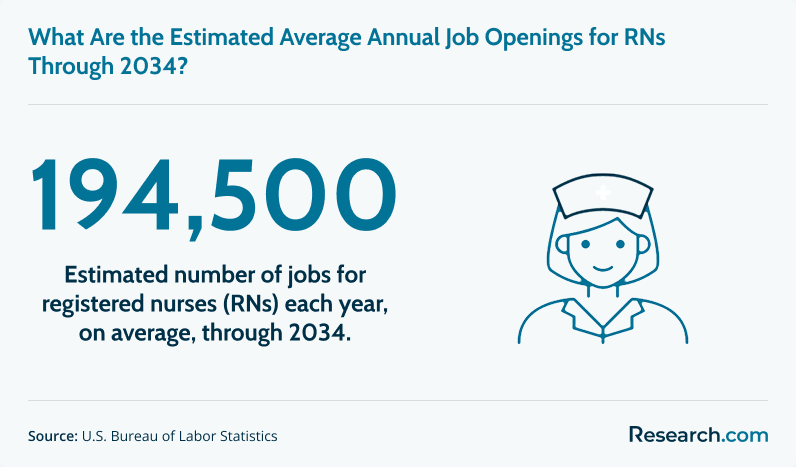
Direct entry MSN students should plan financing early. On average, an estimated total of 194,500 RNs will be needed by 2034, but strong workforce demand does not remove the need for careful borrowing decisions. Students can begin by reviewing school aid pages, federal aid eligibility, scholarship databases, and nursing-specific funding resources such as financial aid options from the American Association of Colleges of Nursing.
Federal student aid
For U.S. citizens and eligible non-citizens, the FAFSA is the starting point for federal graduate aid. Common options may include:
- Federal Direct Unsubsidized Loans
- Federal Direct PLUS Loans (Grad PLUS Loans)
- Federal Nursing Student Loan (NSL)
Scholarships and grants
Scholarships and grants are especially valuable because they do not need to be repaid. Students should search broadly and apply early.
- Institutional scholarships: Awards funded by the university, college of nursing, or graduate school.
- Nursing organization scholarships: Awards from professional associations, foundations, and specialty nursing groups.
- Government and service-based programs: Funding tied to service commitments, shortage areas, or public health needs.
- Private and general scholarships: Awards based on academic merit, financial need, identity, location, career goals, or prior service.
Private student loans
- Private loans from banks, credit unions, or education lenders may help fill funding gaps after federal aid and scholarships.
- Interest rates are often higher than federal loans, and repayment protections may be less flexible.
- A credit check and co-signer may be required, especially for students with limited credit history.
- Companies such as Sallie Mae and Ascent offer graduate and health professions student loans.
Employer tuition assistance or reimbursement
- Current employees should ask whether their employer offers tuition reimbursement, tuition assistance, or education benefits.
- Hospitals and health systems may support employees who are moving into nursing, especially if the student already works in a healthcare role.
- Review service obligations carefully. Some employer programs require you to remain employed for a set period after graduation.
What are the prerequisites for enrolling in an affordable online direct entry MSN program for non-nurses?
Admission requirements vary, but direct entry MSN programs usually expect applicants to show academic readiness for an accelerated science-heavy graduate nursing curriculum. Like students comparing hands-on training options such as the cheapest CNC machining online courses, nursing applicants should verify that a lower-cost option still meets professional and employer requirements.
Common academic requirements
- Bachelor’s degree in a non-nursing field: Applicants generally need a BA, BS, or equivalent degree from a regionally accredited U.S. institution or an internationally recognized equivalent. The previous major may be psychology, biology, business, humanities, social sciences, or another non-nursing field.
- Minimum GPA: Many programs expect a competitive cumulative undergraduate GPA, typically 3.0 on a 4.0 scale or higher. Some may consider applicants with a slightly lower GPA, such as 2.85 or 2.9, if other application elements are strong.
- Strong prerequisite performance: Schools may review science prerequisite grades separately because those courses help predict readiness for nursing coursework.
Common prerequisite courses
Prerequisite courses are often required before enrollment and may need to be completed within a specified timeframe, such as the last 5-7 years. Minimum grades vary by school.
- Human Anatomy & Physiology I & II with labs: Covers body systems, structure, and function.
- Microbiology with lab: Introduces microorganisms, infection, immunity, and disease processes.
- Chemistry: Usually general chemistry, sometimes with lab, although some programs may accept related science coursework.
- Statistics: Prepares students to interpret research, data, outcomes, and evidence-based practice findings.
- Developmental Psychology or Human Growth and Development: Covers development across the lifespan.
- Nutrition: Introduces the relationship between nutrition, health, illness, and patient care.
- Additional science or social science courses: Some schools require biology, sociology, anthropology, psychology, or other courses. Students exploring related health fields can compare prerequisite patterns in affordable online health education programs.
Application materials
- Official transcripts: Required from every postsecondary institution attended.
- Personal statement: Should explain why you are changing careers, why nursing, and why the specific program is a fit.
- Resume or CV: Should include work experience, volunteer work, leadership, healthcare exposure, and transferable skills.
- Letters of recommendation: Typically 2-3 letters from professors, supervisors, or professional references who can evaluate your readiness.
- Interview: Competitive applicants may be asked to discuss motivation, communication skills, ethical judgment, and resilience.
Clinical readiness requirements
- Background check and drug screening: Required by many nursing programs and clinical sites.
- Immunizations and health documentation: Students must meet clinical site health requirements before patient contact.
- BLS/CPR certification: Programs often require Basic Life Support for Healthcare Providers before clinical rotations.
What courses are typically in an affordable online direct entry MSN program for non-nurses?
The curriculum must cover two major goals: preparing non-nurses for RN licensure and developing graduate-level nursing competencies. Course names differ by school, but the content usually moves from foundational nursing skills into advanced practice, leadership, research, systems, or specialty courses.
Pre-licensure nursing courses
- Fundamentals of Nursing Practice: Introduces patient safety, basic care, ethics, communication, documentation, and professional nursing roles.
- Health Assessment with Lab: Builds assessment, interviewing, physical examination, and documentation skills for patients across the lifespan.
- Pharmacology: Covers medication classes, actions, dosing principles, side effects, interactions, and safe administration.
- Pathophysiology: Explains how disease changes normal body function and how those changes guide nursing care.
- Medical-Surgical Nursing: Often taught in a sequence covering acute and chronic adult conditions across body systems.
- Maternal-Newborn Nursing: Focuses on pregnancy, labor, birth, postpartum care, and newborn care.
- Pediatric Nursing: Covers nursing care for infants, children, and adolescents.
- Psychiatric-Mental Health Nursing: Builds skills in therapeutic communication, assessment, crisis response, and care for mental health conditions.
- Community Health or Population Health Nursing: Emphasizes prevention, health promotion, public health, and care for communities.
- Nursing Skills Lab and Simulation: Allows students to practice essential clinical skills before applying them with patients.
- Clinical Rotations or Practicum: Provides supervised patient-care experience in hospitals, clinics, long-term care facilities, and community settings.
Graduate-level MSN core courses
- Advanced Health Assessment: Expands assessment skills and supports diagnostic reasoning.
- Advanced Pharmacology: Provides deeper study of pharmacotherapeutics and prescribing concepts where relevant.
- Advanced Physiology and Pathophysiology: Examines disease mechanisms at cellular, organ-system, and population levels.
- Evidence-Based Practice and Research: Teaches students to appraise research and apply evidence to care decisions.
- Nursing Leadership and Management: Covers team leadership, healthcare organizations, quality improvement, collaboration, and operations.
- Healthcare Informatics and Technology: Explores electronic health records, data, clinical systems, and technology-supported care.
- Healthcare Policy and Ethics: Examines policy, advocacy, ethical decision-making, and the nurse’s professional responsibilities.
- Theoretical Foundations of Nursing: Introduces nursing theories and models that inform practice, education, research, and leadership.
Specialty coursework when offered
- Family Nurse Practitioner: Primary care across the lifespan, common acute and chronic conditions, diagnosis, and treatment planning.
- Adult-Gerontology Nurse Practitioner: Primary or acute care for adults and older adults.
- Psychiatric-Mental Health Nurse Practitioner: Mental health assessment, diagnosis, psychopharmacology, therapy concepts, and lifespan psychiatric care.
- Nurse Educator: Curriculum design, teaching strategies, evaluation, clinical instruction, and academic roles.
- Clinical Nurse Leader: Care coordination, outcomes management, quality improvement, risk assessment, and microsystem leadership.
What types of specializations are available in affordable online direct entry MSN programs for non-nurses?
Specializations differ significantly by school. Some direct entry MSN programs lead to a generalist MSN or Clinical Nurse Leader focus, while others offer or connect to Advanced Practice Registered Nurse tracks. Applicants should not assume that every direct entry MSN leads directly to Nurse Practitioner eligibility. Always confirm the curriculum, certification pathway, clinical hours, and state licensure alignment.
| Specialization | Primary focus | Important caution |
| Family Nurse Practitioner (FNP) | Primary care for patients across the lifespan. | Verify whether the direct entry program includes the FNP track or requires a post-master’s certificate later. |
| Adult-Gerontology Nurse Practitioner | Primary or acute care for adults and older adults. | Clarify whether the track is AGPCNP or AGACNP because settings and competencies differ. |
| Psychiatric-Mental Health Nurse Practitioner | Mental health assessment, diagnosis, therapy-related care, and psychotropic medication management. | Requires substantial in-person clinical experience even if courses are online. |
| Pediatric Nurse Practitioner | Primary or acute care for infants, children, and adolescents. | Confirm whether the school offers PPCNP or PACNP preparation. |
| Women’s Health Nurse Practitioner | Reproductive, gynecological, and women’s health care. | Clinical placement availability can be a deciding factor. |
| Certified Nurse-Midwife | Women’s health, pregnancy, childbirth, postpartum care, and newborn care. | Requires extensive clinical training and may not be available in many direct entry online formats. |
| Certified Registered Nurse Anesthetist | Anesthesia care before, during, and after procedures. | Direct entry online routes are rare; most CRNA pathways require critical care RN experience and are commonly doctoral-level. |
| Clinical Nurse Leader | Care coordination, outcomes, safety, and quality improvement at the point of care. | Common in direct entry MSN programs but different from a Nurse Practitioner role. |
| Nurse Educator | Teaching students, staff development, curriculum, and clinical education. | May require teaching experience or additional credentials for some academic roles. |
| Nursing Informatics | Healthcare data, electronic health records, systems improvement, and technology-supported care. | Best for students interested in clinical systems and data rather than direct advanced practice. |
| Nurse Administrator or Nurse Executive | Leadership, staffing, budgets, policy, operations, and organizational strategy. | Leadership roles may require RN experience in addition to the degree. |
How does accreditation impact program quality and employment outcomes?
Accreditation is one of the first items students should verify. A properly accredited nursing program has been reviewed against recognized standards for curriculum, faculty qualifications, student outcomes, clinical learning, and continuous improvement. For direct entry MSN programs, accreditation can affect eligibility for licensure, certification, transfer credit, financial aid, employer recognition, and future doctoral or certificate study.
Look for nursing program accreditation from the Commission on Collegiate Nursing Education (CCNE) or the Accreditation Commission for Education in Nursing (ACEN). Also confirm institutional accreditation and state board approval for pre-licensure nursing education. If you are comparing other nursing pathways, resources on accredited online RN to BSN programs no clinicals can help you understand how accreditation language appears in online nursing program research, although RN-to-BSN programs serve already licensed nurses rather than non-nurses.
What potential challenges can arise in an affordable online direct entry MSN program for non-nurses?
The biggest challenge is intensity. Students are learning nursing fundamentals, completing graduate coursework, preparing for licensure, attending labs, and finishing clinical hours on an accelerated schedule. The online format adds flexibility, but it does not reduce the clinical expectations of nursing education.
- Clinical placement uncertainty: Some programs arrange placements; others require students to help identify sites. This can be difficult in competitive regions.
- State authorization and licensure limits: A school may not be approved to enroll students or place clinical students in every state.
- Heavy weekly workload: Accelerated programs may leave limited time for employment, caregiving, or travel.
- Technology and online learning demands: Students must manage learning platforms, virtual simulations, online testing, and remote communication.
- Travel for intensives: Even “online” programs may require campus visits, which can add airfare, lodging, childcare, and missed work costs.
- Prerequisite gaps: Missing or expired science prerequisites can delay admission.
- Role misunderstanding: Some students assume all direct entry MSN programs lead directly to NP practice, but many lead first to RN licensure and generalist or CNL preparation.
Students comparing broader nursing options can review affordable online nursing programs nursing, but direct entry MSN applicants should pay special attention to clinical placement, pre-licensure approval, and state eligibility.
How do you choose the best and most affordable online direct entry MSN program for non-nurses?
The best program is the one that is accredited, affordable for your situation, approved for your licensure goals, realistic for your schedule, and aligned with the nursing role you want. Use the following process before applying.
Step 1: Define your target role
Decide whether your goal is to become an RN with master’s-level preparation, a Clinical Nurse Leader, a Nurse Educator, a Nurse Administrator, or an Advanced Practice Registered Nurse. If you want NP practice, verify whether the program itself includes that specialty or whether you will need a post-master’s certificate later.
Step 2: Confirm accreditation and state approval
Only consider programs with appropriate nursing accreditation and state board alignment. Students can begin with accredited online MSN programs, but direct entry applicants must also verify pre-licensure approval in the state where they plan to complete clinicals and seek RN licensure.
Step 3: Compare total cost, not just tuition
Include tuition, fees, prerequisites, supplies, travel, clinical expenses, licensure costs, certification costs, and lost income if the program requires full-time study. Public universities may be more affordable, especially for in-state students, but out-of-state and international students should request a full cost estimate.
Step 4: Investigate clinical placement support
Ask whether the school secures placements, whether students must find preceptors, which states are supported, and what happens if a placement falls through. This is especially important for students outside the school’s primary clinical network.
Step 5: Review outcomes
Ask for recent NCLEX-RN pass rates, graduation rates, certification exam outcomes if applicable, employment support, and typical first roles after graduation. Among bachelor’s level graduates, 88.5% passed the NCLEX in 2025. Use pass rates as one data point, not the only measure of quality.
Step 6: Speak directly with admissions and financial aid
Program websites may not show every cost or restriction. Contact admissions, nursing advisors, clinical placement staff, and financial aid officers. Ask for written confirmation of state eligibility, campus visit requirements, clinical expectations, and total estimated cost.
Step 7: Compare programs in a spreadsheet
Track each school’s cost, credits, length, prerequisites, accreditation, state authorization, clinical placement policy, NCLEX-RN pass rate, specialization, residency requirements, and scholarship options. This makes trade-offs visible and prevents choosing based only on brand name or tuition.
| Question to ask | Why it matters |
| Is the nursing program accredited by CCNE or ACEN? | Accreditation can affect licensure, certification, employment, and future education. |
| Am I eligible to complete clinicals in my state? | Online programs may not be authorized in every location. |
| Who arranges clinical placements? | Clinical placement problems can delay graduation. |
| How many campus visits are required? | Residencies can add travel, lodging, childcare, and missed work costs. |
| What is the full cost of attendance? | Tuition alone does not show the total investment. |
| Does the program lead to my intended role? | A generalist MSN, CNL track, and NP track are not interchangeable. |
| What student support is available online? | Advising, tutoring, simulation support, library access, and career services affect persistence. |
The NCLEX-RN exam is a major milestone for entering nursing practice. The following chart shows first-time taker success rates by nursing degree level and can help students evaluate program effectiveness in context.
What career paths are available for graduates of an affordable online direct entry MSN program for non-nurses?
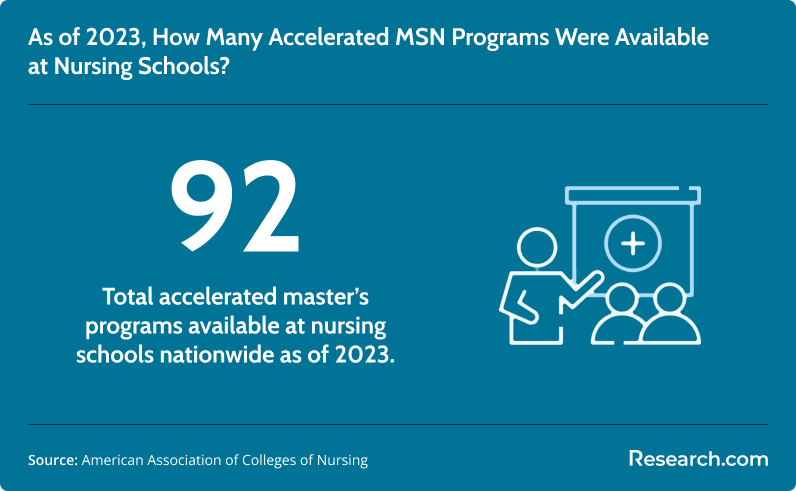
As of 2023, there were 327 accelerated bachelor's nursing programs offered across the U.S. For master's programs, the total was 92. Direct entry MSN graduates enter nursing with graduate preparation, but career progression still depends on licensure, certification, clinical competence, and experience. Some graduates later pursue doctoral study, including options such as the shortest MSN to DNP program.
Advanced Practice Registered Nurse roles
- Nurse Practitioner: NPs provide comprehensive care and may serve as primary care or specialty providers depending on certification and state scope of practice. Students interested in this path may later compare the fastest post master's FNP certificate online if their direct entry MSN does not include FNP preparation.
- Clinical Nurse Specialist: CNSs are expert clinicians in areas such as cardiology, oncology, pediatrics, or gerontology. They may provide direct care, consult with teams, educate staff, and improve practice outcomes.
- Certified Nurse-Midwife: CNMs provide women’s health, prenatal, labor and birth, postpartum, and newborn care.
- Certified Registered Nurse Anesthetist: CRNAs provide anesthesia-related care before, during, and after procedures. Direct entry MSN pathways leading directly to CRNA practice are rare because most CRNA programs require significant critical care RN experience and are typically doctoral-level.
Nursing leadership and management roles
Graduate nursing education can support leadership, but employers often expect bedside or clinical experience before management advancement. Some nationally accredited online schools also offer leadership-oriented programs that may appeal to students comparing broader online education options.
- Clinical Nurse Leader: CNLs coordinate care, manage outcomes, reduce risk, and support evidence-based improvement at the unit or microsystem level.
- Nurse Manager or Nurse Director: These roles supervise staff, manage schedules and budgets, support quality standards, and oversee unit operations.
- Nurse Administrator or Nurse Executive: Administrators handle broader nursing operations, policy, staffing, finance, and strategic planning.
- Chief Nursing Officer: CNOs oversee nursing practice and quality across a health system or organization.
Nursing education and research roles
- Nurse Educator: Educators teach in nursing schools, clinical settings, healthcare organizations, and staff development departments.
- Nurse Researcher: Researchers design studies, analyze outcomes, and contribute to nursing evidence. They may work in universities, research institutions, pharmaceutical companies, or health systems.
Non-traditional and specialized roles
- Nursing Informatics Specialist: Uses nursing knowledge and technology to improve electronic health records, workflows, data use, and patient safety.
- Legal Nurse Consultant: Applies clinical expertise to legal cases, insurance reviews, and healthcare claims.
- Public Health Nurse: Supports community health, prevention, health education, and population-level programs.
- Case Manager or Care Coordinator: Coordinates care plans, transitions, resources, and patient advocacy across settings.
- Quality Improvement or Patient Safety Nurse: Identifies care gaps, analyzes outcomes, and implements safety and quality initiatives.
What is the job market like for graduates with an affordable online direct entry MSN program for non-nurses?
The job market is strong for many nursing roles, especially for advanced practice nurses, nurse leaders, and educators. Demand is tied to healthcare access needs, an aging population, care complexity, and ongoing nursing workforce challenges. However, job outcomes still vary by region, specialty, employer, experience, and certification.
The U.S. Bureau of Labor Statistics projects 46% job growth for Nurse Practitioners from 2023 to 2033, creating over 135,000 new positions. Clinical Nurse Leaders are expected to see a 28-32% increase in opportunities, and Nurse Educators have an 18% growth outlook, nearly triple the average for all occupations. These projections support strong demand, but they do not guarantee employment for every graduate.
Students should distinguish between becoming employable as an RN and becoming competitive for advanced roles. A direct entry MSN may accelerate the academic pathway, but employers may still value hands-on RN experience, specialty certification, and strong clinical references. Students considering alternate nursing routes can compare affordable RN to BSN online programs, which are designed for licensed RNs seeking bachelor’s completion rather than non-nurses entering the field.
Do online direct entry MSN programs offer comprehensive career support and job placement assistance?
Many programs provide career services, but the depth of support varies. Useful services may include resume reviews, interview preparation, clinical site networking, alumni panels, job boards, employer events, certification guidance, and advising for post-master’s certificates or doctoral study. Applicants should ask whether support is tailored to online students and whether the school has employer relationships in the student’s preferred region.
If your goal is a nurse practitioner role, compare programs carefully because direct entry pathways are not all structured the same way. Reviewing direct entry MSN NP programs can help clarify how NP-focused pathways differ from generalist MSN or CNL-focused direct entry programs.
What is the long-term return on investment of an affordable online direct entry MSN program for non-nurses?
The ROI of a direct entry MSN depends on total program cost, borrowing, time out of the workforce, licensure success, specialization, salary growth, and career longevity. A lower tuition program is not automatically the best value if it lacks clinical placement support or does not meet licensure requirements. A higher-cost program may still be reasonable if it has strong outcomes, reliable clinical partnerships, and a clear route to the role you want.
Students targeting advanced practice should examine whether the program leads directly to their desired credential or whether additional education is needed. For example, direct admit NP programs for non nurses may appeal to applicants who want a more direct route to NP preparation, but students should still verify certification eligibility, state authorization, clinical hour requirements, and total cost.
Common mistakes to avoid when choosing an online direct entry MSN
| Mistake | Why it can hurt you | Better approach |
| Choosing based only on tuition | Fees, travel, clinical costs, and prerequisites can make a “cheap” program more expensive than expected. | Compare full cost of attendance and ask for written estimates. |
| Assuming online means fully remote | Nursing requires in-person labs, simulations, and clinical rotations. | Confirm every required campus visit and clinical obligation before enrolling. |
| Ignoring state licensure rules | A program may not meet requirements where you want to practice. | Check state board approval and professional licensure disclosures. |
| Not asking who secures clinical placements | Clinical placement delays can delay graduation and licensure. | Ask whether the school arranges placements and in which states. |
| Assuming every MSN leads to NP practice | Generalist, CNL, education, and NP tracks have different outcomes. | Match the curriculum to your intended credential and job title. |
| Underestimating the workload | Accelerated programs can be difficult to balance with full-time work. | Ask current students or advisors about weekly time expectations. |
| Relying only on rankings | A ranked school may still be a poor fit for your state, budget, schedule, or specialty. | Use rankings as a starting point, then verify personal fit. |
What final questions should you ask before applying?
- Is the nursing program accredited by CCNE or ACEN?
- Is the pre-licensure portion approved for the state where I plan to become licensed?
- Can I complete clinical rotations in my location, and who arranges them?
- How many campus visits, labs, or residencies are required?
- What is the total estimated cost, including fees, travel, supplies, and licensure expenses?
- Does the program lead to RN licensure only, a generalist MSN, CNL preparation, an NP specialty, or another role?
- What are the most recent NCLEX-RN pass rates?
- Can I work while enrolled, or is the program designed as a full-time commitment?
- What scholarships, grants, employer partnerships, or repayment options are available?
- What happens if I cannot secure a clinical site on time?
Key Insights
- An online direct entry MSN is usually a hybrid program, not a fully online degree. Expect online coursework plus required labs, simulations, and clinical rotations.
- Most programs are designed for non-nurses with a bachelor’s degree in another field and typically take 20 months to 3 years to complete.
- Total tuition can range from approximately $18,000 to over $100,000, with some public university options for in-state students falling between $18,000 and $45,000.
- Accreditation, state approval, and clinical placement support are non-negotiable. A low-cost program is not a good value if it does not support licensure or timely clinical completion.
- Career outcomes vary by specialization. A CNL-focused direct entry MSN, a generalist MSN, and an NP pathway lead to different jobs and certification requirements.
- The U.S. Bureau of Labor Statistics projects 46% job growth for Nurse Practitioners from 2023 to 2033, but students should still evaluate local demand, certification rules, and employer expectations.
- Before applying, ask for written details on total cost, clinical placement, campus requirements, NCLEX-RN outcomes, financial aid, and whether the program aligns with your intended nursing role.
References:
- American Association of Colleges of Nursing. (n.d.). New AACN data points to enrollment challenges facing U.S. schools of nursing.
- American Association of Colleges of Nursing. (n.d.). New graduate employment data.
- Health Resources and Services Administration. (2024). Nurse survey fact sheet. U.S. Department of Health and Human Services.
- Health Resources and Services Administration. (n.d.). National Sample Survey of Registered Nurses (NSSRN): Education and training report. U.S. Department of Health and Human Services.
- U.S. Bureau of Labor Statistics. (2024). Nurse anesthetists, nurse midwives, and nurse practitioners. Occupational Outlook Handbook. AACN enrollment data
Other Things You Should Know About the Most Affordable Online Direct Entry MSN Programs for Non-Nurses
These programs typically range from 18 to 24 months in duration. Prospective students should plan for a full-time commitment, as the accelerated nature of the program requires a comprehensive workload focusing on nursing theory, clinical practice, and specialized knowledge.
In 2027, admission requirements for the most affordable online direct entry MSN programs for non-nurses generally include a completed bachelor's degree in any field, a minimum GPA, prerequisite courses in sciences, and submission of transcripts. Some programs may also require letters of recommendation, a personal statement, and relevant work experience or volunteer service.
Yes. Most direct entry MSN programs require a criminal background check, drug screening, immunization records, CPR certification, and a TB test before clinical placement. Many clinical sites also require a current physical exam and proof of health insurance before students begin supervised patient care.