2027 Best Online MSN in Nursing Education Programs

Co-Founder and Chief Data Scientist
Nurse educators are trained to tackle a critical issue in healthcare—skill gaps among nursing staff. A recent survey found that 67% of healthcare CEOs believe these shortages could harm both patient outcomes and the financial stability of medical facilities in the coming decade. By providing targeted, evidence-based instruction, nurse educators play a vital role in closing these gaps and strengthening the overall quality of care.
This guide aims to turn aspirants into effective instructors by presenting the best online MSN in Nursing Education programs on the market, along with key facts for each degree. Prospective students will also be acquainted with general information about online nursing education programs, such as tuition costs, program duration, possible career paths, and potential earnings.
What are the benefits of getting an online MSN in nursing education?
- Postsecondary nurse educators receive an average yearly salary of $87,090 and a median yearly salary of $79,940.
- Earning an online MSN in Nursing Education allows graduates to pursue a career as a nurse educator, nursing professional development specialist, nursing instructional designer, or healthcare training consultant.
- An online MSN in Nursing Education offers more flexible schedules, less rigid learning experiences, more convenience, and usually lower tuition fees than its traditional campus-based counterpart.
What can I expect from an online MSN in nursing education?
A student enrolling in an online MSN in Nursing Education can expect a comprehensive, flexible program designed to prepare them for teaching roles in academic settings, healthcare agencies, or professional development.
The curriculum typically includes advanced nursing theory, curriculum development and evaluation, teaching strategies for both traditional and digital learning environments, measurement and assessment methods, and leadership and communication skills tailored to nurse educators.
This education also covers evidence-based practice and pedagogical theories to equip students with the ability to design and implement effective nursing education programs.
An MSN in nursing education usually involves predominantly online coursework featuring asynchronous classes, allowing students to balance study with work and personal commitments, while including in-person or local clinical/practicum experiences for hands-on teaching practice and capstone projects.
Students can expect rigorous academic demands with support from experienced faculty, opportunities for professional growth, and preparation for national certification exams such as the Certified Nurse Educator. This pathway readies graduates to become competent nurse educators capable of inspiring and shaping future nursing professionals.
Where can I work with an online MSN in nursing education?
A graduate with an online MSN in Nursing Education can work in a variety of academic, clinical, and organizational settings where nursing instruction and staff development are essential. These roles involve educating future nurses, training current staff, and improving the quality of patient care through education.
A graduate's common workplaces include the following:
- Colleges and Universities: Graduates can teach in associate, bachelor's, or graduate-level nursing programs as faculty members, lecturers, or clinical instructors.
- Community Colleges and Vocational Schools: Many nurse educators teach practical nursing (LPN) or associate degree RN programs in community or technical colleges.
- Hospitals and Health Systems: Clinical nurse educators or staff development specialists provide onboarding, continuing education, and skills training to nursing staff and interdisciplinary teams.
- Simulation Labs and Skills Centers: Educators work in simulation environments within schools or hospitals, managing hands-on training using mannequins and virtual tools to enhance clinical instruction.
- Online Nursing Programs: With growing demand for remote learning, MSN-prepared educators often teach or design content for fully online nursing degree or certification programs.
- Public Health Departments and Community Health Centers: Nurse educators may develop and deliver educational programs focused on disease prevention, health promotion, and chronic care management for the public.
- Long-Term Care and Rehabilitation Facilities: Nurse educators provide staff training, ensure regulatory compliance, and lead quality improvement initiatives in extended care environments.
- Healthcare Corporations and Consulting Firms: Some educators design and implement large-scale training programs or consult on curriculum development and staff education strategies.
- Professional Nursing Associations: Nurse educators may work in education or certification departments, helping design continuing education courses or certification prep programs.
How much can I make with an online MSN in nursing education?
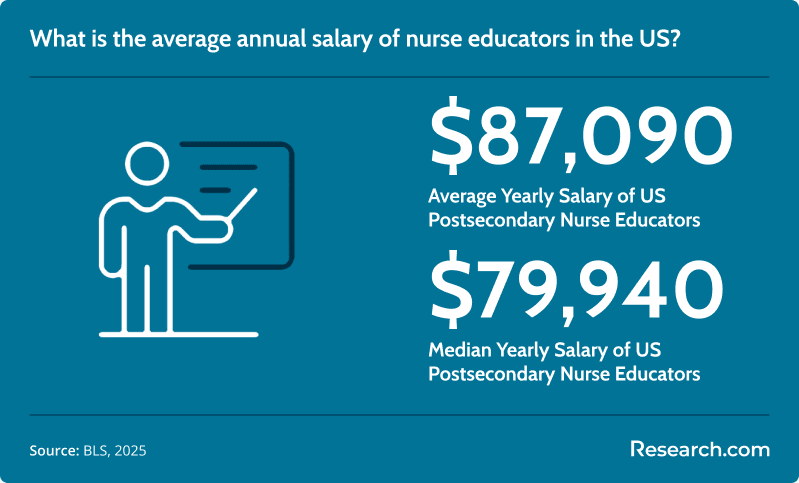
Nursing teachers receive decent pay and are in demand given their impact on the nursing sector. According to the United States Bureau of Labor Statistics (BLS), postsecondary nurse educators receive an average yearly salary of $87,090 and a median yearly salary of $79,940. Both figures are much higher than the collective median annual pay of all jobs in the country ($49,500).
Postsecondary nursing instructors earn from $47,950 to $130,040 each year in their careers. The pay of entry-level roles and starting job grades falls within the lower end of the salary spectrum as new hires work their way to higher pay and positions. On the other hand, experienced educators working in prestigious private institutions typically earn sums well above the average yearly salary.
- Best Online MSN in Nursing Education Programs for 2027 List of Programs
- How long does it take to complete an online MSN in nursing education? Completion Time
- How does an online MSN in nursing education compare to an on-campus program? How does an online MSN in nursing education compare to an on-campus program?
- What is the average cost of an online MSN in nursing education? Average Cost
- What are the financial aid options for students enrolling in an online MSN in nursing education? Financial Aid
- What are the prerequisites for enrolling in an online MSN in nursing education? Requirements
- What courses are typically in an online MSN in nursing education? What courses are typically in an online MSN in nursing education?
- What types of specializations are available in online MSN in nursing education programs? What types of specializations are available in online MSN in nursing education programs?
- How to choose the best online MSN in nursing education? How to choose the best online MSN in nursing education?
- What career paths are available for graduates of online MSN in nursing education programs? Career Paths
- What is the job market for graduates with an online MSN in nursing education? Job Market
- What accreditation and quality standards ensure a program’s credibility? What accreditation and quality standards ensure a program’s credibility?
- What challenges might I face in an online MSN in nursing education program? What challenges might I face in an online MSN in nursing education program?
Best Online MSN in Nursing Education Programs for 2027
Choosing an online MSN in Nursing Education is a career decision, not just a school decision. The right program can help a registered nurse move from bedside practice into teaching, curriculum development, clinical staff training, simulation education, or academic leadership. The wrong fit can create problems with practicum placement, scheduling, cost, certification preparation, or state authorization.
This guide is designed for licensed nurses comparing online and hybrid MSN nurse educator programs. You will find a ranked program list, cost and completion-time expectations, admissions requirements, common courses, specialization options, career outcomes, accreditation checks, and practical questions to ask before applying.
Quick Answer: Is an Online MSN in Nursing Education Worth Considering?
An online MSN in Nursing Education can be a strong option for registered nurses who want to teach nursing students, train clinical staff, design learning programs, or move into professional development roles. Most programs take 2 to 3 years, require a BSN and active RN license, include a teaching practicum, and should hold nursing accreditation from organizations such as the Commission on Collegiate Nursing Education or the Accreditation Commission for Education in Nursing.
The best choice depends on four factors: whether the program is properly accredited, whether it helps arrange local practicum experiences, whether the total cost fits your expected return, and whether the curriculum supports your target role, such as academic nurse educator, clinical educator, simulation coordinator, or staff development specialist.
How to Use This Ranking
Rankings can help narrow your search, but they should not replace your own due diligence. Before applying, confirm that each program still offers the listed track, accepts students from your state, supports your practicum needs, and meets any employer or certification expectations relevant to your career goals.
How do we rank schools?
Because an MSN in Nursing Education requires a major commitment of time, tuition, clinical coordination, and professional energy, our ranking process emphasizes verifiable information and program quality indicators. We reviewed institutional and program data from the IPEDS database, College Scorecard, Peterson's database, and the National Center for Education Statistics. Accreditation status was a key consideration because graduate nursing education quality, financial aid eligibility, and career mobility can depend on it. For more detail on our ranking process, review our methodology page.
Top Online and Hybrid MSN in Nursing Education Programs
| Rank | School and Program | Format and Fit | Credits | Cost per Credit |
| 1 | Texas Christian University Master of Science in Nursing - Nurse Educator | 100% online coursework with local clinical practicums; useful for nurses seeking adult-gerontology or pediatric teaching focus areas | 34 | $2,145 |
| 2 | Duke University Nursing Education MSN | Online MSN focused on nursing science, educational technology, curriculum design, and teaching strategy | 36 | $2,166 |
| 3 | University of Rochester Master's in Nursing Education Program | Hybrid evening model with online and in-person coursework plus student-teaching immersion | 37 | $1,740 |
| 4 | Villanova University Master of Science in Nursing (Nursing Education Track) | Hybrid track with online coursework, summer simulation intensive, and guided practicum | 33 | $1,050 |
| 5 | Drexel University Online Master’s in Nursing Education (MSN) | Online program emphasizing adult learning, simulation, curriculum design, and CNE exam alignment | 45 | $1,134 |
| 6 | Southern Connecticut State University Master of Science Degree in Nursing Education | Flexible model with accelerated and part-time options plus practicum access through Connecticut clinical partners | 37 | $945 |
| 7 | University of Mississippi Medical Center MSN: Nurse Educator Track | Hybrid program with online coursework, occasional in-person meetings, and three practicum experiences | 38 | $545 (in-state); $1,599 (out-of-state) |
| 8 | Texas A&M University MSN-Nursing Education | Primarily online hybrid program with two required Bryan-College Station visits and precepted practicums | 36 | $787.89 (in-state); $1,319.4 (out-of-state) |
| 9 | University of South Carolina MSN in Nursing Education | Five-semester hybrid program with online coursework, local practicums, and select campus immersion requirements | 39 | $770.25 (in-state); $1,438 (out-of-state) |
| 10 | William Carey University Master of Science in Nursing Education | Fully online option for nurses pursuing faculty educator or staff development roles | 35 | $495 |
1. Texas Christian University Master of Science in Nursing - Nurse Educator
The Master of Science in Nursing – Nurse Educator program at Texas Christian University is built for nurses who want to teach in academic, classroom, and clinical learning environments. The program is delivered 100% online, while clinical practicums are arranged locally. Students can choose adult-gerontology or pediatric focus areas and may follow either a two-year or three-year plan. The curriculum emphasizes practical teaching experience, education leadership, and instructional innovation.
- Program Length: 2 to 3 years
- Concentrations:
- Adult-Gerontology
- Pediatric
- Required Credits to Graduate: 34
- Cost per Credit: $2,145
- Accreditation: Commission on Collegiate Nursing Education
2. Duke University Nursing Education MSN
Duke University offers an MSN in Nursing Education for nurses preparing for educator and leadership responsibilities in academic institutions, healthcare organizations, and staff development environments. The program combines nursing science with advanced preparation in teaching, curriculum planning, instructional technology, and leadership. It is especially relevant for nurses who want to influence how future nurses and practicing clinicians learn.
- Program Length: 2 to 3 years
- Required Credits to Graduate: 36
- Cost per Credit: $2,166
- Accreditation: Commission on Collegiate Nursing Education
3. University of Rochester Master's in Nursing Education Program
The University of Rochester offers a Master’s in Nursing Education program for experienced nurses planning to teach in academic or clinical settings. This 37-credit hybrid program combines online learning with in-person evening coursework and supervised teaching experiences. Students complete a capstone student-teaching immersion and may tailor their preparation through specialty options such as pediatrics, oncology, perioperative care, and other clinical areas.
- Program Length: 2 to 3 years
- Concentrations:
- Medical-Surgical Nursing
- Critical Care Nursing
- Emergency Nursing
- OR/Perioperative Services
- Pediatrics
- Women's Health
- Ambulatory Nursing
- Oncology
- Required Credits to Graduate: 37
- Cost per Credit: $1,740
- Accreditation: Commission on Collegiate Nursing Education
4. Villanova University Master of Science in Nursing (Nursing Education Track)
Villanova University offers a Nursing Education MSN track for nurses who want to teach, mentor, and lead in academic, clinical, or community-based environments. The 33-credit hybrid curriculum includes online coursework, a summer simulation intensive on campus, and a supervised practicum. Students select a clinical focus area for the practicum, such as adult-gerontology, parent-child health, or psychiatric/mental health, while developing skills in curriculum design, teaching methods, and education leadership.
- Program Length: 2 to 3 years
- Required Credits to Graduate: 33
- Cost per Credit: $1,050
- Accreditation: Commission on Collegiate Nursing Education
5. Drexel University Online Master’s in Nursing Education (MSN)
Drexel University provides an online MSN in Nursing Education for nurses interested in academic instruction, clinical education, and professional development roles. The 45-quarter credit program integrates advanced clinical concepts, adult learning theory, simulation-based teaching, and curriculum design. Its coursework is aligned with national competencies to support preparation for the Certified Nurse Educator Exam.
- Program Length: 2 to 3 years
- Required Credits to Graduate: 45
- Cost per Credit: $1,134
- Accreditation: Commission on Collegiate Nursing Education
6. Southern Connecticut State University Master of Science Degree in Nursing Education
Southern Connecticut State University offers an MSN in Nursing Education for registered nurses preparing to teach in classroom and clinical environments across different nursing education levels. The 37-credit program includes an accelerated 16-month option and a part-time 2–3 year pathway. Students study nursing theory, educational principles, and leadership while completing practicum experiences through more than 150 affiliated clinical sites in Connecticut.
- Program Length: 2 to 3 years
- Concentrations:
- Accelerated, 16-month program
- Part-time, 2-3 year program
- Required Credits to Graduate: 37
- Cost per Credit: $945
- Accreditation: Commission on Collegiate Nursing Education
7. The University of Mississippi Medical Center MSN: Nurse Educator Track
The University of Mississippi Medical Center offers a hybrid MSN Nurse Educator Track that combines online coursework with limited in-person requirements. Students complete three practicum experiences totaling 360 clinical hours. The curriculum covers curriculum development, teaching methods, education technology, health policy, and leadership, with the option to complete clinical experiences within the university’s healthcare system.
- Program Length: 2 to 3 years
- Required Credits to Graduate: 38
- Cost per Credit: $545 (in-state); $1,599 (out-of-state)
- Accreditation: Commission on Collegiate Nursing Education
8. Texas A&M University MSN-Nursing Education
Texas A&M University offers a 36-credit MSN in Nursing Education for nurses preparing to teach in healthcare organizations or higher education. The hybrid program is mainly online, but students attend two required visits to Bryan-College Station and complete 45 on-campus clinical hours. Coursework includes leadership, educational theory, curriculum planning, and three precepted clinical practicums.
- Program Length: 2 to 3 years
- Required Credits to Graduate: 36
- Cost per Credit: $787.89 (in-state); $1,319.4 (out-of-state)
- Accreditation: Commission on Collegiate Nursing Education
9. University of South Carolina MSN in Nursing Education
The University of South Carolina offers a 39-credit MSN in Nursing Education that can be completed over five semesters. The hybrid format combines online classes with clinical practicums totaling 500 hours, which may be completed locally. Students study educational theory, teaching strategies, curriculum development, and instructional technology, with some courses requiring campus immersion.
- Program Length: 2 to 3 years
- Required Credits to Graduate: 39
- Cost per Credit: $770.25 (in-state); $1,438 (out-of-state)
- Accreditation: Commission on Collegiate Nursing Education
10. William Carey University Master of Science in Nursing Education
William Carey University offers a fully online MSN in Nursing Education for registered nurses interested in faculty educator and healthcare staff development positions. The program focuses on leadership, evidence-based practice, quality improvement, and the integration of nursing and scientific knowledge. Graduates are prepared for instructional roles in LPN, ADN, or BSN programs, as well as staff education positions in healthcare settings.
- Program Length: 18 to 24 months
- Required Credits to Graduate: 35
- Cost per Credit: $495
- Accreditation: Commission on Collegiate Nursing Education
How long does it take to complete an online MSN in nursing education?
Most online MSN in Nursing Education programs take 2 to 3 years. The actual timeline depends on whether you enroll full time or part time, whether the program runs year-round, and how quickly you can complete required teaching or clinical practicum hours. The time commitment can be similar to other graduate options, including an accelerated master's in public administration online, but nursing education programs usually add practicum coordination on top of coursework.
| Enrollment Path | Typical Completion Time | Best For | Trade-Off |
| Full-time | About 18 to 24 months | Nurses who can manage a heavier academic schedule | Less flexibility around work and personal obligations |
| Part-time | Often 2.5 to 3 years | Working nurses balancing shifts, family responsibilities, or leadership duties | Longer time before graduation and career transition |
| Accelerated | As little as 12 to 18 months in some programs | Highly organized students with strong support systems | Intensive workload and limited room for schedule disruptions |
Every nursing education MSN includes more than online lectures. Students usually complete core graduate nursing courses, education-focused coursework, and a supervised teaching practicum. If practicum placement takes longer than expected, graduation may be delayed even when coursework is on track.
College Board data shown in the chart below indicates that 52.11% of nurse educators in the United States earned master's or professional degrees, 42.84% have a doctorate or more, and 5.05% hold a bachelor's degree.
How does an online MSN in nursing education compare to an on-campus program?
Online and on-campus MSN in Nursing Education programs generally prepare nurses for similar outcomes: teaching, curriculum planning, clinical instruction, and education leadership. The difference is how students learn, how they interact with faculty and peers, and how practicum experiences are arranged. Nurses who are also comparing other advanced-practice paths may want to review the best online MSN in nurse midwifery programs to understand how educator-focused and direct-care advanced nursing tracks differ.
| Factor | Online MSN in Nursing Education | On-Campus MSN in Nursing Education | Decision Tip |
| Schedule | Often uses asynchronous coursework, allowing students to study around work shifts | Requires set class times and regular campus attendance | Choose online if flexibility is essential; choose campus if structure helps you stay engaged |
| Learning environment | Uses recorded lectures, online discussions, virtual classrooms, and digital assignments | Provides live classroom discussion, immediate interaction, and in-person demonstrations | Online students need strong self-direction and comfort with learning technology |
| Faculty and peer access | Relies on virtual office hours, discussion boards, messaging, and video meetings | Offers more spontaneous access to faculty, classmates, and campus-based networking | Ask online programs how often students interact live with faculty and cohorts |
| Teaching practicum | Often completed near the student’s home, sometimes with student-arranged preceptors | Usually coordinated through local partner schools, hospitals, or simulation labs | Clarify placement responsibility before enrolling |
| Campus resources | May include digital libraries, technical support, virtual advising, and remote tutoring | May offer simulation labs, writing centers, and in-person student services | Hybrid programs may provide a useful middle ground |
| Overall accessibility | Better for nurses who cannot relocate or commute regularly | Better for students who live near campus and want frequent face-to-face engagement | Do not assume online means easier; it usually means more self-managed |
When an online format makes sense
- You are a working RN with rotating shifts or family obligations.
- You live far from a university that offers a nursing education MSN.
- You are comfortable with independent study, online collaboration, and digital learning platforms.
- You have access to a local site where you may be able to complete practicum requirements.
When an on-campus or hybrid format may be better
- You want frequent in-person faculty interaction and peer networking.
- You learn best through live discussion and scheduled classroom meetings.
- You need easier access to simulation labs, teaching demonstrations, or campus-based practicum support.
- You prefer the school to coordinate most local placement logistics.
What is the average cost of an online MSN in nursing education?
An online MSN in Nursing Education commonly costs $25,000 to $60,000, depending on the school, credit requirements, tuition model, residency status, and fees. Public universities are often less expensive than private institutions, especially when they offer in-state tuition or flat online rates.
| Cost Category | Typical Range or Consideration | What to Ask Before Enrolling |
| Public institutions | Often between $25,000 and $40,000, especially for in-state students or online students receiving flat-rate pricing | Will online students pay in-state, out-of-state, or separate distance-learning tuition? |
| Private institutions | Usually between $40,000 and $60,000, with some specialized or highly ranked programs exceeding that range | Are scholarships, tuition discounts, or employer partnerships available? |
| Program fees | May include technology fees, practicum coordination fees, course materials, software, and administrative charges | Which fees are mandatory and which are included in tuition? |
| Practicum costs | May include background checks, immunizations, travel, parking, liability insurance, or site-specific requirements | Who pays placement-related expenses, and can practicums be completed locally? |
| Opportunity cost | Time spent in school may affect overtime, shift availability, or family obligations | Can you realistically keep your work schedule while completing coursework and practicums? |
If you are comparing educator preparation with other advanced nursing specialties, online MSN PMHNP programs can provide a useful contrast because nurse practitioner tracks often have different clinical-hour expectations, certification pathways, and salary considerations.
Program cost should be weighed against realistic career outcomes, not only against tuition. The chart below shows that the industries with the highest average annual salaries for nurse educators are local government offices ($136,450), physicians' offices ($129,510), and other schools and instruction ($112,800).
What are the financial aid options for students enrolling in an online MSN in nursing education?
Graduate nursing students may combine several funding sources to reduce out-of-pocket costs. Availability depends on the school, enrollment status, employer policies, service commitments, state residency, and federal eligibility. Students should complete aid forms early and ask each program for a full cost-of-attendance estimate, not only tuition.
- Federal Student Aid: Students who complete the Free Application for Federal Student Aid may qualify for federal options such as Direct Unsubsidized Loans and Graduate PLUS Loans, which have fixed interest rates and federal repayment protections.
- Nursing-Specific Scholarships: Organizations such as the American Association of Colleges of Nursing, Nurse Corps, and Nurses Educational Funds, Inc. offer scholarship opportunities for graduate nursing students. Individual schools may also award merit-based or need-based aid.
- Loan Repayment and Forgiveness Programs: Programs such as the Nurse Corps Loan Repayment Program and Public Service Loan Forgiveness can support eligible nurses who work in qualifying underserved, public, or nonprofit settings.
- Employer Tuition Reimbursement: Hospitals and healthcare systems may help pay for graduate nursing education, particularly when the degree supports workforce development, staff retention, or internal education roles.
- State and Institutional Grants: Some states and universities provide graduate education or workforce development funding for nurses, especially in areas facing nursing faculty shortages.
- Military and Veterans’ Benefits: Eligible students may use GI Bill® benefits or military tuition assistance if they or qualifying dependents meet program requirements.
- Private Scholarships and Foundations: Healthcare organizations, community foundations, and education nonprofits may offer awards for nurses pursuing advanced education.
- Payment Plans: Many schools allow students to divide tuition into smaller payments during the semester instead of paying the full balance at once.
Students should contact financial aid offices before applying, because deadlines and eligibility rules may vary by funding source. Applicants comparing aid options across healthcare education programs may also find it useful to review online medical assistant programs that accept financial aid for a broader look at how healthcare training programs structure tuition support.
What are the prerequisites for enrolling in an online MSN in nursing education?
Admissions standards vary, but most MSN in Nursing Education programs look for applicants who already have a strong nursing foundation, an active license, and evidence that they can handle graduate-level work. Because practicum experiences may be tied to state authorization and RN licensure, applicants should confirm requirements before submitting an application.
| Requirement | What It Usually Means | Why It Matters |
| Bachelor of Science in Nursing | Applicants usually need a BSN from a regionally accredited institution and a CCNE- or ACEN-accredited nursing program | Graduate nursing coursework builds on BSN-level clinical and professional preparation |
| Active RN license | A current, unencumbered registered nurse license is commonly required | Programs may require licensure in the state where practicums are completed |
| Minimum GPA | Many programs expect a cumulative undergraduate GPA of 3.0 or higher on a 4.0 scale | Some schools may offer conditional or provisional admission for applicants with lower GPAs |
| Professional nursing experience | Many programs prefer or require 1 to 2 years of clinical nursing experience | Teaching future nurses is easier when students can connect education theory to clinical practice |
| Recommendations | Applicants commonly submit two to three letters from supervisors, faculty, or professional colleagues | References help programs assess leadership, communication, clinical judgment, and academic readiness |
| Statement of purpose | A written essay explains career goals and reasons for choosing nursing education | Programs use it to evaluate fit and motivation |
| Resume or CV | Applicants list education, licensure, certifications, clinical experience, leadership, and teaching exposure | A detailed resume helps show readiness for educator preparation |
| Official transcripts | Schools usually require transcripts from all post-secondary institutions attended | Transcripts verify academic history and prerequisite completion |
| English proficiency | International applicants or non-native English speakers may need TOEFL or IELTS scores | Strong communication skills are essential for graduate study and teaching |
| Interview | Some programs require a video or phone interview | Interviews help assess communication skills, professionalism, and program fit |
Nurses interested in population health, policy, and community education may also compare admissions expectations with online MSN public health nursing pathways, which can emphasize different public health competencies.
What courses are typically in an online MSN in nursing education?
An online MSN in Nursing Education combines graduate nursing content with education theory and supervised teaching practice. The goal is to prepare nurses not only to understand advanced clinical material, but also to teach it clearly, assess learner performance, build curricula, and improve education outcomes. Students comparing educator tracks with direct-care pediatric roles can review MSN pediatric nurse practitioner online programs to see how nurse educator coursework differs from advanced practice preparation.
| Common Course | What Students Learn | How It Applies to Nurse Education |
| Advanced Pathophysiology | Complex disease processes and physiological changes | Helps future educators teach clinical reasoning and disease progression |
| Advanced Health Assessment | Comprehensive physical and psychosocial assessment across the lifespan | Supports classroom, lab, and clinical instruction in assessment skills |
| Advanced Pharmacology | Medication classes, mechanisms of action, safety, and administration principles | Prepares educators to teach medication concepts and safe practice |
| Theoretical Foundations of Nursing Education | Learning theories, education models, and teaching philosophy | Builds the conceptual base for effective instruction |
| Curriculum Design and Development | Course planning, program outcomes, competencies, and accreditation alignment | Prepares graduates to create and revise nursing curricula |
| Teaching Strategies in Nursing | Classroom methods, clinical instruction, simulation, case-based learning, and online teaching | Helps educators match teaching methods to learner needs |
| Assessment and Evaluation in Nursing Education | Testing, clinical evaluation, learner feedback, and program assessment | Supports fair measurement of student progress and course effectiveness |
| Role of the Nurse Educator | Professional expectations, ethics, mentorship, and educator responsibilities | Clarifies the transition from clinician to teacher |
| Evidence-Based Practice and Research | Research appraisal and evidence-informed decision-making | Helps educators update teaching practices and curriculum content |
| Practicum or Teaching Internship | Supervised teaching in an academic, clinical, or staff development setting | Allows students to apply education theory in real teaching situations |
What types of specializations are available in online MSN in nursing education programs?
Most MSN in Nursing Education programs share a core focus on teaching and learning, but some allow students to build expertise around a teaching setting, patient population, technology area, or leadership path. Specialization options matter because a nurse who wants to teach undergraduate pharmacology may need a different practicum and course plan than a nurse who wants to run hospital onboarding or simulation training.
- Academic Nursing Education: Designed for nurses who want to teach in colleges, universities, and nursing schools. Coursework often emphasizes curriculum development, classroom instruction, simulation, and preparation of students for licensure exams such as the NCLEX.
- Clinical Nurse Educator: Focuses on staff education, clinical competency, bedside teaching, preceptor development, and continuing education inside hospitals or healthcare systems.
- Simulation and Technology in Nursing Education: Prepares nurses to use simulation labs, virtual tools, learning platforms, and emerging education technologies to improve clinical teaching.
- Community or Public Health Education: Emphasizes disease prevention, wellness education, health promotion, and outreach for diverse communities.
- Leadership in Nursing Education: Combines education preparation with leadership training for nurses who want to manage faculty teams, influence policy, or direct academic and clinical education programs.
- Pediatric or Maternal-Child Health Education: Supports nurses who want to teach care of children, newborns, mothers, and families.
- Gerontology Nursing Education: Focuses on teaching future nurses how to care for older adults with chronic, complex, or age-related health needs.
How to choose the best online MSN in nursing education?
The best online MSN in Nursing Education is the one that matches your license, schedule, budget, teaching goals, practicum access, and preferred learning style. Many of the same evaluation habits also apply to other online education-focused graduate programs, including the accelerated online specialist degree in education, but nursing programs require extra attention to accreditation, practicum, and state authorization.
Questions to ask before applying
| Factor | What to Confirm | Why It Matters |
| Accreditation | Is the nursing program accredited by CCNE or ACEN? | Accreditation affects quality assurance, employer recognition, financial aid, and certification readiness |
| State authorization | Can the school enroll students in your state? | Online programs may be restricted by state authorization rules |
| Practicum support | Does the school place students, help identify sites, or require students to find preceptors? | Practicum logistics are one of the most common online MSN challenges |
| Curriculum fit | Does the program cover curriculum design, teaching strategy, assessment, simulation, and clinical education? | The course plan should support your target educator role |
| Certification preparation | Does the curriculum align with Certified Nurse Educator expectations? | Some employers value or prefer educator certification |
| Faculty background | Do faculty have experience in nursing education, research, clinical practice, or simulation? | Instructor expertise shapes the quality of mentoring and feedback |
| Total cost | What is the full cost after tuition, fees, books, technology, and practicum expenses? | Low tuition can still become expensive if fees and placement costs are high |
| Student support | Are advising, library access, career services, technical help, and writing support available online? | Distance learners need reliable remote support |
| Outcomes | What are graduation rates, employment outcomes, student satisfaction indicators, and alumni career paths? | Outcomes help evaluate whether students complete the program and use the degree successfully |
Common mistakes to avoid
- Choosing based only on tuition: A lower cost per credit does not always mean the lowest total cost. Compare fees, credits, travel, practicum expenses, and time to completion.
- Ignoring accreditation: Always verify nursing accreditation through official sources before enrolling.
- Assuming “online” means no campus visits: Some hybrid programs require intensives, immersion sessions, or on-campus clinical hours.
- Not asking about practicum placement: If the school expects you to find your own site, start early and ask for written placement guidelines.
- Overlooking state rules: State authorization, RN licensure location, and practicum site approval can affect whether you can enroll or complete requirements.
- Assuming salary outcomes are guaranteed: Pay varies by employer, location, experience, faculty rank, and whether the role is academic, clinical, administrative, or consulting-based.
- Relying only on rankings: Use rankings as a starting point, then compare each program against your own goals and constraints.
What career paths are available for graduates of online MSN in nursing education programs?
Graduates of online MSN in Nursing Education programs can pursue teaching, staff development, curriculum, simulation, and healthcare training roles. The degree is especially relevant for nurses who want to move from direct patient care into education-focused work while still applying their clinical expertise.
| Career Path | Typical Work Setting | Main Responsibilities |
| Nurse Educator | Nursing schools, colleges, universities, and healthcare education programs | Teach courses, supervise clinical rotations, develop learning materials, and prepare students for licensure exams |
| Clinical Nurse Educator | Hospitals, health systems, specialty units, and clinical training departments | Train nursing staff, validate competencies, mentor nurses, and lead continuing education |
| Patient Education Coordinator | Hospitals, outpatient centers, specialty clinics, and community health programs | Create patient and family education programs for treatment plans, chronic disease management, and care transitions |
| Professional Development Specialist | Healthcare systems and staff education departments | Design in-service training, support onboarding, and keep staff current on best practices and regulatory expectations |
| Simulation Lab Coordinator | Nursing schools, hospitals, and clinical education centers | Manage simulation scenarios, equipment, high-fidelity manikins, and learner assessment activities |
| Instructional Designer for Nursing Programs | Universities, online learning companies, healthcare organizations, and education vendors | Build online modules, courses, assessments, and evidence-based nursing learning materials |
| Public Health Educator | Public agencies, nonprofits, community health centers, and outreach programs | Educate communities about prevention, wellness, disease management, and healthy behaviors |
| Healthcare Training Consultant | Consulting firms, hospitals, healthcare vendors, and independent practice | Assess training needs and create customized education programs for quality, safety, or compliance goals |
| Academic Program Director or Dean | Nursing schools and higher education institutions | Oversee nursing programs, faculty teams, curriculum quality, and academic operations, usually after gaining additional experience and education |
Nurses who plan to pursue broader education leadership can also explore accelerated online master's in teacher leadership programs. Those interested in managing hospitals, departments, or other healthcare operations may compare nursing education with fast-track online MBA programs in healthcare administration.
What is the job market for graduates with an online MSN in nursing education?
The labor market for nurse educators is shaped by demand for nursing faculty, ongoing staff development needs in healthcare organizations, and the expansion of online and simulation-based learning. According to the BLS, employment of health education specialists, including nurse educators, is projected to grow by 7% from 2023 to 2033, faster than the national average of 4%. This growth rate differs from medical assistant job growth, but it still points to meaningful demand for education-focused healthcare professionals.
Indeed currently lists over 9,000 job openings for nurse educators in the United States. This number does not include openings in other countries or closely related roles such as instructional designer, training consultant, and professional development specialist.
The industries employing the most postsecondary nursing instructors are colleges, universities, and professional schools (47,930); junior colleges (18,860); and general medical and surgical hospitals (2,840).
The states with the highest employment levels for postsecondary nurse educators, as shown in the visual below, are Texas (6,980), California (5,990), and New York (4,760).
Here's What Graduates Have to Say About Their Online MSN in Nursing Education Programs
- Dinah: "My online MSN in Nursing Education helped me move from bedside nursing into teaching with a stronger command of learning theory, curriculum planning, and clinical instruction. The flexible structure made it possible to keep up with family responsibilities while completing demanding graduate work. I now teach at a local university and feel that I am contributing to nursing in a new and lasting way."
- Emma: "Online study allowed me to test new teaching approaches in my workplace almost immediately. Because the assignments were tied to real clinical education problems, the program helped me grow as both a nurse and an educator. It changed how I mentor others and how I think about leadership."
- Melanie: "I was hesitant about earning the degree online, but the discussion boards, interactive modules, and peer collaboration were stronger than I expected. I learned how to use technology in teaching and how to measure student learning more effectively. Those skills now shape my daily work as a clinical instructor."
What accreditation and quality standards ensure a program’s credibility?
Accreditation should be one of the first items you verify when evaluating an online MSN in Nursing Education. A credible program should hold nursing accreditation from a recognized body such as the Commission on Collegiate Nursing Education or the Accreditation Commission for Education in Nursing. Institutional accreditation also matters because it can affect federal financial aid eligibility, credit transfer, and employer recognition.
Students should also confirm state authorization, practicum approval rules, and whether the program’s curriculum supports certification goals such as the Certified Nurse Educator pathway. If you want a broader point of comparison for nursing program quality, reviewing standards used in the best accelerated BSN program can help you understand how accreditation, clinical requirements, and outcomes are evaluated across nursing education formats.
What challenges might I face in an online MSN in nursing education program?
An online nursing education MSN can be flexible, but it is not low-effort. The biggest challenges usually involve managing graduate coursework while working as a nurse, staying engaged without regular campus meetings, handling technology requirements, and arranging practicum experiences on time.
| Challenge | Why It Happens | How to Prepare |
| Time management | Many students work while completing readings, papers, projects, and practicum hours | Block weekly study time before classes begin and reduce optional commitments during heavy terms |
| Limited face-to-face interaction | Online programs rely on digital communication rather than regular in-person meetings | Attend live sessions when offered and build relationships with faculty early |
| Technology demands | Courses may use learning platforms, video tools, simulations, and online assessment systems | Check hardware, software, internet, and technical support expectations before enrollment |
| Practicum coordination | Online students may need approved local sites and qualified preceptors | Ask for placement policies in writing and begin identifying possible sites early |
| Work-school balance | Nursing shifts, overtime, and family responsibilities can conflict with deadlines | Consider part-time enrollment if your work schedule is unpredictable |
Applicants who are still completing earlier nursing education steps may want to compare expectations with the easiest RN to BSN completion program before committing to graduate-level educator preparation.
References
- BLS (2024, April 3). 25-1072 Nursing Instructors and Teachers, Postsecondary. BLS
- BLS (2025, April 18). Health Education Specialists. BLS
- BLS (2025, July 31). Industry: Cross-industry, Private, Federal, State, and Local Government Period: May 2024. BLS
- College Board. What education level do Postsecondary Nursing Instructors and Teachers have? College Board Additional occupational wage data may be reviewed through the BLS data tool.
- PwC (2023, March 16). How to solve healthcare’s workforce shortage. PwC
- Zippia (2025, January 8). Nurse educator demographics and statistics in the US. Zippia
Key Insights
- An online MSN in Nursing Education is best suited for licensed RNs who want to teach, train staff, design curriculum, coordinate simulation, or move into nursing education leadership.
- Most programs take 2 to 3 years, although full-time, part-time, and accelerated formats can change the timeline.
- Accreditation is nonnegotiable. Look for recognized nursing accreditation, institutional accreditation, and state authorization before applying.
- Practicum placement can make or break the online experience. Ask whether the school finds placements, helps with placement, or expects students to secure their own sites.
- Total cost should include tuition, fees, books, technology, travel, clinical documentation, and potential changes to your work schedule.
- Online programs offer flexibility, but they require discipline, reliable technology, and proactive communication with faculty and preceptors.
- Career options extend beyond college teaching. Graduates may work as clinical nurse educators, professional development specialists, simulation coordinators, patient education leaders, instructional designers, or healthcare training consultants.
- Use rankings as a starting point, then choose the program that fits your state, budget, schedule, practicum access, and long-term educator goals.
Other Things You Should Know About Online MSN in Nursing Education Programs
In 2027, successful nurse educators in online MSN programs need strong communication skills to effectively engage with students virtually. They should be adept in using technology, possess advanced clinical knowledge, and demonstrate excellent curriculum development skills to adapt to the evolving educational landscape.
When selecting an online MSN in Nursing Education program for 2027, consider accreditation, curriculum quality, faculty expertise, flexibility, and student support services. Accreditation ensures program credibility, while a strong curriculum and expert faculty provide a solid educational experience. Flexibility and support services enhance the learning experience for online students.