
2027 Medical Assistant Job Outlook: Demand & Job Growth

Co-Founder and Chief Data Scientist
If you are considering medical assisting, the central question is not just whether you can get hired quickly. It is whether the role offers enough stability, pay, flexibility, and advancement potential to make the training worthwhile. Medical assistants sit at the intersection of clinical care and front-office operations, which makes them especially important in physician offices, outpatient centers, hospitals, urgent care clinics, and specialty practices.
This guide explains the medical assistant job outlook using the stated employment projections, salary figures, common work settings, certification expectations, and career-growth options. It is designed for students comparing entry-level healthcare careers, career changers looking for a practical path into healthcare, and current medical assistants deciding whether to specialize, certify, or continue toward nursing, healthcare administration, billing and coding, or another allied health role.
Quick answer: Is medical assisting a good career outlook?
Yes. Medical assisting has a strong employment outlook. Employment of medical assistants is projected to grow 15 percent from 2023 to 2033, which is much faster than the average for all occupations. The field is expected to add opportunities as the number of employed medical assistants rises from 783,900 in 2023 to 901,900 by 2033. About 119,800 openings are projected each year over the decade, largely from growth, retirements, and workers moving into other careers.
The role is especially attractive for people who want to enter healthcare without spending several years in school. However, the best opportunities usually go to candidates who complete a recognized medical assisting program, build strong clinical and administrative skills, and earn an employer-recognized certification.
Key things you should know about the medical assistant job outlook
- Employment of medical assistants is projected to grow 15 percent from 2023 to 2033, significantly faster than the average for all occupations.
- Approximately 119,800 job openings for medical assistants are expected each year over the decade.
- The total number of employed medical assistants is anticipated to rise from 783,900 in 2023 to 901,900 by 2033, reflecting continued demand across healthcare settings.
- What does a medical assistant do?
- Which industries hire the most medical assistants for 2027?
- Do medical assistants need a license or certification?
- Which states employ the most medical assistants?
- How do you become a medical assistant in the U.S.?
- Medical assistant vs. CNA: which path fits you better?
- What is the projected job growth for medical assistants?
- How can certifications help medical assistants advance?
- Can more education improve medical assistant career options?
- How can medical assistants move into healthcare administration?
- Can advanced academic training support long-term career growth?
- What work-life balance issues should medical assistants expect?
- How does an aging population affect medical assistant demand?
- How much do medical assistants earn?
- What are common advancement paths for medical assistants?
- Which online education options can support advancement?
What does a medical assistant do?
Medical assistants support both patient care and healthcare operations. Their exact duties depend on the employer, specialty, practice size, and state rules, but the role usually blends clinical tasks with administrative work. In a small physician office, one medical assistant may handle patient intake, exam-room preparation, insurance verification, and records updates. In a large hospital or outpatient center, the role may be more specialized.
- Record vital signs: Medical assistants commonly measure blood pressure, temperature, pulse, respiratory rate, height, weight, and other intake information before the provider enters the room.
- Prepare patients and exam rooms: They help patients understand what to expect, stock supplies, prepare instruments, and assist providers during routine exams or procedures. Like professionals following a rehabilitation counselor career path, they often serve as a communication bridge between patients and licensed healthcare providers.
- Support medication and injection workflows: When permitted by state law and employer policy, medical assistants may administer injections, assist with medications, and help track immunization schedules under licensed supervision.
- Maintain electronic health records: They enter patient histories, update charts, document visit details, and help providers access accurate information for treatment planning.
- Coordinate scheduling, billing, and insurance tasks: Medical assistants may book appointments, confirm insurance coverage, process forms, answer patient questions, and support the front desk.
| Responsibility area | What it involves | Why it matters |
| Clinical intake | Taking vital signs, documenting symptoms, preparing patients | Helps providers evaluate patients efficiently and accurately |
| Procedure support | Preparing rooms, supplies, and instruments; assisting during exams | Keeps patient visits organized and reduces delays |
| Records management | Updating electronic health records and patient documentation | Supports continuity of care and accurate clinical decisions |
| Administrative coordination | Scheduling, insurance verification, billing support, phone communication | Keeps the practice running smoothly and improves patient access |
Which industries hire the most medical assistants for 2027?
Medical assistants are employed across many healthcare environments, but demand is strongest where patient volume is high and providers need flexible support staff. If you are comparing the best places to work as a medical assistant, look beyond pay alone. Work schedule, pace, specialty exposure, physical demands, and advancement opportunities can vary widely by setting.
| Industry or workplace | Average salary listed | What the work is usually like | Best fit for |
| Outpatient Care Centers | $46,090 | Fast-moving settings such as urgent care, dialysis clinics, surgical centers, and other facilities that provide care without overnight stays | Medical assistants who want variety, procedure exposure, and a quicker clinical pace |
| Hospitals – State, Local, and Private | $44,350 | Department-based work that may include evenings, weekends, and collaboration with larger care teams | People comfortable with shift work and multidisciplinary healthcare environments; this experience can also help those later exploring an LPN career path |
| Offices of Physicians | $40,670 | Common medical assistant setting with patient intake, exam assistance, records work, scheduling, and front-office duties | Those who prefer predictable weekday routines and ongoing patient relationships; readers comparing roles may also want to understand medical assistant vs physician assistant responsibilities |
| Offices of Other Health Practitioners | $36,480 | Specialty offices such as chiropractic, optometry, and podiatry practices, often with a narrower service focus | Medical assistants who prefer a more specialized and often more routine practice environment |
| Retirement Communities and Assisted Living Facilities | $38,000 - $41,000 est. | Support for wellness checks, routine monitoring, medication-related workflows, and older-adult care coordination | People who enjoy elder care, chronic-condition monitoring, and relationship-based patient support |
Outpatient care centers and hospitals list the highest average salaries among the settings shown, but physician offices remain one of the most common and practical entry points. A good strategy is to decide which environment fits your schedule, personality, and long-term career goals before applying broadly.
Do medical assistants need a license or certification?
In most states, medical assistants do not need a state-issued license to work. They usually perform delegated duties under the supervision of a licensed physician or another qualified healthcare provider. That said, “not legally required” does not mean “unimportant.” Many employers prefer or require certification, especially for positions involving direct patient care, injections, phlebotomy, medication-related support, or specialized clinical workflows.
One widely recognized credential is the Certified Medical Assistant (CMA) offered through the American Association of Medical Assistants (AAMA). Other credentials include the Registered Medical Assistant (RMA), CCMA, and NCMA. Some states, including Washington, have more specific registration or certification requirements. Before enrolling in a program or applying for jobs, verify the rules in the state where you plan to work.
| Credential decision | What to check | Why it matters |
| State rules | Whether your state restricts certain clinical tasks or requires registration/certification | Prevents legal or employment issues after training |
| Employer expectations | Whether local clinics, hospitals, and outpatient centers list certification as required or preferred | Helps you choose the credential that improves hiring odds in your market |
| Program eligibility | Whether your training program prepares you for the exam you want to take | Avoids completing a program that does not align with your certification goal |
| Renewal requirements | Continuing education, fees, and recertification timelines | Helps you plan the long-term cost and maintenance of the credential |
Which states employ the most medical assistants?
Medical assistant opportunities are not evenly distributed across the country. States with large populations, extensive healthcare networks, and many outpatient or physician-practice settings tend to employ more medical assistants. The following states have the highest number of employed medical assistants listed in the source data.
- California (89,910): California has the largest listed employment level for medical assistants, supported by major healthcare markets in areas such as Los Angeles, San Francisco, and San Diego.
- Texas (58,090): Texas continues to offer broad healthcare employment opportunities, especially in large metro areas such as Houston, Dallas, and Austin.
- Florida (54,220): Florida’s large older-adult population helps sustain demand for healthcare services, including medical assisting roles in clinics, outpatient centers, and specialty practices.
- Pennsylvania (28,260): Pennsylvania offers opportunities across large urban healthcare systems and smaller community practices, including markets such as Philadelphia and Pittsburgh.
- New York (25,140): New York’s dense population and large healthcare network create steady demand, particularly in and around New York City.
- Ohio (23,240): Ohio remains a strong healthcare employment market, with opportunities in cities such as Columbus, Cleveland, and Cincinnati.
| State | Employed medical assistants | Decision point for job seekers |
| California | 89,910 | Large job market, but compare wages against cost of living and commute patterns |
| Texas | 58,090 | Broad metro-area opportunities across hospitals, clinics, and outpatient care |
| Florida | 54,220 | Strong fit for those interested in older-adult care and chronic-care support |
| Pennsylvania | 28,260 | Opportunities in both major cities and community healthcare settings |
| New York | 25,140 | Large healthcare network, with competition and cost-of-living considerations |
| Ohio | 23,240 | Steady healthcare employment across several regional hubs |
High employment does not automatically mean the highest pay or easiest hiring process. When comparing states, also review certification preferences, local employer requirements, commute time, benefits, and whether the available roles match your preferred specialty or schedule.
How do you become a medical assistant in the U.S.?
The typical path into medical assisting combines a high school diploma or GED, postsecondary training, hands-on practice, and optional but often valuable certification. Some employers train candidates on the job, but completing a formal program can make you more competitive, especially in markets where certification is preferred.
Medical assisting is also one of several medical jobs no degree seekers may consider when they want to enter healthcare without first completing a long academic program.
- Earn a high school diploma or GED: This is usually the minimum requirement for admission to medical assistant training and entry-level hiring.
- Choose a training route: Many students complete a postsecondary certificate or diploma in medical assisting, often taking about 9 months to a year. Students who want a shorter route may compare 4-week online medical assistant training programs, while those who want broader preparation may consider longer programs.
- Consider an associate degree: A two-year associate degree can provide more general education and a deeper healthcare foundation, which may help if you later want to move into supervision, nursing, or administration.
- Complete hands-on training: Clinical practice is important because employers need medical assistants who can take vitals, document accurately, communicate with patients, and support safe workflows.
- Pursue certification if it helps your target jobs: Certification is not always legally required, but it can strengthen your resume and may be necessary for certain employers. Medical assistants who later want to become nurses may explore options such as a 12-month accelerated nursing degree online, depending on their prior education and eligibility.
| Path | Typical purpose | Who should consider it |
| Certificate or diploma | Focused preparation for entry-level medical assisting | Students who want a relatively fast route into healthcare employment |
| Associate degree | Broader academic preparation with more coursework | Students who may later pursue management, nursing, or additional healthcare education |
| On-the-job training | Employer-based skill development | Candidates in smaller practices or markets where employers are willing to train |
| Certification | Professional validation of medical assisting knowledge and skills | Applicants seeking stronger job prospects or roles with more clinical responsibility |
Medical assistant vs. CNA: which path fits you better?
Medical assistant and certified nursing assistant roles are both entry-level healthcare paths, but they lead to different daily work experiences. The simplest distinction is this: CNAs focus more heavily on direct personal care, while medical assistants combine clinical support with administrative duties. If you are still comparing the roles, this guide to what is the difference between a CNA and MA? can help clarify the scope of each path.
Medical assistants often work in physician offices, clinics, outpatient centers, and hospitals. Their day may include taking vital signs, preparing patients for exams, updating records, scheduling visits, and helping with insurance-related tasks. CNAs are more likely to assist patients with daily living activities, mobility, hygiene, feeding, and bedside support, often in long-term care, hospital, or residential care settings.
The average salary for a medical assistant is around $42,000 per year, compared with a CNA average of $30,000. Medical assistants may also have more administrative advancement options, such as office management, billing, coding, or healthcare operations. CNAs, however, may be a better fit for people who prefer highly hands-on caregiving and want a direct route toward nursing assistant experience. CNAs who plan to continue into registered nursing can compare the best online CNA to RN programs.
| Comparison point | Medical assistant | CNA |
| Main focus | Clinical support plus administrative tasks | Direct daily patient care and bedside support |
| Common settings | Clinics, physician offices, outpatient centers, hospitals | Long-term care, hospitals, residential care, rehabilitation settings |
| Average salary listed | Around $42,000 per year | $30,000 |
| Best fit | People who want a mix of patient care, records, scheduling, and office workflows | People who prefer hands-on caregiving and daily patient assistance |
| Advancement direction | Specialization, office management, billing/coding, nursing, healthcare administration | Nursing pathways, patient care roles, long-term care experience |
What is the projected job growth for medical assistants?
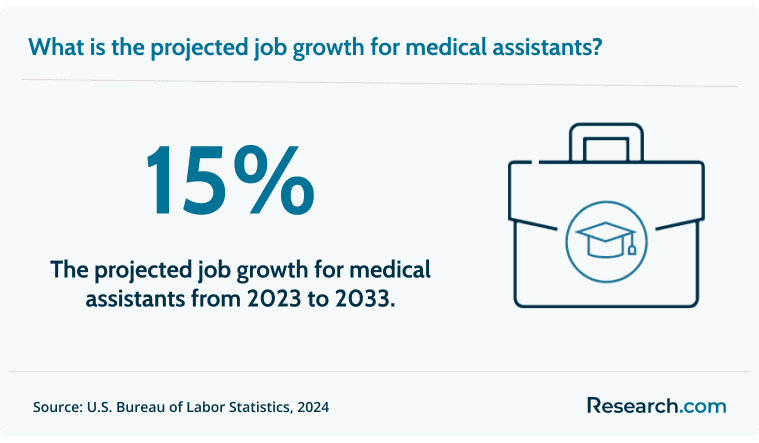
The job outlook for medical assistants is strong. According to the cited U.S. Bureau of Labor Statistics data, employment of medical assistants is projected to grow by 15 percent from 2023 to 2033. That growth would increase the number of employed medical assistants from 783,900 in 2023 to approximately 901,900 by 2033.
The projected growth is connected to several healthcare trends: more outpatient care, ongoing demand for preventive services, and the need to support providers as patient volumes rise. Medical assistants are valuable because they can handle both clinical intake and administrative coordination, which helps practices move patients through visits efficiently.
The field is also expected to have about 119,800 job openings each year on average. Many of these openings come from workers retiring, changing occupations, or moving into higher-level healthcare roles. For job seekers, that means the outlook is not based only on new positions; replacement hiring also contributes to continued demand.
How can certifications help medical assistants advance?
Certification can make a medical assistant more competitive by showing employers that the candidate has met a recognized standard of knowledge and skill. It can be especially useful when applying to hospitals, outpatient centers, specialty practices, and roles involving more clinical responsibility.
Additional credentials may also help medical assistants move into specialized or administrative areas. For example, training in phlebotomy, EKG support, medical billing, coding, or records management can broaden the types of jobs a medical assistant can pursue. Those interested in revenue-cycle or documentation roles can compare different medical billing and coding certifications to see which credentials align with their goals.
| Career goal | Useful skill or credential area | Potential benefit |
| More clinical duties | Medical assisting certification, phlebotomy, EKG-related training | Can support eligibility for roles with broader patient-care responsibilities |
| Front-office advancement | Administrative medical assisting, billing, coding, insurance workflows | Can lead to stronger office coordination or revenue-cycle responsibilities |
| Specialty practice work | Pediatrics, cardiology, dermatology, or other specialty-specific experience | Helps candidates stand out for focused clinical environments |
| Long-term advancement | Nursing prerequisites, healthcare administration, public health, health information | Creates pathways beyond entry-level medical assisting |
Can more education improve medical assistant career options?
Further education can help medical assistants move beyond entry-level clinical support, but it should be chosen with a clear goal. A degree or certificate is most useful when it connects directly to a target role, such as public health outreach, health information, practice management, nursing, or healthcare administration.
Medical assistants interested in prevention, community health, or population-level care may consider a cheap online public health bachelor's degree. This type of education may broaden a medical assistant’s understanding of health systems, prevention, health policy, and community wellness, which can be useful for non-bedside healthcare roles.
How can medical assistants move into healthcare administration?
Medical assistants often gain practical knowledge of scheduling, patient flow, documentation, insurance, provider support, and compliance. That experience can translate well into healthcare administration when paired with management training, administrative certification, or a relevant degree.
A realistic transition plan may include taking on lead medical assistant duties, learning billing and coding basics, helping train new staff, documenting workflow improvements, and applying for office coordinator or practice management roles. Those considering leadership-oriented healthcare careers can review what are the highest paying healthcare administration jobs to understand how far the administrative path can extend.
Can advanced academic training support long-term career growth?
Advanced education may be worthwhile for medical assistants who want to leave routine clinic support and move toward research, laboratory-related work, healthcare management, nursing prerequisites, or other science-based roles. The key is to avoid enrolling simply because a degree sounds impressive. The program should match the job you want next.
For medical assistants interested in broader science preparation, a fast track biology degree online may provide a foundation for future healthcare or science-related study. Others may compare broader biology degree programs if they want a more traditional academic route.
What work-life balance issues should medical assistants expect?
Medical assisting can offer more predictable schedules than some hospital-based healthcare roles, especially in physician offices. However, work-life balance depends heavily on the setting. Outpatient centers, urgent care clinics, hospitals, and high-volume practices may involve evenings, weekends, long shifts, or unexpected overtime. Smaller offices may offer more consistent weekday schedules but fewer advancement opportunities.
The role can also be physically and emotionally demanding. Medical assistants may spend much of the day standing, moving between rooms, calming anxious patients, handling frustrated callers, and keeping up with documentation. Burnout risk increases when staffing is tight, patient volume is high, or duties are unclear.
| Work-life factor | Potential challenge | What to ask before accepting a job |
| Schedule | Evenings, weekends, rotating shifts, or overtime | “What are the normal hours, and how often do shifts change?” |
| Patient volume | Fast pace and limited downtime | “How many providers and patients does each medical assistant support daily?” |
| Role clarity | Clinical and administrative tasks may overlap heavily | “Which duties are expected, and which require additional training?” |
| Physical demands | Standing, walking, stocking rooms, assisting patients | “What physical tasks are part of a typical shift?” |
| Advancement support | Limited growth if training is not encouraged | “Does the employer support certification, cross-training, or promotion?” |
How does an aging population affect medical assistant demand?
An aging population increases demand for routine healthcare, chronic-condition monitoring, preventive services, and follow-up visits. Older adults often need more frequent contact with healthcare providers, which creates more need for staff who can prepare patients, update records, coordinate visits, and keep clinical workflows moving.
This trend also supports growth in outpatient, urgent care, long-term care, and ambulatory settings. As more care shifts away from overnight hospital stays and toward clinics or outpatient facilities, medical assistants become important members of the care team. Their ability to handle both patient-facing tasks and administrative coordination makes them especially useful in settings that manage high appointment volumes.
How much do medical assistants earn?
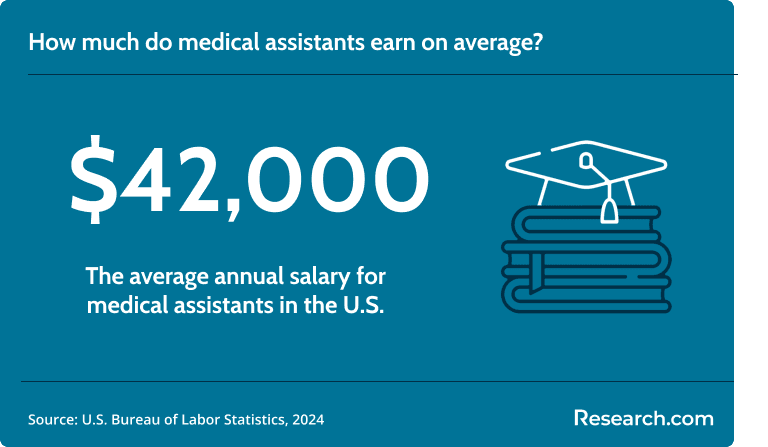
Medical assistants earn an average salary of $42,000 per year, or about $20.19 per hour, according to the stated national data. For many workers, the appeal is not only the wage but also the relatively accessible training pathway and the chance to build healthcare experience without completing a long degree first.
Pay can vary by location, employer type, certification status, specialty, and experience. Outpatient care centers and hospitals show higher listed average salaries than physician offices in the data above, but the best choice is not always the highest hourly rate. Benefits, schedule stability, commute, workload, promotion opportunities, and tuition or certification support can meaningfully affect the value of a job offer.
| Factor | How it can affect pay | What job seekers should compare |
| Location | Wages often differ by region and local demand | Hourly wage, cost of living, commute, and local competition |
| Work setting | Hospitals and outpatient centers may offer different pay and schedules than private offices | Salary, shift expectations, benefits, and workload |
| Certification | Some employers prefer or require certified applicants | Whether certification changes eligibility, pay, or promotion options |
| Experience | Experienced medical assistants may qualify for lead, specialty, or higher-responsibility roles | Training support, promotion policies, and performance review timelines |
| Specialization | Skills in phlebotomy, EHR, billing, or specialty care may improve competitiveness | Which specialized skills are actually requested by local employers |
What are common advancement paths for medical assistants?
Medical assisting can be a long-term role, but it also works well as a launchpad into other healthcare careers. Advancement usually requires one or more of the following: experience, certification, specialty training, leadership exposure, or additional education.
- Clinical specialization: Medical assistants may build skills in areas such as phlebotomy, cardiology, pediatrics, dermatology, or other specialties. Specialization can lead to more focused duties and stronger competitiveness for certain employers.
- Lead medical assistant or trainer: Experienced medical assistants may help onboard new staff, organize clinic workflows, maintain supplies, or coordinate daily patient flow.
- Medical office manager or practice manager: Those with strong administrative skills can move into scheduling oversight, staff coordination, billing workflows, compliance support, and practice operations. Long-term leadership-minded healthcare workers may also explore a chief nursing officer career path, though that route requires substantial nursing education and leadership progression.
- Certified Medical Administrative Assistant (CMAA): Administrative certification may help medical assistants focus more on records, billing, insurance, front-office leadership, and office coordination.
- Health information technician: Medical assistants interested in records, documentation accuracy, privacy, and healthcare software may move toward health information roles. This path is increasingly relevant as healthcare organizations rely on electronic health records (EHR).
- LPN or RN pathway: Medical assistants who want broader clinical authority and deeper patient-care responsibility may return to school to become a Licensed Practical Nurse or Registered Nurse.
| Advancement option | Best for medical assistants who... | Likely next step |
| Specialty medical assistant | Enjoy clinical work and want deeper experience in one practice area | Seek specialty clinics and relevant short-term training |
| Lead medical assistant | Like mentoring coworkers and improving clinic workflows | Build experience, document achievements, and ask for leadership duties |
| Medical office manager | Prefer operations, scheduling, staff coordination, and patient access | Develop administrative, billing, and supervision skills |
| Health information technician | Are detail-oriented and interested in records, data, privacy, and systems | Learn EHR workflows and consider health information training |
| LPN or RN | Want more advanced clinical responsibility and nursing scope of practice | Complete required nursing prerequisites and apply to an approved program |
Which online education options can support advancement?
Online education can be useful for medical assistants who need flexibility while continuing to work. The best options depend on the career goal. A short certification may be enough for billing, coding, or administrative skills, while a degree may be more appropriate for healthcare administration, public health, nursing preparation, or long-term leadership roles.
For medical assistants interested in operations and management, a health administration degree online can help build knowledge in healthcare systems, compliance, resource management, and organizational leadership. Before enrolling, confirm accreditation, transfer credit policies, total program cost, schedule flexibility, and whether the program supports the job you want next.
How to choose the right medical assistant program
Because medical assisting can be entered through several routes, choosing a program should be a practical decision rather than a quick reaction to advertising. A short program may help you enter the workforce faster, but it still needs to prepare you for the duties, certification, and employer expectations in your area.
- Check accreditation and recognition: Make sure the program is accepted by employers and supports the certification exam you plan to take.
- Confirm clinical training: Look for hands-on practice, externship opportunities, or supervised clinical experience.
- Compare total cost, not just tuition: Include fees, books, uniforms, supplies, exam costs, transportation, and lost work time.
- Ask about certification outcomes: Find out whether graduates are eligible for major credentials and whether exam preparation is included.
- Review local employer requirements: Scan job postings in your area to see whether employers require certification, EHR experience, phlebotomy skills, or specific schedules.
- Evaluate schedule fit: Online coursework can be convenient, but clinical skills usually require in-person practice.
- Ask about career services: Strong programs may help with externship placement, resumes, interview preparation, and employer connections.
Common mistakes to avoid when entering medical assisting
| Mistake | Why it can hurt you | Better approach |
| Choosing the fastest program without checking quality | You may finish quickly but lack the preparation employers expect | Confirm certification eligibility, hands-on training, and employer recognition |
| Assuming certification is never needed | Some employers strongly prefer or require certified candidates | Review job postings and state rules before deciding |
| Focusing only on salary | A higher wage may come with difficult shifts, long commutes, or heavy workloads | Compare benefits, hours, patient volume, advancement, and culture |
| Ignoring state-specific scope rules | Allowed duties can vary, especially for injections, medications, or specialized tasks | Check state regulations and employer policies before accepting responsibilities |
| Not planning the next step | You may stay in an entry-level role longer than intended | Decide early whether you want specialization, administration, nursing, or another path |
| Assuming salary outcomes are guaranteed | Actual pay depends on location, employer, experience, and credentials | Use salary data as a benchmark, then compare real local job offers |
Questions to ask before becoming a medical assistant
- Do I want a role that mixes patient care with front-office and records work?
- Am I comfortable taking vital signs, preparing patients, and working under provider supervision?
- Do employers in my area require or prefer certification?
- Which setting fits my lifestyle best: physician office, hospital, outpatient center, specialty practice, or senior care?
- Can I handle the pace, emotional demands, and physical activity of clinical support work?
- Is my goal to stay in medical assisting, specialize, move into administration, or continue into nursing?
- Will the program I choose prepare me for certification and local job requirements?
- What is the total cost of training, and how long will it take to recover that investment through employment?
Here’s what graduates have to say about their medical assistant degrees:
-
: "
Medical assisting gave me the mix of patient interaction and office responsibility I wanted. I get to support people during their visits while also helping the clinic stay organized and efficient. – Joshua
"
-
: "
I chose medical assisting because I wanted a healthcare role with hands-on work and a fast pace. The experience I have gained, especially in pediatrics, has made the career feel stable and meaningful. – Hannah
"
-
: "
After certification, I realized medical assisting could lead in several directions. I started in clinical support and have already moved toward office management, which has made the career feel flexible. – Stanley
"
Key Insights
- Medical assisting has a strong outlook, with employment projected to grow 15% from 2023 to 2033.
- About 119,800 openings are expected each year, supported by both new demand and replacement hiring.
- The aging population and continued shift toward outpatient care are major reasons medical assistants remain important in clinics, urgent care, outpatient centers, and physician offices.
- The average salary for a medical assistant is $42,000 per year, but pay varies by setting, location, certification, experience, and specialty.
- Certification is not always legally required, but it can improve competitiveness and may be expected by many employers.
- Medical assisting is best for people who want a practical healthcare role combining clinical support, patient communication, records, scheduling, and office coordination.
- Career growth is possible through specialization, lead medical assistant roles, office management, health information, billing and coding, healthcare administration, or further education toward LPN or RN roles.
- The smartest program choice is not always the fastest or cheapest one. Prioritize accreditation, certification eligibility, hands-on training, local employer recognition, and total cost.
References:
- CareerExplorer. (2023). The job market for medical assistants in the United States. https://www.careerexplorer.com
- U.S. Bureau of Labor Statistics. (2024). OOH: Medical Assistants. https://www.bls.gov
Other things you should know about the medical assistant job outlook
States with the fastest projected medical assistant growth in 2027 are concentrated in the Sun Belt and Mountain West, including Utah, Arizona, and Florida. Employment demand is highest where population growth, outpatient clinics, and primary care expansion are strongest, according to labor market projections.
To become a medical assistant in 2027, individuals typically need a postsecondary certificate or diploma from an accredited program. These programs often include coursework in anatomy, medical terminology, and clinical procedures, and may be completed in one year or less.
In 2027, telehealth expansion offers mixed impacts on medical assistant roles. While some administrative tasks may shift online, the demand for tech-savvy medical assistants who can facilitate virtual patient care increases. This shift emphasizes adaptable skills in technology and patient communication, underscoring the evolving nature of healthcare delivery.


