2027 Medical Jobs That Don't Require a College Degree

Co-Founder and Chief Data Scientist
You can enter healthcare without a college degree, but “no degree” does not usually mean “no training.” Most accessible medical jobs require a high school diploma or equivalent plus short-term training, a certificate, a state exam, employer-based instruction, or a nationally recognized credential. That distinction matters because choosing the wrong program can cost time and money without helping you qualify for the jobs you want.
This guide is for career changers, recent high school graduates, working adults, and anyone who wants a practical path into healthcare without committing to a two-year or four-year degree right away. In 2023, over 24% of healthcare workers had only a high school diploma, according to the U.S. Bureau of Labor Statistics. At the same time, the healthcare sector is projected to have 1.9 million job openings each year through 2033, creating steady demand for support roles in clinics, hospitals, pharmacies, laboratories, dental offices, and home care.
Below, you will find the best medical jobs with no college degree for 2027, how much they pay, which ones are easiest to enter, which offer remote options, how to choose a credible certification program, and how to turn an entry-level healthcare job into a longer-term career path.
Quick Answer: What are the best medical jobs without a college degree?
The best medical jobs that do not require a college degree include medical assistant, phlebotomist, medical coder and biller, dental assistant, pharmacy technician, home health aide, certified nursing assistant, surgical technician, medical transcriptionist, and sterile processing technician. Some roles can be entered through employer training, while others usually require certification, state-approved training, clinical practice hours, or a postsecondary certificate.
If your priority is fast entry, consider home health aide, medical administrative assistant, CNA, or phlebotomy technician. If your priority is remote work, medical billing and coding or medical transcription may be better fits. If your priority is advancement, medical assistant, CNA, pharmacy technician, and surgical technology can provide experience that supports future moves into nursing, healthcare administration, specialized technician roles, or degree-based healthcare careers.
Key Things You Should Know Before Choosing a No-Degree Medical Job
- No college degree does not always mean no credential. Medical assisting, phlebotomy, pharmacy technology, billing and coding, sterile processing, and CNA roles often require or strongly prefer certification, state-approved training, or employer-recognized credentials.
- Training can be short, but quality matters. Some programs take only weeks or months, but students should confirm accreditation, exam eligibility, clinical requirements, and whether local employers recognize the credential.
- Many jobs are entry points, not endpoints. Non-degree healthcare roles can lead to higher responsibility through experience, additional certification, employer tuition assistance, or later degree completion.
- Pay varies widely by setting and location. Hospitals, government facilities, specialty clinics, night shifts, and high-cost metropolitan areas may pay more than smaller offices or long-term care settings.
- Healthcare demand is strong, but outcomes are not guaranteed. Job prospects depend on local hiring needs, state rules, certification status, experience, schedule flexibility, and the quality of your training.
- Best medical jobs that do not require a college degree for 2027
- Highest-paying medical jobs with no college degree
- Remote medical jobs with no college degree
- Whether online medical certificates count for hospital jobs
- Most in-demand medical jobs with no college degree
- How to move into healthcare without prior medical experience
- Healthcare jobs that train beginners on the job
- Medical certifications you can complete in 6 months or less
- Skills and certifications that strengthen non-degree healthcare careers
- Why specialized technical credentials matter for long-term growth
- How to evaluate certification program credibility
- How online education can support advancement
- How non-degree workers can move toward healthcare administration
- Why continuing education supports career longevity
- How business skills can expand healthcare career options
- Salary differences between certification-based and degree-based medical jobs
- No-degree medical jobs with strong advancement potential
- Easiest medical jobs to start
Best Medical Jobs That Don’t Require a College Degree for 2027
The right no-degree medical job depends on your tolerance for patient contact, schedule demands, physical work, certification requirements, and long-term goals. The table below gives a fast comparison before the role-by-role breakdown.
| Role | Median salary | Typical entry requirement | Best fit for |
| Medical Assistant | $42,000 per year | Certificate often preferred; usually less than a year | People who want both clinical and front-office experience |
| Phlebotomist | $41,810 per year | Certification; often under a year | People comfortable with blood draws and lab workflows |
| Medical Coder and Biller | $48,780 per year | Certification commonly preferred | Detail-oriented workers seeking administrative or remote options |
| Dental Assistant | $46,540 per year | State rules vary; certification may be required | People interested in oral healthcare and procedure support |
| Pharmacy Technician | $40,300 per year | Certification may depend on state regulations | Workers interested in medications, customer service, and accuracy |
| Home Health Aide | $33,530 per year | High school diploma or equivalent; employer training common | People who want direct care work in patients’ homes |
| Certified Nursing Assistant | $38,130 per year | State-approved training program and competency exam | Students considering a future nursing pathway |
| Surgical Technician | $60,610 per year | Postsecondary certificate or associate degree; 12 to 24 months | People who want operating room work and can handle pressure |
| Medical Transcriptionist | $37,060 per year | Certificate often preferred; 6 to 12 months | Strong typists with medical terminology skills |
| Sterile Processing Technician | $39,640 per year | High school diploma or GED; certification often preferred | Detail-focused workers interested in infection control and surgical support |
1. Medical Assistant
- What they do: Medical assistants help keep clinics and physician offices running by collecting patient histories, checking vital signs, preparing exam rooms, assisting with basic procedures, administering simple treatments when allowed, and updating electronic health records. Many also schedule visits, manage forms, and communicate with patients.
- Median Salary: $42,000 per year
- Training: Certification programs available, typically less than a year.
- Good fit if: You want broad exposure to healthcare before deciding whether to pursue nursing, office management, or another clinical path.
2. Phlebotomist
- What they do: Phlebotomists collect blood samples for testing, donations, transfusions, or medical procedures. Their work includes identifying patients correctly, preparing supplies, labeling specimens, following safety protocols, and helping anxious patients remain calm during blood draws.
- Median Salary: $41,810 per year
- Training: Certification required; can be completed in under a year.
- Good fit if: You want a short clinical training path and are comfortable working with needles, blood, and laboratory procedures.
3. Medical Coder and Biller
- What they do: Medical coders review clinical documentation and convert diagnoses, services, and procedures into standardized ICD-10, CPT, and HCPCS codes. Medical billers use those codes to prepare claims, submit them to insurers, follow up on denials, and answer billing questions. Accuracy is essential because mistakes can delay reimbursement, create compliance problems, or cause patient billing issues.
- Median Salary: $48,780 per year
- Training: While a college degree isn’t required, most employers prefer candidates with a certification in medical coding and billing.
- Good fit if: You prefer records, data, insurance rules, and computer-based work over hands-on patient care.
4. Dental Assistant
- What they do: Dental assistants prepare patients and treatment rooms, pass instruments to dentists, handle sterilization, take or process X-rays when allowed, prepare dental materials, document care, and explain basic oral hygiene instructions. Requirements differ by state, especially for radiography or expanded functions.
- Median Salary: $46,540 per year
- Training: Some states require certification, which can be completed in under a year
- Good fit if: You want a healthcare role with procedure support but prefer dental settings over hospitals or long-term care.
5. Pharmacy Technician
- What they do: Pharmacy technicians work under pharmacist supervision to prepare prescriptions, measure medication quantities, label containers, maintain inventory, process insurance information, and assist customers. Accuracy, confidentiality, and attention to dosage instructions are central to the job.
- Median Salary: $40,300 per year
- Training: Certification may be required depending on state regulations
- Good fit if: You are detail-oriented, comfortable with customer service, and interested in medication safety.
6. Home Health Aide
- What they do: Home health aides support older adults, people with disabilities, and patients with chronic illness who need help at home. Tasks may include bathing, dressing, meal preparation, light housekeeping, mobility assistance, reminders about medications, and reporting changes in a client’s condition to family members, nurses, or supervisors.
- Median Salary: $33,530 per year
- Training: Most home health aides require only a high school diploma or equivalent, and many employers provide on-the-job training.
- Good fit if: You are patient, dependable, and comfortable providing personal care in a home setting.
7. Certified Nursing Assistant
- What they do: CNAs provide basic bedside care in nursing homes, hospitals, and home health environments. They help patients bathe, dress, eat, move safely, and stay comfortable. They also take vital signs and report changes to nurses. For readers comparing patient-care paths, CNA work is often discussed alongside less stressful nursing jobs, although the day-to-day workload can still be physically and emotionally demanding.
- Median Salary: $38,130 per year
- Training: State-approved training program and competency exam
- Good fit if: You want direct patient care experience and may later pursue LPN, LVN, or RN training.
8. Surgical Technician
- What they do: Surgical technologists prepare operating rooms, organize sterile instruments, count supplies, assist surgical teams during procedures, maintain sterile technique, and help clean and restock the room after surgery. The role requires precision, focus, and the ability to stay calm when procedures move quickly.
- Median Salary: $60,610 per year
- Training: Surgical technologists typically need a postsecondary certificate or associate degree from an accredited surgical technology program, which can take 12 to 24 months to complete.
- Good fit if: You want a technical operating room role and are willing to complete longer training than many other no-degree healthcare jobs require.
9. Medical Transcriptionist
- What they do: Medical transcriptionists convert healthcare providers’ recorded notes into written reports and patient records. Many also edit speech-recognition drafts, correct terminology, check formatting, and flag inconsistencies. Strong grammar, typing speed, medical vocabulary, and confidentiality are important.
- Median Salary: $37,060 per year
- Training: A college degree is not required, but most employers prefer candidates who complete a medical transcription certificate program, which can be completed in 6 to 12 months.
- Good fit if: You want healthcare-related work that is documentation-focused and may be performed remotely for some employers.
10. Sterile Processing Technician
- What they do: Sterile processing technicians clean, inspect, assemble, sterilize, store, and track surgical instruments and medical equipment. Their work reduces infection risk and helps surgical teams receive the correct tools on time. The job requires careful adherence to protocols and strong attention to detail.
- Median Salary: $39,640 per year
- Training: While a high school diploma or GED is typically required, most employers prefer candidates who complete a sterile processing technician certification program, which can be completed in a few months to a year.
- Good fit if: You want a hospital-based role tied to surgical care but do not want constant direct patient interaction.
What are the highest-paying medical jobs with no college degree?
The highest-paying medical jobs without a traditional college degree are usually technical, regulated, or specialized roles that require formal training beyond high school. Surgical assistants and technologists can earn upwards of $60,000 per year, and licensed practical and licensed vocational nurses earn around $59,730 annually. Massage therapists make approximately $55,310 per year. Medical coding, dental assisting, phlebotomy, and pharmacy technology can also provide stable earnings, although many non-degree healthcare roles pay below the national average salary, which was more than $66,600 in 2023 according to the Social Security Administration.
For example, a medical coding salary can be attractive for people who want administrative healthcare work, but earnings depend heavily on certification, specialty knowledge, accuracy, and experience. The “highest-paying” option is not always the best first job if it requires training you cannot afford, clinical hours you cannot complete, or a schedule that does not fit your life.
Factors that can raise or lower pay
- Location: Pay often reflects local cost of living and labor demand. For example, a therapy aide in Massachusetts can earn around $41,290 annual mean wage, which is 35% more than a therapy aide working in Louisiana who gets paid around $28,770 on average according to the U.S. Bureau of Labor Statistics.
- Experience Level: New workers typically start lower, while experienced employees may qualify for higher pay, lead duties, or more desirable shifts.
- Certifications and Specializations: Credentials such as Certified Pharmacy Technician (CPhT), coding certifications, or advanced technical training can make candidates more competitive.
- Demand for the Role: Jobs serving aging populations, outpatient growth, or high-volume healthcare operations may have steady hiring needs.
- Shift Differentials: Hospitals and 24-hour facilities may pay extra for evenings, nights, weekends, holidays, or hard-to-fill shifts.
- Industry Setting: Hospitals, government facilities, and specialty practices may pay differently than physician offices, nursing homes, retail settings, or home care agencies. Nursing assistants and orderlies, for instance, tend to earn the most in government facilities, as shown below.
Are there remote medical jobs with no college degree?
Yes. Some healthcare jobs that do not require a college degree can be performed remotely, especially roles centered on records, billing, scheduling, documentation, claims, and patient coordination. Remote healthcare jobs are less common in hands-on clinical care, and employers may still require certification, experience, secure technology access, HIPAA training, and familiarity with electronic health record systems.
| Remote-friendly role | Main work | What employers often look for |
| Medical Transcriptionist | Transcribes or edits provider dictation and medical reports | Medical terminology, typing accuracy, confidentiality, and transcription training |
| Medical Billing and Coding Specialist | Codes diagnoses and procedures, submits claims, and reviews denials | Billing and coding certification, payer knowledge, and careful documentation review |
| Virtual Patient Coordinator | Schedules appointments, answers patient questions, updates records, and coordinates follow-ups | Customer service, phone skills, EHR experience, and healthcare office knowledge |
- Medical Transcriptionist: This role can often be done from home because the work involves recorded audio, written reports, and document editing rather than in-person care.
- Medical Billing and Coding Specialist: Because claims, codes, and billing systems are digital, many employers offer remote or hybrid options to experienced, credentialed workers.
- Virtual Patient Coordinator: This job uses phone, email, scheduling platforms, and patient record systems to support clinics and medical groups without requiring constant on-site presence.
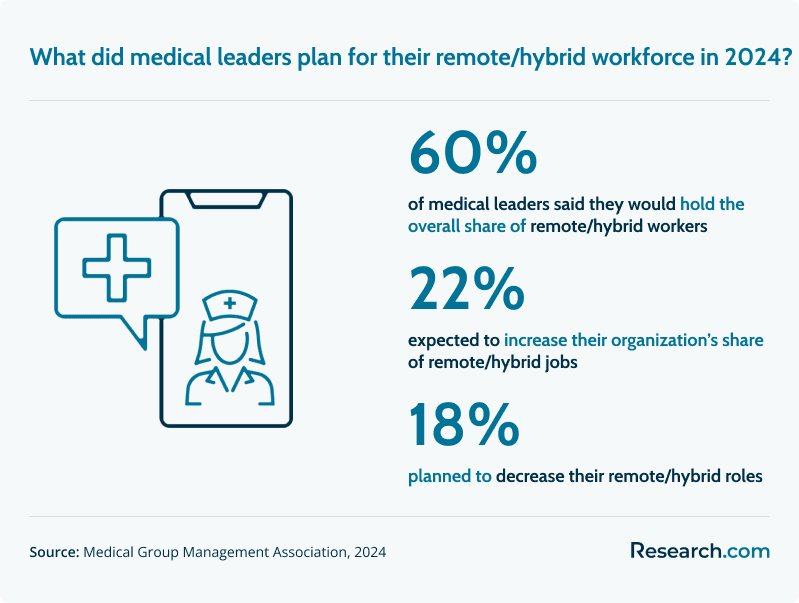
A 2024 poll by the Medical Group Management Association found that 52% of medical groups had 1% to 25% of their workforce working remotely at least half the time. Some organizations planned to increase remote or hybrid staffing, some expected reductions, and others intended to keep their current approach. The infographic below summarizes those plans.
Do online medical certification programs count for hospital jobs?
Online medical certification programs can count for hospital jobs when the credential is recognized, the curriculum matches employer expectations, and any required hands-on training is completed. Hospitals are usually more cautious than smaller offices because they must meet strict compliance, safety, and documentation standards. Before enrolling, confirm whether the program prepares you for the certification named in local job postings.
Online coursework is common for administrative programs, including medical billing and coding classes online. However, clinical roles such as phlebotomy, medical assisting, sterile processing, dental assisting, and surgical technology may require labs, externships, practicums, or in-person skill checks even if lectures are online.
Checklist before enrolling in an online certificate
| Question to ask | Why it matters |
| Is the program accredited or aligned with a recognized certifying body? | Employers may reject credentials from programs with weak recognition. |
| Does it prepare you for a specific exam, such as one from NHA or AAPC? | A named credential is easier to verify than a vague certificate of completion. |
| Are clinical hours, labs, or externships required? | Some healthcare skills cannot be fully learned online. |
| Do local hospitals list this credential in job postings? | Employer acceptance is more important than marketing claims. |
| What are the total costs, including books, exam fees, uniforms, background checks, and immunizations? | Low tuition can be misleading if required extras are expensive. |
| Does the program publish job placement information or employer partnerships? | Career support can matter for first-time healthcare workers. |
Which medical jobs with no college degree are most in demand?
Demand is strongest in roles tied to aging populations, outpatient care, home-based services, and high-volume clinical operations. The best in-demand job for you depends on whether you want direct care, administrative work, or technical support.
- Medical Assistants: Demand for medical assistants is projected to grow 15% from 2023 to 2033, much faster than the average for most occupations. Approximately 119,800 job openings are expected each year, including openings created when workers change careers or retire. Those who want to qualify quickly may compare accelerated medical assistant programs, but should still verify hands-on requirements and employer recognition.
- Home Health Aides: Home health aides have projected job growth of 21% from 2023 to 2033, with approximately 718,900 job openings expected annually. Demand is closely tied to the needs of older adults and people who require support at home rather than in long-term care facilities.
- Veterinary Assistants and Laboratory Animal Caretakers: Employment for veterinary assistants and laboratory animal caretakers is projected to grow by 19% between 2023 and 2033. Around 25,800 openings are expected each year, mainly as workers transfer to other occupations or leave the labor force.
As of 2023, most healthcare workers without a college degree were employed as home health aides, followed by nursing assistants and personal care aides. The chart below shows how non-degree healthcare workers were distributed across selected roles.
How can I switch to a medical career without a healthcare background?
Career changers can enter healthcare by choosing a realistic first role, completing any required short-term training, and using transferable skills from customer service, administration, logistics, caregiving, sales, technology, or military experience. If you later decide to pursue more formal education while employed, accelerated online degree programs for working adults may be worth comparing, especially if your goal shifts toward nursing, public health, healthcare management, or another degree-based path.
A practical transition plan
- Choose your work environment first. Decide whether you prefer hospitals, clinics, dental offices, pharmacies, labs, home care, or remote administrative work.
- Identify the fastest qualifying credential. Review job postings in your area and note which certifications appear repeatedly.
- Start with a role that builds relevant experience. A patient transporter, home health aide, medical receptionist, CNA, or pharmacy technician job can help you learn healthcare systems while earning income.
- Use transferable skills in your resume. Highlight scheduling, confidentiality, documentation, customer service, problem-solving, data entry, and teamwork.
- Get exposure before paying for training. Volunteer, shadow, attend local hiring events, or speak with workers already in the role.
- Plan the second step before taking the first. Ask whether the job can lead to certification reimbursement, tuition assistance, promotion, or a pathway into a higher-paid healthcare role.
If you are comparing healthcare with other accessible career changes, Research.com also covers non-healthcare pathways such as how to become a security guard. The comparison can help you weigh training length, licensing rules, schedule demands, and entry-level pay across fields.
Which healthcare jobs offer on-the-job training for beginners?
Some healthcare employers hire beginners and teach job-specific skills after hiring. These roles can be useful if you need income quickly, want to test whether healthcare is a good fit, or cannot pay upfront for a certificate program.
- Patient Transporter: Patient transporters move patients safely between rooms, tests, procedures, and recovery areas. Employers usually train new hires on safety procedures, wheelchair and stretcher use, communication protocols, and patient privacy.
- Sterile Processing Technician: Some hospitals and surgical centers provide structured training in cleaning, sterilizing, inspecting, and preparing instruments. Certification may still help with hiring or advancement.
- Home Health Aide: Many home health agencies train workers in personal care, safety, documentation, infection control, and communication with supervisors or family members. State rules may require specific training or certification.
For readers considering other beginner-friendly fields, a sales representative career guide can be a useful comparison because sales roles also often value communication skills and may provide employer-led training.
What medical certifications can you get in 6 months or less?
Several healthcare credentials can be completed in 6 months or less, especially for people pursuing entry-level roles. Short programs can be a smart first step, but they should still lead to a credential employers understand. Do not choose a program only because it is fast.
- Phlebotomy Technician Certification: Phlebotomy programs typically take 4 to 6 months and include hands-on blood draw practice. Phlebotomy is often listed among short certificate programs that pay well because it provides a direct path into hospitals, clinics, laboratories, and blood donation centers.
- Medical Billing and Coding Certification: Billing and coding programs can be completed in as little as 3 to 6 months, often online. This path suits people who prefer documentation, insurance claims, coding systems, and remote-friendly administrative work.
- Certified Nursing Assistant Certification: CNA programs often take 4 to 12 weeks and include classroom instruction plus clinical training. CNAs are commonly employed in nursing homes, hospitals, and home healthcare settings.
What additional skills or certifications can enhance non-degree healthcare careers?
After landing an entry-level role, the best way to improve your prospects is to build skills that employers can immediately use. Useful add-ons include electronic health record experience, medical terminology, CPR or basic emergency response training, HIPAA awareness, patient communication, infection control, Excel or spreadsheet skills, and specialty credentials related to your current role.
For administrative workers, medical billing and coding remains one of the most practical areas for advancement. If cost is a concern, compare options carefully and review resources on the cheapest medical coding certification online before enrolling.
Are specialized technical certifications crucial for long-term success?
Specialized credentials are not required for every healthcare support job, but they can become important if you want higher responsibility, better mobility, or access to more technical departments. Employers often look for proof that workers can perform specific tasks safely and accurately, especially in diagnostic, surgical, pharmacy, laboratory, and imaging-related environments.
For example, workers interested in diagnostic imaging may research online ultrasound tech programs. Because many technical healthcare fields include hands-on clinical requirements and employer-specific credential expectations, students should verify whether online coursework is enough or whether in-person labs and supervised clinical experience are required.
How can I assess the credibility of certification programs for non-degree medical roles?
To evaluate a healthcare certificate program, look beyond the homepage. A credible program should clearly state its accreditation or recognition, exam eligibility, curriculum, clinical requirements, total costs, faculty qualifications, employer relationships, and student support services. If a school avoids these details, consider it a warning sign.
| What to verify | Better choice | Risky choice |
| Accreditation or recognition | The program identifies recognized accrediting or certifying bodies | The program uses vague phrases like “nationally accepted” without evidence |
| Exam preparation | The curriculum maps to a specific certification exam | The school promises a certificate but not exam eligibility |
| Clinical or externship support | The program helps arrange required hands-on practice | Students must find clinical placements alone with no support |
| Local employer acceptance | Nearby job postings list the credential | No local employers mention the credential |
| Total cost transparency | Tuition, fees, books, exams, and supplies are listed upfront | Extra costs appear only after enrollment |
Students considering coding should compare program details with established options such as accredited medical coding programs to see whether the curriculum reflects employer expectations.
Can online education bolster career advancement for non-degree healthcare workers?
Online education can help non-degree healthcare workers move beyond entry-level roles when it adds skills that match a clear career goal. Short online courses may help with medical terminology, billing, coding, supervision, public health basics, or healthcare technology. Degree programs may be useful if you want roles that commonly require formal education, such as public health, healthcare administration, nursing, or management.
For example, a worker moving from direct care into population health or community health may compare options for a bachelors in public health online. The key is to connect the program to a specific job target rather than enrolling only because the format is flexible.
Can non-degree holders transition to healthcare administration roles?
Yes, but the transition usually requires proof of leadership, organization, healthcare operations knowledge, and communication skills. A non-degree worker might move from medical assistant to lead medical assistant, from front-desk coordinator to office supervisor, or from billing specialist to revenue cycle team lead. Over time, additional training or a degree may become important for higher-level management roles.
Reviewing examples of high paying healthcare administration jobs can help you understand which positions require a degree, which require experience, and which skills you should build first.
How can continuing education boost career longevity in non-degree healthcare roles?
Healthcare procedures, software systems, insurance rules, privacy requirements, and patient-care expectations change over time. Continuing education helps non-degree workers stay employable, qualify for promotion, and avoid being limited to one narrow task. Useful options include refresher certifications, EHR training, specialty workshops, leadership courses, infection-control updates, and employer-sponsored training.
Some workers also broaden their career options by combining healthcare experience with related fields. For example, a person interested in wellness operations, athletics, or recreation management may compare a cheap sports management degree online with healthcare-focused alternatives before deciding which direction best fits their goals.
Can business skills enhance career opportunities for non-degree healthcare professionals?
Business skills can be valuable for healthcare workers who want to move into office leadership, scheduling, operations, billing, compliance support, inventory control, team supervision, or entrepreneurship. Skills in budgeting, workflow improvement, customer service, data reporting, and staff coordination can make a clinical support worker more competitive for non-clinical advancement.
Workers who want a faster academic route into management may compare fast business degrees online with healthcare administration, public health, or management certificates. The best choice depends on whether your target job is inside a healthcare organization or in a broader business setting.
Common mistakes to avoid when choosing a no-degree medical career
| Mistake | Why it can hurt you | Better approach |
| Choosing the fastest program without checking employer recognition | You may finish quickly but still not qualify for local jobs | Search real job postings before enrolling |
| Looking only at tuition | Books, exams, uniforms, background checks, and supplies can change the true cost | Ask for a full cost breakdown in writing |
| Assuming online training is enough for clinical roles | Some roles require in-person skills practice or clinical hours | Confirm lab, externship, and state requirements |
| Ignoring schedule realities | Healthcare may require evenings, weekends, holidays, or physically demanding shifts | Ask employers about shifts before committing to training |
| Assuming salary outcomes are guaranteed | Pay depends on location, employer, experience, certification, and shift | Use salary data as a planning estimate, not a promise |
| Not planning an advancement path | You may get stuck in a low-paying role longer than expected | Choose jobs that build toward a next credential or promotion |
How do salaries compare between certification-based and degree-based medical jobs?
Certification-based healthcare jobs are usually faster and cheaper to enter than degree-based professions, but they often pay less because the scope of practice, legal responsibility, and required training are more limited. For example, CNAs earn an average salary of $38,130 per year, while a registered nurse with a bachelor's degree earns an average salary of $86,070 per year. Nurse practitioners, who must earn at least a master’s degree, earn an average salary of $129,480 per year.
| Path | Example role | Average or median salary stated | Typical trade-off |
| Short training or certification | Certified Nursing Assistant | $38,130 per year | Faster entry, lower pay, direct care experience |
| Bachelor’s degree | Registered Nurse | $86,070 per year | Longer education, broader clinical responsibility, higher earning potential |
| Master’s degree or higher | Nurse Practitioner | $129,480 per year | Advanced training, diagnostic authority, higher responsibility |
That pattern appears in many fields: more training can increase responsibility and pay, but it also requires more time, tuition, and licensing preparation. A similar decision applies outside healthcare; for instance, the steps to becoming a probation officer often include degree requirements, field training, and state exams that can affect advancement and pay over time. The chart below shows the broader salary relationship by education level using National Center for Education Statistics data.
Which medical jobs with no college degree offer the best career advancement?
The best advancement roles are those that expose you to healthcare systems, patient care, documentation, compliance, and team workflows. A strong first job should help you build experience that transfers into a better credential, higher-paying department, or degree-based role if you choose that route later.
- Medical Assistant: Medical assistants learn both clinical and administrative work, which can support moves into lead medical assistant, medical office manager, licensed practical nurse, registered nurse, or specialized clinic roles. Some employers offer tuition assistance for workers who continue their education.
- Pharmacy Technician: Pharmacy technicians can grow into specialized technician roles, compounding support, inventory leadership, hospital pharmacy settings, or supervisory work. Some use the role to explore whether pharmacy school or another healthcare path is realistic.
- Certified Nursing Assistant: CNA work is one of the clearest entry points into nursing. Many CNAs later pursue LPN, LVN, or RN programs after gaining direct patient care experience and confirming that nursing fits their goals.
What are the easiest medical jobs to get started in?
The easiest medical jobs to start are usually those with short training, employer-provided instruction, or a low barrier to entry. However, “easy to start” does not mean the work is easy. Home care, CNA work, and phlebotomy can be physically demanding, emotionally intense, or highly detail-oriented.
- Home Health Aide: Home health aide roles are among the most accessible because many employers provide training and do not require a college degree. The work involves personal care, companionship, mobility help, meal support, and basic household assistance.
- Medical Administrative Assistant: This role is a good fit for people with clerical, scheduling, phone, or customer service experience. Job duties often include appointment management, patient check-in, records support, and insurance-related paperwork.
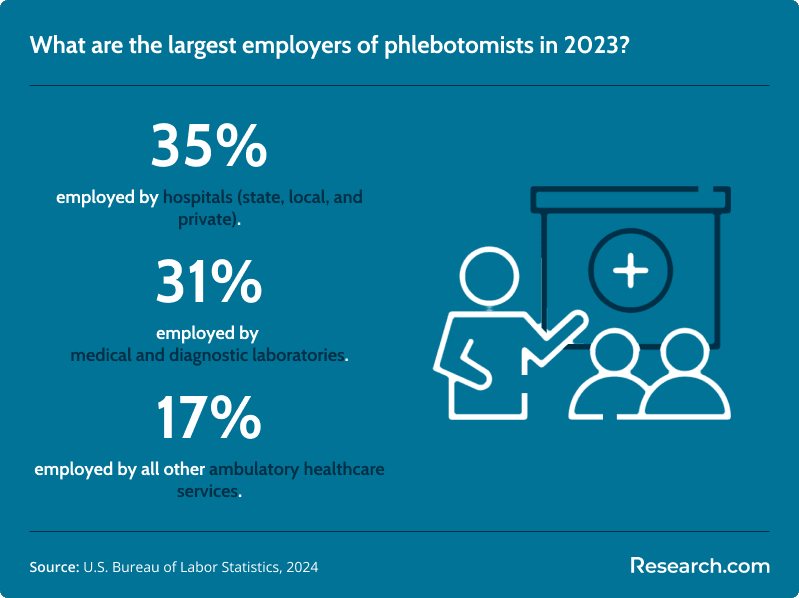
- Phlebotomy Technician: Phlebotomy can be entered through a short certification program, often within a few months. As of 2023, most phlebotomists work in hospitals, while others are employed in different healthcare settings, as shown below.
Requirements vary across career fields. For example, people researching private investigator qualifications will find that licensing, background checks, and experience rules differ by state, much like healthcare certification and training requirements differ by role and location.
What Workers Say About Medical Jobs With No College Degree
- I became a medical assistant without first earning a college degree, and it gave me a stable healthcare job with benefits. Starting with hands-on training helped me learn quickly, and working with patients every day makes the job feel meaningful. Jemma
- Phlebotomy gave me a practical way into healthcare. I completed a short certification program, started working with patients, and found a schedule that fits my life. It is rewarding to know my work supports diagnosis and treatment. Cyrus
- EMT work is demanding, fast-moving, and full of responsibility. I did not need a college degree to begin, but I did need training, focus, and the ability to stay calm during emergencies. Helping people in critical moments is what keeps me committed. Tanya
Questions to ask before choosing a no-degree medical job
- Do I want direct patient care, administrative work, technical support, or remote work?
- Does my state require certification, licensing, an exam, or supervised clinical hours for this role?
- Do local employers recognize the certificate program I am considering?
- What is the total cost of training, including exam fees and supplies?
- Can I handle the physical, emotional, and schedule demands of this job?
- Will this role help me move toward a higher-paying healthcare career later?
- Does the employer offer tuition assistance, paid training, or promotion pathways?
- Are there enough openings for this job in my area?
Key Insights
- More than 24% of healthcare workers in 2023 had only a high school diploma, showing that non-degree workers remain essential to healthcare delivery.
- The healthcare field is projected to have approximately 1.9 million openings each year from 2023 to 2033, but local job availability still depends on role, location, certification, and employer demand.
- The fastest entry points include home health aide, CNA, phlebotomy technician, medical administrative assistant, and some sterile processing or patient transporter roles.
- Home health aide is one of the strongest-demand options, with projected job growth of 21% from 2023 to 2033.
- Phlebotomy and medical billing and coding are among the quicker certification routes, but students should verify exam eligibility, hands-on requirements, and employer acceptance before enrolling.
- Many no-degree medical jobs pay below the 2023 national average salary of more than $66,600, so advancement planning matters.
- The best first job is not always the highest-paying one. A strong entry-level role should match your schedule, strengths, local hiring market, and long-term career goal.
References:
- Glassdoor. (2024, June 6). How much does a medical administrative assistant make? Glassdoor.com. Retrieved March 14, 2025.
- Richards Rolen, E. (2016, November). Healthcare jobs you can get without a bachelor’s degree. U.S. Bureau of Labor Statistics. Retrieved March 14, 2025.
- Salary.com. (2024, March 1). Sterile processing technician salary, hourly rate (March 2025) United States. Salary.com. Retrieved March 16, 2025.
- Smith, S., & Blank, A. (2023, June). Healthcare occupations: Characteristics of the employed. U.S. Bureau of Labor Statistics. Retrieved March 15, 2025.
- SSA. (n.d.). National average wage index. The United States Social Security Administration. Retrieved March 15, 2025.
- U.S. BLS. (2024, August 29). Nursing assistants and orderlies: Pay. U.S. Bureau of Labor Statistics. Retrieved March 15, 2025.
- U.S. BLS. (2024, April 3). Occupational employment and wages, May 2023: 31-2012 occupational therapy aides. U.S. Bureau of Labor Statistics. Retrieved March 14, 2025.
- U.S. BLS. (2024, April 3). Occupational employment and wages, May 2023: 31-9093 medical equipment preparers. U.S. Bureau of Labor Statistics. Retrieved March 14, 2025.
- U.S. BLS. (2024, August 29). Occupational outlook handbook: Healthcare occupations. U.S. Bureau of Labor Statistics. Retrieved March 14, 2025.
- U.S. BLS. (2024, August 29). Occupational outlook handbook: Medical records specialists. U.S. Bureau of Labor Statistics. Retrieved March 14, 2025.
- U.S. BLS. (2024, August 29). Occupational outlook handbook: Nursing assistants and orderlies. U.S. Bureau of Labor Statistics. Retrieved March 14, 2025.
Other Things You Should Know About Medical Jobs That Don't Require a College Degree
In 2027, regulatory requirements for non-degree medical jobs often include obtaining certifications from recognized bodies like the National Healthcareer Association and passing background checks. Some positions may require on-the-job training or state-specific licenses, depending on the job role.
Many states do not require a license for medical assistants, but some employers require certification from the American Association of Medical Assistants or the National Healthcareer Association. If duties include injections or phlebotomy, state rules may require extra training or delegation under a supervising clinician.
In 2027, roles like Medical Assistant, Pharmacy Technician, and Certified Nursing Assistant often require only a certification. These positions involve patient care, medication management, and support to medical staff, offering entry into the healthcare field without needing a college degree.