2027 How to Become A Private Investigator

Co-Founder and Chief Data Scientist
Becoming a private investigator is not a single-degree career path. It is a regulated profession built around evidence gathering, legal compliance, observation, research, interviewing, documentation, and judgment. For some people, the route starts in law enforcement, the military, security, insurance, legal support, or corporate compliance. For others, it begins with education in criminal justice, criminology, cybersecurity, forensic science, psychology, or another analytical field.
This guide explains how to become a private investigator for 2027, including licensing, education, training, costs, salary expectations, career paths, legal limits, and practical steps for choosing the right entry route. It is designed for students comparing degree options, career changers considering investigative work, military or law enforcement professionals planning a transition, and anyone deciding whether private investigation is worth the time and cost.
Quick Answer: How do you become a private investigator?
To become a private investigator, you usually need to meet your state’s age and background requirements, gain relevant investigative or security experience, complete any required training, pass a licensing exam if your state requires one, and apply for a state private investigator license. A degree is not always required, but education in criminal justice, criminology, law, forensic science, cybersecurity, or business can make you more competitive and may help you specialize.
According to the Bureau of Labor Statistics, private investigators earn a median annual salary of $49,540, and the field is projected to grow 5% from 2023 to 2033. Top earners make over $96,600, but income depends heavily on location, specialization, experience, client base, and whether you work for an agency, corporation, law firm, insurance company, or yourself.
What are the main benefits of becoming a private investigator?
- Stable occupational outlook: Employment is projected to grow 5% from 2023 to 2033, which matches the average job growth rate.
- Multiple entry backgrounds: Many investigators come from law enforcement or military service, but others enter through security, legal support, insurance, data analysis, fraud investigation, or criminal justice education.
- Specialization potential: PIs can focus on surveillance, insurance fraud, corporate investigations, legal investigations, missing persons, cybersecurity, financial crimes, or background research.
- Independent work options: Experienced investigators may work for agencies, corporations, attorneys, insurers, or build their own investigation business.
- Meaningful work: Investigators help clients verify facts, document claims, locate people, support legal cases, and make decisions based on evidence.
- What is a private investigator?
- What do private investigators do?
- How do I become a private investigator for 2027?
- What skills and experiences are important for private investigators to have?
- What licenses and certifications do I need as a private investigator?
- How long does it take to become a private investigator?
- What are the educational requirements to become a private investigator?
- How much does it cost to become a private investigator?
- Could further education advance my private investigation career?
- What are the legal and ethical challenges for private investigators?
- How much can I make as a private investigator?
- Can advanced forensic education boost my investigative career?
- How does advanced forensic science education benefit private investigators?
- What are the career paths for private investigators?
- Is a career in private investigation worth it?
- How can I transition from a criminology background to private investigation?
- Could a career in private investigation lead to federal opportunities?
- Can a paralegal certification complement my private investigation career?
What is a private investigator?
A private investigator, often called a PI or private detective, is a licensed professional who collects, verifies, analyzes, and reports information for clients. Clients may include individuals, attorneys, businesses, insurance companies, financial institutions, and sometimes nonprofit or government-adjacent organizations. The work may involve legal investigations, background checks, surveillance, fraud detection, missing-person searches, asset research, witness location, or corporate misconduct inquiries.
The key difference between a private investigator and a law enforcement officer is authority. PIs are private professionals, not police officers. They cannot arrest people in the same way police can, cannot trespass, cannot illegally access accounts or records, and must follow privacy laws, state regulations, evidence-handling rules, and ethical standards. A successful PI knows not only how to find information but also how to collect it legally so it can be useful to a client or attorney.
Private investigation is a natural fit for people who enjoy research, fieldwork, problem-solving, documentation, and careful observation. It is also one of the possible career options for people with a criminology degree, especially for graduates interested in evidence, behavior, law, and investigative methods.
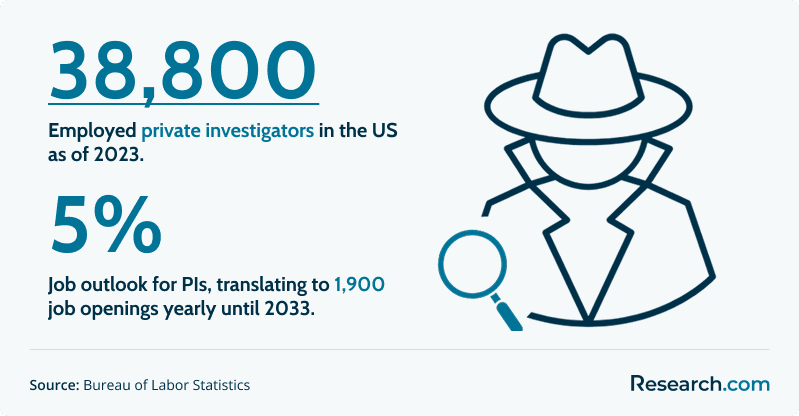
As the image below shows, as of 2023, there are approximately 38,800 private investigators working in the United States, with employment expected to grow by 5% from 2023 to 2033.
What do private investigators do?
Private investigators turn unclear situations into documented facts. Their work may be quiet and research-heavy, or it may require field surveillance, interviews, court-ready reports, and collaboration with attorneys, insurers, employers, or families. The exact duties depend on the client, the state’s laws, and the investigator’s specialization.
Common PI responsibilities include:
- Surveillance: Observing people, locations, or activities to document behavior relevant to a case, such as insurance claims, custody disputes, infidelity allegations, or workplace misconduct.
- Background investigations: Reviewing public records, employment history, financial indicators, litigation history, criminal records where legally accessible, and other information for legal, business, or personal purposes.
- Fraud investigation: Helping insurers, businesses, or attorneys examine suspicious claims, employee misconduct, identity issues, financial inconsistencies, or staged incidents.
- Locating people: Finding missing persons, witnesses, debtors, heirs, former employees, or individuals connected to legal matters.
- Legal support: Assisting attorneys by gathering records, interviewing witnesses, serving as an investigative resource, and preparing documentation for litigation.
- Digital and open-source research: Using lawful online research, public databases, social media review, and data analysis to identify connections, timelines, assets, or inconsistencies.
- Report writing: Preparing clear, factual, time-stamped reports that clients, attorneys, insurers, or courts can understand.
Not every investigator starts in criminal justice. Some come from trades, technical work, or operations roles where they learned to troubleshoot systems and spot inconsistencies. For example, someone who trained through one of the best online HVAC trade schools may not have a traditional investigative background, but technical knowledge, site awareness, and mechanical problem-solving can still be useful in insurance, property, safety, or workplace investigations.
Private investigator duties by work setting
| Work setting | Typical cases | Useful strengths |
| Law firms | Witness location, litigation support, evidence documentation, background research | Legal research, interviewing, report writing, confidentiality |
| Insurance companies | Workers’ compensation claims, staged incidents, disability claims, accident verification | Surveillance, documentation, fraud awareness, patience |
| Corporate security | Employee misconduct, theft, policy violations, due diligence, internal investigations | Professional judgment, interviewing, compliance knowledge, discretion |
| Independent PI agency | Domestic cases, missing persons, background checks, legal support, surveillance | Client communication, business skills, licensing knowledge, adaptability |
| Cyber or financial investigations | Online fraud, identity concerns, financial tracing, data review | Digital research, cybersecurity basics, database skills, analytical thinking |
How do I become a private investigator for 2027?
The private investigator career path is state-regulated, so the exact steps depend on where you plan to work. However, most aspiring PIs follow the same general sequence: confirm eligibility, build relevant experience, complete training, apply for licensure, and then choose an employment or self-employment route.
You do not always need a specific degree. A person may enter the field after earning an affordable online criminal justice degree, completing military service, working in security, gaining legal experience, or developing technical skills in areas such as cybersecurity or data analysis.
Step-by-step path to becoming a private investigator
- Check your state’s eligibility rules. Many states require private investigators to be at least 18 or 21, pass a criminal background check, and be a U.S. citizen or legal resident.
- Review licensing requirements before choosing a program. Some states require a set number of experience hours, an exam, pre-licensing education, sponsorship by an agency, or proof of insurance.
- Build relevant experience. Experience in law enforcement, military service, security, legal support, insurance claims, corporate compliance, fraud investigation, or cybersecurity can strengthen your application.
- Complete education or training if needed. A high school diploma may be enough in some states, but an associate or bachelor’s degree in criminal justice, criminology, law, security studies, forensic science, or a related field can help.
- Apply for a private investigator license. Most states require an application, fees, fingerprinting or background screening, and sometimes an exam.
- Consider specialized certifications. Credentials such as Professional Certified Investigator, Certified Legal Investigator, Certified Fraud Examiner, or cyber investigation certifications can support advancement.
- Decide where to work. New PIs may join an investigation agency, law firm, insurance company, corporate security department, or government contractor before starting their own business.
- Keep learning. Privacy rules, surveillance technology, digital evidence practices, and state regulations change. Continuing education helps reduce legal and professional risk.
Which route should you choose?
| Entry route | Best for | Main advantage | Possible drawback |
| Law enforcement or military background | People with prior investigative, patrol, intelligence, or security experience | Strong credibility and practical field judgment | May still need state PI licensing and private-sector business skills |
| Criminal justice or criminology degree | Students who want broad preparation in law, crime, courts, and evidence | Builds legal and analytical foundation | Can be costly if chosen without checking licensing or ROI |
| Security or loss prevention experience | People seeking a practical, lower-cost entry point | Provides surveillance, documentation, and incident-report experience | May not cover legal research or advanced investigations |
| Cybersecurity, data, or computer background | People interested in online fraud, digital research, or cyber investigations | Strong fit for technology-driven cases | May need training in evidence rules, interviewing, and state PI law |
| Legal support or paralegal background | People who want to work with attorneys or litigation teams | Useful understanding of court procedures and documentation | May require field investigation or surveillance training |
What skills and experiences are important for private investigators to have?
Private investigation requires more than curiosity. Good investigators are disciplined, patient, skeptical, organized, and legally careful. They know how to separate facts from assumptions, document what they observe, and communicate findings without exaggeration.
Core skills include:
- Research and record analysis: Searching public records, databases, court documents, property records, business filings, and lawful online sources.
- Surveillance technique: Observing activities discreetly while avoiding trespassing, harassment, or unsafe behavior.
- Interviewing and communication: Asking useful questions, reading context, listening carefully, and documenting responses accurately.
- Report writing: Producing clear, objective, chronological reports that can stand up to client, attorney, or court review.
- Legal and ethical judgment: Understanding privacy laws, consent rules, evidence handling, state licensing restrictions, and confidentiality obligations.
- Technology competence: Using databases, mapping tools, cameras, case management software, open-source intelligence tools, and secure communication methods.
- Critical thinking: Testing claims, identifying inconsistencies, recognizing bias, and knowing when evidence is not strong enough.
- Professional discretion: Protecting sensitive information and avoiding careless communication with clients, subjects, witnesses, or third parties.
Technology is reshaping investigative work. People asking, I have a computer science degree, now what?, may find that PI work offers a way to apply technical skills to digital research, fraud detection, cybersecurity-adjacent investigations, and data-heavy cases. However, technical ability must be paired with licensing knowledge and lawful evidence practices.
Skills to build before applying for PI jobs
| Skill area | How to build it | Why it matters |
| Legal awareness | Take criminal justice, legal studies, or investigation law courses | Prevents illegal evidence collection and licensing violations |
| Surveillance | Work in security, loss prevention, claims investigation, or supervised PI roles | Many cases require patient observation and accurate documentation |
| Digital research | Learn open-source intelligence, database searching, cybersecurity basics, and data verification | Modern investigations often begin online |
| Writing | Practice incident reports, case summaries, timelines, and evidence logs | Reports are often the final product clients rely on |
| Interviewing | Study investigative interviewing and practice structured questioning | Witnesses and sources can provide details records do not show |
What licenses and certifications do I need as a private investigator?
Most states require private investigators to be licensed before offering investigative services to the public. Licensing protects clients and helps states regulate who can conduct private investigations. Requirements vary, so you should confirm rules with your state licensing board before paying for training, enrolling in a degree, or advertising PI services.
Common license requirements
- State private investigator license: Often requires minimum age, background screening, application fees, experience or education, and in some states, a licensing exam.
- Agency or business license: If you plan to open your own PI firm, your state may require a separate agency license, proof of insurance, bonding, or a qualifying manager.
- Firearms authorization: Carrying a firearm for work requires compliance with state firearm laws and may require a separate permit or security-related credential.
- Continuing education or renewal: Some states require license renewal, updated background checks, or continuing education.
Professional certifications to consider
| Credential | Best fit | How it can help |
| Certified Legal Investigator | Investigators working with attorneys or litigation teams | Shows knowledge of legal investigation practices |
| Professional Certified Investigator | Corporate security, fraud, and internal investigation professionals | Signals advanced investigative and security competence |
| Certified Fraud Examiner | Investigators focused on financial fraud or forensic accounting | Supports specialization in fraud detection and financial evidence |
| Cyber investigation certifications | PIs handling online research, digital evidence, or cyber-related cases | Builds credibility in technology-driven investigations |
Certifications are not a substitute for a state license. They can, however, make a licensed PI more credible in specialized markets such as insurance fraud, corporate investigations, legal investigations, or cyber investigations.
How long does it take to become a private investigator?
Becoming a private investigator typically takes 2 to 6 years, depending on your state’s licensing rules, your education route, and the amount of qualifying experience you need. Someone entering from law enforcement, military service, or security may qualify faster than a student starting from scratch. A bachelor’s degree path usually takes four years, while an associate degree usually takes about two years.
Some states do not require a college degree but may require several years of work experience. Others may count education toward experience requirements. Licensing itself can add time because applicants may need to complete an exam, background check, fingerprinting, insurance documentation, or agency sponsorship.
Private investigator timeline by pathway
| Pathway | Typical timeline | Best for |
| Associate degree plus entry-level experience | About two years for the degree, plus any required experience or licensing time | Students who want a shorter academic route |
| Bachelor’s degree in criminal justice or related field | Usually four years, plus licensing steps | Students seeking broader preparation and long-term advancement options |
| Law enforcement, military, or security transition | Varies based on prior experience and state rules | Experienced professionals with transferable field skills |
| Work experience only | Can take several years if the state requires qualifying experience | People who want to avoid college costs and learn through related work |
| Specialized certification after licensure | Additional months or longer depending on credential requirements | Licensed PIs who want to move into fraud, legal, corporate, or cyber investigations |
People interested in specialized public health, environmental, or compliance investigations may also explore top ranked online CEPH accredited MPH programs if they want broader training in public health systems, regulation, research methods, and evidence-based analysis.
What are the educational requirements to become a private investigator?
There is no universal degree requirement for private investigators. In many states, a high school diploma or equivalent may satisfy the minimum education requirement, but state rules, employer preferences, and specialization goals can raise the bar. A degree can be especially useful if you want to work with attorneys, corporations, insurers, cybersecurity teams, or government contractors.
Relevant fields of study include criminal justice, criminology, law enforcement, legal studies, forensic science, cybersecurity, accounting, psychology, business, and public administration. Military students and veterans may also be able to connect prior service with flexible online education options; for example, online colleges for military students can help service members or veterans compare schools that may fit their schedules and benefits.
Degree options for aspiring private investigators
| Education level | What it can provide | When it makes sense |
| High school diploma or GED | Meets the basic education threshold in some states | You plan to gain experience through security, law enforcement support, or agency work |
| Certificate or short training program | Introduces surveillance, state law, report writing, and investigation basics | You need targeted preparation for licensing or entry-level PI work |
| Associate degree | Builds foundation in criminal justice, legal systems, and public safety | You want a lower-cost academic path than a four-year degree |
| Bachelor’s degree | Provides broader training in law, ethics, research, courts, crime, and analysis | You want stronger long-term options in corporate, legal, government-adjacent, or specialized investigations |
| Graduate or specialized education | Supports advanced work in forensic science, cybersecurity, fraud, compliance, or policy | You already have experience and want to move into higher-skill investigative niches |
How much does it cost to become a private investigator?
The total cost to become a private investigator can range from $2,000 to over $50,000, depending on whether you pursue a degree, pay only for licensing and training, or start your own agency with equipment and insurance. The lowest-cost path is usually related work experience plus state licensing. The highest-cost route is typically a four-year private college degree plus certifications, equipment, insurance, and business setup expenses.
Common cost categories
- Education: A criminology or criminal justice degree is optional in many states, but it can be useful. The average tuition for a four-year public college is $9,750 per year in-state and $28,386 out-of-state, while private colleges average $38,421 per year.
- Licensing: Application and exam fees commonly range from $100 to $500, not including background checks or related documentation costs.
- Training and certifications: Credentials such as Certified Legal Investigator or Professional Certified Investigator can cost between $300 and $1,500.
- Equipment and software: Cameras, secure storage, database access, case management tools, GPS-compliant tools where legal, and computer equipment can add substantial startup costs.
- Insurance and business setup: Independent PIs may need liability insurance, bonding, business registration, agency licensing, marketing, and legal consultation.
Degree path vs. licensing-first path
| Path | Typical costs | Best for | Watch out for |
| Licensing-first path | Licensing fees, training, background check, equipment, and possibly insurance | Career changers with qualifying experience | May limit advancement if employers prefer degrees |
| Associate degree path | Two years of tuition plus licensing and training costs | Students who want structured education without a four-year commitment | Transfer rules matter if you later pursue a bachelor’s degree |
| Bachelor’s degree path | Four years of tuition plus licensing and startup costs | Students targeting corporate, legal, or specialized investigation roles | Debt can reduce ROI if salary expectations are unrealistic |
| Business-owner path | Licensing, agency registration, insurance, equipment, software, marketing, and operating costs | Experienced investigators ready to manage clients and risk | Self-employment income can be inconsistent at first |
The chart below breaks down criminology program tuition costs.
What are the legal and ethical challenges for private investigators?
Private investigators work in a legally sensitive field. The biggest risks are not usually finding information; they are finding it in a way that violates privacy law, licensing rules, trespass law, harassment rules, wiretapping laws, data access restrictions, or evidence standards. A PI who collects information unlawfully can harm a client’s case, face licensing discipline, or expose both the investigator and client to liability.
Common legal and ethical challenges include:
- Privacy boundaries: PIs must understand what information can be legally accessed, recorded, photographed, or shared.
- Surveillance limits: Public observation is not the same as trespassing, stalking, entering private property, or using unlawful tracking methods.
- Digital evidence rules: Investigators must avoid hacking, impersonation, unauthorized account access, and improper data collection.
- Evidence integrity: Reports, photos, videos, and records should be dated, stored securely, and described accurately.
- Confidentiality: Sensitive client and subject information should be protected from unnecessary disclosure.
- Conflicts of interest: PIs should avoid cases where personal, financial, or professional relationships compromise objectivity.
- Misrepresentation: Some forms of pretexting or false identity use may be illegal or unethical depending on the circumstances and jurisdiction.
Because the legal environment changes, serious investigators should pursue continuing education and, when needed, consult legal counsel. Investigators who want to move into advanced criminal justice, management, or public-sector-adjacent roles may also compare education options connected to the highest paying jobs with a master's in criminal justice.
How much can I make as a private investigator?
The median annual salary for private investigators in the U.S. is $49,540 as of 2023. Earnings vary by employer, state, case type, specialization, experience, and business model. The top 10% earn over $96,600 per year, but those earnings are not guaranteed and usually reflect stronger specialization, high-paying industries, established client networks, or advanced investigative responsibilities.
Highest-paying industries for private investigators
- Electric Power Generation, Transmission, and Distribution: $110,090 per year
- General Medical and Surgical Hospitals: $97,060 per year
- Rail Transportation: $89,460 per year
- Other Professional, Scientific, and Technical Services: $89,030 per year
- Insurance Carriers: $88,680 per year
Some investigators improve their earning potential by combining PI licensing with expertise in law, cybersecurity, environmental compliance, financial analysis, or policy. For example, someone interested in regulatory investigations may want to explore schools with strong environmental policy programs if their goal is to work around compliance, environmental claims, or policy-related investigations.
Salaries can also vary by state. The chart below shows the highest-paying states for private investigators.
Could further education advance my private investigation career?
Further education can help if it is tied to a clear investigative goal. A degree or certificate is most valuable when it builds skills that clients and employers actually use: legal research, evidence analysis, forensic methods, cybersecurity, fraud examination, interviewing, compliance, or case documentation. An accredited online criminal justice degree may be a practical option for working adults who want structured training in criminal law, ethics, courts, corrections, policing, and investigative systems.
Further education may be worth considering if you want to:
- Move from general surveillance work into legal, corporate, or fraud investigations.
- Qualify for employers that prefer a degree.
- Prepare for leadership, agency ownership, or specialized consulting.
- Build credibility with attorneys, insurers, corporations, or government contractors.
- Develop stronger writing, legal, analytical, or digital evidence skills.
It may not be worth it if you already meet state licensing requirements, have strong experience, and would need to take on debt for a program that does not improve your target role. Always compare tuition, transfer credits, accreditation, employer expectations, and licensing relevance before enrolling.
Can advanced forensic education boost my investigative career?
Advanced forensic education can help private investigators who want to specialize in evidence-heavy work, digital investigations, fraud, litigation support, or technical analysis. Forensic training may cover evidence preservation, chain of custody, digital data, lab methods, crime scene principles, and scientific documentation. These skills can make a PI more useful to attorneys, insurers, corporations, or agencies handling complex cases.
For cost-conscious students, online schools for forensic science may provide a way to compare programs that build forensic knowledge without requiring a traditional campus schedule. Before enrolling, confirm whether the coursework fits your intended specialty and whether the school has appropriate accreditation.
How does advanced forensic science education benefit private investigators?
Forensic science education helps investigators handle evidence with more precision. It can strengthen skills in documentation, digital forensics, data preservation, evidence interpretation, and scientific reasoning. This is especially useful when a case may involve court proceedings, insurance disputes, cyber activity, fraud, or technical evidence.
Private investigators do not need to become forensic scientists for every role. However, advanced forensic training can create a competitive edge when an investigator wants to move beyond basic surveillance into expert-supported case work. Students comparing options may review the top forensic science colleges to understand what stronger forensic programs typically offer.
What are the career paths for private investigators?
Private investigation can lead to several related careers in law, security, insurance, corporate compliance, fraud detection, intelligence, and data-driven investigations. Many PIs begin with general surveillance or background checks, then specialize as they gain experience. Modern cases increasingly involve databases, digital footprints, financial records, and pattern recognition, which means some investigative work overlaps with analytical roles such as the types of data science jobs that use large datasets to identify risk, fraud, or anomalies.
Career paths for private investigators
| Career path | Typical focus | Average salary listed |
| Detective | Investigates criminal cases for law enforcement or related public safety settings | $49,204 |
| Fraud Investigator | Examines suspicious insurance, financial, or corporate activity | $49,010 |
| Loss Prevention Analyst | Identifies and reduces theft, fraud, and operational risk in retail or corporate settings | $46,581 |
| Recovery Agent | Helps recover stolen, missing, or defaulted assets | $38,772 |
| Securities Consultant | Supports fraud detection, risk review, and security analysis for financial firms | $92,092 |
| Signal Intelligence Analyst | Analyzes intercepted or collected data for military or government-related intelligence work | $69,325 |
The chart below compares salaries across these related paths.
Is a career in private investigation worth it?
A career in private investigation can be worth it if you like independent problem-solving, can tolerate irregular work, understand legal boundaries, and are willing to build credibility over time. It may be less attractive if you need predictable hours, guaranteed income growth, or a job that is mostly desk-based and low-conflict.
The financial case depends on cost and career strategy. The median salary is $49,540 per year, and top professionals make over $96,600, but a PI who spends heavily on education, equipment, marketing, and business setup may need time to see a return. A lower-cost route through related work experience and licensing may offer a better ROI for some career changers.
Cost considerations before choosing this career
- Education: A degree is optional in many states, but a criminology degree can cost between $9,750 for public in-state tuition to $38,421 for private college tuition per year. People from unrelated fields can still transition if they build the right investigative skills; even graduates from the best fashion design program may bring observation, visual analysis, client communication, and detail orientation that are useful in certain investigative contexts.
- Licensing and certification: A private investigator license typically costs between $100 and $500, while some certifications range from $100 to $200.
- Living costs: The average cost of living in the U.S. for a single person is about $1,175 per month, excluding rent.
- Business risk: Self-employed PIs must account for insurance, marketing, equipment, legal compliance, taxes, and inconsistent client demand.
Private investigation may also appeal to people exploring criminal psychology jobs, because many cases involve motives, behavior patterns, deception, risk assessment, and interpersonal dynamics. However, PI work is evidence-based, not guesswork; conclusions must be supported by records, observation, interviews, or other lawful documentation.
Who should consider private investigation?
- People who enjoy research, surveillance, interviews, and documentation.
- Career changers from law enforcement, military service, security, insurance, compliance, legal support, or cybersecurity.
- Students who want a practical criminal justice or criminology-related career outside traditional policing.
- Professionals comfortable with irregular schedules and case-by-case work.
- People who can follow strict legal and ethical boundaries even under client pressure.
Who may want a different path?
- People who want predictable 9-to-5 work and steady assignments.
- Students who expect a degree alone to guarantee high earnings.
- Anyone uncomfortable with confrontation, surveillance, uncertainty, or sensitive information.
- People unwilling to study state licensing rules and privacy laws.
- Those who want law enforcement authority; PIs do not have the same powers as police officers.
The image below gives a breakdown of the cost of living in the U.S.

What graduates say about careers in private investigation
- Private investigation gave me the kind of work I was looking for: complex problems, real consequences, and constant learning. The best moments are when careful research and patient observation help a client finally understand what happened. Elena
- I moved from corporate security into PI work because I wanted more variety and independence. The transition was demanding, especially learning stronger documentation and surveillance practices, but the experience made me much better at analyzing risk and behavior. Malcolm
- Online study helped me prepare for licensing while I kept working full time. Courses in legal procedure, interviewing, and research were useful immediately, and those skills later helped me open my own investigation business. Ronan
How can I transition from a criminology background to private investigation?
A criminology background can transfer well to private investigation because it builds familiarity with crime patterns, social behavior, justice systems, research methods, and legal institutions. The next step is to convert academic knowledge into job-ready investigation skills: surveillance, interviewing, report writing, database research, evidence handling, and state licensing compliance.
Students and graduates asking what jobs can I get with criminology should compare PI work with law enforcement, corrections, victim advocacy, policy research, probation, fraud investigation, and security analysis. Private investigation is a good fit when you want practical casework but do not necessarily want to become a sworn officer.
Practical transition plan for criminology graduates
- Check your state PI licensing rules before applying for jobs.
- Build field experience through security, loss prevention, legal support, claims work, or investigative internships.
- Learn report writing and evidence documentation.
- Develop lawful open-source intelligence and public-records research skills.
- Network with licensed investigators, attorneys, insurance professionals, and corporate security teams.
- Consider certification after you know your target specialty.
Could a career in private investigation lead to federal opportunities?
Private investigation experience can support a move toward federal opportunities, but it does not automatically qualify someone for federal investigative roles. Federal agencies often have strict education, background, fitness, training, citizenship, security clearance, and experience requirements. A PI background may help if it demonstrates legal compliance, interviewing skill, surveillance experience, digital research ability, strong documentation, and sound judgment.
People interested in federal immigration or homeland security-related work should compare their current background with agency-specific requirements. For example, reviewing the requirements for ICE agent can help you understand how federal expectations differ from private investigation licensing.
Skills that may support a federal transition
- Investigative writing and case documentation
- Interviewing and witness communication
- Digital forensics or cyber investigation fundamentals
- Knowledge of constitutional, privacy, and evidence rules
- Foreign language or intelligence analysis skills, when relevant
- Clean background history and professional references
Can a paralegal certification complement my private investigation career?
A paralegal certification can be a strong complement for private investigators who want to work with attorneys, litigation teams, corporate legal departments, or compliance units. It can strengthen legal research, court procedure knowledge, document organization, citation practices, discovery support, and evidence tracking.
This combination is especially useful for PIs who handle civil litigation, personal injury matters, family law support, witness location, background research, or trial preparation. If cost matters, comparing the cheapest online ABA accredited paralegal programs may help you identify lower-cost ways to build legal support skills.
Common mistakes to avoid when becoming a private investigator
| Mistake | Why it can hurt you | Better approach |
| Choosing a school before checking state licensing rules | Your program may not reduce experience requirements or prepare you for licensure | Confirm requirements with your state licensing board first |
| Assuming a degree is always required | You may spend more than necessary for your target role | Compare degree, experience, and licensing-first pathways |
| Focusing only on tuition | Fees, equipment, certification, insurance, and lost work time can change total cost | Calculate full cost, not just tuition |
| Ignoring accreditation | Credits may not transfer, and employers may question the credential | Choose properly accredited schools when pursuing a degree |
| Overlooking legal limits | Illegal surveillance or data access can damage a case and your license | Study privacy, evidence, trespass, recording, and state PI laws |
| Expecting high income immediately | PI income varies by location, specialization, and client base | Build experience, referrals, and a specialized niche over time |
| Starting a PI business too early | Business ownership adds legal, financial, marketing, and insurance risk | Gain supervised experience before operating independently |
Questions to ask before choosing a private investigator program or training route
- Does my state require a PI license, exam, minimum experience, agency sponsorship, insurance, or continuing education?
- Will this degree or certificate count toward licensing requirements in my state?
- Is the school accredited, and will credits transfer if I continue my education?
- What are the total costs, including tuition, fees, books, equipment, licensing, and certification?
- Does the program teach report writing, ethics, evidence handling, legal research, and privacy law?
- Are instructors experienced in actual investigations, law, security, fraud, or forensic work?
- Does the program help with internships, field experience, or employer connections?
- Which specialization am I preparing for: surveillance, legal investigation, fraud, cyber, corporate, insurance, or missing persons?
- How long will it take before I can legally work independently?
- What realistic salary range should I expect in my state and target industry?
Key Insights
- Private investigation is a licensed, evidence-focused profession; the best route depends on your state’s rules, your prior experience, and your target specialty.
- The median annual salary is $49,540, with top professionals making over $96,600, but earnings vary widely by industry, location, experience, and business model.
- Employment is expected to grow 5% from 2023 to 2033, making it a stable but still competitive field.
- A degree is not always required. Criminal justice, criminology, forensic science, cybersecurity, legal studies, accounting, and psychology can all be useful depending on your niche.
- Costs can range from $2,000 to over $50,000. The largest cost difference usually comes from whether you pursue a college degree or enter through experience and licensing.
- Licensing should be checked before enrolling in any program. Requirements vary by state and may include age rules, background checks, exams, experience, fees, and agency licensing.
- Specialization matters. Fraud, legal investigations, corporate security, digital research, insurance investigations, and forensic work can offer stronger career direction than general PI work alone.
- The biggest professional risks are legal and ethical: unlawful surveillance, unauthorized data access, poor documentation, privacy violations, and weak evidence handling.
- Private investigation is most worth it for people who enjoy research, independence, fieldwork, careful documentation, and fact-based problem-solving.
References:
- Bureau of Labor Statistics. Occupational Employment and Wage Statistics – Private Detectives and Investigators.
- Bureau of Labor Statistics. Private Detectives and Investigators – Occupational Outlook Handbook.
- College Tuition Compare. Criminology Program 2024 Tuition.
- Education Data Initiative. Average Cost of College.
- Education Data Initiative. Private vs. Public College Tuition.
- Numbeo. Cost of Living in the United States.
Other Things You Should Know About How to Become a Private Investigator
Most states require a fingerprint-based criminal background check through the state licensing agency and the FBI. Disqualifying offenses often include felonies, fraud, or crimes involving dishonesty. Some states also review recent misdemeanor convictions before issuing a private investigator license.
In 2027, private investigator licensing exams vary by state. For instance, California requires passing a two-hour multiple-choice test administered by the Bureau of Security and Investigative Services, covering laws, regulations, and investigation techniques. Specifics may differ in other regions.