2027 How To Become a Forensic Scientist: Salary & Career Paths

Co-Founder and Chief Data Scientist
Becoming a forensic scientist is not the same as becoming a detective, crime scene investigator, or criminal justice administrator. The job is science-centered: professionals collect, test, interpret, and explain physical or digital evidence so investigators, attorneys, judges, and juries can understand what the evidence does—and does not—show.
This guide is for students comparing majors, career changers exploring laboratory or investigative work, and early-career professionals deciding whether forensic science is worth the time, cost, and training. You will learn what forensic scientists do, which degrees and specialties fit different goals, how long the path usually takes, what salaries look like, which certifications can help, and how to choose a program without overlooking accreditation, cost, or career fit.
The goal is to give you a practical roadmap, not a TV-drama version of the field. Forensic science can be meaningful and intellectually demanding, but it also requires patience, documentation discipline, ethical judgment, and comfort with court scrutiny.
Quick answer: How do you become a forensic scientist?
- Most forensic scientist roles require a bachelor’s degree in forensic science, chemistry, biology, biochemistry, computer science, cybersecurity, or another closely related natural or technical science.
- Many professionals enter the field as forensic science technicians, where they learn evidence handling, laboratory procedures, reporting standards, and courtroom expectations.
- The typical preparation timeline is 4 to 8 years, depending on whether you stop after a bachelor’s degree or pursue graduate study, specialization, or advanced research training.
- Employment for forensic science technicians is projected to grow 14% from 2023 to 2033, with about 2,700 openings each year.
Table of Contents:
- What does a forensic scientist do in a criminal investigation?
- How much do forensic scientists earn in the U.S.?
- Which forensic science specialties can you choose?
- What majors best prepare you for forensic science?
- How many years does it take to become a forensic scientist?
- What career paths can forensic scientists move into?
- Where do forensic scientists earn the highest salaries?
- How can you find affordable forensic science degree options?
- How should you choose the best forensic science college?
- Which forensic science certifications are useful?
- What are the main career stages in forensic science?
- What is the employment outlook for forensic science careers?
- How can professional development strengthen your forensic science career?
- What legal and ethical issues should forensic scientists understand?
What does a forensic scientist do in a criminal investigation?
A forensic scientist applies scientific methods to evidence connected to possible crimes. Depending on the role, that work may happen at a crime scene, in a laboratory, in an evidence processing unit, or in court. The purpose is not to “prove” a theory but to produce objective, testable findings that help the justice system evaluate facts.
Although job titles vary by agency and laboratory, forensic scientists commonly handle these responsibilities:
- Evidence collection and preservation: Some forensic scientists assist with gathering physical materials such as blood, fingerprints, hair, fibers, glass, soil, weapons, or other trace evidence. They must label, package, store, and document each item carefully so the chain of custody remains intact.
- Laboratory testing and comparison: In the lab, forensic professionals use validated techniques to examine biological, chemical, physical, or digital evidence. Work may include DNA testing, toxicology screening, drug identification, firearms comparison, chemical analysis, or digital file recovery.
- Scientific interpretation: Testing is only part of the job. Forensic scientists must evaluate what the results mean, whether the evidence supports or challenges a case theory, and what limitations apply. In digital cases, understanding computer forensics job requirements can be especially important because electronic evidence must be collected and analyzed in a defensible way.
- Technical reporting: Forensic reports must explain the methods used, the evidence examined, the results produced, and the conclusions reached. These reports need to be precise, neutral, and understandable to non-scientists.
- Court testimony: Forensic scientists may serve as expert witnesses. They explain procedures and findings to attorneys, judges, or juries and must be prepared for cross-examination about methodology, uncertainty, contamination risks, and professional standards.
If you are comparing justice-related careers, it helps to understand criminal justice vs forensic science. Criminal justice programs usually focus more on law enforcement, courts, corrections, and policy, while forensic science programs emphasize laboratory science and evidence analysis.
| Work setting | What forensic scientists may do there | Best fit for students who enjoy |
| Crime scene or field unit | Document scenes, collect evidence, photograph materials, preserve chain of custody | Fieldwork, observation, evidence handling, variable schedules |
| Crime laboratory | Analyze samples, run tests, compare evidence, prepare reports | Lab procedures, chemistry, biology, detail-heavy analysis |
| Digital forensics unit | Recover files, analyze devices, preserve electronic evidence | Technology, cybersecurity, data recovery, investigative analysis |
| Medical examiner or coroner setting | Support death investigations, toxicology work, pathology-related evidence review | Biology, medicine, anatomy, cause-of-death questions |
| Courtroom or legal setting | Explain findings, defend methods, answer expert witness questions | Communication, logic, public speaking, legal procedure |
How much do forensic scientists earn in the U.S.?
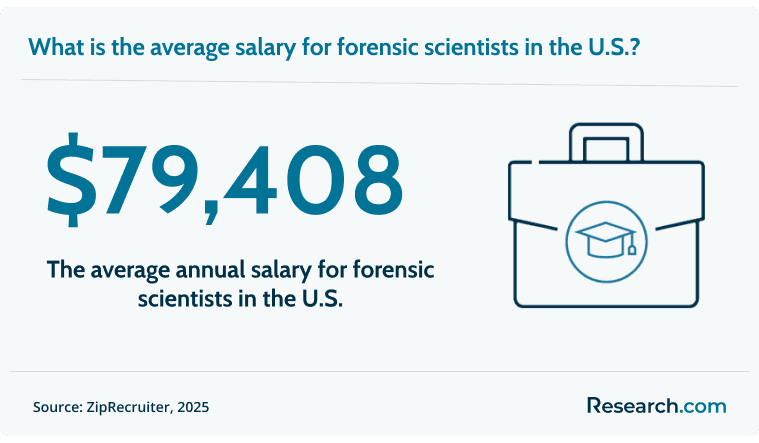
The average salary for forensic scientists in the United States is $79,408 per year. Actual pay can differ sharply by employer, state, education level, specialty, years of experience, and whether the role is local, state, federal, academic, or private-sector.
Entry-level professionals may begin closer to $50,000, while forensic scientists with advanced credentials, specialized expertise, supervisory duties, or federal-agency experience can earn upwards of $100,000 annually. Pay is also shaped by cost of living and caseload complexity, which is why large metropolitan areas and high-demand states may offer stronger compensation.
Credentials can also influence competitiveness. For example, certifications from the American Board of Criminalistics may help demonstrate competence in areas such as criminalistics, forensic biology, chemistry, DNA, drug analysis, or trace evidence, depending on the credential and the employer’s requirements.
| Salary factor | How it can affect pay | What to evaluate before choosing a path |
| Location | States and metro areas with higher demand or higher cost of living may pay more | Compare salary with housing, taxes, commuting, and relocation costs |
| Employer type | Federal agencies and larger laboratories may offer different salary structures than local agencies | Review benefits, pension plans, overtime rules, and advancement paths |
| Specialization | DNA, toxicology, pathology-related work, and digital forensics may require deeper technical preparation | Choose coursework and internships that match the evidence type you want to handle |
| Experience level | Supervisory and expert witness responsibilities can increase earning potential | Ask how long promotion typically takes in a specific lab or agency |
| Graduate education or certification | Advanced study and professional credentials may improve competitiveness for specialized roles | Confirm whether the target employer values the credential before paying for it |
Which forensic science specialties can you choose?
Forensic science is not one single job. It is a collection of scientific and technical specialties focused on different evidence types. Choosing a specialty matters because it affects your major, internships, graduate school options, certifications, and long-term career direction.
- Forensic Biology: Forensic biologists examine biological materials such as blood, saliva, semen, hair, and other bodily evidence. DNA analysis is a major part of this specialty, especially in violent crime, missing-person, and identification cases.
- Forensic Chemistry: Forensic chemists test substances such as drugs, explosives, fire debris, paint, fibers, glass, and unknown chemicals. This path is a strong fit for students who enjoy analytical chemistry and instrumentation.
- Digital Forensics: Digital forensic specialists recover, preserve, and interpret data from computers, phones, storage devices, networks, cloud services, and online communications. Students interested in financial crimes may also explore a master’s in forensic accounting as a related route into fraud and financial investigation.
- Toxicology: Forensic toxicologists test biological samples for alcohol, drugs, poisons, or other substances. Their work can be central in overdose, impaired driving, workplace fatality, poisoning, and death investigation cases.
- Forensic Pathology: Forensic pathologists are physicians who conduct autopsies and determine cause and manner of death. This is a medical career path and requires far more training than most forensic scientist roles.
- Forensic Odontology: Forensic odontologists use dental records, bite mark analysis, and oral structures to support identification or injury assessment. This path is generally tied to dental training.
- Ballistics and Firearms Examination: Firearms examiners study bullets, cartridge cases, firearms, gunshot residue, and firing mechanisms. They may compare evidence to determine whether a specific firearm could be connected to a case.
- Questioned Document Examination: Document examiners analyze handwriting, signatures, inks, paper, printing processes, alterations, and possible forgery. Their work can apply to criminal, civil, financial, and identity-related cases.
- Forensic Entomology: Forensic entomologists use insect activity on remains to help estimate time since death, particularly in outdoor or decomposed-body investigations.
- Forensic Anthropology: Forensic anthropologists analyze skeletal remains to help identify people and assess trauma or postmortem changes. Students drawn to human remains analysis can learn more about how to get into a forensic anthropology career.
| Specialty | Best academic preparation | Common evidence type |
| Forensic biology | Biology, forensic science, molecular biology | DNA, blood, saliva, biological traces |
| Forensic chemistry | Chemistry, forensic chemistry, biochemistry | Drugs, explosives, fibers, paint, glass |
| Digital forensics | Computer science, cybersecurity, digital forensics | Computers, phones, files, networks, cloud data |
| Toxicology | Chemistry, biochemistry, pharmacology-related study | Alcohol, drugs, poisons, biological samples |
| Forensic anthropology | Anthropology, anatomy, osteology, graduate study | Skeletal remains |
| Firearms examination | Forensic science, physics-related coursework, specialized training | Firearms, bullets, cartridge cases, residue |
What majors best prepare you for forensic science?
The best major depends on the evidence you want to analyze. A general forensic science degree can be useful, but many laboratories also value strong preparation in traditional sciences such as chemistry and biology. If you want digital evidence work, a computer-focused major may be more useful than a lab science degree.
- Forensic Science: This major usually combines laboratory science, evidence procedures, crime scene methods, and legal context. It can be a practical choice for students who want broad exposure to the field early in college.
- Psychology: Psychology is more relevant to forensic psychology, behavioral assessment, competency issues, and legal mental health questions than to laboratory evidence testing. If you are comparing specialties, Research.com’s guide to different areas of psychology can help clarify where forensic psychology fits.
- Biochemistry: Biochemistry is useful for students interested in DNA, molecular evidence, toxicology, and advanced lab work. It can also support graduate study or research-focused forensic roles.
- Criminal Justice: A criminal justice degree provides background in courts, policing, corrections, investigations, and evidence procedures, but it may not provide enough laboratory science for some forensic scientist positions. Students asking what is criminal justice administration should understand that this path is often more management- and system-focused than lab-focused.
- Computer Science or Cybersecurity: These majors are strong choices for digital forensics, cybercrime investigation, malware analysis, device imaging, and electronic evidence recovery.
| If your goal is... | Consider this major | Why it fits |
| DNA analysis or biological evidence | Biology, forensic science, biochemistry | Builds laboratory and molecular science skills |
| Drug, toxicology, or trace evidence work | Chemistry, biochemistry, forensic chemistry | Prepares you for analytical testing and instrumentation |
| Digital evidence or cybercrime | Computer science, cybersecurity | Develops technical skills for device, network, and data analysis |
| Crime scene work | Forensic science, criminal justice with science coursework | Combines evidence handling with investigative context |
| Behavioral or legal mental health roles | Psychology | Supports forensic psychology and assessment-focused paths |
How many years does it take to become a forensic scientist?
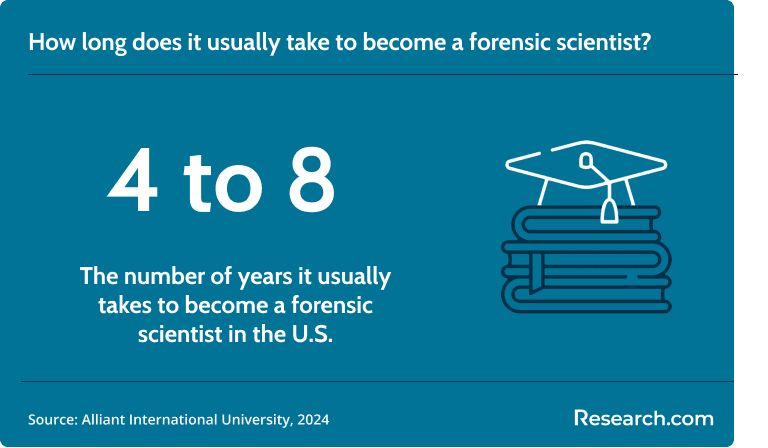
Most people spend 4 to 8 years preparing for forensic science work. A bachelor’s degree normally takes four years and is the usual entry point for many forensic science technician and laboratory roles. Students who want more specialized, research-heavy, or supervisory positions may add graduate school, certification, or additional technical training.
A master’s degree in forensic science or a related discipline can add 2 to 3 years. A Ph.D., often pursued for academic, high-level research, or advanced specialty work, may add another 4 to 6 years. Some professionals also pause between degrees to gain lab, law enforcement, or evidence technician experience.
| Career preparation stage | Typical time involved | What you should focus on |
| Bachelor’s degree | Four years | Science coursework, lab skills, internships, evidence procedures |
| Entry-level work | Varies by employer | Chain of custody, quality standards, reporting, supervised casework |
| Master’s degree | 2 to 3 years | Specialization, research, advanced instrumentation, leadership preparation |
| Ph.D. | 4 to 6 years | Original research, academic teaching, advanced scientific expertise |
| Professional certification or training | Varies by credential | Specialty competence, ethics, continuing education, exam preparation |
Before committing to a long path, ask employers in your target specialty what they actually require. Some roles strongly prefer graduate training, while others value a strong bachelor’s degree plus laboratory experience.
What career paths can forensic scientists move into?
A forensic science background can lead beyond a traditional crime lab. The same skills—scientific reasoning, documentation, evidence control, data interpretation, and expert communication—can translate into investigative, technical, legal, academic, and private-sector roles. For a broader list of possible outcomes, review Research.com’s guide to forensic science degree jobs.
- Crime Scene Investigator: Some forensic scientists move into field-based CSI work, where they document scenes, collect evidence, photograph materials, and coordinate with investigators. This can also help students interested in how to become a forensic ballistics expert gain exposure to firearm-related evidence.
- Forensic Consultant: Experienced specialists may advise attorneys, agencies, private investigators, or organizations that need independent review of forensic evidence. Consulting requires technical expertise and the ability to explain limits and uncertainty clearly.
- Intelligence Analyst: Forensic professionals with strong data interpretation skills may transition into intelligence work supporting agencies such as the FBI, DEA, or Homeland Security. These roles may involve pattern analysis, threat assessment, and case intelligence.
- Policy Advisor or Criminal Justice Reform Advocate: Forensic scientists who understand laboratory standards and justice-system consequences can contribute to policy, quality assurance, evidence reform, and public accountability work.
- Digital Forensics Examiner: Professionals with computing skills can move into electronic evidence analysis, cybercrime investigation, incident response, or private cybersecurity work.
- Private Sector Research Scientist: Lab-trained forensic professionals may work with biotechnology companies, private laboratories, instrument developers, or research groups focused on testing methods and investigative tools.
- Professor or Trainer: With graduate education and field experience, forensic scientists may teach at colleges, universities, academies, or professional training programs.
Where do forensic scientists earn the highest salaries?
Forensic scientist pay differs by state. Demand, local budgets, staffing shortages, cost of living, and the complexity of caseloads can all influence compensation. The states below are among the top-paying options listed in the source data.
- Alaska ($107,427): Alaska has the highest average listed salary for forensic scientists. Remote geography and broad service areas may create roles with substantial responsibility and travel demands.
- California ($96,156): California’s large metropolitan areas and high-volume justice systems can support stronger salaries, especially in advanced laboratory environments.
- Utah ($95,125): Utah offers above-average pay and may appeal to professionals seeking a combination of forensic infrastructure, technology growth, and career development.
- North Dakota ($93,411): North Dakota’s pay reflects the need to attract skilled forensic workers in a less densely populated state.
- Missouri ($93,108): Missouri offers competitive compensation across urban and regional forensic settings, including areas such as St. Louis and Kansas City.
- Mississippi ($92,744): Mississippi’s listed salary can be attractive when considered alongside the state’s lower cost of living.
Students sometimes ask, is forensic science a difficult degree? It can be demanding because it combines science, precision, legal accountability, and technical writing. Salary potential is one factor to consider, but it should not be the only reason to enter the field.
Use state salary data carefully. A higher salary may come with higher living costs, heavier caseloads, relocation challenges, or more competitive hiring standards.
| State | Average salary listed | Decision factor to consider |
| Alaska | $107,427 | Remote work settings, travel, broad case responsibilities |
| California | $96,156 | High cost of living, major metro caseloads, advanced lab opportunities |
| Utah | $95,125 | Growing forensic and technology environment |
| North Dakota | $93,411 | Potential staffing needs in less populated areas |
| Missouri | $93,108 | Urban and regional forensic job opportunities |
| Mississippi | $92,744 | Salary value relative to lower living costs |
How can you find affordable forensic science degree options?
Affordability should be evaluated together with academic fit, lab access, internship support, transfer policies, and accreditation. A low tuition price is not a good deal if the program lacks the coursework, hands-on training, or employer recognition needed for your target role.
Online and hybrid programs may help students manage work, family, and commuting costs, but forensic science often requires laboratory experience. Before enrolling, compare tuition, fees, required campus visits, lab requirements, financial aid, scholarships, and whether credits will transfer if you later change schools. Research.com’s guide to the cheapest forensic science college options can help you begin the cost comparison process.
| Cost factor | Why it matters | Question to ask the school |
| Tuition and fees | Published tuition may not include lab, technology, or program fees | What is the full program cost, not just per-credit tuition? |
| Lab requirements | Forensic science is skill-based and may require in-person laboratory work | Are labs online, on campus, hybrid, or completed through local arrangements? |
| Transfer credits | Accepted credits can reduce both cost and time | How many prior credits can apply to the major? |
| Internship support | Practical experience can improve job readiness | Does the program help place students with labs, agencies, or related employers? |
| Financial aid and scholarships | A higher-priced school may become more affordable with aid | What grants, scholarships, assistantships, or employer benefits are available? |
How should you choose the best forensic science college?
The “best” forensic science college is the one that fits your specialty goals, budget, learning format, and career market. Do not choose a school based only on name recognition or a ranking. Look for a curriculum with strong science requirements, qualified faculty, relevant laboratory training, career services, and connections to forensic laboratories or justice agencies.
When comparing programs, review accreditation, lab facilities, internship access, faculty expertise, research opportunities, and graduate outcomes. If you want a structured comparison, see Research.com’s ranking guide, What college is best for forensic science?
| Program feature | Why it matters for forensic science |
| Accreditation and academic quality | Employers and graduate schools may scrutinize whether the program meets recognized standards |
| Science-heavy curriculum | Laboratory roles often require strong chemistry, biology, statistics, and analytical methods |
| Hands-on lab training | Students need practice with instruments, evidence handling, documentation, and quality control |
| Internships or practicum options | Experience with labs or agencies can make graduates more competitive |
| Faculty background | Instructors with forensic, legal, or laboratory experience can provide field-relevant guidance |
| Career placement support | Strong advising can help students target realistic roles and prepare for interviews or background checks |
Which forensic science certifications are useful?
Certification is not always a legal requirement, but it can strengthen credibility and may be preferred for certain specialties or employers. The right credential depends on your evidence area. Do not pay for a certification simply because it sounds impressive; verify whether it is recognized in your target discipline.
- American Board of Criminalistics Certification: This credential is widely recognized in criminalistics and can apply to areas such as forensic biology, chemistry, molecular biology, drug analysis, and trace evidence. Candidates typically must pass an exam and follow professional ethical standards.
- International Association for Identification Certification: The IAI offers credentials in areas such as latent prints, bloodstain pattern analysis, footwear impressions, tire impressions, and related physical evidence specialties. These certifications can be useful for professionals working with pattern and impression evidence.
- American Board of Forensic Toxicology Certification: This certification is designed for toxicology professionals who analyze drugs, alcohol, poisons, or related substances in biological samples.
- Digital Forensics Certifications such as CFCE, EnCE, and GCFA: Digital evidence professionals may pursue credentials that validate skills in computer examination, forensic imaging, data recovery, incident response, or malware-related analysis.
- Forensic Anthropology Certification: The American Board of Forensic Anthropology offers a respected credential for specialists who analyze human remains and support identification or death investigation work.
| Certification area | Best for | Before you apply, confirm... |
| Criminalistics | Forensic biology, chemistry, DNA, drug, or trace evidence professionals | Whether your lab recognizes the credential for promotion or casework |
| Identification | Latent prints, bloodstain patterns, footwear, tire impressions | Whether your role includes the required practical experience |
| Toxicology | Professionals testing biological samples for substances | Whether your education and lab duties meet eligibility standards |
| Digital forensics | Computer, mobile, network, and electronic evidence examiners | Whether the tools and methods align with your employer’s workflow |
| Forensic anthropology | Human remains and skeletal analysis specialists | Whether you have the advanced education and case experience expected |
What are the main career stages in forensic science?
Forensic science careers usually progress from supervised technical work to independent analysis, specialization, leadership, consulting, or research. Advancement depends on performance, training, agency needs, certifications, education, and the ability to produce defensible reports and testimony.
- Entry-Level: Forensic Science Technician – Many professionals begin by assisting with evidence processing, routine tests, data entry, documentation, and supervised lab work. A bachelor’s degree in forensic science or a related field is commonly expected.
- Mid-Level: Forensic Analyst or Specialist – After gaining experience, professionals may handle more complex casework in areas such as DNA, toxicology, firearms, trace evidence, or digital forensics. Court testimony and junior staff mentoring may become part of the role.
- Senior-Level: Lead Forensic Scientist or Section Supervisor – Senior professionals may review cases, assign work, train analysts, oversee procedures, and help maintain laboratory quality standards.
- Management-Level: Laboratory Director or Crime Lab Manager – Managers oversee budgets, personnel, accreditation, policy, quality systems, and coordination with law enforcement or legal stakeholders.
- Specialist Roles: Forensic Consultant or Expert Witness – Experienced professionals may provide independent review, legal consulting, or expert testimony. Those interested in environmental and wildlife-related cases can also explore how to become a wildlife forensics specialist.
- Academic or Research Roles: Professor or Forensic Researcher – Professionals with advanced degrees may teach, publish research, develop methods, or train future forensic scientists.
| Career level | Typical responsibilities | What helps you move up |
| Entry-level technician | Evidence handling, routine lab work, documentation | Strong lab skills, accuracy, reliability, internship experience |
| Analyst or specialist | Independent testing, case interpretation, reports, testimony | Specialty training, technical competence, clear writing |
| Lead scientist or supervisor | Case review, staff guidance, procedure oversight | Experience, certification, leadership ability, quality assurance knowledge |
| Lab manager or director | Budgeting, accreditation, staffing, strategic planning | Management skills, policy knowledge, broad forensic experience |
| Consultant, expert witness, professor, or researcher | Independent analysis, teaching, research, legal support | Advanced expertise, reputation, communication skills, graduate education |
What is the employment outlook for forensic science careers?
The employment outlook for forensic science technicians is strong. According to the U.S. Bureau of Labor Statistics, employment is projected to grow 14% from 2023 to 2033, which is faster than the average for all occupations. The number of forensic science technician jobs is expected to rise from 18,600 in 2023 to 21,200 by 2033.
The BLS also projects about 2,700 openings for forensic science technicians each year over the decade. Those openings come from both growth and replacement needs when workers transfer to other occupations or leave the labor force.
| Outlook measure | Reported figure | What it means for students |
| Projected employment growth | 14% from 2023 to 2033 | The field is expected to expand faster than the average for all occupations |
| Employment in 2023 | 18,600 | The occupation is specialized, so openings may still be competitive |
| Projected employment by 2033 | 21,200 | Growth is positive but not unlimited; preparation still matters |
| Projected annual openings | About 2,700 each year | Applicants with strong science training and practical experience may be better positioned |
Current demand is influenced by greater reliance on forensic evidence, growing volumes of digital evidence, laboratory quality requirements, and the need to replace experienced workers. However, job availability can still vary by region, specialty, and public-sector funding.
How can professional development strengthen your forensic science career?
Forensic science changes as technology, legal standards, laboratory methods, and digital evidence practices evolve. Ongoing professional development helps forensic scientists maintain technical competence and credibility in court.
Useful development options include advanced workshops, method-specific training, continuing education, professional conferences, graduate coursework, quality assurance training, and cross-disciplinary learning. Professionals interested in federal investigative environments may also find value in understanding what are the requirements to be an ICE agent, especially when comparing forensic work with broader law enforcement career paths.
- Attend training tied directly to your evidence type, such as DNA, toxicology, firearms, latent prints, or digital forensics.
- Learn quality assurance practices, validation standards, uncertainty reporting, and documentation requirements.
- Build courtroom communication skills through mock testimony or expert witness training.
- Stay current on software, instrumentation, cyber tools, and evidence management systems used in your specialty.
- Seek mentorship from senior analysts, laboratory supervisors, or board-certified specialists.
What legal and ethical issues should forensic scientists understand?
Forensic scientists work inside the justice system, so technical accuracy is not enough. They must also follow legal rules, ethical obligations, privacy requirements, and quality standards. A mistake in documentation, contamination control, interpretation, or testimony can affect a person’s liberty, a victim’s case, or public trust in forensic evidence.
Core issues include chain of custody, unbiased analysis, validated methods, conflicts of interest, data privacy, evidence disclosure, report transparency, and honest testimony about uncertainty and limitations. Students who want stronger legal context may also compare related legal education options such as the cheapest online paralegal programs approved by ABA.
| Common mistake | Why it can hurt your career or casework | Better approach |
| Choosing a program without checking accreditation or lab quality | You may graduate without the preparation employers expect | Review accreditation, curriculum, faculty, and hands-on requirements before enrolling |
| Focusing only on tuition | The cheapest program may lack internships, lab access, or career support | Compare total cost against training quality and employment outcomes |
| Assuming online programs meet every career requirement | Some forensic roles require in-person lab skills or specific coursework | Ask how labs, practicums, and employer expectations are handled |
| Ignoring transfer credit policies | You may repeat courses and pay more than expected | Get a written transfer evaluation before committing |
| Relying only on rankings | A highly ranked program may not fit your specialty, budget, or location needs | Use rankings as one tool, not the entire decision |
| Assuming salary outcomes are guaranteed | Pay depends on location, employer, specialty, and experience | Research actual job postings and salary data in your target region |
Questions to ask before choosing a forensic science path
- Do I prefer laboratory analysis, crime scene work, digital evidence, medical investigation, or legal testimony?
- Does my target role require chemistry, biology, computer science, graduate training, or professional certification?
- Will the program provide enough hands-on lab experience for the specialty I want?
- Are internships, agency partnerships, or research opportunities available?
- How much will the degree cost after scholarships, aid, transfer credits, and fees?
- What jobs do recent graduates actually obtain, and where are those employers located?
- Will I be comfortable writing detailed reports and defending my work in court?
- Am I prepared for background checks, strict documentation rules, and exposure to difficult case material?
Key Insights
- Forensic science is a science-based career, not simply a criminal justice role. Strong preparation in biology, chemistry, biochemistry, computer science, or another technical field is often essential.
- A bachelor’s degree is the common entry point, but specialized roles may require a master’s degree, a Ph.D., certification, or additional employer training.
- The average U.S. forensic scientist salary is $79,408, with entry-level professionals starting closer to $50,000 and advanced or supervisory professionals able to earn upwards of $100,000 annually.
- State matters. Alaska ($107,427), California ($96,156), Utah ($95,125), North Dakota ($93,411), Missouri ($93,108), and Mississippi ($92,744) are listed among the higher-paying states, but cost of living and job competition should be part of the decision.
- The field has a positive outlook, with 14% projected growth from 2023 to 2033 and about 2,700 openings projected each year for forensic science technicians.
- Specialty choice should drive your education plan. DNA work, toxicology, firearms, digital forensics, anthropology, and document examination require different skills and credentials.
- Before enrolling, compare accreditation, laboratory training, internships, transfer credits, total cost, and career placement—not just school reputation or tuition.
- Ethics, documentation, chain of custody, and clear testimony are central to the profession. A forensic scientist’s credibility depends as much on careful practice as on technical knowledge.
References:
- Concannon, D,. (2024). How to Become a Forensic Scientist. Alliant International University.
- U.S. Bureau of Labor Statistics. (2024). OOH: Forensic Science Technicians. U.S. BLS
- Zippia. (2025). Forensic Scientist salary. Zippia
- ZipRecruiter. (2025). Forensic Scientist Salary. ZipRecruiter
Other things you should know about becoming a forensic scientist
Yes, many federal and state crime labs require background checks, fingerprinting, and, for some positions, a security clearance. Jobs tied to classified cases or federal evidence handling may also require U.S. citizenship and a clean criminal record before hiring.
In 2026, the average cost of obtaining a bachelor's degree in forensic science ranges from $20,000 to $50,000 per year, depending on whether you choose an in-state public school or a private institution. Financial aid options and scholarships can help lower this expense.