
2027 Is Forensic Science Hard? Career Path & Benefits Explained

Co-Founder and Chief Data Scientist
Forensic science is difficult because it combines rigorous science with evidence rules, criminal investigation, and legal accountability. Students often enter the field because they are interested in crime-solving, but the work is less like television drama and more like careful laboratory analysis, technical documentation, quality control, and testimony that may be challenged in court.
This guide explains how hard forensic science is in the USA, what education is typically required for different forensic roles, when certifications matter, what skills employers look for, how salaries and job growth compare, and how to decide whether this career path fits your strengths, tolerance for pressure, and long-term goals. It is written for high school students, college students, career changers, and graduates weighing forensic science against criminal justice, biology, chemistry, cybersecurity, psychology, or legal studies.
Quick Answer: Is Forensic Science Hard?
Yes. Forensic science is a challenging field because it requires advanced science coursework, precise laboratory procedures, strict evidence handling, objective interpretation, clear report writing, and the ability to explain technical findings in legal settings. Many entry-level forensic science positions require at least a bachelor's degree, and specialized careers such as forensic pathology, forensic anthropology, forensic psychology, and forensic odontology can require graduate, doctoral, medical, or professional education. It can be a meaningful career, but it is not an easy or quick route into criminal investigation.
Key Things You Should Know About Forensic Science
- Typical education: Many entry-level forensic scientist and analyst jobs require a bachelor's degree. Advanced specialties may require master's, doctoral, medical, or professional credentials. Forensic pathology and odontology require doctoral-level preparation, while anthropology and psychology commonly involve graduate study.
- Typical degree cost: Annual costs for forensic science degrees in the U.S. often range from $10,000 to $30,000 at public universities and from $30,000 to over $60,000 at private institutions. Online program costs can be similar once residency rules, fees, technology charges, lab requirements, and travel are included.
- Salary expectations: Forensic scientists earn an average salary of $57,376, with top salaries reaching $87,000. Crime scene investigators earn a national average of $53,013, with entry-level pay at $49,155 and mid-career pay at $54,733.
- Employment outlook: According to the U.S. Bureau of Labor Statistics (2024), the field had 18,600 jobs in 2023 and is projected to grow by 14% through 2033, adding 2,500 new positions.
- Is forensic science hard?
- What degree is needed to become a forensic scientist in the USA?
- Do forensic scientists need certifications or licenses?
- What skills are essential to succeed in forensic science?
- What are the different types of forensic science careers?
- What is a typical day like for a forensic scientist?
- What ethical and legal guidelines should forensic scientists follow?
- Can you earn a quality online forensic science degree affordably?
- Can alternative education paths strengthen a forensic science career?
- How much do forensic scientists make in the USA?
- How are emerging technologies changing forensic science?
- What is the job market like for forensic science graduates?
- What challenges should you consider before entering forensic science?
- Can forensic science skills lead to other investigative careers?
- What else should students consider before choosing this path?
Is forensic science hard?
Forensic science is hard for three main reasons: the academic foundation is science-heavy, the professional work must meet legal standards, and errors can affect real investigations or court outcomes. Students who expect constant crime scene action are often surprised by how much time is spent on chemistry, biology, toxicology, genetics, statistics, instrumentation, documentation, quality assurance, and written reports.
| What Makes It Difficult | What That Looks Like in the Field | How to Prepare Before You Commit |
| Rigorous science courses | Students may study chemistry, biology, math, genetics, toxicology, microscopy, statistics, and laboratory methods. | Review prerequisites early and choose programs with substantial hands-on lab instruction. |
| Strict evidence standards | Evidence must be collected, preserved, analyzed, labeled, stored, and interpreted without contamination or bias. | Practice chain-of-custody procedures, lab notebooks, checklists, quality controls, and peer review. |
| Legal accountability | Findings may be questioned by attorneys, judges, investigators, juries, and opposing experts. | Build the ability to explain scientific methods and uncertainty in plain language. |
| Exposure to traumatic material | Some positions involve violent crime scenes, death investigations, disturbing images, victim evidence, or autopsy-related work. | Ask schools and employers about realistic job shadowing, supervision, wellness resources, and emotional support. |
| Continuous technical learning | Forensic methods, instruments, databases, accreditation standards, and courtroom expectations continue to change. | Expect continuing education, certification renewal, method validation, and professional training throughout your career. |
The level of difficulty varies by specialty. A DNA analyst, toxicologist, digital forensic examiner, crime scene investigator, firearms examiner, and forensic pathologist follow different training paths and face different daily pressures. If you are still comparing schools, review forensic science colleges and programs by curriculum depth, laboratory access, accreditation, internships, faculty expertise, and graduate outcomes.
Forensic science is a strong fit for students who enjoy applied science, careful documentation, evidence-based reasoning, and methodical work under pressure. It may not be the right match if you dislike laboratory work, want quick case resolution, prefer minimal paperwork, or are uncomfortable with legal scrutiny.
What degree is needed to become a forensic scientist in the USA?
The usual entry point is a bachelor's degree in forensic science, chemistry, biology, biochemistry, molecular biology, or a related natural science. The best major depends on the specific job you want. Lab-based roles usually require stronger chemistry, biology, statistics, and instrumentation training, while crime scene roles may place more emphasis on evidence processing, photography, investigative procedure, and field documentation.
If you are researching how to become a forensic scientist, do not choose a degree based on the program name alone. Match the coursework to the job requirements for your target specialty.
| Career Goal | Common Education Route | Decision Notes |
| Forensic science technician or laboratory analyst | Bachelor's degree in forensic science or a natural science | Prioritize programs with chemistry, biology, statistics, instrumental analysis, and extensive laboratory practice. |
| DNA analyst | Bachelor's degree or higher with biology, genetics, molecular biology, and statistics coursework | Employers may review individual courses closely, so the major title alone may not be enough. |
| Forensic toxicologist | Degree in chemistry, biochemistry, pharmacology, toxicology, or a related science | Specialized lab roles may be more competitive for applicants with advanced or focused training. |
| Crime scene investigator | Degree in forensic science, criminal justice, biology, chemistry, or a related field | Field response, photography, scene documentation, chain of custody, and law enforcement procedure are important. |
| Forensic pathologist | Medical degree followed by pathology and forensic pathology training | This is a physician-level career path, not a typical outcome from only a forensic science bachelor's degree. |
| Forensic psychologist | Graduate-level training in psychology | Students should research licensure, supervised practice, and state-specific requirements before choosing this route. |
| Forensic anthropologist | Graduate study in anthropology or biological anthropology | Advanced field methods, skeletal analysis, research, and human osteology are usually central to this specialty. |
A forensic science major can be valuable when it includes rigorous science and real laboratory work. A chemistry or biology degree can also be highly competitive, especially for technical lab positions. What matters most is whether the program gives you the scientific coursework, supervised lab experience, and evidence-handling skills employers expect.
- Bachelor's degree: This is often the baseline credential for entry-level forensic science, technician, and analyst positions.
- Forensic science programs: Strong programs combine laboratory science with evidence handling, criminal procedure, quality assurance, and courtroom preparation. Legal courses are useful, but they should not replace chemistry, biology, statistics, and lab training. Students who prefer legal support work may want to compare ABA-approved paralegal program options.
- Graduate degrees: A master's degree or doctorate may be necessary for specialized analysis, research, expert-level work, teaching, leadership, or certain forensic subspecialties.
- Course planning: Chemistry, biology, mathematics, statistics, laboratory methods, genetics, instrumental analysis, and forensic-specific coursework can all affect employability.
- Accreditation and recognition: Confirm institutional accreditation and check whether the program is respected by forensic labs, agencies, graduate schools, or employers in your preferred area.
Many students mix up forensic science and criminal justice. The difference is important: forensic science focuses on scientific evidence and analysis, while criminal justice covers courts, corrections, policing, policy, and legal systems. If you are undecided, compare a criminal justice degree with a forensic science degree before selecting a major.
Do forensic scientists need certifications or licenses?
Certification is not always legally required for forensic science jobs, but it can strengthen professional credibility, support promotion, and demonstrate competency in a specific discipline. Licensing requirements vary by state and role, especially for positions connected to medicine, psychology, laboratory practice, private investigation, or law enforcement.
| Credential Type | Where It Can Matter | What to Verify First |
| Professional certification | Helps show competence in a recognized forensic discipline. | Check eligibility requirements, exam structure, experience rules, renewal policies, and employer recognition. |
| Specialty certification | May be relevant in DNA analysis, toxicology, criminalistics, digital evidence, firearms, or crime scene work. | Confirm whether employers in your specialty prefer, reward, or require the credential. |
| State license | May apply to certain medical, psychological, laboratory, investigative, or law enforcement-related roles. | Review state laws, agency rules, and employer-specific requirements before enrolling in a program. |
| Continuing education | Often required to maintain credentials and stay current with forensic methods. | Look at approved training providers, renewal timelines, and continuing education hour requirements. |
The American Board of Criminalistics (ABC) is one organization connected with certification in criminalistics. Before investing time or money in any credential, confirm that it is recognized by the labs, agencies, or employers where you plan to apply.
A short certificate by itself usually will not substitute for a science degree in technical forensic roles. Certificates can be useful add-ons, but laboratory positions commonly require substantial chemistry, biology, statistics, and lab training. If your career interest is primarily legal rather than scientific, an affordable online paralegal program may be a better match than a forensic laboratory pathway.
What skills are essential to succeed in forensic science?
Strong forensic scientists are not only technically capable. They are also disciplined observers, precise writers, ethical decision-makers, clear communicators, and reliable professionals who can work within strict protocols.
| Skill | Why Employers Value It | How to Build It as a Student |
| Analytical reasoning | Evidence may be partial, degraded, contaminated, contradictory, or open to more than one interpretation. | Take laboratory science, statistics, research methods, and case-based forensic courses. |
| Attention to detail | A labeling error, incomplete note, or mishandled sample can create serious legal and scientific problems. | Use formal lab notebooks, evidence logs, checklists, and quality-control procedures consistently. |
| Scientific writing | Reports must be accurate, readable, transparent, and defensible if reviewed in court. | Choose courses that require technical reports, literature reviews, data interpretation, and evidence summaries. |
| Oral communication | Forensic professionals may need to explain technical findings to investigators, attorneys, judges, juries, or supervisors. | Look for public speaking, mock trial, courtroom communication, or expert-witness training opportunities. |
| Ethical objectivity | The job is to evaluate evidence honestly, not to help one side win a case. | Study professional ethics, cognitive bias, evidence limitations, disclosure duties, and standards of practice. |
| Technology fluency | Modern forensic work relies on instruments, databases, software, digital evidence tools, and specialized analytical systems. | Build skills in laboratory software, data analysis, cybersecurity basics, instrumentation, and validated technology use. |
When comparing schools, look past attractive course titles. The best forensic science degree programs should develop real lab competence, evidence documentation habits, ethical reasoning, and the ability to communicate uncertainty accurately.
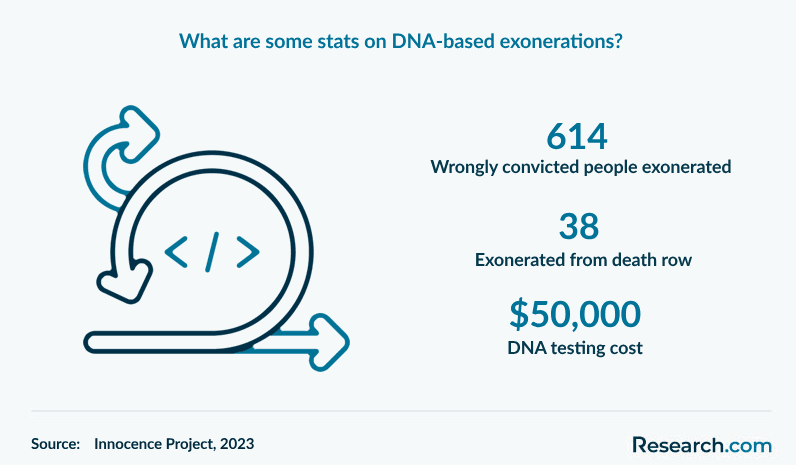
DNA testing has helped correct wrongful convictions in the United States. Since 1989, DNA evidence has contributed to the exoneration of 614 individuals, including 38 people who had been on death row, as reflected in the visual below.
At the same time, DNA evidence has limits. It is not present in every case, testing in a single case can cost up to $50,000, and DNA evidence appears in less than 10% of murder cases.
What are the different types of forensic science careers?
Forensic science is not a single occupation. It includes specialties that support crime laboratories, medical examiner offices, law enforcement agencies, courts, private laboratories, digital investigations, and consulting work. Before choosing a degree, decide which branch matches your interests, academic strengths, comfort with trauma exposure, and preference for lab, field, digital, or clinical work.
| Forensic Career | Core Responsibilities | Best Fit For |
| Forensic DNA analyst | Analyzes biological evidence such as blood, tissue, hair, and other samples to support identification or exclusion. | Students with strong biology, genetics, statistics, and lab-protocol skills. |
| Forensic toxicologist | Tests bodily fluids and tissues for drugs, poisons, alcohol, or other substances. | Students interested in chemistry, pharmacology, toxicology, instrumentation, and impairment or death investigations. |
| Crime scene investigator | Photographs and documents scenes, collects evidence, and maintains chain of custody. | People who can work in unpredictable field settings while following strict evidence procedures. |
| Forensic pathologist | Conducts autopsies and determines cause and manner of death. | Students willing to complete medical school and advanced pathology training. |
| Digital forensic analyst | Preserves, recovers, and examines data from computers, phones, networks, cloud accounts, and storage devices. | Students interested in cybercrime, computer systems, data recovery, and digital evidence protocols. |
| Firearm examiner or ballistics expert | Examines firearms, ammunition, projectiles, trajectories, firearm function, and related evidence. | Students drawn to physical evidence, microscopy, mechanics, comparative analysis, and technical documentation. |
| Forensic chemist | Identifies unknown materials such as controlled substances, explosives, trace evidence, or chemical residues. | Students with strong chemistry, instrumental analysis, and laboratory skills. |
| Forensic anthropologist | Studies skeletal remains to assist with identity, biological profile, trauma assessment, or death-related circumstances. | Students interested in human osteology, anthropology, field recovery, and graduate-level research. |
| Forensic psychologist | Evaluates mental state, competency, risk, criminal responsibility, or behavior in legal contexts. | Students interested in psychology, assessment, courts, expert testimony, and possible graduate options such as online master's programs in forensic psychology. |
Your ideal pathway depends on whether you want to process physical evidence, analyze biological samples, examine digital data, investigate scenes, perform death investigations, or evaluate human behavior. These careers all connect to the justice system, but they require different education, training, and credentials.
What is a typical day like for a forensic scientist?
A forensic scientist's daily routine depends on the specialty and employer. A lab analyst may prepare samples, run instruments, review quality controls, interpret data, and write reports. A crime scene investigator may spend long shifts documenting scenes and collecting evidence. A digital forensic analyst may image devices, recover files, analyze account activity, and organize findings for investigators or attorneys.
- Evidence analysis: Professionals may work with biological samples, chemical substances, trace materials, firearms evidence, toxicology specimens, digital files, or device data.
- Documentation: Reports, notes, photographs, instrument records, case logs, and chain-of-custody forms are essential parts of the work.
- Quality assurance: Forensic tasks often involve controls, calibration, validation, peer review, technical review, and compliance with lab procedures.
- Case communication: Forensic scientists may discuss findings, limitations, timelines, and evidence questions with investigators, attorneys, supervisors, or other experts.
- Court preparation: Some roles require testimony preparation, case file review, method explanation, and responses to cross-examination.
- Field response: Crime scene personnel may travel to scenes, document environments, collect evidence, and coordinate with law enforcement teams.
- Training and method updates: Because tools and standards change, professionals often complete continuing education or participate in method validation.
Digital evidence is increasingly important as cybercrime expands. Over the five years leading up to 2023, the Internet Crime Complaint Center (IC3) received an average of 758,000 complaints per year. From 2019 to 2023, IC3 received 3.79 million total complaints. Reported losses during that period reached $37.5 billion, increasing from $3.5 billion in 2019 to $12.5 billion by 2023, as shown in the chart below.
What ethical and legal guidelines should forensic scientists follow?
Ethics are central to forensic science because the work can influence arrests, prosecutions, convictions, appeals, and exonerations. A forensic scientist is not supposed to prove a preferred theory. The job is to evaluate evidence with valid methods, report findings honestly, and explain limitations clearly.
- Preserve evidence integrity: Collect, label, package, store, transfer, and document evidence in ways that protect chain of custody and reduce contamination risk.
- Remain objective: Do not adjust findings to match agency pressure, prosecutor expectations, defense theories, or personal assumptions.
- Protect confidentiality: Safeguard sensitive case details, victim information, investigative files, and personal data.
- Testify accurately: Explain what the evidence supports, what it cannot prove, and where uncertainty remains.
- Stay within your expertise: Do not perform analyses, issue opinions, or testify beyond your training, validated methods, or professional authority.
- Follow legal and agency rules: Comply with federal, state, local, laboratory, and employer requirements for evidence handling, disclosure, and reporting.
- Disclose conflicts of interest: Identify personal, financial, professional, or institutional conflicts that could affect objectivity.
- Maintain transparent records: Keep complete notes and data so findings can be reviewed, challenged, or reproduced when appropriate.
Ethical practice protects public safety, individual rights, laboratory credibility, and trust in the justice system. It also protects the scientist's professional reputation.
Can you earn a quality online forensic science degree affordably?
Online forensic science degrees can offer flexibility, but students should evaluate them with caution. A low advertised tuition price does not automatically make a program a good investment, and an online format does not remove the need for practical science preparation. Some programs require in-person labs, campus visits, internships, practicums, or local placements, while others focus more heavily on theory or criminal justice content.
| Factor to Check | Why It Affects Your Decision | Question to Ask the School |
| Accreditation | Accreditation can affect transfer credit, graduate school admission, employer recognition, and access to financial aid. | Is the institution accredited, and does the program align with the expectations for my target forensic role? |
| Laboratory requirements | Forensic science is an applied discipline, and many employers expect real laboratory competence. | Are labs completed online, in person, through a hybrid model, at local sites, or during campus residencies? |
| Science depth | Programs differ in how much chemistry, biology, statistics, instrumentation, and forensic method training they include. | Does the curriculum include the exact science courses commonly required by employers? |
| Internships and field experience | Relevant experience can make a major difference in a competitive entry-level market. | Does the program help students find placements with crime labs, agencies, medical examiner offices, or investigative units? |
| Total cost | Fees, lab kits, travel, technology costs, residency rules, and lost work time can change the true price. | What will the full program cost after tuition, fees, materials, travel, and required in-person components? |
Affordability should be judged alongside quality, science preparation, and career fit. A practical next step is to compare affordable online forensic science degree programs by cost, coursework, flexibility, laboratory expectations, and student support.
Can alternative education paths strengthen a forensic science career?
Alternative education can help when it solves a specific career problem. Depending on the role, forensic professionals may benefit from legal studies, cybersecurity, data analytics, public health, biotechnology, intelligence studies, or advanced psychology coursework. The best additional credential is the one that adds targeted skills, not the one that simply adds another line to a resume.
For example, a legal studies associate degree online can help students understand court procedures, legal terminology, evidence rules, and legal writing. That knowledge may support work with attorneys, courts, compliance departments, or investigative teams. However, legal studies usually will not replace chemistry, biology, or laboratory science for students who want forensic lab positions.
| Additional Study Area | When It Can Help | When It Is Not Enough |
| Legal studies | Useful for learning courts, evidence rules, trial procedures, legal writing, and legal terminology. | It typically does not replace science coursework for laboratory-based forensic jobs. |
| Cybersecurity or digital forensics | Useful for cybercrime, device analysis, incident response, fraud investigation, and intelligence work. | It may not prepare students for wet-lab roles involving biological or chemical evidence. |
| Psychology | Useful for forensic psychology, behavioral assessment, victim services, offender-related work, or court-related evaluation. | Licensed psychology roles may require graduate education, supervised practice, and state licensure. |
| Biotechnology | Useful for DNA analysis, molecular methods, biological evidence, and laboratory research. | Students may still need forensic-specific instruction in chain of custody, evidence reporting, and courtroom communication. |
How much do forensic scientists make in the USA?
Forensic science salaries vary by specialty, employer, location, education, experience, union or government pay scale, and advancement opportunities. Government crime labs, police departments, medical examiner offices, federal agencies, private labs, and consulting firms may use very different compensation structures.
| Role or Salary Measure | Reported Pay | Source Context |
| Forensic scientist average salary | $57,376 | PayScale.com (2025) |
| Forensic scientist entry-level average | $50,539 | PayScale.com (2025) |
| Forensic scientist early-career average | $56,389 | PayScale.com (2025) |
| Forensic scientist top salary | $87,000 | PayScale.com (2025) |
| Crime scene investigator national average | $53,013 | PayScale.com (2025) |
| Crime scene investigator entry-level pay | $49,155 | PayScale.com (2025) |
| Crime scene investigator mid-career pay | $54,733 | PayScale.com (2025) |
| Crime scene investigator highest pay | $76,000 | PayScale.com (2025) |
| Forensic science technician median annual salary | $67,440, or $32.42 per hour | U.S. Bureau of Labor Statistics (2024) |
Location can make a noticeable difference. Forensic science technicians report higher salaries in states such as California ($81,910), Massachusetts ($81,690), and New York ($80,170), compared with Alaska ($68,840), as shown in the graphic below.
Do not evaluate salary in isolation. Compare expected pay with cost of living, degree cost, benefits, overtime expectations, job stability, advancement options, and whether your target specialty requires graduate or professional education. Students interested in behavior-focused forensic work may also compare online forensic psychology master's programs if graduate study fits their career plan.
How are emerging technologies changing forensic science?
Technology is reshaping how forensic evidence is collected, tested, interpreted, stored, and presented. The main change is not that technology replaces professional judgment. Instead, forensic workers increasingly need to understand data quality, automated tools, software validation, digital evidence, cybersecurity risks, and the limits of algorithm-based interpretation.
- Digital forensics is expanding: Phones, laptops, cloud accounts, connected devices, online platforms, and network records are now important in many investigations.
- Laboratory automation is increasing: Automated instruments can speed some testing, but analysts still need to evaluate quality controls, interpret results, and document limitations.
- Machine learning and pattern recognition are emerging: These tools may assist with triage, anomaly detection, image review, or large-scale data analysis, but they require validation and careful explanation.
- Cybercrime evidence is growing: Rising complaint volumes and financial losses make digital evidence handling a more important forensic skill set.
- Data integration is becoming more complex: Investigations may combine laboratory results, device data, geolocation records, financial records, communication logs, and intelligence sources, which increases the need for careful data governance.
Students who want to work in intelligence, data-heavy investigations, or technology-enabled analysis may benefit from related graduate study. For example, online master's degree programs in intelligence may be relevant for professionals who want advanced analytical skills in investigative environments.
What is the job market like for forensic science graduates?
The forensic science labor market shows positive growth, but entry-level hiring can still be competitive. The field attracts many students, and employers often favor applicants with strong science coursework, internships, documented lab experience, evidence-handling knowledge, certification progress, and strong communication skills.
| Labor Market Factor | Reported Data | What It Means for Students |
| Current employment base | The field employed approximately 18,600 people in 2023. | This is a specialized occupation, so available openings may depend heavily on region and agency funding. |
| Projected growth | Jobs are expected to grow by 14% from 2023 to 2033. | Growth is favorable, but strong applicants still need relevant coursework, experience, and specialization. |
| New positions | The projection adds about 2,500 new positions. | Students should not rely on growth alone; internships, networking, and technical preparation matter. |
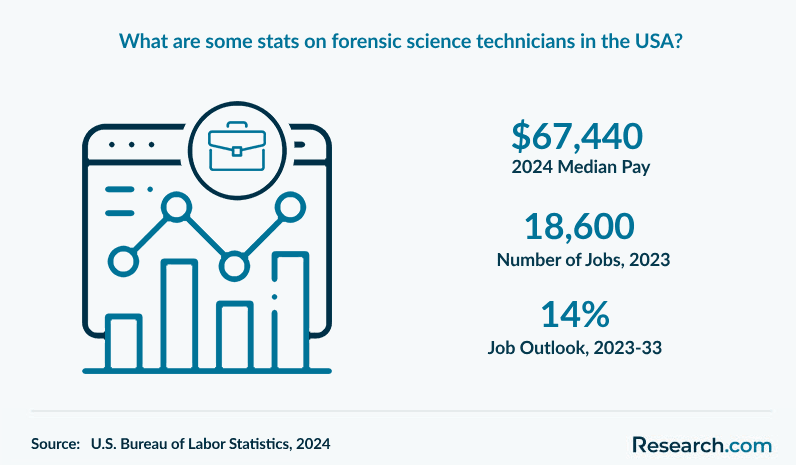
| Median pay | The median annual salary in 2024 was $67,440, or $32.42 per hour. | Compare expected earnings with degree cost, location, employer type, and advancement potential. |
The U.S. Bureau of Labor Statistics (2024) describes this growth as much faster than the average for all occupations. Demand is shaped by forensic service needs, investigative technologies, evidence analysis, and the continuing importance of scientific evidence in legal proceedings, as illustrated below.
To become more competitive, treat career preparation as something that starts well before graduation. Pursue internships, build laboratory competence, learn chain-of-custody practices, attend professional events, ask faculty about local employers, and tailor your resume to the forensic specialty you want.
Some graduates also consider adjacent science careers. If you already have forensic science training and are thinking about advanced life science study, evaluate whether a master's in biotechnology is worth it for your target role, salary expectations, and technical interests.
What challenges should you consider before entering forensic science?
Forensic science can be meaningful, but students should understand the realities before investing in a degree. The challenges include emotional exposure, technical pressure, legal scrutiny, resource limits, and ethical responsibility.
| Challenge | Why It Matters | How to Lower the Risk |
| Emotional strain | Some roles involve violent crimes, death scenes, trauma, victim evidence, disturbing photographs, or autopsy-related material. | Seek realistic exposure through shadowing, internships, practitioner interviews, and supervised field experiences. |
| High responsibility | Mistakes can affect investigations, legal outcomes, agency credibility, and public trust. | Build strong habits in documentation, verification, labeling, peer review, and quality control. |
| Courtroom scrutiny | Methods, conclusions, assumptions, and credentials may be challenged by attorneys or opposing experts. | Practice explaining methods, limitations, uncertainty, and scientific reasoning clearly. |
| Backlogs and limited resources | Some laboratories deal with heavy caseloads, staffing shortages, budget constraints, or delays. | Ask employers about caseload expectations, training, supervision, quality systems, and workload management. |
| Ethical pressure | Professionals may feel pressure to confirm a theory, speed up conclusions, or overstate findings. | Commit to objectivity, transparent reporting, disclosure, peer review, and professional standards. |
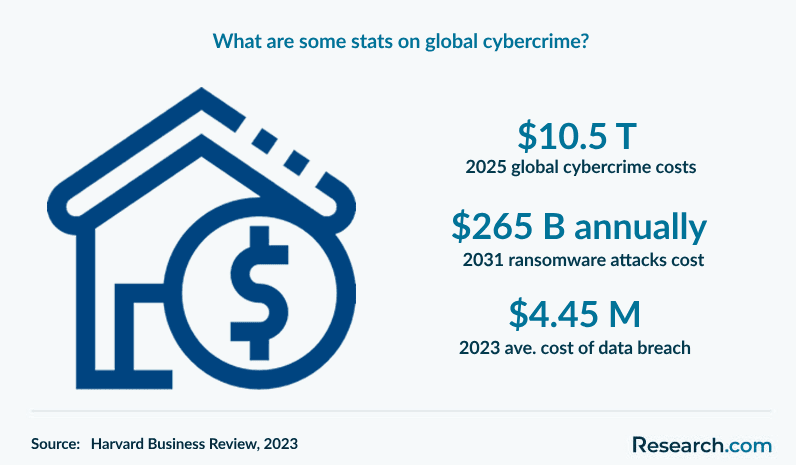
Cybercrime shows how investigative pressure is expanding. In the U.S., cybercrime losses to businesses exceeded $10 billion, while global costs are projected to reach $10.5 trillion by 2025. Ransomware is a major contributor, with projected victim costs of around $265 billion annually by 2031, which is 815 times greater than the $325 million spent in 2015. The average cost of a data breach reached a record high of $4.45 million in 2023, a 15.3% increase from 2020, as shown in the graphic below.
For students who value evidence-based work and public service, the field can still be deeply rewarding. If you are comparing careers that combine technical knowledge, public impact, and emotionally demanding situations, you may also want to explore how to become a public health nurse.
Can forensic science skills lead to other investigative careers?
Yes. Forensic science develops transferable skills in evidence handling, documentation, scientific reasoning, pattern recognition, report writing, quality control, and legal communication. With additional training, those skills can support careers outside traditional crime laboratories.
- Cybersecurity investigation: Forensic reasoning can support digital evidence collection, incident response, fraud analysis, and cybercrime investigations.
- Law enforcement analysis: Evidence interpretation, structured reporting, and investigative support skills can help in analyst roles.
- Intelligence careers: Careful documentation, source evaluation, and analytical discipline can be useful in government, defense, or security-related work.
- Compliance and risk management: Chain-of-custody thinking, audit trails, and documentation habits can transfer to regulated industries.
- Laboratory quality assurance: Forensic lab training can support validation, technical review, quality control, and compliance roles.
If you are interested in federal investigative or intelligence work, research requirements early. Citizenship rules, background checks, fitness standards, security clearances, language skills, and experience expectations can vary widely. A forensic background may help with some pathways, but it does not guarantee eligibility. For a related career comparison, review how to become a CIA officer and compare those requirements with your current plan.
What else should students consider before choosing forensic science?
Before enrolling in a forensic science program, evaluate the decision as both an academic commitment and a career investment. The strongest program is not necessarily the one with the most exciting title. It is the one that prepares you for the specific forensic role you want and gives you the science, experience, and credibility employers value.
Common mistakes to avoid
- Choosing by program title only: A degree labeled "forensic science" is not automatically strong. Review the chemistry, biology, math, statistics, and lab requirements behind the name.
- Skipping the accreditation check: Verify institutional accreditation and whether the program is respected by employers, graduate schools, or agencies in your target specialty.
- Assuming online means fully remote: Some online programs still require in-person labs, practicums, internships, campus visits, or local field placements.
- Looking only at tuition: Add fees, books, lab supplies, technology costs, travel, lost work time, and possible graduate school expenses.
- Ignoring emotional fit: Crime scene response, death investigation, and victim-related evidence are not suitable for everyone.
- Assuming salary outcomes are guaranteed: Pay depends on location, employer type, specialty, experience, credentials, and available openings.
- Relying only on rankings: Rankings can help you discover schools, but curriculum, labs, internships, faculty experience, employer relationships, and outcomes matter more for career readiness.
Questions to ask before enrolling
- Which forensic jobs do graduates actually get after completing the program?
- Does the curriculum meet the coursework expectations for my preferred forensic specialty?
- How many laboratory courses are required, and how are those labs delivered?
- Does the school help students secure internships, field placements, or crime lab experience?
- Do faculty members have experience in forensic labs, investigations, expert testimony, or forensic research?
- Which certifications, graduate programs, or advanced roles do alumni pursue?
- What is the full cost after tuition, fees, labs, supplies, technology, and travel?
- Will my credits transfer if I change schools or continue into graduate study?
- Does the program teach courtroom communication, ethics, uncertainty, and evidence reporting?
What Graduates Say About Their Forensic Science Careers
-
: "
Forensic science let me apply biology to evidence that can affect real cases. The standards are demanding, but knowing the work can contribute to an investigation makes the effort meaningful. Melissa
"
-
: "
Working as a crime scene investigator means the day rarely goes exactly as planned. Scene response, documentation, and coordination with the lab keep the job challenging, and every case adds to my experience. Tavion
"
-
: "
I first entered the field because I liked the science, but the public impact is what made me stay. Careful evidence analysis can help identify the guilty, protect the innocent, and provide answers to families. Nicolette
"
Key Insights
- Forensic science is genuinely challenging: The field requires strong science preparation, disciplined evidence handling, detailed documentation, ethical judgment, and the ability to defend findings in legal settings.
- Your degree should match your target role: A bachelor's degree may be enough for some entry-level technician or analyst roles, while forensic pathology, psychology, anthropology, and related specialties may require graduate, doctoral, medical, or professional education.
- DNA evidence matters, but it is not universal: Since 1989, DNA testing has contributed to 614 U.S. exonerations, including 38 people who had been on death row, but DNA appears in less than 10% of murder cases and testing can cost up to $50,000 per case.
- Digital evidence is changing the profession: From 2019 to 2023, IC3 received 3.79 million internet crime complaints, averaging 758,000 complaints annually, with reported losses totaling $37.5 billion.
- Cybercrime is increasing the need for forensic skills: Reported internet crime losses rose from $3.5 billion in 2019 to $12.5 billion in 2023, while broader cybercrime and ransomware projections point to growing demand for digital investigation expertise.
- Salary varies by role and location: Forensic scientists earn an average of $57,376, with top salaries reaching $87,000. Crime scene investigators average $53,013 nationally, with entry-level pay at $49,155 and mid-career pay at $54,733.
- State differences can be significant: Forensic science technicians report higher salaries in California ($81,910), Massachusetts ($81,690), and New York ($80,170), compared with Alaska ($68,840).
- The outlook is positive but not effortless: The field had 18,600 jobs in 2023 and is projected to grow by 14% through 2033, adding 2,500 jobs. Internships, laboratory skills, specialization, and networking still matter.
- Program quality matters more than the label: Before enrolling, check accreditation, science depth, lab delivery, internship support, total cost, faculty expertise, and alignment with your preferred forensic specialty.
References:
- Federal Bureau of Investigation. (2024). 2023 Internet Crime Report. Internet Crime Complaint Center. Federal Bureau of Investigation.
- Harvard Business Review. (2023, October 27). Fighting AI-driven cybercrime requires AI-powered data security. Harvard Business Review.
- PayScale. (2025, January 16). Average Early-Career Crime Scene Investigator (CSI) Salary. PayScale.
- PayScale. (2025, March 24). Forensic Scientist Salary in 2025 | PayScale. PayScale.
- PayScale. (2024). Forensic science technician salary by state. PayScale.
- Selby, D. (2023, April 25). DNA and wrongful conviction: Five facts you should know. Innocence Project.
- U.S. Bureau of Labor Statistics. (2024, April 18). Forensic science technicians. Occupational Outlook Handbook. U.S. Bureau of Labor Statistics.
Other Things You Should Know About Forensic Science
The American Board of Criminalistics offers certification in molecular biology, drug analysis, and firearms examination, and many lab employers prefer it for analyst roles. Applicants usually need a bachelor’s degree in forensic science, chemistry, biology, or a related field, plus documented training and casework experience.
In 2027, aspiring forensic scientists typically need a bachelor's degree in forensic science or a related field. Coursework often includes biology, chemistry, and criminal justice. Specialized programs may also require lab work or internships, enhancing practical skills important for the field.


