2027 How to Become a Hospital CEO: Salary & Career Paths

Co-Founder and Chief Data Scientist
Becoming a hospital CEO is a career plan that requires years of deliberate preparation. It is not a first healthcare management job, and it is not earned by degree title alone. Hospital CEOs are accountable for clinical performance, financial sustainability, compliance, technology decisions, workforce stability, public trust, and board expectations—often at the same time.
This guide is for students, clinicians, healthcare administrators, business professionals, and public health graduates who want to understand whether the hospital CEO path is realistic and how to prepare for it. You will learn what the role involves, which degrees are most relevant, how executives typically move into CEO positions, what skills matter most, how compensation varies, what labor market data says, and what alternative careers may offer a better fit.
Quick Answer: How Do You Become a Hospital CEO?
Most hospital CEOs reach the role by combining graduate education with a long record of healthcare leadership. A typical route starts with a bachelor’s degree in healthcare administration, business, finance, public health, nursing, medicine, or a related field. Many future executives then earn an MHA, MBA with a healthcare concentration, MPH, or MSN with an administration focus. From there, they progress through management and executive roles in hospital operations, finance, nursing leadership, strategy, compliance, or system administration before being considered for CEO positions.
- A master’s degree is often expected, but it is not enough by itself. Hospital boards usually want leaders who have already managed people, budgets, risk, quality initiatives, and complex operations.
- Several academic backgrounds can lead to the CEO office. CEOs may come from administration, business, finance, public health, nursing, medicine, or other healthcare leadership tracks.
- Compensation can be high, but the range is wide. ZipRecruiter reports an average hospital CEO salary of $151,302 per year, while Salary.com reports an average base salary of $460,000 per year.
- CEO openings are limited and competitive. The U.S. Bureau of Labor Statistics projects 5% growth from 2023 to 2033 for chief executives, including hospital CEOs, but there are far fewer CEO roles than mid-level healthcare management positions.
- Hospitals select leaders who can prove results. Strong candidates show evidence of operational improvement, financial judgment, compliance awareness, physician collaboration, staff retention, crisis leadership, and patient-centered strategy.
- What is a hospital CEO?
- What does a hospital CEO do?
- What education do you need to become a hospital CEO in 2027?
- What career path usually leads to a hospital CEO role?
- What skills do hospital CEOs need?
- How much do hospital CEOs make?
- What is the job outlook for hospital CEOs?
- How should aspiring hospital CEOs invest in professional development?
- How can hospital CEOs strengthen workforce skills?
- How can hospital CEOs build a resilient workforce?
- How do hospital CEOs balance innovation and compliance?
- How can nutrition strategy support hospital performance?
- How can cross-disciplinary education improve CEO leadership?
- What is the ROI of executive leadership training?
- How can hospital CEOs prepare for industry disruption?
- What challenges do hospital CEOs face?
- What other careers fit a master’s degree in hospital administration or public health?
- Can hospital CEOs move into other industries?
What is a hospital CEO?
A hospital CEO is the top executive responsible for a hospital’s overall direction, performance, risk management, and long-term viability. The CEO reports to or works closely with the governing board and leads the senior executive team. Their decisions affect physicians, nurses, administrators, patients, community partners, regulators, payers, donors, and employees across the organization.
The role goes far beyond supervising day-to-day activity. A hospital CEO shapes strategy, evaluates growth opportunities, protects financial health, supports patient safety and quality goals, oversees executive hiring, responds to regulatory pressure, and represents the hospital publicly. In a health system, one CEO may be responsible for several hospitals or facilities instead of a single campus.
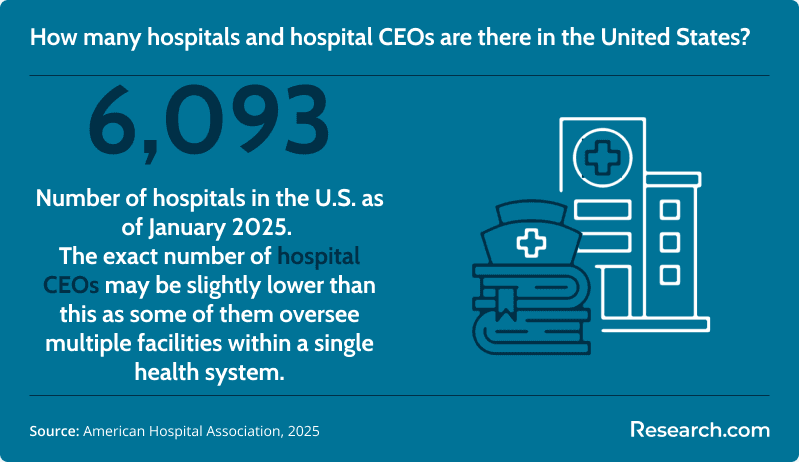
As of 2025, there are 6,093 hospitals in the United States. That does not necessarily mean there are 6,093 separate hospital CEOs, because some executives oversee multiple facilities within larger systems.
What does a hospital CEO do?
A hospital CEO’s work is to keep clinical care, business operations, compliance, workforce strategy, and community obligations moving in the same direction. The job requires both high-level planning and practical decision-making, because hospitals operate under financial, regulatory, staffing, and patient-care pressures every day.
| CEO Responsibility | What the CEO Actually Oversees | Why It Affects Hospital Performance |
| Governance and strategy | Partners with the board and senior leaders to define priorities, approve major initiatives, and align operations with the hospital’s mission. | Clear strategy helps leaders allocate limited resources and respond to changing community needs, technology, competition, and staffing conditions. |
| Financial stewardship | Reviews budgets, revenue, expenses, capital projects, payer mix, reimbursement issues, and long-term sustainability. | Hospitals cannot maintain services, pay staff, invest in equipment, or expand access without disciplined financial management. |
| Operational leadership | Monitors patient flow, department performance, staffing patterns, facility needs, service lines, and technology systems. | Operational quality influences wait times, safety, staff workload, patient satisfaction, and cost control. |
| Quality and safety | Supports systems that reduce preventable harm, improve outcomes, track performance, and strengthen patient experience. | Quality affects accreditation, reimbursement, reputation, public confidence, and the hospital’s core mission. |
| Compliance and enterprise risk | Ensures the organization follows legal, accreditation, billing, privacy, ethical, and safety requirements. | Compliance failures can harm patients, trigger penalties, damage trust, and create major financial exposure. |
| Workforce and culture | Develops senior leaders, supports retention, addresses burnout, and builds a work environment where clinicians and staff can perform well. | Hospitals depend on skilled teams. Poor workforce stability can weaken access, quality, morale, and financial performance. |
| External relationships | Works with public agencies, community organizations, employers, insurers, donors, medical groups, and regional healthcare partners. | Hospitals often serve as major community institutions, and relationships influence access to care, reputation, funding, and public health efforts. |
A CEO’s schedule may include board sessions, finance reviews, physician meetings, community events, emergency preparedness planning, service-line discussions, quality briefings, compliance updates, and executive performance conversations. The role is demanding because decisions often involve incomplete information, competing priorities, and consequences for both patient care and organizational survival.
What education do you need to become a hospital CEO in 2027?
No single license or degree automatically makes someone eligible to run a hospital. However, most competitive CEO candidates have formal education in healthcare, business, finance, public health, clinical practice, or organizational leadership, followed by advanced study and substantial management experience.
Bachelor’s degree
The first step is usually a bachelor’s degree that builds a foundation in healthcare systems, management, analytics, finance, science, or clinical care. Some students choose a campus program, while others prefer a flexible online healthcare management degree that can fit around work or family obligations.
- Healthcare administration
- Business administration
- Public health
- Finance or accounting
- Nursing, medicine, or another clinical discipline
- Health sciences or medical sciences
At the undergraduate level, future executives should look for coursework and experiences that explain how healthcare organizations function. Useful areas include reimbursement, accounting, healthcare law, ethics, quality improvement, statistics, data analysis, leadership, operations, and patient-centered care.
Master’s degree
Graduate education is often the credential that helps healthcare professionals move from supervision into senior management. Many hospitals prefer or require a master’s degree for executive positions, especially when the role includes budget authority, enterprise-level strategy, or responsibility for multiple departments.
| Graduate Degree | Who It Usually Fits Best | Why It Can Help a Future CEO |
| Master of Healthcare Administration | Professionals focused on hospital leadership, health system management, and healthcare operations. | Covers healthcare finance, policy, quality, operations, strategy, and administration in a hospital-centered context. |
| MBA with a healthcare focus | Candidates who want broad business training with healthcare applications. | Strengthens finance, strategy, analytics, organizational leadership, and competitive decision-making. Many healthcare MBA career paths can build toward executive responsibility. |
| Master of Public Health | Professionals drawn to population health, prevention, health equity, epidemiology, policy, or community programs. | Useful for leaders in hospitals and systems that prioritize public health partnerships, community health, policy, and population-level outcomes. |
| Master of Science in Nursing with an administration focus | Experienced nurses preparing for executive clinical or operational leadership. | Combines clinical perspective with management preparation for positions such as nurse executive, operations leader, or eventual CEO candidate. |
Certifications
Professional certifications do not replace executive-level results, but they can show commitment to healthcare management and help candidates strengthen credibility in a competitive field.
- Certified Healthcare Executive. This credential is provided by the Canadian College of Health Leaders.
- Fellow of the American College of Healthcare Executives. The FACHE credential reflects advanced healthcare management knowledge and sustained professional involvement.
- Certified Medical Practice Executive. This credential may be useful for leaders responsible for medical groups, physician practices, or ambulatory operations.
Doctoral degree
A doctorate is not a standard requirement for hospital CEO roles. Some leaders pursue a Doctor of Healthcare Administration, Doctor of Business Administration, or Ph.D. in Healthcare Management when they want deeper preparation in policy, research, systems leadership, or advanced administration. A doctoral pathway may be most relevant for academic health systems, policy-focused executives, research-oriented leaders, or candidates targeting highly specialized senior roles.
What career path usually leads to a hospital CEO role?
The CEO track is usually long because hospital boards want proof that a candidate can lead through complexity. Strong candidates do not simply collect credentials; they build a record of improving operations, managing budgets, leading teams, working with clinicians, handling compliance obligations, and making decisions that hold up under pressure.
- Start with a relevant education plan. Common undergraduate backgrounds include healthcare administration, business, finance, nursing, medicine, public health, and health science. Working adults who need flexibility may consider an accelerated online healthcare administration degree if the format, accreditation, and curriculum support their goals.
- Get direct healthcare experience. Early roles might include healthcare administrator, department coordinator, analyst, finance manager, operations manager, HR manager, clinical supervisor, nurse leader, or physician leader. The priority is learning how hospitals actually operate.
- Take on management responsibility. Future CEOs need experience with teams, budgets, service lines, quality indicators, compliance projects, patient access, and operational improvement. Measurable outcomes matter more than job titles alone.
- Earn a graduate degree at the right time. Many professionals pursue an MHA, MBA, MPH, or MSN when they are preparing for broader administrative or executive responsibilities.
- Move into senior leadership. Common stepping-stone roles include chief operating officer, chief financial officer, chief nursing officer, hospital administrator, vice president of operations, strategy executive, or service-line leader.
- Build board-level credibility. CEO candidates must show that they can communicate with trustees, support physicians, protect compliance, manage crisis situations, improve performance, and lead with financial discipline.
- Compete for CEO opportunities. Many candidates reach serious consideration after 15 to 20 years of progressive experience. Some are promoted from within, while others are recruited from another hospital, health system, or healthcare organization.
Targeted credentials can help at different points in the journey, especially when they add a skill the candidate can apply immediately. Some healthcare certifications may be useful for professionals who want to document specialized knowledge while moving across operational areas.
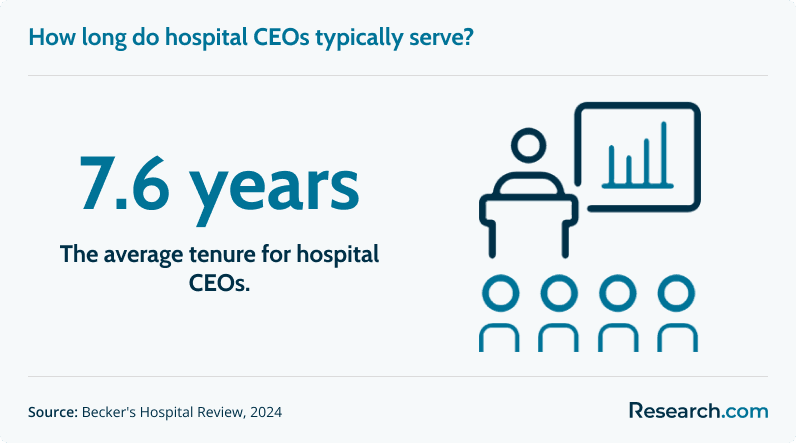
At the executive level, tenure becomes part of the career conversation. The following image shows average tenure patterns among healthcare CEOs.
What skills do hospital CEOs need?
Hospital CEOs need business judgment and healthcare fluency. They must understand finance, regulation, operations, clinical priorities, workforce dynamics, governance, technology, and public communication. Formal programs introduce many of these topics through typical healthcare administration degree requirements, but the strongest skills are refined through years of leadership experience.
| Skill Area | How It Shows Up in a CEO Role | Practical Ways to Develop It |
| Executive leadership | Creates direction, makes difficult calls, sets expectations, and keeps leaders accountable during uncertainty. | Lead larger teams, manage cross-functional projects, seek executive mentorship, and own measurable results. |
| Financial management | Interprets budgets, reimbursement patterns, revenue cycle issues, payer dynamics, capital needs, and cost pressures. | Work closely with finance leaders, request budget responsibility, study healthcare economics, and participate in capital planning. |
| Hospital operations | Improves patient flow, staffing models, department coordination, service delivery, quality performance, and resource use. | Rotate through operations, lead process improvement work, analyze bottlenecks, and learn from frontline clinical leaders. |
| Compliance and risk awareness | Identifies legal, accreditation, privacy, safety, ethical, and billing risks before they escalate. | Join risk or audit committees, partner with compliance officers, review incident patterns, and stay current on healthcare rules. |
| Communication | Explains strategy to boards, physicians, employees, patients, regulators, donors, media, and community groups. | Practice board presentations, physician engagement, media responses, public speaking, and difficult conversations. |
| Strategic thinking | Connects market conditions, patient demand, technology, competition, staffing, and financial realities into a workable plan. | Study healthcare strategy, participate in service-line planning, review market data, and evaluate competing proposals. |
| Crisis leadership | Makes steady decisions during cyberattacks, public health events, natural disasters, financial shocks, or operational failures. | Take part in emergency preparedness planning, incident command exercises, simulations, and after-action reviews. |
| Talent and culture leadership | Builds leadership pipelines, reduces avoidable turnover, supports staff engagement, and addresses burnout risks. | Develop managers, listen to frontline employees, review retention data, and connect culture initiatives to patient care goals. |
How much do hospital CEOs make?
Hospital CEO pay varies dramatically. Compensation depends on hospital size, revenue, location, ownership model, organizational complexity, service lines, market conditions, and performance expectations. A small rural hospital and a large urban health system may both need strong leadership, but their compensation structures can be very different.
Salary sources also use different methods, which is why published figures may not match. ZipRecruiter reports an average hospital CEO salary of $151,302 per year, or $73 per hour. Salary.com reports an average base salary of $460,000 per year. Other industry sources describe the following compensation ranges:
| Hospital CEO Category | Reported Compensation | Factors That Can Affect Pay |
| Average salary | $250,000 – $450,000 per year | Executive experience, hospital complexity, regional market, and organization type. |
| Small hospital CEOs | $150,000 – $300,000 annually | Facility size, payer mix, rural or regional economics, and budget limitations. |
| Large hospital or health system CEOs | $500,000 – $1 million+ annually | Operational scale, system complexity, specialized service lines, and financial performance. |
| Top executives at major health systems | Can earn $2 million or more, including bonuses and incentives | Executive contract terms, incentive structure, organization size, and performance-based compensation. |
Some of the highest paid hospital CEOs earned a base salary of at least $1.5 million. When bonuses, stock awards, option awards, and non-equity incentive plan compensation were included, total pay could exceed $20 million.
CEO compensation may include more than base salary. Depending on the employer, a package may include performance bonuses, retirement contributions, pension benefits, travel allowances, expense accounts, executive health benefits, or equity-based compensation in for-profit settings. These arrangements reflect the responsibility of leading organizations that must deliver care, control risk, retain talent, and remain financially stable.
If you are comparing executive careers more broadly, hospital CEO positions may appear alongside other high-paying business careers. The difference is that healthcare executives also carry direct accountability for patient safety, compliance, access to care, and community trust.
What is the job outlook for hospital CEOs?
The employment outlook for hospital CEOs is tied to the broader chief executive labor market and the continuing complexity of healthcare delivery. The U.S. Bureau of Labor Statistics projects 5% employment growth for chief executives, including hospital CEOs, from 2023 to 2033.
Hospitals and health systems need capable leaders because they face consolidation, financial strain, reimbursement pressure, regulatory demands, cybersecurity risks, workforce shortages, digital transformation, aging population needs, and new care models. However, CEO roles remain limited. The path is much narrower than the market for department managers, administrators, analysts, or directors.
Trends affecting hospital CEO demand
- Consolidation across health systems. Mergers and acquisitions can create larger organizations that require leaders who understand integration, governance, and system-level strategy.
- Regulatory and reimbursement complexity. CEOs need working knowledge of compliance, payer negotiations, Medicare, privacy rules, accreditation expectations, and quality reporting.
- Technology and AI adoption. Telemedicine, electronic health records, artificial intelligence, automation, analytics, and cybersecurity tools require executives who can weigh benefits against privacy, safety, cost, and workflow risks.
- Workforce instability. Recruitment, retention, burnout prevention, succession planning, and leadership development remain central issues for hospital executives.
- Rising patient expectations. Hospitals are evaluated on outcomes, access, communication, transparency, experience, and continuity of care—not clinical treatment alone.
The chart below compares projected employment growth for chief executives, including hospital CEOs, with other top executives, managers, and the overall labor market.
How should aspiring hospital CEOs invest in professional development?
Professional development should solve a defined career problem. Before enrolling in a certificate, conference, executive program, or additional degree, ask which gap it addresses: finance, quality improvement, compliance, operations, workforce planning, physician relations, governance, data analytics, digital health, or crisis leadership.
The strongest development investments have practical value. They align with current responsibilities, help produce visible workplace results, and improve readiness for the next leadership role. A prestigious program may be worthwhile, but a targeted credential can be a better choice when it fills a specific operational gap. For example, leaders who need a better understanding of revenue cycle processes, coding, and documentation may compare options related to medical billing and coding training costs before deciding whether that knowledge is worth the investment.
How can hospital CEOs strengthen workforce skills?
Hospital CEOs are not responsible for personally training every employee, but they are responsible for making workforce development a strategic priority. That includes funding relevant training, expecting managers to develop staff, connecting learning goals to patient care needs, and creating internal pipelines for roles that are difficult to fill.
Training should match the workforce problem. Senior managers may need preparation in finance, compliance, change management, quality improvement, and leadership. Support staff may need workflow training, technology onboarding, role-specific instruction, or clinical-adjacent education. In some organizations, leaders may assess whether partnerships with an online medical assistant school could support staffing plans for ambulatory or patient support roles.
How can hospital CEOs build a resilient workforce?
Workforce resilience is built before a staffing crisis, not after one begins. Hospital CEOs need a long-term plan that addresses retention, manager capability, succession planning, flexible staffing models, well-being support, education partnerships, and career pathways. The goal is to reduce preventable turnover and keep patient care stable when demand, budgets, or staffing levels shift.
External education partnerships can be part of a workforce strategy, especially when hospitals need additional support personnel. For example, an employer reviewing accelerated medical assistant programs should still examine program quality, role expectations, credential requirements, scheduling realities, and applicable regulations before relying on that pipeline.
How do hospital CEOs balance innovation and compliance?
Hospital CEOs must support innovation without treating compliance as optional. Artificial intelligence tools, telehealth, digital monitoring, automation, analytics, and new care platforms may improve access and efficiency, but they can also introduce cybersecurity, privacy, equity, documentation, workflow, safety, and liability concerns.
A safer approach is to test innovations before scaling them. Strong CEOs involve clinical leaders, compliance officers, IT teams, privacy experts, and frontline users early; define success measures; review patient safety implications; and train staff before organization-wide rollout. Some executives also pursue cross-disciplinary learning to better understand programs tied to rehabilitation, wellness, performance, or movement science, including options such as online kinesiology programs.
How can nutrition strategy support hospital performance?
Nutrition can influence hospital performance through recovery support, chronic disease management, food service quality, patient satisfaction, staff wellness, and community health programming. A CEO does not need to be a nutrition expert, but should know when nutrition initiatives support clinical outcomes, preventive care, patient experience, or employee well-being.
Hospitals considering nutrition-related initiatives should involve registered dietitians, physicians, nurses, food service leaders, quality teams, and community partners. Executives who want to understand the training behind nutrition expertise can review the pathway to becoming a nutritionist and consider how that expertise may support hospital wellness, prevention, and patient care goals.
How can cross-disciplinary education improve CEO leadership?
Hospital executives make better decisions when they can ask informed questions across disciplines. Knowledge of biology, public health, informatics, behavioral health, pharmacology, ethics, health equity, and community health can help CEOs evaluate proposals, anticipate operational barriers, and understand how strategic decisions affect care delivery.
Cross-disciplinary learning does not always require earning another full degree. Short courses, certificates, executive education, and affordable academic programs can build useful literacy. For example, leaders who want a stronger science foundation may compare options such as an affordable online biology degree while weighing time, cost, relevance, and opportunity cost.
What is the ROI of executive leadership training?
The value of executive training should be judged by outcomes, not branding alone. A worthwhile program should help a leader make better decisions, reduce operational friction, manage risk, guide change, improve financial performance, support staff, or strengthen patient-related measures.
Before enrolling, candidates should ask whether the curriculum teaches skills they can apply immediately, whether healthcare employers recognize the credential, whether the cost makes sense for the expected career benefit, and whether the schedule works with leadership responsibilities. Targeted online healthcare certificate programs may be useful when they address a specific skill gap instead of adding a credential for its own sake.
How can hospital CEOs prepare for industry disruption?
Disruption is a normal part of hospital leadership. Financial pressure, workforce shortages, cybersecurity threats, new technologies, medication innovation, payer changes, shifting patient expectations, and public health emergencies can all force executives to adjust strategy quickly.
Future-ready CEOs build scenario plans, strengthen data capabilities, invest in leadership pipelines, monitor emerging technologies, develop partnerships, and keep service delivery models flexible. Leaders involved in pharmacy strategy, medication management, or clinical innovation may also want to understand advanced pharmacy education pathways, including options such as an affordable online Doctor of Pharmacy pathway, while remembering that degree choice must match career purpose and licensure requirements.
What challenges do hospital CEOs face?
Hospital CEO work is difficult because success requires balancing priorities that often compete with one another. Leaders must improve care while controlling costs, introduce technology while protecting patient data, support staff while meeting productivity demands, expand access while staying compliant, and maintain trust during crises.
| Challenge | Why It Creates Pressure | How Effective CEOs Respond |
| Financial pressure | Hospitals deal with rising costs, complex reimbursement, payer negotiations, capital needs, and uncertain funding in some markets. | Use disciplined budgeting, transparent reporting, service-line analysis, careful capital planning, and realistic growth strategies. |
| Regulatory compliance | Hospitals must satisfy federal, state, local, privacy, accreditation, billing, safety, and ethical requirements. | Build strong compliance functions, review risk data, support audits, and make compliance part of routine operations. |
| Workforce shortages and burnout | Staffing gaps can reduce access, weaken morale, increase workload, affect safety, and harm financial performance. | Invest in retention, manager development, staffing flexibility, employee support, and honest communication with frontline teams. |
| Technology change | EHRs, AI tools, telehealth, analytics, and cybersecurity systems require funding, training, governance, and workflow redesign. | Pilot new systems carefully, involve clinicians, measure workflow impact, and connect technology decisions to patient and operational goals. |
| Patient satisfaction and quality | Hospitals must balance safety, efficiency, access, communication, outcomes, and patient experience. | Track quality indicators, listen to patient feedback, reduce avoidable delays, and align incentives with care improvement. |
| Crisis management | Pandemics, cyberattacks, natural disasters, mass casualty events, and sudden financial disruptions can strain every function at once. | Maintain emergency plans, clarify decision authority, communicate consistently, and conduct after-action reviews. |
Common mistakes aspiring hospital CEOs should avoid
- Choosing a degree because it sounds impressive. The program should support a specific leadership goal and include healthcare-relevant coursework, not simply add letters after your name.
- Failing to check accreditation and employer recognition. Degrees and certificates are more useful when they come from credible institutions and align with expectations in healthcare management.
- Comparing programs by tuition only. Total cost also includes time, lost work flexibility, travel, transfer credit rules, networking value, employer tuition support, and career relevance.
- Assuming online study is always the right format. Online programs can be excellent, but students should review quality, faculty access, field requirements, networking opportunities, and employer perception.
- Delaying financial experience. Future CEOs must understand budgets, reimbursement, revenue cycles, capital planning, and cost controls.
- Staying too narrow professionally. Leadership in one department may not be enough. CEO candidates need a broad view of hospital operations and system-level strategy.
- Relying too heavily on rankings or prestige. Fit, curriculum, healthcare-specific faculty, executive network, internship access, and applied projects can matter more than general reputation.
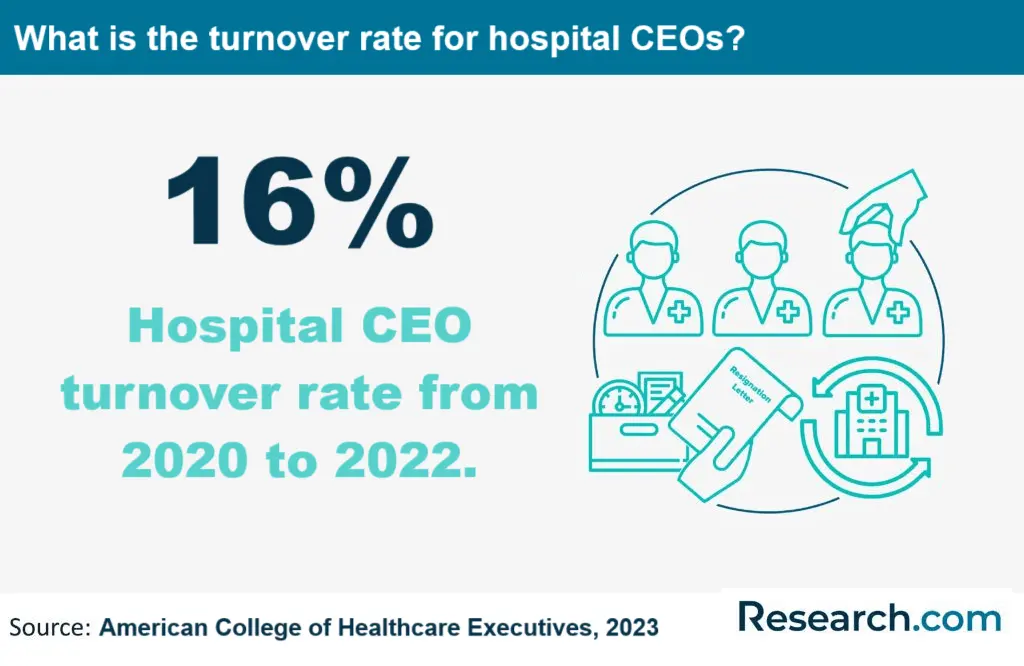
The demands of the role contribute to executive movement over time. The image below shows hospital CEO turnover rates in recent years.
What other careers fit a master’s degree in hospital administration or public health?
A master’s degree in hospital administration or public health can support many leadership careers besides hospital CEO. This matters because some professionals want healthcare impact without the visibility, politics, travel, crisis exposure, and full organizational accountability that come with the chief executive position.
| Career Option | Main Area of Work | Who Might Prefer This Path |
| Healthcare administrator or executive | Hospital operations, clinic leadership, department management, service lines, or executive administration. | Professionals who want leadership responsibility in healthcare without necessarily pursuing the CEO seat. |
| Chief operating officer | Operational performance, patient flow, staffing coordination, service delivery, and process improvement. | Leaders who enjoy execution, systems design, and cross-department problem solving. |
| Chief financial officer | Budgeting, revenue cycle, capital planning, financial strategy, payer issues, and risk management. | Professionals with strong finance, accounting, analytics, and business decision-making skills. |
| Chief nursing officer | Nursing leadership, staffing, clinical quality, patient care standards, and workforce development. | Experienced nurses who want senior executive influence over clinical care and nursing practice. |
| Healthcare policy analyst | Policy research, regulation, access, public programs, financing, and health reform. | Professionals interested in government, advocacy, think tanks, nonprofits, or policy organizations. |
| Public health consultant | Prevention, health equity, program design, compliance, population health, and community initiatives. | MPH graduates who prefer advisory, project-based, or multi-organization work. |
| Health insurance or managed care executive | Coverage strategy, network management, claims, payer operations, population health, and risk. | Leaders interested in the financing and payer side of healthcare. |
| Pharmaceutical or medical device operations role | Regulatory affairs, clinical operations, provider partnerships, business development, or market access. | Professionals who want to apply healthcare knowledge outside hospital settings. |
| Academic or research role | Teaching, health services research, healthcare economics, policy, or public health program leadership. | Professionals drawn to education, analysis, research, or academic administration. |
| Healthcare entrepreneur or consultant | Practice management, health technology, process improvement, consulting, or advisory services. | Self-directed leaders who want to solve healthcare problems independently or through a business venture. |
Executive mobility differs by market. The table below shows the 10 states with the highest hospital CEO turnover rates, according to the American College of Healthcare Executives.
| State | Turnover Rate in % |
| Montana | 30 |
| Vermont | 29 |
| Alaska | 26 |
| Missouri | 25 |
| Michigan | 24 |
| Arkansas | 24 |
| Hawaii | 24 |
| North Dakota | 24 |
| Kansas | 23 |
| Alabama | 23 |
Can hospital CEOs move into other industries?
Yes. Hospital CEOs can move into other sectors, especially organizations that value complex operations, regulatory judgment, stakeholder management, financial oversight, crisis leadership, and mission-driven strategy. Possible transition areas include insurance, biotechnology, pharmaceuticals, consulting, health technology, nonprofit leadership, public policy, education, and corporate social responsibility.
The transition still requires adjustment. A hospital CEO moving outside healthcare may need to learn a different revenue model, customer base, investor environment, sales process, product lifecycle, or competitive landscape. Even so, many core executive skills transfer well: leading large teams, managing major budgets, reporting to boards, using data in decisions, handling public scrutiny, communicating under pressure, and guiding organizations through uncertainty.
Questions to ask before pursuing a hospital CEO path
- Do I want accountability for both patient care performance and financial results?
- Am I prepared to spend many years building operational, financial, compliance, and leadership experience before reaching CEO consideration?
- Do I enjoy working with clinicians, boards, regulators, community leaders, payers, and business stakeholders?
- Can I make difficult decisions when resources are limited and the consequences are significant?
- Would a master’s degree help me now, or do I first need broader healthcare management experience?
- Which skill gap is most urgent for my next role: finance, operations, compliance, quality, workforce strategy, communication, or governance?
- Would I be satisfied in another senior healthcare leadership role if becoming CEO is not the best long-term fit?
What Hospital CEOs Say About the Career
- This job is challenging because decisions affect patients, employees, finances, and the community’s confidence in the hospital. The meaningful part is knowing that strong leadership can improve care and help stabilize an organization people rely on. Mark
- Hospital leadership can offer strong earning potential, but mission matters just as much as compensation. It is like running a complex business where success is measured not only by performance, but also by access, quality, and service. Linda
- A hospital CEO cannot stop learning. Regulations change, technology changes, and workforce needs change. The work is demanding, but it is rewarding for leaders who want to operate where healthcare and business meet. David
Key Insights
- Hospital CEO is a senior leadership role, not an entry-level healthcare administration job. Most candidates need graduate education, extensive experience, and a record of improving operations, finances, quality, or workforce performance.
- The most common graduate pathways include the MHA, MBA with a healthcare focus, MPH, and MSN with an administration focus. The best option depends on whether your background and goals align more closely with operations, business, public health, or clinical leadership.
- Typical stepping-stone roles include healthcare administrator, operations leader, finance manager, chief operating officer, chief financial officer, chief nursing officer, vice president, service-line executive, and hospital administrator.
- Hospital CEO compensation varies widely. ZipRecruiter reports $151,302 per year, while Salary.com reports an average base salary of $460,000 per year. Reported industry ranges include $150,000 – $300,000 annually for small hospital CEOs and $500,000 – $1 million+ annually for large hospital or health system CEOs.
- The U.S. Bureau of Labor Statistics projects 5% growth from 2023 to 2033 for chief executives, including hospital CEOs, but CEO opportunities are limited and competition is strong.
- Hospital CEO turnover remained steady at 16% from 2020 through 2022, the lowest rate since 2011. State-level variation is substantial, with Montana at 30% and Vermont at 29% in 2022.
- As of 2025, there are 6,093 hospitals in the United States, though the number of individual CEOs may be lower because some executives oversee more than one facility.
- The physician CEO pathway has become less common over time. In recent years, only about 5% of hospitals in the U.S. are run by individuals with a medical degree, although higher-ranked hospitals are more likely to have CEOs with physician backgrounds.
- The average tenure for healthcare CEOs is approximately 7.6 years. Among the 20 largest health systems in the U.S., nearly half of the CEOs assumed their roles within the past four years, with five leaders appointed in 2022 and four in 2021.
- If the hospital CEO path is not the right fit, a master’s degree in hospital administration or public health can still support careers in healthcare operations, policy, managed care, consulting, research, health technology, and executive administration.
References:
- American College of Healthcare Executives. (2023, August 8). Hospital CEO Turnover Rate Remains Steady. ache.org.
- American Hospital Association. (2025, January). Fast Facts on U.S. Hospitals, 2025. AHA.org.
- Becker's Hospital Review. (2022, February 22). Average CEO Pay by Hospital Type. beckerhospitalreview.com.
- Brusie, C. (2024, October 4). Revealed: The Eye-Popping Compensation of 5 High-Paid Hospital CEOs. Nurse.org.
- Kuchno, K. (2022, December 4). CEO Tenues at the 20 Largest Health Systems. Becker's Hospital Review.
- Pearson D. (2023, August 9). Hospital CEO turnover encouragingly low for third straight year: ACHE. Health Exec.
- Salary.com. (2025, March 1). Hospital CEO Salary. Salary.com.
- United States Bureau of Labor Statistics. (2024, August 29). Occupational Outlook Handbook: Top Executives. BLS.
- ZipRecruiter. (2025, March 23). Hospital Chief Executive Officer Salary. ziprecruiter.com.
Other Things You Should Know About Becoming a Hospital CEO
Certifications like the Fellow of the American College of Healthcare Executives (FACHE) are often necessary. This credential demonstrates expertise and leadership in healthcare management, and obtaining it typically involves passing an exam and fulfilling ongoing educational requirements.
Most hospital CEOs have at least 10 to 15 years of healthcare leadership experience before reaching the role. Many spend several years as a department manager, director, or chief operating officer, building budgeting, operations, and staff-management experience before moving into the top executive position.