
2027 Highest Paying Business Jobs and Careers

Co-Founder and Chief Data Scientist
Choosing a business career is not just about finding a role with a large salary range. The highest-paying business jobs usually sit at the intersection of leadership, measurable business impact, industry expertise, and the ability to make decisions under pressure. For 2026 career planning, that means looking beyond job titles and asking harder questions: Which roles actually fit your strengths? Which degrees or certifications are worth the cost? How long does advancement usually take? And what risks come with senior-level responsibility?
This guide is for students comparing business majors, professionals considering an MBA or specialized graduate degree, and experienced managers planning a move into executive leadership. You will learn which business roles are associated with the highest salary ranges, what qualifications employers typically expect, how advanced education can support advancement, and how to evaluate whether the investment makes sense for your goals.
Quick Answer: What are the highest-paying business careers?
The highest-paying business careers are usually executive, strategy, finance, product, talent, transformation, and digital leadership roles. Positions such as President, Chief Strategy Officer, VP of Product Management, VP of Digital Marketing, Chief Talent Officer, and Director of Product Management commonly reward professionals who combine business judgment, leadership experience, industry knowledge, and strong analytical skills. Many top roles favor candidates with an MBA, specialized master’s degree, or relevant certifications, but experience and demonstrated results are often just as important.
Key Points to Understand Before Choosing a High-Paying Business Path
- Credentials can open doors, but they do not replace results. Many senior business roles favor candidates with an MBA or specialized graduate training, yet employers still look for evidence that you can lead teams, manage budgets, solve complex problems, and improve business performance.
- Pay depends heavily on industry and function. Finance, technology, healthcare, consulting, digital commerce, and enterprise software often offer stronger compensation for business professionals because the decisions in these fields directly affect revenue, risk, growth, and operations.
- Experience compounds over time. The largest salary jumps usually come after professionals move from execution-focused roles into management, strategy, department leadership, and enterprise-level decision-making.
- Networks matter because senior roles are rarely found through applications alone. Mentors, alumni connections, former colleagues, executive recruiters, and industry communities often influence access to high-level opportunities.
- High-value skills are increasingly analytical and cross-functional. Employers are willing to pay more for professionals who can connect data analytics, financial planning, project execution, digital strategy, talent leadership, and organizational change.
- Highest-Paying Business Jobs and Career Options
- Which business degree is most likely to support a high salary?
- Which business careers may see faster salary growth?
- Is the education cost worth it for high-paying business jobs?
- What career path usually leads to senior business roles?
- What qualifications do employers expect for executive positions?
- Which skills help professionals become high-paid C-level leaders?
- How long can it take to reach the C-suite?
- Can online doctoral programs support executive advancement?
- How can data analytics improve business career mobility?
- When is an affordable online MBA a smart career investment?
- How can graduate degrees improve access to high-paying roles?
- How does globalization affect high-paying business careers?
- What challenges come with high-paying business careers?
- How do mentorship and networking influence advancement?
- How should you weigh the cost and benefits of an online MBA?
- How can certifications strengthen a business career?
- Which future trends may shape high-paying business jobs?
- How should you measure the ROI of advanced business education?
- Can accelerated online degrees speed up business advancement?
- How can affordable online executive MBA programs build leadership capacity?
- How can a complementary bachelor’s degree support a business career?
- How do one-year MBA programs differ from traditional MBA programs?
- How can online MBA programs in project management support career growth?
- How can funding strategies reduce the cost of advanced business education?
- How can accelerated project management study improve business execution?
- What should you compare before choosing an accelerated MBA?
- How can related graduate programs improve strategic decision-making?
- How can accelerated construction management training support business growth?
Highest-Paying Business Jobs and Career Options
The roles below are commonly associated with strong compensation because they influence growth, revenue, operations, product direction, workforce strategy, or enterprise transformation. Salary ranges can vary by company size, location, industry, performance incentives, and equity or bonus structures.
| Role | Salary Range | What the Role Focuses On | Common Preparation |
| President | $150,000 - $300,000+ | Oversees major business functions, aligns operations with strategy, and often works closely with or reports to the CEO. | MBA or business administration background, plus extensive executive leadership experience. |
| Content Architect | $120,000 - $180,000 | Builds the structure, governance, and platform strategy for digital content across channels. | Bachelor’s or master’s degree in marketing, communications, or computer science, along with content management and user experience expertise. |
| Director of Product Management | $140,000 - $220,000 | Guides product development, market positioning, launch planning, and alignment with business goals. | MBA or degree in engineering, business, or computer science, supported by product strategy experience. |
| Assistant Product Manager | $75,000 - $110,000 | Supports product planning, cross-functional coordination, user feedback, and launch execution. | Bachelor’s degree in business, marketing, or engineering, plus strong organization and communication skills. |
| Vice President of Talent Acquisition | $130,000 - $220,000 | Leads hiring strategy, employer branding, workforce planning, and executive recruiting priorities. | Degree in human resources, business administration, or organizational psychology, with senior HR leadership experience. |
| VP of Product Management | $150,000 - $250,000+ | Owns product vision, portfolio priorities, product team leadership, and long-term market fit. | MBA or technical degree in engineering or computer science, combined with product lifecycle leadership. |
| Business Transformation Manager | $120,000 - $200,000 | Manages organizational change, digital transformation, process redesign, and cross-functional implementation. | Business administration, consulting, or management background, with project and change management skills. |
| Chief Strategy Officer | $160,000 - $280,000+ | Shapes long-range strategy, evaluates markets, identifies growth opportunities, and advises executive leadership. | MBA or master’s in business or economics, plus deep strategy and market analysis experience. |
| VP of Digital Marketing | $140,000 - $240,000 | Directs digital channels, performance marketing, analytics, brand growth, and online revenue strategy. | Degree in marketing, business, or communications, with experience across digital channels and measurement tools. |
| Chief Talent Officer | $160,000 - $270,000 | Designs talent strategy, leadership development, workforce performance systems, and organizational culture initiatives. | Human resources or organizational development education, paired with broad talent management experience. |
How to read these salary ranges realistically
- Base salary is only part of executive pay. Bonuses, profit sharing, stock options, and long-term incentives can significantly affect total compensation.
- Title inflation can distort comparisons. A “VP” at a small company may have a different scope than a “Director” at a global enterprise.
- High salary usually comes with high accountability. These roles often involve revenue targets, board visibility, restructuring decisions, hiring responsibility, or public-facing performance pressure.
Which business degree is most likely to support a high salary?
The Master of Business Administration (MBA) is often the most recognized graduate business credential for professionals pursuing executive and management roles. In 2022, among MBA applicants 33% enrolled in the program to earn credentials that will make them more competitive. Still, the best degree depends on the function you want to enter. Some of the strongest college majors for career planning can also lead to high-paying business paths when paired with experience and specialization.
| Degree | Best Fit | Common High-Paying Paths | When It Makes Sense |
| Master of Business Administration (MBA) | Professionals seeking broad leadership, management, or executive preparation. | General management, consulting, operations leadership, product leadership, executive roles. | Choose this if you want flexibility across industries and need stronger leadership, finance, strategy, and organizational skills. |
| Master’s in Finance | Professionals targeting investment, corporate finance, asset management, or financial leadership. | Investment banking, private equity, asset management, corporate finance, CFO-track positions. | Choose this if you want a finance-intensive career and are comfortable with quantitative analysis and market risk. |
| Master’s in Business Analytics | Professionals who want to use data to improve business decisions. | Analytics management, business intelligence, operations analytics, strategy analytics, technology consulting. | Choose this if you want to combine business judgment with data modeling, dashboards, forecasting, and performance measurement. |
| Master’s in Management Information Systems (MIS) | Professionals interested in the overlap between business operations and technology systems. | Technology management, enterprise systems leadership, IT strategy, digital transformation. | Choose this if you want to lead technology-enabled business change without becoming purely technical. |
| Master’s in Healthcare Management | Professionals aiming for leadership in hospitals, health systems, insurance, or healthcare operations. | Healthcare administration, compliance leadership, operations management, executive healthcare roles. | Choose this if you want to work in a regulated, complex, and growing business environment. |
Who should consider an MBA?
- Professionals who want broader leadership options instead of a narrow technical specialization.
- Managers preparing for director, VP, general manager, or executive roles.
- Career changers who need a recognized credential and access to alumni networks.
- Entrepreneurs who need stronger finance, strategy, marketing, and operations knowledge.
Who may not need an MBA?
- Professionals whose target field values licenses or technical credentials more than a general business degree.
- People who already have strong leadership experience and only need a targeted certification.
- Students who would need to take on debt without a clear career plan, promotion path, or employer support.
Which business careers may see faster salary growth?
Some business careers can experience faster pay progression because employers compete for specialized skills tied to revenue, risk management, customer acquisition, product growth, and digital transformation. Different business degree options can support these paths, but career growth depends on performance, industry demand, and the complexity of the problems you can solve.
Data Science and Business Analytics
Business analytics professionals help organizations turn raw information into better decisions. Employers value people who can identify trends, build useful metrics, communicate findings to executives, and connect analysis to financial or operational outcomes. Technology, finance, and healthcare-related majors are often represented among the highest-paying bachelor’s degree paths because these fields rely heavily on data-informed decisions.
Key Roles: Data Scientist, Business Intelligence Analyst, Analytics Manager
Product Management in Technology
Product managers connect customer needs, engineering capacity, market opportunities, pricing, and business strategy. Salary growth can be strong when a product leader proves they can launch products, improve adoption, increase revenue, or manage a high-value product portfolio.
Key Roles: Product Manager, Senior Product Manager, VP of Product
Cybersecurity Management
Cybersecurity has become a business risk issue, not only a technical function. Leaders who can translate cyber threats into operational, legal, financial, and reputational risk are valuable to organizations that handle sensitive systems or customer data.
Key Roles: Chief Information Security Officer (CISO), Cybersecurity Manager, IT Risk Manager
Digital Marketing and E-commerce
Digital marketing leaders are judged by measurable outcomes: revenue, conversion rates, acquisition cost, retention, brand visibility, and campaign performance. Because online growth is central to many companies, professionals who master analytics-driven marketing can move quickly into higher-paying roles. Digital marketing can also be connected to shorter degree pathways that may lead to solid earnings.
Key Roles: Digital Marketing Director, E-commerce Manager, SEO Manager
Management Consulting
Consultants can see rapid salary growth when they build expertise in strategy, operations, restructuring, technology implementation, or organizational performance. The strongest candidates can diagnose ambiguous problems, influence senior stakeholders, and deliver measurable business improvement.
Key Roles: Management Consultant, Strategy Consultant, Senior Consultant
Is the education cost worth it for high-paying business jobs?
A business degree can be worth the investment when it clearly supports your target role, improves your access to employers, builds practical skills, and strengthens your network. It may not be worth it if you enroll only because a credential sounds prestigious, without comparing cost, opportunity cost, career outcomes, and the skills employers actually reward. Some in-demand business roles also involve long hours, travel, intense targets, or high-pressure decision-making, so fit matters as much as pay.
Cost should be evaluated beyond tuition. Include fees, books, time away from work, lost income, commuting or technology expenses, financing charges, and the likelihood that you will actually use the degree to move into a better role. The average cost of a master's degree in business is $56,850. If that cost does not align with your goals, compare lower-cost options such as an accelerated business management degree, employer-funded programs, certificates, or part-time study.
| Question | Why It Matters | Better Decision Rule |
| Will this credential help me qualify for a specific role? | Graduate education is most valuable when tied to a clear career target. | Choose a program only after mapping it to job postings, promotion requirements, or industry expectations. |
| Can I manage the total cost? | Tuition alone does not show the full financial burden. | Compare net cost after scholarships, employer aid, transfer credits, and repayment obligations. |
| Does the program build marketable skills? | Employers pay for applied ability, not just coursework completed. | Look for strategy, finance, analytics, leadership, communication, and project-based learning. |
| Does the school have a useful network? | High-paying roles often come through relationships and referrals. | Evaluate alumni access, career coaching, employer partnerships, and executive mentoring. |
| Can I keep working while studying? | Leaving the workforce can increase opportunity cost. | Compare full-time, part-time, online, hybrid, and accelerated formats before committing. |
What career path usually leads to senior business roles?
High-paying business careers rarely follow one fixed route, but many professionals move through a sequence of education, early specialization, management responsibility, senior leadership, and executive influence. The exact path depends on industry, company size, function, geography, and performance.
| Career Stage | Typical Timeframe | Main Goal | Examples of Roles |
| Entry-level positions | 2-5 years | Build business fundamentals, learn how organizations operate, and prove reliability. | Analyst, coordinator, associate, assistant product manager, marketing specialist. |
| Mid-level management | 5-10 years | Own projects, manage small teams, specialize in a function, and show measurable results. | Manager, senior analyst, product manager, consultant, HR business partner. |
| Senior management | 10-15 years | Lead departments, manage budgets, influence strategy, and develop other leaders. | Director, senior manager, head of function, senior consultant. |
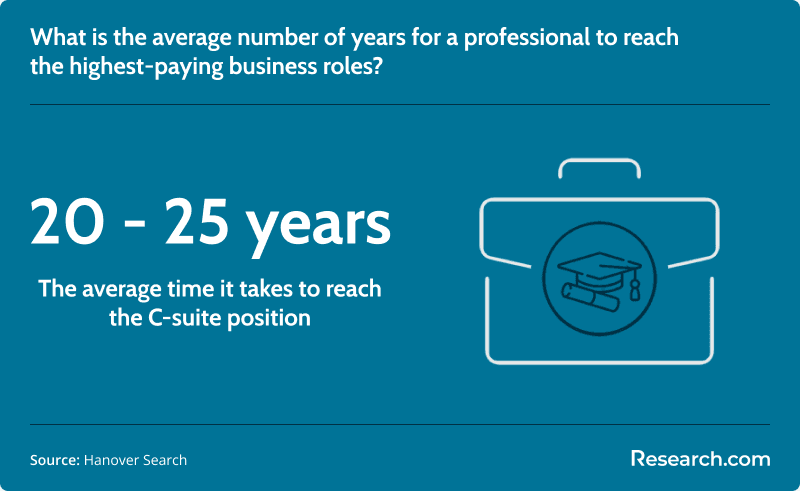
| C-suite | 15-20 years or more | Set enterprise direction, manage risk, report to boards, and shape long-term performance. | CEO, CFO, COO, CMO, CHRO, Chief Strategy Officer. |
Career paths are becoming less linear. In 2023, only 62.6% of C-suite executives used to work for only one company, while in 2018 it was 88.5%. That shift suggests that many senior leaders now build experience across multiple employers, markets, and business models before reaching top executive roles.
Practical steps to move toward higher-paying business roles
- Choose a function where performance can be measured. Revenue growth, cost savings, product adoption, hiring efficiency, risk reduction, and operational improvements are easier to use in promotion conversations.
- Develop a specialty before trying to become a generalist. Finance, analytics, product, operations, HR strategy, cybersecurity risk, or digital marketing expertise can create a stronger leadership foundation.
- Ask for projects with visibility. Cross-functional projects, transformation work, new market launches, and executive reporting can expose you to senior decision-makers.
- Document business outcomes. Track the metrics you improved so your resume and interviews show results rather than responsibilities alone.
- Build relationships across departments. Senior business leaders must influence people they do not directly manage.
What qualifications do employers expect for executive positions?
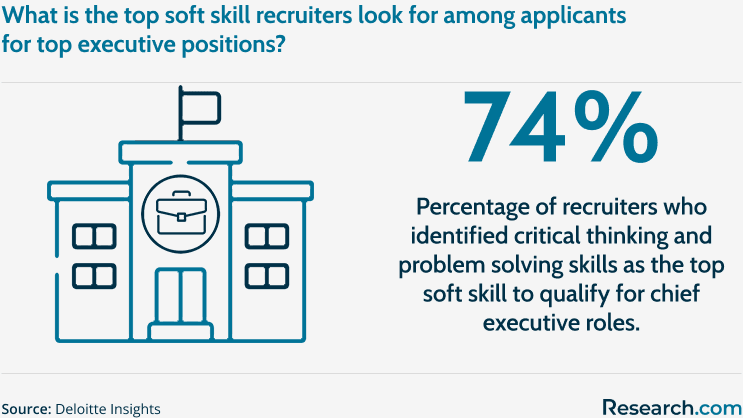
Executive roles require a combination of education, leadership history, industry credibility, financial judgment, and decision-making ability. In 2023, 74% of recruiters identified critical thinking and problem solving skills as the top soft skill to qualify for chief executive roles. Even programs positioned as the most affordable online business degree options may include coursework that develops these capabilities.
- Relevant education: Many executives hold an MBA or specialized master’s degree, especially in fields where strategic, financial, or technical knowledge is important.
- Deep industry experience: Senior leaders are expected to understand the market, customers, competitors, regulations, risks, and operating model of their industry.
- Proven leadership record: Employers look for evidence that a candidate can lead teams, manage conflict, develop talent, and deliver results through others.
- Financial fluency: Executives must understand budgets, margins, forecasts, investment decisions, cash flow, and performance metrics.
- Targeted certifications: Credentials in finance, accounting, HR, project management, analytics, or risk can strengthen credibility when aligned with the role.
- Professional network: A strong network can help candidates access executive search opportunities, board introductions, strategic partnerships, and mentoring.
Requirements differ by company and industry. A technology company may prioritize product scale and digital transformation experience, while a healthcare organization may value regulatory knowledge and operational complexity. Always compare job descriptions for the exact roles you want before investing in another credential.
Which skills help professionals become high-paid C-level leaders?
C-level executives make decisions that affect the entire organization. Technical expertise can help a professional rise, but executive compensation is usually tied to broader capabilities: judgment, influence, strategy, communication, and accountability.
| Skill | Why It Matters at the Executive Level | How to Build It |
| Long-term planning | Executives must anticipate market shifts and position the organization for future growth. | Participate in strategic planning, market research, forecasting, and portfolio reviews. |
| Visionary leadership | Senior leaders must motivate people around goals that may take years to achieve. In 2023, 85% of job postings cited leadership and initiative as a top soft skill employers look for among candidates for top organizational positions. | Lead cross-functional teams, mentor others, and communicate a clear direction during change. |
| Financial analysis | Business leaders need to understand financial statements, trade-offs, and investment priorities. | Study budgeting, forecasting, pricing, profitability, and financial modeling. |
| Risk management | Executives are responsible for weighing operational, financial, legal, reputational, and technology risks. | Join governance, compliance, audit, cybersecurity, or transformation projects. |
| Relationship building | Influence with employees, customers, investors, boards, and partners is central to senior leadership. | Build stakeholder maps, attend industry events, and maintain long-term professional relationships. |
| Communication | Executives must explain complex issues clearly and create confidence in decisions. | Practice board-style presentations, executive summaries, negotiation, and crisis communication. |
| Critical thinking | Ambiguous problems require structured thinking and the ability to challenge assumptions. | Use decision frameworks, post-project reviews, scenario planning, and root-cause analysis. |
| Integrity | Trust is essential when leaders control resources, people, and confidential information. | Make ethical decision-making visible and consistent, especially under pressure. |
| Cultural awareness | Modern organizations often operate across regions, cultures, and work models. | Work on global teams, study cross-cultural communication, and seek international exposure. |
| Global market knowledge | Executives may need to evaluate international opportunities, supply chains, and competitors. | Follow global market trends, trade issues, currency risks, and regional customer behavior. |
How long can it take to reach the C-suite?
There is no guaranteed timeline for becoming a C-suite executive. Compared with some of the easiest business majors, the executive path usually requires a longer period of performance, leadership development, and career risk-taking.
- Industry: Technology and finance may offer faster advancement for high performers, while more regulated or traditional sectors may move more slowly.
- Company size: Large organizations can provide structured advancement and specialization, but competition for executive seats can be intense.
- Performance: Promotions depend on the problems you solve, the results you produce, and your ability to lead through complexity.
- Mentorship and visibility: Sponsors and mentors can help you access assignments that accelerate your growth.
- Economic conditions: Hiring freezes, mergers, restructuring, and market downturns can slow or redirect advancement.
Many professionals spend several years moving through management before they are considered for executive responsibility. Some reach the C-suite within a decade or less, but many take longer. A realistic planning range is often:
- Entry-level positions: 2-5 years
- Mid-level management: 5-10 years
- Senior management: 10-15 years
- C-suite: 15-20 years or more
The best strategy is to focus less on the title timeline and more on evidence of readiness: strategic scope, budget responsibility, people leadership, measurable outcomes, executive communication, and the ability to manage risk.
Can online doctoral programs support executive advancement?
Online doctoral programs can help experienced professionals deepen expertise in leadership, applied research, organizational change, and high-level decision-making. Options such as online DBA programs may be especially relevant for executives, consultants, educators, and senior managers who want advanced business training without leaving the workforce. A doctorate is not required for every high-paying business role, but it can support credibility in consulting, academic leadership, research-driven strategy, and executive education.
How can data analytics improve business career mobility?
Data analytics can accelerate advancement because it helps professionals move from opinion-based recommendations to evidence-based decisions. Leaders who can interpret complex data, spot trends, define performance indicators, and translate analysis into action are better positioned for roles in strategy, operations, marketing, product, and finance. An online MBA business analytics can be useful for professionals who want business leadership training with stronger analytical tools.
When is an affordable online MBA a smart career investment?
An affordable online MBA can be a strong option when it is accredited, financially manageable, aligned with your career goals, and flexible enough to complete while working. It is especially useful for professionals who need broader business training but cannot pause their careers for full-time study. Before choosing a cheap online MBA, compare curriculum quality, career support, faculty experience, alumni outcomes, and total cost rather than tuition alone.
How can graduate degrees improve access to high-paying roles?
Advanced business education can strengthen your qualifications, but its value depends on fit. A graduate degree is most useful when it helps you develop skills that employers already reward and when it connects you to roles where those skills are in demand.
- Stronger earning potential: Advanced degrees can support higher-paying opportunities, particularly in finance, technology, healthcare management, consulting, and executive leadership.
- Deeper specialization: Programs in finance, analytics, healthcare management, cybersecurity management, or digital marketing can prepare professionals for specialized roles with competitive pay.
- Leadership preparation: Graduate study often develops strategic thinking, communication, team leadership, and decision-making skills needed for management roles.
- Career flexibility: An MBA or specialized master’s degree can help professionals shift industries, move from technical work into management, or transition into consulting or entrepreneurship.
- Network access: Alumni groups, faculty connections, peer cohorts, and employer partnerships can be valuable for long-term advancement.
- Competitive positioning: In crowded applicant pools, a relevant graduate degree can help distinguish candidates when combined with strong experience.
- Executive pathway: Many senior leaders use graduate education to strengthen strategy, finance, governance, and leadership judgment before moving into enterprise roles.
If your goal is to compare the highest-paying master’s degrees, look closely at whether each program leads to the business function you want. An MBA may provide breadth, while a Master’s in Finance or analytics-focused degree may provide deeper specialization.
How does globalization affect high-paying business careers?
Globalization expands opportunities for business professionals, but it also increases competition. Companies operating across markets need leaders who understand international customers, distributed teams, supply chains, regulations, and cultural differences.
- More demand for global business knowledge: International growth creates opportunities for professionals who understand trade, market entry, compliance, pricing, and cross-border operations.
- Language and cultural skills can strengthen candidacy: Multilingual and culturally fluent professionals may be more competitive in international sales, business development, and regional leadership roles.
- Remote and hybrid work broaden the market: Professionals can increasingly collaborate with global teams, though they may also compete with candidates from wider talent pools.
- Advanced education can help professionals adapt: Programs such as MBAs or 1 year masters programs can help working professionals build updated skills quickly.
- New global industries create new leadership needs: E-commerce, fintech, renewable energy, and digital platforms have created business roles that require international scale and adaptability.
What challenges come with high-paying business careers?
High compensation often reflects high pressure. Senior business professionals may face long hours, frequent travel, difficult personnel decisions, investor scrutiny, public accountability, or responsibility for major budgets. They must also keep up with technology, regulation, competition, and market volatility. If you are preparing for this level of work, an accelerated online business degree may help build skills faster, but it should be paired with realistic expectations about workload and responsibility.
Common challenges to plan for
- Work-life strain: Senior roles can involve urgent decisions, evening meetings, and travel.
- Continuous reskilling: AI, analytics, cybersecurity, and digital operations are changing employer expectations.
- Stakeholder pressure: Executives must balance employees, customers, boards, investors, regulators, and communities.
- High visibility: Mistakes at senior levels can affect reputation and career mobility.
- Ambiguous problems: Leaders often make decisions with incomplete data and competing priorities.
How do mentorship and networking influence advancement?
Mentorship and networking can shorten the learning curve for business professionals because they provide guidance, feedback, visibility, and access to opportunities. Mentors can help you understand unwritten rules, prepare for leadership transitions, and avoid career-limiting mistakes. A broader network can also connect you to recruiters, industry peers, board opportunities, and specialized roles. Programs such as an online doctorate in organizational leadership may add structured leadership development and professional connections for experienced professionals.
How to build a network that actually helps your career
- Maintain relationships before you need a favor.
- Ask mentors specific questions about skills, roles, and decision points.
- Join professional groups related to your target function, not just general business communities.
- Offer help, introductions, or insight to others so the relationship is reciprocal.
- Use alumni networks, conferences, certification groups, and employer resource groups strategically.
How should you weigh the cost and benefits of an online MBA?
To decide whether an online MBA is worth the cost, compare the total financial investment with the realistic career benefit. Tuition is only one factor. You should also consider fees, time commitment, financing, employer reimbursement, lost free time, career support, accreditation, and whether graduates commonly move into roles similar to the ones you want. For a closer cost breakdown, review How much does an online MBA cost?.
How can certifications strengthen a business career?
Certifications can help business professionals prove specialized skills, especially in fields where employers need evidence of technical competence or current industry knowledge. They are most useful when they match your target role and fill a clear gap in your background.
- Credibility in a specialized area: A certification can signal commitment and competence. For example, a Certified Financial Analyst (CFA) can support finance-focused advancement.
- Updated skills in changing fields: Certifications in digital marketing, analytics, cloud tools, cybersecurity, or business technology can help professionals keep pace with new employer expectations.
- Stronger positioning for project and operations roles: Credentials such as Project Management Professional (PMP) or Lean Six Sigma can support roles tied to execution, process improvement, and operational excellence.
- Leadership alignment: Certifications such as Certified Public Accountant (CPA) or Chartered Financial Consultant (ChFC) can support senior accounting, finance, and planning roles.
- Network access: Many certification bodies offer member communities, continuing education, and professional events that can support career growth.
Before paying for a credential, review job postings for your desired role and confirm that the certification appears often enough to matter. If you also need a broader academic foundation, the cheapest business administration degree online may be worth comparing with certificates and employer training.
Which future trends may shape high-paying business jobs?
High-paying business careers are being influenced by technology, data, changing workplace models, regulation, and sustainability expectations. Artificial intelligence is affecting decision support, automation, customer analysis, forecasting, and operational efficiency. Hybrid work has changed how leaders manage culture and performance. Sustainability and risk governance are also becoming more important in strategy discussions. Professionals who build digital literacy, adaptive leadership, ethical judgment, and cross-functional expertise will be better prepared for these shifts. Flexible programs such as MBA programs online may help working professionals update their skills while continuing to gain experience.
How should you measure the ROI of advanced business education?
Return on investment should be measured through both financial and career outcomes. Consider the payback period, promotion potential, career switching value, employer support, networking benefit, and whether the degree helps you qualify for roles that were previously out of reach. Programs such as affordable AACSB accredited online MBA programs may be attractive to professionals who want recognized accreditation while controlling cost. However, no degree guarantees a raise or promotion, so compare outcomes carefully.
Common mistakes when evaluating business education ROI
| Mistake | Why It Can Hurt You | Better Approach |
| Choosing a program based only on ranking | A highly ranked program may not fit your location, budget, schedule, or career goal. | Compare accreditation, curriculum, alumni outcomes, employer connections, and net cost. |
| Ignoring accreditation | Some employers and financial aid options may depend on institutional or program quality signals. | Verify accreditation before applying or borrowing. |
| Looking only at tuition | Fees, books, travel, technology, and loan interest can change the real price. | Calculate the full cost of attendance and repayment scenario. |
| Assuming an online program is automatically easier | Online courses can be rigorous and require strong time management. | Ask about weekly workload, live sessions, exams, group projects, and support services. |
| Expecting salary outcomes to be guaranteed | Pay depends on industry, location, experience, performance, and economic conditions. | Use salary ranges as planning tools, not promises. |
Can accelerated online degrees speed up business advancement?
Accelerated online programs can help professionals complete credentials faster, but speed should not be the only criterion. A compressed format works best for motivated students who already have strong time-management skills and a clear career goal. The value depends on accreditation, curriculum relevance, faculty quality, employer recognition, and whether the program builds skills you can use immediately. To compare time-efficient options, review online MBA fast.
How can affordable online executive MBA programs build leadership capacity?
Online executive MBA programs are designed for experienced professionals who want to strengthen strategic leadership while continuing to work. A strong program should connect coursework to real executive problems: competitive strategy, finance, operations, organizational change, innovation, and leadership communication. If cost is a major factor, compare formats and outcomes through this guide to an affordable executive MBA online.
How can a complementary bachelor’s degree support a business career?
A focused bachelor’s degree can create a strong foundation for later graduate study or advancement into specialized business roles. For example, a bachelor's degree in finance online can help students build knowledge of markets, financial statements, risk, valuation, and corporate decision-making. That foundation can make later MBA, analytics, consulting, or finance leadership training more practical and easier to apply.
How do one-year MBA programs differ from traditional MBA programs?
One-year MBA programs compress coursework into a shorter format, which can reduce time away from work and lower opportunity cost. Traditional MBA programs may offer more time for internships, electives, networking, and career exploration. A one-year format may fit professionals who already know their target career direction and can handle an intensive pace. A longer format may be better for career changers who need more recruiting support and time to build a new network. To compare accelerated options, review one year MBA programs.
How can online MBA programs in project management support career growth?
Project management-focused MBA programs can help professionals move into roles that require planning, budgeting, stakeholder management, risk control, and execution across teams. This specialization can be useful in operations, technology implementation, consulting, construction, healthcare, and transformation initiatives. If you need a flexible and cost-conscious route, compare affordable online MBA programs in project management.
How can funding strategies reduce the cost of advanced business education?
Funding strategy can determine whether a business degree improves your financial position or creates unnecessary debt. Start with employer tuition reimbursement, scholarships, assistantships, military or public benefits when applicable, payment plans, and transfer credit policies. Then compare loan options carefully. A lower-cost format such as a low cost MBA online no GMAT may help reduce barriers, but admissions convenience should not outweigh accreditation, curriculum quality, and outcomes.
How can accelerated project management study improve business execution?
An accelerated project management degree can help professionals improve how work gets planned, funded, staffed, tracked, and delivered. Coursework that covers agile methods, risk management, budgeting, stakeholder communication, and workflow improvement can translate directly into better business execution. To compare program options, review accelerated project management degree.
What should you compare before choosing an accelerated MBA?
An accelerated MBA should be evaluated with the same rigor as any graduate business program. The shorter timeline can be appealing, but it also means less room for delay, exploration, or adjustment.
- Accreditation: Confirm institutional and program quality before enrolling.
- Curriculum: Look for finance, strategy, analytics, leadership, operations, and applied projects relevant to your goals.
- Faculty experience: Instructors with current business or executive experience can add practical value.
- Career support: Ask about coaching, employer relationships, networking events, and alumni access.
- Format: Compare live versus asynchronous coursework, residency requirements, group projects, and weekly workload.
- Cost and aid: Review tuition, fees, scholarships, employer reimbursement, and repayment options.
For direct program comparisons, explore one year online MBA programs.
How can related graduate programs improve strategic decision-making?
Not every business professional needs an MBA. A complementary graduate field can provide sharper expertise. Economics, for example, can strengthen quantitative reasoning, market analysis, forecasting, policy interpretation, and risk assessment. Professionals who want deeper analytical training may compare options such as affordable masters in economics online with MBA and analytics programs.
How can accelerated construction management training support business growth?
An construction management accelerated degree can be valuable for business professionals working in real estate, infrastructure, facilities, development, logistics, or capital-intensive industries. The training can support better project planning, cost control, regulatory awareness, contractor coordination, and operational decision-making, especially when construction initiatives are tied to broader growth strategy.
Questions to Ask Before Pursuing a High-Paying Business Career
- Do I want to lead people, systems, products, finances, strategy, or clients?
- Which industries are most likely to reward my strengths?
- Am I prepared for the pressure, ambiguity, and accountability that come with senior compensation?
- Will an MBA, specialized master’s degree, certification, or experience-based route be the most efficient next step?
- Can I explain how my work has improved revenue, cost, risk, customer outcomes, or operational performance?
- Do I have mentors or sponsors who can help me understand the path to senior leadership?
- What is my realistic budget for education, and how long would it take to recover the cost?
What Business Graduates Say About Moving Into High-Paying Roles
Building a business career gave me access to opportunities I did not expect, including team leadership and innovation-focused projects. Completing my MBA required discipline, but the leadership and strategy skills I developed helped me move into an executive role where I can influence meaningful decisions. Sarah
My business career taught me to adapt, take calculated risks, and think beyond short-term wins. Moving into leadership changed how I define success because each new responsibility sharpened my judgment and expanded my professional network. Michelle
I began as an entry-level analyst and eventually moved into a VP role where I help shape company strategy. The work carries significant responsibility, but the professional growth and personal satisfaction have made the journey worthwhile. Robert
References:
- Deloitte. (2024). Designing for growth in the C-suite. Deloitte Insights.
- Graduate Management Admission Council. (n.d.). Application trends survey. GMAC.
- LinkedIn. (2024). State of the C-Suites Executive Report.
- McKinsey & Company. (n.d.). What is the C-suite? McKinsey & Company. https://www.mckinsey.com/featured-insights/mckinsey-explainers/what-is-the-c-suite
- PwC. (n.d.). CEO survey: C-suite insights. PwC. https://www.pwc.com/gx/en/issues/c-suite-insights/ceo-survey.html
Key Insights
- The highest-paying business roles are usually leadership positions that affect strategy, revenue, talent, product direction, transformation, or risk.
- Salary ranges in this guide span from $75,000 - $110,000 for Assistant Product Manager roles to $150,000 - $300,000+ for President roles, with other senior business positions commonly listed between $120,000 and $280,000+.
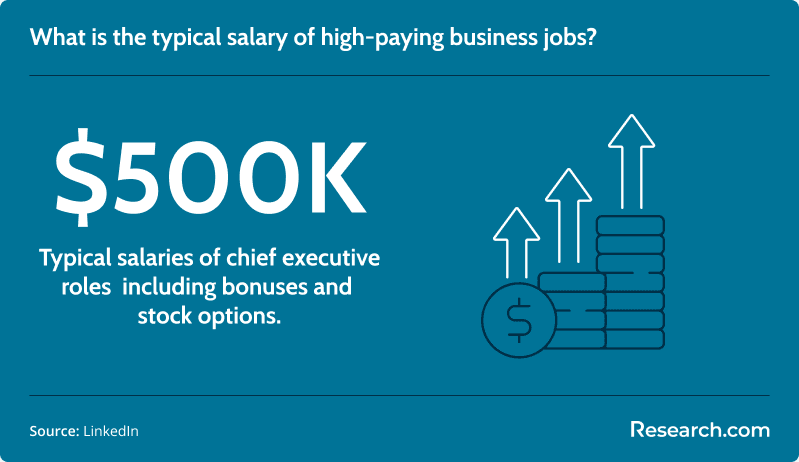
- Executive roles like Chief Executive Officer (CEO), Chief Financial Officer (CFO), and Chief Operations Officer (COO) often command salaries reaching $500,000 or more including bonuses and stock options.
- An MBA is a common route to senior business leadership, but specialized degrees in finance, analytics, MIS, healthcare management, economics, and project management may be better for specific career goals.
- The average cost of a master's degree in business is $56,850, so students should compare total cost, accreditation, employer support, career outcomes, and opportunity cost before enrolling.
- C-suite careers are becoming less linear: only 62.6% of C-suite executives used to work for only one company in 2023, while in 2018 the figure was 88.5%.
- Soft skills matter at the highest levels. In 2023, 85% of posted business careers cited leadership and initiative as a top soft skill, and 74% of recruiters identified critical thinking and problem solving skills as the top soft skill for chief executive roles.
- The smartest career plan is not “get the highest-paying title.” It is to choose a business function where your strengths, education, measurable results, network, and tolerance for responsibility align.
Other Things You Should Know About the Highest Paying Business Jobs and Careers
In 2027, Chief Executive Officer, Chief Financial Officer, and Chief Operating Officer roles remain among the highest-paying positions in business. These roles typically require extensive experience and a proven track record of leadership in managing large teams and corporate strategies.
No. Some top business roles accept a bachelor’s degree, but employers often prefer an MBA for management, finance, or strategy positions. Specialized roles may also value CFA, CPA, or analytics credentials, plus 3–7 years of relevant experience and strong leadership or quantitative skills.
The finance, technology, and healthcare industries are projected to offer the highest-paying business jobs in 2027. Roles in investment banking, technology management, and healthcare administration are among those anticipated to have significant salary growth due to industry demand and economic trends.


