2027 Ways to Find Money to Pay for an MBA

Co-Founder and Chief Data Scientist
Figuring out how to pay for an MBA is often as important as choosing the school itself. Tuition, fees, living costs, lost income, and loan interest can turn a promising career investment into a long-term financial burden if you do not plan carefully. This guide is for working professionals, recent graduates, career changers, and executives who want an MBA but need a realistic funding strategy before applying.
You will learn what an MBA can cost, which funding sources should come first, when loans make sense, how to compare program value, and how to avoid common financing mistakes. If you are still comparing admissions difficulty as well as affordability, review options such as the easiest MBA programs to get into alongside each program’s total cost and career outcomes.
Ways to Find Money to Pay for an MBA Table of Contents
- MBA statistics that affect your funding decision
- MBA trends shaping cost and value
- How much does an MBA cost?
- How to pay for an MBA
- Using technology and industry trends to improve MBA ROI
- Hidden MBA costs and how to plan for them
- Alternative MBA funding routes
- How to improve your MBA admission chances
- How to keep MBA financing sustainable
- How to choose an MBA program
- Whether a low-cost online MBA is worthwhile
- How to assess MBA return on investment
- Whether an affordable executive MBA can deliver value
- Faster alternatives to a traditional MBA
- How loan differences affect your MBA funding plan
- Whether a 1 year online MBA is worth it
- Emerging higher education financing trends
- Specialized nontraditional loans for MBA students
- Career support and networking in MBA programs
- Accelerated business management degrees
- Combining an MBA with a doctorate
- Alternative business degrees for mature professionals
- Accelerated degree programs as an efficient route
- Online MBA programs and career advancement
- Long-term MBA loan repayment management
- Business law as an MBA-adjacent specialization
- MBA scholarships, fellowships, and grants
Quick Answer: What Is the Best Way to Pay for an MBA?
The best MBA funding strategy usually combines multiple sources: school scholarships or fellowships, employer tuition assistance, personal savings, federal loans, and carefully selected private loans only when needed. Start with money you do not have to repay, such as grants, scholarships, fellowships, assistantships, and employer sponsorships. Then compare loan options based on total repayment cost, not just monthly payment size.
A strong plan also considers program format. A full-time MBA may offer intensive networking but can reduce your income while enrolled. A part-time, executive, or online MBA may allow you to keep working, which can lower your opportunity cost even if tuition is similar.
Crucial MBA Statistics
MBA programs remain attractive because they can expand a professional network, deepen business knowledge, and support movement into management roles. If you are asking whether online MBA programs are worth it, the answer depends on accreditation, cost, student support, employer recognition, and your ability to convert the degree into career mobility. According to a 2025 report by the Graduate Management Admission Council, 87% of global recruiters intend to hire MBA graduates to drive strategic growth (GMAC, 2025). The same report found that 74% of recruiters said leaders in their organizations tend to have completed master’s degree programs in business.
GMAC also reported that the main reasons professionals pursued an MBA degree in 2025 were return on investment, the chance to gain practical AI experience, and preparation for leadership roles.
Compensation is a major part of the MBA decision. The average median annual starting salary for new MBA hires is $120,000, compared with $75,000 for graduates with a bachelor's business degree, according to GMAC data cited in the original article.
School reputation can influence outcomes, but it should not be the only factor in your decision. Among the 146 ranked full-time MBA programs in the U.S., the highest compensated graduates are from Harvard University, Stanford University, New York University (Stern), University of Chicago (Booth), and Columbia University.
Admissions can be highly competitive at elite business schools. The average MBA acceptance rate at the top 10 business schools in the United States, including Harvard Business School, University of Pennsylvania Wharton, and Kellogg Business School, is around 18% (Poets&Quants, 2025). Stanford and Harvard are among the most selective, with Stanford’s MBA acceptance rate for the Class of 2026 reported at 6.8% (Admit Lab, 2026).
If a top-ranked program is not realistic financially or academically, accreditation becomes especially important. The Association to Advance Collegiate Schools of Business, or AACSB, is widely treated as a leading business school accreditor. Only about 25 percent of U.S. business schools hold AACSB accreditation, according to AACSB data cited in the original article. When comparing MBA online schools, accreditation should be one of your first checks.
Industry and specialization also shape salary potential. MBA graduates work in consulting, marketing, finance, technology, healthcare, real estate, entrepreneurship, and operations. Marketing-focused graduates may pursue marketing, promotions, or advertising manager roles with a median annual salary of $133,380. Finance-focused graduates may become financial managers with a median annual salary of $131,710 or move toward chief financial officer roles. Technology-focused graduates may pursue chief information officer roles. In the U.S., chief executives earned a mean annual wage of $246,440. Experienced professionals considering senior leadership formats can also compare the best executive MBA programs.
Relevant MBA Trends
MBA programs are changing because employers expect graduates to understand leadership, analytics, technology, risk, sustainability, and global markets. These trends matter for financing because the best-value MBA is not always the cheapest one; it is the program that aligns with your career direction and provides skills employers currently reward.
- More women are entering MBA classrooms. Business schools have expanded recruiting, support, and fellowship efforts aimed at improving gender representation. This has increased interest in MBA pathways among women seeking leadership, entrepreneurship, and career-change opportunities.
- Specializations are becoming more common. MBA students can now focus on fields such as finance, healthcare, sustainability, entrepreneurship, marketing, technology, or information systems. This helps candidates choose programs based on targeted career outcomes instead of a generic business curriculum.
- Technology is now central to business education. Programs increasingly include analytics, artificial intelligence, digital transformation, coding exposure, and data-based decision-making because managers are expected to lead technology-enabled teams.
- Flexible formats are now mainstream. Part-time, online, hybrid, weekend, and executive MBA formats help working professionals continue earning income while studying.
- Soft skills remain essential. Communication, leadership, teamwork, negotiation, and emotional intelligence still influence promotion readiness. These skills expand the range of what you can do with a business degree.
- Global and social impact content is more visible. Many programs now include international business, corporate responsibility, sustainability, and ethical decision-making.
| MBA Program | Best Fit | Duration | Common Formats |
| Full-time MBA | Students who can pause work or study as their primary commitment | 1 - 2 years | One year, Two year |
| Part-time MBA | Working professionals who want to keep earning while enrolled | 2 + years | Evening, Weekend, Blended |
| Executive MBA | Working Executive-Level professionals with substantial experience | 1 - 2 years | Part-time, Blended, International locations |
| Online MBA | Working professionals who need location flexibility | 2 + years | 100% Online, Online + residential component |
How much does an MBA cost?
An MBA can be one of the most expensive master’s degrees because the total price includes more than tuition. Students may also pay administrative fees, program fees, housing, books, supplies, technology costs, health insurance, travel, and living expenses. If you attend a public university outside your state, nonresident tuition can also increase the final bill.
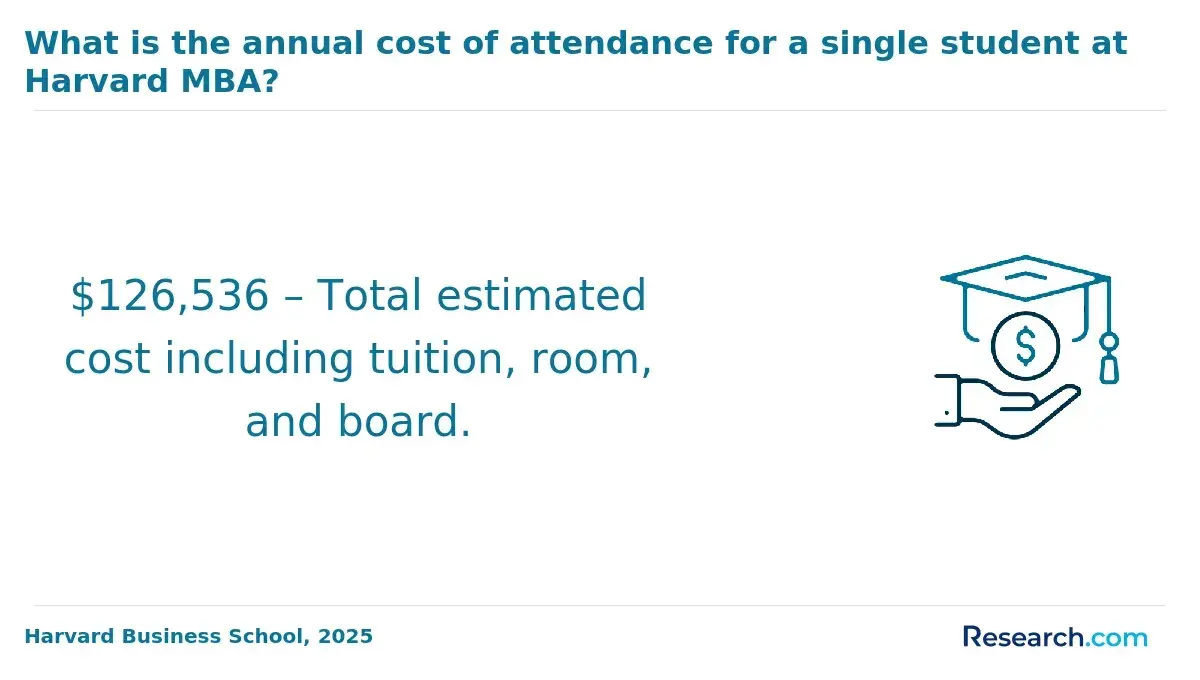
According to recent education financial benchmarks cited in the original article, an MBA costs an average of $64,200 per year. Prestigious private programs can cost significantly more. Harvard Business School lists the annual cost of attendance for an MBA at $118,874 (HBS, 2025).
Your actual cost depends on format, school type, location, residency status, scholarship eligibility, and whether you keep working while enrolled. Applicants without a traditional business background should also compare prerequisites and bridge requirements; this guide to whether you can pursue an MBA without a business degree can help you evaluate that pathway.
| Cost Category | Why It Matters | How to Control It |
| Tuition | The largest direct cost for most MBA students | Compare public, private, online, part-time, executive, and AACSB-accredited options |
| Fees and materials | Program, technology, course material, and administrative charges can add up | Ask for a full cost-of-attendance breakdown before enrolling |
| Living and travel costs | Campus programs may require relocation, commuting, parking, meals, or international trips | Consider online or hybrid formats if relocation costs are high |
| Lost income | Full-time study may reduce or eliminate salary during enrollment | Calculate opportunity cost before choosing a full-time format |
| Loan interest | Borrowing can increase the real cost of the degree over time | Borrow only what you need and prioritize lower-cost funding first |
How to pay for an MBA?
The safest MBA funding plan starts with free or subsidized money, then moves to savings and loans only as needed. Do not begin with borrowing simply because loan applications are convenient. Build a funding stack that reduces debt, protects cash flow, and keeps your post-MBA repayment realistic.
| Funding Option | Repayment Required? | Best For | Main Caution |
| School fellowships | No | Strong applicants, career switchers, leaders, or students meeting school priorities | Highly competitive and deadline-driven |
| Scholarships and grants | No | Students with merit, need, diversity, industry, or mission-based eligibility | Applications may require essays, recommendations, and separate deadlines |
| Graduate assistantships | No repayment, but work is required | Full-time students who can support faculty, research, or administration | May be limited for professional or online MBA formats |
| Employer sponsorship | Usually no, if obligations are met | Employees whose MBA aligns with company needs | May require continued employment after graduation |
| Federal student loans | Yes | Students needing predictable borrower protections | Graduate loan interest can be substantial |
| Private student loans | Yes | Borrowers with strong credit or funding gaps after federal aid | Terms vary widely and protections may be fewer |
| Personal savings, IRA, or 529 funds | No lender repayment | Students trying to reduce borrowing | Tax rules and retirement impact must be reviewed carefully |
| Crowdfunding or alumni support | Usually no | Students with a strong story, community network, or mission-driven goal | Uncertain and rarely enough to fund the full degree |
1. Apply for business school fellowships
Fellowships are among the best MBA funding sources because they generally do not require repayment. They may be funded by the business school, university donors, alumni, foundations, or outside organizations. Awards can vary by purpose, amount, eligibility, and duration.
Harvard Business School, for example, offers summer fellowships for MBA students using the summer between the first and second year to test career options, apply classroom learning, or launch ventures. HBS also offers the Global Opportunity Fellowship and the Rise Career Fellowship. Ask each target school whether fellowship applications are automatic, separate, need-based, merit-based, or tied to a specific career track.
2. Apply for graduate school scholarships
Business schools often use scholarships to recruit high-potential students. Selection may consider prior academic performance, professional record, leadership, community impact, GMAT or GRE scores, and what the applicant can add to the cohort. Start scholarship research before submitting applications because some awards have earlier deadlines than admissions decisions.
3. Work as a graduate assistant
Graduate assistantships can reduce MBA costs while giving students research, teaching, consulting, or administrative experience. These roles are more common for full-time students than for executive or part-time students. The University of Nebraska Omaha, for instance, offers graduate assistantships to MBA students with strong academic performance. Recipients receive tuition remission and a monthly stipend in exchange for 20 hours of work per week.
4. Apply for external scholarships
External MBA scholarships may be merit-based, need-based, identity-based, industry-specific, or mission-focused. Examples include the Forté Fellowships for women applying to participating MBA schools, the Selected Professions Fellowship program for eligible women of color in selected fields, and the Prospanica Scholarship for eligible Hispanic or Latino students enrolled in accredited business schools.
Also search by intended concentration. A student planning to focus on taxation, healthcare, sustainability, entrepreneurship, analytics, or finance may find awards tied to those fields.
5. Seek employer sponsorship
Employer tuition assistance can be one of the most practical ways to pay for an MBA while staying employed. Start with human resources, your manager, or the learning and development office. If no formal program exists, prepare a business case showing how the MBA will help you contribute to revenue growth, operations, leadership development, client service, or strategic projects.
Read the agreement carefully. Many employer sponsorships require a minimum grade, approved school, continued employment period, or repayment if you leave the company too soon.
6. Use federal student loans carefully
The U.S. Department of Education offers the William D. Ford Federal Direct Loan Program. Graduate students may use Direct Unsubsidized Loans and Direct PLUS Loans through the federal student loan system. You can review federal loan types through the federal student loan program.
Direct Unsubsidized Loans are available to eligible undergraduate, graduate, and professional students and are not based on financial need. For graduate students, the annual limit is $20,500. Direct PLUS Loans can cover education expenses not met by other aid, up to the cost of attendance minus other financial assistance. Direct PLUS eligibility is not based on financial need, but it requires a credit check, and borrowers with adverse credit history may need to meet additional requirements.
The cited loan data lists the interest rate at 5.28% for a Direct Unsubsidized Loan and 6.28% for a Direct PLUS Loan. Because federal loan rates can change, confirm current rates and fees before borrowing. To access federal aid, complete the Free Application for Federal Student Aid, or FAFSA.
7. Consider private student loans only after comparison shopping
Private student loans can fill funding gaps, but they should usually come after scholarships, employer support, savings, and federal aid. Private lenders may offer fixed or variable rates, different repayment schedules, and specialized MBA loan products. Your credit profile can strongly affect the terms you receive.
Before signing, compare total repayment cost, deferment options, cosigner release rules, refinancing flexibility, and what happens if your post-MBA income is lower than expected.
8. Use an individual retirement account only with caution
IRS rules may allow early IRA withdrawals for qualified higher education expenses without the 10% early withdrawal penalty. MBA study at an eligible institution can qualify. Eligible expenses may include tuition, books, supplies, equipment, administrative fees, required disability services, and, for students attending more than half-time, room and board.
This does not mean an IRA withdrawal is automatically wise. Income taxes may still apply, and using retirement savings can reduce long-term compounding. Consult a qualified tax professional before using this strategy.
9. Use 529 college savings funds
A 529 college savings plan is a tax-advantaged qualified tuition plan sponsored by states, state agencies, or educational institutions. Funds can be used for graduate study, including an MBA, at accredited institutions. Qualified expenses may include tuition, administrative fees, books, and a computer.
10. Apply for special government and military-related awards
Some government-related and public-service-oriented programs support graduate business education. The Government Finance Officers Association offers scholarships to U.S. citizens preparing for state or local government finance careers. Students considering international MBA study may explore Fulbright Business Grant opportunities. Military-connected applicants can also review the Military MBA Scholarship, which is available to eligible students attending participating military MBA schools.
11. Talk directly with financial aid officers
Do not rely only on website listings. Contact each business school’s financial aid office and ask about scholarship reconsideration, need-based aid, fellowship timing, assistantships, emergency grants, employer billing arrangements, and second-year funding. A focused conversation can uncover options that are not obvious from the admissions page.
Be specific about your budget, your career goals, and why the program fits your plan. If you are comparing a business administration or business management degree with an MBA, ask which option offers the best fit for your background and goals.
12. Use alumni networks strategically
Some alumni fund scholarships through the school, contribute to fellowship pools, mentor students, or support candidates in specific industries. Ask admissions and financial aid teams whether alumni-sponsored awards exist. Networking with alumni can also help you evaluate whether the program’s outcomes justify its cost.
13. Combine savings and budgeting with lower-cost formats
Personal savings can reduce how much you borrow, but you should avoid draining emergency funds. Build a semester-by-semester budget that includes tuition, fees, books, travel, housing, taxes, family obligations, and loan payments after graduation.
If your main concern is affordability and scheduling flexibility, compare an online master’s degree in management with an MBA. Management master’s programs can sometimes meet career goals at a lower cost or with a different admissions profile.
14. Plan for second-year funding
Some full-time MBA awards cover only one year, even when the degree takes two years. If you receive a one-year scholarship, ask whether it renews automatically, requires reapplication, or depends on academic performance. Students wondering whether getting an MBA is hard should remember that academic performance may affect both continuation and future aid.
15. Use crowdfunding as a supplement, not a core plan
Crowdfunding may help cover small gaps, application costs, travel, books, or living expenses. It works best when the campaign explains your career purpose, community impact, and financial need clearly. However, crowdfunding is uncertain and rarely replaces formal aid, employer support, or responsible borrowing.
Leveraging Technology and Industry Trends to Maximize Your MBA Investment
Technology has changed what employers expect from MBA graduates. A program that includes analytics, AI exposure, digital transformation, cybersecurity awareness, or technology strategy may offer stronger relevance for candidates targeting tech-driven roles. For example, an MBA in Information Technology Management can combine business leadership with IT-focused decision-making.
Do not choose a specialization because it sounds trendy. Choose it because it matches your work history, target industry, and hiring market. Ask whether the curriculum includes applied projects, employer partnerships, analytics tools, real cases, and career support for the roles you want.
Students interested in high-earning business fields should compare MBA concentrations with broader guides to the highest paid business majors, but salary should be treated as a possibility, not a guarantee.
How to Pay for an MBA: Use a Layered Funding Strategy
A strong MBA financing plan usually has layers. First, reduce the sticker price through scholarships, fellowships, grants, assistantships, and employer support. Second, choose a format that protects income when possible. Third, use savings without weakening your emergency fund or retirement plan. Fourth, borrow only what remains necessary.
The best plan is not the one with the lowest monthly payment. It is the one with a manageable total cost, a realistic repayment path, and a clear connection between the degree and your career goals.
What are the hidden costs of pursuing an MBA, and how can you avoid them?
Tuition is only the visible part of MBA pricing. Hidden or underestimated expenses can change the real cost of attendance and may push students toward unnecessary borrowing.
- Books and materials: Case packets, textbooks, simulations, databases, and online resources may not be fully included in tuition.
- Application costs: Applying to several MBA programs can create a noticeable expense through application fees, test fees, transcript orders, and travel.
- Technology expenses: Online and hybrid students may need reliable hardware, software, webcams, internet access, or platform fees.
- Lost income: Full-time study can reduce salary and retirement contributions during enrollment.
- Networking costs: Conferences, residencies, international trips, networking events, professional clothing, and travel can add value but also increase total spending.
An online MBA no GMAT option may reduce commuting, relocation, and some testing costs. Still, compare total program price, accreditation, graduation requirements, and employer recognition before assuming online is automatically cheaper.
What are the alternative funding routes beyond traditional methods?
When scholarships, employer benefits, and federal loans do not cover the full amount, some students consider alternative financing. These options can help, but they require careful review because the long-term cost can vary widely.
Borrowers with limited or damaged credit may research student loans for bad credit. Compare these products cautiously. Look at interest rates, origination fees, repayment flexibility, cosigner requirements, and whether refinancing may be possible later.
Income share agreements, or ISAs, are another nontraditional approach. Instead of a conventional loan payment, the borrower agrees to pay a percentage of future income for a set period. This can reduce risk if income is low, but the total cost may be high if income rises. Read the contract carefully.
Crowdfunding, alumni-backed support, professional association grants, and industry sponsorships can also supplement a plan. These should usually support, not replace, a stable core funding strategy.
How can you improve your MBA admission chances?
Better admissions odds can improve financing options because stronger applicants may receive more scholarship consideration. Focus on fit, not just prestige. Build a school list that includes reach, target, and financially realistic programs.
- Show a clear career goal. Explain why an MBA is the right credential for your next step.
- Strengthen test performance if required. GMAT or GRE scores can still affect admission and scholarships at some schools.
- Write specific essays. Connect your experience, leadership examples, and goals to the program’s strengths.
- Choose recommenders carefully. Select supervisors or colleagues who can discuss leadership, analysis, teamwork, and growth potential.
- Engage early. Admissions events, alumni conversations, and information sessions can help you understand what each program values.
For a broader view of selectivity, compare data on MBA acceptance rates before finalizing your school list.
Are your MBA financing strategies sustainable for long-term financial stability?
A financing plan is sustainable when it leaves you able to repay debt, save, handle emergencies, and pursue career options without being trapped by excessive loan obligations. Before enrolling, estimate monthly payments under conservative income assumptions rather than best-case salary expectations.
Students who want a lower-cost route into business or leadership may also compare MBA programs with an online degree that fits their current career stage. The right credential depends on your goals, experience, and budget.
What should you consider when choosing an MBA program?
Financing only works if the program itself is worth funding. Compare MBA programs using academic quality, career relevance, support services, and total cost—not rankings alone.
| Decision Factor | What to Ask | Why It Matters |
| Accreditation | Is the business school accredited by AACSB or another recognized accreditor? | Accreditation can affect employer trust, transferability, and program quality signals. |
| Curriculum and specialization | Does the program offer the concentration, analytics exposure, leadership training, or industry focus you need? | A low-cost MBA may have poor value if it does not support your target role. |
| Format | Can you study full-time, part-time, online, hybrid, or in an executive format? | Format affects income, scheduling, networking, and total opportunity cost. |
| Career support | What coaching, recruiting, alumni access, internships, and employer relationships are available? | Career support can influence whether the degree leads to better opportunities. |
| Net price | What will you pay after scholarships, employer aid, and grants? | The advertised tuition is less useful than your actual out-of-pocket cost. |
| Outcomes | Where do graduates work, and what industries recruit from the program? | Outcomes should align with your target career path. |
Is a cheap online MBA a smart investment for budget-conscious professionals?
A lower-cost MBA can be a smart choice if it is accredited, respected by employers in your field, and supported by useful career services. Many cheap online MBA programs reduce relocation and commuting costs while allowing students to keep working. The trade-off is that students must evaluate networking access, faculty engagement, cohort interaction, and employer recruiting more carefully.
How can you assess the return on investment of your MBA?
MBA ROI is not just starting salary minus tuition. A better calculation includes total attendance cost, lost income, loan interest, time to graduation, career support, promotion potential, industry mobility, and nonfinancial benefits such as confidence, network strength, and leadership readiness.
Compare your target MBA with other graduate credentials, including programs associated with the highest paying masters. Use conservative assumptions. If the degree requires large loans, test whether repayment remains manageable if your salary grows slowly or you change industries later than planned.
Can an affordable executive MBA deliver comparable outcomes?
An affordable executive MBA can be worthwhile for experienced professionals who need leadership development without stepping away from work. These programs may offer flexible scheduling, applied coursework, and peer networks of managers and executives. Compare curriculum rigor, faculty background, employer partnerships, alumni outcomes, and total cost before choosing. Research options such as an affordable executive MBA if you want executive-level study with a tighter budget.
Are there faster alternatives to traditional MBA programs?
Some students want to shorten both tuition exposure and opportunity cost. Fastest online MBA programs may offer accelerated pathways that can often be completed between 12 to 18 months. These programs can work well for disciplined professionals who already have business experience and can handle a compressed workload.
Before choosing speed, confirm that the accelerated format still includes the courses, accreditation, faculty access, and career services you need.
How Can Understanding Student Loan Differences Strengthen Your MBA Funding Strategy?
Loan structure affects the real price of an MBA. Federal and private loans can differ in interest rates, fees, credit requirements, deferment options, repayment plans, and borrower protections. Understanding subsidized vs unsubsidized student loans can help you evaluate when interest begins accruing and how much debt may grow during enrollment.
Do not compare loans only by the amount approved. Compare the total projected repayment cost, the payment flexibility, and the risk if your post-MBA income is delayed.
Is a 1 year online MBA program worth the investment?
A 1 year online MBA program can be valuable when the shorter timeline reduces lost income and gets you back to the labor market faster. The format is usually intense, so it is best for students with strong time management, clear goals, and enough business foundation to keep pace.
Evaluate whether the program compresses the same academic expectations into a shorter schedule or simply offers fewer opportunities for electives, internships, networking, or career exploration.
What are the emerging trends in financing higher education?
Higher education financing is becoming more customized as students look for alternatives to traditional borrowing. MBA students should understand the options but avoid assuming newer means better.
- Income-share agreements: ISAs connect payments to future income for a defined period, but contract terms can be complex.
- Specialized private loans: Lenders increasingly offer products for specific education needs, such as bar study costs. Students in other professional fields can compare examples such as the best bar loans for law students to understand how specialized loans are structured.
- Crowdfunding: Students may raise smaller amounts through personal networks, especially when they can explain a clear mission or community impact.
- Employer-sponsored education: Tuition assistance and reimbursement can support retention and workforce development.
- Flexible repayment options: Some lenders offer income-driven, interest-only, or extended repayment structures, though longer terms may increase total cost.
Are specialized nontraditional loans a viable option for your MBA funding?
Nontraditional loans can help fill gaps, but they require careful due diligence. Review interest rates, fees, credit requirements, deferment rules, grace periods, and repayment triggers. Also check whether the loan is designed for degree programs, career training, certifications, or living expenses. Guides to career training loans can help you understand how alternative education lending differs from traditional student loans.
Does an MBA Program Offer Comprehensive Career Support and Networking Opportunities?
Career support can determine whether an MBA becomes a strong investment. Look for career coaching, employer events, alumni access, resume support, interview preparation, internship support, industry treks, and executive mentoring. Online students should ask whether they receive the same career services as campus students.
Working adults comparing flexible programs may also review affordable online colleges to understand how institutions design support for students balancing employment, family, and school.
Is an Accelerated Business Management Degree a Shortcut to Career Growth?
An accelerated business management degree may be a practical option for students who need business skills faster but do not require a full MBA. These programs can reduce time in school and opportunity cost, especially for learners seeking foundational management, leadership, operations, or entrepreneurship skills. Compare accreditation, curriculum depth, applied projects, and career services before choosing an accelerated business management degree.
Is Combining an MBA with a Doctorate a Strategic Career Move?
Combining business training with doctoral study may make sense for professionals aiming for research, academia, consulting, executive strategy, or thought leadership. It is not the right choice for every MBA candidate because the time, cost, and workload can be significant. If advanced academic credentials fit your goals, compare program structure and affordability, including options such as a low cost doctorate degree online.
Are alternative business degrees a better fit for mature professionals?
Mature professionals may not always need a traditional MBA. Depending on career goals, alternatives such as management, leadership, finance, analytics, entrepreneurship, or specialized master’s programs may provide targeted value with more flexible scheduling. Older learners can compare programs designed around flexibility, prior experience, and career relevance through resources on the best degrees for older adults.
Can Accelerated Degree Programs Offer a More Efficient Route to Success?
Accelerated degree programs can help students build business foundations faster, especially if they are not yet ready for graduate study or need an undergraduate credential first. These programs may reduce time to completion, but students should confirm accreditation, credit transfer rules, workload expectations, and whether the faster pace fits their life.
Is an Online MBA a Fast-Track Option for Career Advancement?
An online MBA can support career advancement when it combines flexibility with strong academics and credible outcomes. It is not automatically a shortcut. Students still need discipline, peer interaction, applied projects, and career support. Professionals looking for a shorter business pathway can compare a fastest business administration degree online with MBA options to determine which credential matches their stage of career.
How Can You Effectively Manage MBA Loan Repayments Over the Long Term?
Loan management should begin before enrollment, not after graduation. Estimate your monthly payments, compare federal and private options, avoid borrowing for lifestyle inflation, and revisit repayment strategies as your income changes. Refinancing, consolidation, or repayment plan changes may help some borrowers, but they can also remove benefits or extend total cost. Compare lenders and repayment structures through resources on school loans companies.
Is a Business Law Specialization a Strategic Addition to Your MBA?
Business law knowledge can strengthen an MBA student’s ability to manage contracts, compliance, risk, governance, employment issues, and regulatory decisions. It can be especially useful for entrepreneurs, executives, consultants, compliance professionals, and managers in regulated industries. If you want deeper legal expertise without pursuing a law degree, compare options such as a business law master degree online.
Scholarships, Fellowships, and Grants for MBA Students
Scholarships, fellowships, and grants should be the first funding sources MBA applicants investigate because they reduce the amount you need to borrow. They can be school-based, employer-based, foundation-funded, government-related, alumni-funded, or tied to a professional association.
MBA scholarships
MBA scholarships may be awarded for academic strength, leadership, work experience, test scores, financial need, diversity, public service, entrepreneurship, or intended industry. If you are comparing an AACSB online MBA, ask whether online students qualify for the same institutional scholarships as campus students.
- Merit-based scholarships: Awarded for strong academic, professional, leadership, or testing records.
- Diversity scholarships: Designed to broaden representation and strengthen the learning environment.
- Need-based scholarships: Awarded to students whose financial profile shows need.
- Industry scholarships: Linked to fields such as finance, healthcare, technology, sustainability, nonprofit leadership, or public service.
MBA fellowships
Fellowships may provide tuition support, stipends, research opportunities, leadership development, or summer funding. They often require essays, recommendations, interviews, and a strong fit with the fellowship mission.
- Research fellowships: Best for students interested in management research, faculty projects, or academic careers.
- Leadership fellowships: Designed for candidates with strong leadership records and clear future impact.
- Career-focused fellowships: Often connected to entrepreneurship, public service, social impact, global work, or underrepresented industries.
MBA grants
Grants do not require repayment and may be awarded by government agencies, corporations, foundations, schools, or nonprofit organizations. They may be based on financial need, academic goals, industry priorities, or service commitments.
- Government grants: May support graduate education in specific fields or public-service pathways.
- Corporate grants: May support employees or students preparing for roles in business-critical areas.
- Foundation grants: Often support social impact, entrepreneurship, sustainability, leadership, or access to education.
How to apply for MBA scholarships, fellowships, and grants
- Start before admission deadlines. Some awards require separate applications and close early.
- Create a tracking system. Record deadlines, documents, essays, recommendations, eligibility rules, and award amounts.
- Customize every application. Generic essays rarely compete well. Match your goals to the funder’s mission.
- Ask about renewal rules. Confirm whether funding is one-year, multi-year, performance-based, or reapplication-based.
- Negotiate respectfully when appropriate. If another school offers stronger aid, some programs may reconsider your package.
Common MBA Financing Mistakes to Avoid
| Mistake | Why It Can Hurt You | Better Approach |
| Choosing by ranking alone | A prestigious program may not justify the debt for your specific career goal | Compare net cost, outcomes, fit, and career support |
| Looking only at tuition | Fees, travel, housing, materials, and lost income can change affordability | Use the full cost of attendance and opportunity cost |
| Ignoring accreditation | Employer trust and academic quality may vary | Verify business school and institutional accreditation before applying |
| Borrowing the maximum available | Loan approval does not mean the debt is affordable | Borrow only after applying free aid and personal contributions |
| Assuming salary outcomes are guaranteed | Pay varies by school, industry, geography, experience, and economy | Use conservative salary projections and multiple repayment scenarios |
| Overlooking employer restrictions | Tuition benefits may require continued employment or repayment if you leave | Read sponsorship agreements before accepting funds |
| Waiting too long to apply for aid | Scholarships and fellowships may close before admission decisions | Track funding deadlines as early as school deadlines |
Questions to Ask Before Committing to an MBA
- What is the total cost of attendance after scholarships, fees, travel, and living expenses?
- How much income will I lose if I study full-time?
- Does the program have AACSB accreditation or another recognized business accreditation?
- What percentage of students receive scholarships, fellowships, assistantships, or employer-sponsored funding?
- Are online, part-time, and executive students eligible for the same career services as full-time students?
- Which employers recruit from the program, and in which industries?
- What is the school’s process for second-year scholarship renewal?
- How much will I owe at graduation under a conservative funding plan?
- What monthly payment can I manage if my post-MBA salary is lower than expected?
- Does the program’s specialization match my actual career target?
Key Insights
- Start with non-repayable funding. Fellowships, scholarships, grants, assistantships, employer sponsorships, and alumni-funded awards should come before loans.
- Total cost matters more than sticker tuition. Include fees, books, travel, housing, technology, lost income, and loan interest when comparing MBA programs.
- Program format affects affordability. Online, part-time, and executive MBAs may let you keep earning while enrolled, while full-time programs may offer deeper immersion and networking.
- Accreditation is a value signal. AACSB accreditation can help identify business schools that meet recognized quality standards.
- Loans require conservative planning. Compare federal and private loans by total repayment cost, borrower protections, and risk—not just the monthly payment.
- ROI is personal. The right MBA depends on your target industry, current experience, career goals, scholarships, debt level, and ability to use the school’s network.
- A cheaper MBA is not automatically better. Low cost is valuable only when the program also provides credible academics, employer recognition, and useful career support.
References:
- Admit Lab. (2026). Harvard MBA acceptance rate (2026): What it means. https://admit-lab.com/blog/harvard-mba-acceptance-rate/
- Association to Advance Collegiate Schools of Business. (2025). AACSB-Accredited Universities and Schools. https://www.aacsb.edu/accredited
- Federal Student Aid. (2025). Financial aid for graduate or professional students. U.S. Department of Education. https://studentaid.gov/sites/default/files/graduate-professional-funding-info.pdf
- Federal Reserve. (2025). Report on economic well-being and student loans. https://www.federalreserve.gov
- Graduate Management Admission Council. (2025). 2025 Corporate Recruiters Survey Report. https://www.gmac.com/market-intelligence-and-research/research-library/employment-outlook/2025-corporate-recruiters-survey-report
- Graduate Management Admission Council. (2025). Prospective Students Survey 2025 report. https://eric.ed.gov/?id=ED675208
- Harvard Business School. (2025). MBA Tuition, Fees & Cost of Attendance. https://www.hbs.edu/mba/financial-aid/tuition-and-cost-of-attendance/Pages/default.aspx
- Indeed. (2026). MBA graduate salary overview. https://www.indeed.com/career-advice/pay-salary/mba-salary
- Poets&Quants. (2025). Acceptance rates & yield at the top 100 U.S. MBA programs. https://poetsandquants.com/2025/04/27/acceptance-rates-yield-at-the-top-100-u-s-mba-programs/
- Scholarships and Grants. (2026). MBA scholarships and fellowships (2026). https://scholarshipsandgrants.us/list/others/mba-scholarships-and-grants/
- University of Nebraska. (2025). Graduate assistantships. https://www.unomaha.edu/college-of-business-administration/mba/scholarships-and-financial-aid/graduate-assistantships.php
- U.S. Department of Education. (2025). Federal student loan programs. https://studentaid.gov/understand-aid/types/loans
Other Things You Should Know About Fund An MBA
In 2027, you can finance your MBA through scholarships, employer sponsorships, federal and private student loans, and personal savings. Other popular methods include crowdfunding, assistantships, and utilizing educational expense platforms that offer education-specific savings plans.
In 2027, aspiring MBA students can explore various financial sources such as scholarships offered by universities, private organizations, and professional associations. Additionally, employer sponsorship programs, student loans, and fellowship opportunities are available to alleviate tuition costs, and some students utilize personal savings.
Modern MBA programs are increasingly offering specialized concentrations, integrating technology, focusing on soft skills development, emphasizing corporate social responsibility and sustainability, and incorporating a global perspective.
Yes, there are scholarships specifically for minority groups, such as the Forté Fellowships for women and the Prospanica Scholarship for Hispanic or Latino students. These scholarships aim to support diversity and inclusion in MBA programs.
Yes, many MBA programs accept students from diverse academic backgrounds. Admissions committees look for strong academic performance, professional experience, and potential for leadership, regardless of the applicant's undergraduate major.