2027 Best One Year MBA Programs

Co-Founder and Chief Data Scientist
A one-year MBA is designed for applicants who want the business credibility, leadership training, and career mobility of an MBA without spending two full academic years out of the workforce. The trade-off is intensity: accelerated MBA programs move quickly, often expect stronger preparation, and may offer less time for internships or career exploration than a traditional two-year format.
This guide is for working professionals, recent business graduates, career switchers, and international or executive candidates comparing fast MBA options for 2027. You will learn how one-year MBA programs work, which schools offer notable accelerated formats, what they cost, how online and campus programs compare, what employers value, and how to decide whether the shorter timeline fits your goals.
Quick Answer: Is a One-Year MBA Worth It?
A one-year MBA can be worth it if you already have business knowledge, clear career goals, and limited interest in a long internship-based career pivot. It is often strongest for professionals who want to move up in their current industry, add management credentials, or return to work quickly. A traditional two-year MBA may be better if you need more time for recruiting, internships, major career switching, or deeper academic exploration.
- MBA graduates in the United States can expect a median starting salary of about $125,000, which is considerably higher than the estimated salary for several other business master’s degrees.
- About 76% of MBA candidates compare multiple program types, showing that applicants increasingly weigh full-time, part-time, online, executive, and accelerated options before enrolling.
- MBA programs help students build leadership, strategy, communication, analytical, and decision-making skills that employers continue to value across industries.
What Can You Expect From an MBA Program?
An MBA program teaches graduate-level business management. Students typically study finance, marketing, accounting, operations, economics, leadership, strategy, and organizational behavior. Many programs also include consulting projects, case studies, simulations, global business experiences, internships, or capstone projects that require students to solve practical business problems.
According to the 2023 Graduate Management Admission Council (GMAC) Corporate Recruiters Report, employers continue to associate MBA training with stronger workforce readiness, higher earning potential, and advanced leadership capabilities. For students, the real value is not only the credential. It is the combination of business fluency, career support, peer learning, and access to employer networks.
Where Can MBA Graduates Work?
MBA graduates work across many sectors because the degree is built around transferable management skills. Common industries include:
- Technology: Product management, strategy, operations, business development, analytics, and leadership roles, especially in major technology markets such as California.
- Finance: Corporate finance, investment analysis, banking, risk management, and financial leadership roles in business centers such as New York.
- Consulting and Healthcare: Strategy, operations improvement, healthcare administration, and organizational transformation roles, often concentrated in metropolitan areas.
The 2023 GMAC Corporate Recruiters Report notes continued employer interest in MBA graduates because of their strategic, analytical, and leadership skills. Large and diversified economies, including California and New York, tend to offer broad opportunities because they host dense concentrations of companies, investors, healthcare systems, consulting firms, and technology employers.
How Much Can You Earn With an MBA?
Compensation varies by industry, location, prior experience, school reputation, specialization, and role. The median starting salary for MBA graduates in the United States in 2023 is estimated at $125,000, according to the 2023 GMAC Corporate Recruiters Report. By comparison, estimated salaries for Master in Management and Master of Data Analytics graduates are $85,000.
This salary premium reflects employer demand for skills such as strategic thinking, leadership, financial judgment, and cross-functional decision-making. GMAC also reports meaningful MBA hiring activity beyond the United States, including East and Southeast Asia. Still, no MBA program can guarantee a specific salary, and applicants should compare outcomes by school, industry, and career function before enrolling.
- 2027 Best One-Year MBA Programs
- What Graduates Say About MBA Programs
- Key Findings for MBA Applicants
- How Long Does It Take to Complete an MBA?
- Online vs. On-Campus MBA Programs
- One-Year MBA vs. Two-Year MBA
- Average Cost of MBA Programs
- Financial Aid Options for MBA Students
- MBA Admissions Requirements
- Common MBA Courses
- MBA Specializations
- How to Choose the Best MBA Program
- MBA Networking Opportunities
- Long-Term MBA ROI
- Personal Development in MBA Programs
- MBA Career Paths
- How MBA Programs Respond to Business Trends
- Accelerated Business Management Degrees vs. MBA Formats
- Business Law and MBA Studies
- MBA Job Market
- Best MBA Specializations for Technology Careers
- Executive MBA Cost and Career Advancement Technology MBA specialization considerations
- Are Online One-Year MBAs Effective?
- Popular MBA Specializations for Advancement MBA hiring outlook
2027 Best One-Year MBA Programs
The one-year MBA programs below are designed for students who want an accelerated graduate business education. Use this list as a starting point, not as the only factor in your decision. Compare tuition, curriculum, accreditation, location, career services, admissions expectations, specialization options, and whether the program is built for early-career, mid-career, executive, or industry-specific candidates.
If you are still building a broader application list, Research.com also covers the easiest MBA programs to get into, which may help applicants who want more flexible admissions pathways.
How We Rank Schools
Research.com evaluates schools through research and data analysis conducted by our team. You can review the full process in our methodology section. Data sources used for this guide include:
- IPEDS database
- Peterson’s database
- Distance Learning Licensed Data Set, College Scorecard database
- National Center for Education Statistics
One-Year MBA Program Comparison
| Rank | School | Program Fit | Tuition | Credits | Accreditation |
| 1 | Northwestern University | Kellogg’s one-year Full-Time MBA is suited to students who want a fast, rigorous business education and a strong general management foundation for leadership roles. | $112,336 | 15.5 course credits | Association to Advance Collegiate Schools of Business (AACSB) |
| 2 | New York University | NYU’s one-year options focus on technology and entrepreneurship or fashion and luxury, making them useful for students targeting New York’s startup, branding, and industry-specific business networks. | $84,180 | 52 | AACSB |
| 3 | University of Southern California | USC Marshall’s 12-month MBA serves mid-career professionals and includes career planning, a Los Angeles campus experience, business travel, and consulting projects. | $127,872 | not indicated | AACSB |
| 4 | Cornell University | The Johnson Cornell Tech MBA is a STEM-designated, technology-centered MBA in New York City for students pursuing business roles in tech-driven environments. | $129,918 | 62 credit hours | AACSB |
| 5 | Duke University | Duke Fuqua’s accelerated MBA is built for students with prior graduate management education who can move directly into electives and experiential learning. | $77,925 | not indicated | AACSB |
| 6 | University of Florida | UF Warrington’s one-year MBA is designed for students with professional and academic preparation who are willing to pause work for an intensive full-time format. | $17,982 (resident); $41,173 (non-resident) | not indicated | AACSB |
| 7 | University of Washington | The Foster School’s one-year Global Executive MBA is aimed at experienced professionals who want a Seattle-based executive format with faculty support and global business coverage. | $106,000 | not indicated | AACSB |
| 8 | Emory University | Goizueta’s one-year MBA combines theory, client-based business projects, international study, coaching, and flexible academic tailoring. | $110,550 | not indicated | AACSB |
| 9 | University of Pittsburgh | Pitt Katz offers a 12-month on-campus MBA for experienced professionals who want to complete three terms from early August to July and return to the workforce quickly. | $50,259 | not indicated | AACSB |
| 10 | Southern Methodist University | SMU Cox’s one-year MBA supports early-career professionals through small classes, personalized instruction, and access to Dallas business networks. | $63,685 | not indicated | AACSB |
| 11 | University of Tennessee, Knoxville | Haslam’s one-year Executive MBA emphasizes global supply chain and gives students opportunities to specialize and apply skills through a required summer internship. | $106,000 | not indicated | AACSB |
| 12 | TCU | TCU Neeley’s full-time MBA uses a 36-credit-hour structure with options in finance, supply chain, marketing, management, energy, healthcare, consulting, real estate, and entrepreneurship. | $127,500 | not indicated | AACSB |
| 13 | Babson College | Babson’s one-year MBA focuses on business and entrepreneurial leadership, making it relevant for students who want to build ventures or lead innovation-focused teams. | $89,550 | not indicated | AACSB |
| 14 | Penn State | Smeal’s STEM-designated Early Career One-Year MBA is a nine-month University Park option for undergraduates or professionals with up to five years of experience. | $30,486 (residents); $49,612 (out-of-state residents) | not indicated | AACSB |
| 15 | University of Cincinnati | Lindner’s one-year MBA includes foundation, core, and elective work, with qualified applicants able to waive foundation courses and pursue more than 20 graduate certificates through electives. | $11,159/semester (resident); $15,696/semester (non-resident | 36 to 48 semester hours | AACSB |
| 16 | University of Miami | Miami Herbert’s Accelerated MBA is for students with a business or related background who want hands-on learning and a diploma in less than twelve months. | $91,998 | 35 | AACSB |
| 17 | College of Charleston | The College of Charleston offers a 39-credit-hour, AACSB-accredited MBA focused on leadership, teamwork, and rapid reentry into the job market. | $32,000 | not indicated | AACSB |
| 18 | University of Kentucky | Gatton’s one-year MBA emphasizes immediate application of business functions and preparation for management and leadership roles. | $36,387 (resident); $43,645 (non-resident | not indicated | AACSB |
| 19 | Pepperdine University | Pepperdine Graziadio offers accelerated 12- or 15-month options, waived courses for some students, small classes, experiential learning, and study-abroad opportunities. | $2,030/unit | 46 | AACSB |
| 20 | Hult International Business School | Hult’s one-year MBA is built around international business, global campus exposure, practical learning, and specialization options for career transformation. | $87,900 | not indicated | AACSB |
| 21 | University of Oregon | Lundquist offers a 15-month, 49-credit accelerated MBA with specializations in sports business, innovation and entrepreneurship, finance and securities analysis, and sustainable business practices. | $32,025 (resident); $$32,025 (non-resident) | 49 | AACSB |
What Graduates Say About MBA Programs
-
: "
Earning my MBA changed how I approached leadership and strategy. The real-world projects and professional network helped me apply what I learned with more confidence. -Jordan
"
-
: "
An online MBA gave me the flexibility to keep working while studying. The structure made it possible to manage family, work, and school without losing access to strong academic resources. -Mike
"
-
: "
The program was demanding, especially the finance and management coursework, but collaborating with classmates from different industries helped me think more broadly and lead more effectively. -Cathryn
"
Key Findings for MBA Applicants
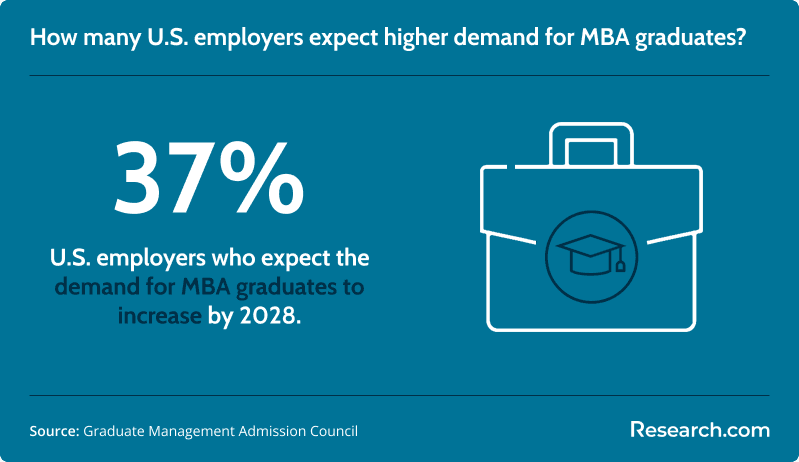
- Employer demand for MBA graduates is expected to remain steady or rise, with 37% of U.S. employers expecting higher demand by 2028.
- MBA graduates in the U.S. are projected to have the highest median starting salary in 2023 at $125,000.
- Employers identify communication, data analysis, and strategy as high-value MBA skills, and their importance is expected to increase over the next five years.
- Even with macroeconomic concerns, 82% of employers express confidence that MBA graduates are prepared for the workforce.
- Online MBA degrees may be viewed less favorably than in-person programs by some employers, but recruiters remain interested in the specific skills online graduates can demonstrate.
- U.S. employers report concerns about some communication and technology skill gaps, which means applicants should evaluate how well a program develops practical, employer-facing capabilities.
How Long Does It Take to Complete an MBA?
A traditional full-time MBA usually takes two years. This format gives students more time for internships, recruiting, networking, student leadership, and academic exploration. It can be a strong choice for applicants who want to switch industries or functions because the extra time creates more room for experimentation and employer access.
Part-time MBA options, including affordable online MBA programs under 15k, are generally built for working adults and may take three to five years because students enroll in fewer courses each term. Some flexible online MBA programs may follow two-year timelines, while accelerated options can move faster.
One-year and accelerated MBA programs compress the schedule. They are often best for students with prior business coursework, relevant work experience, or a clear post-MBA plan. The shorter timeline reduces time away from work, but it also leaves less room for trial and error.
| MBA Format | Typical Timeline | Best For | Main Trade-Off |
| One-year MBA | One year or slightly longer | Prepared applicants with clear goals who want a fast return to work | Less time for internships and broad career exploration |
| Traditional full-time MBA | Two years | Career switchers, internship seekers, and students wanting a deeper campus experience | More time out of the workforce |
| Part-time MBA | Three to five years | Working professionals who need scheduling flexibility | Longer completion time |
| Executive MBA | Varies by school | Experienced managers and executives who want to study while working | Higher cost and demanding work-school balance |
Online vs. On-Campus MBA Programs
Online MBA programs can be credible when they are properly accredited, academically rigorous, and connected to a reputable institution. Employers often pay attention to accreditation, school reputation, curriculum quality, and whether graduates can show practical skills. For applicants comparing speed and flexibility, short online MBA programs may be worth exploring, especially if work or family responsibilities make relocation difficult.
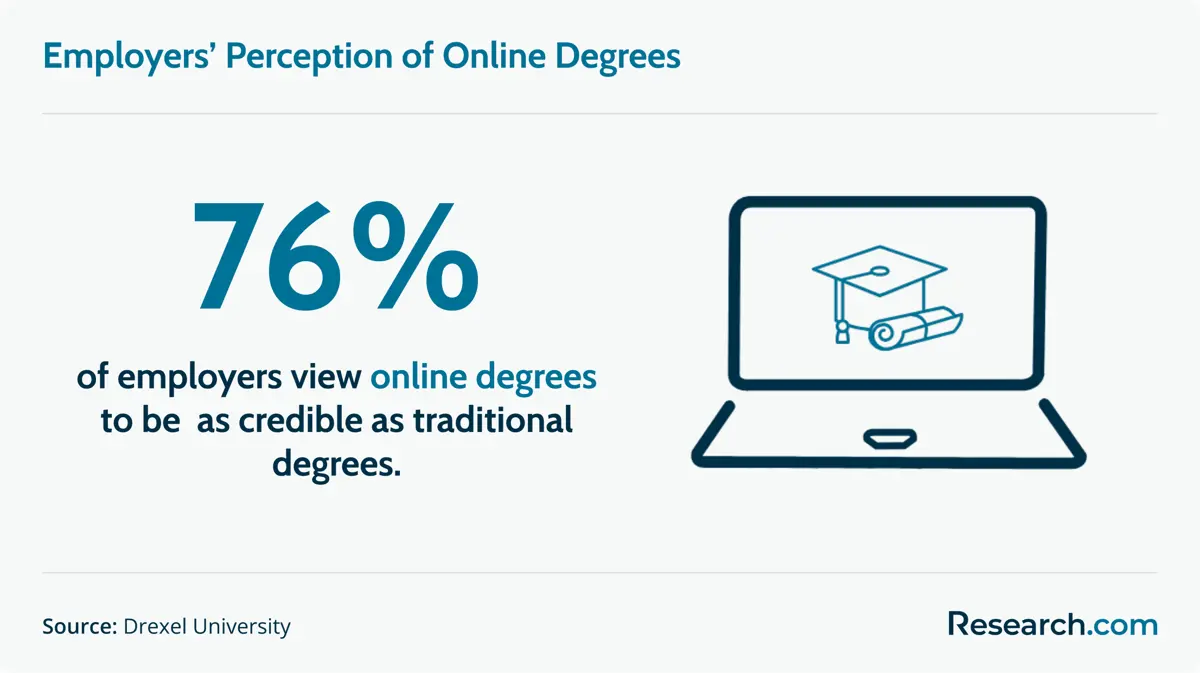
According to Drexel University’s discussion of online and traditional degrees, 76% of academic leaders believe online degrees are equal to on-campus degrees. That figure rises to 89% when the college also has a traditional campus. This does not mean every online MBA is equal. Applicants should verify regional accreditation, business accreditation, student support, career services, faculty access, and employer outcomes.
| Factor | Online MBA | On-Campus MBA |
| Flexibility | Stronger for students balancing work, travel, or family obligations | Better for students who can relocate or pause work |
| Networking | Depends heavily on live sessions, residencies, alumni access, and group projects | Often easier through campus events, clubs, recruiting, and informal interaction |
| Employer Perception | Strongest when accredited and tied to an established school | Often viewed more traditionally, especially for full-time MBA recruiting |
| Career Switching | Possible, but requires proactive networking and career planning | Often stronger for internship-based transitions |
How Does a One-Year MBA Compare to a Traditional Two-Year MBA?
The right choice depends on whether speed or career exploration matters more. A one-year MBA lowers opportunity cost by shortening time away from work, but a two-year MBA usually gives students more time to recruit, intern, test new industries, and build relationships.
- Choose a one-year MBA if: You already know your target industry, have relevant experience, want to advance quickly, or already completed business fundamentals. Applicants seeking simplified admissions may also compare options such as an online MBA no GMAT.
- Choose a two-year MBA if: You want to change careers significantly, need an internship, want more campus involvement, or are still deciding between functions such as consulting, finance, product management, or entrepreneurship.
- Consider cost carefully: A one-year format may reduce living expenses and lost wages, but tuition can still be high. Compare total cost, not just program length.
- Evaluate recruiting access: Some employers recruit most heavily from traditional full-time MBA pipelines. Ask each school how accelerated students participate in recruiting.
- Assess your readiness: A compressed program rewards preparation. If you need foundational accounting, finance, statistics, or economics support, ask whether the program includes bridge coursework.
What Is the Average Cost of MBA Programs?
MBA tuition varies substantially by school, residency status, format, and program length. In this guide, examples range from the University of Florida’s one-year MBA tuition of $17,982 for residents and $41,173 for non-residents to Cornell University’s Johnson Cornell Tech MBA tuition of $129,918. Northwestern University’s Kellogg one-year MBA lists tuition of $112,336, New York University lists $84,180, and the University of Southern California lists $127,872.
Unlike a topic such as the cheapest BCBA online program, MBA pricing is difficult to compare using tuition alone because fees, travel, living costs, lost income, books, health insurance, and international experiences can change the final cost. Students comparing distance options should review the broader MBA online cost picture before assuming an online or accelerated format is automatically cheaper.
Cost Factors to Compare Before Enrolling
| Cost Factor | Why It Matters |
| Tuition | The largest listed cost, but not always the full price of attendance |
| Fees and materials | Technology, student services, course materials, and graduation fees can add up |
| Travel or residency requirements | Online, executive, and global programs may require campus visits or international travel |
| Lost income | Full-time students should include wages they will not earn while enrolled |
| Scholarships and employer aid | Grants, awards, and tuition reimbursement can significantly reduce net cost |
What Financial Aid Options Are Available for MBA Students?
MBA students may use scholarships, grants, federal student loans, private loans, employer reimbursement, savings, or a combination of funding sources. The best strategy is to compare net cost after aid rather than relying on sticker tuition.
- Scholarships and Grants: Business schools may offer merit-based or need-based awards. Columbia Business School reports MBA scholarship awards ranging from $7,500 to $30,000. The AAUW Selected Professions Fellowships offer up to $18,000, and Duke University’s Keller Scholarship offers full tuition remission.
- Federal Student Aid: Eligible students can submit the FAFSA to access federal loan options, including Federal Direct Unsubsidized Stafford Loans and Federal Direct Graduate PLUS Loans.
- Private Loans: Banks, credit unions, and other lenders may offer graduate loans. Compare interest rates, fees, repayment protections, and cosigner requirements before borrowing.
- Employer Reimbursement: Some companies help pay for MBA coursework when the degree supports business needs. Ask about annual limits, grade requirements, repayment obligations, and whether you must remain with the employer after graduation.
What Are the Prerequisites for MBA Programs?
MBA admissions requirements vary by school and format, but most programs expect applicants to show academic readiness, professional maturity, and a clear reason for pursuing the degree. One-year programs may be more selective about prior coursework or work experience because students have less time to build fundamentals after enrollment.
- Bachelor’s Degree: Most programs require an undergraduate degree from an accredited institution.
- Work Experience: Many schools prefer two to three years of professional experience, though some accept early-career applicants.
- GMAT or GRE Scores: Some programs require test scores, while others offer waivers or test-optional pathways. Applicants looking for flexible admissions can compare MBA programs no GMAT required.
- Recommendations: Schools commonly ask for two to three professional or academic references.
- Essays or Personal Statements: Applicants typically explain their goals, leadership experience, accomplishments, and reasons for choosing the program.
- Interview: Some schools use interviews to assess communication ability, motivation, leadership potential, and program fit.
What Courses Are Typically Included in MBA Programs?
MBA curricula usually combine core business courses with electives or concentrations. Accelerated MBA programs may cover similar subjects but in a compressed schedule, so students should be prepared for a heavier academic pace.
- Finance: Investments, capital budgeting, valuation, financial markets, and corporate finance decisions.
- Marketing: Customer analysis, branding, pricing, digital marketing, and go-to-market strategy.
- Accounting: Financial reporting, managerial accounting, cost analysis, and interpretation of financial statements.
- Management: Leadership, team dynamics, negotiation, organizational behavior, and change management.
- Operations: Supply chain management, process improvement, logistics, and operational efficiency.
- Economics: Microeconomic and macroeconomic frameworks for understanding markets, competition, and policy environments.
Electives allow students to align the MBA with career goals in areas such as entrepreneurship, international business, analytics, healthcare, finance, or technology.
What MBA Specializations Are Available?
MBA specializations help students translate broad management training into a clearer career direction. They are especially important in one-year programs because students have less time to experiment. Choose a specialization based on target role, employer demand, prior experience, and the school’s recruiting strengths.
| Specialization | What It Prepares You For | Best Fit |
| Finance | Investment analysis, corporate finance, risk management, and financial leadership | Students pursuing banking, finance, treasury, or CFO-track roles |
| Marketing | Brand strategy, market research, digital campaigns, and customer growth | Students targeting product marketing, brand management, or growth strategy |
| Healthcare Management | Business leadership in hospitals, health systems, pharmaceutical firms, and healthcare organizations | Students with healthcare experience or interest in healthcare administration |
| Entrepreneurship | Business planning, funding, venture creation, and innovation management | Founders, family business leaders, and innovation-focused professionals |
| Business Analytics | Data-informed decision-making, performance measurement, and analytical strategy | Students who want to combine management with data analysis |
| International Business | Global strategy, cross-cultural management, and international finance | Students pursuing multinational or global leadership roles |
Students interested in finance may also review Research.com’s guide to the cheapest online MBA in finance. Leadership remains a core MBA theme as well, which is why some schools offer focused MBA leadership online programs.
As shown in the chart below, 47% of employers plan to hire MBA graduates for strategy and innovation, 45% for consulting, and 44% for marketing. These figures show why specialization choice should connect directly to employer demand and career goals.
How to Choose the Best MBA Program
The best MBA program is the one that fits your career target, budget, timeline, learning format, and admissions profile. Rankings can help you build a shortlist, but they should not replace deeper due diligence.
Questions to Ask Before Applying
- Accreditation: Is the university regionally accredited, and is the business school accredited by a recognized body such as AACSB?
- Career alignment: Does the program place graduates into the roles, companies, functions, or industries you are targeting?
- Curriculum: Are the core courses and specializations relevant to your goals?
- Format: Can you realistically handle the schedule, whether full-time, online, part-time, executive, or hybrid?
- Cost: What is the full cost after scholarships, fees, travel, living expenses, and lost income?
- Admissions fit: Does your academic and professional background match the program’s expectations?
- Network: Are alumni active in your target geography and industry?
- Career support: Does the school provide coaching, recruiting access, interview preparation, and employer connections for accelerated MBA students?
Common MBA Selection Mistakes
| Mistake | Better Approach |
| Choosing only by ranking | Compare placement outcomes, specialization strength, employer access, and fit |
| Looking only at tuition | Calculate total cost, including fees, living costs, travel, and lost income |
| Assuming all online MBAs are viewed equally | Verify accreditation, school reputation, faculty engagement, and career services |
| Ignoring internship limitations in one-year programs | Ask how students recruit, network, and transition careers without a long internship window |
| Overestimating salary certainty | Review outcomes by industry, role, geography, and prior work experience |
| Applying without a clear goal | Define target roles before choosing a format, specialization, or school |
What Networking Opportunities Do MBA Programs Offer?
Networking is one of the most practical reasons to pursue an MBA. Programs may connect students with alumni, faculty, recruiters, executives, founders, consultants, and peers from different industries. These relationships can support internships, job referrals, business partnerships, mentoring, and long-term professional development.
Applicants comparing flexible options should ask whether online students receive the same access to networking events, alumni groups, career fairs, and employer introductions as campus students. Some programs, including online MBA programs no GMAT, can still offer meaningful networking if they include live classes, residencies, cohort projects, and active alumni engagement.
What Is the Long-Term ROI of an MBA?
The long-term return on an MBA includes salary growth, promotion potential, career mobility, leadership credibility, and access to a professional network. ROI is strongest when the degree directly supports a realistic career move and when the student manages cost carefully.
To evaluate ROI, compare your expected post-MBA role with the program’s total cost and opportunity cost. A lower-priced or flexible online MBA may make sense for professionals who want to keep working while studying. A higher-cost full-time or executive format may be justified if it provides stronger access to target employers, leadership roles, or industry networks.
How Do MBA Programs Foster Personal Development?
MBA programs are not only technical business degrees. They are also leadership development experiences. Students practice communication, negotiation, executive presence, decision-making under uncertainty, team leadership, and conflict management. These skills matter because managers are often evaluated by how well they influence people, not just by how well they analyze numbers.
AACSB online MBA programs often include leadership courses, team-based assignments, coaching, and communication-focused work. These experiences can help students identify strengths, address blind spots, and practice collaboration in realistic business scenarios.
Mentoring, career coaching, and peer feedback can also support personal growth. Graduates may leave with stronger confidence, better judgment, and a clearer understanding of how they lead under pressure.
What Career Paths Are Available for MBA Graduates?
MBA graduates can pursue leadership, analytical, strategic, operational, and commercial roles across industries. Salaries vary by employer, geography, experience, and function, but the following roles show the range of career pathways linked to MBA skills.
- Management Analysts: Also known as consultants, these professionals help organizations improve efficiency and profitability. The median annual wage is $99,410.
- Financial Managers: These managers oversee financial planning, investment activity, reporting, and organizational financial health. The median annual wage is $156,100.
- Marketing Managers: These professionals develop strategies to promote products and services. The median annual wage is $156,580.
- Medical and Health Services Managers: These managers lead operations in healthcare facilities and related organizations. The median annual wage is $110,680.
- Information Systems Managers: These professionals coordinate computer-related activities and technology strategy within organizations. The median annual wage is $169,510.
- Operations Managers: These managers oversee production, manufacturing, process improvement, and quality control. The median annual wage is $103,840.
The chart below compares salaries across these roles and can help you think through which MBA specialization may best support your target career.
How Do MBA Programs Adapt to Emerging Business Trends?
Business schools regularly revise MBA curricula to reflect changes in technology, markets, and employer expectations. Current program updates often emphasize digital transformation, sustainability, artificial intelligence, data analytics, innovation, global strategy, and risk management. The goal is to prepare students for leadership in organizations facing rapid disruption.
Students who want a faster business credential outside the MBA format can also compare the fastest business administration degrees online. These programs may be useful for learners who need speed and foundational business training but do not necessarily need the full MBA experience.
What Distinguishes an Accelerated Business Management Degree From a Traditional MBA?
An accelerated business management degree may focus on fast completion, practical management training, and immediate workplace application. A traditional MBA usually offers broader graduate-level business leadership training, stronger peer networks, and deeper access to recruiting and alumni resources.
Students comparing speed-focused programs should review curriculum level, admissions standards, employer recognition, and career outcomes. For a closer look at faster undergraduate or graduate business pathways, Research.com provides a guide to the accelerated business management degree.
Should You Integrate Business Law Into Your MBA Studies?
Business law can strengthen an MBA student’s ability to assess risk, contracts, compliance, governance, employment issues, intellectual property, and regulatory exposure. This can be especially valuable in finance, healthcare, technology, entrepreneurship, and executive leadership roles.
Students who want deeper legal training beyond an MBA elective may consider a related business law master's degree. This type of study can complement management training by adding stronger legal and ethical decision-making skills.
What Is the Job Market for MBA Graduates?
The MBA job market remains strong, according to GMAC’s Corporate Recruiters Survey. The survey reports that 92% of employers plan to hire MBA graduates in 2023. Demand is especially visible in consulting, finance, and technology, where employers value strategic thinking, analytical judgment, and leadership preparation.
GMAC also identifies Central and South Asia, East and Southeast Asia, and the United States as regions with significant demand for MBA graduates. In the U.S., 37% of employers expect demand for MBA graduates to increase by 2028. For a broader review of roles and hiring outlook, see Research.com’s guide to the MBA job outlook.
What MBA Specializations Are Best for a Career in Technology?
Technology-focused MBA students should consider specializations such as information systems, technology management, business analytics, product management, strategy, or entrepreneurship. These areas help students connect business leadership with digital products, data-informed decision-making, platform strategy, cybersecurity concerns, and technology operations.
An online MBA information systems program may be a practical option for working professionals who want to build business and technology skills without relocating. Before enrolling, ask whether the program includes current coursework in analytics, AI, enterprise systems, digital transformation, and technology leadership.
How Do Executive MBA Programs Balance Cost With Career Advancement?
Executive MBA programs are built for experienced professionals who want advanced leadership training while continuing to work. Their value depends on whether the schedule, peer network, executive coaching, employer brand, and curriculum support a meaningful next career step.
Because executive MBA programs can be expensive, applicants should compare tuition with opportunity cost, employer sponsorship, travel requirements, and expected career benefit. For affordability-focused comparisons, Research.com offers a guide to executive MBA online cost.
Are Online One-Year MBA Programs as Effective as Campus-Based MBAs?
Online one-year MBA programs can be effective when they are accredited, well-designed, interactive, and supported by strong faculty and career services. The main question is not whether the program is online. It is whether the program gives students enough structure, networking, feedback, and employer access to achieve their goals.
Remote learners should look for live discussion, cohort-based projects, accessible professors, career coaching, alumni engagement, and transparent outcomes. To compare accelerated distance options, review Research.com’s guide to online MBA programs one year.
What Are the Most Popular MBA Specializations for Career Advancement?
Popular MBA specializations for advancement include finance, marketing, supply chain management, consulting, healthcare management, technology, business analytics, and accounting. The right choice depends on the role you want after graduation. Finance may support investment, corporate finance, or CFO-track roles. Marketing can support brand, product, and growth roles. Technology and analytics can support product, systems, strategy, and data-driven management work.
Accounting is also valuable for students targeting leadership roles in auditing, controllership, corporate accounting, or financial management. An MBA in accounting can help students combine technical financial knowledge with managerial decision-making.
Specialization should not be chosen only because it is popular. Choose it because it matches your background, target employers, and long-term career direction.
Key Insights
- A one-year MBA is best for applicants with clear goals, relevant preparation, and a need to return to work quickly.
- A two-year MBA may be better for major career switchers because it usually offers more time for internships, recruiting, and exploration.
- Accreditation, career outcomes, employer access, and specialization strength matter more than speed alone.
- Total cost should include tuition, fees, living expenses, travel, lost income, and financing costs, not just the published tuition figure.
- Online one-year MBAs can be credible, but students should verify accreditation, live engagement, networking access, and career support.
- MBA salary outcomes are promising but not guaranteed; industry, role, geography, work experience, and school reputation all influence results.
- The strongest MBA choice is the program that connects directly to your target role and gives you the skills, network, and credential needed to reach it.
References:
- Advertising, Promotions, and Marketing Managers: Occupational Outlook Handbook. (2024, April 17). U.S. Bureau of Labor Statistics.
- Computer and Information Systems Managers: Occupational Outlook Handbook. (2024, April 17). U.S. Bureau of Labor Statistics.
- Financial Managers: Occupational Outlook Handbook. (2024, April 17). U.S. Bureau of Labor Statistics.
- Graduate Management Admission Council. (2022). Prospective Students Survey 2022: MBA Programs: Demand & Career Aspirations.
- Graduate Management Admission Council. (2023). 2023 GMAC Corporate Recruiters Report: Degree Profiles - MBA.
- Graduate Management Admission Council. (2023). 2023 GMAC Corporate Recruiters Report: Regional Profile - United States. GMAC.
- Graduate Management Admission Council. (2023). Corporate Recruiters Survey 2023 Summary Report.
- Management Analysts: Occupational Outlook Handbook. (2024, April 17). U.S. Bureau of Labor Statistics.
- MBA Central. (n.d.). The Best States for MBA Graduates.
- Medical and Health Services Managers: Occupational Outlook Handbook. (2024, April 17). U.S. Bureau of Labor Statistics.
- Top Executives: Occupational Outlook Handbook. (2024, April 17). U.S. Bureau of Labor Statistics.
Other Things You Should Know About One Year MBA Programs
The average credit requirement for one-year MBA programs in 2027 is typically between 30 to 50 credits, depending on the institution. These programs are designed to be intensive, accelerating coursework to meet graduation criteria within 12 months.
Many one-year MBA programs require either the GMAT or GRE, but some schools waive both for applicants with strong academic records, advanced degrees, or significant work experience. A common minimum is a 2.7 to 3.0 GPA, plus official transcripts, essays, recommendations, and a resume.