2027 Best Business Schools & MBA Programs

Co-Founder and Chief Data Scientist
Choosing an MBA is not just a question of prestige. It is a career, time, and cost decision that can affect your earning potential, leadership opportunities, professional network, and ability to move into a new industry. MBA programs remain attractive because they combine management training, finance, analytics, strategy, leadership development, and peer networking in one graduate credential. Employers also continue to value the degree: the Graduate Management Admission Council (GMA) reported that 91% hired MBA graduates in 2022.
This guide is for professionals comparing full-time, part-time, online, executive, and accelerated MBA options. It explains what an MBA includes, how long it takes, what it may cost, where graduates work, how to compare programs, and what questions to ask before applying. It also includes a 2027 list of MBA programs to help you start your research with clear, comparable details.
Quick Answer: Is an MBA Worth It?
An MBA can be worth it for professionals who want to move into management, change industries, strengthen business skills, build a stronger network, or qualify for roles that prefer graduate-level business training. The degree is most valuable when the program fits your career goals, is properly accredited, offers strong career support, and can be completed at a cost that makes sense for your expected outcomes.
- Networking is a major advantage. MBA students often build relationships with classmates, faculty, alumni, recruiters, and industry speakers that can support future career moves.
- The degree is broadly applicable. MBA graduates work in finance, consulting, technology, healthcare, operations, marketing, entrepreneurship, government, and nonprofit organizations.
- Compensation can be strong, but it is not automatic. The average MBA graduate brings home over $115,000 a year, though actual pay depends on role, industry, location, experience, and school reputation.
What Can You Expect From an MBA Program?
An MBA is a graduate business degree designed to prepare students for management, leadership, and decision-making roles. Most programs cover core business areas such as accounting, finance, marketing, operations, organizational behavior, strategy, analytics, and leadership. Many also allow students to specialize in a field such as finance, business analytics, healthcare, entrepreneurship, marketing, or supply chain management.
The classroom experience usually blends case studies, team projects, simulations, presentations, data analysis, and applied consulting work. In strong programs, students are expected to connect business theory with real organizational problems, not simply memorize concepts. That practical focus is one reason the MBA remains a common credential for professionals seeking senior management, consulting, strategy, operations, or executive-track roles.
The network can be just as important as the curriculum. Students often learn alongside professionals from different sectors, functions, countries, and career stages. In well-established business schools, alumni networks, faculty connections, employer partnerships, and career offices can provide access to mentorship, internship leads, recruiting events, and long-term professional support.
Where Can MBA Graduates Work?
MBA graduates can work in nearly every sector because organizations of all sizes need people who can manage teams, analyze markets, allocate resources, improve operations, and make strategic decisions. Some graduates join large corporations or Fortune 500 companies. Others enter consulting firms, banks, technology companies, healthcare systems, startups, public agencies, or nonprofit organizations.
Common functions for MBA graduates include corporate strategy, finance, product management, marketing, business development, operations, human resources, analytics, entrepreneurship, and general management. The best path depends on your pre-MBA experience, concentration, internship choices, employer network, and geographic flexibility.
How Much Can You Make With an MBA?
MBA graduates are generally well compensated, with an average annual salary of $115,000. Earnings vary widely by industry, employer, role, work experience, location, and school. The highest-paying occupation for MBA graduates is consultancy, which offers an average starting salary of $147,178—more than triple the annual average wage.
Salary should not be evaluated in isolation. Applicants should compare expected earnings with tuition, fees, living costs, debt, time out of the workforce, relocation expenses, and the opportunity cost of studying full-time. A lower-cost accredited program may produce stronger personal ROI than a more expensive option if it connects well to your target role and market.
- 2027 MBA Program List
- MBA program length and pacing options
- Online MBA vs. on-campus MBA
- Average MBA program cost
- Financial aid for MBA students
- MBA admissions requirements
- Common MBA courses
- MBA specialization options
- How to choose an MBA program
- MBA career paths
- MBA job market outlook
- Transferable skills from an MBA
- MBA return on investment
- Trends shaping MBA education
- Leadership preparation in MBA programs
- Common MBA student challenges
- Finding an affordable quality MBA
- Business administration vs. business management
- Accelerated MBA program benefits
- Accelerated online MBA vs. traditional formats
- Benefits of accredited online MBA programs
- How an MBA builds global business knowledge
- Leadership development options in U.S. business schools
2027 List of the Best MBA Programs
How Do We Rank Schools?
Comparing MBA programs can be difficult because schools vary by format, cost, selectivity, career outcomes, concentrations, and student support. To support a clearer comparison, our team reviewed information from trusted data sources, including the IPEDS database, Peterson’s database, the Distance Learning Licensed Data Set from the College Scorecard database, and the National Center for Education Statistics. These sources helped inform our 2027 ranking of leading business schools and MBA programs. For a fuller explanation of the ranking process, see our methodology page.
1. University of Chicago (Booth)
The University of Chicago Booth School of Business offers its MBA degree through Full-Time, Evening, Weekend, and Executive formats. Students in each format earn the same MBA credential and study with the same faculty while joining Booth’s broader community and alumni network. The program is especially known for analytical thinking, evidence-based problem-solving, and flexible academic planning, making it a strong fit for students who want rigorous business training with multiple scheduling options.
- Program Length: 21 months to three years
- Tracks/concentrations: Accounting, Analytic Finance, Behavioral Science, Business Analytics, Econometrics and Statistics, Economics, Entrepreneurship, Finance, General Management, Healthcare, International Business, Marketing Management, Operations Management, Strategic Management
- Estimated Cost: $161,922 (total tuition cost, full-time)
- Required Credits to Graduate: 2000 units
- Accreditation: Association to Advance Collegiate Schools of Business (AACSB)
2. Harvard University
Harvard Business School delivers a two-year MBA built around general management and applied decision-making. Its case method places students in the role of business leaders who must analyze complex situations, defend recommendations, and learn from classmates with different professional perspectives. The program also incorporates global cases, international classroom discussions, and project-based learning to prepare graduates for leadership in complex organizations.
- Program Length: Two years
- Tracks/concentrations: General Management
- Estimated Cost: $115,638 $161,502 (total cost per year)
- Required Credits to Graduate: 66 credits
- Accreditation: Association to Advance Collegiate Schools of Business International (AACSB)
3. Stanford University
Stanford Graduate School of Business offers an MBA program focused on leadership, innovation, collaboration, and personal development. Students engage with peers from varied backgrounds while building the strategic and interpersonal skills needed to lead organizations and new ventures. The program emphasizes principled leadership and social impact, making it relevant for students who want to combine business success with broader organizational or societal change.
- Program Length: Two years
- Tracks/concentrations: Corporate Financial Modeling, Building and Managing Professional Sales Organizations, The Future of Cities: Entrepreneurship, Policy and Business Strategy
- Estimated Cost: $126,465 $152,157 (cost of first-year attendance)
- Required Credits to Graduate: 90 units
- Accreditation: Association to Advance Collegiate Schools of Business International (AACSB)
4. Northwestern University (Kellogg)
Northwestern University’s Kellogg School of Management offers a Full-Time MBA Program with multiple pathways for students with different academic timelines and career goals. The curriculum combines broad business fundamentals, leadership development, applied experiences, and cross-disciplinary options. Kellogg’s flexible structure and alumni network may appeal to students who want to customize their graduate business education around specific industries or leadership goals.
- Program Length: One to two years
- Tracks/concentrations: Accounting, Economics, Finance, Marketing, Operations, Strategy, Managing Organizations, and Management Science
- Estimated Cost: $120,432 to $162,395 (total cost per year)
- Required Credits to Graduate: 20.5 credits
- Accreditation: Association to Advance Collegiate Schools of Business International (AACSB)
5. University of Pennsylvania (Wharton)
The Wharton School’s MBA program combines a general business foundation with substantial academic flexibility. Students can choose from 21 majors and nearly 200 electives, allowing them to shape the degree around finance, analytics, healthcare, entrepreneurship, sustainability, or other interests. Wharton also emphasizes strategic analysis, measurable business thinking, faculty expertise, peer learning, and advising support throughout the MBA experience.
- Program Length: Two years
- Tracks/concentrations: Accounting; Business Analytics; Business Economics and Public Policy; Business, Energy, Environment and Sustainability; Diversity, Equity & Inclusion; Entrepreneurship & Innovation; Environmental, Social and Governance Factors For Business; Finance; Health Care Management
- Estimated Cost: $246,952 (total program cost)
- Required Credits to Graduate: 19 credit units
- Accreditation: Association to Advance Collegiate Schools of Business International (AACSB)
6. Massachusetts Institute of Technology (Sloan)
MIT Sloan’s full-time MBA is a STEM-designated program that gives students significant room to personalize their academic path. Students can choose majors, dual-degree options, and electives, with 144 units dedicated to elective study. Cross-registration opportunities with Harvard Business School also expand access to courses, peers, and collaborative learning experiences beyond MIT.
- Program Length: Two years
- Tracks/concentrations: Finance, Entrepreneurship and Innovation, Enterprise Management
- Estimated Cost: $125,489 (total cost of attendance per year)
- Required Credits to Graduate: 189 units
- Accreditation: Association to Advance Collegiate Schools of Business International (AACSB)
7. Carnegie Mellon (Tepper)
Carnegie Mellon’s Tepper MBA program is designed for students who want leadership training grounded in analytics, technology, and cross-functional business problem-solving. The STEM-designated curriculum blends quantitative rigor with leadership development and collaborative work across disciplines. Students learn alongside an international peer group and can pursue concentrations aligned with business technology, finance, healthcare analytics, strategy, sustainability, and related fields.
- Program Length: 21 months
- Tracks/concentrations: Accounting, Business Technologies, Communications, Economics, Entrepreneurship, Finance, Health Care Analytics, Marketing, Operations Management, Operations Research, Organizational Behavior, Strategy, Sustainability
- Estimated Cost: $37,856 (total cost per semester)
- Required Credits to Graduate: 64 credits
- Accreditation: Association to Advance Collegiate Schools of Business International (AACSB)
8. University of Massachusetts Amherst (Isenberg)
The UMass Isenberg MBA program emphasizes experiential and collaborative learning. Students can choose among full-time, online, hybrid, and dual-degree options, making the program accessible to different types of learners. Degree requirements vary depending on whether students complete general requirements or add a concentration, with paths ranging from 39 credits to 45 credits.
- Program Length: One and a half to two years
- Tracks/concentrations: Business Analytics, Finance: Asset Management, Healthcare Administration, Management & Entrepreneurship
- Estimated Cost: $2,521 (in-state cost per credit)
- Required Credits to Graduate: 37 49 credits
- Accreditation: Association to Advance Collegiate Schools of Business International (AACSB)
9. Columbia University
Columbia Business School’s MBA program prepares students to operate in a digital and data-driven business environment. Course options include big data, analytics, digital marketing, web programming, AI, machine learning, SQL, and Tableau. The program also uses master classes and immersion seminars to connect students with current business practice and global markets.
- Program Length: Two years
- Tracks/concentrations: Business Administration
- Estimated Cost: $127,058 (total first-year cost)
- Required Credits to Graduate: 60
- Accreditation: Association to Advance Collegiate Schools of Business International (AACSB)
10. University of Michigan (Ross)
The University of Michigan Ross School of Business offers multiple MBA formats for students with different schedules and career plans. The Ross MBA includes the REAL program, which lets students gain practical experience through company consulting, real estate investing, and venture development. Students interested in entrepreneurship can also use the REAL.START program for support in launching and scaling businesses.
- Program Length: Two years
- Tracks/concentrations: Data and Business Analytics; Design Thinking and Innovation; Environmental, Social, and Governance (ESG); Healthcare Management; Management Science
- Estimated Cost: $70,392 (in-state tuition per year)
- Required Credits to Graduate: 57
- Accreditation: Association to Advance Collegiate Schools of Business International (AACSB)
What Online MBA Graduates Say About Their Experience
-
: "
“After 12 years as an educator, I wanted a new direction without stepping away from my responsibilities. An online MBA helped me move into a corporate operations role, and I now use both my education background and new business training every day.” Elsa
"
-
: "
“I had a startup idea but did not know how to turn it into a working business. Feedback from professors and classmates helped me test the concept, improve the plan, and feel ready to pursue it full-time.” John
"
-
: "
“I wondered whether an online MBA would feel as rigorous as a campus program. It ended up giving me strong coursework, useful connections, and the flexibility to keep working from home.” David
"
Key Findings
- An MBA can be completed within two years, although some formats are shorter or longer.
- The total cost of an MBA degree may be about $232,985.
- MBA programs at many leading business schools commonly expect applicants to have two to five years of professional experience.
- Concentrations such as marketing, finance, and entrepreneurship allow students to build targeted expertise.
- For-profit, public organizations are the leading employers of MBA graduates.
- Management roles are expected to have about 1.1 million openings each year until 2032.
How Long Does It Take to Complete an MBA Program?
Most full-time MBA programs take about two years. However, the right timeline depends on your career stage, work schedule, academic background, and ability to step away from full-time employment.
Full-time MBA programs usually suit students who can pause or reduce work responsibilities and want access to internships, campus recruiting, student clubs, and intensive networking. Part-time MBA programs are often better for working professionals who want to keep earning income while progressing through the degree. Some part-time programs allow students to extend the standard two-year curriculum up to five years.
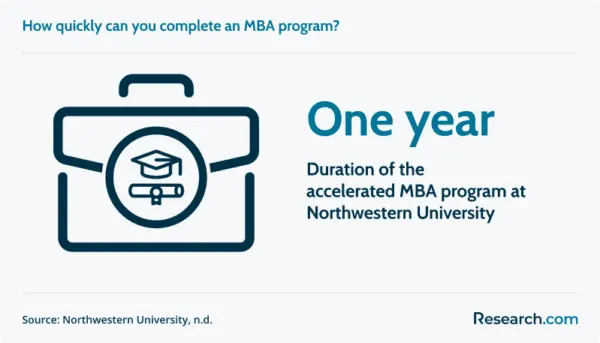
Accelerated MBA programs are typically designed for students with prior business education, strong professional experience, or the ability to handle a compressed course load. Northwestern University offers this type of option in a one-year format.
| MBA Format | Best For | Main Trade-Off |
| Full-time MBA | Students who can study intensively and want internships, campus recruiting, and deep networking | May require leaving or reducing full-time work |
| Part-time MBA | Working professionals who need schedule flexibility | Usually takes longer and may offer a less immersive campus experience |
| Accelerated MBA | Experienced students who want to finish quickly | Compressed pace can be demanding |
| Executive MBA | Senior professionals and managers seeking advancement | Often designed for experienced leaders rather than career changers |
How Does an Online MBA Program Compare to an On-Campus Program?
Many business schools now offer MBA programs in both online and campus-based formats. In some schools, online and on-campus students study similar curricula and learn from the same faculty. The main difference is not always academic content; it is often the learning experience, schedule, networking style, and access to campus resources.
The best online MBAs are often strongest for working adults, parents, military students, out-of-state learners, and professionals who cannot relocate. Online formats can reduce commuting and housing costs, but students should still check whether the program includes residencies, synchronous class meetings, technology fees, or travel requirements.
On-campus MBA programs typically offer more face-to-face networking, student organizations, recruiting events, and informal access to classmates and faculty. They may be a better fit for students who can attend full-time, want a more immersive experience, or plan to use campus recruiting for a major career pivot.
| Factor | Online MBA | On-Campus MBA |
| Schedule | Often more flexible for working professionals | Usually follows a more fixed academic calendar |
| Networking | Requires intentional participation in virtual events, group work, and residencies | Offers more spontaneous in-person networking |
| Relocation | Often unnecessary | May require moving or commuting |
| Best use case | Career advancement while continuing to work | Immersive study, internships, and campus recruiting |
What Is the Average Cost of an MBA Program?
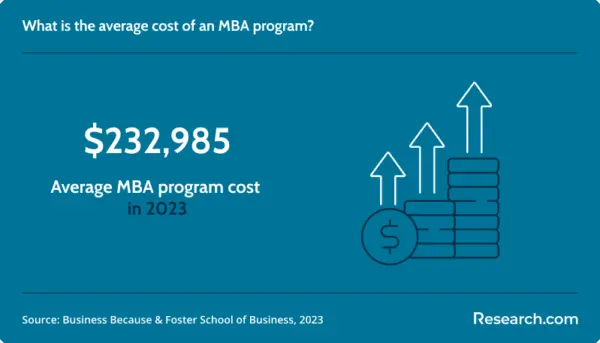
MBA costs differ significantly by school type, format, reputation, location, and student residency status. In 2023, the average MBA tuition was $232,985. Public institutions may cost less than private universities, though this depends on the program and whether the student qualifies for in-state rates.
Students comparing campus and online formats should look beyond tuition. Online MBA cost may be lower when students can avoid relocation, commuting, parking, and housing expenses. However, online programs may still charge technology fees, distance learning fees, residency costs, or other program-specific expenses.
Costs to Include in Your MBA Budget
- Tuition and mandatory fees: Review total program cost, not just per-credit pricing.
- Books, software, and technology: Business analytics, finance, and quantitative courses may require specific tools or platforms.
- Travel or residency expenses: Some online and hybrid MBAs require campus visits or global immersion experiences.
- Lost income: Full-time students should consider wages, bonuses, or promotions they may forgo while studying.
- Interest on loans: Borrowed funds can increase the real cost of the degree over time.
What Financial Aid Options Are Available for MBA Students?
The price of an MBA can discourage applicants, but many students reduce their out-of-pocket cost by combining several funding sources. The best approach is to ask each school for a full aid package estimate and compare net cost, not just published tuition.
- Student loans: Federal and private loans may help cover tuition and eligible education expenses, but students should compare repayment terms carefully.
- Scholarships and grants: Some awards are based on merit, need, professional background, leadership potential, or career goals.
- Fellowships and assistantships: These may provide tuition support, stipends, research opportunities, or teaching-related experience.
- Work-study programs: Eligible students may be able to earn money through approved part-time work.
- Employer assistance: Some employers reimburse tuition or sponsor employees, often with work commitments or grade requirements.
What Are the Prerequisites for Enrolling in an MBA Program?
MBA admissions requirements help schools evaluate whether applicants are academically prepared, professionally mature, and likely to contribute to a rigorous peer-based learning environment. Requirements vary by school, but most applications include academic records, professional information, recommendations, essays, and sometimes test scores.
Bachelor’s Degree
Most MBA programs require a bachelor’s degree from an accredited college or university. The undergraduate major does not always need to be business. Some applicants come from engineering, healthcare, education, liberal arts, public policy, or technology backgrounds. Still, candidates with a bachelor of business administration online or another business-related degree may already have exposure to foundational business concepts.
Transcripts
Applicants usually submit official transcripts from all prior colleges attended. Admissions teams use transcripts to review academic performance, completed coursework, grade trends, and evidence of readiness for graduate study.
Work Experience
Many MBA programs at leading business schools expect two to five years of professional experience. Work history helps students contribute meaningfully to case discussions, team projects, and leadership exercises. Some programs admit early-career applicants, while executive MBA programs usually expect more extensive management experience.
Letters of Recommendation
Recommendation letters typically come from supervisors, managers, professors, mentors, or professional contacts who can describe the applicant’s performance, leadership potential, judgment, communication skills, and readiness for graduate business study.
Standardized Tests
Many MBA programs accept or require GMAT or GRE scores, though test-optional policies are increasingly common. When scores are optional, applicants should submit them only if the results strengthen the application or help offset weaker areas such as GPA or quantitative coursework.
What Courses Are Typically in an MBA Program?
Students often ask, “What does an MBA teach you?” The answer depends on the school and concentration, but most MBA curricula combine core business disciplines with applied leadership and strategic decision-making.
- Finance and Accounting
- Marketing and Branding
- Operations and Supply Chain Management
- Strategy and Business Planning
- Leadership and Organizational Behavior
- Entrepreneurship and Innovation
- Data Analysis and Business Analytics
- Global Business and International Markets
- Ethics and Corporate Social Responsibility
- Information Technology and Digital Transformation
What Types of Specializations Are Available in Online MBA Programs?
MBA specializations let students connect the degree to specific career goals. Common options include finance, marketing, business analytics, human resources, entrepreneurship, healthcare management, strategy, supply chain management, and information systems. Some students also pursue cross-disciplinary pathways, such as online MSN MBA programs, when they want to combine business leadership with another professional field.
A specialization is most useful when it aligns with your target job market. For example, a finance concentration may support roles in corporate finance or investment analysis, while a healthcare administration concentration may be better for hospital, insurance, or health system leadership roles.
How Should You Choose the Best MBA Program?
The best MBA program is not always the highest-ranked or most expensive option. It is the program that fits your career goals, budget, learning style, schedule, academic background, and target employers. Before applying, compare programs using the same criteria so you can evaluate them fairly.
Accreditation and Reputation
Start with accreditation. Look for recognized business-school accreditors such as the Association to Advance Collegiate Schools of Business (AACSB) or the Accreditation Council for Business Schools and Programs (ACBSP). Accreditation helps confirm that the program meets established standards for faculty, curriculum, assessment, and institutional quality.
Faculty Expertise
Review faculty backgrounds, research areas, industry experience, and involvement in your target field. Strong faculty can help students connect theory to current business practice. According to a 2023 Wiley survey, 40% of faculty members aim to improve the analytics skills of students and other in-demand job skills.
Career Services and Placement Support
Career support can significantly affect the value of an MBA. Look for dedicated coaching, resume reviews, interview preparation, employer connections, internship support, alumni networking, and recruiting events in your preferred industries.
Questions to Ask Before You Apply
- Is the business school accredited by a recognized accrediting body?
- Does the program place graduates into the roles, industries, and locations I am targeting?
- What is the total program cost after scholarships, employer aid, and required fees?
- Can I complete the program without leaving work, relocating, or taking on unsustainable debt?
- Are classes synchronous, asynchronous, hybrid, or campus-based?
- How active is the alumni network in my field?
- Does the program offer concentrations, electives, or experiential learning tied to my goals?
What Career Paths Are Available for MBA Graduates?
MBA graduates pursue careers across finance, marketing, consulting, operations, technology, healthcare, entrepreneurship, nonprofit leadership, and general management. The degree can support advancement within a current field or help a professional pivot into a new function, especially when paired with relevant internships, projects, concentrations, and networking.
Popular roles for MBA graduates include:
- Business Development Manager. These professionals identify growth opportunities, build strategic partnerships, assess markets, and help organizations expand revenue and market presence.
- Marketing Manager. Marketing managers plan campaigns, analyze customer needs, manage promotional strategies, evaluate performance data, and help position products or services competitively.
- Financial Analyst. Financial analysts evaluate investments, prepare financial reports, study trends, forecast performance, and provide recommendations that support business decisions.
A 2023 GMAC corporate recruiter survey found that for-profit, public organizations were the top employers of MBAs in the prior year. Hiring also occurred across government, global companies, private for-profit organizations, and nonprofit organizations.
| Employer | % that hired MBAs in 2022 |
| For-profit, public organizations | 96% |
| Government | 92% |
| Global companies | 91% |
| For-profit, private organizations | 88% |
| Nonprofit organizations | 85% |
What Is the Job Market for MBA Graduates?
Organizations need managers who can coordinate teams, interpret data, allocate budgets, lead change, and plan for growth. According to the U.S. Bureau of Labor Statistics (BLS), there will be about 1.1 million openings for management occupations each year from 2022 to 2032.
Growth varies by occupation. The BLS projects an average job growth rate of 3%, while financial manager roles are expected to grow by 16% over the same forecast period. MBA graduates should still evaluate demand by function, industry, and location because a degree alone does not guarantee employment or salary outcomes.
What Skills Can You Gain From an MBA Beyond Business Management?
An MBA builds more than technical business knowledge. Many programs are designed to strengthen leadership behaviors, analytical thinking, communication, and adaptability—skills that can transfer across industries and organizational levels.
- Critical thinking and problem-solving: Students learn to break down ambiguous business problems, evaluate evidence, compare trade-offs, and recommend practical solutions.
- Leadership and team management: Group projects, leadership courses, and simulations help students practice motivation, delegation, conflict management, and team accountability.
- Effective communication: MBA coursework often requires presentations, executive summaries, negotiations, and written recommendations for different audiences.
- Adaptability and resilience: Students work through changing markets, incomplete information, complex cases, and competing priorities that mirror real management challenges.
- Financial literacy: MBA graduates commonly gain stronger skills in budgeting, forecasting, financial reporting, investment analysis, and resource allocation.
- Networking and relationship-building: Programs encourage students to build professional relationships with peers, faculty, alumni, recruiters, and industry contacts.
What Is the Return on Investment of an MBA Program?
MBA ROI depends on more than post-graduation salary. Students should compare tuition, fees, loan interest, living costs, lost wages, and time to completion against potential career advancement, employer access, networking value, and long-term earning potential. A useful ROI estimate should include both direct costs and opportunity costs.
Applicants can improve potential ROI by seeking scholarships, using employer tuition assistance, choosing an accredited lower-cost program, studying part-time while employed, or considering a flexible option such as a cheap MBA online. The lowest tuition is not always the best value, but reducing debt can make the degree less financially risky.
What Emerging Trends Are Shaping MBA Programs?
MBA programs are adapting to changes in technology, analytics, global competition, and employer expectations. Many schools now include more coursework in data analytics, artificial intelligence, cybersecurity, digital transformation, and technology strategy. These subjects help graduates understand how digital tools influence operations, customer behavior, finance, risk management, and decision-making.
Programs are also placing more emphasis on sustainability, ethical leadership, entrepreneurial thinking, and cross-functional collaboration. Some schools partner with technology companies, startup incubators, or industry organizations to give students exposure to applied projects and emerging business models. Fast-format options, including one year MBA schools, also reflect demand from professionals who want graduate business training without a long career interruption.
How Do Top Business Schools Prepare MBA Students for Leadership Roles?
Strong MBA programs do not treat leadership as a single course. They build it through classroom discussion, group projects, simulations, coaching, experiential learning, student organizations, and feedback from peers and faculty. Students are expected to practice decision-making under uncertainty, communicate persuasively, manage conflict, and lead across functions.
Leadership coursework may include organizational behavior, negotiations, strategy, ethics, change management, and executive communication. Simulations and leadership labs often place students in realistic management situations where they must make decisions, defend priorities, and adapt to new information.
Mentorship is another important part of leadership development. Many business schools connect students with alumni, executives, faculty advisors, or professional coaches who can provide feedback on leadership style, career direction, and workplace challenges.
Students who need flexibility may consider online MBA no GMAT programs. These options can include leadership coursework, virtual team projects, and applied assignments while removing a standardized testing barrier for some applicants.
What Challenges Do MBA Students Commonly Face, and How Can They Overcome Them?
MBA students often struggle with time management, heavy reading loads, group projects, quantitative coursework, networking pressure, and balancing school with work or family. Online students may also need to be more deliberate about building relationships because informal campus interactions are limited.
The best response is to plan before the program starts. Students should block weekly study time, clarify expectations with employers and family, use tutoring or academic support early, join student groups, attend networking events consistently, and choose a course load that matches their capacity. Cost-conscious students may also compare options such as the most affordable MBA online no GMAT to reduce financial pressure while preserving flexibility.
How Can You Find an Affordable Yet High-Quality MBA Program?
An affordable MBA should still meet quality standards. Do not choose a program based only on low tuition. Check accreditation, curriculum depth, faculty qualifications, student services, graduation requirements, career support, and employer reputation. A low-cost program that lacks recognized accreditation or career relevance can be a poor investment.
Use transparent cost data and compare total cost rather than advertised tuition. Ask about scholarships, employer partnerships, transfer credit, payment plans, and required in-person experiences. Resources such as an affordable business degree online guide can help you identify lower-cost options while still evaluating academic quality and student support.
What Is the Difference Between Business Administration vs. Business Management?
Business administration and business management overlap, but they are not identical. Business administration usually focuses on how organizations operate across areas such as finance, accounting, marketing, operations, and human resources. Business management often emphasizes leadership, supervision, strategic planning, decision-making, and long-term organizational direction.
The right choice depends on your goals. Students seeking broad operational knowledge may prefer business administration, while those focused on leading teams or managing organizational growth may be drawn to business management. For a more detailed comparison, see our guide to business administration vs. business management.
What Are the Benefits of Accelerated MBA Programs?
Accelerated MBA programs are designed for students who want to complete graduate business training in a shorter period, often around one year. They can be appealing to professionals who want to reduce time away from work, lower some living or relocation expenses, and move more quickly toward promotion or a career pivot.
The main advantage is efficiency. A compressed program can reduce the amount of time spent in school and may allow graduates to reenter or advance in the job market sooner. However, the pace can be intense, and students usually need strong time management skills, clear goals, and enough academic preparation to handle the workload.
Flexible formats such as one year MBA programs online may help working professionals balance school with employment. Still, applicants should confirm that the program includes the concentration, networking access, career support, and accreditation they need.
What Sets Accelerated Online MBA Programs Apart From Traditional Formats?
Accelerated online MBA programs combine a shorter academic timeline with digital delivery. They are often built for experienced professionals who can move quickly through core business topics while continuing to work. Virtual platforms may include live classes, recorded lectures, team projects, discussion boards, simulations, and faculty feedback.
Compared with traditional two-year formats, accelerated programs require faster decision-making and more consistent weekly discipline. They may be a strong fit for students with clear goals, prior business exposure, and limited ability to pause their careers. For more program structure comparisons, review our guide to accelerated online MBA programs.
What Are the Benefits of Accredited Online MBA Programs?
Accreditation is one of the most important quality checks for an online MBA. It signals that the business school or program has been evaluated against recognized academic standards. When comparing options, students may look for accreditation such as an AACSB online MBA, which is widely recognized in business education.
Accredited online MBA programs can offer flexibility, credibility, access to faculty, structured coursework, alumni networks, and career support. They are especially useful for working professionals who need to continue earning income while completing the degree.
How Does an MBA Program Enhance Global Business Acumen?
Modern MBA programs often include global business content because managers increasingly work with international customers, suppliers, teams, competitors, and regulations. Students may study multinational strategy, international finance, supply chains, market entry, cultural intelligence, and global risk.
Global learning can happen through international case studies, diverse cohorts, virtual collaboration, study abroad, consulting projects, or global immersion experiences. Students who want deeper international preparation may also explore related options such as the best online international business degree.
What Leadership Development Programs Do U.S. Business Schools Offer?
U.S. business schools often provide leadership development beyond standard coursework. These opportunities help students practice executive communication, decision-making, team leadership, coaching, and organizational change. They may be available in traditional MBA formats as well as online executive MBA programs.
- Leadership labs and workshops: Students practice decision-making, emotional intelligence, communication, and team leadership through exercises and simulations.
- Mentorship programs: Schools may match students with alumni, executives, faculty, or industry mentors who provide career and leadership guidance.
- Executive coaching: Individual coaching can help students assess leadership strengths, refine goals, and address workplace challenges.
- Leadership fellowships: Some programs offer selective opportunities to work closely with senior leaders or participate in advanced leadership projects.
- Leadership retreats and conferences: These events bring students, faculty, alumni, and executives together to discuss leadership challenges and expand professional networks.
Other Things You Should Know About Business Schools and MBA Programs
Which MBA Is Most in Demand?
MBA graduates are often in strong demand compared with holders of other business graduate degrees, such as master’s degrees in management or finance. However, specialized MBA pathways can be more relevant than a general MBA when employers need specific expertise.
According to 2021 reports from Data USA, many MBA graduates work as accountants, auditors, and financial managers. This suggests that an MBA with a finance focus can be useful for students targeting finance-related roles.
At What Age Is an MBA Best?
The average MBA student is 28, but age should not be the deciding factor. The better question is whether the degree fits your career timing. Early-career professionals may use an MBA to accelerate advancement or change functions. Mid-career professionals may use it to move into management. Senior professionals may choose executive MBA formats to prepare for higher-level leadership.
How Many Business Schools Should You Apply To?
Applicants who want the best college for business management should still build a balanced school list. MBA admissions can be competitive, so applying to five to eight schools can help you include reach, target, and safer options. Fit matters: choose programs where your experience, goals, budget, and learning preferences align with what the school offers.
How Can You Improve Your Application to Top-Ranked MBA Programs?
A strong MBA application shows academic readiness, professional impact, leadership potential, and a clear reason for pursuing the degree. Applicants can improve their competitiveness by taking the following steps:
- Submit strong GMAT or GRE scores when helpful. Even if a school is test-optional, a competitive score may strengthen an application, especially for candidates who want to demonstrate quantitative readiness.
- Quantify professional impact. Use measurable achievements in your resume and essays. For example, describe how you improved revenue, reduced costs, increased efficiency, led teams, or managed projects.
- Get informed feedback. Advisors, mentors, supervisors, or admissions consultants can help you refine your school list, essays, resume, and interview strategy.
What Experiential Learning Opportunities Do MBA Programs Offer?
Experiential learning helps MBA students apply classroom concepts to real business problems. These opportunities can also support career exploration, networking, and skill development.
- Internships: Students gain workplace experience, test career interests, and connect with employers.
- Consulting projects: Teams work with companies or organizations to address actual business challenges.
- Global immersion programs: Students explore international markets, cultures, and business practices through structured global experiences.
- Case competitions: Participants analyze complex business problems, present recommendations, and build teamwork skills.
- Networking events: Conferences, guest lectures, employer sessions, and alumni events help students build professional relationships.
How Do Business Schools Support Innovation and Entrepreneurship?
Business schools encourage entrepreneurship through startup incubators, venture competitions, entrepreneurship courses, mentorship, product development projects, market research, and access to investor or alumni networks. These resources help students test ideas, build business plans, receive feedback, find collaborators, and understand how to move from concept to execution.
What Unique International Experiences Do U.S. Business Schools Offer?
U.S. business schools may offer study abroad courses, global consulting projects, international residencies, exchange programs, multinational case work, and cross-border team assignments. Students interested in global careers should ask whether these experiences are required, optional, included in tuition, or billed separately.
Common Mistakes to Avoid When Choosing an MBA
- Choosing only by ranking. Rankings can help with research, but they do not replace fit, cost, accreditation, career outcomes, and schedule compatibility.
- Ignoring accreditation. Accreditation affects quality assurance, employer perception, and sometimes transferability or eligibility for certain opportunities.
- Comparing tuition instead of total cost. Fees, travel, living expenses, loan interest, and lost income can change the real price of an MBA.
- Assuming online means easier. Online MBA programs can be rigorous and require strong self-direction, time management, and consistent participation.
- Overlooking career services. A program with limited recruiting support may be less useful for students trying to change industries or functions.
- Expecting guaranteed salary outcomes. MBA salaries depend on experience, industry, geography, employer demand, and individual performance.
Key Insights
- An MBA is most valuable when it directly supports a clear career goal, such as management advancement, industry transition, consulting, finance, entrepreneurship, or executive leadership.
- Program format matters. Full-time, part-time, online, executive, and accelerated MBAs serve different students, so choose based on your schedule, career stage, and need for networking or flexibility.
- Cost should be evaluated as total investment, not just tuition. Include fees, housing, travel, technology, lost income, and loan interest before deciding.
- Accreditation, career services, alumni access, concentrations, and employer connections are critical quality indicators.
- The MBA job market is broad, with management occupations expected to have about 1.1 million openings each year until 2032, but individual outcomes depend on preparation and fit.
- Do not apply only to famous schools. A well-matched, accredited, affordable program with strong career support can provide better personal ROI than a higher-cost option that does not align with your goals.
References:
- Business Because & Foster School of Business. (2023, August 10). Cost of MBA report | Average costs and online mbas. Business Because. Retrieved February 8, 2024, from https://www.businessbecause.com/news/mba-cost/6978/mba-cost
- Data USA. (n.d.). Business Administration, Management, & Operations. Data USA. Retrieved February 9, 2024, from https://datausa.io/profile/cip/business-administration-management-operations
- Flynn, J. (2023, March 28). 25 Educational MBA Statistics [2023]: Average Age, Cost, And Salary For MBA Graduates. Zippia. Retrieved February 7, 2024, from https://www.zippia.com/advice/mba-statistics
- Human Resources Managers : Occupational Outlook Handbook: : U.S. (2023, September 6). Bureau of Labor Statistics. Retrieved February 9, 2024, from https://www.bls.gov/ooh/management/human-resources-managers.htm
- U.S. Bureau of Labor Statistics. (2023, September 6). Advertising, Promotions, and Marketing Managers : Occupational Outlook Handbook: : U.S. Bureau of Labor Statistics. Retrieved February 9, 2024, from https://www.bls.gov/ooh/management/advertising-promotions-and-marketing-managers.htm
- U.S. Bureau of Labor Statistics. (2023, September 6). Financial Managers : Occupational Outlook Handbook: : U.S. Bureau of Labor Statistics. Retrieved February 9, 2024, from https://www.bls.gov/ooh/management/financial-managers.htm
- U.S. Bureau of Labor Statistics. (2023, September 6). Management Analysts : Occupational Outlook Handbook: : U.S. Bureau of Labor Statistics. Retrieved February 9, 2024, from https://www.bls.gov/ooh/business-and-financial/management-analysts.htm
- U.S. Bureau of Labor Statistics. (2023, September 6). Top Executives : Occupational Outlook Handbook: : U.S. Bureau of Labor Statistics. Retrieved February 9, 2024, from https://www.bls.gov/ooh/management/top-executives.htm
- Wiley. (2023, March 8). How MBA Programs Are Changing With the Market. AACSB. Retrieved February 8, 2024, from https://www.aacsb.edu/insights/articles/2023/03/how-mba-programs-are-changing-with-the-market
Other Things You Should Know About Business Schools & MBA Programs
MBA graduates are in higher demand than professionals with other business degrees, like a master’s in management or finance. However, those with specialized MBA degrees may be more desirable than those with MBAs in general business.
According to 2021 reports from Data USA, most MBA graduates are employed as accountants, auditors, and financial managers. This suggests that having an MBA in finance can be an advantage in the job market.
There are a few steps you can take to set yourself apart from other applicants to the best business schools, like:
- Get a good GMAT/GRE score. While many B-schools are now test-optional, many allow applicants to submit GMAT or GRE scores if they think it can strengthen their application. Invest in preparation courses or self-study materials if you plan to take a standardized test.
- Measure your impact. Highlight leadership experiences in your resumé and quantify your achievements in every role. For example, instead of saying “managed campaign development," you can say “optimized the campaign development process, decreasing turnaround time by 50%."
Seek expert guidance. Consider working with an admissions consultant for personalized feedback and support with your application strategy.
In 2027, MBA programs are offering cutting-edge experiential learning opportunities. For instance, the University of Pennsylvania's Wharton School provides global immersion programs, Harvard Business School offers FIELD Global Immersion projects, and MIT Sloan School of Management integrates action learning labs that tackle real-world business challenges, enriching student experiences.