2027 Best Online MBA in Sustainability Programs

Co-Founder and Chief Data Scientist
Choosing an online MBA in Sustainability is no longer just about adding a “green business” credential to your resume. The bigger question is whether the degree will help you move into work where business strategy, environmental accountability, regulation, operations, and stakeholder trust intersect. The United Nations has warned that progress toward net-zero emissions by 2050 is not on track, and many organizations are under pressure to reduce environmental impact while remaining profitable and competitive.
This guide is designed for working professionals, career changers, managers, consultants, and business graduates who want to compare online MBA in Sustainability programs and understand what the degree can realistically do for their careers. You will learn what these programs teach, how long they take, what they cost, how online study compares with campus study, what admissions requirements to expect, which careers may be available, and how to evaluate return on investment before enrolling.
Quick answer: Is an online MBA in Sustainability worth considering?
An online MBA in Sustainability can be a strong option if you want business leadership training with a focus on environmental strategy, corporate social responsibility, ESG, sustainable operations, renewable energy, or environmental compliance. It is most useful for professionals who already have some work experience and want to move into management, consulting, strategy, operations, or sustainability-focused leadership roles.
The degree is not the best fit for everyone. If you want a technical environmental science role, engineering licensure, or laboratory-based research work, a specialized science or engineering graduate degree may be more appropriate. If your goal is business leadership with sustainability expertise, however, this MBA can offer a practical bridge between management skills and environmental responsibility.
What are the benefits of getting an online MBA in Sustainability degree?
- Online MBA formats are well suited to working adults because many programs allow students to complete coursework around employment, family responsibilities, and travel demands.
- Graduates may qualify for roles in corporate sustainability, renewable energy, consulting, nonprofit management, compliance, ESG analysis, sustainable supply chain management, and social enterprise leadership.
- Depending on role, industry, location, and seniority, earnings can range from $80,000 to $140,000 or more, with higher compensation generally tied to executive, director-level, or specialized technical positions.
What can I expect from an online MBA in Sustainability program?
An online MBA in Sustainability combines core graduate business training with coursework on environmental responsibility, social impact, sustainable operations, and long-term value creation. Students typically study finance, accounting, leadership, analytics, marketing, strategy, and organizational behavior while learning how sustainability affects supply chains, compliance, product design, investment decisions, public policy, and corporate reputation.
The central purpose of the degree is to prepare business leaders who can make decisions that consider profit, people, and environmental impact together. In practice, that may mean helping a company reduce waste, comply with environmental regulations, measure ESG performance, redesign sourcing practices, evaluate renewable energy investments, or communicate sustainability goals to investors, customers, and regulators.
| Program feature | What it usually means for students | Why it matters |
| Flexible online delivery | Courses may be asynchronous, scheduled in evenings or weekends, or delivered in short terms. | This can make the degree manageable for professionals who cannot pause their careers. |
| Applied business projects | Programs may include consulting assignments, simulations, capstones, case studies, or internships. | Hands-on work helps students translate sustainability concepts into measurable business action. |
| Interdisciplinary curriculum | Students connect sustainability with finance, marketing, operations, law, data, and leadership. | Sustainability roles often require cross-functional influence rather than work in a single department. |
| Leadership focus | MBA coursework emphasizes decision-making, team management, communication, and strategy. | Employers often need professionals who can move sustainability from reporting into execution. |
Where can I work with an online MBA in Sustainability degree?
Graduates can work in many settings because sustainability now affects operations, procurement, finance, compliance, risk management, brand strategy, and stakeholder relations. The best-fit industry depends on your prior background, technical knowledge, professional network, and chosen concentration.
- Corporate sustainability departments: Large companies may hire sustainability professionals to manage ESG initiatives, reporting, emissions reduction plans, vendor standards, and internal sustainability goals.
- Consulting firms: Sustainability consultants help clients assess environmental impact, manage regulatory risk, build reporting systems, improve supply chains, or design sustainability strategies.
- Nonprofit organizations: Mission-driven organizations may need MBA graduates for program management, advocacy, fundraising strategy, operations, and community-based environmental initiatives.
- Green startups and social enterprises: Entrepreneurs and early-stage companies may use sustainability-centered business models in renewable energy, circular products, clean technology, sustainable food systems, or responsible consumer goods.
- Government agencies: Public agencies may need professionals who understand environmental policy, stakeholder management, procurement, sustainable infrastructure, and regulatory implementation.
- Energy and transportation sectors: Companies working in renewable energy, electric vehicles, logistics, and infrastructure may value managers who can connect sustainability goals with cost, efficiency, and growth.
- Technology companies: Tech employers may need sustainability professionals for energy use, data center efficiency, green software solutions, emissions tracking tools, and responsible operations.
- Research organizations and think tanks: Some graduates support applied sustainability research, climate policy analysis, sustainable business models, and environmental strategy development.
How much can I make with an online MBA in Sustainability degree?
Salary outcomes vary widely. Your compensation will depend on your job title, industry, geography, employer size, years of experience, technical skills, and whether the position is individual-contributor, managerial, director-level, or executive. According to PayScale, an MBA in Sustainability graduate has an average annual salary of $98,000.
One common role is sustainability specialist, with an annual salary of $79,590 according to ONET OnLine. Some related roles require additional education, licensing, or technical credentials. For example, environmental engineers earn $105,840.
Advanced leadership roles can pay substantially more. A sustainability director earns $120,217 according to PayScale, 2025, while a chief sustainability officer earns $206,680.
| Role or credential path | Salary figure stated | Important context |
| MBA in Sustainability graduate | $98,000 | Average annual salary reported by PayScale. |
| Sustainability specialist | $79,590 | Often a practical entry or mid-level path for professionals moving into sustainability work. |
| Environmental engineer | $105,840 | This role may require additional degrees, licenses, or certifications beyond an MBA. |
| Sustainability director | $120,217 | Typically requires leadership experience and a record of implementing sustainability strategy. |
| Chief sustainability officer | $206,680 | Executive-level role usually requiring substantial management, strategy, and organizational influence. |
Renewable energy, consulting, corporate sustainability, government, and multinational employers may offer different compensation structures, including bonuses or broader benefits packages. Do not assume that an MBA alone guarantees a specific salary. The strongest outcomes usually come from combining the degree with relevant experience, measurable project results, industry knowledge, and strong professional networks.
- Best Online MBA in Sustainability Programs for 2027
- How long does an online MBA in Sustainability take?
- Online MBA in Sustainability vs. on-campus MBA: which is better?
- How much does an online MBA in Sustainability cost?
- Financial aid options for online MBA in Sustainability students
- Admissions requirements for online MBA in Sustainability programs
- Common courses in an online MBA in Sustainability
- Sustainability MBA concentrations and focus areas
- Long-term ROI of an online MBA in Sustainability
- Executive-focused online MBA in Sustainability programs
- Why accreditation matters
- Doctoral study after an MBA in Sustainability
- Emerging trends in sustainability MBA programs
- Accelerated online MBA in Sustainability formats
- Student support and networking in online programs
- Tuition and ROI compared with other specialized MBAs
- Additional credentials to consider
- How interdisciplinary expertise can improve career options
- Challenges of online MBA in Sustainability programs
- How to choose the right online MBA in Sustainability
- Career paths for MBA in Sustainability graduates
- Job market outlook for sustainability MBA graduates
List of the Best Online MBA in Sustainability Programs for 2027
How do we rank schools?
An MBA in Sustainability can affect your finances, career direction, and professional network for years, so program selection should be based on more than brand recognition. Research.com’s team reviewed schools using a structured ranking methodology and considered information from the Integrated Postsecondary Education Data System, Peterson’s database, including its Distance Learning Licensed Data Set, College Scorecard, and the National Center for Education Statistics (NCES). These sources help support a more transparent comparison of online programs, costs, accreditation, and institutional data.
1. Southern New Hampshire University
Southern New Hampshire University offers an online MBA in Sustainability and Environmental Compliance for students who want business training connected to environmental regulation, energy, and sustainable organizational change. The curriculum blends standard MBA coursework with focused sustainability and compliance classes. Students work through scenario-based learning activities designed to mirror workplace problems, which can help them practice decision-making before applying concepts on the job. The online format uses 10-week terms and includes opportunities to earn credentials in sustainability-related areas.
- Program Length: One to two years
- Tracks/Concentrations: Sustainability and Environmental Compliance
- Cost per Credit: $637
- Required Credits to Graduate: 30
- Accreditation: Accreditation Council for Business Schools and Programs (ACBSP); New England Commission of Higher Education (NECHE)
2. Wilmington University
Wilmington University provides an online MBA in Sustainability that emphasizes executive thinking, analytical skills, and practical business leadership. The program combines sustainability coursework with MBA fundamentals so students can learn how environmental responsibility connects to organizational performance. Seven-week accelerated courses make the program appealing to students who want a faster and flexible path. The program does not require the GMAT and uses an open admission policy, which may broaden access for applicants from varied professional and academic backgrounds.
- Program Length: One year
- Tracks/Concentrations: Sustainability
- Cost per Course: $1,611
- Required Credits to Graduate: 36
- Accreditation: International Accreditation Council for Business Education (IACBE); Middle States Commission on Higher Education (MSCHE)
3. Manhattan College
Manhattan College offers an online MBA with a concentration in Organizations, Markets and Sustainability. The program is structured for students who want applied learning through research collaboration, business plan development, and possible international study trips. Students may choose full-time or part-time enrollment, and classes are delivered in intensive seven-week modules. Small class sizes support closer faculty interaction. The concentration connects management, markets, organizational strategy, and sustainability, preparing students for roles in CSR, strategy, talent management, market research, and sustainability management.
- Program Length: 18 to 24 months
- Tracks/Concentrations: Organizations, Markets and Sustainability
- Cost per Credit: $1,370
- Required Credits to Graduate: 36
- Accreditation: Association to Advance Collegiate Schools of Business (AACSB); MSCHE
4. Pennsylvania State University Global Campus
The Pennsylvania State University Global Campus offers an online MBA with a focus on Business Sustainability Strategy. The curriculum uses the Integration, Collaboration, and Engagement (ICE) framework, which helps students examine business problems across multiple functional areas instead of treating sustainability as a separate topic. Group projects are built into the program to encourage collaboration. Students may also take part in a Global Immersion trip and a virtual Team Performance Immersion, a three-day online experience centered on team dynamics and core coursework.
- Program Length: Two years
- Tracks/Concentrations: Business Sustainability Strategy
- Cost per Credit: $1,260
- Required Credits to Graduate: 48
- Accreditation: AACSB; MSCHE
5. University of Houston-Clear Lake
The University of Houston-Clear Lake offers an MBA with a Sustainability concentration for students interested in the legal, economic, and strategic dimensions of sustainable business. Courses are available online and in hybrid formats, with many offered in eight-week sessions and some sustainability courses running for a full semester. Students apply theory through research projects related to sustainable communities, environmental management, and strategic business. The program is designed to support careers in environmental consulting, compliance, and sustainability-focused business leadership.
- Program Length: 16 to 36 months
- Tracks/Concentrations: Sustainability
- Cost per Credit: $709.20–$1,233.20
- Required Credits to Graduate: 36
- Accreditation: AACSB; SACSCOC
6. University of Maine
The University of Maine offers a fully online MBA with a Sustainability concentration. The program focuses on connecting financial performance, environmental responsibility, and social value. Students study advanced business concepts alongside topics such as sustainable community development, transportation planning, and land use regulation. The curriculum includes 24 credit hours of MBA core coursework and 9 credit hours in the concentration. Courses include Foundations of Business Intelligence, Triple Bottom Line Business, and Launching Sustainable Ventures.
- Program Length: 16 to 36 months
- Tracks/Concentrations: Sustainability
- Cost per Credit: $750
- Required Credits to Graduate: 30-33
- Accreditation: AACSB; NECHE
7. Maharishi International University
Maharishi International University offers an MBA in Sustainable Business for students who want to learn how profitable organizations can deliver sustainable products and services. Classes are delivered through live video conferences, with recordings available for review. The program uses a block system, allowing students to focus on one course at a time. Each semester centers on a major business function and ends with sustainability-focused work in that area. Courses include Sustainable Technologies, Socially Responsible Investing, and Organizational Change for Sustainability.
- Program Length: 16 to 36 months
- Tracks/Concentrations: Sustainable Business
- Cost per Semester: $6,095
- Required Credits to Graduate: 58
- Accreditation: IACBE; Higher Learning Commission (HLC)
8. Bard College
Bard College offers an MBA in Sustainability that integrates management education with environmental and social responsibility. The program uses a low-residency model that combines online learning with intensive in-person retreats, giving students flexibility while still supporting relationship-building and career networking. Mentorship and career development workshops are included. The capstone involves a yearlong consultancy project in which students work with faculty advisors on sustainability problems across different industries.
- Program Length: Two years
- Tracks/Concentrations:
- Impact Finance
- Circular Value Chain Management
- Sustainability Consulting
- Non-Profit Management
- Entrepreneurship
- Cost per Credit: $1,398
- Required Credits to Graduate: 60
- Accreditation: MSCHE
9. Franklin Pierce University
Franklin Pierce University offers an MBA in Energy and Sustainability for working professionals who want flexible online study with full-time or part-time options. The curriculum connects sustainability with business operations, environmental change, and energy-sector innovation. Students examine topics such as renewable energy, climate change mitigation, and regulatory structures at local, national, and international levels. The program may appeal to students interested in energy, sustainability strategy, and environmentally responsible enterprise management.
- Program Length: 16 to 36 months
- Tracks/Concentrations:
- Future of Energy, Business and Society
- Building a Sustainable Enterprise
- Energy Economics
- Cost per Credit: $665
- Required Credits to Graduate: 39
- Accreditation: IACBE; NECHE
10. Antioch University
Antioch University offers an online MBA in Sustainable Business built around the triple bottom line: people, planet, and profit. The program prepares students to manage for-profit and nonprofit organizations with attention to social, environmental, and racial justice. The Sustainable Business concentration introduces TBL practices and sustainability frameworks. Seven-week courses are designed for busy professionals who need flexibility while developing leadership skills for organizations focused on financial, social, and environmental sustainability.
- Program Length: 22 months
- Tracks/Concentrations:
- Earth Systems and Climate Change
- Sustainable Business Strategies
- Policy, Law, and the Ethics of Sustainability
- Cost per Semester Hour: $614
- Required Credits to Graduate: 33
- Accreditation: HLC
How long does it take to complete an online MBA in Sustainability program?
Most online MBA in Sustainability programs take 18 to 36 months, although exact timelines depend on credit requirements, term length, course load, transfer credits, and whether you study full time or part time. Programs with 30 to 40 credits are often shorter than programs with heavier credit requirements, residencies, consulting projects, or additional concentration coursework.
Accelerated formats may be available for students who can handle a faster pace, year-round enrollment, or heavier course loads. Some of the fastest online MBA options may allow completion in 12 to 16 months.
| Enrollment format | Typical fit | Trade-off |
| Full-time online MBA | Students who can dedicate substantial weekly time to coursework. | Faster completion, but less flexibility for demanding jobs. |
| Part-time online MBA | Working professionals balancing school with career and family obligations. | More manageable schedule, but a longer time to graduation. |
| Accelerated MBA | Students with strong time management and a need to finish quickly. | Shorter timeline, but a more intense workload. |
| Low-residency MBA | Students who want online flexibility plus some in-person networking. | Requires travel planning and possible added expenses. |
How does an online MBA in Sustainability program compare to an on-campus program?
An online MBA in Sustainability is usually the better fit for students who need flexibility, while an on-campus program may be stronger for those who want frequent face-to-face interaction, campus recruiting, and in-person networking. Both formats can be academically rigorous, but the learning experience differs.
| Factor | Online MBA in Sustainability | On-campus MBA in Sustainability |
| Schedule | May offer asynchronous courses, evening classes, weekend options, or short terms. | Usually follows a fixed class schedule with required campus attendance. |
| Best for | Working professionals, parents, military students, frequent travelers, and students outside major metro areas. | Students who can relocate or commute and want a more traditional graduate school experience. |
| Interaction | Uses video meetings, discussion boards, virtual group work, and online office hours. | Offers classroom discussion, informal meetings, campus events, and in-person faculty access. |
| Networking | Depends on virtual events, alumni platforms, residencies, and proactive outreach. | Often provides easier access to campus speakers, recruiters, classmates, and local business communities. |
| Applied learning | May use simulations, remote consulting projects, virtual teams, and capstones. | May include site visits, field experiences, workshops, and in-person consulting projects. |
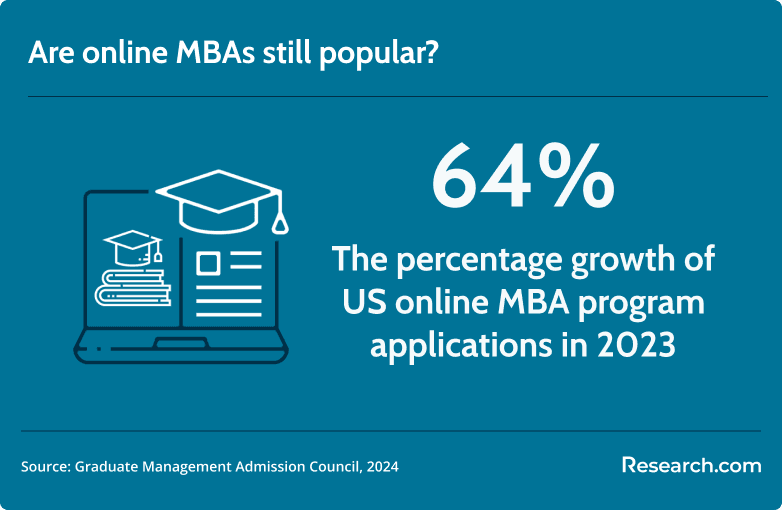
According to the Graduate Management Admission Council (GMAC, 2024a), over half (64%) of online MBA programs in the U.S. reported an increase in applications for the second consecutive year. That suggests online MBA demand remains meaningful among graduate business applicants.
If you are comparing formats, look beyond convenience. Ask whether the online program includes live networking, career coaching, employer engagement, group projects, and faculty access. If you are considering broader options, compare sustainability programs with other online MBA programs to understand cost and format differences.
What is the average cost of an online MBA in Sustainability program?
Costs vary substantially by school, accreditation, credit load, residency status, and program format. A Business Because report stated that the average cost of an MBA program in the U.S. was $243,267 in 2024, a 4.4% increase from 2023. That figure is more closely tied to top business schools, while many online MBA in Sustainability programs may fall between $30,000 and $100,000.
Tuition is only part of the total cost. Students should also review application fees, technology fees, graduation fees, books, software, residencies, travel requirements, global immersion trips, and any required in-person sessions. Some schools charge online students the same rate regardless of residency, while others use in-state and out-of-state pricing. To benchmark broader expenses, compare the average cost of MBA online programs before committing.
| Cost item | Why it matters | Question to ask |
| Tuition per credit or course | This is usually the largest expense. | Is the quoted price per credit, course, semester hour, semester, or full program? |
| Required credits | A lower per-credit price may still lead to a high total cost if the program requires more credits. | How many credits are required to graduate? |
| Residency or travel costs | Low-residency and immersion programs can add transportation, lodging, and meal expenses. | Are any in-person sessions mandatory? |
| Fees | Technology, graduation, and program fees can increase the total price. | What fees are not included in tuition? |
| Opportunity cost | Heavy course loads may reduce work hours or slow career momentum. | Can I keep working while enrolled? |
This chart shows the increasing cost of MBA programs around the world.
What are the financial aid options for students enrolling in an online MBA in Sustainability program?
Financing an online MBA in Sustainability usually requires a mix of school research, employer conversations, scholarship searches, and careful borrowing decisions. Students who want a lower-cost accredited option can also compare the cheapest AACSB online MBA programs.
- Business school scholarships: Many schools award MBA scholarships based on academic performance, leadership potential, professional achievements, financial need, or intended field of study.
- The BCG MBA Fellowship Program: Boston Consulting Group offers this fellowship to support diverse and minority MBA students, including a stipend for living expenses and access to consulting-related career opportunities.
- NBMBAA scholarships: The National Black MBA Association supports African American MBA students at partner schools and provides financial assistance through the Steven Skinner Endowed Scholarship Fund.
- Employer tuition assistance: Some employers reimburse or sponsor graduate education, especially when the degree is relevant to the employee’s current or future role.
- Work-study arrangements: Some students combine part-time work with online study to reduce reliance on loans while gaining experience.
- Student loans: Federal and private loans may help cover tuition and related expenses, but repayment terms, interest rates, and long-term debt should be reviewed carefully.
Ways to reduce the total cost
- Ask whether transfer credits, prior graduate credits, or waived foundation courses can lower the number of credits you must complete.
- Compare total program cost, not just cost per credit.
- Prioritize accredited programs that fit your goals instead of choosing solely by name recognition.
- Confirm whether online students qualify for the same scholarships as campus students.
- Use employer tuition benefits before borrowing if your company offers reimbursement.
What are the prerequisites for enrolling in an online MBA in Sustainability program?
Admissions requirements differ by institution, but most online MBA in Sustainability programs expect applicants to show readiness for graduate business coursework and the ability to contribute professionally to class discussions. Applicants may come from business, science, engineering, public policy, nonprofit, healthcare, energy, consulting, or other fields.
- Bachelor’s degree: Applicants generally need a bachelor’s degree from an accredited institution. The major may be flexible, although business, environmental science, economics, public administration, or related backgrounds may be helpful.
- Professional experience: Many online MBA programs prefer or require two to five years of work experience, especially because students often apply course concepts to workplace problems.
- Minimum GPA: Programs often look for a GPA around 3.0 on a 4.0 scale, although strong work experience, leadership, or other application strengths may help offset a lower GPA at some schools.
- GMAT or GRE scores: Some schools still request test scores, while others waive or eliminate the requirement based on experience, academic history, or program policy.
- Prerequisite courses: Students may need prior coursework in accounting, economics, math, or statistics. Some schools offer bridge or foundation courses for applicants without this preparation.
- Personal statement or essay: Applicants usually explain why they want an MBA in Sustainability, what career outcomes they seek, and how the program fits their goals.
- Letters of recommendation: Programs often request two to three recommendations from supervisors, professors, or professional colleagues who can speak to leadership potential and graduate readiness.
- Computer proficiency: Because coursework is online, students should be comfortable with spreadsheets, presentations, word processing, video meetings, learning platforms, and collaborative tools.
International applicants may also need English proficiency documentation and credential evaluation. Before applying, confirm whether the program requires business foundation courses, live attendance, residency participation, or specific technology standards.
What courses are typically in an online MBA in Sustainability program?
An online MBA in Sustainability usually includes the same core business subjects found in a traditional MBA, with added attention to environmental strategy, compliance, ESG, sustainable innovation, and responsible leadership. The best programs help students understand how sustainability affects decision-making across finance, operations, marketing, law, and analytics.
- Organizational Behavior and Ethical Leadership: Students examine leadership, culture, team dynamics, ethics, and organizational change in settings where sustainability goals must be implemented across departments.
- Managerial Decision-Making: This course develops structured approaches to business decisions that weigh financial, environmental, social, and risk-related outcomes.
- Data Analytics: Students learn how to interpret data, identify performance trends, measure sustainability indicators, and support evidence-based management decisions.
- Global Sustainability and Strategic Advantage: Coursework explores how sustainability can influence competitive positioning, market risk, resource constraints, climate concerns, and long-term strategy.
- Environmental Law: Students study legal and regulatory frameworks that affect environmental responsibility, compliance, reporting, and business operations.
- Financial Analysis: This course covers financial statements, budgeting, forecasting, ratios, investment evaluation, and cost-benefit analysis, including sustainability-related considerations.
- Global Marketing Management: Students learn how to develop marketing strategies for products, services, and brands that communicate environmental, social, and economic value.
A GMAC survey (2024b) found that sustainability matters to many MBA candidates. Among global regions, 50% of Eastern European candidates and 41% of Canadian applicants are unlikely to consider a school that does not prioritize sustainability, treating it as a dealbreaker.
This chart shows the percentage of MBA candidates who consider sustainability a dealbreaker when choosing a business school.
What types of specializations are available in online MBA in Sustainability programs?
Specializations allow students to align an MBA with specific sustainability career goals. Some programs offer a formal concentration, while others provide electives, certificates, or project tracks.
- Sustainable Business Strategy: Focuses on integrating sustainability into competitive strategy, long-term planning, risk management, and business model design.
- Environmental Management: Covers resource use, waste reduction, pollution prevention, energy efficiency, and practical ways organizations reduce environmental impact.
- Innovation Management: Emphasizes new products, technologies, services, and processes that support sustainability-focused business growth.
- Climate Change and Leadership: Connects climate science, mitigation, adaptation, policy, and executive leadership responsibilities.
- Social Entrepreneurship: Prepares students to build or lead ventures designed to address social and environmental problems while remaining financially sustainable.
- Sustainable Investing and Consulting: Examines ESG analysis, responsible investment, risk assessment, impact measurement, and advisory work.
Students comparing sustainability tracks with other MBA specializations should think about which labor market they want to enter. Sustainability is broad, so a student interested in renewable energy may need different electives than someone targeting ESG finance, nonprofit leadership, or sustainable supply chains.
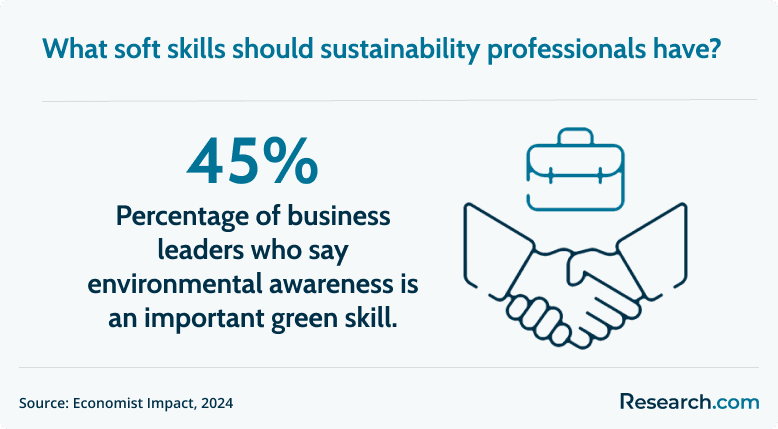
An Economist Impact report (2024) highlighted the importance of soft skills as companies make the green transition. The report identified environmental awareness (45% of business leaders), innovation and creativity (37%), problem-solving (31%), adaptability (31%), teamwork and collaboration (30%), systems analysis (28%), communication and influencing (27%), and entrepreneurship (23%).
That means the strongest candidates are not only familiar with sustainability frameworks. They can also influence teams, analyze complex systems, communicate trade-offs, and turn strategy into operational change.
What is the long-term return on investment of an online MBA in Sustainability?
The ROI of an online MBA in Sustainability depends on more than salary after graduation. You should compare tuition, fees, time away from work, debt, employer support, promotion potential, role change, and the strength of the school’s network. The degree is most likely to pay off when it helps you move into a higher-responsibility role, pivot into a growing sustainability field, or qualify for leadership opportunities that were previously out of reach.
Before enrolling, ask whether the program gives you practical evidence of skill: consulting projects, capstones, analytics work, ESG reporting experience, regulatory case studies, or industry partnerships. If you are still deciding whether graduate business school is the right investment, review the broader question of whether an MBA is worth it for your goals.
Is an Executive-Focused Approach Essential in an Online MBA in Sustainability?
An executive-focused approach is not mandatory, but it can be valuable for experienced professionals who want senior leadership roles. Sustainability leaders often need to persuade executives, boards, investors, employees, suppliers, regulators, and community stakeholders. Courses in governance, executive communication, innovation, negotiation, and enterprise strategy can be especially useful for these responsibilities.
If you already manage teams or hold a senior role, comparing sustainability MBA options with an online executive MBA may help you decide whether you need a traditional MBA structure or a program built around executive-level leadership development.
How does accreditation enhance the quality of online MBA in Sustainability programs?
Accreditation helps students evaluate whether a business school or institution meets recognized academic standards. For MBA students, programmatic business accreditation from organizations such as AACSB, ACBSP, or IACBE can signal that the curriculum, faculty qualifications, student outcomes, and institutional processes are reviewed against external benchmarks. Institutional accreditation also matters for transfer credit, employer recognition, and access to certain types of financial aid.
Accreditation does not guarantee a job or a salary, and it should not be the only selection factor. However, choosing an unaccredited or poorly recognized program can create problems if you later pursue another degree, apply for tuition reimbursement, or seek roles with employers that screen for accredited graduate credentials. Students looking for flexible options should still verify accreditation even when reviewing the easiest MBA program online.
Is a Doctoral Degree in Sustainability a Viable Next Step?
A doctoral degree may make sense if your goal is applied research, university teaching, high-level consulting, policy work, or executive strategy grounded in original research. A DBA in Sustainability is generally more practice-oriented, while a PhD path is often more research-intensive. Most MBA graduates do not need a doctorate for corporate sustainability roles, but it can be useful for professionals who want to become subject-matter authorities or lead complex research-based initiatives.
If you are comparing advanced business credentials after the MBA, you can explore affordable online DBA programs and examine whether doctoral study aligns with your career timeline, research interests, and financial plan.
What are the emerging trends shaping online MBA in Sustainability programs?
Online MBA in Sustainability curricula are evolving as employers expect sustainability professionals to work with data, regulation, supply chains, technology, and stakeholder pressure. Programs increasingly emphasize ESG measurement, circular economy models, sustainable supply chain management, climate risk, renewable energy strategy, and analytics. Many also use virtual collaboration tools and live case studies to help students practice remote teamwork, which reflects how many modern organizations operate.
Leadership is also becoming more important. Sustainability work often fails when it remains isolated in a single department. Professionals who understand change management, organizational culture, and executive decision-making may be better positioned to move sustainability from reporting into business strategy. Students who want a deeper leadership research path may also compare MBA study with a PhD in leadership online.
Can I Complete an Online MBA in Sustainability Program Through an Accelerated Format?
Yes, some online MBA in Sustainability programs offer accelerated formats. These programs compress coursework into shorter terms, heavier course loads, or year-round enrollment. They can be useful if you want to finish quickly, reduce time in school, or use a degree for an upcoming promotion or career transition.
The trade-off is intensity. Accelerated students need strong time management, reliable weekly study hours, and comfort with independent learning. Before choosing this format, compare assignment expectations, live-session requirements, group project demands, and capstone timelines. If speed is a priority, it may also help to compare this route with an accelerated business degree online.
Do online MBA in Sustainability programs offer extensive student support and networking opportunities?
Many online MBA programs provide support services, but the quality varies. Strong programs usually offer academic advising, technical support, career coaching, virtual mentoring, alumni access, student organizations, webinars, employer events, and structured group work. These services matter because online students must be more intentional about building relationships than campus students.
When evaluating a school, ask how often students interact live with faculty, whether career services work with online learners, and whether alumni networking is active in sustainability-related fields. Students who need a shorter path should compare support services carefully when reviewing fast track MBA programs, because compressed timelines can leave less room for informal networking.
How do tuition costs and ROI of an online MBA in Sustainability compare to specialized MBA programs?
An online MBA in Sustainability is one type of specialized MBA. It should be compared with other concentrations based on your target industry, expected career path, tuition, employer demand, and opportunity cost. For example, sustainability may be the better fit for renewable energy, ESG, compliance, supply chain, consulting, and CSR careers. Healthcare management, finance, analytics, or technology management may be better choices for students targeting those sectors directly.
Cost-effectiveness depends on fit. A lower-cost program with weak career alignment may be less valuable than a more expensive program with strong employer connections in your intended field. Students exploring industry-specific alternatives can compare sustainability programs with the best affordable online MBA healthcare management options to understand how tuition and career outcomes differ by specialization.
Should I pursue additional specialized credentials alongside an online MBA in Sustainability?
Additional credentials can help if they add targeted skills that your MBA does not fully cover. Useful add-ons may include ESG reporting, project management, data analytics, supply chain management, environmental compliance, energy management, or industry-specific certificates. The right credential depends on the role you want.
Be cautious about stacking unrelated credentials. A healthcare-focused doctorate, for example, is not a general substitute for sustainability training. However, professionals working where sustainability intersects with healthcare, pharmaceuticals, or environmental health may benefit from understanding specialized pathways such as online accelerated PharmD programs, especially if their goals involve healthcare operations, pharmaceutical systems, or environmentally responsible health-sector leadership.
How Can Interdisciplinary Expertise Amplify Your Career Prospects After an Online MBA in Sustainability?
Sustainability problems rarely belong to one discipline. A supply chain emissions issue may involve procurement, finance, data systems, law, vendor relationships, and consumer communication. A renewable energy strategy may require operations knowledge, policy awareness, capital budgeting, and stakeholder management. For this reason, professionals who combine sustainability with finance, technology, healthcare, engineering, analytics, or public policy may have more ways to create value.
Interdisciplinary comparison can also prevent poor degree choices. If you are deciding between sustainability leadership and another sector, review career outcomes in adjacent fields before enrolling. For example, comparing sustainability paths with the best paying medical jobs with bachelor's degree can clarify whether you want a business sustainability role, a healthcare career, or a hybrid path.
What challenges might I face in an online MBA in Sustainability program?
Online MBA students often underestimate the discipline required. Flexibility helps, but it also means you must manage deadlines, group projects, reading, quantitative assignments, and live sessions without the daily structure of campus attendance. Sustainability coursework can also be complex because it blends business strategy with law, data, science, ethics, and public policy.
| Common challenge | Why it happens | Better approach |
| Falling behind in asynchronous courses | No fixed classroom schedule can make coursework easy to postpone. | Block recurring study times each week before the term begins. |
| Weak networking | Online students may not meet classmates or faculty casually. | Attend live sessions, join groups, contact alumni, and use career services early. |
| Choosing by tuition alone | The cheapest program may lack the right accreditation, support, or sustainability depth. | Compare total value, not just price. |
| Assuming the MBA is technical training | MBA programs focus on management, not engineering or environmental science licensure. | Choose electives or additional credentials if you need technical depth. |
| Ignoring career fit | Sustainability is broad, and roles vary across ESG, compliance, operations, energy, and consulting. | Match courses and projects to a specific career direction. |
Students interested in healthcare, environmental management, or pharmaceutical sustainability should compare degree requirements carefully. A specialized option such as low cost online pharm D programs may serve a very different purpose than an MBA in Sustainability.
How to choose the best online MBA in Sustainability program?
The best online MBA in Sustainability is the program that fits your career goal, budget, schedule, learning style, and desired industry—not simply the program with the most recognizable name. Use a decision process that compares outcomes and trade-offs.
- Check accreditation first: Look for recognized institutional accreditation and, when possible, business accreditation such as AACSB, ACBSP, or IACBE.
- Match the curriculum to your target role: ESG, renewable energy, consulting, compliance, nonprofit leadership, and sustainable supply chain roles may require different electives and projects.
- Review applied learning: Prioritize programs with consulting projects, capstones, simulations, internships, or employer partnerships.
- Evaluate faculty expertise: Look for instructors with sustainability research, consulting, corporate, policy, energy, or compliance experience.
- Compare schedule flexibility: Decide whether you need asynchronous coursework, part-time study, accelerated terms, or limited residency requirements.
- Assess student support: Confirm that online students receive advising, technical help, career counseling, library access, and networking support.
- Calculate total cost: Include tuition, fees, books, technology, travel, residencies, and lost work time if applicable.
- Ask about career outcomes: Request information on alumni roles, employer connections, internship options, and career coaching for sustainability-focused students.
Questions to ask before enrolling
- Is the program accredited by a recognized institutional accreditor and, if applicable, a business accreditor?
- Does the sustainability concentration include ESG, compliance, analytics, climate risk, energy, or supply chain coursework relevant to my goals?
- Are online students eligible for the same scholarships and career services as campus students?
- How many hours per week do students typically spend on coursework?
- Are there live class meetings, residencies, travel requirements, or group projects?
- Can I speak with alumni working in sustainability roles?
- What is the full program cost after fees?
- Will my employer reimburse any portion of the degree?
What career paths are available for graduates of online MBA in Sustainability programs?
Graduates can pursue many sustainability careers, especially when they combine the MBA with relevant experience, technical literacy, project results, and industry knowledge. The roles below include salary data from the BLS, ONET OnLine, PayScale, and ZipRecruiter.
- Chief Sustainability Officers ($206,680): CSOs lead organization-wide sustainability strategy, set priorities, guide implementation, and connect environmental goals with business performance.
- Corporate Social Responsibility Directors ($142,940): CSR directors manage programs related to ethical business practices, environmental stewardship, community impact, and corporate accountability.
- Environmental Policy Advisors ($131,098): These professionals advise government agencies, nonprofits, or companies on policies that support sustainability and environmental compliance.
- Industrial Operations Managers ($125,900): Operations managers oversee production and process efficiency while reducing waste, improving resource use, and maintaining compliance.
- Sustainability Managers ($92,800): Sustainability managers coordinate strategies, reporting, resource-efficiency initiatives, internal programs, and compliance efforts.
- Social and Community Service Managers ($83,400): These managers lead programs addressing community needs, social well-being, housing, education, poverty, and related public-service priorities.
- Environmental, Social, and Governance Analysts ($82,640): ESG analysts evaluate company practices, risks, disclosures, and performance for investors, internal leaders, or external stakeholders.
- Environmental Compliance Specialists ($70,083): Compliance specialists monitor adherence to environmental laws, conduct audits, assess risks, and help organizations reduce environmental harm.
- Sustainable Investment Analysts ($70,835): These analysts evaluate investment opportunities in companies or funds that prioritize sustainability, ethics, and environmental responsibility.
This chart illustrates the wage differences among sustainability jobs.
What is the job market for graduates with an online MBA in Sustainability degree?
The job market for sustainability-focused business professionals is shaped by climate goals, regulation, investor pressure, supply chain risk, energy transition, consumer expectations, and corporate reporting demands. Graduates with an MBA in Sustainability may be especially competitive when they can translate sustainability goals into financial, operational, and strategic decisions.
According to BLS and ONET OnLine data, the following occupations are expected to see notable employment growth from 2023 to 2033:
- Transportation, Storage, and Distribution Managers: 9%
- Environmental Specialists: 7%
- Chief Sustainability Officers: 6% to 8%
- General and Operations Managers: 5.8%
- Sustainability Specialists: 3% to 5%
A LinkedIn report (2024) found that green jobs and skills are projected to have a hiring rate 54.6% higher than the broader workforce. LinkedIn also reported in 2023 that the green talent pool is predominantly male and that women must enter the field at a rate 2.5 times higher than they do now to close the gap.
Industries that may value sustainability MBA graduates include renewable energy, transportation, technology, environmental consulting, sustainable agriculture, corporate social responsibility, manufacturing, government, and nonprofit organizations. The strongest candidates typically demonstrate both business fluency and practical sustainability skills, such as ESG reporting, carbon accounting literacy, supply chain analysis, compliance knowledge, stakeholder engagement, and project leadership.
Here’s What Graduates Have to Say About Their MBA in Sustainability Degree
- “I selected the online MBA in Sustainability because it matched both my professional goals and the schedule I needed. Being able to complete coursework around my job was important, and the classes consistently connected business decisions to current sustainability problems. Working with classmates who cared about similar issues made the experience more meaningful. I was able to apply new strategies at work right away, and the program helped me feel prepared to pursue sustainability-focused leadership.” - Yvanna
- “The online MBA in Sustainability gave me a way to study environmental business practices without leaving my full-time role. The coursework was demanding, but it related directly to issues I was already seeing in my organization. The flexible pace helped me manage school and work, and the professional connections I built were valuable. The program strengthened my ability to lead sustainability initiatives and opened new career possibilities.” - Kole
- “Earning an online MBA in Sustainability helped me move my interest in sustainability into a more strategic career direction. I could balance my studies with my job, and the material was useful in areas such as corporate social responsibility and sustainable leadership. I also built a network of professionals with similar goals. The degree gave me practical tools to take on more meaningful sustainability work.” - Steven
Common mistakes to avoid when choosing an online MBA in Sustainability
- Choosing without checking accreditation: Always verify institutional and business accreditation before applying.
- Looking only at tuition: A low advertised price may exclude fees, residencies, travel, books, and technology costs.
- Assuming every sustainability MBA teaches the same content: Some programs focus on compliance, while others emphasize ESG, energy, social enterprise, consulting, or strategy.
- Overlooking career services: Online students need strong career support, alumni access, and networking opportunities.
- Expecting guaranteed salary growth: Salary depends on experience, role, location, employer, and performance, not just the degree.
- Ignoring time demands: Even flexible online programs require consistent weekly study, group work, writing, and quantitative analysis.
- Choosing a program that does not match your target industry: A renewable energy career may call for different electives than ESG investing or nonprofit management.
Key Insights
- An online MBA in Sustainability is best for professionals who want business leadership roles connected to ESG, environmental compliance, renewable energy, CSR, sustainable operations, consulting, or responsible investment.
- Most programs take 18 to 36 months, while accelerated options may shorten completion to 12 to 16 months for students who can manage a heavier workload.
- Costs vary widely. A Business Because report stated that the average cost of an MBA program in the U.S. was $243,267 in 2024, a 4.4% increase from 2023, but many online MBA in Sustainability programs may cost between $30,000 and $100,000.
- Salary outcomes are role-dependent. Reported figures include $98,000 for MBA in Sustainability graduates, $79,590 for sustainability specialists, $120,217 for sustainability directors, and $206,680 for chief sustainability officers.
- Online MBA demand remains strong: 64% of online MBA programs in the U.S. reported application increases for the second consecutive year.
- Sustainability is increasingly important to MBA candidates, with 50% of Eastern European candidates and 41% of Canadian applicants unlikely to consider a school that does not prioritize sustainability.
- Green skills require more than technical knowledge. Employers also value environmental awareness, innovation, problem-solving, adaptability, teamwork, systems analysis, communication, and entrepreneurship.
- The best program choice depends on accreditation, curriculum fit, applied learning, faculty expertise, networking, student support, total cost, and alignment with a specific career path.
References:
- Graduate Management Admission Council. (2024a, October). Application Trends Survey. https://www.gmac.com/market-intelligence-and-research/research-library/admissions-and-application-trends/2024-application-trends-survey-report
- Graduate Management Admission Council. (2024b, March). Prospective Students Survey. https://www.gmac.com/market-intelligence-and-research/research-library/admissions-and-application-trends/2024-gmac-prospective-students-survey-summary-report
- LinkedIn. (2023). The Green Gender Gap. https://economicgraph.linkedin.com/content/dam/me/economicgraph/en-us/Green-Gender-Gap-Report.pdf
- LinkedIn. (2024, September). Global Climate Talent Stocktake. https://economicgraph.linkedin.com/content/dam/me/economicgraph/en-us/PDF/linkedIn-global-climate-talent-stocktake-sept-2024.pdf
- ONET OnLine. (2024a, December 4). Chief Sustainability Officers. Retrieved January 29, 2025, from https://www.onetonline.org/link/summary/11-1011.03
- ONET OnLine. (2024b, December 4). Sustainability Specialists. Retrieved January 29, 2025, from https://www.onetonline.org/link/summary/13-1199.05
- U.S. Bureau of Labor Statistics. (2024a, April 3). Occupational Employment and Wages, May 2023 - Environmental Scientists and Specialists, Including Health. Occupational Outlook Handbook. https://www.bls.gov/oes/current/oes192041.htm
- U.S. Bureau of Labor Statistics. (2024b, August 29). Occupational projections, 2023–33, and worker characteristics, 2023 (Numbers in thousands). Employment Projections. https://www.bls.gov/emp/tables/occupational-projections-and-characteristics.htm
Other Things You Should Know About Online MBA in Sustainability Degrees
Most online MBA in sustainability programs end with a capstone consulting project. Students usually work in teams to solve a real business problem, such as reducing emissions or improving ESG reporting, and submit a written report and presentation during the final term.
Most 2027 online MBA in Sustainability programs require entrance exams like the GMAT or GRE. Some programs might offer waivers based on professional experience or prior academic achievements. Verify specific requirements with the school's admissions department.
In 2027, online MBA programs in Sustainability often offer specializations like Renewable Energy Management, Sustainable Supply Chain Management, and Corporate Social Responsibility. These specializations prepare students to tackle environmental challenges in specific sectors, enhancing their career prospects in industries committed to sustainability.