2027 Best Online Dual Master's in Counseling Programs

Co-Founder and Chief Data Scientist
Making a major career move feels risky, especially when the economy feels uncertain. It’s a fact that professionals with dual majors face 56% less impact from income shocks than those with a single specialization. This highlights a clear strategy for building a truly resilient career. A dual masters in counseling isn't just about adding another credential; it's a calculated investment in your professional future-proofing.
To help you make the most informed decision, our career planning experts, with over a decade of experience, have developed this comprehensive guide. We'll cover everything from program logistics to the specific, high-value career paths this degree unlocks.
What are the benefits of getting an online dual master’s in counseling program?
- This degree qualifies you for specialized, high-impact roles like clinical director or policy advisor, allowing you to bridge clinical practice with organizational leadership.
- You gain access to higher earning potential, with salaries for advanced roles reaching over $95,000 annually.
- The online format offers the flexibility to earn your credentials from a top-tier institution without having to relocate or put your current career on hold.
What can I expect from an online dual master’s in counseling program?
An online dual masters in counseling program is a significant commitment, typically requiring three to four years of dedicated study. You should expect a curriculum that is just as rigorous and demanding as any on-campus equivalent. The primary difference is the flexible delivery format, not a reduction in academic standards.
The program structure is designed to integrate two distinct academic disciplines. This involves extensive graduate-level coursework covering both fields. You will also be required to complete multiple supervised clinical internships to gain the practical, hands-on experience necessary for licensure.
A key factor in your success will be the quality of the university's support for online students. The best programs have dedicated coordinators who provide robust assistance in securing high-quality internship placements in your local area. This logistical support is a critical component of a well-run online degree.
Where can I work with an online dual master’s in counseling program?
A dual master's degree significantly broadens your career options beyond traditional clinical settings. Your combined expertise makes you a valuable asset in a wide range of industries.
- Private Companies: The largest share of counselors, 55%, work in the private sector, often in roles related to corporate wellness or Employee Assistance Programs (EAPs).
- Healthcare: About 27% of counseling professionals work in healthcare settings, including hospitals, outpatient clinics, and integrated care facilities where interdisciplinary skills are highly valued.
- Non-Profits: Community agencies and advocacy organizations employ 21% of counselors, offering opportunities to make a direct impact on specific populations.
- Education: Roughly 15% of counselors find roles in educational environments, working in K-12 schools or university wellness centers.
- Government: Another 7% of counselors work in the public sector, contributing to public health initiatives and social service agencies at the local, state, or federal level.
How much can I make with an online dual master’s in counseling program?
The average salary for a counselor is about $52,978, but a dual master's degree positions you to earn significantly more. Your ultimate earning potential is influenced by several key factors that unlock access to higher-paying, specialized roles.
- Education Level: Holding an advanced degree provides a significant salary advantage, with average earnings reaching around $95,830.
- Experience: Salaries grow with experience, starting around $53,000 for entry-level professionals and increasing to over $87,000 for those with 20 or more years in the field.
- Industry: Your choice of industry matters, with roles in the education sector averaging approximately $82,651 annually.
- Specialization: Niche roles that require dual expertise command higher salaries. For example, a substance abuse social worker can earn up to $76,266.
- Location: While the national average salary for specialized roles is about $83,804, your earnings can be higher depending on the state where you practice.
- List of the Best Online Dual Master’s in Counseling Programs for 2027 List of Programs
- How long does it take to complete an online dual master’s in counseling program? Completion Time
- How does an online dual master’s in counseling program compare to an on-campus program? How does an online dual master’s in counseling program compare to an on-campus program?
- What is the average cost of an online dual master’s in counseling program? Program Cost
- What are the financial aid options for students enrolling in an online dual master’s in counseling program? Financial Aid
- What are the prerequisites for enrolling in an online dual master’s in counseling program? What are the prerequisites for enrolling in an online dual master’s in counseling program?
- What courses are typically in an online dual master’s in counseling program? What courses are typically in an online dual master’s in counseling program?
- What types of specializations are available in online dual master’s in counseling programs? Specializations
- How to Choose the Best Online Dual Master’s in Counseling Program How to Choose the Best Online Dual Master’s in Counseling Program
- What career paths are available for graduates of an online dual master’s in counseling program? Career Paths
- What is the job market for graduates of an online dual master’s in counseling program? Job Market
- What challenges might I encounter in an online dual master’s in counseling program? What challenges might I encounter in an online dual master’s in counseling program?
Best Online Dual Master’s in Counseling Programs for 2027
Choosing an online dual master’s in counseling is not the same as choosing a standard counseling degree. You are comparing programs that may prepare you for more than one professional pathway, such as clinical mental health counseling, school counseling, marriage and family therapy, pastoral care, addiction counseling, or administrative leadership. That can create more career flexibility, but it also makes accreditation, licensure alignment, field placement support, and total cost much more important.
This guide is for students who want graduate-level counseling preparation without giving up the option to work in schools, agencies, private practice, faith-based settings, community organizations, or interdisciplinary roles. You will learn which programs are available, how online and campus formats compare, what these degrees typically cost, what admissions committees look for, and how to decide whether a dual counseling pathway is worth the time and expense.
Quick Answer: Is an Online Dual Master’s in Counseling Worth Considering?
An online dual master’s in counseling can be a strong choice if you want preparation for two related counseling or helping-profession roles and you are willing to commit to a longer, more intensive graduate program. Most full-time programs take three to four years, often require substantial supervised fieldwork, and may involve state-specific licensure rules. The best option is usually a properly accredited program that clearly matches the credentials you want to pursue in the state where you plan to practice.
| Choose an online dual master’s in counseling if... | Consider a different path if... |
| You want broader eligibility across counseling settings, such as schools and clinical agencies. | You only need one credential and want the shortest route to licensure. |
| You can manage graduate coursework, field placements, and state licensure planning at the same time. | You are not yet sure whether counseling is the right profession for you. |
| You need online flexibility because of work, family, location, or relocation constraints. | Your preferred state board does not recognize the program’s curriculum or fieldwork structure. |
| You want to build a specialized professional identity that combines counseling with education, theology, family therapy, addiction services, or leadership. | You are mainly interested in research psychology rather than applied counseling practice. |
How We Rank Online Dual Master’s in Counseling Programs
Because graduate counseling education can be expensive and licensure-sensitive, our ranking process emphasizes transparent program information, academic quality indicators, affordability, and student decision value. Research.com uses established data sources, including the IPEDS database, Peterson's database, the College Scorecard database, and The National Center for Education Statistics.
These sources help us evaluate schools using consistent institutional and program-level information. For a fuller explanation of how Research.com evaluates programs, see our ranking methodology.
Top Online Dual Master’s in Counseling Programs for 2027
The programs below are designed for students who want counseling preparation across more than one setting, credential, or specialty area. Before applying, confirm with the school and your state licensing board whether the curriculum, practicum, internship hours, and modality meet your specific licensure goals.
| School | Dual Counseling Focus | Program Length | Credits or Units | Listed Cost | Accreditation |
| Colorado Christian University | Mental health and school counseling | 3 years | 75 credits | $698 per credit | Council for Accreditation of Counseling and Related Educational Programs (CACREP) |
| Miami University | Clinical mental health and school counseling | 3 years | 66 credits | $700 per credit | Council for Accreditation of Counseling and Related Educational Programs (CACREP) |
| Boston College | Theology, ministry, and mental health counseling | 36 months | 84 credits | $1,834 per credit | Masters in Psychology and Counseling Accreditation Council (MPCAC) |
| Northern Kentucky University | Clinical mental health and school counseling | 3 years | 72 credits | $647 (in-state); $909 (out-of-state) | Council for Accreditation of Counseling and Related Educational Programs (CACREP) |
| California State University, San Bernardino | School and professional counseling dual concentration | 3 years | 72 units | ~20,700(in−state); 54,000 (out-of-state) | WASC Senior College and University Commission (WSCUC) |
| Lamar University | Counseling and development with Texas school counseling and LPC preparation | 30 months | 60 credits | ~$360 per credit | Association for Advancing Quality in Educator Preparation (AAQEP) |
| Loma Linda University | Counseling, marital and family therapy, and drug and alcohol counseling | 3 years | 121 quarter units | $862 per quarter unit | Commission on Accreditation for Marriage and Family Therapy Education (COAMFTE); California Board of Behavioral Sciences (BBS) |
| Walden University | Clinical mental health counseling and school counseling | 45 months | 111 quarter credits | $535 per quarter hour | Council for Accreditation of Counseling and Related Educational Programs (CACREP) |
1. Colorado Christian University - Dual Master’s Degree in Mental Health & School Counseling
Colorado Christian University offers a dual counseling pathway that combines mental health counseling and school counseling preparation in one structured plan of study. The program is built around a faith-informed counseling perspective and may appeal to students who want to work with clients in schools, community agencies, or clinical practice settings.
- Program Length: 3 years
- Required Credits to Graduate: 75
- Cost per Credit: $698
- Accreditation: Council for Accreditation of Counseling and Related Educational Programs (CACREP)
2. Miami University - Master's in Clinical Mental Health and School Counseling
Miami University offers a dual-specialty graduate counseling program for students seeking preparation in both clinical mental health counseling and school counseling. The program is Ohio-focused and includes 1,300 hours of field placement, making it important for applicants to confirm how the experience aligns with their preferred state credentialing requirements.
- Program Length: 3 years
- Required Credits to Graduate: 66
- Cost per Credit: $700
- Accreditation: Council for Accreditation of Counseling and Related Educational Programs (CACREP)
3. Boston College - Dual Master of Arts in Theology and Ministry and Mental Health Counseling
Boston College provides a dual M.A. option that brings together theological formation, ministry preparation, and clinical mental health counseling. This program is best suited for students who want to work at the intersection of spirituality, pastoral care, and mental health practice while pursuing a licensure-oriented counseling track.
- Program Length: 36 months
- Required Credits to Graduate: 84
- Cost per Credit: $1,834
- Accreditation: Masters in Psychology and Counseling Accreditation Council (MPCAC)
4. Northern Kentucky University - Dual Degree in Counseling: Clinical Mental Health and School Counseling
Northern Kentucky University combines Master of Science and Master of Arts counseling preparation for students interested in both clinical mental health and K-12 school counseling roles. The structure is designed for students who want broader practice options across community and educational environments.
- Program Length: 3 years
- Required Credits to Graduate: 72
- Cost per Credit: $647 (in-state); $909 (out-of-state)
- Accreditation: Council for Accreditation of Counseling and Related Educational Programs (CACREP)
5. California State University, San Bernardino - MS Counseling: School and Professional Dual Concentration
California State University, San Bernardino offers a cohort-based MS Counseling track with school and professional counseling concentrations. The program is designed around California credentialing pathways, including LPCC and PPS School Counseling preparation, so applicants outside California should verify transferability before enrolling.
- Program Length: 3 years
- Required Units to Graduate: 72
- Total Estimated Tuition: ~20,700(in−state); 54,000 (out-of-state)
- Accreditation: WASC Senior College and University Commission (WSCUC)
6. Lamar University - Master's in Counseling and Development
Lamar University offers a 100% online counseling and development program that is structured to meet coursework requirements for the Texas School Counseling Certification and the Licensed Professional Counselor credential. Its accelerated format may appeal to students who want an online route with a defined Texas credentialing focus.
- Program Length: 30 months
- Required Credits to Graduate: 60
- Cost per Credit: ~$360
- Accreditation: Association for Advancing Quality in Educator Preparation (AAQEP)
7. Loma Linda University - MS in Counseling and Marital and Family Therapy with Drug and Alcohol Counseling
Loma Linda University offers an intensive online option that combines counseling, marital and family therapy, and drug and alcohol counseling preparation. The program may fit students who want a broader behavioral health profile that includes LPCC, MFT, and addiction-focused preparation.
- Program Length: 3 years
- Required Quarter Units to Graduate: 121
- Cost per Quarter Unit: $862
- Accreditation: Commission on Accreditation for Marriage and Family Therapy Education (COAMFTE); California Board of Behavioral Sciences (BBS)
8. Walden University - MS Dual Degree in Clinical Mental Health Counseling and School Counseling
Walden University offers an online dual degree for students seeking academic preparation in clinical mental health counseling and school counseling. The curriculum includes skills simulations and specialization options, which can help students shape their studies around specific client populations or professional interests.
- Program Length: 45 months
- Required Quarter Credits to Graduate: 111
- Cost per Quarter Hour: $535
- Accreditation: Council for Accreditation of Counseling and Related Educational Programs (CACREP)
How Long Does an Online Dual Master’s in Counseling Take?
Most full-time online dual master’s in counseling programs require three to four years. The timeline is longer than many single-focus master’s programs because students must complete coursework across two areas and usually need supervised practicum or internship experiences that meet credentialing standards. Some integrated degrees shorten the path by allowing shared credits, while part-time enrollment can extend the calendar for students balancing school with work or caregiving.
The time commitment should be evaluated against your career stage and credential goals. The average age for a professional counselor is 44, which suggests that graduate counseling education is often pursued by people who are already established in another career or who are making a planned professional transition.
How to Think About Speed Versus Licensure Readiness
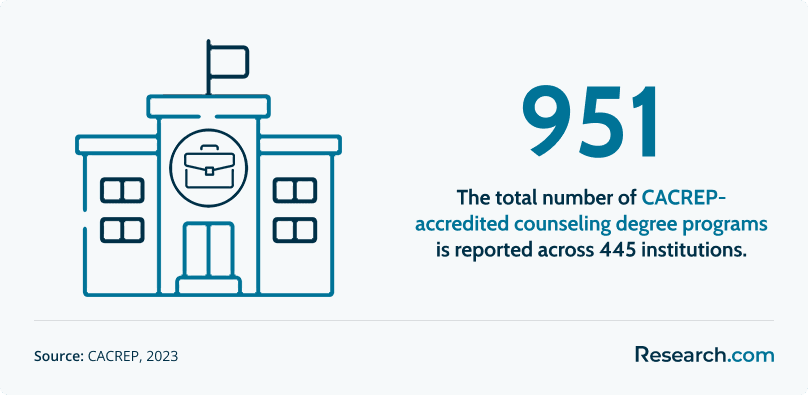
A faster program is not always the better program. Counseling licensure depends on specific coursework, supervised experience, and state board requirements. If you need a shorter route focused on school counseling alone, compare dual programs with accelerated online school counseling master's programs. With over 951 accredited counseling programs available, students have many options, but the right choice is the one that meets the credential requirements for the role and state they actually plan to enter.
| Enrollment Pattern | Typical Fit | Main Trade-Off |
| Full-time dual program | Students who can devote substantial weekly time to coursework and fieldwork | Faster completion, but heavier workload |
| Part-time dual program | Working adults, parents, and career changers who need flexibility | More manageable schedule, but longer time to graduate |
| Accelerated single-focus counseling program | Students who only need one counseling credential | Shorter path, but less cross-specialty preparation |
| Campus-based dual program | Students who prefer in-person structure and local networking | Less geographic flexibility |
Online Versus On-Campus Dual Master’s in Counseling Programs
Accredited online and campus-based counseling programs can cover the same professional competencies, but they differ in delivery, scheduling, networking, and placement logistics. The most important question is not whether online learning is legitimate; it is whether the specific online program is accredited, state-aligned, and able to support your field placement needs.
When an Online Dual Master’s Makes Sense
Online programs are often best for students who cannot relocate, need to keep working, or want access to a specialized program outside their immediate area. Online graduate education is now common, with 39% of graduate students enrolled in fully online courses. Career advancement is also a major driver, as 21% of online students enroll specifically for career growth.
- Best for: Working professionals, military-connected students, rural students, caregivers, and students who need scheduling flexibility.
- Watch for: Local internship availability, synchronous class times, residency requirements, and state licensure limitations.
- Ask before applying: “Will the school help me secure approved field placements near where I live?”
When an On-Campus Program May Be Better
On-campus dual counseling programs can provide face-to-face mentoring, predictable meeting times, peer connection, and easier access to campus-based clinics or school partnerships. Students who learn best through in-person discussion and immediate feedback may find this format more supportive.
Campus resources can also matter for students with family responsibilities. Some colleges with daycare on campus may make graduate study more realistic for parents who want in-person instruction while managing childcare needs.
| Factor | Online Program | On-Campus Program |
| Flexibility | Usually stronger for working adults and students outside commuting distance | Often less flexible but more structured |
| Networking | Requires intentional effort through virtual groups, residencies, and field sites | More natural in-person contact with faculty and peers |
| Fieldwork | May require students to identify or coordinate local placements | Often tied to regional school, clinic, or agency partners |
| Licensure planning | Requires careful state-by-state verification | Often most aligned with the school’s home state |
| Learning style | Best for self-directed students comfortable with digital platforms | Best for students who want routine, live interaction, and campus services |
What Is the Average Cost of an Online Dual Master’s in Counseling?
The average total tuition for a dual masters in counseling program is typically between $62,510 and $69,030. Actual costs can differ significantly based on public versus private status, residency, credit requirements, online fees, clinical placement costs, travel requirements, and whether the program charges by semester, credit, quarter hour, or unit.
Do not evaluate cost by tuition alone. A lower per-credit price can become less affordable if the program requires more credits, unpaid fieldwork during work hours, travel to campus, or extra fees. A more expensive program may be a better investment if it has strong licensure alignment, placement support, and a clear record of preparing graduates for the roles you want.
Some students also compare adjacent credentials outside counseling when planning a broader career strategy. For example, criminal justice certificate programs may be relevant for professionals interested in victim advocacy, corrections counseling, forensic settings, or justice-adjacent human services roles. However, certificates should not be treated as substitutes for state-required counseling education or supervised clinical hours.
Salary outcomes vary by location, license, employer, specialization, and experience. The chart below includes roles such as substance abuse social worker, where salaries can reach around $76,266, but no degree can guarantee a specific salary.
Financial Aid Options for Online Dual Master’s in Counseling Students
Graduate counseling students may be able to combine several funding sources, including federal aid, scholarships, employer benefits, assistantships, and payment plans. Because dual programs are longer than many single master’s programs, it is especially important to estimate total borrowing before enrolling.
- Federal Grants: Grants do not have to be repaid, but graduate grant availability is more limited than undergraduate aid. Currently, 6.40 million students receive this type of aid.
- Federal Student Loans: Federal loans are a common graduate-school funding source. 31.4% of students at public universities receive federal loans to help pay for education costs.
- Scholarships: Universities, counseling associations, community foundations, and private organizations may offer scholarships based on merit, need, identity, service commitment, or professional goals.
- Graduate Assistantships: Some institutions offer teaching, research, advising, or administrative roles that may include a stipend or tuition support.
- Employer Tuition Assistance: Students already working in schools, healthcare, nonprofits, or human services should ask whether their employer reimburses approved graduate coursework.
How to Compare the True Cost of Programs
| Cost Item | Why It Matters | Question to Ask |
| Tuition per credit or unit | Advertised prices can be hard to compare when programs use different credit systems. | “What is the total estimated tuition through graduation?” |
| Fees | Technology, clinical, student services, and graduation fees can add to the bill. | “Which fees are mandatory for online students?” |
| Field placement expenses | Internship schedules may reduce paid work hours or require travel. | “Are placements paid, unpaid, remote, local, or school-arranged?” |
| Residency or campus visits | Some online programs include in-person intensives. | “Will I need to travel, and how often?” |
| Licensure exam and post-degree supervision | Graduation is not always the final step before independent practice. | “What costs should I expect after the degree?” |
Admissions Requirements for Online Dual Master’s in Counseling Programs
Most online dual master’s in counseling programs require a bachelor’s degree from an accredited institution, a minimum GPA, recommendations, and a statement explaining why the applicant is prepared for graduate counseling study. Some programs may also require interviews, prerequisite coursework, background checks, or proof of relevant work or volunteer experience.
Students comparing mission-driven or historically supportive online learning environments may also review top HBCU online programs as part of a broader graduate-school search, especially if community, affordability, and student support are priorities.
- Bachelor's Degree: A four-year degree is usually required, but the major may not have to be psychology, counseling, education, or social work.
- Minimum GPA: Many programs prefer a GPA of 3.0 or higher, though some may consider applicants with strong professional backgrounds through provisional or conditional admission.
- Statement of Purpose: Applicants should explain why a dual program is necessary for their goals, not simply why they want to help people.
- Letters of Recommendation: Programs commonly request two to three references from professors, supervisors, or professionals who can evaluate graduate readiness.
- Relevant Experience: Experience in education, social services, healthcare, ministry, crisis work, youth development, or advocacy can strengthen an application.
The statement of purpose is especially important for dual-degree applicants because admissions committees want to see a coherent plan. For example, an applicant with classroom experience might explain how a masters in educational counseling online could help them connect student mental health support with school-based systems and family collaboration.
Courses Commonly Found in an Online Dual Master’s in Counseling
Dual counseling programs usually combine core counseling courses with specialized coursework from the second discipline. The counseling foundation is often shaped by accreditation expectations and state licensure requirements, while the second area may focus on school systems, theology, marriage and family therapy, addiction treatment, leadership, or another professional domain.
Licensure rules can also affect where your degree is most useful. If you may move after graduation, review LPC state reciprocity early so you understand how professional counselor licenses may or may not transfer across states.
- Counseling Theory & Practice: Students study major counseling approaches and learn how different theories inform client assessment, treatment planning, and intervention.
- Professional Ethics and Law: Coursework covers confidentiality, informed consent, mandated reporting, scope of practice, documentation, and ethical decision-making.
- Research Methods: Students learn to read clinical research, evaluate evidence, and apply evidence-informed practices responsibly.
- Human Growth and Development: This area examines cognitive, emotional, social, and psychological development across the lifespan.
- Supervised Practicum/Internship: Students complete hands-on clinical or school-based experience under qualified supervision.
Clinical Foundation Courses Matter Even in Dual Programs
The counseling core is what prepares students for ethical client work, regardless of specialization. Similar foundations appear in many online master's programs clinical mental health counseling, because professional practice requires shared competencies in assessment, ethics, cultural responsiveness, documentation, and supervised counseling skills.
Common Dual Master’s in Counseling Specializations
The best dual degree pairings combine two fields that strengthen each other. A dual pathway should not just add credits; it should help you qualify for a specific professional role or serve a population more effectively.
| Dual Pathway | Best For | Potential Caution |
| Counseling and Social Work (LPC/LCSW) | Students interested in therapy, case management, advocacy, systems navigation, and community services | Licensure requirements for LPC and LCSW are separate and state-specific. |
| Counseling and Education | Students who want school counseling, student support, college advising, or education leadership roles | School counseling credentials may require state-specific coursework and field placements. |
| Counseling and Public Administration | Future nonprofit, agency, or government leaders who need clinical insight and management skills | This path may not add a second clinical license. |
| Counseling and Art Therapy | Clinicians who want to integrate creative or expressive approaches into therapeutic work | Art therapy credentials may have separate requirements. |
| Counseling and Business (MBA) | Students interested in private practice ownership, behavioral health startups, or healthcare leadership | The business component may not reduce clinical supervision requirements. |
Counseling Versus Counseling Psychology
Counseling degrees are usually applied, practice-oriented, and built for direct client service. Psychology programs may place more emphasis on research, assessment, or academic study depending on the degree level and program design. If your main interest is psychological research rather than counseling practice, compare these programs with an online counseling psychology degree before committing to a licensure-focused counseling route.
How to Choose the Best Online Dual Master’s in Counseling Program
The best online dual master’s in counseling program is the one that matches your intended license, state, population, schedule, budget, and career goal. Rankings can help you build a shortlist, but they should not replace licensure verification or a careful review of field placement requirements.
- Check Accreditation First: Verify whether the counseling component is CACREP-accredited or otherwise recognized for your intended license, and confirm whether the second discipline has its own relevant accreditation.
- Confirm State Licensure Alignment: Ask the program to identify which state requirements it is designed to meet and whether it has determined eligibility in your state.
- Evaluate Field Placement Support: Online students should know whether the school finds sites, approves student-found sites, or leaves most placement work to the student.
- Review Faculty Expertise: Faculty with experience in your target area can shape your mentorship, research interests, internship choices, and professional network.
- Compare Online Format Details: Look at synchronous class times, asynchronous flexibility, residency requirements, cohort structure, and part-time options.
- Estimate Total Cost and Borrowing: Use total program cost, not just per-credit tuition, when comparing programs.
- Ask About Outcomes: Request information on licensure exam preparation, graduation support, alumni roles, and career services for online students.
Questions to Ask Before You Apply
| Question | Why It Matters |
| Which licenses or credentials is this program designed to support? | Dual degrees can sound broad, but licensure eligibility is specific. |
| Does the program meet requirements in my state? | State boards control licensure, not universities alone. |
| Who is responsible for finding practicum and internship sites? | Placement delays can extend time to graduation. |
| Are there in-person residencies or campus visits? | Travel can affect cost, scheduling, and feasibility. |
| Can I attend part time? | Many dual-degree students are working adults. |
| What happens if I move during the program? | Relocation can change licensure and field placement requirements. |
Career Paths for Graduates of Online Dual Master’s in Counseling Programs
Graduates of dual counseling programs may pursue specialized clinical, school-based, administrative, policy, or private-practice roles, depending on their licenses, supervised experience, and second area of preparation. Only about 2.6% of U.S. jobs require a master’s degree, but many counseling and behavioral health leadership roles require graduate preparation and professional credentials.
1. Clinical Director
A clinical director oversees counseling programs, staff supervision, service quality, compliance, and often budgeting within an agency, healthcare organization, or behavioral health setting. This role requires both clinical judgment and management skill.
Median Salary: $77,000 per year.
2. School and Family Counselor
School and family counselors support students while also working with families, teachers, administrators, and community resources. Dual preparation can be useful when student needs cross academic, emotional, behavioral, and family-system concerns.
Median Salary: $64,000 per year.
3. Corporate Wellness Program Manager
Corporate wellness program managers design employee mental health and wellness initiatives. This role combines counseling-informed insight with organizational planning, communication, and program evaluation.
Median Salary: $75,000 per year.
4. Mental Health Policy Advisor
Mental health policy advisors use clinical knowledge to inform public policy, nonprofit strategy, advocacy, or program development. This path is often best suited to graduates who combine counseling expertise with public administration, social work, or policy training.
Median Salary: $78,000 per year.
5. Private Practice Specialist
A private practice specialist may build a niche practice around a combined skill set, such as counseling with art therapy, family therapy, faith-informed care, addiction services, or school-family consultation. Independent practice requirements vary by state and license.
Median Salary: $77,714 per year.
Dual counseling preparation is one way to build an interdisciplinary professional profile. Similar cross-disciplinary preparation appears in advanced healthcare tracks, including some of the best online msn in psychiatric mental health nurse practitioner programs, where students prepare for complex behavioral health roles that require both clinical training and systems-level thinking.
Job Market Outlook for Online Dual Master’s in Counseling Graduates
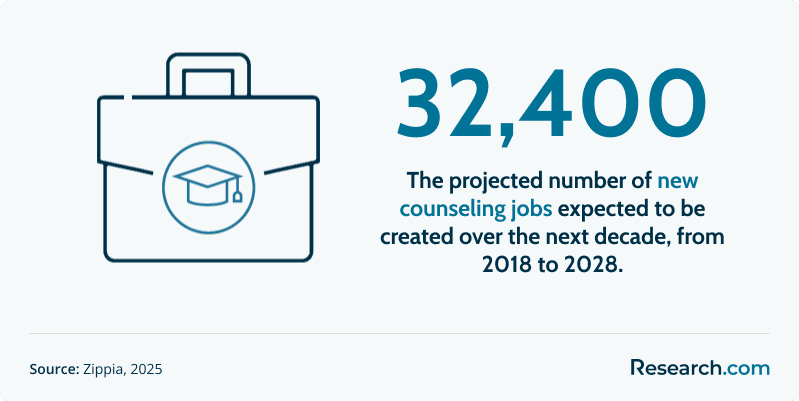
The counseling job market is supported by continued demand for mental health services across schools, community agencies, healthcare settings, and private practice. The field is expected to add approximately 32,400 new jobs, creating opportunities for graduates who meet licensure and experience requirements.
Graduate education can also support employment stability. Data shows that nearly 90% of master’s degree graduates are employed in their field, though outcomes vary by program, location, license, specialization, and labor market conditions.
Some frontline counseling roles have average tenure around one to two years, often because of workload, compensation, burnout, or advancement opportunities. A dual masters in counseling may help graduates move toward more specialized or leadership-oriented roles over time, but career resilience depends on licensure completion, supervised experience, professional networking, and ongoing continuing education.
Current Trends Affecting Counseling Careers
- Telehealth and hybrid care: Online counseling and hybrid service models have changed how many clients access care, but states and employers may set different rules for remote practice.
- School mental health demand: Schools continue to need professionals who understand academic, behavioral, family, and emotional support systems.
- Licensure portability concerns: Counselors who expect to move should plan early because state requirements can differ.
- AI in documentation and administration: AI tools may assist with scheduling, note organization, training simulations, or administrative tasks, but ethical counseling practice still requires human judgment, confidentiality protections, and professional accountability.
- Employer preference for specialized skills: Graduates with training in trauma, addiction, family systems, school counseling, crisis response, or leadership may be more competitive for certain roles.
What Graduates Say About Their Online Dual Master’s in Counseling Experience
-
: "“I spent 12 years in project management and wanted to move into mental health work, but stepping away from employment completely was not realistic. The online dual counseling and business pathway helped me make the transition in stages. I could join class from a hotel during work travel or from home after hours. Today, I work as a clinical director for a mental health startup, and that combination of clinical and business preparation made the role possible.”
— Michael"
-
: "“After two decades in social work, I felt ready for a new level of clinical independence. Pursuing preparation connected to both clinical social work and professional counseling gave me a clearer path toward private practice and supervision. I was anxious about returning to school, but the online format made the process more manageable than I expected.”
— Chloe"
-
: "“I had provided pastoral care for years, but I knew goodwill was not enough when people were facing serious mental health challenges. I needed formal clinical training and an ethical framework. The online dual program let me continue serving my congregation while developing the skills to support people more responsibly.”
— James"
Challenges to Expect in an Online Dual Master’s in Counseling Program
Online dual counseling programs offer flexibility, but they are not easy. Students must manage graduate-level reading, clinical skill development, technology requirements, field placement paperwork, supervision expectations, and often state licensure planning. The workload can be especially demanding for students who continue working full time.
Common challenges include finding approved local placements, building relationships with faculty and classmates online, staying organized across two areas of study, and maintaining professional boundaries during emotionally intense training. Students who need lower-cost options should compare tuition, fees, accreditation, and licensure alignment carefully when researching the cheapest online counseling degree.
Common Mistakes to Avoid
| Mistake | Why It Can Hurt You | Better Approach |
| Choosing a program before checking accreditation | Accreditation can affect licensure eligibility, employer recognition, and transfer options. | Verify programmatic and institutional accreditation before applying. |
| Assuming online programs automatically meet your state’s licensure rules | Licensure is controlled by state boards, and requirements differ. | Confirm eligibility with both the school and your state licensing board. |
| Comparing only per-credit tuition | Total cost depends on credits, fees, fieldwork expenses, and time to completion. | Calculate the full cost through graduation and post-degree licensure steps. |
| Ignoring internship logistics | Field placement delays can slow graduation and licensure progress. | Ask how placements are approved, supervised, and documented. |
| Choosing a dual degree without a clear career reason | Extra coursework may not improve outcomes if you only need one credential. | Define the role, license, and population you want to serve first. |
| Relying only on rankings | A highly ranked program may not fit your state, schedule, or specialization. | Use rankings as a shortlist, then verify fit with advisors and licensing boards. |
Practical Steps Before Enrolling
- Identify your target role. Decide whether you want to work in clinical practice, schools, family therapy, addiction services, ministry, leadership, policy, or another setting.
- Map the required credential. Find the license or certificate required for that role in your state.
- Verify accreditation. Check institutional accreditation and the counseling program’s specific recognition.
- Confirm state alignment in writing. Ask admissions or program leadership whether the degree is designed to meet your state’s requirements.
- Ask about field placements. Clarify who finds sites, what types of sites qualify, and whether placements are available near you.
- Calculate total cost. Include tuition, fees, books, travel, technology, lost work hours, exam costs, and post-degree supervision.
- Compare flexibility honestly. Review live class times, weekly workload, part-time options, and residency requirements.
- Speak with current students or alumni. Ask about placement support, faculty responsiveness, workload, and licensure preparation.
Key Insights
- An online dual master’s in counseling is best for students with a clear reason to combine two counseling-related pathways, not for students who simply want more credentials.
- Most full-time programs take three to four years, and fieldwork requirements can shape your schedule as much as online classes do.
- Accreditation and state licensure alignment are the most important selection factors. Always verify both before enrolling.
- The average total tuition for a dual masters in counseling program is typically between $62,510 and $69,030, but total cost depends on credits, fees, residency rules, and placement expenses.
- Online programs can be as academically serious as campus programs, but students must be proactive about networking, technology, and local practicum or internship planning.
- Dual counseling graduates may pursue roles such as clinical director, school and family counselor, corporate wellness program manager, mental health policy advisor, or private practice specialist, depending on licensure and experience.
- No program can guarantee licensure, salary, or employment. The strongest applicants choose programs by matching accreditation, state requirements, field support, cost, and career goals.
References:
- Bureau of Labor Statistics. (2024). The impact of double majors during economic downturns. Monthly Labor Review. Retrieved from BLS
- Council for Accreditation of Counseling and Related Educational Programs. (2024). 2023 vital statistics report. Retrieved from CACREP
- Council for Accreditation of Counseling and Related Educational Programs. (2025). 2024 vital statistics report. Retrieved from CACREP
- EducationDynamics. (2024). Online college students 2024 report. Retrieved from EducationDynamics
- Health Resources and Services Administration. (2024). State of the behavioral health workforce report. Retrieved from HRSA
- National Association of Colleges and Employers. (2024). Graduate outcomes. Retrieved from NACE
- Zippia. (2024). Counselor demographics. Retrieved from Zippia
- Zippia. (2024). Counselor skills. Retrieved from Zippia
- Zippia. (2024). Counselor trends. Retrieved from Zippia
- ZipRecruiter. (2024). Master’s degree in counseling salary. Retrieved from ZipRecruiter
- ZipRecruiter. (2024). Master’s-level counselor salary. Retrieved from ZipRecruiter
Other Things You Should Know About Online Dual Master’s in Counseling Programs
In 2027, online dual master's in counseling programs may offer specialties such as clinical mental health counseling, school counseling, and marriage and family therapy. These programs enable students to gain expertise in specific counseling areas, preparing them for diverse career opportunities.
In 2027, students can expect the cost of an online dual master's in counseling program to range from $20,000 to $50,000. Expenses vary based on factors such as institution reputation, residency status, and additional fees like technology and course materials. Financial aid and scholarships can also significantly reduce overall costs.
Yes. Most online dual master’s counseling programs require a supervised practicum and internship, often totaling about 700 to 900 clinical hours. Students usually complete these placements in approved settings and must meet state licensure and program supervision standards before graduation.