
2027 Most Affordable Online Substance Abuse Counseling Degree Programs

Co-Founder and Chief Data Scientist
With around 50% of teenagers in the US having misused a drug at least once, the demand for qualified substance abuse counselors has never been more urgent. However, many prospective counselors are overwhelmed by the complexities of licensure requirements, financial constraints, and doubts about the quality of online education, making it difficult to navigate the path toward a meaningful career in this field.
As a career planning expert, I understand these anxieties and have seen firsthand how selecting the right program can turn these challenges into opportunities for professional growth.
In this article, I will help you navigate the key factors to consider when evaluating affordable online substance abuse counseling degree programs, such as cost, program flexibility, financial aid options, and how well these programs prepare you for licensure requirements. Hopefully, by the end, you will have a clearer understanding of how to choose a program that aligns with your budget, career goals, and personal fulfillment.
What are the benefits of enrolling in most affordable online substance abuse counseling degree programs?
- With state licensure, graduates can work as substance abuse counselors in settings such as rehabilitation centers, outpatient clinics, hospitals, and government agencies. Without licensure, they may find roles as assistant addiction counselors or case managers in community health and social service organizations.
- The average annual salary for substance abuse, behavioral disorder, and mental health counselors is around $60,080, providing a competitive income in a field with a projected job growth of 19%.
- Online programs offer flexible learning options, allowing students to balance their education with personal and professional responsibilities.
What can I expect from the most affordable online substance abuse counseling degree programs?
In affordable online substance abuse counseling degree programs, you can expect a thorough curriculum designed to prepare you for both the practical and theoretical aspects of addiction counseling. Coursework typically covers essential topics such as addiction theories, counseling techniques, ethics, mental health disorders, and crisis intervention. Most programs also include supervised internships or field placements, providing hands-on experience that is crucial for meeting licensure requirements. While these programs are designed to be flexible, allowing you to study at your own pace, they also adhere to rigorous academic standards to ensure you are well-prepared for the licensure process. Depending on the program, you will be guided on how to meet the licensure requirements specific to your state, which may involve additional examinations or clinical hours after graduation.
Where can I work after graduating from the most affordable online substance abuse counseling degree programs?
Graduates who have earned their degree but have not yet obtained licensure may work in supportive roles, such as case managers or addiction counselor assistants, within community health organizations, nonprofit agencies, or social service departments. These positions typically involve assisting licensed counselors and supporting clients in their recovery. Once licensure is obtained, graduates can work as fully qualified substance abuse counselors in settings such as rehabilitation centers, outpatient clinics, hospitals, government agencies, or even in private practice. Licensure opens up opportunities for more responsibility and direct client interaction, including conducting individual and group counseling sessions.
How much can I make with a degree from the most affordable online substance abuse counseling degree programs?
The earning potential for substance abuse counselors can vary depending on the industry and location. On average, substance abuse, behavioral disorder, and mental health counselors in the US earn around $60,080 annually as of 2023. Salaries can differ by the setting in which you work. For instance, counselors employed by residential mental health and substance abuse facilities tend to earn around $49,250, while those in outpatient care centers make approximately $58,480. Roles in individual and family services offer similar earnings at $58,210, while positions in local government can provide higher salaries, with an average of $68,830. These figures demonstrate that there are opportunities for competitive pay across various sectors, with potential for growth as you gain experience and advance in your career.
- List of the Most Affordable Online Substance Abuse Counseling Degree Programs for 2027 Most Affordable Certifications
- How long does it take to complete the most affordable online substance abuse counseling degree programs? Completion Timeline
- How does an online substance abuse counseling program compare to an on-campus program? Online vs. On-Campus
- What is the average cost of the most affordable substance abuse counseling degree programs? Average Cost
- What are the financial aid options for students enrolling in the most affordable substance abuse counseling degree programs? Financial Aid
- What are the prerequisites for enrolling in the most affordable substance abuse counseling degree programs? Enrollment Prerequisites
- What courses are typically in the most affordable substance abuse counseling degree programs? Courses
- What types of specializations are available in the most affordable substance abuse counseling degree programs? What types of specializations are available in the most affordable substance abuse counseling degree programs?
- What are the licensure pathways after graduation? What are the licensure pathways after graduation?
- What additional certifications and training opportunities can further enhance your career? What additional certifications and training opportunities can further enhance your career?
- How do you choose the best affordable online substance abuse counseling degree programs? How do you choose the best affordable online substance abuse counseling degree programs?
- What is the job market for graduates with a degree from the most affordable online substance abuse counseling programs? What is the job market for graduates with a degree from the most affordable online substance abuse counseling programs?
- Is the program accredited and backed by industry standards? Is the program accredited and backed by industry standards?
- What hidden costs should I consider when evaluating an online substance abuse counseling degree? What hidden costs should I consider when evaluating an online substance abuse counseling degree?
- Should I integrate family and marriage therapy techniques into my substance abuse counseling practice? Should I integrate family and marriage therapy techniques into my substance abuse counseling practice?
- What role do emerging technologies play in substance abuse counseling education? What role do emerging technologies play in substance abuse counseling education?
- What advanced educational options can enhance my career in substance abuse counseling? What advanced educational options can enhance my career in substance abuse counseling?
- What student support services are critical for success in online substance abuse counseling programs? What student support services are critical for success in online substance abuse counseling programs?
- How do industry partnerships and alumni networks enhance career opportunities in substance abuse counseling? How do industry partnerships and alumni networks enhance career opportunities in substance abuse counseling?
- Can integrating behavior analysis training elevate my substance abuse counseling career? Can integrating behavior analysis training elevate my substance abuse counseling career?
- How do employers perceive online substance abuse counseling degrees? How do employers perceive online substance abuse counseling degrees?
- How can accelerated psychology courses complement my substance abuse counseling education? How can accelerated psychology courses complement my substance abuse counseling education?
Most Affordable Online Substance Abuse Counseling Degree Programs for 2027
Choosing an online substance abuse counseling degree is a cost, licensure, and career decision—not just a school search. The right program can help you build the academic foundation for addiction counseling, prevention work, case management, recovery support, or graduate study. The wrong program can leave you with credits that do not align with your state’s credentialing rules.
This guide is designed for students comparing affordable online bachelor’s programs in substance abuse counseling, addiction studies, psychology with addictions coursework, and related human services pathways. You will find a ranked program list, cost and completion-time details, licensure considerations, online-versus-campus trade-offs, financial aid options, common courses, specialization choices, career outlook, and practical questions to ask before enrolling.
Quick answer: What is the most important thing to know?
Affordable online substance abuse counseling degree programs usually require 120 credits and are commonly structured for completion in 4 years. However, affordability should not be the only deciding factor. Before enrolling, confirm that the school is accredited, that the curriculum fits your state’s addiction counselor credentialing requirements, and that the program includes any fieldwork, practicum, or supervised experience you may need after graduation.
How we rank schools
Research.com evaluates affordable online substance abuse counseling degree programs using a research-based process guided by our ranking methodology. The analysis draws from institutional and program data, including the IPEDS database maintained by the National Center for Education Statistics (NCES).
We also use information from Peterson's database, including its Distance Learning Licensed Data Set, to review online education offerings. Cost and outcome context is supported by the College Scorecard, while NCES data helps verify institutional details.
| Rank | School and Program | Credits | Cost per Credit | Accreditation Listed |
| 1 | City Vision University - BS in Substance Abuse Counseling | 120 | $266.67 ($800 per course) | National Association for Addiction Professionals (NAADAC) |
| 2 | Southern New Hampshire University - BA in Human Services (Substance Abuse Concentration) | 120 | $330 | New England Commission of Higher Education (NECHE) |
| 3 | University of South Dakota - BS in Addiction Counseling and Prevention | 120 | $354.75; $250 (active duty) | National Addiction Studies Accreditation Commission (NASAC) |
| 4 | Purdue Global - BS in Psychology in Addictions | 120 | $371 | National Addiction Studies Accreditation Commission (NASAC) |
| 5 | Northwestern State University of Louisiana - BS in Addiction Studies | 120 | $375 | National Addiction Studies Accreditation Commission (NASAC) |
| 6 | Liberty University - BS in Psychology (Addictions and Recovery Concentration) | 120 | $390 (full-time); $455 (part-time); $250 (military) | Southern Association of Colleges and Schools Commission on Colleges (SACSCOC) |
| 7 | Ottawa University - BS in Addiction Counseling | 120 | $449; $250 (military and spouses) | National Addiction Studies Accreditation Commission (NASAC) |
| 8 | Ohio Christian University - BA in Substance Abuse Counseling | 120 | $450; $250 (military) | Higher Learning Commission (HLC) |
| 9 | Crown College - BS in Alcohol and Drug Counseling | 120 | $530 | Higher Learning Commission (HLC) |
| 10 | University of Cincinnati - BS in Substance Abuse Counseling | 120 | $566 (in-state); $581 (out-of-state) | Higher Learning Commission (HLC) |
1. City Vision University - BS in Substance Abuse Counseling
City Vision University offers an online BS in Substance Abuse Counseling intended to prepare students for addiction counselor certification in select states. The 120-credit program covers addiction prevention, treatment concepts, coping strategies, and the Twelve Core Functions of Substance Abuse Counseling. Students may also prepare for Certified Addiction Counselor and Peer Support Specialist pathways. The school notes that the degree may not satisfy certification requirements in some states, including Alaska, Arizona, and others, so students should verify state rules before applying.
- Program Length: 4 years
- Concentrations: Clinical Counseling; Christian Recovery Ministry Counseling
- Credits Required to Graduate: 120
- Cost per Credit: $266.67 ($800 per course)
- Accreditation: National Association for Addiction Professionals (NAADAC)
2. Southern New Hampshire University - BA in Human Services (Substance Abuse Concentration)
Southern New Hampshire University offers a BA in Human Services with a Substance Abuse concentration. This option may fit students who want a broader human services foundation while adding addiction-focused coursework. The curriculum introduces culturally responsive care, ethical decision-making, prevention, intervention, rehabilitation, screening methods, psychological analysis of addictive behaviors, and the Twelve Core Functions used in addiction counseling practice.
- Program Length: 4 years
- Concentrations: Substance Abuse Concentration
- Credits Required to Graduate: 120
- Cost per Credit: $330
- Accreditation: New England Commission of Higher Education (NECHE)
3. University of South Dakota - BS in Addiction Counseling and Prevention
University of South Dakota provides a BS in Addiction Counseling and Prevention focused on the causes, prevention, and treatment of substance use disorders. Students study addiction from multiple disciplinary perspectives while building critical thinking and problem-solving skills. Graduates are eligible for addiction and prevention credentialing through the South Dakota Board of Addiction and Prevention Professionals (SDBAPP), but students who plan to work outside South Dakota should check whether the coursework meets their own state’s certification standards.
- Program Length: 4 years
- Concentrations: Treatment; Prevention
- Credits Required to Graduate: 120
- Cost per Credit: $354.75; $250 (active duty)
- Accreditation: National Addiction Studies Accreditation Commission (NASAC)
4. Purdue Global - BS in Psychology in Addictions
Purdue Global offers an online BS in Psychology in Addictions for students who want addiction studies within a psychology-based degree. Coursework addresses addiction processes, pharmacology, prevention, recovery, substance use disorders, gambling addiction, and eating disorders. Students may choose a business foundations concentration or a practicum track. The program also includes preparation for optional NCAC Level I and II certification exams, plus a Peer Recovery Support Specialist Micro-Credential and certification exam.
- Program Length: 4 years
- Credits Required to Graduate: 120
- Cost per Credit: $371
- Accreditation: National Addiction Studies Accreditation Commission (NASAC)
5. Northwestern State University of Louisiana - BS in Addiction Studies
Northwestern State University of Louisiana offers a BS in Addiction Studies that examines addictive behaviors, psychology, and current developments in addiction counseling. The program can support students interested in addiction-related service roles as well as careers that use communication, data analysis, and human behavior knowledge. Graduates may also apply their training in areas such as human resources or communications, depending on their experience and career goals.
- Program Length: 4 years
- Credits Required to Graduate: 120
- Cost per Credit: $375
- Accreditation: National Addiction Studies Accreditation Commission (NASAC)
6. Liberty University - BS in Psychology (Addictions and Recovery Concentration)
Liberty University offers a 100% online BS in Psychology with an Addictions and Recovery concentration. The program combines psychology coursework with addiction and recovery topics, including assessment, diagnosis, and treatment planning. It is also designed for students who want biblical principles integrated into their study of psychology and counseling-related practice.
- Program Length: 4 years
- Concentration: Addictions and Recovery
- Credits Required to Graduate: 120
- Cost per Credit: $390 (full-time); $455 (part-time); $250 (military)
- Accreditation: Southern Association of Colleges and Schools Commission on Colleges (SACSCOC)
7. Ottawa University - BS in Addiction Counseling
Ottawa University offers an accelerated BS in Addiction Counseling that prepares students to support people affected by substance abuse. Coursework includes addiction, alcoholism, chemical dependency, substance use disorders, co-occurring disorders, counseling theories, intake, assessment, treatment planning, and case management. The curriculum also emphasizes cultural competence for work with varied communities.
- Program Length: 4 years
- Credits Required to Graduate: 120
- Cost per Credit: $449; $250 (military and spouses)
- Accreditation: National Addiction Studies Accreditation Commission (NASAC)
8. Ohio Christian University - BA in Substance Abuse Counseling
Ohio Christian University offers a BA in Substance Abuse Counseling designed around educational requirements for chemical dependency counseling licensure in Ohio. Students study assessment, treatment planning, ethical interventions, individual counseling, family counseling, and group counseling. Graduates may apply for Certified Chemical Dependency Assistant (CDCA) status after completing 40 hours of specific training. The program also incorporates Christian principles into counseling preparation.
- Program Length: 4 years
- Credits Required to Graduate: 120
- Cost per Credit: $450; $250 (military)
- Accreditation: Higher Learning Commission (HLC)
9. Crown College - BS in Alcohol and Drug Counseling
Crown College offers a BS in Alcohol and Drug Counseling that explores how substance abuse affects individuals and families. Students examine emotional, cognitive, cultural, professional, financial, and spiritual dimensions of addiction. The program may appeal to learners who want to combine addiction counseling preparation with a values-based educational environment.
- Program Length: 4 years
- Credits Required to Graduate: 120
- Cost per Credit: $530
- Accreditation: Higher Learning Commission (HLC)
10. University of Cincinnati - BS in Substance Abuse Counseling
The University of Cincinnati offers an online BS in Substance Abuse Counseling for students preparing for work in drug and alcohol addiction treatment. The research-oriented curriculum aligns with the Ohio Chemical Dependency Professionals Board’s requirements for Chemical Dependency Counselor Assistant (CDCA) certification and meets part of the criteria for Licensed Chemical Dependency Counselor III (LCDC III) status in Ohio. Students should review Ohio requirements carefully and verify transferability if they plan to practice elsewhere.
- Program Length: 4 years
- Credits Required to Graduate: 120
- Cost per Credit: $566 (in-state); $581 (out-of-state)
- Accreditation: Higher Learning Commission (HLC)
How long does it take to complete an affordable online substance abuse counseling degree?
Most affordable online substance abuse counseling bachelor’s programs are built around 120 credits and are commonly completed in 4 years by full-time students. The timeline can change if you transfer credits, study part time, enroll in an accelerated format, or pause for work and family obligations.
Some students choose a direct addiction counseling degree, while others enroll in a psychology or human services degree with a substance abuse counseling concentration. These broader programs can still take 4 years, but they may include additional coursework in human services systems, psychology, social services, or case management. Students who want a faster route may also compare an accelerated human services degree online, especially if they have transfer credits or prior college experience.
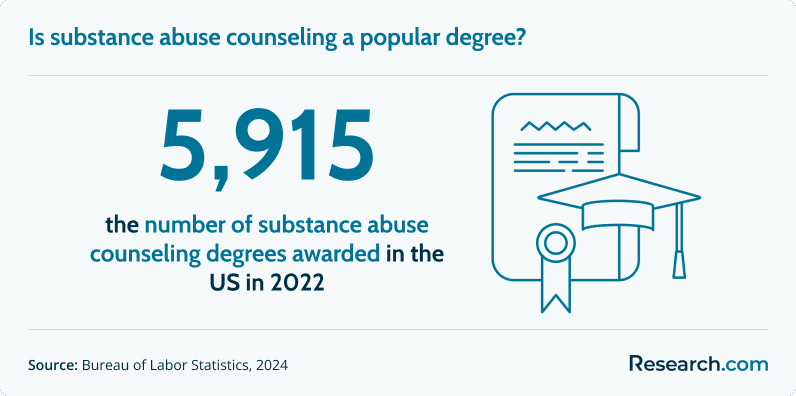
In 2022, around 5,915 substance abuse counseling degrees were awarded across the United States.
Online vs. on-campus substance abuse counseling programs: which format is better?
Online and campus-based substance abuse counseling programs can cover similar academic content, but the learning experience differs. Online programs are often better for working adults, caregivers, military students, and learners who need geographic flexibility. Campus programs may be better for students who want face-to-face interaction, structured schedules, and easier access to local university partnerships.
| Factor | Online Program | On-Campus Program | Best Fit |
| Schedule | Coursework can often be completed remotely with more scheduling flexibility. | Classes usually meet at set times and locations. | Online works well for students balancing school with work or family. |
| Interaction | Communication may happen through discussion boards, video meetings, email, and virtual advising. | Students get more immediate in-person access to instructors and peers. | Campus may suit learners who prefer live discussion and classroom community. |
| Field experience | Students may need to arrange internships or supervised placements in their local area. | Schools may have established placement relationships near campus. | Ask each program how it helps online students secure approved placements. |
| Technology | Students need reliable internet, a capable computer, and comfort with learning platforms. | Technology is still used, but students rely more on campus resources. | Online is best for self-directed learners who can manage digital coursework. |
Both formats can be valid if the institution is properly accredited and the curriculum fits your career goals. If you are comparing healthcare-focused online programs more broadly, flexible options such as women's health nurse practitioner online programs show how remote learning can support working professionals in adjacent care fields.
What does an affordable online substance abuse counseling degree cost?
The cost of an affordable online substance abuse counseling degree varies by school, residency status, transfer credits, and fee structure. Based on the figures provided, students can expect tuition of around $65,000, whether they pay in-state or out-of-state rates. In-state tuition typically ranges from $63,600 to $67,920, while out-of-state tuition ranges from about $63,600 to $69,720.
Published cost per credit ranges from $530 to $566 for in-state students and from $530 to $582 for out-of-state students. These amounts do not always include every expense. Students should also ask about technology fees, textbooks, course materials, background checks, practicum-related costs, exam fees, graduation fees, and any certification preparation costs.
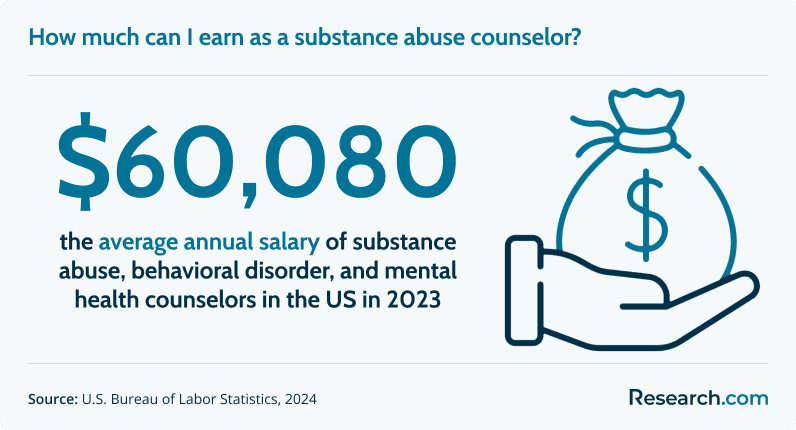
Cost should be evaluated alongside career goals. The average salary of substance abuse, behavioral disorder, and mental health counselors in the US is $60,080, but individual earnings vary by location, employer, credential level, experience, and work setting. Students considering other counseling pathways may also compare the pros and cons of a master's in marriage and family therapy. Those exploring healthcare alternatives can review the differences between an MSN vs. RN preparing for a career in nursing.
What financial aid can help lower the cost?
Students in online substance abuse counseling programs may be able to reduce out-of-pocket costs through federal, state, institutional, employer, and private funding. Aid eligibility depends on the school, enrollment status, financial need, academic record, and program type.
- Federal financial aid: Students should start with the Free Application for Federal Student Aid (FAFSA). Depending on eligibility, federal aid may include Pell Grants, federal loans, and work-study.
- State aid: Some states provide grants or scholarships for residents, including students preparing for high-need human services and behavioral health roles.
- Institutional scholarships: Colleges may offer merit-based, need-based, transfer, adult learner, or program-specific awards. Ask whether online students qualify for the same awards as campus students.
- Employer tuition assistance: Students already working in healthcare, behavioral health, social services, corrections, or nonprofit settings should ask whether their employer reimburses tuition or supports professional credentialing.
- Private scholarships and grants: Professional associations, foundations, community organizations, and recovery-focused groups may offer scholarships for students entering addiction counseling or related fields.
- Work-study programs: Eligible students may earn money through federal or school-based work-study, sometimes in roles connected to community services or student support.
Questions to ask about financial aid before enrolling
- Is the program eligible for federal financial aid?
- Do online students pay the same tuition as campus students?
- Are scholarships renewable each year?
- Will transfer credits reduce both time and tuition?
- Are practicum, background check, certification, or exam fees included in the published estimate?
What are the admissions requirements?
Admissions requirements vary by institution, but most bachelor’s-level online substance abuse counseling programs expect applicants to show readiness for undergraduate study. Requirements may be different for transfer students, adult learners, military students, and students applying to master’s-level counseling programs.
- High school diploma or GED: A high school credential or equivalent is usually the minimum requirement for bachelor’s admission.
- Prior college coursework: Transfer applicants may need official transcripts from every college previously attended.
- Minimum GPA: Some schools use a minimum GPA requirement, often around 2.5-3.0, to evaluate academic preparation.
- Human services experience: Certain programs may value volunteer work, peer support experience, healthcare employment, social services work, or related background.
- Personal statement: Applicants may be asked to explain their interest in addiction counseling and their professional goals.
- Recommendations: Some programs request academic or professional references, especially for more selective or advanced pathways.
What courses are common in online substance abuse counseling programs?
Coursework usually blends addiction science, counseling foundations, ethics, assessment, treatment planning, and client support skills. A strong curriculum should prepare students to understand substance use disorders while also recognizing co-occurring mental health concerns, family systems, cultural factors, and legal responsibilities.
- Introduction to Substance Abuse Counseling: Students learn basic addiction concepts, treatment settings, counselor responsibilities, and initial client assessment practices.
- Psychology of Addiction: This course examines psychological factors connected to addiction, including depression, anxiety, behavior patterns, and co-occurring disorders.
- Ethical and Legal Issues in Counseling: Students study confidentiality, informed consent, mandatory reporting, boundaries, documentation, and professional conduct.
- Group Therapy for Addiction: This course focuses on group counseling skills, group dynamics, facilitation methods, and peer support in recovery settings.
- Assessment and Diagnosis in Addiction Counseling: Students explore screening tools, diagnostic frameworks, and clinical decision-making for substance use and mental health concerns.
- Treatment Planning and Case Management: Coursework covers goal setting, service coordination, documentation, progress monitoring, and referrals.
- Crisis Intervention and Relapse Prevention: Students learn strategies for responding to urgent client needs and supporting continued recovery after treatment.
These courses build a foundation for students who want to become a drug and alcohol counselor or pursue related behavioral health roles. In 2023, the highest paying industries for substance abuse counselors were non-government organizations ($94,050) and religious organizations ($78,220). See the chart below for more information.
What specializations are available?
Specializations help students tailor their degree toward specific client populations, treatment settings, or long-term career goals. Not every school offers every track, so review the catalog carefully before applying.
| Specialization | What It Emphasizes | Where It May Be Useful |
| Addiction Recovery Counseling | Recovery stages, therapeutic support, relapse prevention, and long-term sobriety planning. | Rehabilitation centers, outpatient programs, and community health organizations. |
| Co-occurring Disorders Counseling | Integrated support for clients facing both substance use and mental health challenges. | Mental health facilities and integrated treatment programs. |
| Child and Adolescent Substance Abuse Counseling | Developmentally appropriate services for children and teens affected by substance use. | Schools, juvenile detention centers, and community mental health centers. |
| Forensic Addiction Counseling | Addiction counseling in legal, correctional, probation, or court-connected settings. | Prisons, jails, probation offices, and justice-related treatment programs. |
| Family Counseling and Support | Family dynamics, relationship strain, and support systems affected by addiction. | Family therapy centers, addiction clinics, and social services agencies. |
Students who want a broader clinical or social services pathway may later consider graduate study. For example, an easiest social work degree option may appeal to those who want to expand into social work roles after building addiction counseling experience.
What are the licensure pathways after graduation?
A degree alone does not automatically authorize independent counseling practice. Most states require graduates to complete supervised clinical hours, pass a national or state-specific examination, satisfy background check requirements, and follow continuing education rules. Requirements can differ substantially by state and by credential level.
Before enrolling, identify the exact credential you want—such as addiction counselor, chemical dependency counselor, peer support specialist, or another state-specific title—and ask the program to explain how its curriculum maps to that credential. Keep records of syllabi, field hours, supervisor signatures, and completed trainings. If your goal is broader counseling licensure, review guidance on the fastest way to become a licensed counselor.
What certifications and training can strengthen your career?
Additional credentials can help demonstrate focused competency beyond the bachelor’s degree. Depending on your state and employer, useful training may include cognitive-behavioral therapy, trauma-informed care, motivational interviewing, crisis intervention, relapse prevention, peer recovery support, case management, and ethics continuing education.
Certification requirements vary, so students should avoid assuming that one credential works everywhere. Compare certification options against your state board’s rules, your employer’s expectations, and your long-term career plan. For a broader view of counseling roles, review different types of counselors.
How do you choose the best affordable online substance abuse counseling degree?
The best program is the one that matches your state requirements, budget, schedule, support needs, and career direction. A low tuition rate is helpful, but it should not outweigh accreditation, licensure alignment, field placement support, or academic quality.
- Check accreditation first: Confirm institutional accreditation and review whether the addiction studies program has specialized recognition, such as National Addiction Studies Accreditation Commission (NASAC), when relevant.
- Match the curriculum to your state: Ask whether the program satisfies educational requirements for the credential you want in the state where you plan to work.
- Compare total cost, not just tuition: Include fees, books, background checks, field placement expenses, certification costs, and technology requirements.
- Evaluate flexibility honestly: Online learning can be convenient, but it requires discipline, reliable technology, and time management.
- Ask about field placement help: Online students should know whether the school finds placements, approves student-found sites, or expects students to arrange everything independently.
- Review student support: Strong advising, career coaching, tutoring, technical support, and licensure guidance can make a major difference.
- Talk to admissions and alumni: Ask direct questions about graduation requirements, transfer credit, practicum expectations, and career outcomes.
Common mistakes to avoid
| Mistake | Why It Can Hurt You | Better Approach |
| Choosing only by the lowest tuition | A cheap program may not fit your state’s credentialing requirements. | Compare cost, accreditation, curriculum, and licensure alignment together. |
| Ignoring state licensure rules | Requirements for addiction counseling credentials differ by state. | Contact the relevant state board before enrolling. |
| Assuming online means no fieldwork | Many counseling-related pathways require supervised experience. | Ask how internships, practicums, or supervised hours are handled for online students. |
| Overlooking transfer policies | Credits that do not transfer can increase cost and time to graduation. | Request a formal transfer evaluation before committing. |
| Relying only on rankings | A ranked school may still be a poor fit for your location, schedule, or credential goal. | Use rankings as a starting point, then verify details directly with the school. |
What is the job market for graduates?
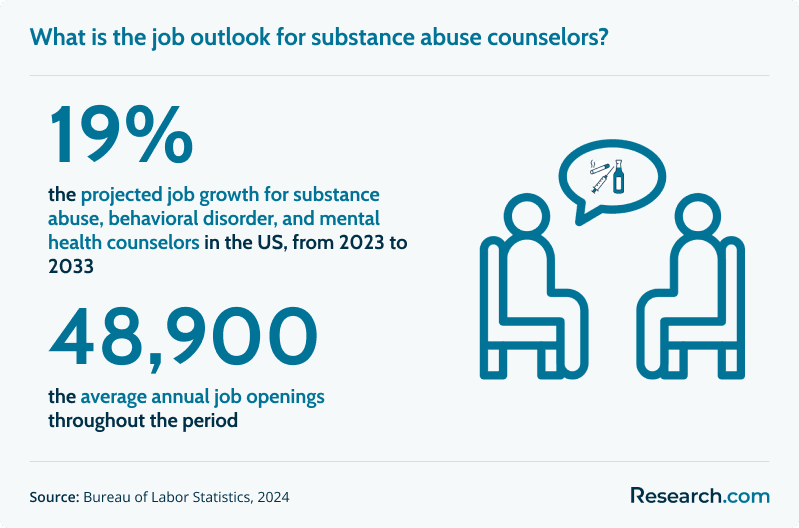
The labor market for substance abuse counselors is expected to remain strong. Demand for substance abuse, behavioral disorder, and mental health counselors is projected to grow by 19% from 2023 to 2033, which is much faster than the average growth rate for other occupations.
Graduates may pursue roles in rehabilitation centers, outpatient clinics, hospitals, government agencies, community organizations, religious organizations, and nonprofit settings. Across the next decade, an estimated 48,900 annual job openings are expected. Actual job eligibility depends on state credentialing, supervised experience, employer requirements, and the level of responsibility involved.
Students who want to move into leadership, program administration, advanced case management, or broader human services roles may eventually consider an online masters in human services or another graduate pathway aligned with their goals.
Is the program accredited and aligned with industry expectations?
Accreditation should be one of the first items you verify. Institutional accreditation affects financial aid eligibility, transfer credit, graduate school admission, and employer confidence. Program-level recognition may also matter in addiction studies, especially when it connects to curriculum standards used by the field.
Ask whether the institution is accredited by a recognized accreditor, whether the program has specialized addiction studies recognition, and whether coursework aligns with the credentialing standards in your state. Students planning graduate study can also compare related options such as online masters degrees in counseling.
What hidden costs should you check before enrolling?
Published tuition rarely tells the whole story. Online students may also pay technology fees, online course fees, textbooks, software subscriptions, background checks, drug screening fees, liability insurance, practicum travel expenses, graduation fees, transcript fees, and certification or exam fees.
Before applying, request a full cost sheet from admissions or financial aid. Ask whether tuition is locked, whether fees change by term, and whether transfer credits can reduce the total. For a broader cost comparison, review how much does it cost to get a counseling degree.
Should substance abuse counselors study family and marriage therapy concepts?
Family systems often influence recovery, relapse risk, communication patterns, and client support. Students who want to work with couples, families, parents, or youth may benefit from coursework that examines family dynamics, relationship stress, and the impact of addiction on households.
This does not mean every substance abuse counseling student needs a marriage and family therapy degree. It does mean that family-focused training can be useful for certain roles. Students interested in this combined perspective can compare a family and marriage counseling degree online with addiction counseling programs.
How are technology and AI changing substance abuse counseling education?
Online counseling education increasingly uses digital learning platforms, video supervision tools, virtual simulations, telehealth training, and interactive case studies. These tools can help students practice documentation, client engagement, ethical decision-making, and treatment planning in structured learning environments.
Technology does not replace supervised clinical experience or human counseling skills. Instead, it changes how students learn, communicate, and prepare for modern behavioral health settings. Students considering long-term behavioral health careers can also explore the future of psychology careers.
What advanced education options can improve career mobility?
A bachelor’s degree can prepare students for entry-level addiction-related roles or credentialing steps, but some positions require graduate education, advanced licensure, or specialized certification. Students interested in clinical supervision, research, teaching, policy, or administrative leadership may eventually pursue master’s or doctoral study.
For research-heavy or psychology-focused goals, options such as the best online psychology PhD programs may be relevant. Students should compare admission requirements, licensure outcomes, residency expectations, and whether the doctoral pathway fits their intended career.
What student support services matter most in an online program?
Online students should not settle for limited support. Strong programs provide academic advising, technical help, tutoring, career coaching, library access, writing assistance, licensure guidance, and field placement support. Peer discussion groups, faculty availability, and mentoring can also help students stay connected in a remote format.
If you plan to pursue counseling credentials beyond addiction studies, ask whether advisors understand multiple pathways. Students comparing specialized counseling options may also review cheapest online school counseling programs (CACREP accredited).
How do partnerships and alumni networks affect career opportunities?
Partnerships with treatment centers, community agencies, hospitals, correctional programs, and nonprofit organizations can improve access to internships, practicum sites, guest speakers, job leads, and mentorship. Alumni networks can also help students understand how the degree is used in real workplaces.
Ask whether online students can access the same employer connections as campus students. If you are still deciding between addiction counseling and a broader behavioral science degree, compare options such as the cheapest online colleges for psychology.
Can behavior analysis training strengthen addiction counseling practice?
Behavior analysis can help counselors understand measurable behavior patterns, triggers, reinforcement, intervention planning, and progress tracking. This can complement addiction counseling approaches when used ethically and within the counselor’s scope of practice.
Students who want formal behavior analysis credentials should review eligibility requirements carefully. An affordable BCBA online masters program may be worth exploring for professionals who want to add recognized behavior analysis expertise to their broader counseling or behavioral health background.
How do employers view online substance abuse counseling degrees?
Employers generally focus on whether the school is accredited, whether the program is relevant to the role, whether the applicant meets state credentialing rules, and whether the graduate has practical experience. The online format itself is less important when the institution is reputable and the degree supports the job requirements.
Students should verify accreditation, licensure alignment, fieldwork support, and employer recognition before enrolling. For related guidance, review whether are online psychology degrees accredited and how accreditation affects credibility.
Can accelerated psychology courses support substance abuse counseling training?
Accelerated psychology coursework can deepen a student’s understanding of behavior, motivation, development, mental health, and assessment. This can be useful for addiction counseling students who want stronger preparation in psychological concepts or who plan to continue into graduate study.
Before adding courses, make sure they fit your degree plan and do not increase cost unnecessarily. Students comparing faster behavioral science pathways can review accelerated psychology programs.
What graduates say about affordable online substance abuse counseling programs
- Carmen: "I was working and raising a family, so I needed a degree that would not require me to be on campus every week. The online format gave me the structure I needed without forcing me to step away from my responsibilities. The coursework was demanding, but it helped me feel more prepared to support people affected by addiction."
- Gabriel: "The program helped me connect addiction treatment concepts with mental health counseling strategies. I appreciated the focus on current research and practical application, and online learning made it possible for me to continue working while finishing my degree."
- Diana: "What helped me most was the balance between theory and applied assignments. The work was challenging, but it pushed me to build the skills I now use in the field. Affordability mattered, but so did finding a program that prepared me for real counseling-related responsibilities."
Key Insights
- Most affordable online substance abuse counseling bachelor’s programs require 120 credits and are commonly designed for completion in 4 years.
- The lowest tuition is not always the best value. Accreditation, licensure alignment, field placement support, and transfer credit policies can affect your total return on investment.
- State requirements matter. A program that supports credentialing in one state may not meet requirements in another.
- Online programs can be a strong fit for working adults, but students should confirm how internships, practicums, supervised hours, and local placements are handled.
- Financial aid may include FAFSA-based aid, state grants, institutional scholarships, employer tuition assistance, private scholarships, and work-study.
- The job outlook is favorable, with demand for substance abuse, behavioral disorder, and mental health counselors projected to grow by 19% from 2023 to 2033 and an estimated 48,900 annual job openings over the next decade.
- Before enrolling, ask the school for a written explanation of total cost, accreditation, transfer credit, licensure preparation, fieldwork requirements, and student support services.
References:
- Bureau of Labor Statistics. (2024). Occupational employment and wages, May 2023 - 21-1018 substance abuse, behavioral disorder, and mental health counselors. Retrieved January 17, 2025, from BLS.
- Bureau of Labor Statistics. (2024). Substance abuse, behavioral disorder, and mental health counselors. Retrieved January 17, 2025, from BLS.
- National Center for Drug Abuse Statistics. (2025). Drug abuse statistics. Retrieved January 17, 2025, from NCDAS.
- Data USA. (2025). Substance abuse counseling. Retrieved January 17, 2025, from Data USA.
Other Things You Should Know About The Most Affordable Online Substance Abuse Counseling Degree Programs
The program should hold regional accreditation, and its counseling curriculum should be tied to CACREP standards when possible. For addiction-counseling licensure, many state boards also expect coursework aligned with the licensure rules of the state board of behavioral health, social work, or counseling.
Completing an online substance abuse counseling degree can qualify you for licensure in 2027, but requirements vary by state. Typically, you must ensure the program is accredited and meet specific coursework, supervised experience, and examination requirements set by the state licensing board.
Admission requirements typically include a high school diploma or GED, a minimum GPA, and possibly letters of recommendation. Some programs may also require completion of certain prerequisite courses in psychology or social work to qualify for enrollment.


