
2027 What Can You Do With an Animation Degree?

Co-Founder and Chief Data Scientist
An animation degree can lead to more than studio animation work. Graduates may build careers in film, television, games, advertising, visual effects, motion design, education, product visualization, medical animation, VR/AR, and freelance production. The hard part is not figuring out whether animation has career options; it is choosing a path that matches your portfolio, software skills, income goals, and tolerance for a competitive project-based job market.
This guide explains what you can do with an animation degree, how animation careers differ, what salaries and hiring conditions look like, which skills and tools matter, and how to make the degree pay off. It is written for students comparing animation programs, recent graduates building a portfolio, and working artists deciding whether to specialize, freelance, or pursue more education.
Quick Answer: What Can You Do With an Animation Degree?
With an animation degree, you can work as an animator, storyboard artist, character designer, 3D modeler, VFX artist, multimedia designer, technical director, game animator, motion designer, or visualization specialist. Some graduates work in entertainment, while others apply animation skills in corporate training, healthcare, architecture, education, marketing, and interactive media.
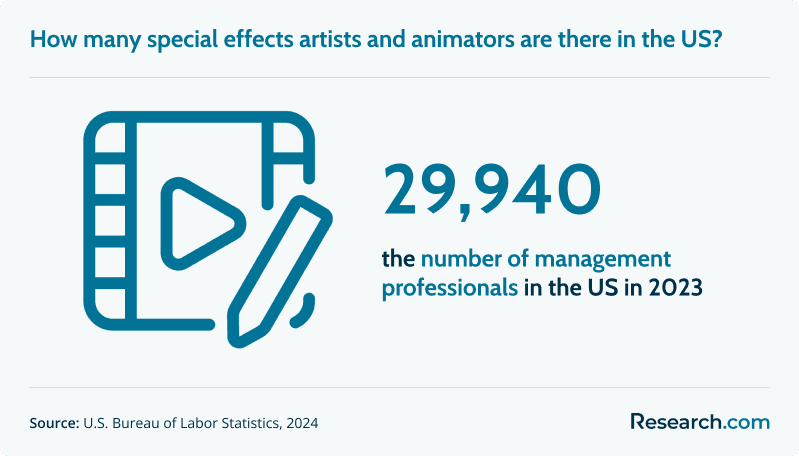
In 2023, the United States had 29,940 special effects artists and animators, and the average annual salary was $109,630. Employment for multimedia artists and animators is projected to grow by 8.2% from 2022 to 2032, with an average of 9,400 job openings each year. The strongest candidates usually combine a degree with a polished portfolio, internship or project experience, software fluency, and a clear specialty.
Key Things You Should Know About Animation Degree Careers
- The employment outlook is positive: multimedia artists and animators are projected to see 8.2% job growth from 2022 to 2032, with an average of 9,400 annual openings.
- Animation graduates are not limited to movies and TV. Top-paying sectors include motor vehicle manufacturing and telecommunications, where annual salaries reach up to $149,480.
- Location still matters. California had the highest employment level for special effects artists and animators in 2023, with 13,470 professionals, followed by major markets such as Washington, New York, and Texas.
- Freelance work is common in animation, especially for artists who build strong reels, maintain client relationships, and can manage contracts, deadlines, and revisions.
- The global animation market is estimated at $391 billion, which reflects demand across entertainment, advertising, gaming, education, and international production pipelines.
- Animation degree jobs
- Nontraditional animation careers
- How to start freelancing after graduation
- What animation degree programs teach
- Animation software commonly taught in college
- Whether internships are necessary
- Useful certifications for animation graduates
- Average salary with an animation degree
- Animation job market outlook
- Essential animation career skills
- Getting hired with a bachelor’s degree
- Other career paths for animation graduates
- Career advancement strategies
- How to build an animation portfolio
- How AI affects animation jobs
- Online continuing education options
- How game development can complement animation
- Continuing education for experienced animators
- Whether a doctorate makes sense
- Combining AI and animation skills
- Complementary technical skills
- Animation degree return on investment
- Professional networks for animators
- Affordable ways to finance animation education
- Graduate animation admissions requirements
- Whether an advanced degree can accelerate your career
- Accelerated online doctorate options
- Health informatics and medical animation
- Emerging animation industry trends
- Common challenges for animation graduates
- Data science and animation careers
What Jobs Can You Get With an Animation Degree?
An animation degree prepares you for roles that blend art, storytelling, motion, technology, and production workflows. The best job fit depends on what you can demonstrate in your portfolio. Employers and clients usually want to see finished scenes, reels, models, storyboards, rigs, motion graphics, or interactive work that proves you can solve a specific production problem.
The table below compares common animation degree jobs by focus area and reported average annual salary.
| Role | What the role does | Good fit for graduates who enjoy | Average annual salary |
| Animator | Creates motion sequences for characters, objects, scenes, products, or interfaces. | Movement, timing, acting, visual storytelling, and production collaboration. | $81,974 |
| Storyboard Artist | Plans scenes visually so directors, producers, and artists can understand pacing, camera direction, and narrative flow. | Drawing, composition, cinematic thinking, and translating scripts into visual beats. | $101,933 |
| Character Designer | Develops the look, personality, proportions, expressions, costumes, and visual identity of characters. | Concept art, anatomy, style development, and expressive visual design. | $82,870 |
| 3D Modeler | Builds digital characters, props, vehicles, products, or environments for animation, games, VR, and visualization. | Sculpting, modeling, texturing, form, detail, and spatial design. | $71,132 |
| Visual Effects Artist | Adds or enhances digital effects in live-action or animated footage, including simulations, compositing, creatures, explosions, and environments. | Problem-solving, realism, compositing, simulation, and technical artistry. | $115,100 |
| Multimedia Designer | Combines animation, graphics, video, audio, and text for digital campaigns, websites, presentations, apps, and educational content. | Design variety, marketing content, interactive media, and cross-platform production. | $61,503 |
| Technical Director | Solves production pipeline problems and may specialize in rigging, lighting, shading, tools, rendering, or workflow support. | Art plus technology, troubleshooting, scripting, systems, and team support. | $138,545 |
| Game Animator | Creates animations for gameplay, cutscenes, characters, creatures, environments, combat systems, and interactive movement. | Games, character motion, mechanics, iteration, and close collaboration with developers. | $100,000 |
Animation, interactive technology, video graphics, and special effects degrees are growing at a rate of 6.23%, with around 5,696 degrees awarded in 2022. In 2023, there were around 29,940 visual effects artists and animators in the US.
Are There Nontraditional Careers for Animation Graduates?
Yes. Many animation graduates work outside traditional entertainment studios. Animation is useful anywhere people need to explain motion, visualize invisible processes, simplify complex information, or create immersive digital experiences.
Nontraditional paths can be especially attractive if you want more industry variety, steadier corporate clients, or a niche portfolio that is less dependent on film and television hiring cycles. Students asking whether they can get an art degree online should also consider how online portfolios, remote collaboration tools, and digital production pipelines have expanded where animation skills can be used.
| Career area | How animation is used | Skills that help |
| VR and AR | Creates immersive environments, spatial interfaces, simulations, and interactive objects. | 3D modeling, game engines, UI/UX thinking, asset optimization. |
| Healthcare and science visualization | Explains anatomy, procedures, molecular processes, environmental changes, or scientific data. | Research accuracy, 3D visualization, medical or scientific literacy. |
| Corporate training | Builds animated lessons, safety simulations, onboarding modules, and explainer videos. | Instructional design, motion graphics, clear communication. |
| Architecture and product visualization | Shows buildings, vehicles, consumer products, interiors, or prototypes before they are built. | 3D modeling, rendering, lighting, realism, client presentation. |
| UX and product design | Uses motion to clarify interactions, transitions, onboarding flows, and digital experiences. | Design systems, prototyping, user research, motion design. |
| Marketing and social media | Creates animated ads, brand videos, reels, launch assets, and campaign visuals. | Branding, editing, typography, platform-specific storytelling. |
If you want a more technical path, supplementing an animation background with programming or systems knowledge can help. For example, online computer science degree programs can support careers in game tools, interactive media, simulation, and technical direction. Graduates who prefer brand-focused creative work may also compare animation with an online graphic design degree.
Freelancing and Why Many Animators Consider It
Freelancing is common in animation because production needs often change by project. Independent animators may work on commercials, short films, game assets, explainer videos, social media content, YouTube channels, product demos, or independent studio contracts.
Approximately one out of five people working in animation are freelancers. This path can offer flexibility and creative range, but it also requires business skills. Freelancers must estimate time accurately, write contracts, manage revisions, invoice clients, save for taxes, and keep marketing themselves between projects.
How Do You Start Freelancing as an Animator After Graduation?
Freelancing after graduation works best when you treat it as both a creative practice and a small business. A degree may help establish credibility, but clients usually decide based on your reel, reliability, communication, and whether your style fits their project.
- Choose a service before chasing every project. Start with a clear offer, such as 2D explainer videos, character loops, game animations, product visualization, motion graphics, storyboard packages, or VFX cleanup.
- Build a focused portfolio. Show finished work that matches the clients you want. A polished 45-second reel with relevant examples is often stronger than a long collection of unrelated class assignments.
- Create a simple online presence. Use a portfolio site, ArtStation, Behance, LinkedIn, or another professional platform so clients can review your work quickly.
- Network where production teams spend time. Join animation groups, attend events, participate in online communities, and reconnect with classmates, instructors, and internship supervisors.
- Use freelance platforms selectively. Job boards can help you find early projects, but avoid racing to the bottom on price. Look for clients who provide clear scopes and respect revision limits.
- Set business rules early. Define rates, deposits, deadlines, file delivery terms, revision rounds, and ownership rights before beginning work.
- Keep learning while working. Continued training matters in animation just as it does in other fields; for comparison, Research.com’s guide to the cheapest online master's degree in early childhood education shows how cost-conscious graduate study can be evaluated when professionals want to add credentials without overspending.
What Should You Expect in an Animation Degree Program?
An animation degree usually combines studio art, design foundations, animation principles, digital production, storytelling, and portfolio development. The most useful programs do more than teach software. They help students understand motion, timing, acting, visual clarity, production roles, feedback cycles, and how to finish work under constraints.
Common coursework may include 2D animation, 3D animation, character design, storyboarding, figure drawing, digital modeling, rigging, lighting, compositing, motion graphics, sound, visual development, game animation, and senior portfolio or capstone projects. Some students find animation accessible because the work is project-based and creative; Research.com’s overview of the easiest degrees to get online can help students compare workload expectations across majors.
Many programs also include internships, studio partnerships, critiques, collaborative projects, or client-based assignments. These experiences matter because animation hiring is portfolio-driven. If you are comparing online options, review whether the school is eligible for federal aid and whether it appears among colleges that accept FAFSA.
Animation Degree Options to Compare
| Program type | Best for | Key trade-off |
| Associate degree | Students seeking a lower-cost entry point, transfer pathway, or technical foundation. | May not provide as much portfolio depth as a bachelor’s program. |
| Bachelor’s degree | Students who want broad training, internships, portfolio development, and access to entry-level studio roles. | Requires a larger time and cost commitment. |
| Certificate or bootcamp | Graduates or working adults who need a specific tool, technique, or portfolio upgrade. | Usually narrower than a degree and may not replace formal education for some employers. |
| Master’s degree | Artists seeking advanced specialization, teaching preparation, research, or leadership roles. | Best value depends heavily on career goals and total cost. |
What Are the Top Animation Software Programs Taught in Animation Degrees?
Animation programs vary, but many introduce students to tools used in 2D animation, 3D modeling, motion graphics, visual effects, rendering, and interactive production. Software changes over time, so students should focus on transferable skills as well as specific applications.
- Adobe Animate: Often used for 2D animation, vector-based work, web animation, and projects that connect with other Adobe tools.
- Autodesk Maya: A major 3D production tool for modeling, rigging, animation, simulation, and studio pipelines.
- Blender: An open-source 3D tool used for modeling, animation, rendering, sculpting, and visual effects, especially by students, independents, and small teams.
- Cinema 4D: Frequently associated with motion graphics, broadcast design, product animation, and visually dynamic commercial work.
- Houdini: Known for procedural workflows, simulations, effects, and complex VFX production.
Animation students interested in brand strategy, paid media, and campaign production may also benefit from an affordable social media marketing degree, especially if they want to use animation in advertising or digital content strategy.
Are Internships Necessary to Find a Job in Animation?
Internships are not always required, but they can make the transition from school to work much easier. Animation employers and clients want evidence that you can take feedback, meet deadlines, collaborate in a pipeline, and produce usable work. Internships help prove those abilities.
An internship can also help you understand which part of animation you actually enjoy. A student may enter college wanting to animate characters but discover an interest in lighting, rigging, production coordination, game animation, or VFX. If you are also exploring how to become a game developer, internships with game studios can expose you to animation systems, engines, gameplay iteration, and cross-functional production.
In 2023, the highest-paying industries for special effects artists and animators were motor vehicle manufacturing ($149,480) and telecommunications ($128,120). Internships and project work in non-entertainment sectors can therefore be valuable for students who want to pursue specialized or higher-paying applications of animation.
What Certifications Are Valuable for Animation Graduates?
Certifications are not a substitute for a strong portfolio, but they can help validate software ability, especially when applying to technical, game, VFX, or motion graphics roles. They are most useful when paired with finished work that shows the certified skill in context. Students comparing credential options can also review Research.com’s guide to online certification programs that pay well.
| Certification | What it signals | Best for |
| Adobe Certified Expert (ACE) | Proficiency with Adobe tools used in animation, design, motion graphics, and compositing workflows. | 2D animators, motion designers, multimedia designers. |
| Autodesk Certified Professional | Advanced knowledge of Autodesk software such as Maya or 3ds Max. | 3D animators, modelers, riggers, technical artists. |
| Certified Blender Artist | Skill with Blender’s open-source 3D modeling, rendering, and animation toolset. | Freelancers, indie creators, 3D generalists. |
| Unity Certified Developer | Ability to work with Unity for interactive experiences and game production. | Game animators, technical artists, VR/AR creators. |
| Houdini Certified Artist | Expertise in procedural effects, simulations, and VFX workflows. | VFX artists, effects TDs, simulation specialists. |
What Is the Average Salary for Someone With an Animation Degree?
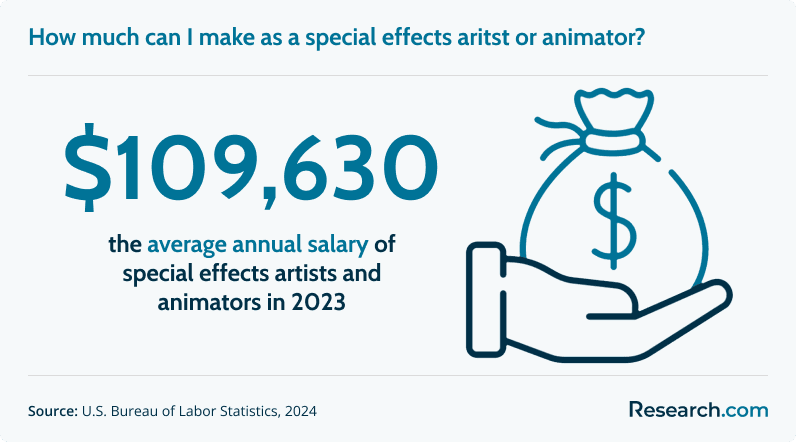
Salary depends on role, industry, location, experience, software specialization, portfolio quality, and whether you work full time, contract, or freelance. As of 2023, special effects artists and animators earned an average annual salary of $109,630. This figure should be treated as a labor-market benchmark, not a guaranteed outcome for every graduate.
Some roles report lower average pay, especially early-career generalist or multimedia positions. Other roles, such as technical director, VFX artist, or specialized game animator, may report higher salaries when the artist has advanced technical ability and a strong production record.
What Is the Job Market for Animators?
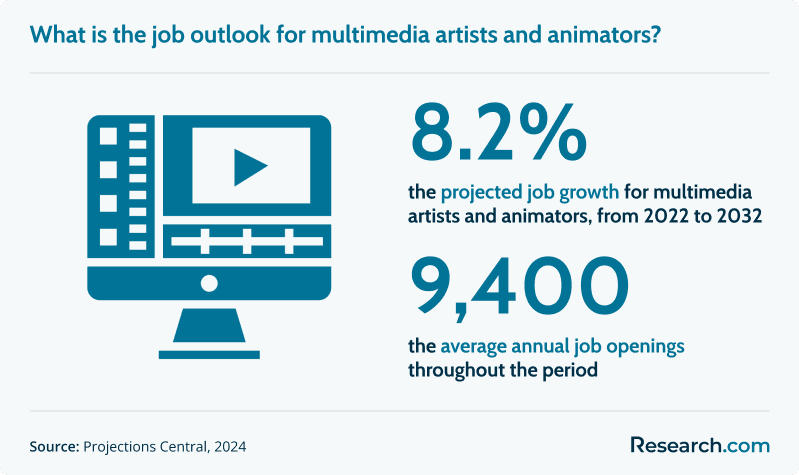
The animation labor market is competitive but active. From 2022 to 2032, employment of multimedia artists and animators is projected to grow by 8.2%, with an average of 9,400 annual job openings. Demand comes from entertainment, games, advertising, streaming content, product visualization, education, corporate media, and emerging interactive formats.
Geography can affect opportunity. In 2023, California had the highest employment level for special effects artists and animators, with 13,470 workers. Other notable states included Washington with 2,490, New York with 1,950, Texas with 1,870, and Florida with 1,690. Remote work and freelance platforms have expanded access to projects, but major production hubs still matter for networking, internships, studio roles, and specialized teams.
What Skills Do You Need for a Successful Animation Career?
Animation careers reward artists who can combine visual judgment with technical execution. Software knowledge matters, but it is only one part of employability. Strong animators understand movement, storytelling, collaboration, file organization, feedback, and production realities.
| Skill | Why it matters | How to demonstrate it |
| Creativity and visual storytelling | Animation must communicate emotion, action, brand identity, or information clearly. | Include scenes, storyboards, character moments, or motion pieces with a clear purpose. |
| Attention to detail | Small timing, spacing, lighting, and continuity errors can weaken finished work. | Show polished final pieces, not only rough tests. |
| Technical proficiency | Studios and clients need artists who can work within common tools and pipelines. | List software honestly and include project files, breakdowns, or process clips when appropriate. |
| Time management | Animation production is deadline-driven and revision-heavy. | Finish capstones, freelance projects, internships, or collaborative assignments on schedule. |
| Collaboration and communication | Animators often work with directors, designers, developers, editors, clients, and other artists. | Explain your role in group projects and how you responded to feedback. |
| Problem-solving | Production work often involves constraints, technical issues, and creative revisions. | Use portfolio descriptions to explain the challenge, your approach, and the outcome. |
Can You Get a Job in Animation With Just a Bachelor’s Degree?
Yes, a bachelor’s degree can be enough for many entry-level animation jobs, but the degree alone is rarely enough. Hiring decisions usually depend on your demo reel, portfolio quality, specialization, software ability, internship or project experience, and whether your work matches the employer’s production needs.
Degree Path
A bachelor’s program can provide structure, critique, production projects, faculty guidance, and access to internships. It is a strong option for students who need a guided path and want time to build a portfolio across several areas.
Self-Taught Path
Some animators build careers through independent study, tutorials, personal projects, online communities, and consistent portfolio development. This route requires discipline and a realistic way to receive feedback from working artists.
Bootcamps and Workshops
Short-term training can help artists strengthen a specific skill, such as character animation, 3D modeling, VFX simulation, storyboarding, or motion graphics. These programs are most useful when they produce portfolio-ready work.
Certifications and Add-On Credentials
Software certifications can support a resume, but they should reinforce a visible skill rather than stand alone. Employers want proof that you can apply tools to real production problems.
If you are comparing animation with other career timelines, Research.com’s guide to 2 year healthcare degrees shows how shorter education pathways can lead to different kinds of workforce entry. The right choice depends on whether your priority is creative work, speed to employment, income stability, or long-term specialization.
What Other Career Paths Can Animation Graduates Pursue?
Animation graduates can move into adjacent creative roles when their portfolios show design thinking, production skill, and audience awareness. For example, motion graphics, graphic design, UX animation, visual effects, social content production, and digital product storytelling often overlap with animation training. If you want to compare related creative paths, review careers connected to a graphics design master’s degree.
Animation can also support careers in creative direction, production management, instructional design, visual journalism, product marketing, scientific communication, and game development. The key is to translate your animation work into the language of the industry you want to enter. A medical company may care about accuracy and clarity. A game studio may care about responsiveness and engine integration. An ad agency may care about speed, brand fit, and concept development.
What Are the Key Strategies for Advancing Your Career in Animation?
Career growth in animation usually comes from specialization, stronger credits, better networks, and the ability to deliver reliably. Early-career animators often begin as generalists or assistants, then move toward a clearer niche such as character animation, rigging, lighting, VFX, motion design, technical art, or art direction.
- Specialize without becoming too narrow too soon. Build one strong primary skill and at least one supporting skill, such as 3D animation plus rigging or motion design plus editing.
- Keep your reel current. Replace student work as soon as you have stronger professional or personal projects.
- Ask for critique from working artists. Feedback from instructors, mentors, supervisors, and peers can reveal weaknesses you may not see.
- Build a professional reputation. Reliability, clear communication, and revision discipline can lead to referrals.
- Study career paths deliberately. Research.com’s guide to a career in animation can help you map options and decide where your skills fit best.
How Can You Build a Compelling Animation Portfolio?
Your portfolio is the most important career asset you will produce. It should answer one question quickly: “Can this person do the work we need?” Do not make employers search through unrelated assignments to find your strongest pieces.
Portfolio Checklist
- Lead with your best work. Put the strongest piece first and avoid saving it for the end.
- Keep the reel focused. A shorter reel with excellent work is better than a long reel with uneven quality.
- Show your specialty. If you want character animation work, prioritize acting, body mechanics, facial expression, and timing. If you want VFX work, show simulations, compositing, breakdowns, and realism.
- Explain your role. For team projects, state exactly what you created.
- Include process selectively. Breakdowns, boards, rigs, models, or before-and-after shots can help employers understand your contribution.
- Make contact easy. Include your name, email, portfolio link, and professional profiles.
If you need to add marketable skills quickly, Research.com’s guide to fast degrees online may help you compare accelerated education options, though animation employers will still expect portfolio evidence.
How Does the Rise of AI Impact Job Opportunities for Animators?
AI is changing animation workflows by assisting with tasks such as rigging, motion capture cleanup, in-betweening, concept exploration, rotoscoping, style testing, and asset generation. These tools can speed up parts of production, but they also raise the bar for entry-level artists whose work previously centered on routine tasks.
The safest strategy is not to ignore AI or rely on it completely. Animators should learn how AI tools fit into production while strengthening skills that remain difficult to automate: visual judgment, storytelling, performance, taste, art direction, ethical decision-making, client communication, and the ability to revise work toward a specific brief.
Some animators may also add management skills to move toward producer, supervisor, or studio leadership roles. For those evaluating graduate business options, Research.com lists MBA under 10k programs that can help compare cost-conscious management education.
The animation industry remains active. In 2022, the US alone had 313 ongoing animation programs commissioned for television and video-on-demand.
What Are the Online Further Education Options for Animation Graduates?
Online learning can help animation graduates update software skills, build a new specialization, or transition into adjacent fields without committing immediately to another full degree. The best option depends on your gap: portfolio quality, tool fluency, technical depth, business knowledge, or industry-specific subject matter.
| Online option | Best use | What to verify |
| Software certificates | Learning Maya, Blender, Houdini, Adobe tools, Unity, or other production software. | Whether the course produces portfolio-ready work, not just completion badges. |
| Specialized animation schools | Focused training in character animation, storyboarding, VFX, or game animation. | Instructor experience, critique quality, student reels, and alumni outcomes. |
| Online college certificates | Structured study that may connect to credit or financial aid eligibility. | Accreditation, cost, transfer policies, and whether the school appears among FAFSA-approved online certificate programs. |
| Short courses | Targeted upskilling through platforms such as Coursera, Udemy, or LinkedIn Learning. | Instructor quality, project depth, and whether the course aligns with your reel goals. |
| Graduate degree | Advanced specialization, teaching, research, or leadership preparation. | Total cost, portfolio expectations, faculty expertise, and career relevance. |
Programs such as CGMA’s professional certificates or Animation Mentor’s online animation program can be useful for artists who need structured critique from experienced practitioners. Before enrolling, compare the curriculum against job postings for the roles you want.
How Can a Game Development Degree Complement Animation Skills?
Game development can make an animator more valuable in interactive media. Game animation differs from linear animation because movement must respond to player input, mechanics, camera changes, and engine constraints. A game-focused education can teach coding basics, game engines, gameplay systems, UI design, asset pipelines, and collaboration with developers.
If your goal is to work on games, VR, AR, or real-time experiences, a game development degree online can complement animation training by giving you technical context beyond character movement or visual polish.
Are There Continuing Education Options for Experienced Animators?
Experienced animators often need targeted education rather than another broad degree. Short courses, mentorship programs, workshops, software certificates, conference training, and advanced studio intensives can help working artists refresh skills without stepping away from employment.
Continuing education can be especially useful when changing specialties, such as moving from 2D animation to motion graphics, from general 3D work to Houdini effects, or from studio production to teaching. Older learners and career changers can also compare flexible programs through Research.com’s guide to online school for seniors.
Is a Doctorate the Next Step in Advancing an Animation Career?
A doctorate is not the standard next step for most studio animators. It may make sense if your goals involve academic research, university teaching, curriculum leadership, emerging media research, animation technology, human-computer interaction, digital arts theory, or executive-level innovation work.
For artists focused on production roles, a stronger reel, targeted mentorship, or a specialized master’s program may offer a clearer return. If you are considering doctoral study for research or academic reasons, compare program cost carefully, including options such as cheap online PhD programs.
Can Combining AI and Animation Further Enhance Career Prospects?
Combining AI and animation can strengthen your profile if you use AI as a production and creative problem-solving tool rather than a shortcut. Employers may value artists who understand automation, procedural workflows, generative tools, dataset limitations, ethical use, and how to integrate AI outputs into a controlled art direction process.
Animators interested in deeper AI knowledge can explore online AI masters programs. This path is most relevant for technical artists, creative technologists, tool builders, researchers, and professionals working in simulation, interactive media, or advanced visual effects.
Can Complementary Technical Skills Enhance an Animation Career?
Yes. Technical skills can help animators move into higher-responsibility roles, especially in 3D production, games, simulation, pipeline development, tools, rendering, and interactive experiences. Useful areas include scripting, Python, game engines, shaders, procedural modeling, data visualization, real-time rendering, and basic software development.
Some animators also study engineering or hardware-related subjects when working in simulation, robotics visualization, product animation, or embedded interactive systems. If you are comparing technical education costs, Research.com’s guide to electrical engineering degree cost can provide a benchmark for a very different but potentially complementary discipline.
What Is the Return on Investment of an Animation Degree?
The ROI of an animation degree depends on total cost, debt, portfolio strength, internships, location, job target, and how quickly you can earn paid credits after graduation. A high-cost program with weak portfolio support may be risky. A lower-cost program with strong faculty critique, industry connections, transfer options, and portfolio outcomes may be more practical.
Questions to Ask Before Enrolling
- Is the institution accredited?
- Does the program publish student reels or portfolio examples?
- Are internships, studio projects, or industry critiques available?
- Which software and production workflows are taught?
- How much will tuition, fees, software, hardware, supplies, and living costs add up to?
- Can you transfer credits from a community college or prior program?
- What roles do graduates actually obtain?
- Does the curriculum match your target career: games, VFX, motion graphics, 2D animation, 3D animation, or visualization?
Students still deciding on a major can compare animation with other options through Research.com’s guide to the best degree to get. The “best” degree is not universal; it depends on your skills, career goals, finances, and willingness to build a portfolio outside class.
Which Professional Networks Can Boost an Animation Career?
Professional networks can lead to critiques, internships, referrals, collaborations, and freelance clients. Animation is a relationship-driven field because studios and producers often hire people whose work and reliability are already known.
- ASIFA-Hollywood: Useful for animation community engagement, events, and industry visibility.
- SIGGRAPH: Valuable for computer graphics, visual effects, real-time technology, research, and technical artistry.
- ArtStation and Behance: Helpful for portfolio visibility and discovery.
- LinkedIn: Important for professional networking, recruiters, studio updates, and alumni connections.
- Local meetups and festivals: Useful for finding regional studios, indie teams, and collaborators.
Animators who want to build networks in emerging technology may also consider programs such as an accelerated online AI masters degree, particularly if their goals include creative technology, real-time pipelines, or AI-supported media production.
How Can You Finance Animation Education Affordably?
Animation education can become expensive because students may need tuition, fees, hardware, drawing supplies, software, storage, and portfolio expenses. Cost control matters because early animation careers can include internships, contract work, freelance gaps, or relocation costs.
Ways to Reduce Cost
- Start with community college and transfer credits into a bachelor’s program.
- Compare public, private, online, and hybrid options.
- Check institutional scholarships, portfolio scholarships, grants, and work-study options.
- Use student discounts for software and hardware when available.
- Choose a program with strong portfolio outcomes, not just attractive facilities.
- Consider a lower-cost entry point such as a cheap online associates degree if you need foundational coursework before committing to a bachelor’s program.
What Are the Admission Requirements for Animation Graduate Programs?
Graduate animation programs usually evaluate both academic readiness and creative potential. Requirements vary, but applicants are commonly asked for transcripts, a portfolio or reel, a statement of purpose, recommendation letters, resume or CV, and evidence of relevant art, design, or production experience.
The portfolio is often the most important part of the application. It should show your current skill level, your artistic direction, and your ability to complete work. If you are looking for programs with more accessible admissions standards, Research.com’s guide to the easiest masters programs to get into can help you understand how admissions selectivity differs, although animation programs may still require strong creative submissions.
Should You Pursue an Advanced Degree to Accelerate an Animation Career?
An advanced degree can help if it gives you a specific advantage: advanced technical training, a stronger portfolio, teaching preparation, research experience, industry mentorship, or leadership development. It may not be necessary if your main barrier is a weak reel, limited networking, or lack of practical experience.
Before enrolling, compare the cost of the degree with the career outcome you want. For working professionals who need a faster academic pathway, online one year masters programs may be worth reviewing, but only if the curriculum directly supports your animation goals.
Could an Accelerated Online Doctorate Propel an Animation Career?
An accelerated doctorate is a specialized option, not a mainstream animation career requirement. It may be relevant for professionals pursuing academic leadership, research, digital media theory, human-computer interaction, visualization research, or executive roles that require advanced credentials.
If you are comparing doctoral formats, review completion expectations, dissertation or capstone requirements, accreditation, faculty expertise, and total cost. Research.com’s guide to a 1 year online PhD can help you understand accelerated doctoral pathways, but students should verify whether any program fits their discipline and career purpose.
Can Health Informatics Enhance Medical Animation?
Medical animation is a specialized area where accuracy matters as much as visual quality. Animators may create surgical explanations, anatomy models, patient education videos, pharmaceutical visuals, medical device demonstrations, or training simulations.
Health informatics can support this path by helping animators understand healthcare data, clinical workflows, terminology, privacy concerns, and evidence-based communication. If you want to move into medical visualization, studying online health informatics may complement animation skills and improve your ability to collaborate with clinicians, researchers, and healthcare organizations.
What Are the Emerging Trends in the Animation Industry?
Animation is being shaped by new production tools, changing viewer habits, interactive media, and cross-industry demand. Graduates who understand these shifts can make smarter decisions about specialization and portfolio development.
- AI-assisted workflows: AI tools are influencing concept development, cleanup, rigging, motion assistance, and production efficiency, which makes creative judgment and tool literacy more important.
- Real-time production: Game engines and real-time rendering are increasingly relevant for games, virtual production, VR, AR, simulation, and interactive experiences.
- Streaming and content diversification: Streaming platforms and digital media channels continue to support demand for animated content, including culturally varied stories and niche formats.
- Hybrid styles: Blending 2D and 3D techniques can create distinctive visual identities while supporting efficient workflows.
- Remote and cloud-based collaboration: Distributed production makes it possible to work with teams and clients beyond one city, but it also requires strong communication and file-management discipline.
- Non-entertainment demand: Healthcare, education, automotive, corporate learning, architecture, and product visualization use animation to explain complex ideas.
Working adults who need flexibility while responding to these changes can compare online degrees for working adults.
What Challenges Do Animation Graduates Encounter in Today’s Competitive Market?
Animation graduates often face a difficult mix of creative competition, fast-changing software, project-based hiring, and portfolio pressure. A degree can help, but it does not guarantee employment. Graduates need to show production-ready work and continue improving after school.
| Common mistake | Why it hurts | Better approach |
| Choosing a program without checking accreditation | It can affect transfer credits, financial aid, and credential recognition. | Verify accreditation before applying or borrowing. |
| Focusing only on tuition | Software, hardware, fees, supplies, and relocation can change the real cost. | Calculate total attendance and portfolio-building expenses. |
| Relying only on a degree | Employers usually hire based on demonstrated work. | Build a targeted reel, seek critique, and complete practical projects. |
| Making a portfolio too broad | Employers may not understand what role you want. | Tailor reels for character animation, VFX, games, motion graphics, or modeling. |
| Ignoring networking | Many opportunities come through referrals and industry relationships. | Attend events, join communities, maintain alumni connections, and ask for feedback. |
| Assuming online programs are automatically career-ready | Quality varies widely across online courses and degrees. | Review student work, faculty background, critique structure, and career support. |
Some students may reduce cost and build foundations through an accelerated associate degree program, especially if they plan to transfer later or need a shorter path to basic technical skills.
How Can Data Science Enhance an Animation Career?
Data science can strengthen animation careers in areas where creative decisions intersect with audience behavior, production planning, simulation, personalization, and analytics. For example, data skills can help teams evaluate viewer engagement, forecast content performance, optimize production resources, or build data-driven visualizations.
This combination is most relevant for animators interested in analytics-driven media, interactive platforms, technical art, visualization, marketing performance, or production strategy. If you want a structured way to add analytical skills, compare options such as a cheap online masters in data science.
What Graduates Say About Their Animation Degree
- The program helped me understand both the creative and technical sides of animation. Working with different tools, receiving critiques, and completing hands-on projects made the transition into the job market much easier. Miles
- My degree gave me a practical foundation and helped me see how the industry works. Faculty experience, software training, internships, and production-style projects were the most useful parts of the program. Lisa
- The biggest benefit was building real work for my portfolio. The program pushed me to use industry tools, accept feedback, and develop the confidence to present my work professionally. Blake
Key Insights
- An animation degree can lead to careers in animation, VFX, games, motion design, storyboarding, character design, 3D modeling, technical direction, corporate media, medical visualization, and VR/AR.
- The degree is most valuable when it produces a strong portfolio. Employers and clients usually care more about finished work and production readiness than coursework alone.
- In 2023, special effects artists and animators earned an average annual salary of $109,630, but actual earnings vary by role, industry, location, experience, and employment type.
- The job outlook is positive, with projected growth of 8.2% from 2022 to 2032 and an average of 9,400 annual openings for multimedia artists and animators.
- California remains the largest employment hub, with 13,470 special effects artists and animators in 2023, but remote work and freelance production have broadened access to projects.
- Freelancing can offer flexibility, but it requires business discipline, contracts, client communication, pricing strategy, and consistent self-marketing.
- AI is changing animation workflows. Graduates who learn to use AI tools while strengthening storytelling, art direction, technical judgment, and ethical decision-making will be better positioned.
- Before choosing a program, verify accreditation, compare total cost, review student portfolios, ask about internships, and make sure the curriculum matches your target career path.
References:
- Glassdoor. (2024). How much does a storyboard artist make? Retrieved September 19, 2024, from Glassdoor.
- Glassdoor. (2024). How much does a character designer make? Retrieved September 19, 2024, from Glassdoor.
- Glassdoor. (2024). How much does a technical art director make? Retrieved September 19, 2024, from Glassdoor.
- Indeed. (2024). Multimedia designer salary in United States. Retrieved September 19, 2024, from Indeed.
- Projections Central. (2024). Long-term occupational projections (2022-2032). Retrieved September 19, 2024, from Projections Central.
- Salary.com. (2024). 3D modeler salary in the United States. Retrieved September 19, 2024, from Salary.com.
- Statista. (2022, June 15). Number of ongoing animation programs commissioned for TV and video-on-demand in selected markets worldwide as of May 2022, by country. Statista.
- Talent.com. (2024). Vfx Artist average salary in the USA, 2024. Retrieved September 19, 2024, from Talent.com.
- Talent.com. (2024). Animator average salary in the USA, 2024. Retrieved September 19, 2024, from Talent.com.
- U.S. Bureau of Labor Statistics. (2024). Occupational employment and wages, May 2023 - 27-1014 Special effects artists and animators. Retrieved September 19, 2024, from BLS.
- U.S. Bureau of Labor Statistics. (2024). Special effects artists and animators. Retrieved September 19, 2024, from BLS.
- ZipRecruiter. (2024). Animator salary. Retrieved September 19, 2024, from ZipRecruiter.
Other Things You Should Know About What You Can Do With an Animation Degree
In 2027, animation graduates can explore diverse career paths including 3D modeling, game design, and visual effects artistry. The growing demand in entertainment, tech, and advertising industries offers roles such as animator, storyboard artist, and multimedia specialist.
To succeed with an animation degree in 2027, you need strong skills in 3D modeling, computer graphics, and storytelling. Knowledge of software like Maya and Adobe Creative Suite is essential. Additionally, understanding emerging technologies like virtual reality can provide a competitive edge.
Animation employers expect a short, focused portfolio with 8 to 12 pieces that show character design, storyboard panels, animation clips, and 3D modeling or motion graphics work. For many studios, a demo reel under 90 seconds is preferred, with your strongest work first.


