
2027 Best Careers To Pursue With an History Master’s Degree

Co-Founder and Chief Data Scientist
A master’s degree in history can lead to far more than teaching, but the best path depends on how you want to use your research, writing, interpretation, and evidence-analysis skills. Some graduates move into museums, archives, higher education, public policy, cultural resource management, publishing, journalism, law-related work, nonprofit development, or digital humanities. Others use the degree as a foundation for doctoral study, law school, or a career pivot into research-heavy business and communications roles.
This guide is for students considering a history master’s degree, current graduate students planning their next step, and working adults deciding whether advanced history study can support a career change. You will learn which careers commonly fit the degree, what skills employers value, how to present your research experience outside academia, what certifications can strengthen your profile, and what mistakes to avoid when comparing programs or career options.
Quick Answer: What Can You Do With a Master’s in History?
With a master’s in history, you can pursue careers in museums, archives, higher education, public policy, historical consulting, cultural resource management, grant writing, digital history, genealogy, and research-based writing or editing. The degree is especially useful for roles that require advanced research, source evaluation, long-form writing, historical interpretation, and the ability to explain complex context clearly.
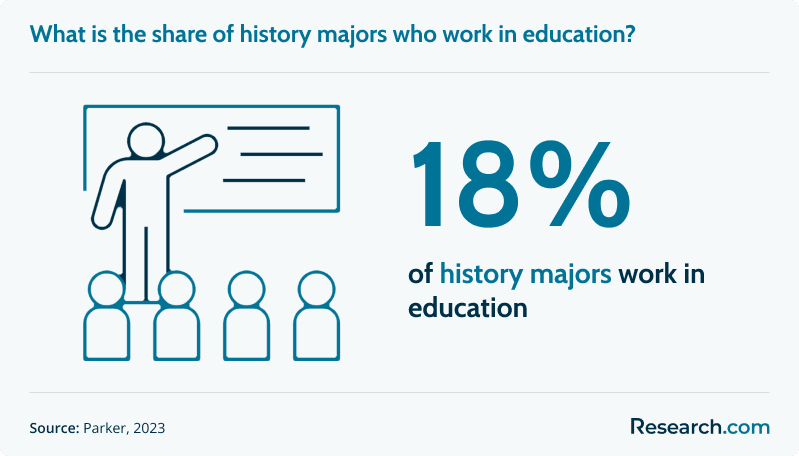
The degree is not limited to academia. While 18% of history majors work in education, graduates also enter management, legal, sales, and administration roles. For readers who want a wider view of possible outcomes, Research.com’s guide to history career paths can help connect specific roles with education and experience requirements.
Key Things You Should Know About Careers to Pursue with a History Master's Degree for 2027
- Employment outcomes are broader than many students assume. A 2023 survey by the American Historical Association found that 86% of history graduates were employed or continuing their education within one year of graduation, which shows that the degree can support multiple professional directions when paired with a clear career strategy.
- Education is only one major destination. Although 18% of history majors work in education, graduates also move into management (15%), legal (11%), sales (10%), and administration (10%) roles.
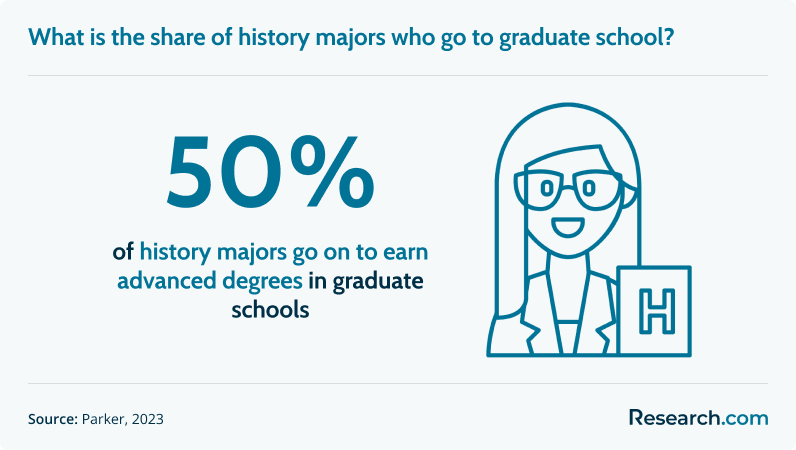
- Graduate study is common among history majors. 50% of history majors pursue advanced degrees, reflecting the major’s strong preparation for academic, professional, and research-focused pathways.
- Transferable skills are the degree’s main career asset. Employers can use the research, critical thinking, writing, communication, and analytical skills developed in graduate history training across business, law, government, nonprofit, media, and cultural organizations.
- Historical context remains professionally useful. Organizations that work across cultures, communities, policy areas, heritage assets, or public communication often need people who can explain how past events shape current decisions.
- Additional credentials can improve marketability. Certifications in archival science, museum studies, digital humanities, project management, grant writing, or public history can help translate academic preparation into job-ready specialization.
- Best careers for history master’s graduates in 2027
- Which history master’s skills matter most to employers?
- What transferable abilities do history master’s graduates develop?
- How should history graduates build a professional network?
- How should history master’s graduates write a stronger resume?
- Do internships matter for history master’s graduates?
- How can history students use LinkedIn effectively?
- How can graduates present research experience to employers?
- Can flexible history master’s programs work for nontraditional students?
- Can a history master’s degree lead to journalism?
- Can fast online credentials complement a history master’s degree?
- Can accelerated degrees strengthen a history graduate’s career options?
- How can history master’s graduates find financial aid for further study?
- Can you finish a history master’s degree in one year?
- What unconventional careers fit a history master’s degree?
- Which professional certifications pair well with a master’s in history?
- What challenges do history master’s graduates face in the labor market?
- Which certification choices can improve career prospects?
- What emerging skills should history graduates build?
- What advanced academic options are available after a history master’s degree?
- Which academic fields complement a master’s in history?
Best Careers to Pursue with a History Master's Degree for 2027
The strongest career choice for a history master’s graduate usually depends on three questions: Do you want to work directly with historical materials? Do you prefer research and writing? Or do you want to apply historical thinking in policy, law, communications, education, or technology? A master’s degree can be especially helpful for roles that involve original research, collections work, public interpretation, advanced writing, or specialized subject expertise.
| Career | Median Salary | Job Outlook | Best Fit For |
| Museum Curator | $54,570 | 11% | Graduates interested in collections, exhibitions, public education, and object-based interpretation. |
| Archivist | $56,760 | 11% | Students who enjoy preservation, records management, metadata, and helping researchers access primary sources. |
| History Professor | $80,560 | 8% | Graduates planning for teaching, academic research, publishing, and often further doctoral study. |
| Policy Analyst | $78,700 | 3% | Researchers who want to connect historical context with public issues, legislation, programs, and institutional decisions. |
| Digital Historian | $62,000 | 6% | Graduates who want to combine historical research with digital archives, mapping, databases, or public-facing tools. |
| Historical Consultant | $65,000 | 6% | Professionals who can advise media, authors, developers, heritage organizations, or institutions on historical accuracy. |
| Genealogist | $50,000 | 6% | Researchers who enjoy archival investigation, family records, local history, and client-facing historical documentation. |
| Cultural Resource Manager | $63,000 | 6% | Graduates interested in historic preservation, compliance, heritage sites, and coordination with public or private stakeholders. |
| Grant Writer | $53,800 | 4% | Strong writers who want to help museums, nonprofits, schools, or historical organizations secure funding. |
| Historical Writer or Editor | $62,400 | 5% | Graduates who want to turn research into books, articles, scripts, web content, educational materials, or editorial projects. |
Museum Curator
Median Salary: $54,570
Job Outlook: 11%
Museum curators care for collections, shape exhibitions, research artifacts or artworks, and help the public understand the significance of historical materials. This path is a good fit if you enjoy combining scholarship with storytelling, preservation, and public engagement.
Archivist
Median Salary: $56,760
Job Outlook: 11%
Archivists preserve, arrange, describe, and provide access to records, photographs, manuscripts, digital files, and other historically important materials. They often work for museums, libraries, universities, government offices, historical societies, and other institutions responsible for long-term records stewardship.
History Professor
Median Salary: $80,560
Job Outlook: 8%
History professors teach college courses, advise students, design curricula, conduct research, and publish scholarly work. A master’s degree may support some teaching roles, but competitive academic positions often require additional graduate preparation, especially for tenure-track university jobs.
Policy Analyst
Median Salary: $78,700
Job Outlook: 3%
Policy analysts evaluate public issues, programs, laws, and institutional decisions. A history background can be valuable because policy work often requires understanding long-term causes, social context, precedent, and the consequences of previous decisions.
Digital Historian
Median Salary: $62,000
Job Outlook: 6%
Digital historians use technology to organize, analyze, visualize, and present historical information. Common projects may involve digital archives, interactive timelines, mapping tools, databases, online exhibits, or educational resources.
Historical Consultant
Median Salary: $65,000
Job Outlook: 6%
Historical consultants provide subject-matter expertise for films, documentaries, books, exhibits, heritage projects, institutional histories, and preservation efforts. This career rewards graduates who can verify facts, explain context, and communicate clearly with nonacademic audiences.
Genealogist
Median Salary: $50,000
Job Outlook: 6%
Genealogists investigate family histories through census records, archives, immigration documents, local histories, legal records, newspapers, and other sources. The work requires patience, documentation discipline, and the ability to turn fragmented evidence into a coherent narrative.
Cultural Resource Manager
Median Salary: $63,000
Job Outlook: 6%
Cultural resource managers help identify, protect, and interpret historic sites, artifacts, and landscapes. They may coordinate with government agencies, developers, tribes, preservation organizations, or private firms to support compliance with heritage protection requirements.
Grant Writer
Median Salary: $53,800
Job Outlook: 4%
Grant writers prepare funding proposals, project descriptions, budgets, and supporting materials for organizations such as museums, historical societies, universities, libraries, and education nonprofits. History graduates often bring strong evidence-based writing and mission-focused storytelling to this work.
Historical Writer or Editor
Median Salary: $62,400
Job Outlook: 5%
Historical writers and editors create, revise, and fact-check content for books, magazines, online publications, museums, educational platforms, documentary projects, and other media. If you want to combine historical expertise with narrative craft, pairing history training with writing study can be useful; Research.com’s guide to the best online master’s programs in creative writing can help you compare related options.
How to Choose the Right History Career Path
| If You Prefer... | Consider... | Why It May Fit |
| Working with original sources and records | Archivist, genealogist, digital historian | These roles rely on documentation, source evaluation, cataloging, and long-term preservation. |
| Public education and interpretation | Museum curator, historical consultant, cultural resource manager | These careers turn historical evidence into exhibits, site interpretation, media guidance, or community-facing projects. |
| Research and argumentation | Policy analyst, professor, legal-adjacent roles | These fields value evidence-based reasoning, persuasive writing, and contextual analysis. |
| Writing for broad audiences | Historical writer or editor, grant writer, journalism-related roles | These careers reward clarity, accuracy, narrative structure, and audience awareness. |
| Technology-supported research | Digital historian, digital archivist, data visualization roles | Digital tools can expand access to historical materials and make research more usable for public or institutional audiences. |
What skills from a history master’s degree are most valuable in the job market?
The most marketable skills from a history master’s degree are not limited to knowing historical facts. Employers are more likely to value how you think, how you investigate evidence, how you explain complexity, and how reliably you can produce polished work from messy information.
- Critical thinking. Graduate history training requires you to compare explanations, test claims against evidence, and avoid unsupported conclusions.
- Advanced research. Students learn to locate, assess, organize, and synthesize information from primary sources, secondary scholarship, archives, databases, and public records.
- Clear writing. History graduate work builds the ability to produce structured, evidence-based writing for expert and nonexpert readers.
- Contextual judgment. Understanding political, social, economic, and cultural context can help organizations make better decisions in multicultural or historically sensitive environments.
- Evidence interpretation. Many employers need professionals who can interpret qualitative and quantitative information, identify patterns, and explain what the evidence does and does not prove.
These strengths also explain why history can work well as a pre-law background. A bachelor’s degree in history can help prepare students for legal study, and some graduates gain experience as paralegals before law school. Research.com’s comparison of paralegals and lawyers explains how the roles differ, including the juris doctor and bar exam requirements for lawyers.
History graduates’ employment patterns should also be viewed alongside broader enrollment and field data. The American Historical Association’s tracking of undergraduate history enrollments provides useful context for understanding student interest in the discipline and its long-term academic pipeline.
What transferable skills do history master’s graduates gain?
Transferable skills are the bridge between a history degree and jobs that do not include “historian” in the title. The key is to translate academic experience into employer language: research becomes market analysis, thesis planning becomes project management, and seminar discussion becomes stakeholder communication.
- Analytical reasoning. History graduates learn to evaluate competing interpretations, identify weak evidence, and build logical arguments. This is one reason history can support legal preparation; students considering that route can review Research.com’s guide to degree options for future lawyers.
- Project management. Completing a thesis, capstone, or major research paper requires planning, scheduling, source tracking, revision, and independent execution.
- Public speaking. Graduate seminars, conference presentations, teaching assistantships, and public history projects often build confidence in explaining complex material aloud.
- Collaboration. Research teams, faculty mentorship, exhibit projects, archives work, and community partnerships help students learn how to work with different stakeholders.
- Adaptability. Because history covers institutions, cultures, economies, conflicts, communities, and ideas, graduates can often move across subject areas and industries.
| Academic Experience | Employer-Friendly Translation | Where It Helps |
| Writing a thesis or capstone | Managing a long-term research project from question development to final deliverable | Policy, consulting, publishing, nonprofit research, communications |
| Archival research | Finding, verifying, organizing, and interpreting complex records | Archives, museums, law-adjacent work, genealogy, compliance, records management |
| Seminar presentations | Explaining specialized information to a defined audience | Teaching, training, public history, client-facing roles, program management |
| Historiography review | Comparing competing interpretations and identifying evidence gaps | Research analysis, policy, journalism, strategy, legal support |
| Digital history project | Using tools to organize, visualize, or publish information | Digital archives, content strategy, educational technology, public humanities |
These skills can support employment in many industries, but they are most valuable when paired with examples. Employers need to see evidence of outcomes: reports completed, collections processed, exhibits supported, grants drafted, datasets cleaned, interviews conducted, or public programs delivered.
How can history graduates build a professional network?
History careers are often relationship-driven, especially in museums, archives, public history, nonprofit work, consulting, and higher education. A strong network can help you learn which roles are realistic, what qualifications employers expect, and where openings may appear before they are widely advertised.
- Start with your department. Ask faculty, advisors, and alumni about career paths connected to your research interests, not just academic jobs.
- Join relevant professional associations. Organizations such as the American Historical Association, public history groups, museum associations, and archival organizations can provide job boards, conferences, webinars, and mentoring opportunities.
- Attend events with a goal. Before a conference or local history event, identify a few people or institutions you want to learn about and prepare specific questions.
- Volunteer strategically. Museums, historical societies, archives, preservation groups, and community history projects can offer practical exposure and contacts.
- Maintain relationships. Send thoughtful follow-ups, share relevant work, and keep mentors informed about your progress without contacting them only when you need a recommendation.
What are the best resume tips for history master’s degree holders?
A strong resume for a history master’s graduate should not read like an academic transcript. It should show what you can do for an employer: research, write, organize information, manage deadlines, communicate findings, and support projects with accuracy.
- Customize every resume. Match your strongest experiences to the job description instead of sending the same academic-focused document to every employer.
- Translate your research. Describe research projects in terms of scope, sources, methods, deliverables, and audience.
- Use numbers when they are accurate. If you processed a collection, supported an exhibit, wrote grant materials, or managed content, quantify the work only when you can do so truthfully.
- Include relevant affiliations. Professional memberships can signal engagement with archives, museums, public history, digital humanities, or your historical specialty.
- Keep the document focused. A concise resume is usually more effective than a long list of coursework unless the coursework directly supports the role.
If you completed a more affordable online history program, you can frame that experience positively by emphasizing self-direction, digital collaboration, schedule management, and the ability to balance rigorous study with work or family responsibilities.
| Common Resume Problem | Better Approach |
| Listing only courses and professors | Highlight projects, research methods, tools, writing outputs, and public-facing work. |
| Using academic language without explanation | Convert specialized terms into skills employers recognize, such as analysis, reporting, editing, or records management. |
| Describing duties instead of results | Show what you produced, improved, organized, presented, or delivered. |
| Sending the same resume for every role | Adjust keywords and examples for archives, policy, museums, writing, nonprofit, or business roles. |
| Hiding technical skills | List digital archives tools, databases, GIS, content systems, citation managers, or other relevant platforms if you have used them. |
Are internships important for history master’s graduates?
Internships can be very important because many history-related employers want proof that you can apply academic skills in practical settings. Museums, archives, government agencies, historical societies, policy organizations, publishers, and nonprofits may use internships to evaluate whether candidates understand workplace expectations, deadlines, public audiences, and collaborative projects.
For students moving from graduate school into nonacademic careers, internships can reduce the “experience gap.” They can also help you test a path before committing to it. A student who thinks they want museum work may discover they prefer archives; another who enjoys historical writing may find grant writing or journalism more practical.
Where to Look for History Internships
- Museums and historical societies. Look for collections, education, exhibition, interpretation, and visitor engagement opportunities.
- Archives and libraries. Search for processing, digitization, metadata, preservation, and reference internships.
- Government offices. Consider records management, policy research, historic preservation, and cultural resource roles.
- Nonprofit organizations. Explore grant writing, program evaluation, community history, and public engagement positions.
- Media and publishing organizations. Seek research, fact-checking, editorial, documentary, or content development internships.
How can history students leverage LinkedIn to find job opportunities?
LinkedIn works best when history students use it as a professional research and relationship-building tool, not just a place to upload a resume. A strong profile should explain your historical training in practical terms and make it easy for employers or alumni to understand your interests.
- Write a clear headline. Use language such as “History MA candidate focused on archival research and public history” or “Graduate researcher interested in policy analysis and historical communication.”
- Showcase projects. Add thesis topics, digital exhibits, archival projects, conference presentations, publications, or public history work.
- Follow target organizations. Track museums, archives, universities, policy centers, nonprofits, publishers, and cultural institutions.
- Join relevant groups. Participate in history, archives, museum, public humanities, and digital humanities communities.
- Request informational interviews. Contact alumni or professionals with specific, respectful questions about their roles and career paths.
- Engage with substance. Share or comment on historical work, public history projects, research tools, and career-relevant discussions.
How can history master’s graduates showcase their research experience to employers?
Research experience becomes more persuasive when you describe it as a process and an outcome. Instead of saying only that you wrote a thesis, explain the question you investigated, the sources you used, the method you applied, the deliverable you produced, and why the work mattered.
- On a resume: Use bullet points that connect research to skills such as source evaluation, database searching, archival documentation, qualitative analysis, writing, editing, or presentation.
- In a portfolio: Include writing samples, exhibit text, digital projects, published articles, conference papers, grant samples, or public history materials when you have permission to share them.
- In interviews: Prepare a short example of a difficult research problem, how you verified information, and how you communicated findings to an audience.
- For career changes: Connect your work to the employer’s needs, such as compliance, policy context, audience education, historical accuracy, records organization, or strategic communication.
If you are still comparing programs, understanding typical history degree requirements can help you choose coursework, research experiences, and capstone options that align with your target roles.
Can flexible history master’s programs address the needs of nontraditional students?
Flexible history master’s programs can be useful for working adults, parents, military-affiliated learners, caregivers, and students who cannot relocate for graduate school. Online and hybrid formats may offer asynchronous coursework, part-time enrollment, digital library access, remote advising, and recorded lectures, making advanced study more manageable for students with substantial responsibilities outside school.
Flexibility should not be the only selection factor. Nontraditional students should also verify accreditation, faculty expertise, research expectations, internship access, technology support, transfer policies, and whether the program’s schedule fits their actual weekly availability. Students balancing family and education may also benefit from Research.com’s guide to college options for moms.
Can a History Master’s Degree Transition into Journalism?
A history master’s degree can support a move into journalism because both fields require careful research, source evaluation, context, writing discipline, and the ability to explain complicated events clearly. History graduates may be especially well suited for long-form reporting, investigative research, documentary work, historical features, fact-checking, editorial research, and analysis-driven media roles.
The transition usually requires building journalism-specific evidence. That may include clips, newsroom internships, multimedia skills, interviewing experience, editing practice, and familiarity with media ethics. If you are weighing this shift, Research.com’s guide asking whether journalism is a good major can help you compare expectations in the media field.
Can fast online degrees complement a history master’s degree?
Fast online credentials can complement a history master’s degree when they add skills that employers specifically request. For example, a history graduate interested in digital archives, communications, nonprofit operations, or data-supported research may benefit from targeted training outside the traditional history curriculum.
The best choice is not the fastest credential by default. Before enrolling, compare outcomes, accreditation, cost, workload, and whether the program teaches a skill you will actually use. Research.com’s overview of quick online degrees can help readers understand how shorter programs may fit into a broader career plan.
Can additional accelerated degrees amplify your career trajectory?
Accelerated degrees can be useful when they fill a clear gap between historical expertise and a target job. A graduate who wants to work in records management, paralegal support, digital media, business administration, or information technology may benefit from a faster credential that adds practical training.
However, adding another degree without a purpose can increase cost and delay job searching. Compare accelerated options carefully and ask whether a certificate, internship, portfolio project, or employer training would be more efficient. Students exploring shorter academic pathways can review Research.com’s guide to the quickest associate degree options.
How can history master’s graduates secure financial aid for advanced education?
History master’s graduates planning further study should compare funding sources before committing to a program. Options may include institutional scholarships, department awards, assistantships, grants, employer tuition support, federal aid, and loans. The right mix depends on program format, enrollment status, eligibility, academic goals, and expected career return.
Applicants should ask schools direct questions about total cost, fees, assistantship availability, scholarship renewal rules, loan obligations, and whether part-time students qualify for the same aid as full-time students. Research.com’s guide to online colleges that accept financial aid may help students identify flexible programs that participate in aid processes.
Can I complete a history master's degree in one year?
Some students may be able to complete a history master’s degree in one year through an accelerated program, but the workload can be intensive. Traditional master’s programs in history often extend over two years, especially when students complete a thesis, language requirement, teaching responsibilities, or substantial research component.
Before choosing a one-year format, verify accreditation, faculty support, research expectations, course availability, and whether the compressed timeline will still allow you to complete internships, writing samples, or a thesis that supports your goals. Students comparing accelerated graduate options can review Research.com’s guide to one year degree programs.
What are some unconventional career paths for history master’s degree holders?
Not every history master’s graduate wants a museum, archive, or classroom career. Some use the degree in roles that require narrative skill, cultural context, research depth, or the ability to explain how institutions and communities change over time.
- Content creation. History graduates can write, edit, script, research, or produce educational and historical content for digital platforms, publishers, podcasts, documentaries, or cultural organizations.
- Policy analysis. Historical context can help analysts understand how public problems developed and why previous solutions succeeded or failed.
- Cultural resource management. This path connects historical research with preservation, compliance, community engagement, and heritage protection.
- Corporate storytelling. Some organizations need professionals who can research institutional history, develop anniversary campaigns, create archives, or shape brand narratives responsibly.
- Technology-supported history work. Digital archiving, data visualization, GIS, digital exhibits, and metadata projects can turn historical expertise into accessible public resources.
- Media consulting. Film, television, documentary, gaming, and publishing projects may need historical accuracy review, including areas related to art history careers.
Some graduates also explore broader education settings beyond the traditional secondary or college classroom. If you are considering early learning environments, Research.com’s guide asking whether early childhood education is easy can help clarify the demands of that field.
| Unconventional Path | Why History Helps | What to Add |
| Journalism or documentary research | Source checking, context, narrative structure, and investigative habits | Published clips, interviewing practice, multimedia production, newsroom experience |
| Corporate or institutional history | Archival research and responsible storytelling | Communications skills, project management, stakeholder interviewing |
| Digital humanities | Historical interpretation combined with public access | GIS, metadata, web publishing, database skills, visualization tools |
| Grant writing | Evidence-based persuasion and mission-driven writing | Budget literacy, nonprofit experience, proposal samples |
| Legal-adjacent research | Document analysis, argument construction, and precedent awareness | Legal terminology, paralegal experience, compliance knowledge |
What professional certifications complement a master’s in history?
Certifications can help history master’s graduates demonstrate specialized, practical competence. They are most valuable when they match a target job rather than simply adding another line to a resume.
- Certified Archivist. This credential aligns well with archival preservation, arrangement, description, and access work.
- Project Management Professional (PMP). Project management training can support roles involving exhibits, grants, research programs, digital initiatives, or institutional projects.
- Digital Humanities Certificate. This option can help bridge traditional historical training with digital tools and methods. It may also complement programs similar to those highlighted in Research.com’s guide to the best online history degree programs.
- Grant Writing Certification. This can be useful for nonprofit, museum, academic, and community history roles that depend on external funding.
- Certified Historical Interpreter. This credential can support public-facing roles at historic sites, museums, parks, and heritage organizations.
What challenges do history master’s degree holders face in the evolving job market?
History master’s graduates often face a translation problem: they have strong research and communication skills, but employers may not immediately understand how graduate historical training applies to business, policy, nonprofit, media, or technology roles. This can make the first post-degree job search more difficult if the candidate presents experience only in academic terms.
Other challenges include competition for museum and academic roles, limited entry-level openings in some cultural institutions, the need for digital skills, and the expectation that applicants have internships or applied project experience. Working adults who need affordable upskilling options can review Research.com’s guide to affordable online universities for job holders.
What certification options enhance career prospects for history master’s graduates?
The best certification depends on your intended career direction. Archivist credentials help with records and collections roles, grant writing credentials support nonprofit and museum funding work, project management credentials help with cross-functional projects, and digital humanities training can support technology-enabled history work.
Before paying for a credential, ask whether employers in your target field recognize it, whether it requires experience, how long it takes, and whether you will leave with a portfolio-ready project. Research.com’s review of online certificate programs that pay well can help readers compare broader credential options beyond history.
| Career Goal | Useful Credential Direction | Why It Helps |
| Archives or records work | Archival certification or records management training | Signals knowledge of preservation, description, access, and information stewardship. |
| Museum or public history roles | Historical interpretation or museum studies training | Supports exhibit work, audience engagement, and public-facing historical communication. |
| Nonprofit advancement | Grant writing certification | Shows ability to prepare persuasive, funder-aligned proposals. |
| Digital history | Digital humanities certificate | Builds capacity in digital archives, visualization, mapping, or public web projects. |
| Project-based leadership | Project management credential | Helps demonstrate planning, budgeting, timeline management, and stakeholder coordination. |
What emerging skills can history master’s graduates develop for future success?
History graduates can improve long-term career resilience by adding technical and communication skills that complement traditional research strengths. Digital literacy is especially important as archives, museums, publishers, universities, and public agencies continue to manage large volumes of digital information.
- Digital archiving and metadata. Useful for preserving, describing, and making collections discoverable.
- GIS and mapping tools. Valuable for spatial history, cultural resource management, public history, and community research.
- Data visualization. Helps turn historical or institutional information into accessible charts, maps, timelines, and exhibits.
- Multimedia communication. Supports podcasts, video scripts, online exhibits, social content, and digital learning materials.
- Basic coding or web publishing. Useful for digital humanities projects, online archives, and public-facing research platforms.
- Project management. Important for coordinating exhibits, grants, community partnerships, research teams, and digital initiatives.
Targeted professional development can be more efficient than another full degree if it directly supports your goals. Research.com’s guide to certification programs for careers that pay well can help readers compare credential-based options.
What networking events or organizations are ideal for history professionals?
The best networking spaces depend on your intended niche. Academic historians, public historians, museum workers, archivists, preservation professionals, and digital humanities specialists often gather in different venues. Choose organizations and events that match your career target rather than joining every possible group.
Conferences
- AHA Annual Meeting. The American Historical Association’s major gathering can help students and professionals connect with scholars, employers, publishers, graduate programs, and career resources.
- Regional and specialty conferences. Smaller events focused on public history, digital history, medieval history, environmental history, local history, or another specialty can offer more focused conversations and easier networking.
Professional Organizations
- American Historical Association (AHA). Membership can provide access to publications, resources, events, and professional conversations across the discipline.
- Organization of American Historians (OAH). This organization is relevant for professionals focused on U.S. history, teaching, and scholarship.
- National Council on Public History (NCPH). This is especially useful for professionals in museums, archives, historical societies, consulting, preservation, and other public history settings.
- Specialty organizations. Groups connected to a specific era, region, method, or theme can help you build a more targeted professional identity.
Local History Groups
- Local historical societies. These groups often host lectures, exhibits, volunteer projects, and community history initiatives that can lead to practical experience.
- Community archives. Volunteering or interning with local archives can help you develop hands-on skills and meet professionals who understand regional opportunities.
Online Platforms
- LinkedIn. Use LinkedIn to follow organizations, contact alumni, join professional groups, and track job postings in archives, museums, education, policy, and research.
- Online forums and communities. Digital communities tied to specific historical topics or professional interests can help you learn tools, find projects, and discover less visible career paths.
Students comparing online graduate options can also review communities connected to the best online history degree programs, where alumni and current students may share practical insights about coursework, faculty support, and career outcomes.
What Graduates Say About Their History Master's Degree
“I had always been drawn to history, even though my undergraduate training was in business. After working in finance, I wanted a career that felt more connected to my interests. The online format let me study while keeping my full-time job, and that flexibility helped me move into work with a historical society.” - Shane
“I did not think I could manage graduate school while working and raising a family. Being able to complete coursework around my schedule made the degree possible, and it helped me open new professional doors.” - Kyle
“Returning to school after years in another field was intimidating. The online program gave me access to supportive faculty and a learning environment where I felt taken seriously. It helped me find a clearer direction for the next stage of my career.” - Gabriel
What advanced academic opportunities can history master’s graduates pursue?
History master’s graduates who want to continue in academia may consider doctoral study, specialized research programs, certificates in public history or archival studies, or interdisciplinary graduate work. A PhD can be appropriate for students who want intensive research training, advanced teaching opportunities, or scholarly careers, but it requires careful consideration of time, funding, career goals, and the competitiveness of academic hiring.
When comparing doctoral options, evaluate accreditation, faculty research fit, funding packages, teaching expectations, placement history, dissertation support, and whether online or hybrid formats meet your needs. Students concerned about cost can explore Research.com’s guide to the most affordable online doctorate programs.
What additional academic majors complement a master’s in history?
Complementary academic fields can help history graduates apply their skills in more specialized or marketable ways. Political science, sociology, international relations, education, journalism, library and information science, digital humanities, public administration, and data-focused fields can all pair well with historical training depending on the career goal.
The right combination should support a specific direction. Political science may fit policy work, journalism may fit media careers, library and information science may fit archives, and digital humanities may support technology-enabled research and public history. For a broader comparison of academic fields, review Research.com’s guide to the best college majors to pursue.
Common Mistakes History Master’s Graduates Should Avoid
| Mistake | Why It Hurts | Better Decision |
| Assuming the degree automatically leads to a specific job | Many roles require internships, portfolios, certifications, technical tools, or further education. | Identify target job postings early and build the missing experience before graduation. |
| Choosing a program only because it is convenient | Flexibility matters, but weak advising, limited research fit, or poor career support can reduce value. | Compare accreditation, faculty expertise, curriculum, internship access, and alumni outcomes. |
| Using academic language in job applications | Employers outside academia may not understand thesis-focused descriptions. | Translate research into skills such as analysis, writing, documentation, project management, and reporting. |
| Ignoring digital skills | Many history-related roles now involve digital collections, databases, web content, or online public engagement. | Build experience with digital archives, metadata, GIS, visualization, or publishing tools when relevant. |
| Relying only on rankings or reputation | A highly ranked program may not fit your schedule, budget, research area, or career path. | Use rankings as one input, then evaluate cost, support, curriculum, and professional opportunities. |
| Assuming salary outcomes are guaranteed | Pay varies by role, location, experience, employer type, and additional credentials. | Use salary data as a starting point and research local job postings before enrolling or changing careers. |
Questions to Ask Before Choosing a History Master’s Program or Career Path
- What career do I want this degree to support? A student targeting archives should make different choices than one targeting journalism, policy, or doctoral study.
- Does the program offer applied experience? Look for internships, practicums, digital projects, teaching opportunities, public history work, or thesis options aligned with your goals.
- Who teaches in my area of interest? Faculty expertise matters if you plan to write a thesis, apply to doctoral programs, or build a specialty.
- How will I pay for the degree? Compare tuition, fees, aid, assistantships, employer support, and the opportunity cost of reducing work hours.
- Will online or campus study better serve my goals? Online programs can be flexible, while campus programs may provide easier access to archives, faculty, assistantships, and local internships.
- What evidence will I graduate with? Aim to leave with writing samples, project examples, references, technical skills, and a clear professional story.
Key Insights
- A history master’s degree is most valuable when tied to a career plan. The degree can support museum, archive, policy, education, writing, consulting, nonprofit, journalism, and digital humanities roles, but outcomes depend on experience and positioning.
- The core career asset is skill transfer. Research, writing, evidence analysis, context-building, and communication are useful across many fields when translated into employer language.
- Applied experience matters. Internships, volunteer work, digital projects, portfolios, grant samples, exhibit work, or archival processing experience can make a history graduate more competitive.
- Certifications should be strategic. Choose credentials that match your target role, such as archival certification, digital humanities, grant writing, historical interpretation, or project management.
- Digital skills are increasingly important. Graduates who can work with digital archives, metadata, GIS, web publishing, visualization, or multimedia communication may have more flexible options.
- Program choice should balance cost, quality, fit, and outcomes. Do not choose only by tuition, speed, or ranking; evaluate accreditation, faculty support, curriculum, funding, flexibility, and career preparation.
References:
- Data USA. (2025). History. datausa.io history profile
- US Bureau of Labor Statistics. (29 Aug 2024). Archivists, curators, and museum workers. bls.gov archivists, curators, and museum workers
- US Bureau of Labor Statistics. (29 Aug 2024). Field of degree: History. bls.gov field of degree history
- US Bureau of Labor Statistics. (2 Dec 2024). Political scientists. bls.gov political scientists
- US Bureau of Labor Statistics. (29 Aug 2024). Postsecondary teachers. bls.gov postsecondary teachers
- US Bureau of Labor Statistics. (29 Aug 2024). Technical writers. bls.gov technical writers
- US Bureau of Labor Statistics. (29 Aug 2024). Writers and authors. bls.gov writers and authors
Other Things You Should Know About Careers to Pursue with a History Master's Degree
Yes. Public-school K–12 history teachers usually need a state-issued teaching license, plus a bachelor’s degree, supervised student teaching, and passing scores on state content and pedagogy exams. Private schools may not require licensure, but public schools do.
In 2027, top career paths for history master's degree holders include museum curator, archivist, historical consultant, and policy analyst. These roles leverage expertise in research and historical analysis, offering varied opportunities across public history, government, and cultural organizations.


