2027 Best Careers You Can Have with an Associate of Arts Degree

Co-Founder and Chief Data Scientist
An Associate of Arts (AA) degree can be a practical two-year route into work, a lower-cost first step toward a bachelor’s degree, or a way for working adults to reset their career direction without committing immediately to a four-year program. The challenge is that “AA degree jobs” can mean very different things depending on your major, transfer plan, state licensing rules, certifications, and prior experience.
This guide explains what an AA degree can realistically do for your career in 2026. You will learn which fields commonly hire AA graduates, which roles often need additional credentials, how AA degrees compare with other associate degrees, how to evaluate salary and return on investment, and what to ask before choosing an online or campus-based program.
Quick answer: Is an Associate of Arts degree worth it?
An Associate of Arts degree is worth considering if you want a flexible, lower-cost credential that can help you enter fields such as administration, education support, healthcare support, public service, legal support, technology support, or creative services while also keeping the option to transfer into a bachelor’s program. It is not always enough by itself for licensed roles, advanced technical positions, or jobs that require a bachelor’s degree, but it can be a strong foundation when paired with experience, certifications, a portfolio, or further education.
What are the benefits of getting an associate of arts degree?
- An associate of arts degree can help you qualify for employment in only two years across roles in the federal government, private industry, nonprofit organizations, and local public agencies.
- Online AA degree programs may reduce costs tied to on-campus fees, room and board, transportation, and scheduling conflicts, especially for students who need to keep working full-time.
- With an AA degree, you can make a median annual salary of at least $40,000, with earnings often increasing as you add experience, certifications, or a bachelor’s degree.
- Best career paths for AA degree holders
- Types of associate degrees and how an AA differs
- Healthcare careers with an AA degree
- Education careers with an AA degree
- Business and administration careers with an AA degree
- Technology careers with an AA degree
- Creative arts careers with an AA degree
- Government and public service careers with an AA degree
- Legal careers with an AA degree
- Other career options for AA graduates
- Common myths about Associate of Arts degrees
- How an AA degree can support entrepreneurship
- Long-term career outlook for AA graduates
- Return on investment for an AA degree
- How to finish an AA degree faster
- Why accreditation matters for AA programs
- How digital skills expand AA career options
- Emerging trends in Associate of Arts degrees
- AA degree vs. advanced degree options
- Certifications that can strengthen AA career prospects
- Professional development after an AA degree
- Choosing the right major for future career prospects
- Digital skills and faster career mobility
- How working adults can complete an online AA degree
- How certificate programs complement an AA degree
- Why digital communication skills matter
- Networking and mentorship for AA graduates
- Creative writing skills for AA career growth
- Affordable education and financial support
- Factors to consider when choosing an AA program
- Challenges AA graduates may face
- Tips for building a successful career with an AA degree
What are the best career paths for AA degree holders?
The best AA degree career path depends on whether you want to work immediately, transfer into a bachelor’s program, or combine the degree with a certificate or license. AA programs usually emphasize general education, communication, humanities, social sciences, and transferable academic skills. That makes them useful for roles where writing, organization, customer service, analysis, and people skills matter.
Common AA-friendly fields include healthcare support, business administration, education support, technology support, legal support, public service, and creative work. Some roles listed below may require additional training, exams, state licensure, or an applied associate degree rather than a general AA, so always verify requirements before enrolling.
| Career area | Common roles | Best fit for students who want... | Extra credential often needed? |
| Healthcare | Medical assistant, phlebotomist, dental hygienist, radiologic technologist | Patient-facing work, stable demand, clear technical pathways | Often yes, especially for licensed clinical roles |
| Business and administration | Administrative assistant, accounting clerk, HR assistant, customer service representative | Office-based work and broad entry-level options | Sometimes; software or industry certifications can help |
| Technology | Computer support specialist, help desk technician, web developer, technical writer | Digital problem-solving and skills-based advancement | Often helpful; portfolios and certifications matter |
| Education | Teacher assistant, early childhood educator, library assistant, paraprofessional | Working with students while deciding whether to pursue teaching | Frequently depends on state, district, or employer rules |
| Creative arts | Graphic designer, web designer, copywriter, multimedia producer | Portfolio-driven work and freelance opportunities | Portfolio usually matters more than the degree title |
| Government and public service | Police officer, firefighter, government clerk, TSA officer, case manager | Public-facing service, benefits, and structured hiring processes | Often yes for public safety roles |
| Legal support | Paralegal, legal assistant, courtroom clerk, legal secretary | Research, documentation, law office support, and procedural work | Paralegal certificates may improve prospects |
Popular AA-related job examples
- Healthcare: AA graduates may move into medical assistant, phlebotomist, healthcare billing, or healthcare administration support roles. Students who want to become a dental hygienist should check state licensing and program-specific requirements before assuming an AA alone is enough.
- Business: Administrative assistant, office coordinator, customer service representative, human resources assistant, and accounting clerk roles often value communication, organization, and software skills.
- Technology: Help desk, computer support, web design, junior web development, and technical writing can be accessible when the AA is paired with demonstrable skills.
- Education: Teacher assistant, preschool support, paraprofessional, school secretary, and library assistant roles may fit students considering a future bachelor’s degree in education.
- Creative services: Graphic design, copywriting, web design, multimedia production, and freelance work depend heavily on portfolio quality.
Salary expectations for AA degree careers
Pay varies by occupation, location, employer, experience, licensure, and whether the AA is paired with technical training. According to the U.S. Bureau of Labor Statistics (BLS), median annual wages for AA holders range from $30,000 to $60,000. Administrative support roles typically pay $38,000, while healthcare jobs, like dental hygienists, can reach $77,810 annually (BLS, 2023).
What an AA degree does well—and where it has limits
- Strong fit: Students who want transfer flexibility, lower upfront cost, general education credits, and broad entry-level options.
- Less ideal fit: Students who need immediate eligibility for a licensed clinical, engineering, or highly technical occupation unless the program includes the required applied coursework and credentials.
- Best strategy: Choose the AA with a clear next step: transfer plan, career certificate, internship, portfolio, or employer-recognized certification.
Online AA programs and program quality
Online AA programs can be a good option for working adults and students who need scheduling flexibility. Top programs are offered by schools like Southern New Hampshire University, Liberty University, and others. Before enrolling, confirm accreditation, transfer agreements, total cost, student support, and whether the program matches your career goal.
What are the various types of associate degrees?
Not all associate degrees are built for the same outcome. An AA is usually transfer-oriented and broad, while some other associate degrees are more technical or occupation-specific. Understanding the difference matters because employers and four-year universities may treat credits differently.
Note: This article focuses on the Associate of Arts (AA) degree. Other associate degree types are included here only for comparison.
| Degree type | Main focus | Best used for | Typical fields |
| Associate of Arts (AA) | Liberal arts, humanities, social sciences, communication, and general education | Transferring to a bachelor’s program or qualifying for broad entry-level roles | Humanities, psychology, communication, education, business, social sciences |
| Associate of Science (AS) | Science, math, analysis, and technical preparation | Transfer into science, technology, engineering, math, or health-related bachelor’s programs | Biology, chemistry, computer science, engineering, mathematics |
| Associate of Applied Science (AAS) | Career-specific technical training | Direct workforce entry after graduation | Nursing, medical assisting, information technology, automotive technology, business administration, criminal justice |
| Associate of Fine Arts (AFA) | Creative and performing arts | Art careers or transfer into a Bachelor of Fine Arts program | Visual arts, music, dance, theater, graphic design |
| Associate of General Studies (AGS) | Broad interdisciplinary study | Exploration, personal development, or flexible credit accumulation | Humanities, science, business, general electives |
| Associate of Engineering (AE) | Engineering principles and technical skills | Engineering transfer or engineering support roles | Civil engineering, mechanical engineering, electrical engineering |
| Associate of Occupational Studies (AOS) | Vocational and hands-on career preparation | Direct employment in a specific trade or occupation | Culinary arts, hospitality management, cosmetology, automotive repair |
| Associate of Business Administration (ABA) | Business operations, management, and administration | Business employment or transfer into business administration | Accounting, marketing, human resources, finance |
If your goal is business advancement, compare AA and ABA options carefully. Some students later continue through accelerated online business degree programs to complete a bachelor’s credential more quickly.
What are the best healthcare careers with an AA degree?
Healthcare can offer strong opportunities for associate-level learners, but it is also one of the fields where degree type, clinical hours, accreditation, certification, and state licensing matter most. An AA may help you meet general education requirements or qualify for administrative support roles, while clinical occupations may require an AAS, approved program, licensure exam, or additional certificate.
Healthcare roles to research
- Medical assistant: Handles front-office duties and basic clinical tasks in physician offices and clinics.
- Healthcare billing specialist: Works with insurance claims, coding-related documentation, and patient billing processes.
- Medical office administrator: Coordinates scheduling, records, office workflow, and communication in healthcare settings.
- Phlebotomist: Draws blood for medical testing, often after completing a short certificate or approved training.
- Dental hygienist: Provides preventive oral care and patient education; requirements vary and usually involve an accredited dental hygiene program.
- Radiologic technologist: Uses imaging equipment; students comparing this path may also want broader context on how much radiologists make.
- Respiratory therapist: Supports patients with breathing and cardiopulmonary conditions, typically through a specialized accredited program.
- Registered nurse (RN) or licensed practical nurse (LPN): Nursing pathways usually have strict program and licensing rules, so confirm requirements before choosing an AA.
Healthcare salary examples
According to the Bureau of Labor Statistics (BLS) data from 2023, several healthcare careers that can be pursued with an associate's degree offer competitive salaries.
| Healthcare occupation | Median salary cited |
| Dental hygienist | $77,810 per year |
| Diagnostic medical sonographer | $75,380 |
| Respiratory therapist | $61,830 |
| Radiologic technologists and technicians | $61,370 |
| Physical therapist assistants and aides | $61,180 |
| Surgical assistants and technologists | $51,510 |
| Medical assistants | $37,190 |
Before committing to a healthcare path, ask whether the program prepares you for licensure or certification in your state. Students aiming for management roles later may compare bachelor’s and graduate options, including affordable online healthcare administration degrees, after gaining experience.
What are the best education careers with an AA degree?
An AA degree can be useful for education support roles, especially for students who want to work in schools while deciding whether to complete a bachelor’s degree and pursue teacher licensure. However, most lead teacher roles in public schools require more than an AA.
Education roles to consider
- Teacher assistant: Supports classroom instruction, helps students with assignments, and assists with daily routines.
- Early childhood educator: Works with young children in preschools, daycare centers, or early learning programs.
- Paraprofessional: Provides support for students with disabilities or additional learning needs.
- Behavior therapist: Works with children and adolescents who need behavioral support, often under supervision and with additional training.
- School secretary or administrative assistant: Manages records, communication, scheduling, and office tasks in education settings.
- Library assistant: Helps organize materials, assist patrons, and support library operations.
Education salary examples
According to Bureau of Labor Statistics (BLS) data from 2023, education-related careers connected to associate-level preparation show a wide salary range.
| Education occupation | Median salary cited |
| Special education teachers focusing on preschool children | $76,420 |
| Preschool teachers | $37,130 |
| Library technicians and assistants | $36,700 per year |
| Teaching assistants | $35,550 per year |
| Childcare workers | $32,070 |
For education careers, check state rules, school district hiring standards, background check requirements, and whether your credits transfer into a bachelor’s program in education.
What are the best business and administration careers with an AA degree?
Business and administration are among the most flexible areas for AA graduates because many entry-level roles value communication, organization, customer service, spreadsheet skills, and reliability. Advancement often depends on performance, software proficiency, industry knowledge, and sometimes a bachelor’s degree.
Business and administration roles
- Administrative assistant: Provides scheduling, correspondence, document management, and office support.
- Office manager: Coordinates daily office operations, supplies, workflow, and administrative staff.
- Human resources assistant: Supports recruiting, onboarding, benefits paperwork, and employee records.
- Customer service representative: Handles customer questions, complaints, orders, and account issues.
- Accounting clerk: Supports data entry, bookkeeping, invoices, and basic financial records.
- Payroll specialist: Processes timekeeping, payroll data, and employee payment records.
- Marketing assistant or social media specialist: Helps with campaigns, research, posting, content calendars, and analytics.
- Project management specialist: Coordinates timelines, deliverables, communication, and documentation, usually with experience or training.
Business salary examples
Data from the Bureau of Labor Statistics (BLS) in 2023 show that administrative, business, sales, and support careers vary widely in pay.
| Business or administrative occupation | Median salary cited |
| Sales managers | $157,610 |
| Project management specialists | $98,580 |
| Market research analysts and marketing specialists | $83,190 |
| Public relations specialists | $66,750 |
| Personal service managers | $62,980 per year |
| Sales and related occupations | $53,280 |
| Office and administrative support occupations | $47,940 |
| Bookkeeping, accounting, and auditing clerks | $47,440 |
| Payroll and timekeeping clerks | $47,390 |
| Secretaries and administrative assistants | $46,010 per year |
| Human resources assistants, excluding payroll and timekeeping | $42,620 annually |
| Customer service representatives | $39,680 |
For business careers, an AA is often strongest when paired with Excel, bookkeeping software, CRM systems, communication skills, and measurable work experience.
What are the best technology careers with an AA degree?
Technology employers often care about what you can do, not only what degree you hold. An AA can help you build communication and problem-solving skills, but you will usually need technical evidence: certifications, projects, a GitHub profile, a portfolio, troubleshooting experience, or internships.
Technology roles to explore
- Computer support specialist: Helps users solve hardware, software, network, and account access issues.
- Help desk technician: Troubleshoots common technical problems and escalates complex issues.
- Network technician: Assists with installing, configuring, and maintaining networks.
- Web developer or web designer: Builds and maintains websites; a portfolio is often essential.
- Cybersecurity analyst: Identifies, investigates, and helps reduce security risks. Students can build foundational knowledge through online cybersecurity courses.
- Junior programmer: Writes and tests code under supervision. Some students later use affordable online software engineering degree programs to deepen formal training.
- Technical writer: Creates manuals, support guides, product documentation, and troubleshooting content.
Technology salary examples
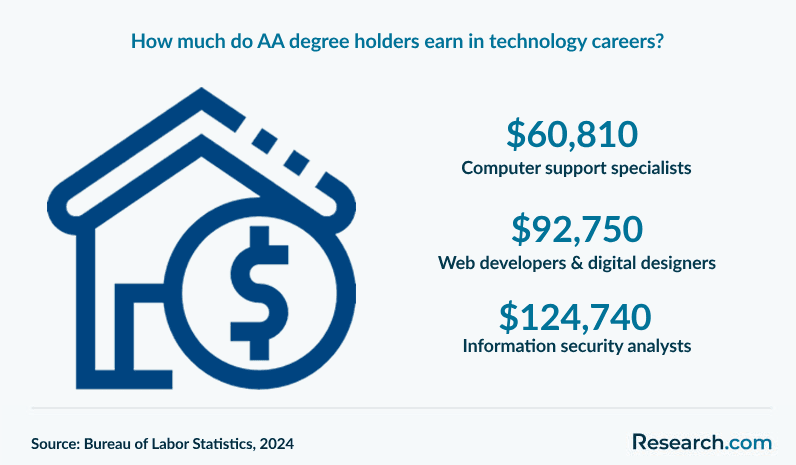
In 2023, the Bureau of Labor Statistics (BLS) reported the following median salaries for selected technology roles.
| Technology occupation | Median salary cited |
| Information security analysts | $124,740 |
| Web developers and digital designers | $92,750 |
| Computer programmers | $92,610 annually |
| Technical writers | $86,620 |
| Computer network support specialists | $78,640 |
| Computer support specialists | $60,810 per year |
| Computer user support specialists | $56,550 |
If you want a faster path from AA-level coursework into more advanced computing roles, compare certificates, bootcamps, portfolios, and accelerated computer science degree options before deciding.
What are the best creative arts careers with an AA degree?
Creative careers are often portfolio-driven. An AA degree can give you a foundation in writing, visual communication, media, humanities, or design, but employers and clients will usually want proof of your skill through samples, published work, campaigns, websites, reels, or client projects.
Creative roles to consider
- Graphic designer: Creates visual assets for digital and print use.
- Web designer: Plans website layouts, user experience, and visual structure.
- Animator: Produces motion graphics, animation, or visual effects for media.
- Copywriter: Writes marketing, advertising, email, social, or website copy.
- Technical writer: Converts complex information into clear documentation.
- Multimedia producer: Coordinates video, audio, graphics, and interactive content.
- Freelance artist: Sells original or commissioned work independently.
- Art instructor or music teacher: Teaches lessons or classes, depending on employer and credential requirements.
- Musician: Performs, records, teaches, or produces music.
Students looking for a shortened academic path may compare accelerated options such as online associate degree programs that may be completed quickly, but should verify accreditation, workload, credit transfer, and whether the timeline is realistic.
Creative arts salary examples
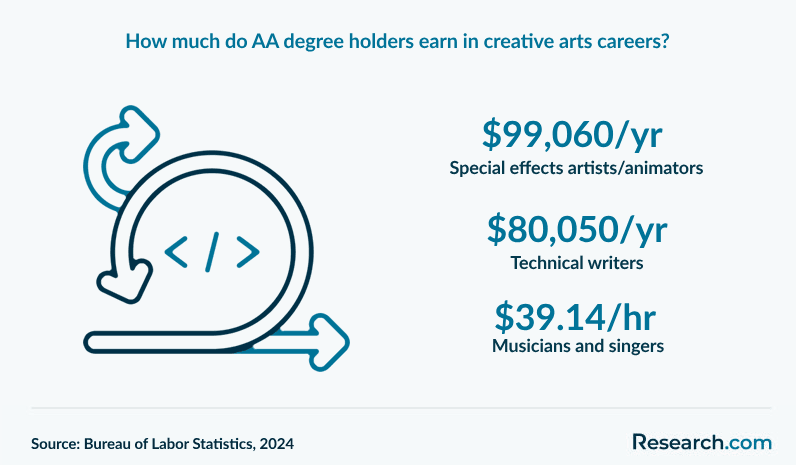
According to the Bureau of Labor Statistics (BLS), the creative arts field includes both salaried and freelance occupations with varied earnings.
| Creative occupation | Median salary or pay cited |
| Producers and directors | $107,170 |
| Postsecondary art, drama, and music teachers | $100,840 |
| Special effects artists and animators | $99,060 annually |
| Web developers and digital designers | $92,750 |
| Technical writers | $80,050 |
| Graphic designers | $58,910 per year |
| Musicians and singers | $39.14 per hour |
What are the best government and public service careers with an AA degree?
Government and public service careers can be attractive for AA graduates because many agencies use structured hiring criteria, training academies, civil service exams, or experience-based advancement. Requirements vary significantly by agency, state, and role.
Public service roles to research
- Police officer: Enforces laws, responds to calls, writes reports, and protects public safety.
- Correctional officer: Supervises individuals in jails or prisons and maintains facility security.
- Firefighter: Responds to fires, rescues, and emergency calls; often requires academy training and physical testing.
- Emergency medical technician (EMT): Provides emergency medical care after completing required training and certification.
- Parole officer: Monitors individuals on parole and coordinates rehabilitation requirements.
- Government clerk or administrative assistant: Handles records, forms, customer service, and agency communications.
- Case manager: Coordinates services for individuals or families, depending on agency requirements.
- Park ranger or environmental technician: Supports conservation, visitor services, monitoring, and environmental protection.
- Postal worker or transportation security administration (TSA) officer: Works in federal service roles with specific hiring procedures.
Government and public service salary examples
The Bureau of Labor Statistics (BLS) provides the following salary figures for selected public service and related occupations.
| Public service occupation | Median salary cited |
| Case managers, based on the related occupation of social and community service managers | $77,030 |
| Police officers | $74,910 |
| Parole officers | $61,800 annually |
| Park rangers | $60,380 |
| Social workers | $58,380 |
| Emergency medical technicians (EMTs) | $57,252 |
| Firefighters | $57,120 |
| Postal workers | $56,510 |
| Correctional officers | $53,300 |
| Environmental technicians | $50,660 |
| Transportation security administration (TSA) officers, categorized under protective service occupations | $47,810 |
| Administrative assistants | $46,010 |
| Government clerks | $43,560 |
Before choosing a public service path, review age requirements, background checks, physical standards, academies, security clearances, and state or agency-specific exams.
What are the best legal careers with an AA degree?
An AA degree can support entry into legal offices, courts, law enforcement, and compliance-related environments. It will not qualify you to practice law, but it can help you build research, writing, organization, and document-management skills used in legal support roles.
Legal support roles
- Paralegal: Assists attorneys with legal research, drafting, document organization, case preparation, and client files. If this is your target, compare ABA approved paralegal programs and employer preferences in your area.
- Legal assistant: Provides administrative and case support in law firms, legal departments, or government offices.
- Courtroom clerk: Supports court operations, records, schedules, and courtroom procedures.
- Legal secretary: Manages legal correspondence, filings, calendars, and office communication.
- Police officer or correctional officer: Public safety roles can connect to legal systems and may accept associate-level education depending on agency rules.
Legal salary examples
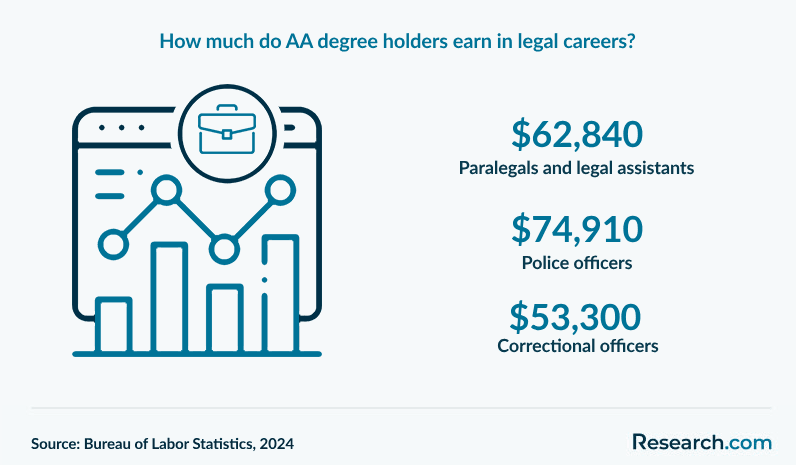
Paralegals and legal assistants earn a median salary of $62,840, depending on location. In Georgia, paralegals can earn an average of around $68,000 per year. Students interested in that market may compare online paralegal certificate options before applying.
| Legal or related occupation | Median salary cited |
| Police officers | $74,910 |
| Paralegals and legal assistants | $62,840 |
| Legal secretaries | $59,200 annually |
| Correctional officers | $53,300 |
Legal careers reward accuracy, confidentiality, writing ability, and deadline management. For paralegal roles, ask employers whether they prefer an associate degree, certificate, ABA-approved program, bachelor’s degree, or experience.
What are some other good careers with an AA degree?
AA graduates are not limited to the most obvious fields. Because the degree builds broad transferable skills, it can support entry into hospitality, tourism, sales, human services, transportation, finance, arts administration, and construction administration—especially when combined with industry experience.
| Field | Possible AA-related roles | Important caution |
| Hospitality and tourism | Hotel manager, restaurant manager, travel agent | Management roles usually require experience beyond the degree. |
| Sales | Retail sales associate, sales representative | Income may depend on commissions, industry, and performance. |
| Human services | Social work assistant, substance abuse counselor | Counseling roles may require state credentials or supervised hours. |
| Transportation | Truck driver, air traffic controller | Training, licensing, exams, or federal requirements may apply. |
| Healthcare administration | Medical coder, health information technician | Certificates and coding credentials may improve prospects. |
| Finance | Insurance agent, financial analyst | Licensing or a bachelor’s degree may be needed for some roles. |
| Arts and entertainment | Museum curator, event planner | Curator roles often require more education; event planning values experience. |
| Construction | Construction manager, construction inspector | Technical knowledge, certifications, and field experience are important. |
What are some myths and misconceptions about Associate of Arts degrees?
AA degrees are sometimes misunderstood because they sit between high school and a bachelor’s degree. The reality is more nuanced: an AA can be valuable, but only when it is matched to a clear education or career plan.
| Myth | Reality |
| An AA degree is only for students who could not attend a four-year college. | Many students choose an AA for affordability, flexibility, smaller classes, transfer planning, or career exploration. |
| An AA degree cannot lead to good pay. | Some associate-level healthcare, technology, business, and public service roles report competitive wages, though outcomes vary by role and credential. |
| You cannot transfer with an AA. | Many AA programs are intentionally designed for transfer, but you must verify transfer agreements and course equivalencies. |
| Employers do not value AA degrees. | Many employers value the degree when it is paired with relevant skills, reliability, software ability, experience, or certifications. |
| AA degrees are only for young students. | Working adults often use AA programs to finish credits, change careers, or qualify for promotion. |
| All AA degrees are the same. | Majors, transfer pathways, electives, advising, and institutional reputation can differ substantially. |
| An AA guarantees a high-paying job. | No degree guarantees salary. Career outcomes depend on occupation, location, experience, licensing, and labor market conditions. |
| Online AA degrees are not worthwhile. | Accredited online AA programs can be credible, but students should check accreditation, support, transferability, and total cost. |
How can an Associate of Arts degree prepare you for entrepreneurship?
An AA degree can support entrepreneurship by strengthening communication, problem-solving, writing, customer understanding, and basic business thinking. It is not a substitute for market research, funding, legal setup, or industry expertise, but it can help you develop the flexible skills needed to start small and learn quickly.
- Communication and negotiation: Writing, speech, and humanities coursework can help with pitches, client conversations, proposals, and conflict resolution.
- Critical thinking: Social science and general education courses can improve your ability to evaluate markets, customers, and risks.
- Financial literacy: Math and introductory business courses can support budgeting, pricing, and cash-flow planning.
- Marketing and branding: Communication and creative arts electives can help with brand voice, campaigns, and customer messaging.
- Digital operations: Basic technology skills can support e-commerce, social media, customer management, and online service delivery.
Potential AA-friendly business ideas include freelance writing, graphic design, web support, tutoring, daycare services, local event services, virtual administrative support, and niche healthcare support businesses. Students interested in healthcare-related ventures may also compare 2 year healthcare degrees before entering regulated fields.
What is the long-term career outlook for an Associate of Arts degree?
The long-term outlook for AA graduates is strongest when the degree is used as a platform rather than a stopping point. Graduates who continue building skills, earning certifications, transferring credits, gaining experience, and networking tend to have more options than those who rely on the credential alone.
Over time, AA graduates may move from support roles into supervision, coordination, sales, training, operations, or bachelor’s-level professional roles. Some also move into advanced academic areas later; for example, students exploring social science pathways may ask what can you do with a masters in sociology after completing further education.
What is the return on investment for an AA degree?
ROI for an AA degree depends on total cost, lost work time, debt, transfer value, and post-graduation earnings. The degree can have a favorable ROI when tuition is low, credits transfer cleanly, and the student uses the credential to enter a field or reduce the cost of a bachelor’s degree.
To evaluate ROI, compare tuition, fees, books, technology costs, transportation, childcare, financial aid, employer tuition benefits, transfer credits, expected salary, and the cost of any required certification. Prospective students may also compare AA outcomes with quick degrees that pay well to see whether another credential better matches their goals.
How can I fast-track my Associate of Arts degree completion?
You can finish an AA degree faster by using transfer credits, dual enrollment credits, CLEP or credit-by-exam options where accepted, summer terms, accelerated courses, prior learning assessment, and full-time enrollment. The right strategy depends on your schedule, academic readiness, and college policies.
Before choosing an accelerated option, confirm that the school is accredited, the workload is realistic, credits transfer, and student support is available. Compare accelerated associates degree programs carefully instead of choosing only the shortest timeline.
How does accreditation influence the value of your AA degree?
Accreditation affects whether your credits are likely to transfer, whether you can access federal financial aid, and whether employers or licensing bodies will recognize your education. A low-cost program can become expensive if credits do not transfer or if the credential is not accepted for your goal.
Students planning to use financial aid should verify institutional accreditation and aid eligibility. A good starting point is comparing accredited online colleges that accept FAFSA, then confirming details directly with the school and the U.S. Department of Education resources.
How can AA graduates leverage digital skills to expand their career opportunities?
Digital skills can make an AA degree more marketable because many entry-level roles now involve software, online communication, data entry, customer platforms, web content, or digital collaboration. Useful skills include spreadsheets, presentation tools, content management systems, social media analytics, basic data analysis, customer relationship management software, and web publishing.
Creative students may expand their portfolio through an online graphic design degree or focused design coursework, while business students may pursue software and analytics certificates.
What are the emerging trends in Associate of Arts degrees?
Several trends are shaping AA programs and career outcomes in 2026. The most important shift is that students increasingly need both transferable academic skills and career-specific evidence of ability.
- Online and hybrid learning: More students want flexible schedules that allow work and study to coexist.
- Transfer pathway planning: Colleges continue emphasizing transfer agreements so AA graduates can avoid losing credits.
- Career readiness: Internships, certificates, applied projects, and career advising are becoming more important to student outcomes.
- Interdisciplinary study: Students are combining communication, business, technology, and creative skills to fit changing workplace needs.
- Employer partnerships: Community colleges increasingly align programs with local workforce needs in healthcare, technology, business, and public service.
- Digital communication and content: Students in writing and creative fields may later explore advanced study such as online MFA programs creative writing.
How does an AA degree compare with advanced degree options?
An AA degree is faster and usually less expensive than a bachelor’s, master’s, or doctoral degree. It is best for broad foundational learning, entry-level work, career exploration, and transfer. Advanced degrees usually offer deeper specialization, broader professional networks, and access to occupations that require higher credentials.
| Credential | Best for | Main trade-off |
| AA degree | Affordable transfer pathway, general education, entry-level roles | May not meet requirements for licensed or advanced roles |
| Bachelor’s degree | Professional roles, promotions, teacher licensure pathways, management preparation | More time and higher total cost |
| Master’s degree | Specialization, leadership, counseling, analytics, education, social science advancement | Requires prior undergraduate preparation |
| Doctoral degree | Research, academia, advanced professional practice, executive expertise | Longest timeline and highest commitment; compare costs carefully, including affordable online doctorate options if relevant |
What additional certifications can bolster your AA career prospects?
Certifications can help AA graduates show job-specific competency. The best certification depends on the target field: healthcare billing, IT support, cybersecurity, bookkeeping, project coordination, digital marketing, paralegal studies, early childhood education, or design software.
Creative professionals may eventually consider advanced credentials such as an online MFA, but many AA graduates get the fastest return from shorter, employer-recognized certificates tied directly to job postings.
What role does ongoing professional development play in boosting career success?
Ongoing professional development helps AA graduates stay competitive as job tools, software, regulations, and employer expectations change. Good options include workshops, certifications, employer training, professional associations, mentorship, portfolio updates, and continuing education courses.
For writing-focused or creative students, continuing into affordable bachelor's degrees in creative writing may strengthen long-term options in publishing, communications, marketing, or education-related fields.
How can AA graduates select the right college major to maximize future career prospects?
Choose an AA major by working backward from your target outcome. If you plan to transfer, match the AA curriculum to the bachelor’s major. If you plan to work immediately, choose electives, certificates, and internships that build job-ready skills.
- Review job postings for your target roles and list the required skills.
- Check whether the major has transfer agreements with four-year schools.
- Ask whether credits apply to the bachelor’s major or only count as electives.
- Compare tuition, fees, financial aid, graduation support, and advising quality.
- Use career data and resources such as Research.com’s guide to the best college degrees to understand broader demand patterns.
Can enhanced digital skills accelerate career opportunities for AA graduates?
Yes. Digital skills can help AA graduates move faster into roles that require online communication, customer platforms, content creation, marketing analytics, office software, or technical support. Digital capability is especially useful when combined with an internship, portfolio, or certificate.
Students interested in marketing and online brand work may compare accelerated online social media marketing programs to build practical skills beyond the AA curriculum.
How can working adults successfully pursue an online AA degree?
Working adults should choose online AA programs with predictable scheduling, asynchronous classes, transfer-friendly policies, strong advising, and technical support. Flexibility matters, but so does accountability: students should map weekly study blocks before enrolling.
- Choose asynchronous courses if work hours change week to week.
- Ask how many credits you can transfer in.
- Confirm whether prior learning, military training, or professional certifications can count for credit.
- Use tutoring, advising, and career services early—not only when problems arise.
- Compare costs through resources such as affordable online universities for working adults.
How can certificate programs complement your Associate of Arts degree?
Certificate programs can turn a broad AA degree into a more targeted career credential. For example, an AA in liberal arts plus a bookkeeping certificate, IT support certificate, paralegal certificate, digital marketing certificate, or medical billing certificate can be easier for employers to interpret than a general degree alone.
When comparing options, focus on employer recognition, cost, exam preparation, hands-on projects, and job-posting alignment. Research.com’s guide to certificate programs that pay well can help you compare options by career direction.
How can investing in digital communication skills benefit your AA career?
Digital communication skills help AA graduates write clearer emails, collaborate remotely, present ideas, manage social media, support clients, and build a professional online identity. These skills matter in administrative roles, sales, education support, marketing, public service, and creative work.
If communication is central to your career plan, you may later compare an accelerated online communications degree with shorter certificates or employer-based training.
How can networking and mentorship enhance your AA degree career prospects?
Networking and mentorship can help AA graduates learn which roles are realistic, which certifications employers respect, and how to avoid dead-end applications. Many opportunities come through instructors, alumni, internships, local employers, professional associations, and community events.
- Ask instructors which employers commonly hire from the program.
- Use LinkedIn to connect with alumni in your target field.
- Attend local career fairs and employer information sessions.
- Request informational interviews before choosing a certificate or transfer major.
- Compare career-focused credentials, including certification programs that pay well, against real job postings.
How can integrating creative writing skills enhance your AA degree career prospects?
Creative writing skills can help AA graduates compete for roles in content marketing, advertising, public relations, publishing, social media, grant writing, nonprofit communication, and freelance services. Strong writing is also useful in legal support, education, business administration, and customer success roles.
Students who want structured writing training may compare accelerated creative writing degree online options with certificates, workshops, and portfolio-based learning.
How can I secure affordable education and financial support with an AA degree?
To keep an AA degree affordable, compare total cost—not just tuition. Include fees, books, software, commuting, technology, childcare, lost work hours, and whether credits will transfer. The cheapest program is not always the best value if it lacks accreditation or transfer support.
- Complete the FAFSA if you plan to use federal aid.
- Look for scholarships, grants, work-study, employer tuition assistance, and payment plans.
- Ask whether online courses have additional technology or distance-learning fees.
- Compare community college transfer agreements before enrolling.
- Review online colleges that offer financial aid if affordability and aid eligibility are priorities.
What do graduates have to say about Associate of Arts careers?
-
: "
My Associate of Arts degree gave me room to explore different subjects, including literature and psychology, before choosing a direction. Smaller classes and accessible instructors helped me build confidence for my next academic and career step. — Emilia
"
-
: "
The AA program helped me strengthen communication and critical thinking skills while gaining hands-on experience through internships and projects. That combination made my resume stronger when I started applying for jobs. — Michelle
"
-
: "
Flexible scheduling made it possible to study while managing work and family responsibilities. The electives helped me shape the degree around my interests, and faculty mentorship helped me plan what to do next. — Geronimo
"
What factors should be considered when choosing an Associate of Arts degree program?
Choosing the right AA program is a financial and career decision. Do not rely only on a college’s marketing page or a ranking. Compare the program against your transfer plan, career goal, budget, and schedule.
| Factor | What to ask | Why it matters |
| Accreditation | Is the institution properly accredited? | Affects transfer, financial aid, and employer recognition. |
| Transferability | Which bachelor’s programs accept these credits? | Prevents lost time and duplicate coursework. |
| Major alignment | Does the AA match my intended bachelor’s major or career field? | General credits may not always apply to specialized majors. |
| Total cost | What is the full cost after fees, books, and aid? | ROI depends on total cost, not advertised tuition alone. |
| Online support | Are tutoring, advising, library access, and technical help available remotely? | Support services affect completion, especially for working adults. |
| Career services | Does the school help with resumes, internships, interviews, and employer connections? | Career support can turn the degree into job opportunities. |
| Program difficulty and pacing | Is the workload realistic for my schedule? | Students comparing easy associate degrees should still verify quality and transfer value. |
What challenges do AA degree holders face in advancing their career?
AA graduates may face competition from bachelor’s degree holders, unclear employer perceptions of general degrees, limited specialized training, and fewer professional networks. These barriers are manageable, but they require strategy.
- Credential gaps: Some roles require a bachelor’s degree, license, or industry certification.
- Skill gaps: A general AA may not provide enough technical depth for specialized jobs.
- Limited experience: Employers often want internships, projects, or work history in addition to education.
- Transfer issues: Credits may not apply cleanly if the student changes majors or schools.
- Networking gaps: Students who study online or part time may need to be more intentional about building professional connections.
Some graduates later pursue advanced credentials, including 1 year masters degree programs, but that step usually comes after completing a bachelor’s degree and confirming that a graduate credential is necessary for the target role.
What are the tips for building a successful career with an Associate of Arts (AA) degree?
An AA degree is most useful when you actively connect it to a career plan. Use the degree to build transferable skills, then add targeted experience and credentials.
- Clarify your goal early: Decide whether the AA is for transfer, employment, promotion, or career change.
- Choose electives strategically: Select courses that support your intended bachelor’s major or career field.
- Build experience: Use internships, part-time work, volunteering, freelancing, or campus projects to create proof of ability.
- Add a focused credential: Consider certificates in IT support, bookkeeping, digital marketing, paralegal studies, medical billing, early childhood education, or design.
- Create a portfolio when relevant: Design, writing, web, marketing, and technical fields often require samples.
- Use career services: Get help with resumes, cover letters, interview preparation, and employer connections.
- Network intentionally: Connect with instructors, alumni, local employers, professional associations, and mentors.
- Keep transfer options open: If a bachelor’s degree may be needed later, confirm course equivalencies before taking classes.
- Strengthen digital tools: Software, data, communication platforms, and online collaboration skills can improve employability.
- For design careers, compare specialized training: A focused option such as a UX UI degree online may be more targeted than a general AA alone.
Other Things You Should Know About Associate of Arts Degree Careers
What skills are expected of someone with an Associate of Arts degree?
Employers and transfer institutions usually expect AA graduates to have broad academic and workplace-ready skills. The strongest graduates can show these skills through coursework, projects, jobs, or internships.
- Communication: Clear writing, speaking, listening, and professional interaction.
- Critical thinking: Ability to evaluate information, compare arguments, and solve problems.
- Research: Skill in finding, assessing, and synthesizing information from credible sources.
- Time management: Ability to handle deadlines, priorities, and multiple responsibilities.
- Adaptability: Comfort learning across disciplines and adjusting to new environments.
- Cultural awareness: Respect for diverse perspectives and ethical decision-making.
- Creativity: Ability to generate ideas, communicate visually or verbally, and approach problems from new angles.
- Technology use: Familiarity with digital tools, office software, online learning systems, and basic workplace platforms.
- Teamwork: Collaboration, feedback, conflict resolution, and shared accountability.
- Self-directed learning: Motivation to keep improving after graduation.
What educational pathways are available after an AA degree?
After completing an AA, you can transfer, add a certificate, enter the workforce, or change into a more applied associate program. The best choice depends on your target occupation and budget.
- Transfer to a bachelor’s program: This is the classic AA pathway. Confirm that your courses satisfy major requirements, not only general electives.
- Add an applied associate or certificate: Students who want technical preparation may pursue an AAS, AS, or targeted certificate after or alongside the AA.
- Enter the workforce: Apply for entry-level roles in administration, education support, customer service, public service, legal support, or creative work.
- Continue toward graduate study later: Graduate school is usually not a direct next step from an AA, but the AA can begin a longer path through a bachelor’s degree and beyond.
Can I take out student loans for AA degrees?
Yes. Students may use student loans for eligible Associate of Arts programs, but borrowing should be a last step after grants, scholarships, work-study, employer tuition assistance, and payment plans are considered.
- Federal student loans: Offered through the federal government and generally associated with lower interest rates and more flexible repayment options than private loans.
- Private student loans: Offered by banks, credit unions, and private lenders, often with stricter eligibility rules and potentially higher interest rates.
Before borrowing, calculate the total program cost, expected monthly repayment, likely starting pay, and whether credits will transfer. For official information, visit the Federal Student Aid website.
What resources can I consult to learn more about Associate of Arts degrees?
Use multiple sources before making a decision. College websites are useful, but they should be checked against independent labor, transfer, and financial aid information.
- U.S. Bureau of Labor Statistics (BLS): Useful for occupational descriptions, job outlook, and wage data.
- American Association of Community Colleges (AACC): Provides context on community college education and workforce development.
- College Board: Helps students explore colleges, programs, and transfer-related planning.
- Community College Research Center (CCRC): Publishes research on community college outcomes and student pathways.
- National Center for Education Statistics (NCES): Offers data on institutions, enrollment, and completion.
- Association of American Colleges and Universities (AAC&U): Provides resources connected to liberal arts learning and transferable skills.
- College Navigator and program search tools: Useful for comparing accredited institutions, costs, and programs.
- Career counseling offices: Community colleges often provide advising, resume help, transfer planning, and job search support.
Common mistakes to avoid when choosing an AA degree
- Choosing a school without checking accreditation: This can affect financial aid, transfer, and employer recognition.
- Looking only at tuition: Fees, books, transportation, technology, and lost work time affect the real cost.
- Assuming every online program transfers: Always verify transfer agreements course by course.
- Ignoring licensure rules: Healthcare, education, counseling, public safety, and legal support roles may require specific credentials.
- Picking a major without a next step: A general AA is more valuable when connected to a career, certificate, or bachelor’s plan.
- Skipping career services: Advising, internships, and employer connections can materially change outcomes.
- Assuming salary outcomes are guaranteed: Published wage data are medians or estimates, not promises of individual earnings.
Key Insights
- An Associate of Arts degree is best understood as a flexible foundation: it can support entry-level employment, transfer to a bachelor’s program, career change, or later specialization.
- The strongest AA career outcomes usually come from combining the degree with experience, certificates, licensure where required, digital skills, or a clear transfer plan.
- Median annual wages for AA holders range from $30,000 to $60,000. Administrative support roles typically pay $38,000, while healthcare jobs, like dental hygienists, can reach $77,810 annually (BLS, 2023).
- Healthcare and technology roles can offer strong pay, but many require applied training, certifications, portfolios, or state-specific credentials beyond a general AA.
- Education, legal support, public service, and business administration can be practical AA pathways, especially for students who build experience while studying.
- Online AA programs can work well for adults and working students, but accreditation, transferability, support services, and total cost matter more than convenience alone.
- Top programs are offered by schools like Southern New Hampshire University, Liberty University, and others, but students should still compare outcomes, costs, credit transfer, and advising before enrolling.
- An AA degree can lower the cost of a bachelor’s degree if credits transfer cleanly; poor transfer planning can reduce its value.
- Common mistakes include choosing without checking accreditation, assuming all online credits transfer, ignoring licensure requirements, and relying on salary data as a guarantee.
- The best next step is to choose a target career, check actual job postings and credential requirements, compare accredited programs, and build a practical plan for experience, transfer, or certification.
Resources:
- Bureau of Labor Statistics. (2024). Career Outlook: Healthcare. U.S. Department of Labor. Bureau of Labor Statistics.
- Bureau of Labor Statistics. (2024). Employment projections: 2023-2033 summary. U.S. Department of Labor. Bureau of Labor Statistics.
- Bureau of Labor Statistics. (2024). Field of degree: Healthcare and related. U.S. Department of Labor. Bureau of Labor Statistics.
- Bureau of Labor Statistics. (2024). Healthcare occupations. U.S. Department of Labor. Bureau of Labor Statistics.
- Bureau of Labor Statistics. (2024). Library technicians and assistants. U.S. Department of Labor. Bureau of Labor Statistics.
- Bureau of Labor Statistics. (2024). Preschool teachers. U.S. Department of Labor. Bureau of Labor Statistics.
- Bureau of Labor Statistics. (2024). Respiratory therapists. U.S. Department of Labor. Bureau of Labor Statistics.
- Bureau of Labor Statistics. (2024). Surgical technologists. U.S. Department of Labor. Bureau of Labor Statistics.
- Bureau of Labor Statistics. (2024). Teacher assistants. U.S. Department of Labor. Bureau of Labor Statistics.
- Bureau of Labor Statistics. (2024). Diagnostic medical sonographers. U.S. Department of Labor. Bureau of Labor Statistics.
- Bureau of Labor Statistics. (2024). Dental hygienists. U.S. Department of Labor. Bureau of Labor Statistics.
- Bureau of Labor Statistics. (2024). Physical therapist assistants and aides. U.S. Department of Labor. Bureau of Labor Statistics.
Other Things You Should Know About Associate of Arts Degree Careers
Microsoft Office Specialist, Google Workspace, and QuickBooks certifications can strengthen applications for office support roles. Many employers also expect basic typing and bookkeeping skills. For administrative assistant jobs, employers often require proficiency in Excel, Word, and scheduling software before hiring.
In 2027, industries like healthcare, technology, and media exhibit high demand for associate degree holders. Positions like medical technicians, IT support specialists, and digital media coordinators offer promising opportunities, reflecting industry growth and the need for skilled professionals with practical training.