
2027 How to Become a Dental Hygienist

Co-Founder and Chief Data Scientist
Becoming a dental hygienist is a structured healthcare career path: you need the right accredited education, national and clinical exams, and a state license before you can practice. For many students and career changers, the appeal is clear: dental hygiene can offer patient-facing work, flexible scheduling, strong wages, and a faster education timeline than becoming a dentist.
This guide explains how to become a dental hygienist in 2026, what degree you need, how licensure works, what the job pays, where hygienists work, and when advanced education or related credentials make sense. It also covers common mistakes to avoid so you can compare programs, plan costs, and choose a path that fits your long-term career goals.
Quick Answer: How Do You Become a Dental Hygienist?
To become a dental hygienist, you generally need to graduate from a CODA-accredited dental hygiene program, pass the National Board Dental Hygiene Examination, pass a state or regional clinical exam, and apply for licensure in the state where you plan to work. Most entry-level dental hygienists earn an associate degree in dental hygiene, which typically takes two to three years.
- Most dental hygienists complete an accredited associate degree program before applying for licensure.
- Every state requires dental hygienists to be licensed, and licensure usually includes the NBDHE, a clinical exam, and state-specific requirements.
- Employment is projected to increase by 19,600 from 2023 to 2033.
- Dental hygienists often work in dental offices, and part-time schedules are common in the profession.
- The median annual salary for dental hygienists is over $87,000, with top earners making over $100,000.
- Steps to become a dental hygienist
- What dental hygienists do
- Dental hygienist vs. dentist
- Dental hygiene degree options
- Dental hygienist licensure requirements
- Dental hygienist salary
- Work settings and schedule
- Becoming a dentist after dental hygiene
- Job outlook for dental hygienists
- Continuing education requirements
- Associate degrees for career changers
- Career advancement for dental hygienists
- Paying for advanced dental hygiene education
- Additional certifications and career options
- Benefits of advanced education
- Online graduate certificates
- Moving into other healthcare roles
- Accelerated certification programs
- Pharmacy knowledge and oral healthcare
- Business and leadership training
- Ergonomics and movement science
- Supplementary healthcare certifications
- Accelerated PharmD programs
- Biology and dental hygiene practice
- Healthcare regulations and scope of practice
- Legal and regulatory updates
- Interdisciplinary degree options
- Online medical degrees
- Digital tools and online certifications
- Doctoral education and leadership
What are the steps on how to become a dental hygienist?
The path to becoming a dental hygienist is not optional or informal. Because dental hygienists provide clinical patient care, states require candidates to complete approved education, pass exams, and maintain licensure. The exact process varies by state, but the general sequence is consistent across the U.S.
| Step | What You Need to Do | Why It Matters |
| 1. Finish high school or earn an equivalent credential | Prioritize biology, chemistry, anatomy, and communication courses. Students comparing healthcare paths may also review what it takes to become a nutritionist. | Science and patient communication skills help prepare you for dental hygiene coursework. |
| 2. Enroll in an accredited dental hygiene program | Choose a program accredited by the Commission on Dental Accreditation, usually leading to an associate degree. | Graduation from an accredited program is typically required before licensure. |
| 3. Complete classroom and clinical training | Study oral anatomy, radiography, periodontics, infection control, patient assessment, and preventive care. | Clinical practice prepares you to work safely with real patients. |
| 4. Pass the NBDHE | Take the National Board Dental Hygiene Examination after completing your program. | This written exam verifies your academic readiness for licensure. |
| 5. Pass a clinical exam | Complete the state or regional practical examination required where you plan to practice. | This confirms that you can perform core dental hygiene procedures competently. |
| 6. Apply for state licensure | Submit education records, exam scores, fees, and any state-specific law or ethics requirements. | You cannot legally practice as a dental hygienist without state authorization. |
| 7. Renew your license and complete continuing education | Track renewal deadlines and required CE hours. Some professionals also explore flexible healthcare credentials, including the easiest certifications to get online, when they want broader skills. | Continuing education keeps your license active and helps you stay current with clinical standards. |
Before applying to a program, confirm that it is accredited, ask how clinical placements are arranged, and check whether graduates are eligible for licensure in your state. A low tuition price or convenient schedule will not help if the program does not meet licensing requirements.
What is a dental hygienist?
A dental hygienist is a licensed oral healthcare professional who focuses mainly on prevention. Hygienists clean teeth, remove plaque and tartar, take dental X-rays, assess oral health, screen for signs of disease, apply preventive treatments, document findings, and teach patients how to care for their teeth and gums.
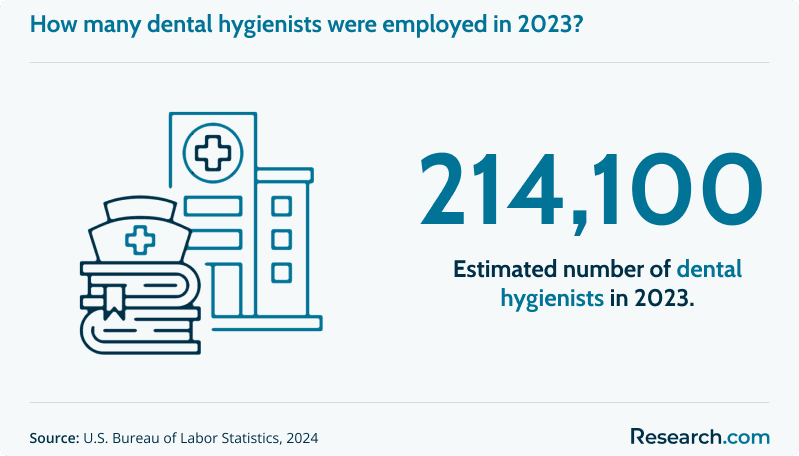
Dental hygienists are important because they often spend significant time with patients during routine visits. Their work can help identify early signs of gum disease, cavities, oral inflammation, and other concerns before they become more serious. In 2023, there were approximately hundreds of thousands of dental hygienists employed across the United States, showing the size and importance of this workforce in routine dental care.
| Common Responsibility | What It Involves |
| Preventive cleanings | Removing plaque, tartar, and stains from teeth using dental instruments. |
| Patient assessment | Reviewing medical history, checking gums, noting oral health concerns, and documenting findings. |
| Dental imaging | Taking X-rays when allowed by state law and office protocols. |
| Patient education | Explaining brushing, flossing, diet, tobacco risks, and preventive care habits. |
| Collaboration with dentists | Sharing observations so the dentist can diagnose conditions and plan treatment. |
How is a dental hygienist different from a dentist?
Dental hygienists and dentists both work in oral healthcare, but they are trained for different levels of responsibility. Dental hygienists concentrate on preventive services and patient education. Dentists diagnose oral diseases, create treatment plans, perform restorative and surgical procedures, and may own or manage dental practices.
The distinction matters when you are choosing a career path. Dental hygiene usually requires less time in school than dentistry, but it also comes with a narrower scope of practice. Dentistry requires a dental degree, broader clinical authority, and a longer training timeline.
| Category | Dental Hygienist | Dentist |
| Primary focus | Preventive oral care, cleanings, screenings, education, and support for dental treatment plans. | Diagnosis, treatment planning, restorative care, surgery, and overall clinical responsibility. |
| Typical education | Associate degree in dental hygiene for entry-level practice. | Bachelor's degree followed by a DDS or DMD. |
| Scope of practice | Varies by state, but generally centered on preventive and supportive care. | Broader authority to diagnose and treat dental conditions. |
| Independence | Often works under dentist supervision, depending on state law and setting. | Can practice independently after licensure. |
| Income comparison | Strong allied health wages, with a median annual salary above $87,000. | Dentists can earn about twice the income of a dental hygienist. |
What degree do you need to become a dental hygienist?
The minimum educational requirement for most dental hygienist roles is an associate degree in dental hygiene from an accredited program. These programs are commonly offered by community colleges, technical colleges, and some universities. They typically take about two to three years and combine classroom instruction with supervised clinical practice.
Dental hygiene coursework usually includes anatomy, radiography, periodontics, dental materials, infection control, pharmacology basics, community oral health, and clinical dental hygiene techniques. According to the American Dental Education Association, there are 327 entry-level dental hygiene programs across the U.S., which gives students more geographic and institutional options than many specialized fields, including some colleges with forensic science programs.
Some hygienists continue into a bachelor's degree in dental hygiene. More than 50 universities and colleges nationwide offer this level of education, and in the United States, 54 academic institutions offer bachelor's-level degree completion programs in dental hygiene. A bachelor's degree may be useful for hygienists who want to move into public health, education, research, sales, administration, or leadership roles. As with nursing bridge pathways such as the cheapest RN to BSN program, the value depends on your career goal, transfer credits, cost, and employer expectations.
| Credential | Best For | Typical Career Use |
| Associate degree in dental hygiene | Students who want the standard entry route into clinical dental hygiene. | Licensure preparation and employment in dental offices. |
| Bachelor's degree in dental hygiene | Licensed hygienists who want broader career options or degree completion. | Public health, education support, leadership preparation, or expanded professional mobility. |
| Master's degree in dental hygiene | Professionals aiming for advanced education, research, administration, or teaching roles. | Academic, leadership, policy, and specialized professional roles. |
No matter which degree level you choose, the key question is whether the program prepares you for licensure in the state where you intend to work.
How do you get licensed as a dental hygienist?
Dental hygienist licensure is handled by state boards, so requirements are not identical everywhere. However, most states require the same basic components: accredited education, a national written exam, a clinical exam, and a state application.
- Graduate from a CODA-accredited program: Most candidates complete an associate or bachelor's program accredited by the Commission on Dental Accreditation. Accreditation is essential because state boards often use it to determine whether your education qualifies for licensure.
- Pass the National Board Dental Hygiene Examination: The NBDHE is administered through the Joint Commission on National Dental Examinations. It measures knowledge of oral health, patient care, dental hygiene process, and related sciences. The scoring scale ranges from 49 to 99, with a minimum passing score of 75 required to qualify for licensure according to the 2024 NBDHE candidate guide.
- Complete the required clinical examination: Many states require a state or regional clinical exam through approved testing organizations. These exams evaluate hands-on skills such as patient assessment, instrumentation, and preventive procedures.
- Submit your state license application: You may need transcripts, exam results, background checks, fees, CPR documentation, and a state law or ethics exam.
- Keep the license active: Most states require periodic renewal and continuing education. At least 19 colleges and universities offer master's degree programs in dental hygiene for professionals who want more advanced preparation, and some students compare flexible graduate healthcare pathways with options such as the cheapest BSN to MSN online programs.
Before enrolling, check your state dental board website. Do not rely only on a school brochure, because licensure rules may include state-specific exams, supervision rules, local anesthesia requirements, or continuing education topics.
What is the average salary for a dental hygienist?
As of May 2023, the median salary for dental hygienists is $87,530 per year, or approximately $42.08 per hour. The lowest 10 percent earned less than $65,110 annually, while the highest 10 percent earned over $118,400. The offices of dentists were the highest-paying industry listed for dental hygienists, with an average salary of $88,450.
Dental hygiene can pay well compared with many shorter healthcare training routes, including some easy certificate programs that pay well. However, pay varies by state, metro area, employer, experience, schedule, and whether the hygienist works full time or part time.
| Salary Factor | How It Can Affect Earnings |
| Location | Wages can differ significantly by state and local labor market. |
| Experience | Experienced hygienists may qualify for higher pay, preferred schedules, or specialized roles. |
| Employment status | Full-time workers may have better access to benefits; part-time workers may trade benefits for flexibility. |
| Employer type | Dental offices, public health settings, government roles, and physician offices may have different pay structures. |
| Additional credentials | Expanded functions, local anesthesia authorization, or advanced education may improve competitiveness where allowed. |
Benefits such as vacation, sick leave, retirement contributions, and health insurance are often more accessible to full-time employees. Because many dental hygienists work part time, some choose to work for more than one dental office to increase hours or income.
What is the work environment like for dental hygienists?
Dental hygienists usually work in clean, well-lit clinical spaces equipped for patient care. Their day may include reviewing health histories, preparing instruments, taking X-rays, cleaning teeth, applying preventive agents, documenting findings, and explaining home-care routines to patients.
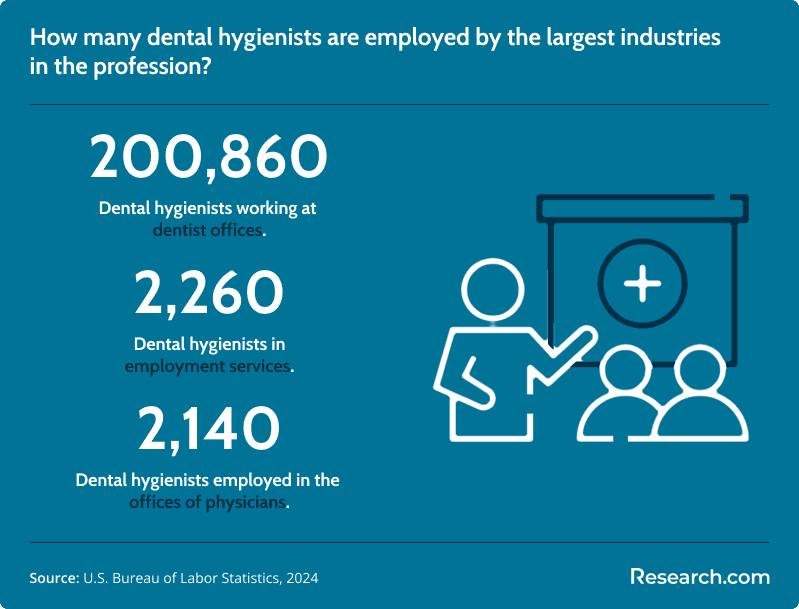
About 94% of dental hygienists are employed in dentist offices. Around 2% work in offices of physicians or government settings according to the 2023 data from the U.S. Bureau of Labor Statistics. Dental offices remain the dominant work setting, but experienced hygienists may also find roles in public health, education, research, sales, administration, and government. Those interested in teaching or academic leadership sometimes compare graduate education pathways, including options like a PhD in education.
| Work Environment Feature | What to Expect |
| Schedule | Part-time and flexible schedules are common, but benefits may depend on full-time status. |
| Physical demands | The work requires hand precision, posture control, and repeated movements during patient care. |
| Patient interaction | Hygienists need strong communication skills to educate patients and reduce anxiety. |
| Teamwork | Hygienists coordinate closely with dentists, assistants, front-office staff, and sometimes public health teams. |
| Clinical standards | Infection control, documentation, and patient safety procedures are central to daily work. |
Can dental hygienists become dentists?
Yes. A dental hygienist can become a dentist, but dental hygiene licensure does not automatically shorten or replace dental school requirements. Hygienists who want to become dentists must complete the prerequisites for dental school, earn or finish a bachelor's degree if needed, take the Dental Admission Test, complete dental school, and pass dental licensure exams.
- Complete a bachelor's degree: Hygienists with an associate degree usually need to finish a bachelor's degree, often with science prerequisites such as biology or chemistry. Students who value accelerated healthcare education may compare timelines with options such as fast track social work degree online programs, though dental school admissions have their own requirements.
- Take the DAT: The Dental Admission Test evaluates readiness for dental school in areas such as natural sciences, reading comprehension, and quantitative reasoning.
- Apply to dental school: Dental schools review academic performance, DAT results, prerequisite completion, recommendations, and clinical exposure.
- Earn a DDS or DMD: Dental school generally takes four years and includes classroom, lab, and supervised clinical training.
- Pass dental licensing exams: Graduates must complete the required written and clinical exams for dentist licensure.
- Begin practice as a dentist: Prior dental hygiene experience can help with patient communication, prevention-focused care, and clinical confidence.
This route can be worthwhile for hygienists who want diagnostic authority, a broader scope of practice, and ownership or specialist opportunities. It is less practical for those who mainly want a shorter education path, lower student debt, or part-time clinical flexibility.
What is the job outlook for dental hygienists?
The job outlook for dental hygienists is strong. Employment is projected to grow by 9% between 2023 and 2033, compared with the average growth rate of 4% for all occupations. The profession is expected to add 19,600 jobs during that period.
Each year, an estimated 16,400 job openings for dental hygienists are expected. Many of these openings are likely to come from replacement needs as workers retire, reduce hours, or move into other occupations. Students comparing administrative healthcare roles may also review affordable medical billing and coding online schools, but dental hygiene remains more directly clinical and patient-facing.
Demand is supported by preventive dental care, greater awareness of the connection between oral health and overall health, and state-level changes that may allow hygienists to use more of their training. States with high employment levels, such as California and Florida, continue to need skilled dental hygienists.
What continuing education is required for dental hygienists?
Continuing education is required to keep a dental hygiene license active. Requirements vary by state, but many states require license renewal every one to three years and a specific number of CE hours during each renewal cycle. These requirements typically range from 10 to 30 hours, depending on state rules.
Common CE topics include infection control, ethics, CPR, patient care, radiography, risk management, opioid-related education, new dental technology, and updates in clinical practice. Courses may be offered online, in person, through professional associations, or at workshops. Hygienists looking for broader professional development may compare affordable certificates, but state-approved CE should always be chosen based on license renewal rules first.
| CE Decision | What to Check |
| Approval | Confirm the course is accepted by your state dental board. |
| Topic requirements | Some states require specific subjects such as infection control, CPR, or ethics. |
| Format | Online CE may be convenient, but some states limit how many hours can be completed online. |
| Documentation | Keep certificates and records in case of audit. |
| Renewal deadline | Track due dates early to avoid late fees or license interruption. |
What are the most lucrative associate degrees for a career change?
Dental hygiene is often attractive to career changers because the entry-level education route is shorter than many healthcare professions while still leading to licensed clinical work. If you are comparing several two-year pathways, reviewing the best associate degrees can help you compare earning potential, licensing requirements, program length, and long-term mobility.
Do not choose an associate degree based on salary alone. Compare accreditation, clinical requirements, physical demands, state licensing rules, schedule flexibility, and whether the role matches the kind of work you want to do every day.
How to Advance Your Career as a Dental Hygienist
Career advancement in dental hygiene usually comes from one or more of three strategies: expanding clinical permissions where state law allows, earning advanced education, or moving into nonclinical roles such as education, public health, administration, research, or practice management.
| Advancement Path | When It Makes Sense | Possible Outcome |
| Bachelor's degree completion | You already hold an associate degree and want broader career mobility. | Eligibility for public health, education support, leadership, or degree-required roles. |
| Master's degree | You want to teach, conduct research, manage programs, or move into policy-oriented work. | Advanced academic, administrative, or public health opportunities. |
| Specialized clinical training | Your state allows expanded functions or your employer values advanced skills. | More responsibility in areas such as anesthesia support, periodontics, or population-specific care. |
| Practice management or administration | You want less chairside clinical work and more operational responsibility. | Office management, compliance, scheduling, training, or business roles. |
| Professional association involvement | You want mentorship, CE access, policy updates, or leadership exposure. | Stronger network and better awareness of changes in the profession. |
Some hygienists pursue accelerated graduate options when they want a faster route into leadership or specialized roles. Programs such as an online masters one year may be worth comparing if the curriculum, accreditation, cost, and career outcome fit your plan.
How can I finance my advanced dental hygiene education?
Paying for advanced dental hygiene education requires more than looking at tuition. Compare total program cost, fees, books, clinical or campus requirements, travel, technology expenses, lost work hours, and whether your employer offers tuition support.
- Ask your employer first: Some dental practices, public health employers, or healthcare systems may offer tuition reimbursement or CE funding.
- Complete financial aid paperwork: Federal and state aid may be available depending on the program and your enrollment status.
- Look for professional scholarships: Dental hygiene associations, foundations, and schools may offer targeted awards.
- Compare debt to career outcome: Do not borrow heavily for a credential unless it supports a clear career change, promotion, or required qualification.
- Review related healthcare programs carefully: Some professionals considering administrative transitions may compare options such as accredited medical billing and coding schools online with financial aid.
Can additional certifications expand my career opportunities?
Additional certifications can help dental hygienists move into adjacent roles, but they should be chosen strategically. A certificate is most useful when it builds a skill your employer values, meets a state requirement, or supports a planned transition into education, administration, billing, public health, or healthcare operations.
For example, a hygienist who wants to understand revenue cycle workflows or move toward front-office leadership may compare accredited medical billing and coding schools online. That does not replace dental hygiene licensure, but it may broaden administrative options in dental or healthcare settings.
What are the benefits of pursuing advanced education as a dental hygienist?
An associate degree is enough for many clinical dental hygiene jobs, but a bachelor's or master's degree can make sense when your goal extends beyond routine chairside care.
- Broader role options: Advanced education may support movement into public health, education, research, administration, or program coordination.
- Leadership preparation: Degree programs may include management, policy, teaching, or evidence-based practice coursework.
- Greater professional flexibility: Additional education can help if you later want to reduce clinical hours or move into a less physically demanding role.
- Stronger critical thinking and research skills: Graduate study often emphasizes data, program evaluation, and healthcare decision-making.
- Potential income benefits: Advanced credentials may improve competitiveness, but salary gains are not guaranteed and depend on role, location, and employer.
If you are also comparing other healthcare fields, admissions standards can vary widely. For example, students exploring nursing may ask what is the easiest nursing school to get into, but ease of admission should never be the only factor; accreditation, licensure outcomes, and career fit matter more.
Should I enroll in an online graduate certificate program for dental hygienists?
An online graduate certificate can be useful for a licensed dental hygienist who wants targeted training without committing to a full degree. It is not usually necessary for entry-level dental hygiene practice, but it may support career movement into management, public health, education, policy, or specialized healthcare operations.
When comparing the cheapest online graduate certificate programs, look beyond price. Confirm the school’s accreditation, whether credits can transfer into a future degree, whether the content fits dental or healthcare settings, and whether the credential is recognized by employers in your target role.
- Healthcare management: Useful for hygienists aiming for supervisory, administrative, or clinic leadership responsibilities.
- Public health and policy: Relevant for community oral health, prevention programs, and access-to-care initiatives.
- Advanced dental or healthcare practice topics: Helpful when the curriculum aligns with state scope-of-practice rules or employer needs.
Can Dental Hygiene Experience be Transferred to Other Healthcare Roles?
Dental hygiene experience can translate well into other healthcare roles because hygienists already understand patient communication, infection control, documentation, clinical workflows, and preventive care. However, moving into a different licensed occupation usually requires additional education, certification, or state approval.
Some hygienists explore clinical support or administrative roles when they want broader healthcare experience or less repetitive chairside work. For example, affordable online medical assistant programs may help professionals compare allied health options, but medical assisting and dental hygiene are separate career paths with different scopes and employer expectations.
Can Accelerated Certification Programs Provide a Competitive Edge?
Accelerated certification programs can be helpful when they fill a specific skills gap, but they should not be viewed as shortcuts around licensure. For dental hygienists, the best short programs are usually those that strengthen a practical area: office operations, patient coordination, digital records, billing, compliance, or another employer-valued skill.
A credential such as a medical assistant certification may be relevant for someone considering a broader allied health move. Before enrolling, ask whether the program is recognized by employers, whether hands-on training is included, and whether it leads to a credential that actually matters in your target job market.
Can Integrating Pharmacist Education Complement My Dental Hygiene Career?
Pharmacology knowledge can help dental hygienists better understand medication histories, drug interactions, dry mouth risks, bleeding concerns, and patient counseling needs. This is especially useful when caring for patients with complex medical conditions or multiple prescriptions.
Dental hygienists do not need to become pharmacists to practice, but learning the basics of pharmacy education can support better interprofessional communication. Reviewing pharmacist education requirements can help you understand the depth of training behind medication management and when referral or collaboration is appropriate.
Can Business and Leadership Training Accelerate My Dental Hygiene Career?
Business and leadership training can be valuable if you want to move from clinical production into operations, supervision, compliance, or practice development. Dental offices need leaders who understand scheduling, billing workflows, patient retention, staff training, quality assurance, and regulatory expectations.
An accelerated healthcare administration degree online may be worth considering if your goal is management beyond a single dental operatory. Compare curriculum carefully: the strongest option for a hygienist should connect healthcare operations with real leadership skills, not just general business theory.
Can Ergonomics and Movement Science Training Enhance My Dental Hygiene Career?
Dental hygiene can be physically demanding because the work involves repetitive hand movements, sustained posture, and close visual focus. Ergonomics training can help reduce strain, improve positioning, and support long-term career sustainability.
Movement science education may be especially useful for hygienists who want to teach ergonomics, improve their own clinical longevity, or understand musculoskeletal injury prevention. An online kinesiology degree can provide broader study in biomechanics and human movement, though it is a bigger commitment than a short ergonomics course.
Can Supplementary Healthcare Certifications Enhance My Career Prospects?
Supplementary healthcare certifications can strengthen a dental hygienist’s resume when they align with a clear role. Useful areas may include medical coding, healthcare administration, compliance, patient coordination, public health, or digital health tools.
For hygienists considering a move into billing or administrative healthcare roles, reviewing the medical.coder salary can provide a comparison point. Still, compensation varies by occupation, employer, location, and experience, so a salary article should be only one part of your decision.
Can an Accelerated Online PharmD Program Deepen My Therapeutic Insights?
An accelerated online PharmD program is a major professional commitment and is not a typical advancement route for dental hygienists. It may be relevant only for someone who wants to transition into pharmacy or develop deep medication expertise for a broader healthcare career.
For most hygienists, shorter pharmacology-focused CE or healthcare courses will be more practical than a full PharmD. Consider the cost, licensure implications, time required, and whether pharmacy practice is truly your intended career direction.
How Does a Strong Foundation in Biology Impact My Dental Hygiene Practice?
Biology supports dental hygiene practice because oral health is connected to anatomy, microbiology, inflammation, systemic disease, genetics, and immune response. A stronger science background can improve how hygienists understand periodontal disease, caries risk, wound healing, and patient-specific prevention strategies.
Some hygienists who want deeper science preparation for teaching, dental school, research, or graduate study may compare the most affordable biology degree online. For routine clinical practice, however, the required dental hygiene curriculum already includes the core biological science needed for licensure.
Are Evolving Healthcare Regulations Shaping My Dental Hygiene Career?
Healthcare regulations continue to affect dental hygiene through licensure rules, supervision requirements, infection control standards, documentation expectations, reimbursement policies, and scope-of-practice changes. Hygienists should monitor state board updates and professional association guidance instead of assuming rules are the same everywhere.
Some professionals explore broader healthcare training, including pharmacy-related education such as the best PharmD programs in the US, when they want to understand integrated care more deeply. For most dental hygienists, staying current with state-approved CE and scope-of-practice updates is the more immediate priority.
Are Regulatory and Legal Updates Impacting My Dental Hygiene Practice?
Yes. Dental hygienists must pay attention to legal and regulatory updates because even small changes can affect what procedures they may perform, how they document care, what supervision is required, and which continuing education topics are mandatory.
Reliable ways to stay current include checking your state dental board, joining professional organizations, attending approved seminars, and completing relevant online healthcare certifications when they support compliance or career goals. Do not rely on rules from another state or outdated advice from social media.
Can Interdisciplinary Degrees Broaden My Dental Hygiene Career?
Interdisciplinary degrees can broaden a dental hygienist’s career when they connect oral health with public health, healthcare administration, education, policy, business, or another clinical discipline. They are most useful for hygienists who want to move beyond routine clinical care and into systems-level work.
For example, someone interested in medication management, interprofessional care, or a career shift may examine an online pharmacy school. The better question is not whether another degree sounds impressive, but whether it leads to a role you actually want and can realistically pursue.
Can Online Medical Degrees Further Diversify My Healthcare Expertise?
Online medical and healthcare degrees can help dental hygienists understand broader clinical systems, administration, research, or healthcare delivery. They may be useful for professionals moving toward management, teaching, policy, or interdisciplinary care.
If you are comparing medical degree programs online, check whether the degree is fully online, whether clinical experiences are required, whether it leads to licensure, and whether it is designed for your intended occupation. Many clinical healthcare careers cannot be completed entirely online because hands-on training is required.
Can Digital Innovations and Online Certifications Enhance My Dental Hygiene Career?
Digital tools are increasingly part of dental hygiene practice. Hygienists may work with electronic health records, digital radiography, intraoral imaging, patient communication platforms, scheduling systems, and teledentistry workflows depending on the setting.
Online certifications can help when they teach practical digital or administrative skills. For example, a 4 week online course for medical coding and billing cost may interest hygienists who want to understand billing workflows or move toward administrative support. Before paying, confirm what credential is awarded and whether employers recognize it.
Can Advanced Online Doctoral Programs Propel My Dental Hygiene Leadership?
Advanced doctoral programs can support leadership, research, education, or high-level healthcare administration, but they are not necessary for most dental hygiene careers. They make sense only when the degree aligns with a specific long-term objective, such as teaching at a higher level, leading programs, conducting research, or moving into healthcare executive roles.
Some clinicians compare options such as DNP online programs when they are evaluating advanced clinical leadership models. Dental hygienists should be careful to distinguish between degrees that support nursing practice, pharmacy practice, education, and dental hygiene-related leadership.
Common Mistakes to Avoid When Becoming a Dental Hygienist
| Mistake | Why It Can Hurt You | Better Approach |
| Choosing a program without checking accreditation | You may not qualify for licensure if the program does not meet state requirements. | Confirm CODA accreditation and ask the state dental board whether graduates are eligible. |
| Looking only at tuition | Fees, instruments, uniforms, exams, travel, and lost work time can change the true cost. | Request a full cost estimate before enrolling. |
| Assuming online coursework means fully online training | Dental hygiene requires clinical practice, so hands-on training is still necessary. | Ask where and how clinical requirements are completed. |
| Ignoring state licensure differences | Requirements for exams, anesthesia, supervision, and CE can vary. | Review the state board rules for the state where you plan to work. |
| Assuming salary is guaranteed | Pay depends on location, hours, experience, benefits, and employer type. | Research local job postings and talk with working hygienists in your area. |
| Not considering physical demands | Repetitive clinical work can be challenging over time. | Learn ergonomics early and evaluate whether the work fits your long-term health needs. |
Questions to Ask Before Choosing a Dental Hygiene Program
- Is the program accredited by the Commission on Dental Accreditation?
- Are graduates eligible to take the NBDHE and required clinical exams?
- What percentage of students complete the program on time?
- Where do students complete clinical training, and are placements arranged by the school?
- What is the total cost, including instruments, uniforms, exam fees, insurance, and transportation?
- Does the program meet licensure requirements in the state where I plan to practice?
- Can I transfer credits into a bachelor's degree later?
- What academic support is available if I struggle with science or clinical skills?
- How does the program prepare students for board exams?
- What do recent graduates say about workload, faculty support, and job placement?
Key Insights
- The standard route to becoming a dental hygienist is an accredited dental hygiene program, the NBDHE, a clinical exam, and state licensure.
- An associate degree in dental hygiene is the minimum educational requirement for most entry-level roles.
- Dental hygienists earned a median annual salary of $87,530 as of May 2023, but actual income depends on location, schedule, employer, and experience.
- About 94% of dental hygienists work in dentist offices, and part-time scheduling is common.
- Employment is projected to grow by 9% from 2023 to 2033, with an expected increase of 19,600 jobs.
- Advanced education is most valuable when it supports a specific goal, such as teaching, public health, research, administration, or leadership.
- Before enrolling, verify accreditation, licensure eligibility, clinical placement details, total cost, and state-specific requirements.
References:
- ADEA. (n.d.). Degree completion programs in dental hygiene. American Dental Education Association. Retrieved September 15, 2024.
- ADEA. (n.d.). Dental hygiene by the numbers. American Dental Education Association. Retrieved September 15, 2024.
- ADEA. (n.d.). Graduate programs in dental hygiene. American Dental Education Association. Retrieved September 15, 2024.
- ADEA. (n.d.). Program costs. American Dental Education Association. Retrieved September 15, 2024.
- U.S BLS. (2024, August 29). Dental hygienists: Job outlook. U.S. Bureau of Labor Statistics. Retrieved September 13, 2024.
- U.S. BLS. (2024, August 29). Occupational outlook handbook: Dental hygienists. U.S. Bureau of Labor Statistics. Retrieved September 13, 2024.
- U.S. BLS. (2024, August 29). What dental hygienists do. U.S. Bureau of Labor Statistics. Retrieved September 15, 2024.
- U.S. BLS. (2024, April 3). Occupational employment and wage statistics: 29-1292 dental hygienists. U.S. Bureau of Labor Statistics. Retrieved September 15, 2024.
Other Things You Should Know About How to Become a Dental Hygienist
As of 2027, to become a dental hygienist, you need to complete an accredited dental hygiene program, which typically awards an associate degree. Additionally, passing the National Board Dental Hygiene Examination and obtaining a state license are required. Check state-specific requirements, as they may vary.
Yes. In the United States, dental hygiene programs must include supervised clinical practice before graduation, and many accredited associate programs require about 600 to 900 clinic hours. These hours are completed in student clinics and external rotations to meet state licensing and exam eligibility rules.


