
2027 Best Online Colleges that Accept FAFSA

Co-Founder and Chief Data Scientist
Choosing an online college that accepts FAFSA is not just about finding a flexible degree program. It is about making sure the school is eligible for federal student aid, understanding which aid you may qualify for, and avoiding debt decisions that could follow you long after graduation. This guide explains how FAFSA works for online learners, how accreditation affects eligibility, which costs aid can cover, and how to compare online colleges before you enroll.
It is written for students considering an online certificate, associate, bachelor’s, master’s, or doctoral program; adults returning to school; military-connected students; part-time learners; and anyone trying to reduce the cost of online education without choosing a low-quality program.
Quick Answer: Can You Use FAFSA for Online Colleges?
Yes. Eligible students can use FAFSA to apply for federal financial aid at online colleges if the school participates in federal student aid programs and the program is eligible for Title IV funding. Online students may qualify for grants, federal loans, work-study, and aid from states or colleges that use FAFSA information. The key requirement is not whether the program is online or on campus; it is whether the institution and program are properly accredited and approved for federal aid.
- FAFSA aid is not limited to low-income students. Middle-income and some higher-income students may still qualify for federal loans, grants, or school-based aid.
- About half of undergraduate students relied on some form of federal financial aid in 2019-20, according to the National Association of Student Financial Aid Administrators (NASFAA).
- In SY 2021-22, 6.2 million students received a Pell Grant, with awards averaging $4,160, according to NASFAA.
- The total federal volume for Pell Grants was $25.8 billion in 2021-22, according to NASFAA.
- Over $2.6 billion in Pell Grants went unclaimed by an estimated 767,000 graduates from the high school class of 2022 because FAFSA applications were not completed, according to NASFAA, 2024.
- In AY 2021-22, the average Pell Grant award for undergraduate students was $4,597 across 5,519 institutions, according to the National Center for Education Statistics.
- The practical takeaway: even if you are unsure whether you will qualify, completing the FAFSA is usually worth the time because it can unlock federal, state, and institutional aid.
Affordable Quick Online Degree Programs With High Acceptance Rates
Students often search for FAFSA-eligible online colleges because they want three things at once: affordability, flexibility, and a realistic path to employment. The degree you choose matters as much as the school. Some online bachelor’s programs are especially common among working adults because they are widely available, often transfer-friendly, and connected to broad career paths.
The options below are not a guarantee of admission, salary, licensure, or job placement. Use them as starting points for comparing accredited online programs that may accept federal student aid.
1. Business Administration
A business administration degree covers core functions such as marketing, finance, operations, management, and human resources. It can fit students who want a flexible major that supports many business administration careers, including entry-level management, sales operations, business analysis, and administrative leadership roles.
2. Psychology
Psychology programs introduce students to human behavior, cognition, development, research methods, social behavior, and mental health concepts. This major may be useful for students interested in human resources, social services, case support, healthcare-adjacent roles, or graduate study in counseling, psychology, or related fields. Students who want to become licensed psychologists or counselors should confirm graduate degree and state licensure requirements before choosing this path.
3. Counseling
An online counseling-related degree can build foundational knowledge in communication, ethics, human development, mental health, and helping relationships. At the bachelor’s level, it may prepare students for support roles in social services, community organizations, or human services. Students seeking licensed counseling practice should verify whether the program leads to the required graduate education and supervised experience in their state.
4. Computer Science
Computer science focuses on programming, software systems, algorithms, databases, networks, and problem solving. Graduates may pursue roles such as software developer, web developer, systems analyst, or technical support specialist depending on their skills and experience. Students who want a shorter route should compare accelerated options, including 2-year computer science degree online pathways, while checking accreditation, transfer rules, and course intensity.
5. Healthcare Administration
A healthcare administration degree prepares students for the operational side of healthcare organizations. Coursework often includes healthcare finance, policy, compliance, leadership, quality improvement, and information systems. It can be a good fit for students who want to work in hospitals, clinics, insurance organizations, long-term care, or health services management without becoming a clinical provider.
6. Nursing
Nursing programs prepare students to provide patient care, coordinate treatment, and support health promotion in clinical settings. Because nursing is a licensed profession, online students must be especially careful. Confirm that the program is approved for the nursing credential you need, includes required clinical experiences, and meets your state’s licensure rules before enrolling.
7. Social Work
Social work degrees focus on helping individuals, families, groups, and communities address barriers such as poverty, trauma, disability, family instability, and access to services. Graduates may pursue human services, case management, advocacy, or community support roles. Students who want licensed social work practice should confirm whether the degree meets the educational requirements for their state and whether graduate study is required.
8. Accounting
Accounting programs teach students how to record, analyze, report, and interpret financial information. Common topics include financial accounting, managerial accounting, taxation, auditing, business law, and accounting systems. Graduates may pursue roles such as bookkeeper, accountant, auditor, payroll specialist, or financial analyst, depending on credentials and experience.
9. Management
Management degrees emphasize leadership, organizational behavior, operations, project coordination, budgeting, decision-making, and team supervision. They can support career growth for students who already have work experience and want to move into supervisory roles. Students planning on graduate business study may also compare MBA programs without GMAT if standardized testing is a barrier.
10. Special Education
Special education programs prepare students to support learners with disabilities through individualized instruction, assessment, classroom adaptation, and collaboration with families and school teams. Because teacher certification is state-regulated, online students should verify that the program meets licensure requirements in the state where they plan to teach.
- What is FAFSA?
- Who is eligible for FAFSA at online colleges?
- How does FAFSA lower online college costs?
- Why does accreditation matter for FAFSA?
- Examples of online colleges that accept FAFSA
- Documents needed for FAFSA as an online student
- Financial aid for part-time online students
- Other financial aid options beyond FAFSA
- Career support services at FAFSA-eligible online colleges
- Trends in FAFSA processing for online education
- Choosing FAFSA-supported programs in specialized fields such as nursing
- Advanced online degrees that may use FAFSA support
- Using accelerated programs to make financial aid go further
- Current FAFSA statistics
- Evaluating quality and cost-effectiveness
- How fast-track online degrees fit with FAFSA funding
- Common myths about FAFSA and online education
- Accredited online colleges and the value of federal aid
- Long-term career outcomes
- FAFSA mistakes to avoid
- FAFSA benefits for military students
What is FAFSA?
The FAFSA, or Free Application for Federal Student Aid, is the federal form students use to apply for aid for college, career school, and trade school. It is free to submit and is used by the federal government, many states, and many colleges to determine eligibility for grants, loans, work-study, and other financial aid.
Online students complete the same FAFSA as campus-based students. What matters is whether the institution and program are eligible for federal student aid. If they are, your aid package may help pay for tuition, required fees, books, supplies, and other approved education-related costs included in the school’s cost of attendance.
Main Types of Federal Student Aid
| Type of aid | How it works | Does it need to be repaid? | What online students should check |
| Grants | Need-based aid awarded through federal programs and sometimes states or schools. | No, unless eligibility changes or enrollment requirements are not met. | Confirm whether the online program is eligible and whether enrollment status affects the award. |
| Federal Work-Study | A part-time work program that lets eligible students earn money through approved jobs. | No, because it is earned wages. | Ask whether remote, local, or off-campus work-study placements are available for online students. |
| Subsidized Loans | Federal loans for eligible students where the government pays interest during certain periods, including while enrolled at least half-time. | Yes. | Borrow only what you need and understand repayment obligations before accepting the loan. |
| Unsubsidized Loans | Federal loans that are not based on financial need and begin accruing interest while you are in school. | Yes. | Compare total borrowing against expected program value and your repayment plan. |
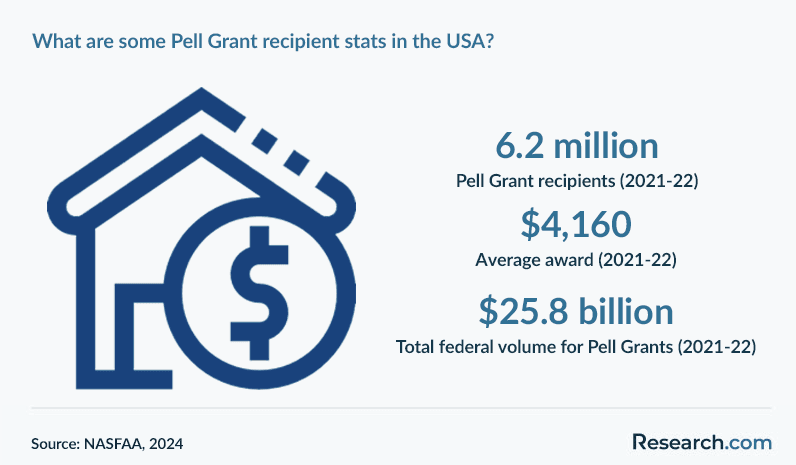
As the figure above shows, in AY 2021-22, 6.2 million Pell Grant recipients received an average award of $4,160. The total federal aid volume was $25.8 billion for the Pell Grant program.
Who is eligible for FAFSA at online colleges?
FAFSA eligibility for online students is generally the same as it is for students attending in person. You must meet federal student aid requirements, enroll in an eligible program, and maintain the academic progress standards set by your school.
- Basic eligibility: Students typically must be a U.S. citizen or eligible non-citizen, have a valid Social Security number, and enroll in an eligible degree or certificate program at a Title IV-accredited online college.
- Program eligibility: Not every online program at a school is automatically eligible for federal aid. Always confirm program-level eligibility with the financial aid office.
- Financial need: Grants and subsidized loans are linked to financial need, while some loan programs are not.
- Academic progress: Students must meet Satisfactory Academic Progress (SAP) standards to keep receiving aid. SAP usually considers GPA, completed credits, and pace toward graduation.
- Application process: Online and campus students use the same FAFSA form. When adding schools, use the institution’s official name and Department of Education school code from the school’s financial aid page.
- No automatic income cutoff: There is no income limit that prevents you from submitting the FAFSA. Aid eligibility depends on multiple factors, not income alone.
One important update for students comparing older financial aid advice: many older resources refer to Expected Family Contribution (EFC). The redesigned FAFSA now uses a different aid eligibility calculation framework, so students should rely on current guidance from the school’s financial aid office and the official federal student aid site.
How does FAFSA aid reduce the cost of online education?
FAFSA does not reduce tuition by itself. Instead, it allows eligible students to be considered for aid that can be applied to the school’s approved cost of attendance. That package may include grants, work-study, and federal loans. The school then applies aid according to its billing and disbursement process.
| Cost factor | How FAFSA-related aid may help | Decision tip |
| Tuition and required fees | Grants and loans may be applied directly to institutional charges. | Compare total program cost, not just cost per credit. |
| Books, supplies, and technology | Aid may help cover approved education-related expenses included in cost of attendance. | Ask whether online course materials, proctoring, software, or technology fees are extra. |
| Living expenses | Some aid may be refunded to the student after school charges are paid, depending on eligibility and cost of attendance. | Use refunds carefully; loan refunds must still be repaid if borrowed. |
| Borrowing costs | Subsidized loans can reduce interest costs compared with loans where interest accrues immediately. | Accept grants first, then work-study, then borrow only what is necessary. |
FAFSA-based aid is affected by your financial profile, enrollment intensity, program type, school cost, and institutional aid policies. Full-time, half-time, and less-than-half-time enrollment may lead to different aid amounts.
Research also suggests that application support matters. According to the National Bureau of Economic Research, providing FAFSA application assistance and financial aid information increased college persistence and credit completion by about 25%. Students received an average of $547 more in total federal aid and $292 more in Pell Grants, as shown in the graph below.
The lesson for online students is simple: do not self-disqualify. Complete the FAFSA early, ask your school how aid will be packaged, and compare the net price after grants and scholarships before deciding whether to borrow.
Why accreditation matters for online colleges that accept FAFSA
Accreditation is one of the most important checks you can make before enrolling in an online college. A school must be properly accredited and approved to participate in federal student aid programs for students to use FAFSA-based federal aid there. Accreditation also affects transfer credits, graduate school options, licensure, and employer perception.
- Federal aid eligibility: Only eligible institutions can participate in federal student aid programs.
- Academic quality: Accreditation signals that a school has been reviewed against recognized educational standards.
- Credit transfer: Accredited credits are more likely to be considered by other colleges, though transfer is never guaranteed.
- Licensure impact: Fields such as nursing, teaching, counseling, and social work may require specific program approvals in addition to institutional accreditation.
- Employer recognition: Employers are more likely to understand degrees from accredited institutions, especially when the program is relevant and the student has demonstrable skills.
How to verify accreditation before applying
- Search the U.S. Department of Education’s accredited institution database at https://ope.ed.gov/accreditation/Search.aspx/.
- Review the school’s accreditation page and confirm the name of the accrediting agency.
- Ask the financial aid office whether your specific online program is Title IV eligible.
- For licensed fields, contact the state licensing board or review the board’s approved program list.
- Use the U.S. Department of Education’s College Scorecard to compare graduation rates, debt levels, and other school-level data.
Examples of online colleges that accept FAFSA
Many accredited online colleges participate in federal student aid programs. The schools below are examples of institutions offering online undergraduate and graduate options. This is not a ranking, and it is not a complete list. Always verify current tuition, aid eligibility, program availability, and state authorization directly with the school.
1. University of Maryland Global Campus
The University of Maryland Global Campus offers online bachelor’s programs in more than 30 areas, including fields such as computer science and cybersecurity. The school is designed for working adults and transfer students, and eligible students may use scholarships, financial aid, and career services. UMGC accepts up to 90 transfer credits for prior learning, which can shorten the path to graduation for students with previous college or documented learning.
- Program Length: 3-4 years
- Tracks/concentrations: Various
- Tuition cost: $324 per credit (in-state) $499 per credit (out-of-state) $250 per credit (military)
- Required Credits to Graduate: 120 credits
- Accreditation: Middle States Commission on Higher Education
2. The University of Florida Online
The University of Florida Online offers fully online bachelor’s degrees in 25 different fields. Students can pursue a University of Florida degree through an online format while accessing financial aid options, academic support, faculty connections, alumni networks, and career services.
- Program Length: 4 years
- Tracks/concentrations: Various
- Tuition cost: $129.18 total per credit hour (tuition + fees)
- Required Credits to Graduate: 120 credits
- Accreditation: Southern Association of Colleges and Schools Commission on Colleges (SACSCOC)
3. Colorado State University Global
Colorado State University Global offers online bachelor’s, master’s, and certificate programs. Students looking for schedule flexibility may benefit from its fully online structure, career coaching, student success support, and transparent pricing model.
- Program Length: 4 years
- Tracks/concentrations: Various
- Tuition cost: $350/credit
- Required Credits to Graduate: 120 credits
- Accreditation: Higher Learning Commission (HLC)
4. Penn State World Campus
Penn State World Campus offers more than 200 online degrees and certificates. Its online programs serve transfer students, adult learners, veterans, and students who want a Penn State credential without relocating.
- Program Length: 4 years
- Tracks/concentrations: Various
- Tuition cost: $671 per credit
- Required Credits to Graduate: 120 credits
- Accreditation: Middle States Commission on Higher Education
5. Arizona State University
Arizona State University (ASU Online) offers more than 300 online degrees and certificates in areas such as business, education, and engineering. ASU Online provides resources for veterans, adult learners, and transfer students, along with student support services for online learners.
- Program Length: 4 years
- Tracks/concentrations: Various
- Tuition cost: Base tuition $6,888 AZ resident; $32,394 Non-resident
- Required Credits to Graduate: 120 credits
- Accreditation: Higher Learning Commission (HLC)
Students with previous credits or work-based learning should also compare competency based degrees online, because these programs may allow faster progress when students can demonstrate mastery of required skills.
What documents do online students need for FAFSA?
Online students use the same FAFSA documentation as campus-based students. Requirements vary by dependency status, tax situation, marital status, and verification requirements, but most applicants should be ready with the following:
- FSA ID: Your username and password for federal student aid information online.
- Social Security number: Used to confirm identity and connect federal records.
- Federal tax information: This may include your tax return, W-2 forms, and related schedules, or parent information if you are a dependent student.
- Untaxed income records: Examples may include child support received, interest income, veterans non-education benefits, or worker’s compensation.
- Asset information: Be prepared to report savings, checking balances, investments, stocks, bonds, and real estate other than your primary residence when required.
- Driver’s license: This is optional, but having it available may help with processing in some cases.
What financial aid can part-time online students receive through FAFSA?
Part-time online students can qualify for federal student aid, but the amount and type of aid may change based on enrollment status. Many aid programs require at least half-time enrollment, while some grants may be prorated when students take fewer credits.
| Aid type | Availability for part-time online students | What to ask the school |
| Pell Grants | Part-time students may qualify, but awards are typically adjusted based on credit load. | How many credits are required for the award amount shown in my package? |
| Federal Work-Study | Eligible part-time students may be considered if the school participates and funds are available. | Are work-study jobs available remotely or near my location? |
| Direct Subsidized Loans | May be available to eligible students, commonly tied to at least half-time enrollment. | What is the minimum credit load to keep loan eligibility? |
| Direct Unsubsidized Loans | May help cover remaining costs, but interest accrues during school. | What will my total borrowing look like at graduation? |
| State and institutional aid | Some states and colleges use FAFSA information to award grants or scholarships to part-time students. | Are online and part-time students eligible for the same school-based aid? |
Other financial aid options for online students beyond FAFSA
FAFSA should be your first step, but it should not be your only step. Many students reduce costs by combining federal aid with scholarships, employer benefits, military education benefits, state aid, and careful program selection.
- Employer tuition reimbursement: Some employers help pay for degree or certificate programs that relate to your job or career path. Ask about annual caps, grade requirements, repayment agreements, and approved schools.
- Military Tuition Assistance: Active-duty service members, veterans, and dependents may qualify for education benefits through military branches or veteran programs. These benefits may work alongside FAFSA-based aid.
- Scholarships: Look for school scholarships, professional association awards, nonprofit scholarships, employer-sponsored scholarships, and private foundation aid related to your field or background.
- State grants: Some states support residents enrolled in approved in-state online programs. Eligibility can vary widely by state, residency, enrollment level, and school.
- Private loans: Private loans may fill funding gaps, but they often carry different interest rates, credit requirements, and repayment protections than federal loans. Use them cautiously and only after reviewing federal options.
Cost pressure is one reason students should compare all aid sources. The 2021-2022 school year showed that the overall cost of attending a four-year college for first-year, full-time students living on campus was most expensive at private, non-profit schools, averaging $55,800. This was followed by private, for-profit institutions at $32,900 and public universities at $26,000, as shown in the graph below.
Career support services online students should expect from FAFSA-eligible colleges
A lower tuition price is not enough if the school does not help students finish and move toward employment. When comparing FAFSA-eligible online colleges, review career services as carefully as tuition and accreditation.
- Career advising: Look for virtual appointments, career planning sessions, job search strategy support, and guidance for career changers.
- Resume and cover letter help: Strong programs offer feedback tailored to your target field, not just generic templates.
- Interview preparation: Ask about mock interviews, recorded interview practice, and coaching for remote hiring processes.
- Employer connections: Useful services may include virtual career fairs, employer information sessions, alumni networks, and job boards.
- Internship support: Online learners should ask whether the college helps identify local, remote, or virtual internship opportunities.
- Portfolio development: Programs in business, technology, education, healthcare administration, and design may help students build e-portfolios, project samples, or digital badges.
- Graduate school planning: If your career requires advanced education, ask for help comparing graduate programs, including options such as the easiest online master's degree paths that align with your goals.
Current trends affecting FAFSA and online education
FAFSA processing and online education are both becoming more digital, but students still need to be proactive. Improved online interfaces, better data matching, automated validation, and more streamlined verification can reduce errors, but they do not eliminate the need to check deadlines, school eligibility, and award details. Students comparing online colleges that accept FAFSA should expect schools to provide clear online aid portals, electronic document submission, and timely communication about missing requirements.
AI and automation are also changing online learning and the job market. Students should look for programs that teach current tools ethically and practically, especially in fields such as computer science, business, healthcare administration, accounting, and education. At the same time, do not choose a program only because it mentions AI. Ask how technology is integrated into coursework, assessment, career preparation, and academic integrity policies.
How to choose FAFSA-supported online programs in specialized fields like nursing
Specialized fields require more caution than general majors because accreditation alone may not be enough. Nursing, teaching, counseling, social work, and some healthcare programs may require programmatic accreditation, state approval, supervised practice, clinical placements, exams, or licensure.
- Confirm licensure fit: Ask whether the program meets requirements in your state, not just the school’s home state.
- Review clinical or fieldwork requirements: Online does not always mean fully remote. Nursing and education programs often require in-person placements.
- Check placement support: Ask whether the school finds clinical sites or whether students must secure their own.
- Compare outcomes: Review graduation, exam pass, placement, and student support data when available.
- Understand costs: Licensure exams, background checks, uniforms, equipment, travel, and clinical fees may add to tuition.
Students considering nursing should be especially careful. Program accessibility matters, but it should not outweigh licensure readiness. For broader comparison, review resources such as the easiest nursing schools to get into while still verifying state approval and clinical requirements directly.
Advanced online degree options that may use FAFSA support
FAFSA is not only for first-time undergraduate students. Eligible students in qualifying graduate and professional programs may use federal aid options as well, although aid types and borrowing rules differ from undergraduate aid. Online master’s degrees, certificates, and doctoral degrees online may support career advancement when they are accredited, recognized in the field, and aligned with a clear professional goal.
Before enrolling in an advanced online program, ask whether the credential is required for your target role, whether employers in your field value the institution, and whether the salary or promotion potential justifies the cost. Avoid assuming that a graduate degree automatically produces a strong return on investment.
Can accelerated online programs help students use financial aid more efficiently?
Accelerated programs can reduce time to completion, but they are not automatically cheaper or easier. They work best for students who have transfer credits, strong time management, clear career goals, and the ability to handle condensed coursework. When paired with FAFSA-based aid, accelerated degree programs may help some students reduce total enrollment time and enter the workforce sooner.
| Accelerated option | Best for | Main risk | What to verify |
| Transfer-friendly bachelor’s program | Students with prior college credits. | Credits may not apply to major requirements. | Request an official transfer evaluation before committing. |
| Competency-based program | Students with work experience and self-paced learning ability. | Progress may stall without discipline or support. | Confirm accreditation, aid eligibility, pacing rules, and employer recognition. |
| Short-term certificate | Students seeking a targeted skill upgrade. | Some certificates may not qualify for aid or may have limited labor market value. | Ask whether the certificate is Title IV eligible and connected to real job requirements. |
| Accelerated graduate pathway | Professionals pursuing advancement or a required credential. | High workload and potential borrowing. | Compare total cost, completion rate, and career outcomes. |
Current FAFSA statistics students should know
FAFSA participation affects millions of students and billions of dollars in educational funding. The following figures from the cited sources show why completing the application matters:
- Providing FAFSA application assistance and aid eligibility information increased the likelihood of students persisting in college and earning credits by about 25%, according to the National Bureau of Economic Research.
- That assistance increased total federal aid received by about $547 and Pell Grant aid by $292 on average.
- About half of undergraduate students relied on some form of federal financial aid in 2019-20, according to the National Association of Student Financial Aid Administrators (NASFAA).
- In SY 2021-22, over 6 million students received a Pell Grant, with awards averaging $4,859, according to NASFAA.
- The total federal volume for Pell Grants was $25.8 billion in 2021-22, according to NASFAA.
- Due to uncompleted FAFSA applications, over $2.6 billion in Pell Grants went unclaimed by an estimated 767,000 graduates from the high school class of 2022, according to NASFAA, 2024, as shown in the figure below.
- Since the 2024–25 redesigned application went live, more than 3.1 million FAFSA forms have been successfully submitted, according to the U.S. Department of Education.
- In the 2021-22 academic year, the average Pell Grant award for undergraduate students was $4,597 across 5,519 institutions, according to the National Center for Education Statistics.
- The maximum Pell Grant award for the 2022-23 academic year was $6,895, according to the U.S. Department of Education.
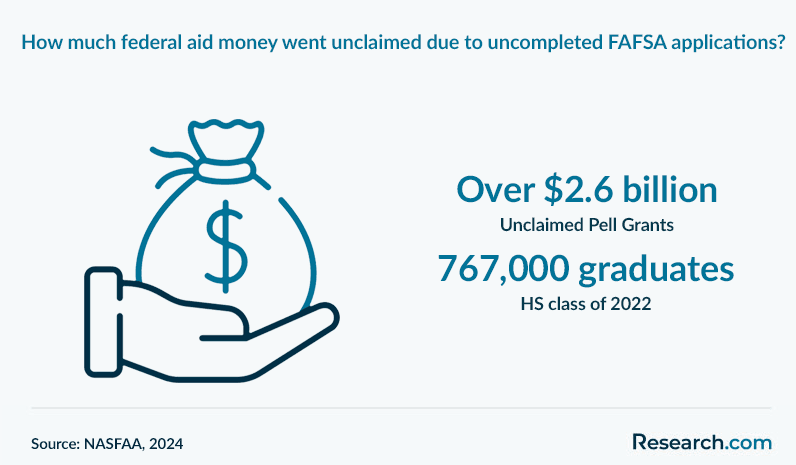
These figures do not mean every student will receive the same aid amount. They do show that FAFSA is a major gateway to education funding and that not applying can leave potential aid unused.
How to evaluate quality and cost-effectiveness in FAFSA-supported online education
The lowest tuition is not always the best deal, and the most recognizable school is not always the best fit. A cost-effective online college combines fair pricing, eligible financial aid, strong academic support, credible accreditation, realistic completion timelines, and career outcomes that match your goals.
| Factor | What to compare | Red flag |
| Total cost | Tuition, fees, books, technology fees, residency requirements, travel, clinical costs, and graduation fees. | A school advertises low tuition but hides required fees. |
| Net price | Cost after grants, scholarships, and employer or military benefits. | You are encouraged to borrow before seeing your full aid package. |
| Accreditation | Institutional accreditation and any programmatic accreditation required for your field. | The school avoids direct answers about accreditation or licensure. |
| Completion timeline | Transfer credits, course availability, term structure, and required prerequisites. | The advertised completion time assumes maximum credits every term. |
| Student support | Advising, tutoring, technical help, disability services, career services, and mental health resources. | Online students receive fewer services than campus students. |
| Career value | Employer partnerships, internships, licensure pass rates, alumni outcomes, and portfolio opportunities. | The program makes broad salary claims without evidence. |
Students focused on affordability can compare cheapest online bachelor degree options, but price should be weighed against accreditation, support, transfer policy, and career relevance.
How fast-track online degrees fit with FAFSA funding
Fast-track degrees can work well with FAFSA funding when they are accredited, aid-eligible, and realistic for the student’s schedule. Shorter programs may reduce the number of terms you pay for, but compressed courses can also increase weekly workload. Students comparing fast track degrees online should ask whether aid is disbursed by term, whether courses are offered year-round, and whether accelerated pacing affects SAP requirements.
The best use case is a student with transfer credits, a stable schedule, and a career goal that benefits from faster completion. The worst use case is a student who chooses speed over fit, fails courses, loses aid eligibility, and ends up paying more.
Myths and realities about online education with FAFSA
| Myth | Reality |
| Online courses are easier than on-campus courses. | Accredited online courses can be just as demanding as campus courses. Students still need time for readings, assignments, exams, projects, and participation. |
| You must be highly tech-savvy to succeed online. | Most learning platforms are designed for regular users, but students should be comfortable with email, file uploads, video meetings, learning management systems, and basic troubleshooting. |
| Online learning is only recorded lectures. | Many programs use discussions, simulations, projects, labs, case studies, group work, and interactive tools. |
| My family earns too much, so FAFSA is pointless. | There is no income cutoff for submitting the FAFSA. Aid depends on multiple factors, and some students who do not qualify for grants may still qualify for loans or school-based aid. |
| FAFSA is too complicated and only needs to be done once. | The FAFSA is submitted annually, and help is available from schools and federal student aid resources. |
| Part-time and online students cannot receive federal aid. | Eligible online and part-time students may receive aid, although award amounts and requirements can differ from full-time enrollment. |
| Undocumented students can receive federal FAFSA aid for online programs. | Undocumented students are generally not eligible for federal financial aid through FAFSA, although some states and colleges may offer separate aid programs. |
What accredited online colleges are available, and why does federal aid matter?
Accredited online colleges give students access to recognized academic programs and, when eligible, federal financial aid. Students exploring nationally accredited online colleges should confirm whether the institution participates in federal aid programs, whether the specific program is eligible, and whether credits or credentials will support their next academic or career step.
Federal aid matters because it can lower upfront costs, expand access to grants, provide federal loan protections, and make school-based aid possible. However, aid should not be treated as free purchasing power. Grants and scholarships reduce cost; loans create repayment obligations. A good decision compares the full cost of attendance with completion likelihood and career value.
Long-term career outcomes for FAFSA-supported online education
FAFSA-supported online education can improve career mobility when the program is accredited, completed successfully, and aligned with labor market needs. The strongest outcomes tend to come from programs that combine relevant curriculum, practical projects, internships or clinical experiences, career support, and credentials employers understand.
Students should evaluate outcomes by asking direct questions: What jobs do graduates get? What percentage finish the program? What support exists for internships or licensure? Do employers recruit from this program? Does the school publish debt or earnings information? Some students may prioritize speed and earning potential by comparing pathways related to the fastest high paying degree, but no degree guarantees a specific salary or job.
Common FAFSA mistakes to avoid when applying to online colleges
FAFSA mistakes can delay aid, reduce eligibility, or create unexpected bills. Before submitting your application or enrolling in an online program, watch for these common problems.
- Missing deadlines: Federal, state, and school deadlines may differ. Submit early so you do not miss limited state or institutional funds.
- Entering inaccurate information: Incorrect Social Security numbers, names, income details, or school codes can slow processing.
- Forgetting required signatures: An unsigned FAFSA cannot be processed correctly.
- Assuming the school is eligible: Do not rely on advertising. Confirm Title IV participation and program eligibility with the financial aid office.
- Ignoring accreditation: A non-accredited or improperly accredited school may limit aid eligibility, credit transfer, employment value, or licensure options.
- Borrowing the full offered amount automatically: You are not required to accept every loan in your package. Borrow only what you need.
- Not updating financial changes: If your financial situation changes, ask the school whether a professional judgment or aid review is possible.
- Overlooking part-time eligibility: Part-time online students may still qualify for aid, but they should verify minimum credit requirements.
- Choosing only by sticker price: Compare net price, completion support, transfer credits, and career outcomes. Students seeking low-cost options can review cheap accredited online colleges as part of a broader comparison.
FAFSA benefits for military students in online education
Military-connected students often combine multiple education benefits. FAFSA can supplement resources such as the GI Bill, Tuition Assistance, scholarships, and school-based military benefits. Depending on eligibility, federal aid may help cover remaining tuition, fees, books, supplies, or other approved costs after military benefits are applied.
Students should compare how each school handles benefit coordination, transfer credits for military training, deployment interruptions, course withdrawals, and academic advising. Many military friendly online colleges provide dedicated support for active-duty service members, veterans, spouses, and dependents. Useful features may include asynchronous classes, rolling start dates, military tuition rates, trained benefit advisors, and flexible leave policies.
The best strategy is to speak with both the school’s financial aid office and military benefits office before enrolling. Ask how FAFSA aid, military benefits, scholarships, and refunds interact so you understand your true out-of-pocket cost.
Questions to ask before choosing an online college that accepts FAFSA
- Is the institution accredited, and by which accrediting agency?
- Is my specific online program eligible for federal student aid?
- What is the total cost of attendance, including fees and required technology?
- How many of my transfer credits will apply to the degree?
- What happens to my aid if I enroll part-time or take a term off?
- What are the SAP requirements, and how could failed or withdrawn courses affect aid?
- Does the program meet licensure or certification requirements in my state?
- What career services are available to online students?
- What percentage of students complete the program?
- How much debt do typical students take on, and what repayment support is available?
Key Insights
- Online students can use FAFSA if the school and program are eligible for federal student aid; online delivery alone does not disqualify a program.
- Accreditation is non-negotiable. It affects FAFSA eligibility, transfer credits, licensure, employer recognition, and graduate school options.
- There is no income cutoff for submitting FAFSA, so students should apply even if they assume they will not qualify for need-based grants.
- Part-time online students may qualify for aid, but awards and loan eligibility often depend on credit load and enrollment status.
- Grants and scholarships should be prioritized before loans. Federal loans can help, but they must be repaid.
- Accelerated and competency-based programs can reduce time and cost for the right student, but they require discipline and careful verification of aid rules.
- Specialized fields such as nursing, teaching, counseling, and social work require extra checks for state licensure and program approval.
- The smartest choice is not simply the cheapest online college. It is the accredited program with a manageable net cost, strong completion support, and a realistic connection to your career goal.
References:
- Bettinger, E. P., Long, B. T., Oreopoulos, P., & Sanbonmatsu, L. (2009). The role of simplification and information in college decisions: Results from the H&R Block FAFSA experiment. NBER.org.
- National Center for Education Statistics. (2024). Use the data. NCES.
- National Association of Student Financial Aid Administrators. (2024). Journal of Student Financial Aid. NASFAA.
- EducationData.org. (2023, January 23). Pell Grant statistics: Annual data on recipients and funding. EducationData.org.
- U.S. Department of Education. (2023). Fiscal year 2023 FSA annual report. U.S. Department of Education.
- National Association of Student Financial Aid Administrators. (2023). National student aid profile. NASFAA.
- National Center for Education Statistics. (2024). Fast Facts: Tuition costs of colleges and universities (76). NCES.
- National Association of Student Financial Aid Administrators. (2024, April 28). NCAN report: $3.6 billion in Pell Grants went unclaimed in 2022. NASFAA.
Other Things You Should Know About Online Colleges that Accept FAFSA
Yes. To receive federal Direct Loans as an online student, you usually must be enrolled at least half-time, which is commonly 6 credit hours per term for undergraduates. Pell Grants have no half-time minimum, but you still must meet your school’s satisfactory academic progress rules.
Online colleges accepting FAFSA in 2027 offer a variety of degrees, including associate's, bachelor's, master's, and doctoral programs. These institutions provide flexibility in fields like business, healthcare, education, and technology to accommodate diverse career goals.
Students can verify if an online college accepts FAFSA for 2027 by checking the school's Federal School Code on the official FAFSA website or consulting the college's financial aid office directly. Accredited institutions typically participate in federal aid programs.


