
8 Best College Admissions Consultants Ranking for 2027

Co-Founder and Chief Data Scientist
College admissions have grown increasingly selective, even for highly qualified applicants. Harvard’s acceptance rate dropped to just 3.5% for the Class of 2027, down from about 16% in 1980 (CBS News, 2023). Similar patterns are emerging across the top 100 U.S. universities, where larger applicant pools and more demanding criteria have driven acceptance rates to historic lows. Today, many students are turning to college admissions consultants for expert, targeted support that goes beyond what school-based counselors can provide.
In this article, I’ll examine how the top college admissions consultants work, how they structure their services, and what families should expect in terms of pricing and outcomes. I’ll also look at how success is measured, which trends are reshaping the college admissions space, and how to distinguish high-quality advising from generic coaching. The aim is to help high-achieving students make informed decisions at one of the most critical points in their academic journey.
What are the benefits of working with college admissions consultants?
- College admissions consultants help students submit all applications on time and without errors, improving completion and reducing disqualification risks.
- Students who work with consultants are less likely to transfer schools, which affects 37% of undergraduates, adding $12,000–$26,000 per semester to the total cost of college.
- Some consultants report over 90% of their students graduate within four years, compared to the national six-year completion average.
- Top 8 Best College Admissions Consultants for 2027 Best College Consultants
- What should students expect when working with college admissions consultants? What to Expect
- How early should students start working with a college admissions consultant? How To Start
- What is the average price of private college admissions consultants? Average Cost
- Do admissions consultants offer payment plans or financial assistance? Payment Plans
- How do you measure the success rate of college application consultants? Success Rates
- How do I choose the best college admissions consultant for my needs? Choosing Consultants
- What is the role of families in the college admissions consulting process? What is the role of families in the college admissions consulting process?
- What admissions trends should students be aware of for applying in 2027? Admissions Trends
Best College Admissions Consultants for 2027: How to Compare Your Options
Choosing a college admissions consultant is a high-stakes family decision because the service can cost thousands of dollars and the quality varies widely. Some students need full application management, while others only need essay feedback, school-list strategy, testing guidance, or help staying on schedule. The best consultant is not automatically the most expensive one; it is the advisor whose experience, ethics, communication style, and service scope match the student’s goals.
This guide compares leading college admissions consulting firms, explains what students should expect, breaks down typical costs, and shows families how to evaluate whether private advising is worth the investment. It also covers timing, payment options, success-rate claims, family involvement, admissions trends, and common mistakes to avoid before signing a contract.
Quick Answer: What Is the Best College Admissions Consultant?
There is no single best college admissions consultant for every student. PrepScholar may appeal to families who want test prep combined with admissions planning, HelloCollege offers a team-based model with flexible hourly options, Empowerly emphasizes data-supported profile evaluation, The Princeton Review brings a large test-prep and admissions brand, IvyWise focuses on former admissions officer counseling, Solomon Admissions Consulting uses a structured methodology with a large admissions-officer network, and Quad Education Group offers broad support from former admissions officers across many institutions.
Before choosing, compare each provider’s pricing, counselor background, contract terms, ethical standards, communication process, and whether their services fit your target schools and budget. Be cautious with advertised acceptance-rate claims because student outcomes depend heavily on academic profile, school selectivity, application strategy, institutional priorities, and fit.
| Consultant | Best Fit | Average Costs | Reported Results and Reviews |
| PrepScholar | Students who want admissions guidance paired with adaptive SAT/ACT preparation and narrative development | Comprehensive admission packages range from $6,895 for 7 applications up to $12,895 for 20 applications | Students are reported to be 6.1x more likely to be admitted to Ivy League institutions and have a 99% acceptance rate to their top 10 schools; 4.6 / 5 on Trustpilot |
| HelloCollege | Families who want one coordinated team across applications, essays, test prep, tutoring, and financial aid, anchored by a dedicated counselor. | Comprehensive packages range from $5,000 to $20,000, with most families investing around $8,000. | Students admitted to every top 50 college. 9/10 students admitted into a top 3 college choice. 99% of families would recommend. 98% said the process felt less stressful. 4.8/5 "excellent” rating on Trustpilot. A+BBB rating. |
| Empowerly | Students who want personalized advising supported by a data-driven applicant evaluation tool | Packages typically start around $4,000 and vary based on service level and counselor experience | 98% of students are admitted to Top 100 U.S. colleges; 4.8 / 5 on Trustpilot and 5 / 5 on G2 |
| The Princeton Review | Students who prefer a well-known education brand with admissions and test-prep experience | Packages start at $1,800; full-service programs range from $4,500 to $10,000 | 80% of students are admitted to their target colleges; 4.3 / 5 on Trustpilot across more than 2,000 reviews |
| IvyWise | Applicants seeking high-touch counseling from former Ivy League and top university admissions officers | Custom packages typically range from $5,000 to $15,000 | 98% of students are admitted to at least one top-choice school; 4.6 / 5 on Trustpilot across more than 1,200 reviews |
| Solomon Admissions Consulting | Students applying to selective undergraduate, transfer, BS/MD, or graduate programs who want a structured methodology | Packages range from $6,000 to $20,000 depending on counselor seniority and scope | Clients gain admission at rates four to five times higher than national averages; 4.7 / 5 on Trustpilot (346 reviews) and A+ rating with the Better Business Bureau |
| Quad Education Group | Families looking for essay, interview, scholarship, and admissions strategy from a large former-admissions-officer network | Programs begin at $5,900 per package | 98% of clients gain admission to targeted schools; 4.8 / 5 average on Trustpilot from 449 reviews |
| Great College Advice | High school students and families seeking personalized, strategic college admissions guidance | $5,000–$20,000+ for comprehensive college consulting but fees depend on grade level at start, selectivity of target schools, and how many essays/applications are included. | 97% top-three-choice acceptance rate, with overwhelmingly positive student and parent testimonials. |
Families who want one coordinated team across applications, essays, test prep, tutoring, and financial aid, anchored by a dedicated counselor.
1. PrepScholar
PrepScholar is a strong option for students who want college counseling connected to structured test preparation. Its model combines adaptive SAT/ACT prep, application strategy, essay support, and extracurricular positioning. The company says it hires educators with test scores in the 99th percentile, which may appeal to students who need both admissions coaching and rigorous test guidance.
A distinctive part of PrepScholar’s approach is its “Passion Project” support, which is designed to help students turn interests into concrete accomplishments that can strengthen the overall application story.
- Primary Service: Data-driven college counseling, adaptive SAT/ACT preparation, essay editing, and extracurricular profile building.
- Average Costs: Comprehensive admission packages range from $6,895 for 7 applications up to $12,895 for 20 applications.
- Reported Success Rate: Students are reported to be 6.1x more likely to be admitted to Ivy League institutions and have a 99% acceptance rate to their top 10 schools.
- Client Review Ratings: 4.6 / 5 on Trustpilot.
2. HelloCollege
HelloCollege is best for families seeking highly personalized admissions guidance from a dedicated counselor with support from a team of 80+ experts across essay writing, test preparation, academic tutoring, and financial aid.
Counselors include former admissions officers from Northeastern, Duke, UChicago, Occidental, UC Berkeley, RPI, and WashU Law, representing 60+ combined years of admissions-office experience. Using this experience, counselors help students develop their Stand-Out Factor, a proprietary approach to shaping applications that make a stronger impression on the most competitive colleges.
Families also gain access to a proprietary applicant platform to organize college research, essays, and deadlines into a month-by-month planner. Among the Class of 2026, 99.7% of students reported staying organized and meeting their deadlines, and 9 in 10 were accepted at at least one of their top-three colleges.
- Primary Service: Comprehensive college admissions counseling for grades 7–12, including essay coaching, ACT/SAT preparation, academic tutoring, and financial aid planning. Offered in flexible and personalized plans.
- Average Costs: Comprehensive packages range from $5,000 to $20,000 based on level of support, college list selectivity, and whether tutoring and test prep are included, with most families investing around $8,000.
- Reported Success Rate: Among the class of 2026, 9 out of 10 students were accepted to at least one of their top three college choices; 89% reported earning scholarships; 98% reported feeling less stressed about the college application process, and 99.7% reported feeling more confident applying to college. Students with ten or more tutoring hours saw an average increase of 150 points on the SAT and 5 points on the ACT. HelloCollege students have been admitted to every Top 50 university, including every Ivy League school, MIT, Stanford, and Duke.
- Client Review Ratings: 4.9 out of 5 on Google across 400+ reviews; 4.8 "Excellent" TrustScore on Trustpilot. Listed as a Best College Consultant by Forbes Advisor. A+ BBB rating and a NACAC member organization.
3. Empowerly
Empowerly focuses on individualized admissions counseling supported by its Empowerly Score®, which compares applicant profiles against thousands of historical profiles. This can help students understand how their academic record, activities, essays, and goals may align with target schools.
Its counseling services cover profile strategy, essay planning, interview preparation, and scholarship guidance. Families who want data-informed advising alongside personalized coaching may find this approach useful.
- Primary Service: Personalized college admissions counseling with profile-based strategy, essay guidance, and scholarship support.
- Average Costs: Packages typically start around $4,000 and vary based on service level and counselor experience.
- Reported Success Rate: 98% of students are admitted to Top 100 U.S. colleges.
- Client Review Ratings: 4.8 / 5 on Trustpilot; 5 / 5 on G2.
4. The Princeton Review
The Princeton Review offers admissions advising through its Premier Admissions program. The service is led by former admissions officers from selective institutions such as MIT and Amherst and includes planning, essay review, and interview preparation.
This provider may be a practical choice for students who want an established national brand that combines admissions counseling experience with a long history in standardized test preparation.
- Primary Service: One-on-one Premier Admissions Counseling with essay support, interview coaching, and strategic planning.
- Average Costs: Packages start at $1,800; full-service programs range from $4,500 to $10,000.
- Reported Success Rate: 80% of students are admitted to their target colleges.
- Client Review Ratings: 4.3 / 5 on Trustpilot across more than 2,000 reviews.
5. IvyWise
IvyWise provides high-touch admissions counseling through former Ivy League and top university admissions officers. Students work with a dedicated counselor and may also receive support from research and writing specialists.
The firm’s services can include academic planning, testing strategy, application development, interview preparation, and review of the full admissions profile. It is best suited for families seeking an intensive, personalized process.
- Primary Service: One-on-one counseling with application strategy, profile review, and interview preparation.
- Average Costs: Custom packages typically range from $5,000 to $15,000.
- Reported Success Rate: 98% of students are admitted to at least one top-choice school.
- Client Review Ratings: 4.6 / 5 on Trustpilot across more than 1,200 reviews.
6. Solomon Admissions Consulting
Solomon Admissions Consulting works with students through a network of over 150 former college admissions officers from top-ranked institutions. Its proprietary Solomon Methodology provides a step-by-step structure for academic planning, extracurricular strategy, essay development, and application execution.
The firm supports high school, transfer, BS/MD, and graduate applicants. Families considering Solomon should pay close attention to counselor seniority, service scope, and how much hands-on writing or research support is included in the selected package.
- Primary Service: Individualized admissions consulting using the Solomon Methodology across high school, transfer, BS/MD, and graduate applications.
- Average Costs: Packages range from $6,000 to $20,000 depending on counselor seniority and scope.
- Reported Success Rate: Clients gain admission at rates four to five times higher than national averages.
- Client Review Ratings: 4.7 / 5 on Trustpilot (346 reviews); A+ rating with the Better Business Bureau.
7. Quad Education Group
Quad Education Group offers admissions advising through more than 200 former admissions officers from top U.S. institutions. Its services include essay support, interview preparation, scholarship advising, and personalized admissions strategy.
The company reports a 7× increase in admission odds and over $23 million in merit aid secured annually. Families comparing Quad with other firms should ask how students are matched with counselors, how often advising occurs, and what scholarship support includes.
- Primary Service: Essay support, interview preparation, scholarship advising, and personalized admissions strategy.
- Average Costs: Programs begin at $5,900 per package.
- Reported Success Rate: 98% of clients gain admission to targeted schools.
- Client Review Ratings: 4.8 / 5 average on Trustpilot from 449 reviews.
8. Great College Advice
Great College Advice provides personalized college admissions counseling to families across the United States and more than 45 countries. Founded in 2007, its services cover in-depth assessments, high school planning, college list development, essay support, application strategy, interviews, waitlist guidance, and financial aid award comparison.
This provider reports that its students have admissions rates 3× to 10× higher than selective college averages. Its counselors include educators, academic advisers, admissions readers, and experienced college counselors who use a collaborative approach to help students navigate the admissions process.
- Primary Service: College assessments, high school planning, college list development, essay support, application guidance, interviews, and post-application counseling.
- Average Costs: Pricing is not publicly listed; families can schedule a complimentary consultation to learn about available packages.
- Reported Success Rate: 97% of students are accepted to one or more of their top 3 choices.
- Client Review Ratings: 5.0 / 5 average on TrustAnalytica from 37 reviews.
What Should Students Expect From a College Admissions Consultant?
A college admissions consultant helps students plan, organize, and strengthen the application process. The work usually begins with a review of the student’s grades, course choices, test history, activities, interests, goals, and target colleges. From there, the consultant builds a strategy that may include school-list development, essay planning, application timelines, interview practice, and financial aid coordination.
The best consultants do not replace the student’s voice. They help students clarify their story, understand admissions expectations, avoid missed deadlines, and make thoughtful choices. A strong process should feel structured, transparent, and student-led.
| Consulting Step | What It Usually Includes | Why It Matters |
| Profile review | Assessment of grades, courses, testing, activities, awards, and readiness | Identifies strengths, weaknesses, and realistic next steps |
| College list planning | Selection of reach, match, and safety schools based on fit and admissions context | Reduces the risk of applying only to overly selective or poorly matched schools |
| Essay strategy | Brainstorming, outlining, drafting, and revising personal statements and supplements | Helps students present a clear, authentic, and cohesive application narrative |
| Interview preparation | Practice responses, messaging feedback, and confidence-building | Prepares students for alumni, admissions, or scholarship interviews |
| Timeline management | Deadlines for essays, recommendations, testing, applications, and financial aid | Keeps students organized and prevents last-minute errors |
| Family communication | Parent updates, planning conversations, and role clarification | Balances parental support with student ownership |
| Decision support | Review of acceptances, waitlists, scholarships, and alternate options | Helps families choose a college with academic, financial, and personal fit |
- Initial Comprehensive Review: The consultant examines academic performance, standardized testing, extracurricular depth, and readiness for the schools under consideration.
- Customized School List: Students receive a balanced list of reach, match, and safety colleges based on fit, selectivity, goals, and institutional priorities.
- Strategic Essay Development: Advising may include topic selection, drafting, revision, tone review, and guidance on maintaining an authentic student voice.
- Interview Preparation: Students practice answering questions clearly and connecting their experiences to the college’s values and opportunities.
- Timeline Management: Consultants often create calendars for applications, recommendations, test dates, scholarship deadlines, and aid forms.
- Self-Reflection Exercises: Students may complete activities that help them identify values, goals, challenges, and meaningful experiences.
- Holistic Profile Enhancement: Advising can include recommendations for internships, leadership roles, summer programs, research, service, or other enrichment activities.
- Data-Driven Decision Support: Some firms use admissions trends, historical outcomes, or predictive tools to guide strategy.
- Family Communication: A clear communication plan helps parents stay informed without taking over the student’s application.
- Outcome Tracking: Post-submission guidance may include reviewing admissions decisions, responding to waitlists, and comparing enrollment options.
When Should Students Start Working With a College Admissions Consultant?
Students targeting selective colleges usually benefit from starting earlier than senior year. Sophomore year can be helpful for course planning, activity development, testing strategy, and summer experience decisions. Starting early gives students time to build a stronger profile rather than simply polishing an application at the end.
Spring of junior year is often the latest practical starting point for families that want meaningful strategic help. By then, students can still refine their school list, plan testing, request recommendations, and begin essays before senior-year deadlines arrive.
Senior-year consulting can still be valuable, especially for essay review, application organization, interview preparation, or waitlist strategy. However, late-stage advising is usually more reactive. The consultant can improve presentation and execution, but there is less time to address academic or extracurricular gaps.
| Starting Point | Best Use of Consulting | Limitations |
| Sophomore year | Course planning, activity strategy, testing roadmap, summer planning, early college research | Requires a longer commitment and may cost more if support continues through senior year |
| Junior year | School-list development, test planning, essay preparation, recommendation strategy, timeline management | Some profile-building opportunities may already be limited |
| Senior year | Essay review, application completion, interview prep, deadline tracking, decision support | Less time to change the underlying academic or extracurricular profile |
Families interested in selectivity should also understand how admit rates vary across institutions. Reviewing college acceptance rates can help students build a balanced list instead of applying only to highly competitive schools.
How Much Do Private College Admissions Consultants Cost?
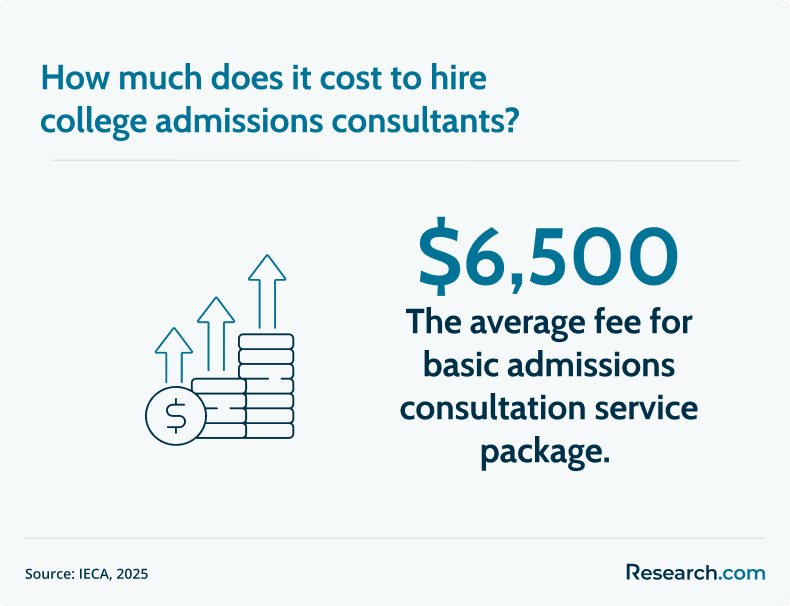
Private college admissions consulting prices vary based on counselor experience, program length, service intensity, and the number of applications supported. Hourly advising may be enough for families who need targeted help, while full-service packages are designed for students who want support from planning through enrollment decisions.
Hourly rates typically fall between $100 and $500, while full-service packages can range from $4,000 to $25,000. Families considering highly selective schools, long-term planning, or intensive essay support often pay more.
| Pricing Model | Typical Cost | Best For |
| Hourly Consulting | $100–$300 per hour, with an average around $225 | Students who need focused support with essays, interviews, college lists, or short-term strategy |
| Flat-Fee Packages | $4,000–$6,000 | Families that want bundled help with college lists, essay editing, and application planning |
| Comprehensive Plans | $8,000–$15,000 | Students seeking start-to-finish guidance, including extracurricular advising, testing coordination, and financial aid support |
| Elite Consultants | $20,000–$25,000 | Families seeking highly individualized advising from consultants with Ivy League placement records |
| Monthly Subscriptions | $15–$50 per month | Students who want lower-cost AI-based guidance, document review, or light-touch coaching |
Price alone does not determine value. A lower-cost consultant who gives specific, timely, ethical advice may be more useful than an expensive package with vague deliverables. Before paying, ask exactly what is included, how many meetings are covered, who reviews essays, how quickly feedback is returned, and whether support continues after applications are submitted.
Do College Admissions Consultants Offer Payment Plans or Financial Assistance?
Many admissions consultants provide flexible payment options, but policies vary by provider. Families should ask about affordability before the first paid session, especially if they are also budgeting for testing, application fees, campus visits, and other admissions-related expenses.
- Installment Payment Plans: Some firms allow families to divide package fees into monthly payments, sometimes without interest.
- Sliding Scale Pricing: Certain consultants adjust fees based on household income or demonstrated financial need.
- Need-Based Scholarships: Some firms and nonprofit organizations offer partial or full advising scholarships for eligible students.
- Pro Bono Services: Free advising may be available through volunteer initiatives connected to organizations such as the Independent Educational Consultants Association (IECA) and the National Association for College Admission Counseling (NACAC).
- Bundled Family Discounts: Families with siblings or multiple students may qualify for reduced pricing.
- A La Carte Options: Students can often purchase only essay review, interview prep, or school-list help instead of a full package.
- Monthly Subscriptions: Lower-cost plans may include AI-powered tools, document feedback, or limited advising access.
Families should also account for the broader college application cost, including test registrations, application fees, and travel. A consultant’s fee is only one part of the admissions budget.
How Should Families Measure the Success of a College Admissions Consultant?
Success should not be measured only by whether a student gets into one highly selective college. Admissions outcomes depend on many factors outside a consultant’s control, including institutional priorities, applicant volume, program capacity, academic record, recommendations, and fit. A better evaluation looks at process quality, transparency, student growth, and whether the consultant helped the student apply wisely.
Families should treat published acceptance-rate claims as marketing claims unless the consultant explains how the numbers are calculated. Ask whether the data includes all students, only full-package clients, only students applying to certain schools, or only successful outcomes.
- Compare Acceptance Rate Increases Carefully: Ask whether clients are admitted at higher rates than national averages and whether the comparison accounts for student qualifications. Some top-performing firms often show a 15% to 25% improvement at target schools.
- Look at Student Yield: Ask how often students enroll at recommended schools after acceptance, which can indicate whether the college list was well matched.
- Track Scholarship Outcomes: Review whether students secure merit aid. Consultants who regularly help clients secure $10,000–$50,000 in annual scholarships may be providing meaningful financial value.
- Review Test Score Improvements: If test planning is part of the service, ask whether students improve their SAT or ACT results through recommended prep strategies.
- Check Application Completion Rates: A strong consultant should help students submit complete, accurate applications before deadlines.
- Request Satisfaction Metrics: Some consultants track surveys or Net Promoter Scores. Scores above 60 indicate positive feedback and strong referral potential.
- Ask About Referral Rates: A high share of new clients from past-family referrals, such as 70% to 90%, can signal trust and satisfaction.
- Inquire About Retention and Graduation Data: Some consultants follow students after enrollment and report whether they persist and graduate within four years, with top firms reporting over 90% rates.
- Review Portfolio Quality: Ask to see anonymized examples of planning documents, essay feedback style, or activity strategy rather than only headline results.
- Evaluate ROI: Compare the consulting fee with scholarship awards, improved college fit, reduced application stress, and the quality of final options.
| Question to Ask | What a Strong Answer Looks Like | Warning Sign |
| How do you calculate success rates? | The consultant explains the denominator, student categories, and time period clearly | They cite impressive rates without explaining the data |
| Do you guarantee admission? | They refuse to guarantee outcomes and explain admissions uncertainty | They promise access, influence, or guaranteed acceptance |
| Who will work with my student? | The firm identifies the counselor’s background and support team | The sales call is handled by one person, but the assigned advisor is unclear |
| How is essay feedback handled? | They preserve the student’s voice and provide revision guidance | They imply they will write essays for the student |
| What happens after decisions arrive? | They help compare options, aid offers, waitlists, and next steps | The package ends immediately after application submission |
How Do You Choose the Right College Admissions Consultant?
The right consultant should match the student’s needs, not just the family’s anxiety level. A student applying broadly to public universities may need a different level of support than a student targeting highly selective private colleges, BS/MD programs, scholarships, or specialized arts programs.
Start by identifying the problem you are trying to solve. If the student struggles with organization, prioritize timeline management. If essays are the concern, look for strong writing feedback. If the school list feels unrealistic, choose a consultant with clear admissions strategy experience. If cost is the main issue, ask about financial aid and scholarship advising.
- Relevant Experience: Look for consultants with direct admissions, counseling, or advising experience, especially with students applying to similar colleges or programs.
- Clear Scope of Services: Confirm whether the package includes school-list strategy, essay review, activity review, interviews, financial aid guidance, or post-decision support.
- Ethical Standards: Reputable consultants follow professional codes and avoid unrealistic promises, hidden influence claims, or essay-writing shortcuts.
- Communication and Responsiveness: Ask how often meetings occur, how quickly feedback is returned, and how parents are included without taking over.
- Transparent Pricing: Request a written contract with fees, deliverables, cancellation terms, refund policies, and any additional charges.
- Parent and Student Feedback: Read verified reviews when available and ask for references from recent families.
- Trial Consultations: Use an introductory session to evaluate whether the consultant listens well, gives specific advice, and connects with the student.
Common Mistakes When Hiring an Admissions Consultant
| Mistake | Why It Can Hurt | Better Approach |
| Choosing only by brand name | A well-known company may not assign the best-fit counselor for your student | Ask who will personally advise the student and what experience they bring |
| Focusing only on price | The cheapest option may offer too little support, while the highest price may not guarantee better results | Compare deliverables, meeting frequency, feedback quality, and contract terms |
| Believing guaranteed-admission claims | No ethical consultant can control college decisions | Choose advisors who explain uncertainty and focus on fit, quality, and strategy |
| Waiting until deadlines are close | Last-minute help limits time for reflection, revision, and profile development | Begin planning early enough to improve both the application and the applicant profile |
| Letting parents lead every conversation | Applications can become less authentic when the student’s voice is overshadowed | Set boundaries so the student owns the process while parents support logistics and finances |
| Ignoring financial fit | An acceptance may not be useful if the college is unaffordable | Discuss aid, scholarships, and total cost early in the college-list process |
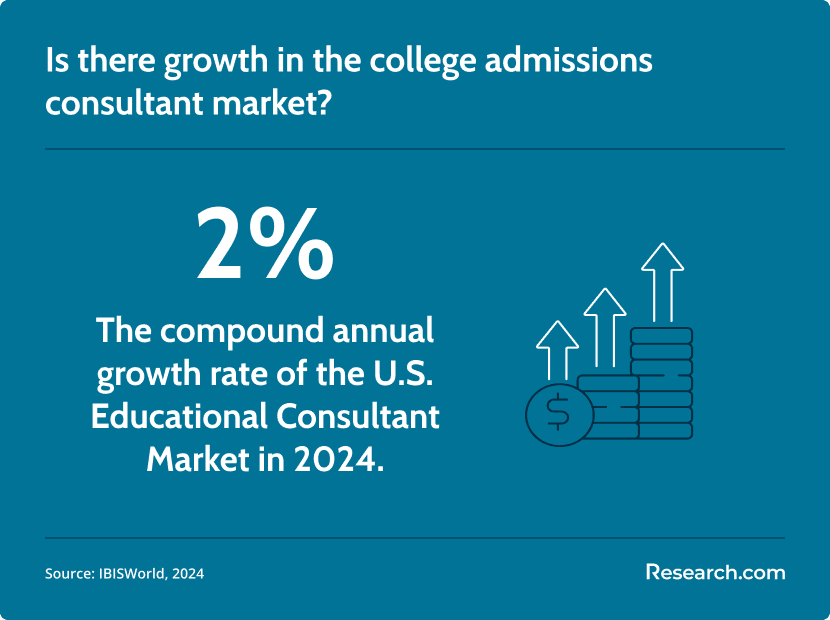
The college admissions consulting industry has expanded as families seek more specialized guidance. The chart below shows the size of the market and how it has changed in recent years.
What Role Should Families Play in the Admissions Consulting Process?
Students should lead the admissions process because colleges are evaluating their goals, judgment, and voice. Families, however, still play an important supporting role. The healthiest arrangement is a partnership: the student owns the application, the consultant provides guidance, and the family supports planning, finances, logistics, and emotional stability.
Parents often help with FAFSA tasks, compare aid packages, and evaluate tuition and other college fees. These financial conversations should happen early so the college list reflects what the family can realistically afford.
Families can also help schedule campus visits, monitor major deadlines, and keep documents organized. However, they should avoid rewriting essays, pushing prestige over fit, or speaking for the student during consultant meetings.
According to Harvard Summer School, regular check-ins can support students when families avoid dominating the decision-making process. The most effective parents ask thoughtful questions, listen carefully, and help students reflect without forcing predetermined answers.
- Helpful family role: Budget planning, deadline awareness, encouragement, transportation, aid comparison, and thoughtful discussion.
- Unhelpful family role: Taking over essays, pressuring the student toward prestige-only choices, contacting the consultant excessively, or making decisions without student input.
- Best consultant-family dynamic: Clear communication rules, student-centered meetings, and scheduled parent updates.
What Admissions Trends Should Students Watch for Applying in 2027?
The 2027 admissions cycle is shaped by changing testing policies, broader use of artificial intelligence, and new approaches to socioeconomic and geographic diversity. Students do not need to chase every trend, but they should understand how these developments affect application strategy.
SAT and ACT Policies Are Still Changing
More institutions are reinstating SAT and ACT requirements after the test-optional period, while many colleges continue to accept applications without scores. Students with strong scores may benefit from submitting them, but the decision should be based on each college’s current policy and the student’s profile. Consultants can help students decide when test submission strengthens an application and when it may not add value.
Artificial Intelligence Is Raising the Bar for Authentic Essays
AI tools such as ChatGPT have changed how students brainstorm and revise essays. Colleges are increasingly attentive to authenticity, originality, and personal reflection. Some institutions have started using AI-detection tools to review tone, structure, and originality. A consultant can help students use technology responsibly while keeping the final essay personal, accurate, and written in the student’s own voice.
Diversity Strategy Has Shifted After the 2023 Supreme Court Ruling
Following the 2023 Supreme Court ruling on affirmative action, colleges are using different approaches to understand applicants’ backgrounds and expand socioeconomic and geographic diversity. According to Wyner (2023), some institutions are increasing outreach to low-income ZIP codes and placing more attention on applicants from under-resourced schools. Students should present context clearly and honestly, especially when experiences have shaped their educational path.
Consulting platforms now vary by delivery method, and more than half are available as online services. The chart below shows how consulting services are distributed by delivery method.
What Do Students Say About College Admissions Consultants?
- : "At first, I assumed admissions came down to grades and test scores. My consultant helped me look more closely at college fit, including campus culture, values, and student life. That changed how I built my list and made the process feel more intentional. I ended up applying to schools where I could picture myself growing academically and personally. — Llewellyn"
- : "I was unsure whether a consultant would actually help, but the feedback was much more specific than I expected. My counselor pointed out weak spots early, gave me clear ways to improve them, and helped my applications feel more connected. The final version represented me better and showed my readiness more clearly. — Ava"
- : "My family worried about the cost at first, but the scholarship guidance made a major difference. My consultant found merit aid opportunities I had missed and walked me through the applications. The financial aid offers I received lowered what we expected to pay, so the support ended up being valuable beyond admissions. — Anthony"
Is a College Admissions Consultant Worth It?
A college admissions consultant may be worth it if the student needs structure, individualized feedback, selective-college strategy, essay support, or help managing a complex application list. It may also be helpful for families navigating the U.S. admissions process for the first time or applying to specialized programs.
It may not be necessary if the student has strong school counseling support, a straightforward college list, good organization, and access to reliable essay feedback. Families on a tight budget should consider lower-cost options first, such as school counselors, nonprofit advising programs, a la carte essay review, or targeted hourly consulting.
| Choose a Consultant If... | Consider a Lower-Cost Alternative If... |
| The student is applying to highly selective colleges or specialized programs | The student is applying mainly to less selective schools with clear requirements |
| The family needs help building a realistic and balanced school list | The student already has strong guidance from a school counselor |
| The student struggles with deadlines, essays, or presenting a cohesive story | The student is organized and needs only minor proofreading or checklist support |
| The family wants help comparing scholarships and aid offers | Cost is the main concern and free advising resources are available |
| The process is creating significant stress or confusion | The family can manage the process with school-based and nonprofit resources |
Questions to Ask Before Signing a Consulting Contract
- Who will be the student’s primary counselor, and what is their admissions or advising background?
- How many meetings, essay reviews, and application reviews are included?
- Will the consultant help build the school list, or only review applications after schools are chosen?
- How quickly will the student receive essay feedback?
- Does the consultant write, rewrite, or heavily edit essays in a way that could compromise authenticity?
- Are parents included in meetings, and if so, how often?
- What happens if the student changes target schools or adds applications?
- Are financial aid, scholarships, and affordability included in the advising process?
- What refund, cancellation, or unused-hours policy applies?
- How does the consultant define and report student outcomes?
Key Insights
- The best consultant depends on the student’s needs. Some families need full-service strategy, while others only need essay review, timeline support, or scholarship guidance.
- Success-rate claims require scrutiny. Ask how firms calculate admissions outcomes before relying on reported acceptance boosts or top-school placement numbers.
- Costs vary widely. Hourly rates typically fall between $100 and $500, and full-service packages can range from $4,000 to $25,000.
- Earlier planning creates more options. Sophomore or junior-year advising allows time for course planning, activity development, testing strategy, and stronger applications.
- Ethics matter. Avoid any consultant who promises admission, claims improper influence, or offers to write essays for the student.
- Families should support, not control. Parents can help with finances, logistics, and encouragement, but the student’s voice should remain central.
- AI and testing policies are changing strategy. Students should verify each college’s current SAT/ACT policy and keep essays authentic even when using AI tools for brainstorming.
- Value is not only admission. A good consultant may help students reduce stress, build a better college list, improve essays, identify scholarships, and make a more informed enrollment decision.
References:
- Belkin, D. (2024, October 16). Wall Street Journal coverage of early Ivy League admissions consulting. The guru who says he can get your 11-Year-Old into Harvard.
- Claybourn, C. (2023, September 18). U.S. News & World Report guide to application planning. A complete guide to the college application process.
- Eng, E. (2025, July 11). AdmissionSight overview of consultant pricing. College admissions consultant cost: The Ultimate guide.
- Jump, J. (2022, July 11). Inside Higher Ed opinion on ethics in admissions work. Admissions needs professional ethics more than ever.
- IBISWorld. (2024). Market-size reporting for education consultants in the United States. Education Consultants in the US - Market Size (2005–2030).
- IECA. Retrieved 17 July 2025. Professional standards from the Independent Educational Consultants Association. Principles of Good Practice.
- Ivy Coach®, Inc. (2023, November 14). Commentary on private college counselor usage. Data underestimates use of private college counselors.
- Krebs, K. (2024, November 12). HelloCollege discussion of advising costs. How much does a college counselor cost?
- LaPorte, N. (2025, March 9). Town & Country article on the college counselor trend. The College Counselor Rock Star Diaries.
- Lemire, S. (2024, November 5). Parents article on whether paid advising is worthwhile. Is paying for college advising worth the cost?
- Market Research Future. (2025). Education consulting market report. US Education Consulting Market Size, Growth Report 2035.
- NACAC. (2024, October 7). National Association for College Admission Counseling ethics guidance. Guide to ethical practice in college admission.
- National Center for Education Statistics. (2023). Federal data on college persistence and completion. Undergraduate Retention and Graduation Rates.
- Picchi, A. (2023, December 18). CBS News reporting on high-cost Ivy League consulting. What does it take to get into an Ivy League college?
- Pearson, S. (2025, March 21). General Academic guide to hiring admissions consultants. Should you hire a college admissions consultant?
- Torres, K. (2024, August 15). College Ready explanation of consulting services and pricing. Understanding College Consultant Services & Costs.
- Wyner, J. (2023, July 12). Chronicle of Higher Education analysis of diversity strategy after affirmative action changes. Two big things colleges can do right now to increase diversity.
Other Things You Should Know About College Admissions Consultants
College admissions consultants in 2027 must comply with data privacy laws, such as FERPA, which governs student information handling. They may also be subject to industry standards set by bodies like the IECA for ethical practices in consulting.
Yes. Many consultants follow ethics standards from the Independent Educational Consultants Association (IECA), which requires honesty, confidentiality, and clear disclosure of fees and conflicts of interest. Consultants who advise on financial aid must also avoid misrepresenting aid awards or guaranteeing admission.


