2027 10 Best Accredited Non-Profit Online Universities

Co-Founder and Chief Data Scientist
Choosing an online university is not just a question of convenience. Students also need to know whether the school is accredited, whether credits will transfer, whether the degree will be respected by employers, and whether the total cost makes sense for their career goals. Non-profit online universities are often attractive because they combine flexible delivery with institutional missions focused on education rather than shareholder profit.
This guide is for working adults, transfer students, career changers, military learners, parents, and first-time college students comparing accredited non-profit online universities. You will learn how these schools differ from for-profit institutions, what accreditation means, how much online study may cost, what support services to expect, and how to evaluate whether a program is worth the investment.
Quick answer: Are accredited non-profit online universities worth considering?
Yes, accredited non-profit online universities can be a strong option for students who need flexible scheduling but still want a degree from a recognized institution. The best choice is usually a school with institutional accreditation, transparent tuition, strong student support, clear transfer credit policies, and programs that match your career or licensure goals.
- Accredited non-profit online universities follow external quality standards and typically reinvest revenue into academic programs, faculty, student services, and learning infrastructure.
- Online formats can help students study while working, caregiving, serving in the military, or managing other responsibilities, especially when courses are asynchronous.
- A bachelor’s degree can improve employment options. According to the U.S. Bureau of Labor Statistics, bachelor’s degree holders typically earn $1,493 weekly (U.S. Bureau of Labor Statistics, 2023), though individual salaries depend on field, experience, location, and employer demand.
Affordable Quick Online Degree Programs With High Acceptance Rates
Some online degree fields are especially common at non-profit universities because they serve broad employer needs and work well in flexible formats. The right major depends on your interests, transfer credits, career target, and whether the field requires licensure or graduate study.
1. Business Administration
An online business administration degree introduces students to core areas such as finance, marketing, management, operations, and organizational strategy. Graduates may pursue roles such as business analyst, marketing manager, or financial analyst, depending on their experience, specialization, and local labor market.
2. Psychology
An online psychology degree helps students examine human behavior, cognition, development, emotion, research methods, mental health, and social interaction. It can support entry-level work in human resources, social services, case support, and healthcare-adjacent roles, while also preparing students for graduate study in psychology, counseling, or related fields.
3. Counseling
A counseling-focused degree introduces students to psychological theory, communication skills, ethics, mental health topics, and helping relationships. Graduates may qualify for support roles in social services, human resources, or community organizations, but licensed counseling careers usually require graduate education and state-specific licensure.
4. Computer Science
An online computer science degree develops skills in programming, software design, data structures, algorithms, systems, and security fundamentals. Graduates may move into software development, IT consulting, cybersecurity, or related technology roles, especially when they build strong project portfolios and practical experience.
5. Healthcare Administration
An online healthcare administration degree focuses on healthcare operations, policy, finance, compliance, leadership, and service delivery. Graduates may pursue roles such as hospital administrator, health services manager, or clinical director after gaining the required experience for supervisory responsibilities.
6. Nursing
Online nursing programs may cover anatomy, pharmacology, patient care, clinical judgment, and healthcare ethics. Students should confirm clinical requirements and state approval before enrolling because registered nurse pathways and advanced nursing roles are tied to licensure rules.
7. Social Work
Online social work programs teach students about human behavior, social welfare systems, community practice, policy, advocacy, and client support. Graduates may work in social service agencies, nonprofit organizations, community programs, or case management roles; clinical social work usually requires graduate education and licensure.
8. Accounting
An online accounting degree covers financial reporting, auditing, taxation, accounting systems, and regulatory compliance. Graduates may pursue work as accountants, auditors, or tax advisors, while CPA eligibility depends on state education requirements and any additional credits required beyond the bachelor’s degree.
9. Management
An online management degree emphasizes leadership, planning, team coordination, organizational behavior, operations, and decision-making. With experience, graduates may qualify for roles such as business manager, project manager, or operations director.
10. Management Information Systems
A management information systems degree blends business training with technology coursework in databases, systems analysis, IT project management, and information strategy. Graduates may pursue careers such as IT manager, systems analyst, or database administrator, depending on technical depth and work experience.
- 2027 list of accredited non-profit online universities
- What non-profit online universities are
- Non-profit vs. for-profit online universities
- Why accreditation matters
- Cost of attending a non-profit online university
- Financial aid options for online students
- Student support services to expect
- Whether you can complete a degree fully online
- Reasons to choose a non-profit online university
- Career outcomes for online graduates
- Benefits of affordable online master’s programs
- Advanced degree options online
- Return on investment for online degrees
- Faster degree completion options
- Challenges in online learning
- How schools measure student success
- Digital tools used in online learning
- How to choose the right non-profit online university
- How to apply
- How online universities prepare students for the job market
- National vs. regional accreditation
- How to find affordable non-profit online degrees
2027 List of the 10 Best Accredited Non-Profit Online Universities
How this ranking should be used
A ranking can help you build a shortlist, but it should not make the decision for you. The best accredited non-profit online university for one student may not be the best for another because program availability, transfer credit, tuition, pacing, support services, and licensure alignment vary widely.
Research.com’s team prepared this ranking using our ranking methodology and data from the Integrated Postsecondary Education Data System, Peterson’s database and its Distance Learning Licensed Data Set, College Scorecard, and the National Center for Education Statistics (NCES). Use the list below as a starting point, then verify current tuition, admissions rules, course format, and accreditation directly with each school.
1. Southern New Hampshire University Online
Southern New Hampshire University Online (SNHU) offers more than 150 online bachelor’s programs for students who want broad program choice and flexible scheduling. Many courses are asynchronous, and students may choose between taking two courses or one course per term. SNHU uses industry-aligned curricula and personalized student support. Its estimated cost is around $330 per credit, and the university is accredited by the New England Commission of Higher Education (NECHE).
2. University of Arizona Online
The University of Arizona Online provides bachelor’s programs across areas such as engineering, business, health, and psychology. The university is accredited by the WASC Senior College and University Commission (WSCUC). It uses 7.5-week courses and offers six start dates, giving students multiple entry points during the year. Undergraduate tuition is estimated at around $500 to $600 per credit, and students may access several financial aid options.
3. Western Governors University
Western Governors University (WGU) is a nonprofit university accredited by the Northwest Commission on Colleges and Universities (NWCCU). It offers programs in business, education, technology, health, and nursing. WGU is known for competency-based education, which allows students to move through coursework as they demonstrate mastery. Its flat-rate tuition is charged by six-month terms, and the average annual cost for a bachelor’s tuition is $8,010.
4. Franklin University
Franklin University, accredited by the Higher Learning Commission (HLC), serves online students through career-focused programs designed for practical skill development. Offerings include forensic accounting, psychology, cybersecurity, and applied management. Students may use academic advising, networking resources, and other support services. Bachelor’s degrees cost $398 per credit hour.
5. Wilmington University
Wilmington University (WilmU) offers more than 200 academic programs and includes dual-credit options that may help eligible students shorten the path to completion. The university reports a student-to-faculty ratio of 17:1 and provides academic advising, work-integrated learning, and other student resources. Undergraduate tuition is $419 per credit hour, and Wilmington University is accredited by the Middle States Commission on Higher Education (MSCHE).
6. Kennesaw State University Online
Kennesaw State University Online (KSU) emphasizes interactive coursework, peer collaboration, and online academic engagement. Students may use flexible scheduling, tutoring, networking, and academic support. Accredited by the Southern Association of Colleges and Schools Commission on Colleges (SACSCOC), KSU offers 15-week sessions for a typical three-credit hour course, with students spending around six to nine study hours weekly. Undergraduate tuition is $240.40 per credit hour.
7. Liberty University
Liberty University offers online programs that integrate faith-based values into the curriculum. Program options include business administration, education, and nursing. Students can choose from flexible course schedules and multiple start dates throughout the year. Online learners may use academic advising and career placement assistance. Liberty University is accredited by SACSCOC, and tuition is $390 per credit hour for full-time learners.
8. Regent University Online
Regent University Online uses both asynchronous discussion and real-time lectures to support students with varied schedules. A typical schedule includes eight-week courses, and students may spend 15 to 20 hours studying each week. Online learners can access academic advising, career counseling, and other academic resources. Tuition ranges from $395 to $450 per credit hour depending on the program, and Regent University Online is accredited by SACSCOC.
9. University of Maryland Global Campus
The University of Maryland Global Campus (UMGC) offers undergraduate and graduate programs for students who need flexible schedules. Support services include academic tutoring, career services, and extracurricular opportunities. UMGC emphasizes career-focused learning and collaborative online experiences with peers and mentors. Tuition is $324 for in-state learners and $499 for out-of-state students, and the university is accredited by MSCHE.
10. Park University
Park University offers online programs in fields such as education, health, management, and liberal arts. The university is accredited by the HLC. Students typically pay $575 per credit hour and may explore several financial aid options. Park University uses five eight-week terms and delivers coursework through online learning environments designed for flexible study.
Students interested in university leadership careers can also compare higher education administration programs. Those planning a psychology-related pathway may want to review online psychology certificate programs.
Learners seeking a faith-based environment may also compare Christian online colleges.
Key findings from available data
- More than 1,700 private non-profit colleges and universities are operating in the U.S.
- One of four students is enrolled in a private non-profit institution.
- The six-year graduation rate in private non-profit universities is 77.5%, compared with 46% for private for-profit institutions.
- Average tuition and fees in private non-profit schools from 2022 to 2023 was $38,421, while tuition and fees in for-profit colleges were $15,868.
- Among undergraduate students enrolled in exclusively distance education courses, 21.3% were from private non-profit universities and 71.9% were from for-profit universities.
What are non-profit online universities?
Non-profit online universities are colleges or universities that offer degree programs through online or hybrid delivery while operating under a non-profit structure. Before comparing majors, including the best college majors for your goals, it helps to understand the institution type behind the degree.
Traditional colleges deliver instruction primarily in person. Online universities deliver coursework entirely or partly through digital platforms. Non-profit universities are typically governed by a board of trustees or directors and reinvest revenue into academic programs, student services, faculty, facilities, and institutional improvements rather than distributing profits to owners or shareholders.
Many non-profit online universities offer bachelor’s, master’s, doctoral, certificate, and continuing education programs. Some also provide flexible pathways such as transfer-friendly programs and online degree completion programs for students who already have college credits.
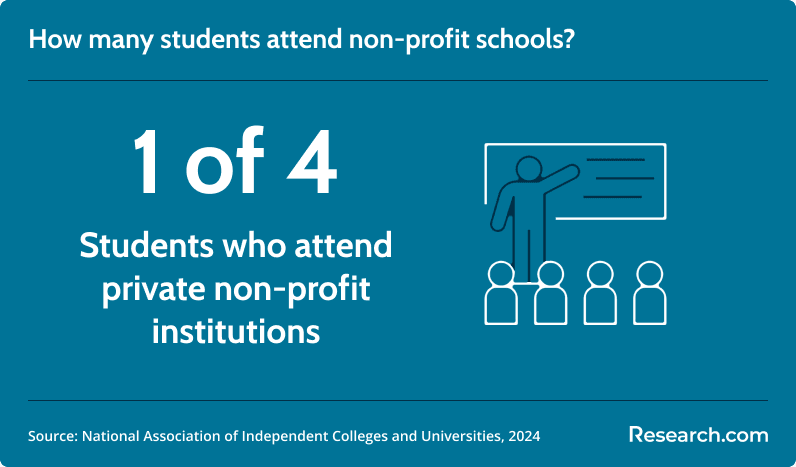
According to the National Association of Independent Colleges and Universities (NAICU, 2024), more than 1,700 private non-profit colleges and universities operate in the U.S. One of four higher education students attends a private non-profit institution.
How do non-profit online universities compare to for-profit online universities?
The biggest difference is institutional purpose. Non-profit universities are organized around an educational mission, while for-profit institutions are owned by private entities, investors, or shareholders and operate as businesses. Both can offer legitimate online programs, but students should compare governance, accreditation, costs, transferability, graduation outcomes, and student protections before enrolling.
| Factor | Non-profit online universities | For-profit online universities |
| Governance | Usually overseen by a board of trustees or directors | Often controlled by private owners, investors, or shareholders |
| Main funding sources | Tuition, fees, public funding, donations, and endowments, depending on the institution | Primarily tuition and fees, with possible support from loans or investors |
| Institutional purpose | Education, research, public service, and student success | Revenue generation through educational programs |
| Program focus | Often broad, including liberal arts, professional fields, research-oriented programs, and graduate study | Often career-focused, with programs in areas such as nursing, IT, cybersecurity, and business |
| Use of revenue | Reinvested in instruction, student services, facilities, technology, and institutional priorities | May be used for operations, marketing, recruitment, investors, or shareholders |
| Graduation outcomes | 77.5% of private non-profit university students completed bachelor’s degrees within six years | 46% of private for-profit college students completed bachelor’s degrees within six years |
According to the National Student Clearinghouse Research Center, 77.5% of private non-profit university students completed their baccalaureate degrees within six years, compared with 46% of students at private for-profit colleges (National Student Clearinghouse Research Center, 2023).
These numbers are useful, but they should not replace program-level research. Always review the specific school, program, accreditation status, transfer policy, student outcomes, and total cost before applying.
Why is accreditation crucial for non-profit online universities?
Accreditation is one of the most important checks in online education. It signals that an institution or program has been reviewed by a recognized accrediting body and meets established academic and operational standards. Without recognized accreditation, students may face problems with financial aid, credit transfer, graduate school admission, employer recognition, and licensure eligibility.
- Accreditation helps confirm that a degree comes from a legitimate institution rather than a diploma mill.
- Credits are more likely to transfer when courses come from a recognized accredited institution, although transfer is never automatic.
- Federal and state financial aid are tied to recognized accreditation.
- Licensure boards in regulated fields may require degrees from accredited institutions and, in some cases, programmatically accredited programs.
- Employers often use accreditation as a basic credibility check when evaluating applicants.
Many non-profit universities hold regional accreditation, while many for-profit colleges have historically been nationally accredited. Regional accreditation is often viewed as more widely recognized for credit transfer and graduate admissions, but students should verify current recognition through official sources and professional licensing boards.
Programmatic accreditation can be just as important as institutional accreditation in fields such as nursing, counseling, social work, education, accounting, and healthcare. If you are considering traditional or accelerated online bachelor degree programs, check whether your specific program needs specialized accreditation for licensure, certification, or employer acceptance.
How much does it cost to attend a non-profit online university?
Cost varies by institution, residency status, program, enrollment pace, transfer credits, fees, and financial aid. NCES (2023) reported that the average tuition and fees in private non-profit schools from 2022 to 2023 was $38,421. Tuition and fees in for-profit colleges were $15,868, while public schools averaged $9,750.
Online students may save on housing, commuting, and some campus-based expenses, but they may still pay technology fees, online course fees, books, proctoring fees, graduation fees, or program-specific costs. Some schools charge the same online tuition regardless of state residency, while others distinguish between in-state and out-of-state learners.
| Cost factor | Why it matters | Question to ask |
| Tuition per credit or term | Determines the base cost of completing required credits | Is tuition charged per credit, per term, or through a flat-rate model? |
| Transfer credits | Accepted credits can reduce both time and total cost | How many of my prior credits will apply to my exact degree plan? |
| Fees | Technology, online platform, course, and graduation fees can add up | What is the full cost of attendance, not just tuition? |
| Residency policy | Some public universities charge different rates by residency | Do online students pay in-state, out-of-state, or flat online tuition? |
| Program requirements | Clinical, practicum, lab, or travel requirements may add expenses | Are there in-person requirements, placement costs, or equipment costs? |
The chart below shows tuition differences among institution types.
What financial aid options do students get at non-profit online universities?
Financial aid can make an online degree more affordable, but students should compare aid packages carefully. A lower advertised tuition does not always mean the lowest net cost, and loans must be repaid. Some learners also reduce total costs by choosing transfer-friendly programs, accelerated pathways, or short degrees that pay well.
- Federal and state aid: Eligible students may use programs such as Pell Grants and Direct Loans to help pay tuition and approved education costs.
- Institutional scholarships: Non-profit universities may offer scholarships based on academic achievement, financial need, background, program of study, or enrollment status.
- Private scholarships and grants: Corporations, foundations, professional associations, religious groups, and community organizations may offer additional funding.
- Military and veteran benefits: Many non-profit universities support active-duty service members, veterans, and eligible family members through tuition assistance and benefit processing.
- Employer tuition reimbursement: Working students may receive partial or full tuition support from employers, often in exchange for meeting grade, program, or service requirements.
What types of student support services do non-profit online universities offer?
Strong support services matter because online students often manage coursework without daily in-person contact. Before enrolling, confirm that the school provides support designed specifically for online learners rather than simply extending limited campus services to remote students.
- Academic advising: Advisors help students choose courses, understand degree requirements, plan schedules, and stay on track.
- Tutoring and writing support: Online tutoring, writing centers, and workshops can help students strengthen assignments, study habits, and course understanding.
- Library and research help: Virtual libraries, research databases, citation support, and librarian access can be essential for papers and projects.
- Technical support: Help desks assist with learning platforms, logins, software, hardware requirements, and troubleshooting.
- Career services: Career teams may offer resume reviews, interview preparation, job search guidance, internship support, and virtual career events.
- Counseling and mental health services: Some schools provide confidential support or referrals for students facing personal, emotional, or mental health concerns.
- Accessibility services: Students with disabilities can request accommodations that support equal access to coursework and assessments.
- Online student community: Virtual clubs, student groups, discussion spaces, and events help remote learners build connections.
Can students complete their degrees entirely online?
Many students can complete online degrees entirely at a distance, but not every program is fully online. Business, psychology, computer science, management, accounting, and similar fields are often easier to deliver fully online. Nursing, education, counseling, social work, and healthcare programs may require clinical placements, practicums, internships, labs, student teaching, or local site approval.
Online courses may be asynchronous, synchronous, or a combination of both. Asynchronous courses allow students to complete weekly work on their own schedule, while synchronous courses require real-time attendance through video meetings or live sessions. Many programs also use discussion boards, messaging tools, productivity apps, online exams, and learning management systems.
In 2022, 16.5% of undergraduate students in public universities were enrolled in exclusively distance education courses. The share was 21.3% for private non-profit universities and 71.9% for for-profit universities (NCES, 2023).
Students also increasingly use online pathways for graduate education, including flexible options such as one year masters programs. Before enrolling, ask whether the program can be completed in your state, whether any in-person work is required, and whether the degree meets licensure requirements where you plan to work.
Why should students consider attending a non-profit online university?
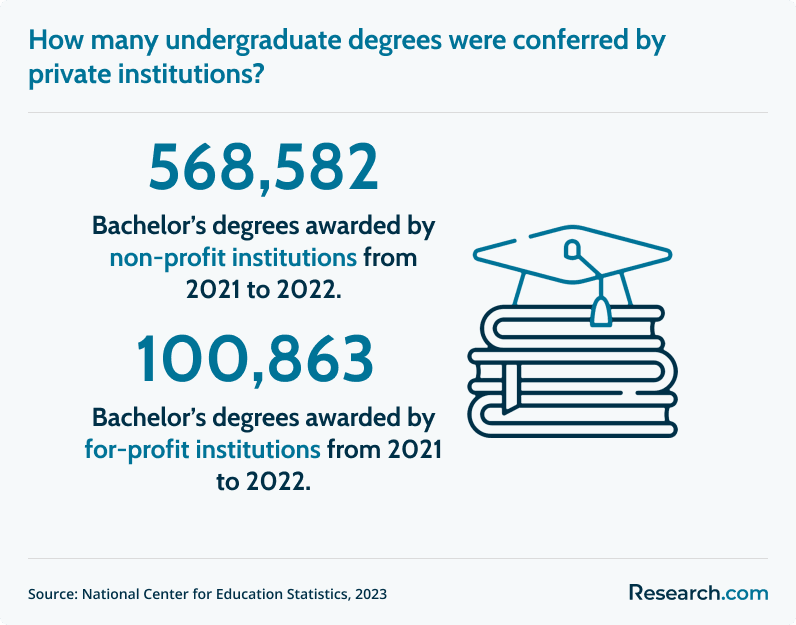
Students often choose non-profit online universities because they want flexibility without giving up institutional credibility. From 2021 to 2022, private non-profit institutions awarded 568,582 bachelor’s degrees, while for-profit schools awarded 100,863 undergraduate degrees (NCES, 2023).
- Mission-centered structure: Non-profit universities generally reinvest resources into instruction, student services, academic programs, and institutional priorities.
- Recognized academic standards: Accredited programs are reviewed against external standards, which can support employer confidence and future education plans.
- Flexible scheduling: Online coursework can help students balance school with work, caregiving, military service, or other responsibilities.
- Broad program options: Non-profit universities commonly offer programs across business, education, healthcare, technology, liberal arts, public service, and graduate fields.
- Student support: Advising, tutoring, career services, library resources, accessibility services, and technical help can improve persistence.
- Career mobility: A degree from an accredited institution may support promotions, career changes, graduate study, or entry into professional fields.
What career outcomes can students expect from non-profit online universities?
Career outcomes depend on the degree field, labor market, student experience, location, internships, professional network, licensure status, and employer expectations. A non-profit online degree can support career advancement, but it does not guarantee a job, promotion, or salary increase.
Many non-profit online universities build programs with input from employers or industry professionals. Career services may include resume help, interview preparation, virtual career fairs, internship support, alumni networking, and job search coaching.
Accreditation also affects outcomes. Students comparing regionally accredited online schools may have an easier time identifying institutions with widely recognized credentials for transfer, graduate admission, and employer review. However, programmatic accreditation and state authorization can be equally important in licensed professions.
Career changers should pay close attention to entry requirements in their target field. Some roles require only a bachelor’s degree, while others require certification, supervised experience, a master’s degree, or state licensure.
What benefits do affordable online masters programs from non-profit universities offer?
Affordable online master’s programs from non-profit universities can help working professionals deepen expertise, qualify for advancement, or move into specialized roles while maintaining employment. These programs may combine rigorous academic expectations with flexible scheduling, applied coursework, faculty mentorship, and career support.
Students should compare total tuition, credit requirements, practicum expectations, admissions standards, employer reimbursement options, and post-graduation outcomes. To explore cost-focused options, compare affordable online masters programs that align with your field and long-term goals.
Are advanced degree options available at non-profit online universities?
Yes. Many non-profit online universities offer graduate certificates, master’s degrees, and doctoral programs. Advanced degrees may be useful for leadership, research, education, healthcare, counseling, public administration, business, and technology careers. The right option depends on whether you need academic depth, licensure preparation, a terminal credential, or applied professional training.
Doctoral applicants should examine dissertation or capstone requirements, residency expectations, faculty mentorship, research support, and time-to-completion policies. Professionals seeking a shorter route to an advanced credential may compare online doctoral programs, but should still verify academic rigor, accreditation, and career fit.
What is the return on investment of a non-profit online degree?
The return on investment of a non-profit online degree is best measured by comparing net cost with the realistic career value of the credential. This includes tuition after grants and scholarships, fees, time to completion, loan debt, transfer credits, employer support, expected job opportunities, and whether the degree is required for your target role.
Do not judge ROI only by the sticker price. A more expensive program may be worthwhile if it has strong completion support, licensure alignment, employer recognition, and transfer credit acceptance. A cheaper program may be a poor investment if credits do not transfer, the program lacks needed accreditation, or students struggle to finish.
Students considering graduate study can also compare lower-cost options such as the cheapest easiest master's degree pathways while checking whether the program’s content, reputation, and outcomes support their career plans.
Can I complete my degree faster with non-profit online universities?
Many non-profit online universities offer faster completion routes, especially for students with prior college credits, military training, professional certifications, or relevant work experience. Common acceleration options include competency-based education, credit for prior learning, transfer-friendly degree plans, condensed terms, and year-round start dates.
Acceleration works best for organized students who can manage heavier weekly workloads. Before choosing a fast option, ask how many credits will transfer, whether the program has fixed course sequences, whether financial aid covers the pace you want, and whether shortening the timeline will affect learning quality. You can also review accelerated school programs to compare fast-track structures.
| Acceleration option | Best for | Watch out for |
| Transfer credits | Students with previous college coursework | Not all accepted credits may apply to major requirements |
| Competency-based education | Self-directed learners with existing knowledge | Requires strong time management and independent study habits |
| Condensed terms | Students who can handle intensive coursework | Short terms can be difficult while working full time |
| Credit for prior learning | Adults with military, professional, or certification experience | Documentation and assessment rules vary by school |
What challenges do students face in non-profit online education?
Online learning can be flexible, but it is not effortless. Students need self-discipline, reliable technology, communication skills, time management, and comfort with digital tools. Asynchronous courses can be convenient, but they also require students to stay motivated without frequent in-person reminders.
Common challenges include balancing work and family duties, avoiding procrastination, managing weekly deadlines, navigating technology problems, and staying connected with faculty and classmates. Students considering very fast formats, such as an associate degree in 6 months online accredited option, should be especially careful to evaluate workload, support services, and credit requirements.
How do non-profit online universities measure student success and satisfaction?
Non-profit online universities often evaluate student success through graduation rates, retention rates, course completion, student satisfaction surveys, career placement information, alumni outcomes, and engagement data. Prospective students should review these measures because they reveal more than a school’s marketing claims.
When comparing bachelor's degree online cheap programs, look beyond affordability. Ask whether students graduate, whether they receive academic support, whether graduates find relevant work, and whether learners report strong online faculty interaction.
How non-profit online universities use digital tools to improve learning
Online programs increasingly rely on learning management systems, video platforms, interactive simulations, virtual labs, digital libraries, online tutoring, discussion tools, analytics dashboards, and AI-supported learning resources. These tools can improve feedback, collaboration, accessibility, and student engagement when used responsibly.
Technology should support instruction rather than replace it. Strong online programs still need qualified faculty, clear course design, reliable academic advising, accessible materials, and meaningful assessments. Students preparing for competitive fields, including careers where a bachelor's degree that pay 100k may be part of the long-term plan, should look for programs that combine digital learning with practical projects, employer-relevant skills, and career support.
How do I choose the right non-profit online university?
The best school is the one that fits your degree goal, budget, schedule, learning style, and career requirements. Whether you are comparing degrees or online certificates that pay well, use a decision process rather than choosing based only on brand name or advertised tuition.
| Selection factor | What to verify | Why it matters |
| Accreditation | Institutional accreditation and any required programmatic accreditation | Affects aid, transfer, licensure, graduate admission, and credibility |
| Program fit | Curriculum, concentrations, electives, practicum requirements, and outcomes | The degree must match your actual career or academic goal |
| Format | Asynchronous, synchronous, hybrid, full-time, part-time, or competency-based | Your schedule must realistically support the workload |
| Total cost | Tuition, fees, books, technology, travel, and time to completion | Net cost matters more than advertised tuition |
| Transfer policy | Maximum transferable credits and how credits apply to the degree | Accepted credits can shorten the degree and reduce cost |
| Support services | Advising, tutoring, career services, library access, accessibility, and tech help | Support can affect persistence and completion |
| Outcomes | Graduation rates, retention, alumni careers, and licensure pass information when relevant | Outcomes help estimate whether students finish and benefit |
Students should also compare education investment against career alternatives. For example, some high-paying fields require less than a bachelor’s degree. A physical therapy assistant pathway may be attractive for some students because a physical therapist assistant salary average of $83,170 can be substantial, and the role generally requires an associate degree rather than a bachelor’s degree.
Common mistakes to avoid when choosing an online university
- Choosing a school before verifying institutional and programmatic accreditation.
- Looking only at tuition per credit instead of total cost of attendance.
- Assuming every online program is available in every state.
- Assuming online nursing, counseling, social work, or education programs automatically meet licensure requirements.
- Ignoring transfer credit limits and degree applicability rules.
- Choosing based only on rankings without checking program fit.
- Borrowing the maximum loan amount without estimating future repayment.
- Assuming salary outcomes are guaranteed by the degree alone.
How can students apply to non-profit online universities?
Admissions requirements vary by institution and program. Some non-profit online universities have selective admissions, while others are designed for broad access. Even when applying to one of the easiest bachelor degree to get online options, students should prepare carefully and submit complete materials.
- Research the program: Confirm the degree title, curriculum, format, start dates, accreditation, and career alignment.
- Review admissions requirements: Check prerequisites, GPA expectations, standardized test policies, transfer credit rules, and program-specific requirements.
- Gather documents: Prepare transcripts, identification, recommendations, resumes, personal statements, and any required supplemental materials.
- Request transfer evaluations: If you have prior credits, ask how they apply to the exact degree plan before committing.
- Write a focused personal statement: Connect your academic background, work experience, goals, and reasons for choosing the program.
- Ask for feedback: Have an advisor, mentor, or trusted reviewer check your application materials for clarity and accuracy.
- Track deadlines: Monitor email, admissions portals, financial aid deadlines, and document submission dates.
- Complete interviews or advising sessions: If required, use these meetings to ask practical questions about workload, support, and outcomes.
- Review the offer: Before enrolling, compare aid, transfer credits, total cost, start date, and program requirements.
How do non-profit online universities prepare students for the evolving job market?
Many non-profit online universities update programs to reflect employer expectations, digital work environments, and changing professional standards. Strong programs connect academic theory with applied learning, projects, internships, case studies, portfolios, certifications, and career coaching.
- Career services: Students may receive career counseling, resume support, interview preparation, and job search guidance.
- Industry-aligned curriculum: Programs may be updated to reflect current tools, regulations, technologies, and workplace expectations.
- Networking: Online learners may participate in virtual events, alumni groups, internships, and employer partnerships.
- Professional credentials: Some programs include or prepare students for certifications in fields such as data analytics, cybersecurity, project management, and healthcare.
Students should ask whether the program includes hands-on projects, employer-reviewed competencies, internship options, portfolio development, or preparation for relevant certification exams.
National vs. Regional Accreditation for Online Universities
Accreditation type affects transfer, financial aid, employer review, graduate admission, and licensure. Regional accreditation has traditionally been associated with many public and non-profit colleges and is often widely recognized for transfer and graduate education. National accreditation has often applied to vocational, technical, religious, and career-oriented institutions.
Neither label should be evaluated in isolation. Students should confirm whether the accreditor is recognized, whether the program meets professional requirements, and whether credits will transfer to the schools they may attend later. Students exploring career-focused online options can compare nationally accredited online colleges, but they should ask employers, licensing boards, and future graduate programs whether the credential will be accepted.
How to Find Affordable Non-Profit Online Degrees
Finding an affordable online degree requires more than searching for the lowest tuition. The goal is to minimize total cost while preserving quality, accreditation, transferability, and career value.
- Compare total cost, not just tuition: Include fees, books, technology, proctoring, residency, travel, and graduation expenses.
- Ask for a transfer credit review: Prior coursework can reduce cost only if it applies to your degree requirements.
- Look for flat-rate tuition when appropriate: Schools such as Western Governors University use flat-rate tuition, which can help motivated students who complete more credits per term.
- Submit the financial aid application early: Compare grants, scholarships, loans, employer support, military benefits, and payment plans.
- Consider accelerated options carefully: Faster programs may lower total cost, but only if you can handle the pace and complete successfully.
- Check residency rules: Some institutions, including the University of Maryland Global Campus, charge different rates for in-state and out-of-state learners.
- Review affordable school lists: Use resources such as cheap online degrees USA to identify potential options, then verify all details with the school.
Questions to ask before enrolling
- Is the institution currently accredited by a recognized accreditor?
- Does my specific program need programmatic accreditation for licensure or certification?
- Can the program be completed from my state?
- How many of my transfer credits will count toward graduation requirements?
- What is the full cost of attendance after fees and required materials?
- What financial aid will I receive, and how much will be loans?
- Are classes asynchronous, synchronous, hybrid, or competency-based?
- How many hours per week should I expect to study?
- What student support services are available to online learners?
- What graduation, retention, and employment outcomes does the school report?
Key Insights
- Accredited non-profit online universities can offer flexible, credible degree pathways, but students still need to verify accreditation, program fit, cost, and outcomes.
- Non-profit and for-profit online universities differ in governance, mission, revenue use, and graduation outcomes; the best choice depends on the specific school and program.
- Tuition is only one part of affordability. Transfer credits, fees, residency rules, financial aid, time to completion, and employer reimbursement can significantly change net cost.
- Licensure fields require extra caution. Nursing, counseling, education, social work, and similar programs may have clinical, practicum, state authorization, or programmatic accreditation requirements.
- Faster online degrees can save time and money, but only for students who can manage compressed coursework and independent learning.
- The strongest online programs combine recognized accreditation, transparent pricing, career-relevant curriculum, reliable technology, and support services built for remote learners.
References:
- College Board. (n.d.). For-profit vs. nonprofit colleges: What’s the difference and why does it matter? Big Future. Retrieved June 3, 2024, from https://bigfuture.collegeboard.org/plan-for-college/find-your-fit/types-of-colleges/types-of-colleges/for-profit-vs-non-profit
- National Center for Education Statistics. (2023). Digest of Education Statistics. https://nces.ed.gov/programs/digest/current_tables.asp
- U.S. Bureau of Labor Statistics. (2023, September 6). Earnings and unemployment rates by educational attainment, 2023. Education Pays. https://www.bls.gov/emp/chart-unemployment-earnings-education.htm
Other Things You Should Know About Non-Profit Online Universities
The 2027 Best Accredited Non-Profit Online Universities offer a range of financial aid options, including scholarships, grants, federal student loans, and work-study programs. It's recommended to check each university's financial aid office or website for specific programs and eligibility requirements.
A 2027 non-profit online university should hold accreditation from a U.S. Department of Education–recognized regional accreditor, such as HLC, SACSCOC, NECHE, MSCHE, WASC Senior College and University Commission, or NWCCU. Program-specific fields may also require additional approval from bodies like CACREP or CCNE.
Admission requirements often include a high school diploma or GED, transcripts, and possibly SAT/ACT scores. Some universities may also require letters of recommendation or a personal statement. It's advisable to check each university's specific criteria for 2027 applicants.