2027 Best Online Vocational Trade Schools

Co-Founder and Chief Data Scientist
Choosing an online vocational trade school is a practical decision for students who want career-focused training without committing to a traditional four-year campus program. The appeal is clear: many trade programs are shorter, skills-based, and designed around specific jobs in healthcare, technology, automotive services, construction, business support, public safety, and other applied fields. The harder question is whether an online format can give you enough hands-on preparation, employer recognition, and value for the cost.
This guide explains how online vocational trade schools work, what to expect from the learning experience, how to compare programs, and which schools stand out in 2027. You will also learn how accreditation, clinical or lab requirements, career services, tuition, certification preparation, and job market demand should affect your decision.
Quick Answer: Are Online Vocational Trade Schools Worth Considering?
Online vocational trade schools can be worth it for students who need flexible training for a specific career, especially when the program is accredited, includes required hands-on practice, prepares students for certification or licensure where needed, and has clear career support. They are not the right fit for every trade. Programs that require extensive physical practice, supervised clinical work, or state licensing should be reviewed carefully before enrollment.
Key benefits of online vocational trade schools
- Flexible scheduling: Many programs allow students to complete lectures, assignments, and skills practice around work, caregiving, or other responsibilities.
- Lower indirect costs: Online study may reduce commuting, relocation, housing, and printed material expenses, although students should still budget for fees, tools, equipment, uniforms, exams, and local training requirements.
- Broader access: Students who live far from a campus may be able to complete career training online or through a hybrid format with local hands-on placements.
- Career-focused curriculum: Trade programs usually concentrate on job-ready skills instead of broad general education requirements, though some community colleges also offer associate degree pathways.
What Is an Online Vocational Trade School?
An online vocational trade school is a career training institution that delivers some or all coursework remotely. Programs may lead to certificates, diplomas, career studies credentials, or associate degrees. Unlike many academic degree programs, vocational education is built around applied skills for a defined occupation or industry.
Online does not always mean fully remote. Some programs use a hybrid model: students complete theory courses online, then attend labs, clinical rotations, apprenticeships, internships, or supervised practice in person. This is especially common in healthcare, automotive, welding, electrical, cosmetology, and other hands-on fields.
What students can expect
- Online lectures and modules: Students often complete readings, recorded lectures, quizzes, and assignments through a learning management system.
- Skills demonstrations: Programs may use video demonstrations, virtual simulations, project-based assignments, or live instructor feedback.
- Hands-on requirements: Some trades require in-person labs, externships, clinical placements, apprenticeships, or state-approved practice hours.
- Career preparation: Strong programs help students prepare resumes, interview for jobs, locate apprenticeships, and understand certification or licensing steps.
- Employer-aligned training: The best programs regularly update coursework to reflect current tools, safety practices, software, equipment, and industry expectations.
Where Can You Work After Completing an Online Vocational Trade Program?
Your career options depend on the program you choose, the credential you earn, your state’s requirements, and the amount of supervised experience you complete. Graduates may pursue roles in healthcare facilities, repair shops, manufacturing settings, IT departments, public agencies, business offices, schools, construction-related fields, and community service organizations.
For example, students who complete medical coding or billing training may pursue administrative healthcare roles, while students in automotive or diesel technology may seek technician positions. Those who study early childhood education, law enforcement, human services, or behavioral health may enter community-based, educational, or public service settings depending on local requirements.
| Program area | Possible work settings | Decision point before enrolling |
| Healthcare support | Hospitals, clinics, long-term care facilities, rehabilitation centers, medical offices | Check whether the program includes required clinical hours and prepares you for certification or licensure. |
| Technology and cybersecurity | IT departments, managed service providers, software firms, public agencies | Review whether coursework aligns with current employer tools and industry certifications. |
| Automotive and diesel technology | Dealerships, repair shops, fleet maintenance departments, transportation companies | Confirm how the school provides hands-on diagnostics, shop experience, and equipment training. |
| Business and administration | Corporate offices, small businesses, healthcare organizations, public agencies | Compare certificates with associate degree options if you want advancement potential. |
| Public safety and human services | Law enforcement agencies, social service organizations, rehabilitation programs | Review background check, field placement, and state or agency hiring requirements. |
How Much Can You Make After Online Vocational Trade School?
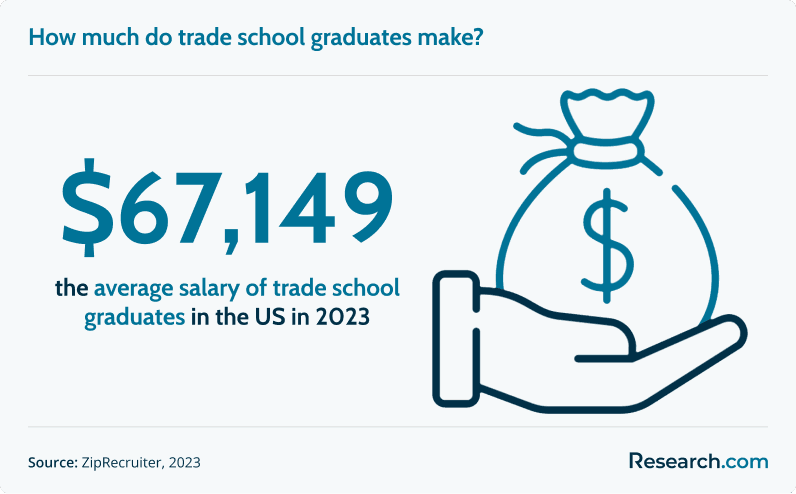
Earnings vary widely by occupation, location, experience, employer, credentials, and licensing status. Trade school graduates in the US earn an average annual salary of $67,149 as of 2023, with reported earnings ranging from about $27,000 to $106,000.
Common vocational occupations include electricians, nursing assistants/aides, and automotive mechanics and technicians. Some trade-related roles have higher median annual wages: transportation, storage, and distribution managers have a median annual salary of $105,580, nuclear power reactor operators have a median annual salary of $104,260, and elevator mechanics have a median annual salary of $97,860. By state, the highest average salaries for trade jobs are reported in Washington ($64,626), Maryland ($63,100), and New York ($62,292).
These figures should be used as comparison points, not guarantees. Before enrolling, look up local job postings, ask schools for graduate outcome data, and check whether the credential is enough for entry-level employment in your area.
- Best Online Vocational Trade Schools in 2027
- Key Advantages of Online Vocational Trade Education
- Accreditation and Why It Matters
- Online vs. Campus Trade Schools
- Hands-On Training in Online Programs
- Future Trends in Online Vocational Education
- Online Trade Programs for Working Adults
- Industry Partnerships and Job Placement
- Career Preparation for Changing Industries
- Employment Support After Graduation
- Certification and Licensure Preparation
- Return on Investment
- Lifelong Learning and Advanced Study
- How to Choose an Online Vocational Trade School
- Teaching Quality and Course Effectiveness
- Employer Recognition of Online Credentials
- Fast-Track Vocational Programs
- How to Accelerate Online Vocational Training
- Challenges of Online Vocational Trade Education
- Online Ultrasound Tech School Considerations
- Financial Aid and Tuition Support
- Combining Vocational Credentials With an Accelerated Bachelor’s DegreeFinancial planning note
- How to Use Job Market Trends When Choosing a ProgramTuition supportAdditional decision point
Best Online Vocational Trade Schools in 2027
How the schools were reviewed
Our ranking process considers institutional quality, online learning options, vocational program availability, affordability, student outcomes, and institutional credibility. Research.com uses its own ranking methodology and reviews data from established sources, including the IPEDS database, the National Center for Education Statistics, Peterson’s, and the College Scorecard.
The schools below are community colleges offering online, hybrid, or flexible vocational education. Many also provide associate degree options, which can be useful for students who want to stack credentials or continue into fields such as business, psychology, or human resources.
| School | Selected online or vocational programs | Cost per credit | Accreditation |
| San Juan College | Medical Coding/Billing; Surgical First Assistant; Behavioral Health/Mental Health; American Sign Language (ASL); Veterinary Certificate; Occupational Safety | $56 (in-state); $178 (out-of-state) | Higher Learning Commission (HLC) |
| New Mexico Junior College | Early Childhood Education; Cosmetology – Instructor Certificate; Barbering; Welding; Horsemanship; Welding; Practical Nursing | $40 (in-district); $60 (out-of-district); $75 (out-of-state) | Higher Learning Commission (HLC) |
| Metropolitan Community College | Diesel Technology; Electrical Technology; Automotive Technology; Industrial and Commercial Trades; Welding Technology; Precision Machine Technology | $40 (in-state); $34 (in-state resident 62 years of age and older); $102 (out-of-state); $51 (out-of-state resident 62 years of age and older) | Higher Learning Commission (HLC) |
| State Fair Community College | Automotive Service Technology; Graphic Design; Precision Machining Technology; Early Childhood Careers; Health Occupations | $151-$401 (in-district); $216-$466 (Missouri residents); $282-$532 (out-of-state) | Higher Learning Commission (HLC) |
| Southwest Virginia Community College | Automotive Diagnostics and Repair; Human Services Technology; Law Enforcement; Substance Abuse Rehabilitation Counselor; Crime Scene Technology | $163.63 (in-state); $363.46 (out-of-state) | Southern Association of Colleges and Schools Commission on Colleges (SACSCOC) |
School highlights
San Juan College offers Career Technical Education programs designed to build job-focused skills in two years or less. Students interested in healthcare administration pathways may use its medical coding and billing options as a starting point if they want to become a medical coder.
New Mexico Junior College provides distance learning and career training options across fields such as petroleum technology, criminal justice, practical nursing, barbering, cosmetology, and welding.
Metropolitan Community College offers online associate and certificate programs as well as technical training in areas such as mechanical design, plumbing apprenticeship, automotive technology, diesel technology, and industrial trades.
State Fair Community College gives students access to online courses, online open-enrollment programs, and technical programs connected to high school districts.
Southwest Virginia Community College supports online degree-seeking and transfer students, including learners interested in business, technology, public safety, human services, and automotive training.
Key Findings
- Online trade schools increasingly use virtual simulations and other digital tools to support applied learning.
- The average salary for trade school graduates in the US is $67,149 in 2023, with earnings ranging from around $27,000 to $106,000.
- Electrician, nursing assistant/aide, and automotive mechanic and technician are among the popular vocational roles in the US.
- The highest-paying trade jobs listed here by median annual salary are transportation, storage, and distribution managers ($105,580), nuclear power reactor operators ($104,260), and elevator mechanics ($97,860).
- In 2022, 53.7% of civilian workers required more than a year of preparation to perform their jobs.
- Washington ($64,626), Maryland ($63,100), and New York ($62,292) are the top three states listed for the highest average salaries for trade jobs.
What Graduates Say About Online Vocational Training
-
: "
“Online vocational school helped me keep working while I studied. The schedule made it possible to manage family responsibilities, and the resources helped me build the skills and contacts I needed to move into a job.” – Sarah
"
-
: "
“Remote training let me control when and where I studied. The practical assignments, career-focused lessons, networking opportunities, and mentoring made the program feel connected to real work instead of just online coursework.” – Javier
"
-
: "
“The program combined technical instruction with applied projects, virtual labs, and industry examples. Studying online also forced me to become more adaptable and independent, which helped when I started applying for jobs.” – Alex
"
What Are the Key Advantages of Pursuing Vocational Trade Education Online?
The main advantage of online vocational training is flexibility. Students can often study without leaving a job, moving closer to campus, or rearranging family obligations around a fixed classroom schedule. This is especially valuable for adult learners, career changers, rural students, and workers who need to upgrade skills while employed.
Online delivery can also make training more accessible and sometimes less expensive by reducing travel and housing costs. However, students should compare the full cost, not just tuition. Some programs require supplies, proctored exams, certification fees, background checks, immunizations, uniforms, technology, software, or local clinical and lab expenses.
| Advantage | Why it matters | What to verify |
| Flexible course access | Useful for students balancing work, family, and school | Whether courses are asynchronous, synchronous, or hybrid |
| Reduced travel burden | Can help students avoid commuting or relocation | Whether any labs, internships, clinicals, or exams require travel |
| Focused career preparation | Courses usually map directly to occupational skills | Whether the curriculum matches current job postings and certification requirements |
| Potentially faster completion | Some certificates take less time than traditional degrees | Whether acceleration affects hands-on practice, instructor access, or exam readiness |
Are Online Vocational Trade Programs Accredited, and Does Accreditation Matter?
Accreditation matters because it signals that a school or program has been reviewed against recognized quality standards. It can affect employer recognition, transfer credit, financial aid eligibility, and whether a credential is accepted for certification or licensure.
Students should distinguish between institutional accreditation and programmatic approval. A college may be institutionally accredited, but a specific healthcare, cosmetology, aviation, or technical program may also need approval from a state board or professional accreditor. Before enrolling, ask the school to identify the exact accreditor and explain whether the program meets requirements in your state.
How Do Online Vocational Trade Schools Compare to Traditional Campus Programs?
Online and campus trade schools serve different learners. Online programs are usually better for students who need flexibility and can manage independent study. Campus programs may be stronger for students who need daily structure, immediate instructor feedback, and regular access to physical shops, labs, or equipment.
| Factor | Online vocational trade school | Campus trade school |
| Schedule | Often more flexible, especially with asynchronous coursework | Usually follows set class, lab, or shop schedules |
| Hands-on practice | May use simulations, local placements, hybrid labs, or project submissions | Often includes regular in-person labs, workshops, and equipment access |
| Student support | Delivered through virtual advising, tutoring, office hours, and technical support | Available through in-person offices, instructors, and peer interaction |
| Best for | Working adults, rural students, self-directed learners, career changers | Students who need structure, frequent supervision, or extensive physical practice |
| Risk to watch | Insufficient hands-on training or weak local placement support | Less flexibility and higher commuting or relocation costs |
Some programs also use workshops, labs, or simulated workplaces to mirror industry settings. If you are comparing online and campus options, ask exactly how practical skills are taught, assessed, and documented.
How Do Online Vocational Trade Schools Provide Hands-On Training?
Strong online vocational programs do not rely only on readings and recorded lectures. They combine theory with demonstrations, virtual simulations, interactive software, supervised projects, lab kits, local externships, clinical placements, or apprenticeship connections. The format depends heavily on the trade.
Healthcare programs, for example, may allow online coursework but still require supervised clinical experience. Students reviewing options such as a 12-month respiratory therapy program should confirm whether clinical requirements are available in their location before applying.
Questions to ask about hands-on learning
- Which parts of the program are fully online, hybrid, or in person?
- Does the school arrange clinicals, internships, labs, or apprenticeships, or must students find their own sites?
- What equipment, software, tools, uniforms, or materials are required?
- How are practical skills evaluated?
- Does the training meet certification, licensure, or employer requirements in your state?
The chart below shows popular trade jobs in the US and their median annual wages in 2022. These are separate from the highest-paying trade jobs listed earlier: transportation, storage, and distribution managers ($105,580), nuclear power reactor operators ($104,260), and elevator mechanics ($97,860).
What Innovations Are Shaping Online Vocational Trade Education?
Online vocational education is becoming more interactive as schools adopt tools that can support applied learning at a distance. Virtual simulations, adaptive learning platforms, artificial intelligence, augmented reality, virtual reality, and Internet of Things technologies may help students practice procedures, receive feedback, and understand industry equipment before entering a lab or worksite.
These tools can improve access, but they do not eliminate the need for real-world practice in fields that require physical competence, patient interaction, machinery use, safety procedures, or supervised hours. Students should view technology as a training aid, not a substitute for required field experience.
How Do Online Vocational Trade Programs Work for Working Professionals?
Online vocational programs often fit working adults because they may allow students to review lessons after work, complete assignments on a weekly schedule, and communicate with instructors through online office hours or learning platforms. This structure can be especially helpful for students exploring a real estate appraiser career or other fields where adult learners may already be employed.
Support services matter. A flexible schedule is useful only if students can get help when they need it. Look for programs with responsive instructors, tutoring, technical assistance, career advising, and clear assignment expectations.
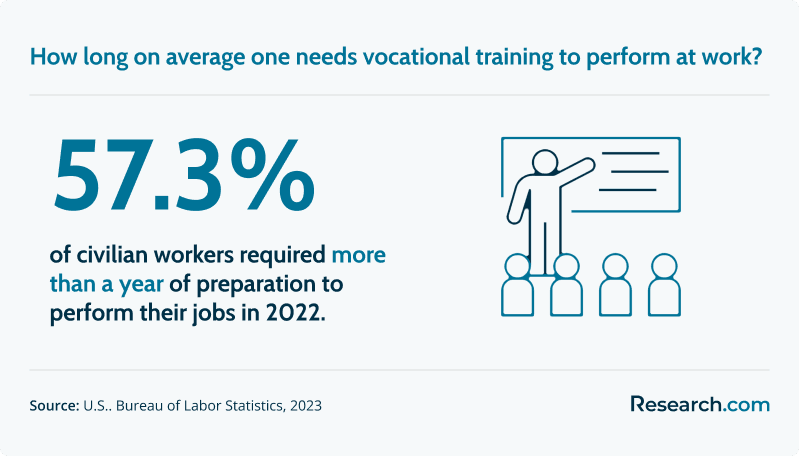
Preparation time is also important. In 2022, 57.3% of civilian workers required more than a year of preparation to perform their jobs. That means students should not choose a program only because it is short; they should choose one that provides enough preparation for the occupation they want.
Do Industry Partnerships Improve Job Placement Opportunities?
Industry partnerships can improve the value of an online trade program when they lead to internships, apprenticeships, employer feedback, updated curriculum, job fairs, advisory boards, or direct recruiting relationships. Partnerships are especially important in hands-on trades because students need exposure to workplace expectations, tools, safety practices, and employer standards.
Before enrolling, ask whether partnerships are active and specific. A general statement that a school “works with employers” is less useful than a list of companies, apprenticeship sponsors, clinical sites, or agencies that regularly accept students or hire graduates.
How Are Online Vocational Trade Schools Preparing Students for Changing Industries?
Good vocational programs revise their curriculum as industry tools and requirements change. This may include updated software, new safety practices, emerging healthcare protocols, cybersecurity concepts, modern diagnostics, or industry-specific equipment. In healthcare, for instance, students weighing training options may also compare career outcomes such as a respiratory therapist salary when deciding whether a program’s time and cost make sense.
Many community colleges also offer broader academic pathways. A student can begin with a certificate, continue into an associate degree, or compare a certificate vs. degree route depending on career goals. This matters because some roles require more than a short certificate, while others reward job-ready technical skills and certifications.
In 2022, more than half of the US civilian working population needed one year of preparation time to perform their jobs. Occupational groups with especially high preparation requirements included business and financial operations (93.30%) and educational instruction and library (86.70%).
What Role Do Online Vocational Trade Schools Play in Helping Graduates Find Jobs?
Online trade schools can support employment by offering career counseling, resume reviews, interview preparation, job boards, employer introductions, apprenticeship guidance, and certification exam support. These services are most useful when they are embedded throughout the program instead of offered only at the end.
Students should ask for transparent graduate outcome information. Useful indicators include completion rates, credential exam pass rates, employment rates, apprenticeship placement, average time to employment, and whether jobs are related to the field of study. When evaluating career possibilities, students can also compare occupations through guides to the best trade school jobs.
How Do Online Vocational Trade Schools Prepare Graduates for Certification and Licensure?
Many trade careers require or strongly prefer certification, licensing, registration, or board approval. Online vocational schools may prepare students through exam review modules, practice tests, instructor-led review sessions, skills assessments, and coursework aligned with certification standards.
However, students must verify requirements independently. Licensure rules can vary by state and occupation. Ask whether the program meets your state’s requirements, whether supervised hours are included, and whether graduates are eligible to sit for the relevant exam immediately after completion.
What Is the Return on Investment of Online Vocational Trade Education?
Return on investment depends on total cost, completion time, job placement, wage potential, certification requirements, and whether the credential leads to the role you want. A low-cost program is not automatically a good value if it lacks accreditation, hands-on training, or employer recognition. A more expensive program may be worthwhile if it has strong placement support and prepares students for required credentials.
Students comparing vocational training with broader academic pathways may also consider whether credentials can stack into associate or bachelor’s programs, including options such as online dual degree programs.
| ROI factor | What to examine | Why it matters |
| Total cost | Tuition, fees, books, tools, software, exams, travel, background checks | Advertised tuition may not reflect the real cost of completion. |
| Time to completion | Program length, course availability, clinical or apprenticeship timelines | Longer timelines can affect income and scheduling. |
| Credential value | Accreditation, employer recognition, certification eligibility | The credential must be accepted for the job you want. |
| Career outcomes | Graduate employment rates, local job postings, salary data | ROI depends on realistic employment opportunities, not marketing claims. |
| Transfer options | Credit articulation, associate degree pathways, bachelor’s completion routes | Stackable credits can improve long-term flexibility. |
Can Online Vocational Trade Schools Support Lifelong Learning and Advanced Academic Pursuits?
Some vocational schools, especially community colleges, allow students to build from a short certificate into an associate degree or transfer pathway. This can help workers update skills, change specialties, or prepare for supervisory roles later in their careers.
Students with long-term academic goals should ask whether credits transfer, whether the school has articulation agreements, and whether the credential can support future study. Some professionals eventually pursue advanced options, including a doctorate degree online, but vocational credits do not always transfer smoothly into every academic pathway.
What Criteria Should Students Consider When Choosing an Online Vocational Trade School?
The best online trade school is not necessarily the cheapest, fastest, or highest-ranked option. The right choice is the program that matches your occupation, state requirements, schedule, budget, and preferred learning style.
| Selection criterion | What to ask | Warning sign |
| Accreditation | Who accredits the institution, and does the program meet state or industry requirements? | The school cannot clearly explain accreditation or licensing eligibility. |
| Hands-on training | How are labs, clinicals, internships, or apprenticeships arranged? | Students must find placements alone with little school support. |
| Cost | What is the full cost including fees, tools, exams, software, and travel? | The school advertises only tuition and avoids discussing extra expenses. |
| Schedule | Are courses asynchronous, live, hybrid, full-time, or part-time? | The schedule conflicts with work or required in-person components. |
| Career services | Does the school offer job placement assistance, resume help, interview prep, and employer connections? | Career support is vague or unavailable until after graduation. |
| Outcomes | What are completion rates, employment outcomes, and certification pass rates? | The school provides testimonials but no outcome data. |
Salary should be part of the decision, but not the only factor. Trade school jobs pay an average of $67,149 in the U.S. in 2023, yet pay varies substantially by occupation, state, credential, and experience.
How Can You Assess Teaching Quality and Course Effectiveness?
Course quality is easier to judge when you look beyond brochures. Review syllabi, instructor qualifications, lab requirements, assessment methods, student support hours, technology requirements, and how frequently the curriculum is updated. If possible, speak with current students or recent graduates.
Useful signs include experienced instructors, clear grading rubrics, practical assignments, updated tools, responsive communication, and access to tutoring or mentorship. Some learners may also compare short career-focused options such as quick courses that pay well, but fast completion should not replace strong instruction.
Do Employers Value Credentials From Online Vocational Trade Schools?
Employers may value online vocational credentials when they come from accredited schools and demonstrate practical competence. In many trades, employers care less about whether theory courses were completed online and more about whether the graduate can perform the work safely, pass required exams, use industry tools, and meet licensing or certification standards.
Students who want to combine technical training with broader career mobility may later compare affordable degree pathways such as the cheapest online bachelor's options. This can be helpful for workers aiming for supervisory, administrative, or management roles.
Can Fast-Track Programs Speed Up Career Advancement?
Fast-track vocational programs can help motivated students finish sooner, especially when they already have related experience or can study intensively. These programs often use compressed terms, modular coursework, and focused skill sequences.
Acceleration has trade-offs. Shorter does not always mean better. Students should confirm accreditation, instructor access, hands-on training quality, exam preparation, and career support before choosing fast track programs.
How Can I Fast-Track My Online Vocational Education?
You can move faster by choosing a program with multiple start dates, transfer credit options, credit for prior learning, competency-based modules, accelerated terms, or stackable certificates. Some students also choose intensive associate degree options, including programs where they can get an associate's degree in 6 months.
Before accelerating, make sure the pace is realistic. A fast program still needs enough time for practice, feedback, exam preparation, and any required field experience.
Challenges of Online Vocational Trade Education
Online vocational education offers flexibility, but it also requires careful planning. The biggest challenge is often hands-on skill development. Some trades require physical practice, specialized equipment, patient interaction, or supervised hours that cannot be fully replaced by videos or simulations.
Quality also varies. Students should not assume every online trade program is accredited, employer-recognized, or eligible for financial aid. A program that looks convenient may create problems later if it does not meet licensing standards or lacks sufficient field training.
Self-management is another challenge. Online students need discipline, reliable technology, time management, and the ability to ask for help early. Without regular classroom structure, falling behind can happen quickly.
Common mistakes to avoid
- Choosing a school before verifying accreditation and state approval.
- Looking only at tuition instead of total program cost.
- Assuming an online program automatically meets licensure requirements in your state.
- Ignoring clinical, apprenticeship, lab, or internship requirements.
- Relying only on rankings instead of reviewing outcomes and employer recognition.
- Assuming salary figures are guaranteed after graduation.
- Choosing the fastest program without checking hands-on training quality.
Is an Online Ultrasound Tech School a Good Career Choice?
An online ultrasound tech school may be a good fit for students who need flexible coursework while preparing for diagnostic medical sonography. However, ultrasound training requires hands-on clinical experience, so students should confirm how the school arranges local placements and whether the program meets relevant accreditation and certification expectations.
Benefits to review before choosing this path
- Flexible coursework: Online theory classes may help students balance school with work or family obligations.
- Clinical training: Most credible programs require supervised practice in healthcare settings so students can learn equipment use and patient interaction.
- Cost considerations: Online study may reduce commuting or housing expenses, but clinical, equipment, exam, and fee costs should still be reviewed.
- Accreditation and certification preparation: Students should check whether the program has relevant recognition, such as by the Commission on Accreditation of Allied Health Education Programs (CAAHEP), and whether it prepares graduates for appropriate credentialing steps.
What Financial Aid and Tuition Support Options Are Available?
Affordability is one of the main reasons students compare online vocational programs. Funding options vary by school, program type, accreditation status, state, and student eligibility. Always confirm aid eligibility directly with the institution before enrolling.
- Federal financial aid: Accredited schools may allow eligible students to submit the FAFSA for federal grants, loans, or work-study opportunities.
- Vocational scholarships: Schools, private organizations, workforce groups, and professional associations may offer scholarships for trade and technical education.
- Payment plans: Some institutions let students divide tuition into scheduled payments instead of paying the full amount upfront.
- State grants and workforce programs: State agencies may support training for residents entering high-demand fields.
- Employer tuition assistance: Some employers help workers pay for training related to their current or future job responsibilities.
- Low-cost resources: Open educational resources, digital textbooks, software trials, and school-provided tools can reduce out-of-pocket expenses. Students comparing affordability can also review the cheapest online colleges USA options for broader cost comparisons.
Can Vocational Trade Credentials Complement an Online Accelerated Bachelor’s Degree?
Vocational credentials and an online accelerated bachelor's program can work well together when they support the same career direction. A certificate may provide immediate job-ready skills, while a bachelor’s degree may help with advancement, management, or career changes.
This combination is not automatically worth the cost. Students should check whether credits transfer, whether the bachelor’s program recognizes prior vocational coursework, and whether the combined timeline is manageable.
How Can Students Use Job Market Trends to Choose the Right Online Vocational Program?
Students should choose a vocational program based on real labor market evidence, not only personal interest or school marketing. Start by reviewing local job postings, employer requirements, wages, certification expectations, and whether entry-level roles are actually available in your region.
Industry associations, labor department resources, alumni outcomes, employer advisory boards, and school placement data can also help you judge whether a program is aligned with current demand. If many employers require certification, licensure, or hands-on experience, make sure the school prepares you for those expectations.
Students who want a broader comparison of school options can review accredited online trade school programs and then narrow the list based on cost, accreditation, hands-on training, state eligibility, and career outcomes.
Key Insights
- Online vocational trade schools are best for students who want flexible, career-focused training, but the quality of hands-on preparation is the deciding factor.
- Accreditation, state approval, certification eligibility, and employer recognition should be checked before enrollment, especially in licensed fields.
- Salary potential varies widely. The average salary for trade school graduates in the US is $67,149 in 2023, but outcomes depend on occupation, location, experience, and credentials.
- Fast programs can save time, but students should not trade speed for weak instruction, limited practice, or poor career support.
- The strongest online trade programs clearly explain total cost, hands-on requirements, job placement support, certification preparation, and graduate outcomes.
- Before enrolling, compare programs using real job postings, local licensing rules, school outcome data, and your ability to complete any required in-person training.
References:
- Diehl, E. (2023, November 29). Average salary for trade jobs by state for 2022. SoFi.
- U.S. Bureau of Labor Statistics. (2023). Half of civilian workers required over 1 year of preparation time to perform their jobs in 2022. Retrieved December 25, 2023, from BLS.
- ZipRecruiter. (2023). Trade school salary. Retrieved December 25, 2023, from ZipRecruiter.
Other Things You Should Know About Online Vocational Trade Schools
Yes, many trade fields require state licensure before a graduate can work legally. Common examples include plumbing, electrical work, HVAC, and cosmetology. Licensing rules are set by state boards, and many require supervised hours, a passing score on the National Electrical Code exam, or a state board exam.
Students can access federal aid such as Pell Grants and Stafford Loans, as well as scholarships specific to trade schools. Many vocational institutions also offer payment plans. Check with each school for specific opportunities and application deadlines for 2027.
The admission requirements for top online vocational trade schools in 2027 vary, but typically include a high school diploma or GED, a completed application form, possibly entrance exams, and sometimes a personal statement. Some programs may also require relevant work experience or prerequisite coursework, depending on the field of study.