
2027 Best Military-Friendly Online Colleges in America

Co-Founder and Chief Data Scientist
Military-connected students often need a college plan that can survive deployments, relocation, irregular work hours, family obligations, and benefit paperwork. A military-friendly online college should do more than advertise flexibility; it should help you use GI Bill® benefits or tuition assistance correctly, evaluate military transfer credits, stay enrolled during service interruptions, and convert your military experience into a civilian career advantage.
This guide is for active-duty service members, veterans, reservists, National Guard members, spouses, and dependents comparing online colleges for 2027. It explains how to identify military-friendly programs, compare costs and support services, avoid weak online schools, and choose a degree path that fits your career goals after service.
Quick Answer: What Makes an Online College Military-Friendly?
A military-friendly online college is an accredited institution that offers flexible online learning, knowledgeable military or veteran advisors, clear policies for military transfer credit, support for GI Bill® and tuition assistance users, career services for veterans, and resources for students whose education may be interrupted by deployment or permanent change of station. The best choice is not always the school with the biggest discount; it is the school that combines affordability, recognized accreditation, strong student support, and a degree that leads toward your target career.
| What to Check | Why It Matters for Military Students | What to Ask Before Enrolling |
| Accreditation | Accreditation affects degree recognition, transfer credit, graduate school options, and eligibility for military education benefits. | Is the institution listed in the U.S. Department of Education accreditation database? |
| Military transfer credit | Credit for training and service may reduce the number of courses you need to complete. | How will my military transcript be evaluated, and which credits apply to my major? |
| Cost after benefits | Tuition is only one part of the price; fees, books, technology, and benefit limits can change the real cost. | What will I owe after GI Bill®, tuition assistance, scholarships, and institutional discounts? |
| Online format | Asynchronous courses are often easier to manage during deployments, training periods, or shift work. | Are lectures live, recorded, self-paced, or deadline-based? |
| Career alignment | The right degree should connect military skills to civilian job requirements. | What roles do graduates pursue, and does the program prepare students for certifications or licensure if needed? |
Key Things to Know About Military-Friendly Colleges
- Military students may qualify for multiple types of education funding, including federal aid, GI Bill® benefits, tuition assistance, institutional scholarships, and benefits for spouses or children.
- Many employers value military experience because it can demonstrate leadership, discipline, adaptability, teamwork, and experience working under pressure.
- Postbaccalaureate students enrolled in at least one distance education course increased from 42% in 2019 to 71% in 2020, before decreasing to 56% in 2021.
- The percentage of postbaccalaureate students who took distance education courses exclusively increased from 33% in 2019 to 52% in 2020, before decreasing to 40% in 2021.
- Salary outcomes vary by degree, role, employer, location, experience, certifications, and industry. Reported average salaries include $79,000 for a Bachelor's degree (BS/BSc) in accounting and $81,000 for a Master's in Accounting (MAcc).
- Business Administration graduates with a Bachelor's degree (BS) can expect to earn around $75,000.
- Computer Science reports a high average of $83,812.
- Economics and Healthcare Administration graduates see starting salaries around $77,609 and $49,204, respectively.
- Management roles with a Master's in Business Administration (MBA) typically start at $125,000.
- Management Information Systems graduates average $81,267.
- Registered Nurses earn an average of $89,010.
- Social work careers often start lower, averaging around $41,189, while Special Education positions start slightly higher at $51,992.
Affordable Quick Online Degree Programs With High Acceptance Rates for 2027
Military-connected students often look for online degrees that are practical, affordable, transferable, and quick enough to support promotion, career change, or civilian employment. The programs below are commonly chosen because they connect well with military experience, offer broad career options, and are available in flexible online formats. High acceptance rates can improve access, but students should still verify accreditation, total cost, credit transfer rules, and career outcomes before applying.
1. Business Administration
A business administration degree builds skills in management, operations, marketing, finance, communication, and organizational leadership. It can be a strong fit for service members who have supervised teams, managed logistics, coordinated projects, or handled operational planning and want to translate those responsibilities into civilian business roles.
2. Psychology
A psychology degree introduces students to human behavior, cognition, emotion, research methods, development, social interaction, and mental health concepts. It can support entry into human resources, social services, case management, healthcare support, or graduate study in counseling or psychology. Military students interested in people-focused roles should confirm whether their long-term career goal requires graduate education or licensure.
3. Counseling
Counseling programs focus on communication, helping relationships, ethical practice, behavioral theory, and mental health foundations. They may prepare graduates for support roles in social services, education, human resources, or community organizations. Students who want to become licensed professional counselors should carefully check whether an online program meets the education requirements in the state where they plan to practice.
4. Computer Science
Computer science programs teach programming, algorithms, data structures, systems thinking, software development, and technical problem-solving. This path can be especially useful for military students with experience in communications, intelligence, cybersecurity, systems operations, or technical troubleshooting.
5. Healthcare Administration
Healthcare administration degrees prepare students to understand healthcare operations, policy, finance, compliance, human resources, and quality improvement. Veterans with medical, administrative, logistics, or leadership experience may find this degree useful for moving into clinic, hospital, insurance, public health, or health information settings.
6. Nursing
A Bachelor of Science in Nursing (BSN) combines scientific coursework with clinical preparation for patient care. Students study anatomy, physiology, pharmacology, health assessment, care planning, and nursing practice. Military students should confirm clinical placement requirements, state authorization, and licensure alignment before enrolling in an online nursing pathway.
7. Social Work
A social work degree trains students to support individuals, families, and communities facing social, economic, health, or behavioral challenges. Coursework typically covers social policy, human behavior, casework, advocacy, ethics, and intervention methods. Students aiming for licensed clinical social work should review graduate degree and state licensure requirements early.
8. Accounting
An accounting degree develops skills in financial reporting, auditing, taxation, budgeting, and analysis. Graduates learn how organizations record, interpret, and use financial information such as balance sheets, income statements, and cash flow statements. This route can lead to accounting, auditing, financial analyst, or compliance roles, depending on credentials and experience.
9. Economics
Economics programs examine markets, incentives, policy, data, forecasting, and decision-making. Students learn how economic systems operate and how data can be used to evaluate business, government, and financial issues. This degree may appeal to military students interested in policy analysis, finance, research, consulting, or government work.
10. Special Education
A special education degree prepares students to teach and support learners with disabilities. Coursework often covers disability categories, individualized education plans, assistive technology, instructional strategies, assessment, and classroom support. Students planning to teach should verify teacher licensure requirements in their state before choosing an online program.
- Top-ranked military-friendly online colleges in the US for 2027
- Benefits offered by military-friendly online colleges
- Admissions requirements for military-friendly degree programs
- Career paths with an online military-friendly degree
- Support services for military and veteran online students
- Financial aid and scholarships for military-connected students
- How to evaluate the reputation of an online college
- How to succeed in online learning as a military student
- How to maximize military benefits for online degreesOnline learning planning checklist
- Career support and networking for veterans
- How online degrees support the transition to civilian careers
- Online doctoral programs for military-connected students
- Accelerated online bachelor’s degrees for military career progressionDoctoral program considerations
- Whether a military-friendly online degree is worth the investment
- Graduation and retention rates in military-friendly online programs
- Challenges military students should expect in online programs
- Salary examples by degree and field
- Veterans’ mental health and wellness in online learning
- Associate degrees as a strategic option for military students
- Certification programs that can strengthen career prospects
- Accreditation and quality assurance for military-friendly online colleges
- Affordable online bachelor’s degrees for military students
What are the top-ranked military-friendly online colleges in the U.S. for 2027?
The following institutions are frequently considered by military-connected online students because they combine online program availability with military or veteran services, benefit support, and flexible learning options. Rankings should be used as a starting point, not a final decision. Always compare the exact program, cost after benefits, transfer credit evaluation, and student support model.
1. University of Maryland Global Campus (UMGC)
The University of Maryland Global Campus (UMGC) is widely known for serving active-duty service members, veterans, and military families. UMGC offers online and hybrid options, global locations, military-focused advising, and processes for evaluating military training for possible college credit. The institution also provides reduced tuition rates for military personnel and financial aid options that may help lower out-of-pocket costs. Military Times recognized UMGC as a top university for veterans seeking online or hybrid degrees.
2. Arizona State University (ASU)
Arizona State University (ASU) Online serves more than 6,000 active duty service members, veterans, and military family members pursuing degrees. ASU Online offers flexible online programs, multiple start dates, and support services that can help students begin coursework on a schedule that fits military and family responsibilities. The Military Active Duty Reservist Commitment Scholarship is one option designed to help undergraduate military students manage education costs.
3. Liberty University
Liberty University offers many online programs for military-affiliated students, including undergraduate, graduate, and doctoral options. The university provides discounted tuition for online students and a 15% discount for new online students with parents who served honorably in the military. Its flexible course structure and military-oriented policies may appeal to active-duty members, veterans, and family members seeking a large online program menu.
4. University of Central Florida
The University of Central Florida (UCF) Online provides online programs and military student resources for active-duty service members, veterans, and dependents. UCF does not offer a separate military discount, but as a state school, its tuition falls within the military tuition assistance cap of $250 per credit hour. That pricing structure can make UCF Online a cost-conscious option for eligible students using tuition assistance.
5. University of Massachusetts Global (UMass Global)
The University of Massachusetts Global (UMass Global) offers online programs designed for active-duty service members, veterans, spouses, and families. The university provides financial aid options such as scholarships, grants, and loans, along with reduced tuition for active-duty military personnel, spouses, and family members. UMass Global also works with programs such as the Yellow Ribbon Program and GI Bill Program to help eligible students use benefits effectively.
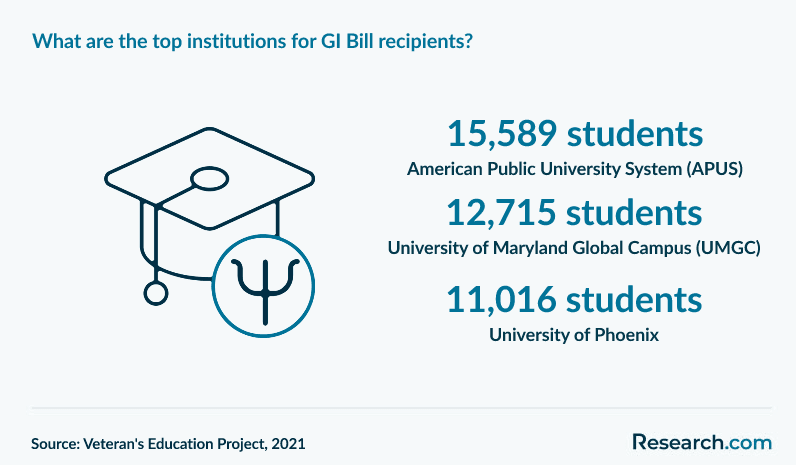
Veterans using the GI Bill for online education have also enrolled heavily in several large online providers. The American Public University System (APUS) had over 15,500 students enrolled in 2021, while the University of Maryland Global Campus (UMGC) and University of Phoenix enrolled over 12,700 and 11,000 students respectively, as shown below.
What benefits do military-friendly online colleges offer?
Military-friendly online colleges are valuable when their policies reduce friction for students whose education must fit around service, transition, relocation, or family demands. The strongest institutions provide both financial and nonfinancial support.
| Benefit | How It Helps | Decision Tip |
| Academic credit for military experience | Military training may count toward elective, general education, or major requirements. | Ask for a written transfer evaluation before committing. |
| Flexible online learning | Asynchronous classes can make it easier to study during shift work, travel, or deployment preparation. | Confirm whether deadlines are weekly, self-paced, or fixed. |
| Military tuition discounts | Discounts, fee waivers, and scholarships can reduce costs not covered by GI Bill® or tuition assistance. | Compare total net cost, not just advertised tuition. |
| Dedicated military advisors | Specialists can help with enrollment, benefit certification, transfer credits, and academic planning. | Ask whether advisors are available outside standard business hours. |
| Career transition services | Veteran-aware career counselors can help translate military roles into civilian resumes and interviews. | Look for veteran job fairs, alumni networks, and employer partnerships. |
| Disability and wellness services | Support may include accommodations, counseling referrals, or accessibility resources. | Contact disability services before classes begin if you need accommodations. |
- Military transfer credit: Schools may award college credit for military training and experience, which can shorten the path to graduation.
- Disability services: Veterans with service-connected or other disabilities may receive accommodations that make online learning more accessible.
- Discounts and waivers: Some colleges offer reduced tuition, application fee waivers, and scholarships for active-duty students, veterans, spouses, or dependents. GI Bill® benefits may not cover every expense.
- Financial support: Students may combine VA, DoD, federal, institutional, and private aid when eligible.
- Flexible course access: Online learning can help students continue their education despite deployments, relocation, or changing duty schedules.
- Job search assistance: Career teams may help with resumes, cover letters, interview preparation, and veteran-focused career events. Some programs also help students explain how military experience connects to employer diversity, equity, and inclusion priorities.
- Networking: Veteran alumni, student organizations, and professional networks can help students build civilian career contacts.
- Reduced residency requirements: Some programs limit or waive campus visits, which is especially important for students stationed overseas.
- Veterans’ preference: Qualifying military service can provide hiring preference in some state and federal employment processes.
- Wider program choice: Online delivery lets students compare programs nationwide instead of being limited to schools near a duty station.
What are the requirements and admission process for military-friendly degree programs?
Military-friendly admissions requirements usually resemble standard college admissions, but the process may include additional benefit, transfer credit, and service-documentation steps. The best schools make these steps clear before you apply.
| Admission Step | Typical Requirement | Military Student Consideration |
| Confirm eligibility | High school diploma or GED completion and any required GPA minimum | Requirements may vary by college and program. |
| Submit application | Online application through the college website | Ask whether application fees are waived for military students. |
| Send transcripts | High school, prior college, and military training transcripts when applicable | Request a clear explanation of which credits apply to your degree plan. |
| Provide test scores | Standardized test scores may be optional or required depending on the school | Do not assume test scores are needed; check the specific program. |
| Document service | DD Form 214 or equivalent documentation may be requested | Documentation may be needed for benefits, discounts, or military-specific services. |
| Complete additional materials | Essay, personal statement, or program-specific forms may be required | Healthcare, counseling, education, and graduate programs may have extra requirements. |
- Eligibility basics: Most undergraduate programs require a high school diploma or GED completion, may set a minimum GPA requirement, and may request proof of military status for military-specific benefits.
- Application documents: Expect to submit an online application, official transcripts, possible standardized test scores, military service documentation, and possibly an essay or personal statement.
- Military support: Strong programs provide admissions counselors who understand active-duty, veteran, and dependent student needs; they may also offer streamlined review or expedited support during deployment or Permanent Change of Station.
Distance education remains an important option for graduate and professional students. In 2019, 42% of postgraduate students were enrolled in at least one online course, rising to 71% in 2020 and then decreasing to 56% in 2021. For postgraduate students taking only online courses, the share was 33% in 2019, 52% in 2020, and 40% in 2021, as shown below.
These figures show that online and blended learning have become normal parts of higher education, even though enrollment patterns shifted after the peak of emergency remote learning.
What types of careers can I pursue with an online military-friendly degree?
An online military-friendly degree can support many career paths, but the best choice depends on your military background, desired industry, credential requirements, and willingness to pursue certifications or graduate study. Service members often bring experience in leadership, logistics, operations, security, training, healthcare, technology, and crisis management; the degree should help convert that experience into civilian language and credentials.
| Degree Area | Military Experience It May Build On | Possible Civilian Roles |
| Business Administration | Team leadership, operations, planning, supervision | Operations manager, project manager, entrepreneur, human resources manager |
| Cybersecurity or IT | Communications, intelligence, systems, network operations | Cybersecurity analyst, software developer, network administrator, data analyst |
| Healthcare Management | Medical administration, patient support, logistics, compliance | Clinic manager, hospital administrator, health information manager |
| Logistics and Supply Chain | Procurement, movement control, inventory, transportation | Logistics coordinator, supply chain analyst, warehouse manager |
| Public Administration | Public service, leadership, policy implementation, budgeting | City manager, nonprofit manager, grant writer, policy analyst |
| Criminal Justice | Security, investigations, compliance, discipline | Paralegal, probation officer, security engineer |
- Aviation: Veterans interested in aviation management may pursue roles such as air traffic controller, airline operations specialist, airport operations manager, or aviation safety officer.
- Business Administration: This path can lead to entrepreneurship, human resources, operations, project management, and leadership roles. Students aiming for senior roles may later consider an MBA, including affordable online executive MBA programs.
- Criminal Justice: Military experience in discipline, security, and law enforcement-related environments can connect to roles such as paralegal, probation officer, or security engineer.
- Cybersecurity: Technical and analytical military experience can support careers such as cybersecurity engineer, cybersecurity analyst, digital forensics investigator, or penetration tester. Students can learn more about how to become a cybersecurity engineer or compare some of the cheapest cyber security degree online options.
- Healthcare Management: Veterans with medical, administrative, or leadership experience may pursue clinic manager, health information manager, hospital administrator, or public health administrator roles. Graduate-level options include affordable online masters in healthcare administration programs.
- Information Technology: IT degrees can support careers in cybersecurity analysis, data analysis, network administration, and software development.
- Logistics: Military planning and supply chain experience can translate into logistics coordinator, procurement specialist, supply chain analyst, or transportation specialist roles. Students can compare affordable online supply chain management degree programs if this path fits their background.
- Public Administration: Veterans with public service and leadership experience may pursue city management, grant writing, nonprofit leadership, or policy analysis.
- Supply Chain Management: This field focuses more deeply on sourcing, inventory, purchasing, warehousing, and end-to-end supply chain strategy.
What kind of support services do military-friendly online colleges offer?
Support services are often what separate a truly military-friendly school from a school that merely enrolls military students. Before applying, confirm that support is available to online students, not only campus-based students.
- Dedicated military and veteran staff: Look for VA liaisons, military enrollment specialists, benefit certification staff, and career counselors familiar with veteran transitions.
- Academic support: Useful services include online tutoring, writing centers, academic coaching, disability services, and help navigating degree requirements after transfer credit is applied.
- Mental health and wellness resources: Some colleges provide counseling, peer groups, referrals, PTSD-related resources, and online wellness workshops.
- Career transition support: Strong programs offer veteran-focused resume support, military skills translation, job search coaching, employer connections, alumni networking, and interview preparation.
What financial aid and scholarships are available for students of military-friendly online colleges?
Military-connected students should build a full funding plan before enrolling. Do not assume one benefit will cover every charge. Compare tuition, fees, books, technology costs, course materials, and the timing of benefit payments. Students comparing military-friendly schools with other values-based options may also want to understand how aid works at Christian universities online.
Federal Aid Options
- Free Application for Federal Student Aid (FAFSA): The FAFSA is required for most federal aid programs.
- Pell Grant: This is a need-based grant for eligible undergraduate students.
- TEACH Grant: This grant is for students who commit to teaching in high-need fields.
- Federal Direct Subsidized Loans: These need-based loans carry low interest rates.
- Federal Direct Unsubsidized Loans: These loans are available regardless of financial need but have higher interest rates.
Military and Veteran Benefits
- GI Bill® Benefits: Eligible veterans may use education benefits such as the Montgomery GI Bill® - Active Duty and Selected Reserve or the Post-9/11 GI Bill®.
- Yellow Ribbon Program: Participating colleges and the VA may help cover remaining tuition costs after GI Bill benefits are applied. Always confirm whether the online program participates.
- Veteran Educational Assistance Program (VEAP): This benefit has limited eligibility and applies to veterans who served on active duty between 1976 and 1985.
Scholarships and Grants
- Many scholarships are limited to veterans, active-duty students, military spouses, dependents, or specific branches of service.
- Research scholarship opportunities through the Department of Veterans Affairs, military branches, veteran service organizations, and individual colleges.
- Ask whether scholarships reduce your balance after benefits or replace other institutional aid.
Financial Aid Comparison Checklist
- Use each college’s financial aid calculator to estimate your net price.
- Compare aid packages from multiple online colleges before committing.
- Include hidden and recurring costs such as books, technology, lab fees, clinical fees, graduation fees, and exam fees.
- Create a budget that includes housing, childcare, transportation, and family expenses alongside tuition.
- Review veteran-specific financial planning resources offered by the VA or your military branch.
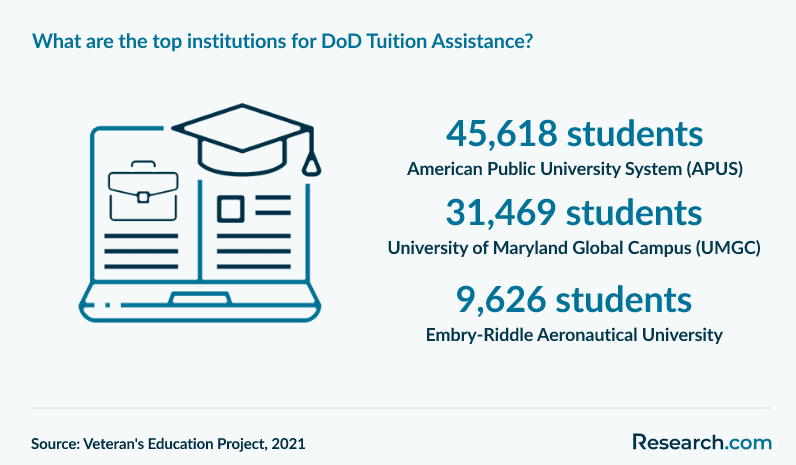
The Department of Defense also offers tuition assistance. APUS had a staggering 45,600 students enrolled through this route, while UMGC had over 31,400 students and Embry-Riddle Aeronautical University had nearly 10,000 students using online programs in 2021, as shown below.
How can I check the reputation of online colleges?
Reputation should be evaluated with evidence, not marketing language. A college may call itself military-friendly, but students should verify accreditation, outcomes, employer recognition, and the quality of military student services.
- Start with accreditation: Accreditation confirms that a school or program has gone through an external quality review. It can affect credit transfer, graduate school admission, employer recognition, and GI Bill® eligibility.
- Use official databases: Check the school’s website, then confirm the information through the U.S. Department of Education's database of accredited institutions. Regional accreditation is generally the most widely recognized institutional accreditation.
- Look beyond advertisements: Review graduation rates, retention rates, faculty credentials, student support availability, complaint histories, and student reviews. Pay special attention to feedback from online and military-connected students.
- Ask employers and alumni: Contact career services to ask about employer partnerships, veteran job placement support, alumni outcomes, and whether graduates work in your target field.
How can I best leverage online learning offered by military-friendly colleges?
Online learning works best when you choose a format that matches your service obligations and build a schedule before classes start. Flexibility is useful, but it also requires planning and consistent communication.
Understand the Course Format
- Asynchronous learning: Recorded lectures, readings, and assignments let you study when your schedule allows.
- Synchronous learning: Live sessions create real-time discussion but can be harder to manage across time zones or shifting duty schedules.
- Blended learning: A mix of recorded work and live interaction may offer both flexibility and community.
- Flexible deadlines: Ask whether instructors can accommodate deployment, training, or unexpected duty demands.
- Rolling admissions: Some programs let students begin at multiple points throughout the year instead of waiting for a traditional semester start.
Evaluate Online Engagement
- Choose programs that require meaningful interaction, not just uploaded readings and exams.
- Look for discussion boards, collaborative projects, instructor feedback, virtual office hours, and peer communities.
- Ask whether online students receive the same tutoring, advising, and library access as campus students.
Check Technology Requirements
- Confirm that you have reliable internet access and a computer that meets program requirements.
- Ask whether the school offers technical support during evenings, weekends, or different time zones.
- Find out whether eligible students can access loaner laptops or other technology assistance.
Students who want to complete a credential quickly may also compare online military-friendly programs with the best fast-track accelerated degree programs, especially when transfer credit can shorten the timeline.
How to Maximize Military Benefits for Online Degrees
Military education benefits can reduce the cost of an online degree, but only if you understand how each benefit applies to your school, program, enrollment status, and course schedule. The safest approach is to speak with both the school’s military benefits office and the relevant VA or DoD resource before enrolling.
- Use GI Bill® benefits strategically: Confirm that the institution is approved for GI Bill® use, ask how benefits apply to online courses, and check whether the program participates in the Yellow Ribbon Program.
- Explore tuition assistance: Active-duty service members may use the Department of Defense Tuition Assistance Program, which covers up to $250 per credit hour for eligible students. Ask whether the college’s tuition and fees fit within that limit.
- Request a military credit evaluation early: Do not rely on a general promise of credit for service. Ask how your military transcript applies to your exact degree requirements.
- Layer scholarships carefully: Veteran, military spouse, dependent, branch-specific, and institutional scholarships may reduce remaining costs after primary benefits are applied.
- Work with a trained military liaison: A knowledgeable advisor can help you avoid benefit timing issues, over-enrollment, unused transfer credits, and courses that do not apply to your degree plan.
Students comparing cost-saving options can also review affordable online courses to understand how tuition, format, and program structure affect total cost.
How can military-friendly colleges enhance career support and networking for veterans?
Career support should help veterans translate military experience into civilian value. Effective military-friendly colleges offer resume coaching, military skills translation, interview practice, employer introductions, veteran alumni networks, virtual career fairs, and mentoring from professionals in target industries. These services are especially useful when a student is moving from a military occupational specialty into a new civilian field.
Veterans who plan to move into leadership, advanced technical, healthcare, education, or policy roles may also compare graduate pathways, including affordable online masters programs, after confirming that the graduate credential fits their career plan.
How do online degrees from military-friendly colleges help veterans transition to civilian careers?
Online degrees can help veterans transition into civilian work by pairing military experience with recognized academic credentials. The strongest programs do not erase military experience; they help students explain it in terms employers understand.
- Skill matching: Programs can connect leadership, communication, planning, technical knowledge, and problem-solving experience to civilian job requirements.
- Upskilling and reskilling: Online degrees can help veterans build new competencies in areas such as cybersecurity, healthcare management, public administration, business, and information technology.
- Credential recognition: A degree can strengthen a resume when combined with military achievements, certifications, and relevant experience.
- Veteran-aware career advising: Career staff can help convert military job titles, duties, and accomplishments into civilian resume language.
- Job search resources: Online job boards, interview preparation, career workshops, and employer events can help veterans navigate hiring processes outside the military.
Are online doctoral programs tailored to military needs?
Some online doctoral programs are designed with flexible schedules that may appeal to military-connected students pursuing senior leadership, research, education, healthcare, or consulting roles. However, doctoral study is demanding and often includes research, writing, residencies, practicums, or dissertation requirements. Military students should confirm the time commitment, residency expectations, faculty support, transfer policy, and whether the degree is respected in their target field.
Veterans comparing advanced online options can review programs such as the cheapest fastest life experience PhD degrees, but they should be especially careful to verify accreditation, degree legitimacy, and employer acceptance before enrolling.
How can accelerated online bachelor degrees enhance military career progression?
Accelerated online bachelor’s programs can help military students complete a degree faster when they combine shorter terms, year-round scheduling, generous transfer credit, and clear degree planning. These programs work best for disciplined students who can manage a heavier pace and already have prior college credit, military training credit, or professional experience.
Military professionals seeking faster completion can compare the fastest online bachelor degree options, but they should confirm that speed does not come at the expense of accreditation, faculty access, course quality, or preparation for licensure.
Is the investment in a military-friendly online degree worth it?
A military-friendly online degree may be worth it when the program is accredited, affordable after benefits, aligned with a realistic career goal, and supported by strong advising and career services. It may not be worth it if credits do not transfer efficiently, benefits do not cover expected costs, the program lacks employer recognition, or the degree does not lead toward a role you actually want.
| Choose This Path If... | Consider Another Option If... |
| You can use GI Bill®, tuition assistance, scholarships, or transfer credits to reduce cost. | You would need to borrow heavily for a degree with uncertain career value. |
| The degree matches your civilian career target. | You are choosing a major only because it is fast or easy to enter. |
| The school is properly accredited and recognized by employers or graduate programs. | The school cannot clearly explain accreditation, outcomes, or credit transfer. |
| The online format works with your service, work, and family schedule. | You need in-person structure, labs, clinical placement, or local networking that the program does not provide. |
Students focused on return on investment can also compare degree options with lists of the fastest degree with highest salary, while remembering that salary outcomes are never guaranteed.
What are the graduation and retention rates for military-friendly online programs?
Graduation and retention rates can help you judge whether students are persisting and completing the program, but they should be interpreted carefully. Military students may stop out because of deployments, relocation, family responsibilities, or benefit timing issues, so ask whether the school tracks outcomes for veteran and active-duty students specifically.
- Ask for graduation, retention, and course completion data for online students.
- Ask whether the school publishes outcomes for military-connected students.
- Review whether students can pause enrollment for deployment or service-related interruptions without penalty.
- Compare support services, not just outcomes numbers.
- Students who want a lower-cost first credential may also compare low cost online associate degree programs before committing to a bachelor’s program.
What potential challenges should military students consider in online programs?
Online education offers flexibility, but military students can face challenges that traditional students may not experience as often. Planning for these issues before enrollment can prevent wasted benefits, lost credits, and unnecessary stress.
| Common Mistake | Why It Causes Problems | Better Approach |
| Choosing a school before checking accreditation | Your credits, degree, or benefits may not be recognized as expected. | Verify the school through official accreditation sources before applying. |
| Looking only at tuition | Fees, books, technology, and benefit limits can change the real price. | Compare total cost after all aid and benefits. |
| Assuming all military credit applies | Some credits may count only as electives or may not fit your major. | Request a program-specific transfer evaluation. |
| Ignoring licensure rules | Education, nursing, counseling, and social work often have state-specific requirements. | Confirm state authorization and licensure alignment before enrolling. |
| Overloading courses during active service | Heavy course loads can lead to withdrawals, poor grades, or benefit waste. | Start with a manageable schedule and adjust after the first term. |
| Relying only on rankings | A top-ranked school may not be the best fit for your cost, schedule, or career target. | Use rankings as one input alongside accreditation, cost, transfer credit, and support. |
Students who need a shorter credential may compare the top 6-month accelerated associate's degree online options, while still checking accreditation, credit transfer, and academic support.
What are some salaries of graduates from online military-friendly programs?
Salaries depend on experience, location, employer, degree level, certifications, specialization, and labor market conditions. Military experience may help some applicants stand out, especially when it aligns with the role, but it does not guarantee a specific salary. The figure below shows salary examples across selected degrees and job categories in the United States.
Accounting reports $79,000 for a Bachelor's degree (BS/BSc) and $81,000 for a Master's in Accounting (MAcc). Business Administration graduates with a Bachelor's degree (BS) can expect around $75,000. Computer Science reports an average of $83,812. Economics and Healthcare Administration graduates show starting salaries around $77,609 and $49,204, respectively. Management positions with a Master's in Business Administration (MBA) typically start at $125,000. Management Information Systems graduates average $81,267.
In healthcare, registered nurses earn an average of $89,010. Specialized nursing roles may pay more, including nurse anesthetists who earn a substantial $240k/year salary. Students comparing advanced nursing roles can review psychiatric nurse practitioner salary by state. Those preparing for nursing careers can compare nursing degree online programs. Social work careers tend to have lower starting points, averaging around $41,189, while Special Education positions start slightly higher at $51,992. Students in education can also compare the cheapest online special education master's degree programs.
Veterans' Mental Health and Wellness in Online Learning
Online education can be convenient, but it can also feel isolating. Veterans transitioning to civilian life may be managing work, family, service-connected health needs, stress, or readjustment challenges while completing coursework. A military-friendly college should make wellness support visible and easy to access.
- Ask whether counseling services are available to online students.
- Look for peer support groups, veteran student organizations, and referrals for specialized services.
- Confirm how disability accommodations are requested and implemented in online courses.
- Use stress management, wellness, academic coaching, and tutoring resources early instead of waiting until grades suffer.
Wellness support is not separate from academic success. Students who receive timely mental health, accessibility, and peer support are often better positioned to stay engaged and complete their programs.
Affordable Online Bachelor’s Degrees for Military Students
Affordability for military students should be measured by net cost, not the advertised tuition rate. A program that looks inexpensive may become costly if few credits transfer, fees are high, benefits do not apply cleanly, or students need extra terms to graduate.
Key Features of Affordable Online Bachelor’s Degrees
- Reduced tuition for military students: Many military-friendly colleges offer tuition discounts, waivers, or scholarships for service members, veterans, and military families. Some also participate in the Yellow Ribbon Program.
- Credit for military experience: Converting military training into college credit can reduce both time and tuition, but only if the credits apply to the degree requirements.
- Flexible learning options: Asynchronous classes, multiple start dates, and accelerated tracks can help students balance school with deployments, work, and family responsibilities.
Students comparing cost-conscious options can review the cheapest online college bachelor degree programs and then verify which schools offer military-specific support, transfer credit, and benefit guidance.
Are Associate Degrees a Strategic Option for Military Students?
Associate degrees can be a practical first step for military students who want a shorter, lower-cost credential or need a bridge into bachelor’s study. They typically require fewer credits than a bachelor’s degree and may support entry-level roles, technical careers, promotion points, or later transfer into a four-year program.
This route makes sense if the program is accredited, credits transfer cleanly, and the credential supports your career goal. It is less useful if you plan to enter a profession that requires a bachelor’s or graduate degree. Students weighing this option should understand how much is an associate degree and compare transfer agreements before enrolling.
What Certification Programs Can Enhance Military Career Prospects?
Certifications can help military students prove specialized skills, especially in fields where employers value job-ready credentials. They can be useful alongside a degree or as a shorter step before committing to a full program.
- Technology: Cybersecurity, networking, cloud, data, and software credentials can complement IT or computer science degrees.
- Healthcare: Administrative, informatics, billing, coding, and clinical support credentials may strengthen healthcare career entry.
- Project management: Military leadership and operations experience can pair well with project-focused credentials.
- Business and logistics: Supply chain, procurement, finance, and management certifications can support advancement.
Students deciding which credential to pursue can compare options such as what certificate makes the most money, but they should choose certifications based on employer demand in their target field rather than salary claims alone.
How to Navigate Military-Friendly Accreditation and Quality Assurance for Online Colleges
Accreditation is one of the most important quality checks for online colleges. It helps determine whether your degree is recognized by employers, whether credits may transfer, whether graduate schools may accept your academic record, and whether you can use GI Bill® and other eligible military benefits.
Students should verify accreditation through official sources before applying. Some students may also compare nationally accredited online colleges, especially for career-focused programs, but they should understand how national accreditation may affect transfer credit and graduate school options compared with regional accreditation.
Do colleges offer benefits or resources specifically for spouses and dependents of active-duty service members and veterans?
Yes. Some colleges provide benefits for military spouses and dependents, although availability varies widely by institution. Families should review each college’s policy rather than assuming military benefits automatically extend to dependents.
- Tuition discounts: Some schools offer reduced tuition for spouses and dependents of active-duty service members or veterans.
- Scholarships and grants: Colleges, military organizations, and private groups may offer funding specifically for spouses and dependents.
- Flexible admissions policies: Some institutions consider frequent relocation, deployment-related disruption, or nontraditional academic histories.
- Military family support: Dedicated offices may help families understand financial aid, benefits, enrollment, and campus or online resources.
- Childcare support: Colleges with childcare services may provide priority access or discounted options for military families, when available.
- How to find benefits: Search college websites for “Military & Veterans,” “Military Spouse Education,” or “Military Family” resources. Organizations such as Military OneSource and the Student Veterans of America can also help families identify support options.
Important note: Benefits for spouses and dependents differ significantly by college. Before applying, confirm eligibility, required documentation, tuition rules, scholarship deadlines, and whether benefits apply to online programs.
Questions to Ask Before Choosing a Military-Friendly Online College
- Is the institution accredited, and is the specific program accredited if my field requires it?
- How many of my military training credits will apply directly to my degree requirements?
- What will the total cost be after GI Bill®, tuition assistance, scholarships, discounts, fees, books, and technology costs?
- Does the program offer asynchronous courses that can work around deployments or shift schedules?
- What happens academically and financially if I deploy, relocate, withdraw, or pause enrollment?
- Are military and veteran advisors available to online students?
- Does the program meet licensure requirements in the state where I plan to work?
- What career services are available specifically for veterans?
- Can the school provide graduation, retention, and employment outcome information for online students?
- Will this degree help me qualify for the civilian role I want, or would a certificate, associate degree, or graduate program be a better fit?
Key Insights
- The best military-friendly online college is accredited, affordable after benefits, flexible enough for military life, and strong in veteran advising and career support.
- Do not choose a school based only on a military discount. Transfer credit, fees, benefit eligibility, program quality, and career alignment can matter more than the advertised tuition rate.
- GI Bill®, tuition assistance, Yellow Ribbon participation, scholarships, and institutional discounts can lower costs, but students should calculate the full net price before enrolling.
- Military transfer credit can shorten a degree, but only credits that apply to your program requirements will reduce time to graduation.
- Online degrees can support civilian career transitions in business, IT, cybersecurity, healthcare, logistics, public administration, criminal justice, education, and social services.
- Students pursuing licensed fields such as nursing, counseling, education, or social work must verify state-specific requirements before choosing an online program.
- Accelerated degrees, associate degrees, and certifications can be smart options when they match your career goal and come from recognized, accredited providers.
- Ask hard questions before applying: accreditation, cost after benefits, military credit, deployment policies, online support, career outcomes, and licensure alignment should all be clear in writing.
References:
- Fain, P. (2021, August 20). Military Students and Online Colleges. Veterans Education Project.
- National Center for Education Statistics. (2023). Postbaccalaureate Enrollment. Condition of Education. U.S. Department of Education, Institute of Sciences.
- Payscale. (2024). Average Bachelor of Science (BS / BSc), Accounting Degree Salary. Payscale.
- Payscale. (2024). Average Master of Accounting (MAcc) Degree Salary. Payscale.
- Payscale. (2024). Average Bachelor of Business Administration (BBA) Degree Salary. Payscale.
- Payscale. (2024). Average Bachelor of Science (BS / BSc), Computer Science (CS) Degree Salary. Payscale.
- Payscale. (2024). Average Bachelor of Arts (BA), Economics Degree Salary. Payscale.
- Payscale. (2024). Average Bachelor of Science (BS / BSc), Healthcare Administration Degree Salary. Payscale.
- Payscale. (2024). Average Master of Business Administration (MBA) Degree Salary. Payscale.
- Payscale. (2024). Average Bachelor of Science (BS / BSc), Management Information Systems (MIS) Degree Salary. Payscale.
- Payscale. (2024). Average Registered Nurse (RN) Hourly Pay. Payscale.
- Payscale. (2024). Average Bachelor of Social Work (BSW / BSocW) Degree Salary. Payscale.
- Payscale. (2024). Average Bachelor of Science in Education (BSEd), Special Education Degree Salary. Payscale.
Other Things You Should Know About Military-Friendly Online Colleges in America
Yes. Many military-friendly online colleges accept JST credits evaluated by the American Council on Education, and some also award credit for CLEP or DSST exams. Schools set their own transfer limits, often capping transfer credits at 90 semester hours for a bachelor’s degree.
In 2027, top military-friendly online colleges often offer financial benefits such as tuition discounts, scholarships, and access to the GI Bill. Institutions also typically waive certain fees and provide financial aid counseling to help service members maximize their benefits.


