2027 Most Affordable Online Supply Chain Management Degrees

Co-Founder and Chief Data Scientist
A supply chain management degree is for students and working adults who want to understand how products, materials, data, and money move from suppliers to customers. The decision matters because employers increasingly expect formal training: 2023 reports state that 67% of supply chain managers believe at least a bachelor's degree is needed to enter the field. At the same time, cost, location, and work schedules can make a traditional campus program difficult to complete.
This guide focuses on affordable online supply chain management degrees, what they cost, how long they take, what you study, and how to judge whether a program is credible. It also explains career options, salary data, job-market signals, financial aid, online versus campus trade-offs, and practical questions to ask before enrolling.
Quick answer: Are affordable online supply chain management degrees worth considering?
Yes, an affordable online supply chain management degree can be a practical option if the school is properly accredited, the curriculum includes logistics, procurement, analytics, operations, and global supply chain topics, and the total cost fits your expected career path. Online programs are especially useful for working adults who need schedule flexibility or cannot relocate for school.
- A degree from an affordable online supply chain management program can prepare students for roles such as logistician, procurement specialist, operations analyst, inventory control manager, and supply chain manager.
- According to a 2023 report from the Association for Supply Chain Management, supply chain professionals earned an average annual salary of $98,570.
- Online study can reduce relocation and commuting barriers, but students still need to compare accreditation, tuition, transfer policies, career support, and hands-on learning options before enrolling.
What can you expect from an affordable online supply chain management degree?
An online supply chain management degree teaches how organizations plan, source, move, store, and deliver goods and services. Students usually study the full supply chain cycle, including supplier selection, transportation, warehousing, demand forecasting, inventory control, risk management, global logistics, and performance analysis.
Most programs combine business foundations with technical supply chain coursework. Case studies, simulations, group discussions, spreadsheet-based assignments, and analytics projects are common because employers value graduates who can solve operational problems rather than only describe theory.
- Typical subjects include logistics, procurement, inventory management, operations management, supply chain analytics, and global supply chain strategy.
- Many online programs use business scenarios, simulations, or applied projects to help students practice decision-making.
- Online discussion boards, live sessions, and instructor feedback can help students build communication, analytical, and problem-solving skills.
- Online supply chain management degrees can take anywhere from 1 to 4 years to complete.
- Bachelor's degree programs in supply chain management can cost anywhere from $30,000 to $70,000, while master's degree programs may cost up to $100,000, depending on the institution chosen.
Where can you work with a supply chain management degree?
Supply chain skills apply to any organization that buys, produces, stores, ships, or delivers goods. Graduates may work for private companies, government agencies, nonprofit organizations, consulting firms, logistics providers, healthcare networks, manufacturers, retailers, and technology companies.
- Manufacturing
- Retail
- Transportation
- Healthcare
- Technology
- Consulting firms
The degree is versatile because supply chain problems appear across industries: late shipments, supplier shortages, rising transportation costs, excess inventory, demand volatility, and compliance risks. Graduates may pursue roles in logistics, procurement, operations analysis, distribution, supplier management, and consulting.
How much can you earn with a supply chain management degree?
According to data for supply chain professionals in the US in 2023, the average median salary is $98,570. Individual pay can differ widely based on education level, role, industry, location, professional certifications, technical skills, and years of experience.
A degree does not guarantee a specific salary. However, supply chain management can lead to career paths with strong advancement potential, especially for graduates who develop analytics, procurement, negotiation, transportation, inventory planning, and leadership skills.
- Most Affordable Online Supply Chain Management Degrees for 2027
- How long does it take to complete an online supply chain management degree?
- Online vs. on-campus supply chain management programs
- What does an online supply chain management degree cost?
- Financial aid options for online supply chain management students
- Admission requirements for online supply chain management degrees
- Common courses in an online supply chain management degree
- Supply chain management specializations
- How to judge the credibility of an online supply chain management degree
- Accelerated online supply chain management pathways
- Interdisciplinary learning and supply chain strategy
- How to choose the best affordable online supply chain management degree
- Sustainability and ethical practices in supply chain programs
- Doctoral study after an online supply chain management degree
- Is an online supply chain management degree a good investment?
- Networking and mentorship in online supply chain programs
- Experiential learning in online supply chain management degrees
- Career paths for supply chain management graduates
- Job market for online supply chain management graduates
- Lifelong learning in supply chain management
- Digital transformation and supply chain education
- How supply chain programs keep pace with industry change
Most Affordable Online Supply Chain Management Degrees for 2027
How do we rank schools?
Because tuition is a major factor in choosing a degree, Research.com evaluates programs using a transparent methodology that considers affordability and program quality. The ranking draws on established education data sources, including the IPEDS database, the National Center for Education Statistics, the College Scorecard database, and Peterson’s database, including its Distance Learning Licensed Data Set.
1. Florida State College at Jacksonville BAS in Logistics
Florida State College at Jacksonville offers an online Bachelor of Applied Science in Logistics for students preparing for logistics and supply chain leadership roles. The curriculum covers supply chain management, global operations, regulatory compliance, applied analysis, and critical thinking.
Graduates may pursue roles such as operations manager, transportation manager, or logistician, where they plan, coordinate, and improve logistics activities in complex operating environments.
- Program Length: 4 years
- Required Credits to Graduate: 120
- Cost per Credit: $104.88 (in-state lower division courses) $116.52 (in-state upper division courses); $218.55 (out-of-state)
- Accreditation: Accreditation Council for Business Schools and Programs (ACBSP); Southern Association of Colleges and Schools Commission on Colleges (SACSCOC)
2. Broward College BAS in Supply Chain Management
Broward College provides an online Bachelor of Applied Science in Supply Chain Management that emphasizes applied learning. Students may build practical skills through case studies, independent research projects, or internships while studying organizational leadership, global business issues, and problem-solving in supply chain settings.
- Program Length: 4 years
- Required Credits to Graduate: 120
- Cost per Credit: $122.90 (in-state); $243.40 (out-of-state)
- Accreditation: Southern Association of Colleges and Schools Commission on Colleges (SACSCOC)
3. Georgia Military College BAS in Supply Chain Management and Logistics
Georgia Military College offers an online Bachelor of Applied Science in Supply Chain Management and Logistics for students who already hold an Associate of Applied Science degree in business, CIS, supply chain, or logistics. The program is designed to help students move from technical preparation into broader supply chain and logistics advancement opportunities.
- Program Length: 4 years
- Required Credits to Graduate: 180
- Cost per Credit: $184
- Accreditation: Southern Association of Colleges and Schools Commission on Colleges (SACSCOC)
4. Kennesaw State University BAS in Supply Chain Management
Kennesaw State University offers an online Bachelor of Applied Science in Supply Chain Logistics for students who have completed an Associate of Applied Science from a Technical College System of Georgia institution or another regionally accredited 2-year technical college. Coursework includes supply chain, logistics, statistics, warehousing, management, behavioral science, marketing, and quality management.
- Program Length: 4 years
- Required Credits to Graduate: 120
- Cost per Credit: $214
- Accreditation: Southern Association of Colleges and Schools Commission on Colleges (SACSCOC)
5. Clayton State University BBA in Supply Chain Management
Clayton State University offers an online Bachelor of Business Administration in Supply Chain Management. The program develops knowledge in transportation, logistics, supply chain principles, and financial performance analysis, preparing students for business roles that require both operational and managerial judgment.
- Program Length: 4 years
- Required Credits to Graduate: 120
- Cost per Credit: $226.33 (in-state); $226.33 (out-of-state)
- Accreditation: Southern Association of Colleges and Schools Commission on Colleges (SACSCOC)
6. Athens State University BS in Supply Chain Management
Athens State University offers an online Bachelor of Science in Logistics and Supply Chain Management taught by faculty with industry experience. Students study demand forecasting, logistics planning, sourcing, inventory management, delivery coordination, and supply chain efficiency through coursework and collaborative projects.
- Program Length: 4 years
- Required Credits to Graduate: 124
- Cost per Credit: $251
- Accreditation: Accreditation Council for Business Schools and Programs (ACBSP); Southern Association of Colleges and Schools Commission on Colleges (SACSCOC)
7. Columbia Southern University BSBA in Supply Chain Management
Columbia Southern University offers an online Bachelor of Science in Business Administration with a Supply Chain Management concentration. Students learn to develop, implement, and evaluate business strategies in supply chain environments, including inventory control, logistics tracking, and demand analysis.
- Program Length: 4 years
- Required Credits to Graduate: 120
- Cost per Credit: $270
- Accreditation: Southern Association of Colleges and Schools Commission on Colleges (SACSCOC)
8. Avila University BA in Supply Chain Management
Avila University offers a 100% online Bachelor of Arts in Supply Chain Management. The program is aligned with Association for Supply Chain Management (ASCM) standards and covers operations alignment, warehousing, project management, procurement, quality control, and the movement of commodities across sectors.
- Program Length: 4 years
- Required Credits to Graduate: 120
- Cost per Credit: $275
- Accreditation: Higher Learning Commission (HLC)
9. Minnesota State University - Moorhead BS in Global Supply Chain Management
Minnesota State University - Moorhead offers a Bachelor of Science in Global Supply Chain Management in online, on-campus, or hybrid formats. The program combines operations, project management, and business coursework with an emphasis on local, national, and international supply chain strategy.
- Program Length: 4 years
- Required Credits to Graduate: 120
- Cost per Credit: $354.16
- Accreditation: Higher Learning Commission (HLC)
10. Western Illinois University Bachelor of Business in Supply Chain Management
Western Illinois University offers a Bachelor of Business in Supply Chain Management with a curriculum built around business practices and applied experience. Students may also pursue an integrated option that allows them to complete both a bachelor's degree and an MBA in just five years.
- Program Length: 4 years
- Required Credits to Graduate: ~120
- Cost per Credit: $493.06
- Accreditation: Accreditation Council for Business Schools and Programs (ACBSP
Program comparison at a glance
| School | Degree | Credits | Cost per Credit | Best fit |
| Florida State College at Jacksonville | BAS in Logistics | 120 | $104.88 (in-state lower division courses) $116.52 (in-state upper division courses); $218.55 (out-of-state) | Students seeking one of the lowest listed per-credit rates and logistics-focused applied coursework |
| Broward College | BAS in Supply Chain Management | 120 | $122.90 (in-state); $243.40 (out-of-state) | Students who want applied projects, case studies, or internship-style learning |
| Georgia Military College | BAS in Supply Chain Management and Logistics | 180 | $184 | AAS graduates in business, CIS, supply chain, or logistics |
| Kennesaw State University | BAS in Supply Chain Management | 120 | $214 | Technical college graduates moving into bachelor’s-level supply chain study |
| Clayton State University | BBA in Supply Chain Management | 120 | $226.33 (in-state); $226.33 (out-of-state) | Students who prefer a business administration foundation |
Key Findings
- An online supply chain management degree commonly takes two to four years, depending on prior credits, enrollment status, and degree level.
- Transportation, storage, and distribution managers can earn high salaries in certain industries, including computer and peripheral equipment manufacturing ($189,700) and scientific research and development services ($178,880).
- Common specialization areas include sustainability in supply chain management, global logistics, and supply chain analytics.
- The job market for graduates with a degree from the most affordable online supply chain management programs is promising, with a projected growth rate of 8% until 2032.
- 70% of job-seekers in the supply chain management industry found employment within 3 months of a job search.
How long does it take to complete an online supply chain management degree?
A bachelor's supply chain degree online typically takes about four years for full-time students who enter without significant transfer credit. A master's degree, such as a Master of Science in Supply Chain Management, often takes about two to three years, depending on course load and program format.
Completion time depends on transfer credits, work experience policies, prerequisites, enrollment intensity, and whether the program offers shorter formats. Some accelerated degree programs for working adults can be completed in a year or two.
| Path | Typical time frame | Who it may fit |
| Bachelor’s degree | About four years | Students starting college or changing fields who need broad business and supply chain preparation |
| Master’s degree | About two to three years | Professionals who already have a bachelor’s degree and want advanced supply chain or operations roles |
| Accelerated pathway | A year or two | Working adults with prior credits, relevant experience, or a clear need to finish quickly |
How does an online supply chain management program compare to an on-campus program?
Online and campus programs can cover similar academic content, but the student experience differs. The right choice depends on your schedule, location, learning style, support needs, and access to internships or employer networks.
| Factor | Online program | On-campus program |
| Schedule | Often more flexible, especially when courses are asynchronous | Usually follows fixed class times |
| Location | Can be completed from anywhere with reliable internet access | Requires physical attendance or relocation |
| Interaction | Uses discussion boards, video meetings, email, and virtual team projects | Offers face-to-face conversations with classmates, faculty, and staff |
| Learning environment | Requires strong self-direction and time management | Provides more built-in structure and immediate campus resources |
| Hands-on learning | May include simulations, remote projects, and local internships | May provide labs, campus events, and local employer connections |
Students comparing a fully online degree with an in-person logistics and supply chain management degree should pay close attention to internship options, faculty access, career services, and the technology platforms used for coursework.
What is the average cost of an online supply chain management degree?
Students can generally expect to pay anywhere from $7,070 to $35,262 per year for tuition. For public institutions in the student’s state of residency, the median in-state tuition was $7,070 in 2021. Students attending private institutions or out-of-state public institutions faced a higher median tuition of $35,262 in 2021.
Schools offering the most affordable online supply chain management degrees charge around $5,000 to $10,000. However, tuition is only part of the total price. Students should also check fees, books, technology costs, transfer-credit limits, residency rules, and whether tuition differs for online students.
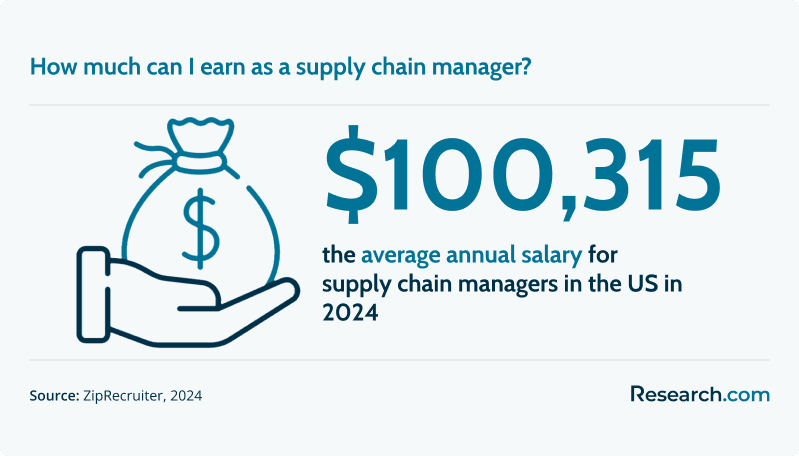
Return on investment can be favorable for graduates who move into management or specialized roles. According to 2024 compensation data from Salary.com, the supply chain management salary hovers around $100,315.
What are the financial aid options for students enrolling in online supply chain management degrees?
Affordable tuition matters, but students should also pursue aid that does not have to be repaid before turning to loans. Start by confirming that the school participates in eligible aid programs and that the degree is offered by an accredited institution.
- Federal Aid: Students can submit the Free Application for Federal Student Aid (FAFSA) to be considered for federal grants, loans, and work-study programs.
- Scholarships: Colleges, professional associations, employers, and private organizations may offer awards for students in supply chain management or related business fields.
- Employer Assistance: Some companies provide tuition reimbursement or education benefits for employees pursuing job-related credentials, including a supply chain online degree.
- State Aid: Students may qualify for state grants or scholarships based on residency, financial need, academic record, or program eligibility.
- Military Benefits: Service members, veterans, and dependents may be eligible for tuition assistance, GI Bill benefits, or military-affiliated scholarships.
- Alternative Loans: Private loans can fill funding gaps, but borrowers should compare rates, repayment terms, eligibility requirements, and long-term debt impact before signing.
What are the prerequisites for enrolling in online supply chain management degrees?
Admission requirements vary by school and degree level. Before applying, review the program’s admissions page, transfer-credit rules, required test scores, GPA expectations, and prerequisite coursework.
Bachelor's Degree Requirements
- High school diploma or equivalent
- Minimum GPA requirement, usually ranging from 2.0 to 3.0
- SAT or ACT scores, when required by the institution
- Foundational coursework in areas such as mathematics, business, economics, or engineering
Master's Degree Requirements
- Bachelor's degree from an accredited institution
- Minimum GPA requirement, usually ranging from 2.5 to 3.0
- GRE or GMAT scores, when required
- Prior coursework in supply chain management, operations management, business administration, or a related area
Doctorate (PhD) Degree Requirements
- Master's degree in a related field, sometimes required for doctoral admission; this may include an MBA or an affordable online master's in accounting
- Minimum GPA requirement, usually ranging from 3.0 to 3.5
- GRE or GMAT scores, when required
- Relevant professional experience or research preparation
- Statement of purpose, recommendation letters, and writing samples, depending on the program
Some programs also expect applicants to have experience with business software, statistics, spreadsheets, or introductory supply chain concepts. Transfer students should ask how many credits will apply before enrolling.
What courses are typically in an online supply chain management degree?
Affordable programs generally cover the same core areas as higher-cost programs. The strongest curricula connect supply chain theory with measurable business outcomes such as cost reduction, service reliability, quality, risk control, and customer satisfaction.
- Introduction to Supply Chain Management: Covers core functions such as sourcing, procurement, logistics, distribution, and coordination across suppliers and customers.
- Operations Management: Examines process improvement, quality management, inventory control, production planning, and operational efficiency.
- Logistics and Transportation Management: Focuses on warehousing, transportation modes, distribution networks, freight movement, and delivery performance.
- Global Supply Chain Strategies: Explores international sourcing, trade issues, cross-border logistics, risk management, and global coordination.
- Supply Chain Analytics: Teaches students how to use data to forecast demand, monitor performance, and improve decisions. Students may also build database management skills through data-heavy assignments.
What types of specializations are available in an online supply chain management degree?
Specializations let students focus on the part of supply chain management that best matches their career goals. Availability differs by school, so applicants should confirm whether a concentration appears on the transcript or simply functions as elective coursework.
- Sustainable Supply Chain Management: Covers responsible sourcing, environmental impact, resource efficiency, and corporate social responsibility.
- Global Logistics and International Trade: Focuses on customs, import/export procedures, international shipping, trade rules, and global market conditions.
- Supply Chain Analytics and Big Data: Emphasizes forecasting, performance dashboards, data modeling, and decision support.
- Operations and Inventory Management: Prepares students to balance service levels, stock availability, inventory cost, and process performance.
- Supply Chain Strategy and Innovation: Examines lean methods, agile supply chains, partnerships, continuous improvement, and strategic redesign.
Students interested in advanced leadership research may later compare supply chain graduate options with programs such as a cheap online PhD organizational leadership program.
The chart below indicates the industries with the highest employment levels of transportation, storage, and distribution managers.
What factors impact the credibility of online supply chain management degrees?
Employers may accept online degrees when the institution is legitimate, accredited, and academically rigorous. The most important credibility signal is accreditation. Students should verify institutional accreditation and, when available, business-specific accreditation before enrolling.
Program alignment with industry practice also matters. Some programs connect coursework to organizations such as the Association for Supply Chain Management (ASCM) or the Council of Supply Chain Management Professionals (CSCMP), which may support certification preparation, networking, or exposure to current professional standards.
Technology coverage is another credibility factor. Strong supply chain programs introduce enterprise resource planning systems, transportation management systems, analytics platforms, forecasting methods, and data-driven decision-making. These tools matter because modern supply chains depend on visibility, automation, and rapid response.
Faculty qualifications should be easy to find. Programs taught by instructors with industry experience, research expertise, or professional credentials may offer stronger career relevance. Students comparing online options can also review broader guidance on the best online degrees to get to understand what makes an online program credible.
Are there accelerated pathways in online supply chain management education?
Some colleges offer accelerated pathways for students who want to finish faster without skipping essential coursework. These may include condensed terms, transfer-friendly bachelor’s completion programs, bridge courses, or stackable credentials that let students move from foundational study into advanced supply chain classes.
An accelerated associates degree online can sometimes serve as a lower-cost starting point before a bachelor’s program, especially for students who want to complete general education or business prerequisites efficiently.
Can an Interdisciplinary Approach Strengthen Supply Chain Strategies?
Supply chain management benefits from knowledge outside traditional business coursework. Data analytics, engineering, sustainability, public policy, finance, law, and even urban planning can shape how organizations design resilient transportation networks, manage infrastructure constraints, and respond to regulation.
For example, students interested in logistics networks, transportation systems, and sustainable infrastructure may find useful parallels in an affordable urban planning degree. Interdisciplinary thinking can help supply chain professionals develop more practical solutions to real-world operating problems.
How do you choose the best affordable online supply chain management degree?
The best affordable program is not always the one with the lowest tuition. It is the program that is accredited, realistically priced, transfer-friendly, career-relevant, and aligned with your goals.
- Check accreditation first. Look for recognized institutional accreditation and, when relevant, business accreditation such as Accreditation Council for Business Schools and Programs (ACBSP) or Association to Advance Collegiate Schools of Business (AACSB). Accreditation is also a key consideration in other fields, including the cheapest online elementary education degree programs.
- Calculate the full price. Compare tuition, mandatory fees, books, software, transfer-credit acceptance, residency pricing, and graduation fees.
- Review the curriculum. A strong program should include logistics, procurement, operations, analytics, inventory, risk management, and global supply chain topics.
- Investigate faculty experience. Look for instructors with practical supply chain, operations, logistics, analytics, or procurement backgrounds.
- Evaluate flexibility. Confirm whether courses are asynchronous, synchronous, part-time, full-time, or offered in accelerated terms.
- Compare student support. Online learners should have access to advising, tutoring, library resources, technical support, and career services.
- Ask about employer connections. Internship options, project partnerships, alumni networks, and career fairs can affect your job search.
- Look beyond rankings. Rankings are useful starting points, but your transfer credits, location, schedule, career goals, and financial aid package may change the best choice for you.
| Question to ask | Why it matters |
| Is the institution accredited? | Accreditation affects credibility, financial aid eligibility, transfer options, and employer acceptance. |
| How many credits will transfer? | Transfer credit can reduce both time to graduation and total cost. |
| Are courses asynchronous or live? | Course format determines whether the program fits your work schedule. |
| Does the program include analytics tools? | Supply chain employers increasingly value data-driven decision-making. |
| What career services are available to online students? | Resume help, interview coaching, employer events, and internship support can improve job-search readiness. |
How do online supply chain management degrees address sustainability and ethical practices?
Many supply chain programs now include sustainability, ethical sourcing, corporate social responsibility, and resource efficiency because companies face pressure to manage environmental impact, supplier conduct, and responsible procurement. Coursework may examine green logistics, supplier audits, emissions considerations, waste reduction, and ethical decision-making.
Students who want broader management preparation can also compare supply chain coursework with cheapest MBA programs online, especially if they plan to move into leadership roles that involve finance, strategy, operations, and people management.
Is Pursuing a Doctorate the Next Step After Your Online Supply Chain Management Degree?
A doctorate may make sense for graduates who want to teach, conduct research, consult at a high level, or compete for senior leadership positions. It is not necessary for most entry-level or mid-career supply chain roles, so students should weigh time, cost, opportunity cost, and career goals carefully.
If doctoral-level business education is under consideration, reviewing DBA programs cost can help clarify how advanced study compares with certifications, a master’s degree, or direct professional experience.
Is an online supply chain management degree a worthwhile investment?
An online supply chain management degree can be worthwhile when it leads to skills employers need and does not require unsustainable debt. The strongest return often comes from choosing an accredited, lower-cost program; transferring credits; using employer tuition assistance; and building practical experience while studying.
Students comparing different graduate business routes may also review one year MBA programs to understand how accelerated business degrees differ from specialized supply chain degrees.
How do online supply chain management degrees enhance networking and mentorship opportunities?
Online students should not assume networking happens automatically. Strong programs create virtual career fairs, alumni panels, mentoring programs, professional association connections, team projects, and faculty-led career guidance. These opportunities can help students learn how hiring works in logistics, procurement, operations, and consulting.
Students exploring related business disciplines may also compare options such as the cheapest online degree economics program if they want additional grounding in markets, trade, policy, and economic decision-making.
How do online supply chain management degrees integrate experiential learning opportunities?
Experiential learning is important because supply chain jobs require judgment under constraints: limited inventory, late shipments, supplier disruptions, cost pressure, and customer expectations. Online programs may use simulations, capstone projects, virtual labs, case analyses, remote internships, or employer-sponsored projects to build applied skills.
Students who want to broaden their operational perspective across industries may also consider a fast track healthcare administration degree, particularly if they are interested in healthcare logistics, operations, or service delivery systems.
What career paths are available for graduates of an online supply chain management degree?
Graduates can work in roles that focus on transportation, sourcing, planning, inventory, analysis, supplier management, and operations improvement. Entry-level roles may emphasize data gathering and coordination, while advanced roles require leadership, negotiation, cost control, risk management, and technology adoption.
- Logistics Manager: Professionals in this logistic career path oversee the movement and storage of goods, coordinate transportation, and work to improve delivery speed, cost, and reliability.
- Procurement Specialist: These professionals source suppliers, negotiate contracts, monitor vendor performance, and help organizations purchase goods and services cost-effectively.
- Operations Analyst: Analysts examine supply chain data, identify bottlenecks, build reports, and recommend improvements to processes and performance.
- Supply Chain Consultant: Consultants advise organizations on supply chain strategy, process redesign, technology adoption, and performance improvement.
- Inventory Control Manager: These managers forecast demand, track inventory levels, reduce excess stock, and improve inventory turnover.
Some professionals add specialized credentials outside supply chain to expand their role. For example, the fastest and cheapest paralegal certificate programs may interest those who work with contracts, compliance, or regulated supply chains.
In 2022, the top-paying industry for transportation, storage, and distribution managers was computer and peripheral equipment manufacturing, offering an average annual salary of $189,700.
What is the job market for graduates of an online supply chain management degree?
The labor market includes opportunities across logistics, procurement, distribution, consulting, manufacturing, retail, and healthcare. The job outlook for logisticians is especially strong, with an 18% projected job growth in the US from 2022 to 2032. This increase is expected to result in approximately 38,300 new logistician jobs by 2032.
Other supply chain roles, including logistics managers, procurement specialists, and operations analysts, continue to be needed because organizations rely on efficient sourcing, storage, transportation, and fulfillment to remain competitive.
The number of supply chain management service businesses is also growing by 3.6% from 2022 to 2032. In 2023, there were 4,525 supply chain management services in the country. A report from the Association of Supply Chain Management also found that 70% of supply chain management graduates found a job in 3 months or less.
Graduates who combine a degree with software skills, analytics ability, internship experience, and industry knowledge are generally better positioned than those who rely on the credential alone.
How do online supply chain management degrees support lifelong learning?
Supply chain work changes as technology, regulation, transportation systems, consumer expectations, and global risks change. Online programs can support ongoing learning through alumni webinars, certification preparation, continuing education modules, and access to professional communities.
Some programs maintain connections with groups such as the Association for Supply Chain Management (ASCM) or the Council of Supply Chain Management Professionals (CSCMP). These relationships may help graduates stay informed about certifications, industry events, and professional development opportunities.
Professionals who need targeted upskilling rather than a full degree may also compare short online degrees that focus on specific career skills.
How do online supply chain management degrees prepare you for digital transformation?
Modern supply chains depend on data, automation, digital platforms, and fast communication across suppliers, warehouses, carriers, and customers. Online supply chain programs increasingly include analytics, artificial intelligence concepts, cloud-based collaboration, forecasting, and virtual simulations to help students understand technology-driven operations.
Students who want a wider business foundation may also compare supply chain degrees with an online business degree cheap to decide whether they need a specialized supply chain curriculum or broader business training.
How do online supply chain management degrees adapt to industry changes?
Supply chain management evolves as companies adopt new technologies, respond to global disruptions, and redesign networks for cost, speed, resilience, and sustainability. Accredited online colleges should regularly review curricula so students learn current tools and practices rather than outdated operational models.
- Technology and automation: Programs may introduce automation, artificial intelligence, machine learning, robotics, and analytics tools used to improve supply chain performance.
- Global operations and sustainability: Coursework often addresses international logistics, trade regulations, supplier responsibility, environmental impact, and ethical sourcing.
- Data analytics and forecasting: Students learn to analyze data, forecast demand, evaluate inventory needs, and support decisions across complex supply networks.
- Industry partnerships: Some schools use webinars, internships, guest lectures, and employer projects to keep coursework connected to professional practice.
Common mistakes to avoid when choosing an online supply chain management degree
| Mistake | Better approach |
| Choosing only by lowest tuition | Compare total cost, accreditation, transfer credits, completion time, and career support. |
| Ignoring accreditation | Verify institutional accreditation before applying or paying deposits. |
| Assuming online means easier | Plan weekly study time and confirm whether courses require live attendance. |
| Overlooking analytics skills | Prioritize programs that include data analysis, forecasting, and supply chain technology. |
| Expecting salary outcomes to be guaranteed | Use salary data as a benchmark, but factor in role, experience, industry, and location. |
| Relying only on rankings | Use rankings as a starting point, then evaluate fit, cost, curriculum, and student support. |
Key Insights
- An affordable online supply chain management degree can be a smart path if it is accredited, career-relevant, and priced within a realistic budget.
- The best programs teach more than logistics basics. Look for procurement, operations, inventory, global supply chain strategy, analytics, and applied projects.
- Online learning is flexible, but it requires discipline. Students should confirm course format, live-session expectations, internship options, and support services before enrolling.
- Cost comparisons should include tuition, fees, books, software, transfer policies, and financial aid—not just the advertised per-credit rate.
- Supply chain graduates can pursue roles in logistics, procurement, operations analysis, consulting, inventory control, transportation, and distribution across many industries.
- Career outcomes depend on more than the degree. Students improve their prospects by gaining experience, learning supply chain software, building analytics skills, and networking with employers and professional organizations.
References:
- Association for Supply Chain Management. (2023). The supply chain profession in 2023: salaries and careers across the globe. ASCM.
- Data USA. (2024). Logistics, materials, & supply chain management. Retrieved March 22, 2024, from Data USA.
- IBISWorld. (2024). Supply chain management services in the US - Number of businesses. Retrieved March 22, 2024, from IBISWorld.
- O*NET OnLine. (2024a). 11-3071.04 - Supply chain managers. Retrieved March 22, 2024, from O*NET.
- O*NET OnLine. (2024b). Hot technologies: 11-3071.04 - Supply chain managers. Retrieved March 22, 2024, from O*NET.
- U.S. Bureau of Labor Statistics. (2023a). Logisticians. Retrieved March 22, 2024, from BLS.
- U.S. Bureau of Labor Statistics. (2023b). Occupational employment and wages, May 2022 - 11-3071 transportation, storage, and distribution managers. Retrieved March 22, 2024, from BLS.
- U.S. Bureau of Labor Statistics. (2023c). Occupational employment and wages, May 2022 - 13-1081 logisticians. Retrieved March 22, 2024, from BLS.
Other Things You Should Know About Affordable Online Supply Chain Management Degrees
The affordability of online supply chain management degrees in 2027 is determined by tuition rates, availability of financial aid, scholarship options, and additional costs like technology fees. Programs often offer competitive pricing and financial aid packages to attract a diverse student body while maintaining quality education.
Admission requirements for affordable online supply chain management programs in 2027 typically include a bachelor's degree from an accredited institution and a resume. Some programs may not require a GMAT or GRE score, emphasizing work experience and transcripts as primary evaluation criteria.
Yes, scholarships are available for affordable online supply chain management degrees in 2027. Students can explore options from universities, professional organizations, and supply chain institutes, which often require the submission of an application outlining academic achievements and career goals.
Yes, many online supply chain management degrees end with a capstone project in the final 1 to 6 credits. Students usually complete a case study, operations analysis, or process-improvement project, and some programs require a minimum 2.0 or 2.5 GPA before enrollment.