
2027 Best Accelerated Online Bachelor's Degree in Supply Chain Management

Co-Founder and Chief Data Scientist
Choosing an accelerated online bachelor’s degree in supply chain management is usually a time, cost, and career decision. You may already work in logistics, purchasing, transportation, warehousing, retail, manufacturing, the military, or operations and want a bachelor’s credential without spending four years on campus. Or you may be changing careers into a field where employers need people who can keep products, materials, data, and suppliers moving efficiently.
Supply chain management matters because organizations continue to face pressure to control costs, reduce delays, manage inventory, improve forecasting, and respond to disruptions. The U.S. Bureau of Labor Statistics reported in 2024 that employment of logisticians is projected to grow 18% until 2032, and this guide also cites the BLS projection that demand for logisticians in the U.S. is expected to grow by 19% from 2023 to 2033.
This guide explains what accelerated online supply chain management programs include, how long they take, what they cost, how they compare with campus programs, which careers they can lead to, and how to choose a program without overpaying or selecting a degree that does not fit your goals.
Quick answer: Is an accelerated online bachelor’s in supply chain management worth considering?
An accelerated online bachelor’s degree in supply chain management can be a strong option if you already have transfer credits, need schedule flexibility, and want to move faster into logistics, procurement, operations, inventory, transportation, or supply chain analytics roles. These programs commonly require 120 credit hours, but accelerated terms, transfer credit, military credit, prior learning assessment, and year-round enrollment can shorten the time to graduation.
The degree is most useful when it comes from an accredited institution, includes practical coursework in logistics, sourcing, operations, data analysis, ERP systems, and supply chain strategy, and fits your budget after financial aid, employer assistance, or military benefits are applied.
What are the benefits of getting an accelerated online bachelor’s degree in supply chain management?
- Faster completion: An accelerated online bachelor’s degree in supply chain management can help qualified students finish sooner than a traditional four-year route, especially when they transfer prior credits.
- Flexible scheduling: Online delivery can make it easier to study while working, parenting, serving in the military, or managing other responsibilities.
- Career-relevant training: Students build skills in logistics, procurement, inventory control, operations, analytics, transportation, and supplier management.
- Strong labor-market alignment: The demand for logisticians in the U.S. is expected to grow by 19% from 2023 to 2033.
- Clearer advancement path: A bachelor’s degree may support movement from coordinator or analyst roles into management, planning, purchasing, or operations leadership positions.
What can I expect from an accelerated online bachelor’s degree in supply chain management?
An accelerated online bachelor’s degree in supply chain management is a business-focused undergraduate program built around the movement of goods, services, information, money, and materials. Instead of following only long semester-based courses, many accelerated programs use shorter sessions, frequent start dates, and year-round course availability so students can complete credits more quickly.
Coursework usually combines general business foundations with specialized supply chain topics. You can expect classes in logistics, procurement, operations management, transportation, inventory control, forecasting, business statistics, data analysis, global supply chain strategy, and enterprise resource planning. Some programs also include a capstone, internship, project, or applied business simulation.
Online delivery varies by school. Some programs are asynchronous, meaning you can complete weekly work on your own schedule. Others include live sessions, group projects, or set deadlines. Competency-based programs may allow students to move faster when they can prove mastery of the material.
| Program feature | What it means for students | Why it matters |
| Accelerated terms | Courses may run in shorter blocks instead of full semesters. | You may finish faster, but the weekly workload can be heavier. |
| Transfer-friendly design | Many students enter with prior college, military, or professional learning. | Accepted credits can reduce both time and total cost. |
| Online coursework | Classes are delivered through a learning platform with lectures, readings, assignments, discussions, and exams. | This format works well for independent learners who can manage deadlines. |
| Business and analytics focus | Programs often include accounting, statistics, operations, forecasting, sourcing, logistics, and systems courses. | Employers increasingly expect supply chain professionals to interpret data and improve processes. |
| Capstone or applied project | Students may solve a real or simulated supply chain problem before graduation. | Applied work can strengthen a resume and help connect coursework to job responsibilities. |
Where can I work with an online bachelor’s degree in supply chain management?
Graduates can work anywhere organizations buy materials, manage vendors, move products, forecast demand, control inventory, or coordinate distribution. Common employers include logistics providers, transportation companies, manufacturers, wholesalers, retail and e-commerce businesses, healthcare systems, government agencies, defense contractors, consulting firms, food and beverage companies, and technology-enabled fulfillment operations.
The job setting depends on the role. A logistics analyst may spend much of the day reviewing cost, delivery, and performance data. A procurement specialist may negotiate with suppliers and manage contracts. An inventory analyst may work closely with warehouse, retail, or production teams. A transportation manager may coordinate carriers, shipping routes, compliance requirements, and freight costs.
How much can I earn with an online bachelor’s degree in supply chain management?
Earnings vary by role, location, employer, experience, and industry. According to the U.S. Bureau of Labor Statistics, logisticians earned a median annual wage of $80,880 in May 2024. Transportation, storage, and distribution managers earned a median salary of $102,010, with top earners making over $180,000. Purchasing managers had a median wage of $139,510.
These figures do not guarantee a specific salary after graduation. Entry-level roles often pay less than management positions, and higher compensation typically requires experience, measurable results, technical skill, leadership ability, and sometimes graduate education or professional certification.
| Career category | Salary figure cited | What affects pay |
| Logisticians | $80,880 median annual wage in May 2024 | Experience, industry, location, analytics skills, and responsibility level |
| Transportation, storage, and distribution managers | $102,010 median salary; top earners making over $180,000 | Size of operation, team leadership, compliance scope, and network complexity |
| Purchasing managers | $139,510 median wage | Procurement volume, supplier risk, contract responsibility, and industry |
- Best accelerated online bachelor’s degree in supply chain management programs for 2027
- How long does an accelerated online bachelor’s in supply chain management take?
- Online accelerated supply chain degree vs. on-campus program
- Average cost of an accelerated online supply chain management bachelor’s degree
- Financial aid options for accelerated online supply chain students
- Admissions requirements and prerequisites
- Common courses in an accelerated online supply chain degree
- Popular supply chain management specializations
- How to evaluate accreditation and academic quality
- Advanced degree options after a supply chain bachelor’s
- How to choose the best accelerated online supply chain program
- Career paths for supply chain management graduates
- Job market for graduates
- Entrepreneurship opportunities with a supply chain degree
- Supply chain management vs. other accelerated online programs
List of the Best Accelerated Online Bachelor's Degree in Supply Chain Management Programs for 2027
How do we rank schools?
Research.com evaluates online accelerated degree programs with the goal of helping students compare options more clearly. Our rankings use our methodology and draw from trusted education data sources that help verify institutional information, online availability, student outcomes, and program context.
- IPEDS database
- Peterson's database, including the Distance Learning Licensed Data Set
- College Scorecard database
- National Center for Education Statistics
Rankings should be treated as a starting point, not the final decision. Before enrolling, confirm current tuition, transfer-credit rules, accreditation, online delivery format, graduation requirements, and whether the curriculum matches your career goal.
| School | Program | Length | Tuition or cost listed | Accreditation listed |
| Bellevue University | BS in Supply Chain, Transportation & Logistics Management | ~60-week accelerated format through cohort pacing | $449 per credit | Higher Learning Commission (HLC) |
| University of St. Francis | BS in Supply Chain Management | Around two years | $38,110 per year for full-time study | Accreditation Council for Business Schools and Programs (ACBSP) |
| American Military University | BA in Supply Chain Management | Two to four years | $350, $250, and $315 depending on eligibility | Accreditation Council for Business Schools and Programs (ACBSP) |
| Ball State University | BS in Logistics and Supply Chain Management | Three to four years (120 credit hours) | $471 in-state; $703 out-of-state | Association to Advance Collegiate Schools of Business (AACSB) |
| Western Governors University | BS in Supply Chain and Operations Management | Most students finish in around 19 months | $7,910 per year | Accreditation Council for Business Schools and Programs (ACBSP) |
| Arizona State University | BS in Supply Chain Management | Four years; flexible | Varies by residency and course load | AACSB |
| Oregon State University | BS in Supply Chain and Logistics Management | Four years; flexible | $411 per credit | AACSB |
| Arkansas State University | BS in Global Supply Chain Management | Four years | $282 per credit | AACSB |
| Wayne State College | BS in Supply Chain Management | Four years | $37,920 total program cost | International Accreditation Council for Business Education (IACBE) |
| University of Arkansas | BSBA in Supply Chain Management | Four years | $356.25 per credit | AACSB |
1. Bellevue University – BS in Supply Chain, Transportation & Logistics Management
Bellevue University’s online Bachelor of Science in Supply Chain, Transportation & Logistics Management is designed for adult learners who want a practical route into logistics and supply chain work. The accelerated cohort structure helps students move through the curriculum in a defined sequence.
The program covers global sourcing, transportation economics, warehousing, ERP systems, lean Six Sigma, logistics analytics, and core supply chain principles. Courses such as Principles of SCM, Global Procurement, and the capstone are intended to connect business theory with applied supply chain decision-making.
- Program Length: ~60-week accelerated format through cohort pacing
- Tracks/concentrations: N/A
- Cost per Credit/Tuition: $449 per credit
- Accreditation: Higher Learning Commission (HLC)
2. University of St. Francis – BS in Supply Chain Management
University of St. Francis’ online accelerated bachelor’s completion program is especially relevant for students who already have significant college credit. Applicants begin with at least 60 transfer credits and complete the remaining coursework through eight-week sessions with six entry points per year.
The curriculum includes supply chain planning and forecasting, inventory control, customer experience, business analytics, project management, and ERP systems. This makes the program a practical choice for learners who want a completion pathway rather than a full four-year reset.
- Program Length: Around two years
- Tracks/concentrations: N/A
- Cost per Credit/Tuition: $38,110 per year for full-time study
- Accreditation: Accreditation Council for Business Schools and Programs (ACBSP)
3. American Military University – BA in Supply Chain Management
American Military University, part of the American Public University’s system, offers an online Bachelor of Arts in Supply Chain Management for students seeking strategic and operational knowledge in procurement, logistics, warehouse management, transportation, and reverse logistics.
The 120-credit program includes general education, supply chain core coursework, and a 15-credit concentration in options such as government contracting, reverse logistics, or transportation management. Its tuition structure may be especially relevant for military-affiliated learners.
- Program Length: Two to four years
- Tracks/concentrations: N/A
- Cost per Credit/Tuition: $350 (full-time), $250 (military-rate), and $315 (with Veteran Grant or APUS Opportunity Grant).
- Accreditation: Accreditation Council for Business Schools and Programs (ACBSP)
4. Ball State University – BS in Logistics and Supply Chain Management
Ball State University’s online Bachelor of Science in Logistics and Supply Chain Management is offered through the Miller College of Business. The program prepares students to understand how products and services move from sourcing to customer delivery.
Students complete hands-on learning through internships, practical projects, and a senior capstone with industry partners. Elective options include project management, lean six sigma, and quality systems, giving students ways to strengthen operational and process-improvement skills.
- Program Length: Three to four years (120 credit hours)
- Tracks/concentrations: N/A
- Cost per Credit/Tuition: $471 (in-state), $703 (out-of-state); Students are advised to use Ball State’s cost estimator.
- Accreditation: Association to Advance Collegiate Schools of Business (AACSB)
5. Western Governors University – BS in Supply Chain and Operations Management
Western Governors University’s online Bachelor of Science in Supply Chain and Operations Management uses a competency-based model that lets students progress by demonstrating mastery. This can benefit motivated learners with prior work experience or strong self-direction.
The curriculum includes data storytelling, analytics, SQL, R, quality assurance, budgeting, and project leadership. It also embeds three bachelor’s certificates in Business Analytics, Operations Excellence, and Solutions Design, with opportunities to earn recognized third-party credentials during the program.
- Program Length: Competency-based—most students finish in around 19 months.
- Tracks/concentrations: N/A
- Cost per Credit/Tuition: $7,910 per year
- Accreditation: Accreditation Council for Business Schools and Programs (ACBSP)
6. Arizona State University - BS in Supply Chain Management
Arizona State University’s online BS in Supply Chain Management is delivered through the W. P. Carey School of Business. The program is built around sourcing, production, logistics, distribution, and global market strategy.
Students complete 120 credit hours and finish with a capstone experience that brings together core supply chain concepts in a real-world or simulated business setting.
- Program Length: Four years; flexible
- Tracks/concentrations: N/A
- Cost per Credit/Tuition: Varies by residency and course load; tuition calculator available.
- Accreditation: AACSB
7. Oregon State University - BS in Supply Chain and Logistics Management
Oregon State University’s online Bachelor of Science in Supply Chain and Logistics Management is offered through the College of Business and Ecampus. The program emphasizes systems thinking for students who want to solve logistics, sourcing, and distribution problems.
Coursework includes global sourcing, logistics analytics, enterprise resource planning, and risk management. The program may be a good fit for students who want a broad, analytical supply chain education from an AACSB-accredited business school.
- Program Length: Four years; flexible
- Tracks/concentrations: N/A
- Cost per Credit/Tuition: $411 per credit
- Accreditation: AACSB
8. Arkansas State University - BS in Global Supply Chain Management
Arkansas State University’s online Bachelor of Science in Global Supply Chain Management is offered through the Neil Griffin College of Business. The program focuses on the flow of products, services, finances, and information across international networks.
Students study procurement, transportation, inventory control, and international logistics. The program prepares graduates for roles in logistics, e-commerce, purchasing, manufacturing, and global business.
- Program Length: Four years
- Tracks/concentrations: N/A
- Cost per Credit/Tuition: $282 per credit
- Accreditation: AACSB
9. Wayne State College – BS in Supply Chain Management
Wayne State College offers an online Bachelor of Science in Supply Chain Management through its School of Business & Technology. The program is built for students who want practical business knowledge alongside supply chain-specific training.
The curriculum includes negotiation, big-data decision-making, transportation economics, and integrated logistics. Students complete 21 credits of foundation coursework, 27 credits of core business classes, and 21 credits focused on supply chain management.
- Program Length: Four years
- Tracks/concentrations: N/A
- Cost per Credit/Tuition: $37,920 total program cost
- Accreditation: International Accreditation Council for Business Education (IACBE)
10. University of Arkansas – BSBA in Supply Chain Management
The University of Arkansas’ online Bachelor of Science in Business Administration with a Supply Chain Management major is offered through the Sam M. Walton College of Business. It is designed for students who want a business administration foundation with focused supply chain study.
The program emphasizes data-informed decision-making, strategic relationship management, process improvement, sourcing, distribution, procurement, logistics, and operations.
- Program Length: Four years
- Tracks/concentrations: N/A
- Cost per Credit/Tuition: $356.25 per credit
- Accreditation: AACSB
How long does it take to complete an accelerated online bachelor’s degree in supply chain management program?
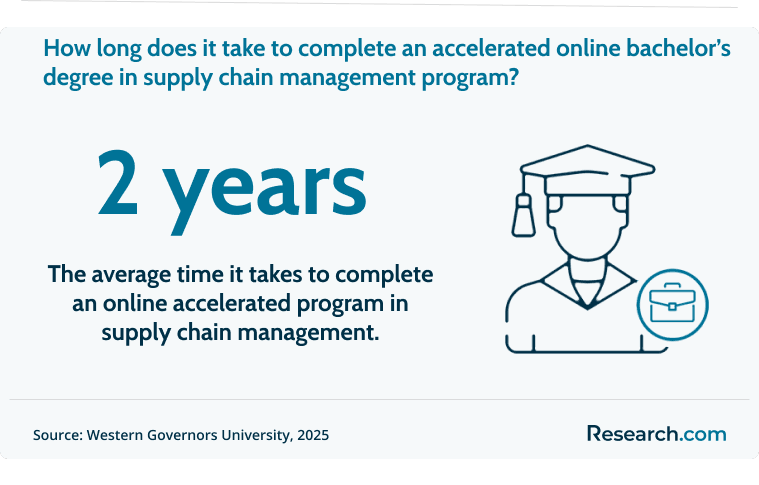
Most bachelor’s degrees in supply chain management require 120 credit hours. The difference is how quickly students can complete those credits. A traditional full-time bachelor’s degree often takes four years, while accelerated online programs may use five- to eight-week courses, year-round enrollment, multiple start dates, transfer credits, and competency-based assessments to reduce the timeline.
Students with an associate degree, prior college coursework, military training, professional certifications, or approved prior learning may finish faster because they do not have to complete all 120 credits at the new institution. For full-time students with substantial transfer credit, completion in about two years may be realistic. Some programs report average timelines closer to 18–24 months when students can move quickly and demonstrate mastery.
Students who want deeper specialization after graduation may later consider the fastest online graduate certificate in logistics and supply chain management as a shorter post-bachelor’s option.
| Student situation | Likely timeline | Important caution |
| No prior college credit | Often closer to the full bachelor’s timeline | Acceleration may still help, but 120 credit hours is a substantial workload. |
| Associate degree or 60 transfer credits | Often around two years, depending on credit acceptance | Not every credit may apply to the major or graduation requirements. |
| Military, professional, or prior learning credit | Potentially shorter if the school awards applicable credit | Ask for an official transfer evaluation before enrolling. |
| Competency-based student | Can be faster for highly self-directed learners | Students must be disciplined and able to master material independently. |
How does an accelerated online bachelor’s degree in supply chain management program compare to an on-campus program?
The best format depends on your schedule, learning style, budget, and need for speed. Online accelerated programs are usually better for working adults and students with transfer credits. Campus programs may be better for students who want in-person networking, structured class schedules, campus recruiting, and face-to-face support.
| Factor | Accelerated online program | Traditional on-campus program |
| Pace | May be completed in 18 to 36 months for students with the right credit background and course load. | Usually follows a four-year academic calendar. |
| Flexibility | Often offers asynchronous coursework, multiple starts, and remote access. | Requires attendance at set class times and campus locations. |
| Work-life fit | Often better for employed students, parents, military learners, and career changers. | Often better for students who can attend full time and want campus life. |
| Learning style | Requires independence, time management, and comfort with digital tools. | Provides more immediate in-person interaction with faculty and classmates. |
| Cost considerations | May reduce housing, commuting, and relocation expenses, but tuition varies widely. | May include campus fees, housing, transportation, and location-based costs. |
| Networking | Networking may happen through virtual events, faculty, projects, internships, and online career services. | Networking may be easier through campus organizations, career fairs, and peer groups. |
If your long-term goal includes executive leadership, consulting, or teaching, an accelerated bachelor’s can be the first step toward graduate study, including options such as the fastest online DBA in management degree programs. If cost is the main constraint, compare broader business options as well, including an affordable online bachelor's in management degree.
What is the average cost of an accelerated online bachelor’s degree in supply chain management program?
Costs vary significantly by school, residency status, tuition model, transfer credits, military status, fees, books, and whether the program charges by credit, term, or year. The examples below show why students should compare total cost, not only tuition per credit.
- Wayne State College: $37,920 total for 120 credit hours. This reflects the online Supply Chain Management program at a per-credit rate of $316.
- American Public University (Veteran Grant or APUS Opportunity Grant): $37,800 total with Veteran Grant or APUS Opportunity Grant.
- American Public University (Military Preferred Rate): $30,000 total for active-duty military and qualified military-affiliated students.
- American Public University (Standard Rate): $42,000 total for full-time students without financial aid or military benefits.
Students should also check whether tuition includes technology fees, course materials, proctoring, graduation fees, and other charges. A lower per-credit price is not always the cheapest route if the school accepts fewer transfer credits or requires more courses after enrollment.
| Cost question | Why it matters | What to ask the school |
| How many credits will transfer? | Transfer credit can be the biggest factor in total cost. | Can I receive an official degree audit before I commit? |
| Is tuition per credit, per term, or per year? | Different pricing models make direct comparison difficult. | What is the estimated total cost to finish my exact remaining credits? |
| Are there separate online fees? | Fees can increase the real cost beyond listed tuition. | Which fees are mandatory for online students? |
| Do I qualify for discounts? | Military rates, employer partnerships, grants, and scholarships may lower cost. | What institutional aid, military pricing, or transfer scholarships are available? |
| Will this degree support my next step? | ROI depends on career fit, not just program price. | What roles do graduates pursue, and what career services support online students? |
Some students use a supply chain bachelor’s as a foundation for leadership-oriented graduate programs, including the shortest online organizational leadership master's programs. Others may compare graduate business options such as a low cost MBA in project management online if they want to strengthen project execution, operations leadership, and cross-functional management skills after graduation.
What are the financial aid options for students enrolling in an accelerated online bachelor’s degree in supply chain management program?
Financial aid for online accelerated students generally depends on institutional accreditation, enrollment status, citizenship or residency eligibility, academic progress, and the school’s participation in aid programs. Start with federal aid, then compare state, institutional, employer, military, and private funding.
- Federal Financial Aid: Eligible students can apply for grants, loans, and work-study by completing the Free Application for Federal Student Aid (FAFSA). Federal aid is typically available only for eligible students attending accredited institutions that participate in federal aid programs.
- State Aid Programs: Some states offer scholarships, grants, or tuition support for residents, including online students enrolled through eligible institutions. Requirements differ by state.
- Institutional Scholarships and Grants: Schools may offer merit scholarships, need-based awards, transfer scholarships, military discounts, veteran grants, or online learner grants. Students who want to add technical analytics skills later can also compare funding for related credentials such as the shortest graduate certificate programs in data analytics online.
- Employer Tuition Assistance: Many companies support education in job-relevant fields such as supply chain management, logistics, procurement, operations, and analytics. Ask whether reimbursement is paid upfront or after you pass each course. If you are planning future graduate study, it may also help to understand broader MBA benefits.
- Military and Veteran Benefits: Military-affiliated students should ask about tuition rates, transfer credit for training, veteran grants, and benefit coordination before enrollment.
- Private Scholarships and Loans: Business associations, logistics organizations, community groups, and private lenders may offer additional funding. Private loans usually require careful comparison because rates and borrower protections differ from federal loans.
What are the prerequisites for enrolling in an accelerated online bachelor’s degree in supply chain management program?
Admissions requirements vary by school, but accelerated online bachelor’s programs usually expect students to show readiness for college-level business coursework. Completion programs may also require a minimum number of transfer credits before admission.
- High School Diploma or Equivalent: Applicants generally need a high school diploma or GED. Some schools may require a minimum GPA, often around 2.5 or higher.
- Transfer Credits: Many accelerated pathways are built for students who already completed college coursework or an associate degree. Transfer evaluation is also important in technical fields such as affordable automotive technology online programs, where prior hands-on training or technical courses may affect academic planning.
- Official Transcripts: Schools typically require transcripts from high school and every college previously attended.
- Standardized Test Scores: Many institutions are test-optional, but some may request SAT or ACT scores, particularly when other academic indicators are limited.
- Work Experience: Professional experience in logistics, purchasing, transportation, operations, warehousing, the military, or business may strengthen an application and may qualify for prior learning credit at some schools.
- Technology Requirements: Online students need dependable internet access, a suitable computer, and the ability to use learning management systems, spreadsheets, video tools, and other digital platforms.
What courses are typically in an accelerated online bachelor’s degree in supply chain management program?
Supply chain management programs usually begin with business fundamentals, then move into specialized logistics and operations coursework. Students need the business foundation because supply chain decisions affect costs, cash flow, customer satisfaction, vendor relationships, and company strategy.
| Course area | Typical topics | Career relevance |
| Business core | Financial accounting, microeconomics, business statistics, organizational behavior | Helps students understand the financial and organizational context of supply chain decisions. |
| Logistics management | Distribution, warehousing, freight movement, delivery performance | Prepares students for logistics analyst, coordinator, and transportation-related work. |
| Procurement and sourcing | Supplier evaluation, purchasing, contract basics, negotiation, vendor relationships | Supports roles in purchasing, sourcing, supplier management, and procurement operations. |
| Operations management | Process design, production planning, quality, efficiency, continuous improvement | Builds skills for operations, manufacturing, service delivery, and process improvement roles. |
| Transportation systems | Carrier selection, route planning, freight costs, compliance, network design | Useful for transportation, distribution, and logistics management paths. |
| Supply chain analytics | Forecasting, dashboards, data interpretation, performance metrics | Helps graduates use data to reduce waste, improve service, and make better decisions. |
| ERP systems | Enterprise Resource Planning (ERP) systems, integrated business data, planning tools | Gives students exposure to systems used to coordinate inventory, purchasing, production, and finance. |
| Capstone or internship | Applied projects, case studies, consulting-style work, business simulations | Allows students to demonstrate practical problem-solving before graduation. |
Students who want to move quickly into graduate-level specialization after the bachelor’s degree may compare the fastest online master's degree in supply chain management after confirming admissions requirements, cost, and career fit.
What types of specializations are available in an accelerated online bachelor’s degree in supply chain management program?
Not every bachelor’s program offers formal concentrations, but many allow students to choose electives or certificates that shape their career direction. A specialization is most valuable when it matches the job titles you want after graduation.
- Logistics and Transportation Management: Focuses on freight, shipping, warehousing, carrier management, routing, distribution, and delivery performance.
- Procurement and Sourcing: Covers supplier selection, purchasing strategy, negotiation, contract management, supplier risk, and ethical sourcing.
- Operations and Production Management: Emphasizes process improvement, production planning, quality control, lean systems, workflow, and service operations.
- Supply Chain Analytics: Builds skills in data analysis, forecasting, dashboards, metrics, demand planning, and evidence-based decision-making.
- Global Supply Chain Management: Explores international sourcing, cross-border logistics, compliance, risk, supplier networks, and global distribution.
Students comparing business programs in different industries should look closely at how the curriculum connects to operations. For example, a fast-track online esports business degree may focus more on the business of gaming and events, while accelerated online fashion merchandising programs may connect supply chain concepts to retail, inventory, and product movement in fashion markets.
Those drawn specifically to logistics leadership may want to review the logistics manager salary and career path to understand how specialization, experience, and management responsibility can influence long-term options.
How can I assess a program’s accreditation and academic quality?
Accreditation is one of the first items to verify because it affects financial aid eligibility, credit transfer, graduate school admission, and employer confidence. Start by checking whether the institution is accredited by a recognized accreditor, then review whether the business program has programmatic accreditation such as AACSB, ACBSP, or IACBE.
Program quality also depends on curriculum currency, faculty experience, student support, applied learning, career services, and employer connections. A school with a familiar name is not automatically the best fit, and a cheaper program is not automatically the best value.
| Quality factor | What to verify | Red flag |
| Institutional accreditation | The school is accredited by a recognized accrediting body. | The institution avoids clear accreditation details or uses vague language. |
| Business accreditation | The program or business school lists AACSB, ACBSP, or IACBE when applicable. | The program claims prestige without naming the accreditor. |
| Curriculum relevance | Courses include analytics, logistics, procurement, operations, ERP, and supply chain strategy. | The degree is mostly general business with only one or two supply chain courses. |
| Online student support | Advising, tutoring, library access, career services, and technology support are available remotely. | Services are designed mainly for campus students. |
| Career alignment | The school can explain common roles, internships, projects, and employer relationships. | Graduation outcomes are unclear or not discussed. |
If you are comparing graduate business options later, it may also help to review broader affordability resources such as cheapest MBA online programs.
What advanced degree options can further boost my supply chain management career?
A bachelor’s degree can qualify graduates for many entry-level and mid-level roles, but some leadership, consulting, analytics, and executive positions may favor advanced education. Common next steps include a master’s in supply chain management, an MBA with a concentration in operations or logistics, a master’s in business analytics, or leadership-focused graduate programs.
An advanced degree makes the most sense when it supports a specific goal: moving into senior management, leading global operations, managing larger supplier networks, entering consulting, or shifting into analytics-heavy roles. Working professionals may also compare flexible executive options, including the best value for money executive MBA online programs.
Before enrolling in graduate school, ask whether your employer values the credential, whether tuition assistance is available, and whether the curriculum includes practical projects, case studies, industry tools, and measurable leadership development.
How do I choose the best accelerated online bachelor’s degree in supply chain management program?
The best program is not simply the fastest or cheapest. It is the program that accepts the right credits, fits your weekly schedule, teaches the skills your target jobs require, carries credible accreditation, and has a total cost you can justify.
- Confirm accreditation first: Choose a properly accredited institution. If comparing business accreditors, review the differences between ACBSP vs AACSB and IACBE so you understand what each designation means.
- Request an official transfer evaluation: Do not rely on informal estimates. Ask how many credits apply to general education, business core, major requirements, and electives.
- Match the curriculum to your goal: Logistics, procurement, analytics, global supply chain, transportation, and operations programs can lead to different job paths.
- Check the online format: Determine whether courses are asynchronous, synchronous, competency-based, cohort-based, or self-paced.
- Calculate total cost to completion: Include tuition, fees, books, software, exams, transfer credits, financial aid, employer support, and time away from work.
- Evaluate faculty and industry relevance: Programs taught by instructors with supply chain, operations, logistics, or procurement experience may provide more applied examples.
- Look at career services for online students: Ask whether remote students receive resume support, interview preparation, internship assistance, and employer networking.
- Think beyond the bachelor’s: If you may move into healthcare operations, for example, a fast-track MBA in healthcare management online could be a later option that combines supply chain knowledge with sector-specific leadership.
| If this describes you | Prioritize this program feature | Avoid this mistake |
| You have many transfer credits | A generous, transparent transfer-credit policy | Choosing based on advertised speed before receiving a degree audit |
| You work full time | Asynchronous courses, predictable deadlines, and strong advising | Underestimating the weekly workload of accelerated classes |
| You want logistics roles | Transportation, warehousing, distribution, and analytics coursework | Selecting a general business degree with limited logistics content |
| You want procurement roles | Sourcing, negotiation, supplier management, and contract-related courses | Ignoring whether purchasing and supplier topics are included |
| You want management advancement | Leadership, operations, analytics, project work, and applied capstone experiences | Assuming the degree alone guarantees promotion or salary growth |
What career paths are available for graduates of an accelerated online bachelor’s degree in supply chain management?
Graduates can pursue roles that connect planning, purchasing, operations, inventory, transportation, suppliers, and customers. The best entry point depends on your prior experience. Someone with warehouse or transportation experience may move naturally into logistics coordination or transportation analysis. A student with business or finance experience may fit procurement, sourcing, or operations analysis.
The skills developed in supply chain programs are also relevant in industries that combine business strategy with operations. For example, students comparing sport-related business leadership may review a fast-track online MBA in sports management, while students interested in broader leadership responsibilities can explore how to become a manager.
| Career path | Salary cited | Typical responsibilities |
| Logistics Analyst | $98,866 | Reviews transportation costs, inventory levels, delivery performance, and process data to recommend operational improvements. |
| Supply Chain Manager | $100,315 | Coordinates sourcing, logistics, supplier performance, demand planning, risk management, and end-to-end product movement. |
| Procurement Specialist | $86,619 | Sources goods and services, evaluates suppliers, negotiates with vendors, manages contracts, and supports purchasing needs. |
| Operations Manager | $108,972 | Leads daily operations, improves workflows, manages teams, monitors production or service performance, and supports business goals. |
| Transportation Manager | $106,916 | Plans and manages the movement of goods, carrier relationships, routes, freight costs, and regulatory compliance. |
| Inventory Control Analyst | $76,482 | Tracks stock levels, forecasts demand, reduces excess inventory, prevents stockouts, and uses inventory systems to support decisions. |
These salary figures are useful for comparison, but actual compensation depends on role level, geography, industry, credentials, employer size, and experience. Graduates often start in analyst, coordinator, associate, or specialist roles before moving into management.
What is the job market for graduates with an accelerated online bachelor’s degree in supply chain management?
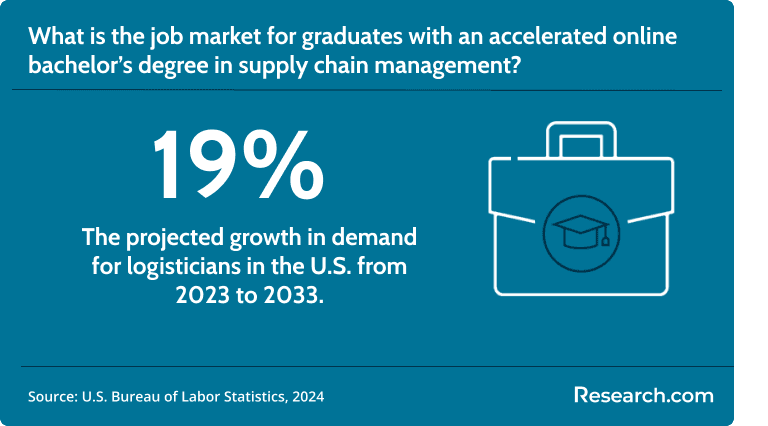
The job market for supply chain graduates is supported by the continuing need for reliable logistics, inventory planning, sourcing, transportation, and operations management. According to the U.S. Bureau of Labor Statistics, employment of logisticians is projected to grow by 19% from 2023 to 2033, much faster than the average for all occupations.
The BLS also projects about 26,100 job openings for logisticians each year throughout the decade. These openings are expected to come from both job growth and the need to replace workers who leave the occupation.
Graduates with analytics, systems, and process-improvement skills may be especially competitive because modern supply chains rely on forecasting tools, ERP platforms, supplier data, inventory systems, transportation metrics, and performance dashboards. Students who want a more narrowly focused logistics entry point may also compare training such as the cheapest online freight broker training program.
Supply chain knowledge can also apply in specialized manufacturing, repair, distribution, and inventory environments. For example, students comparing technical trade paths may review the cheapest gunsmithing school programs online, but a bachelor’s in supply chain management is broader and more business-oriented.
Here’s what graduates have to say about their accelerated online degree in supply chain management:
"The online format made it possible for me to keep working while finishing school. I studied after shifts, completed the degree in under three years, and used the credential to move into a logistics role with better long-term options." – Marisa
"The accelerated pace pushed me to stay organized, and the coursework connected directly to my job. I could use what I learned in planning meetings almost immediately, which made the degree feel practical instead of abstract." – Dev
"Going back to school felt intimidating at first, but the online system was easier to manage than I expected. The projects and instructor feedback helped me build confidence, and I eventually moved into an operations leadership role for a distributor." – Jerome
Can an accelerated online degree in supply chain management foster entrepreneurial success?
Yes, a supply chain management degree can support entrepreneurship when the business depends on sourcing, inventory, fulfillment, vendor relationships, production, or distribution. Entrepreneurs need to understand how to buy materials, control costs, forecast demand, manage suppliers, avoid stockouts, deliver products, and scale operations without creating waste.
The degree is not a substitute for market research, funding, sales, legal planning, or product development. However, it can give founders a stronger operational foundation. Students who are comparing business ownership paths can also explore jobs for entrepreneurship degree programs and outcomes.
How does an accelerated online degree in supply chain management compare to other accelerated online programs?
An accelerated supply chain management degree is best for students who want to work with logistics, procurement, operations, inventory, data, transportation, and supplier networks. It is more operations-focused than many general business degrees and more movement-of-goods focused than finance, marketing, or human resources programs.
Students who prefer investment analysis, corporate finance, risk modeling, or financial decision-making may be better served by accelerated finance programs. Students who want broad management preparation may consider management degrees, while students targeting a specific industry should compare whether that industry-focused program includes enough operations or analytics coursework.
| Program type | Best for students interested in | Less ideal if you want |
| Supply chain management | Logistics, sourcing, inventory, transportation, operations, analytics, and distribution | Pure finance, accounting, marketing, or HR-focused work |
| Finance | Investments, financial analysis, risk, budgeting, and capital decisions | Hands-on logistics and operational network management |
| General management | Broad leadership, supervision, planning, and organizational coordination | Deep supply chain, procurement, or transportation specialization |
| Industry-specific business programs | Applying business skills in fields such as sports, fashion, esports, or healthcare | A broad supply chain credential that transfers across many industries |
Common mistakes to avoid when choosing an accelerated online supply chain management degree
- Choosing speed over fit: A fast program is not valuable if it does not teach the skills required for your target jobs.
- Skipping the accreditation check: Accreditation affects financial aid, credit transfer, graduate admission, and employer recognition.
- Comparing only tuition per credit: Total cost depends on transfer credits, fees, books, pacing, and how many credits you must complete at the school.
- Assuming all credits will transfer: Ask for an official evaluation before enrolling, especially if you have credits from multiple schools.
- Underestimating accelerated workload: Shorter terms can mean more reading, assignments, and exams each week.
- Ignoring online support: Advising, tutoring, library access, career services, and technical support matter more when you study remotely.
- Assuming salary outcomes are guaranteed: A degree can open doors, but pay depends on role, location, experience, performance, and employer needs.
- Overlooking practical learning: Capstones, projects, internships, simulations, and software exposure can help you show employers what you can do.
Questions to ask before enrolling
- Is the institution properly accredited, and does the business program hold AACSB, ACBSP, or IACBE accreditation?
- How many of my credits will transfer into the major, not just into electives?
- What is the estimated total cost to finish based on my remaining credits?
- Are courses asynchronous, synchronous, cohort-based, or competency-based?
- How many hours per week should I expect to spend on each accelerated course?
- Does the curriculum include logistics, procurement, operations, analytics, ERP systems, and supply chain strategy?
- Are there concentrations, certificates, or electives aligned with my career goal?
- What career services are available to online students?
- Do online students have access to internships, projects, employer events, or alumni networks?
- What happens if I need to slow down or stop out for a term?
Key Insights
- An accelerated online bachelor’s degree in supply chain management is best for students who want a faster, flexible route into logistics, procurement, operations, transportation, inventory, or supply chain analytics.
- Most programs still require 120 credit hours, so the fastest timelines usually depend on transfer credits, competency-based progress, military credit, or prior learning.
- The strongest programs combine business fundamentals with applied supply chain coursework in sourcing, logistics, operations, analytics, ERP systems, and strategy.
- Cost varies widely. Compare total completion cost, not just per-credit tuition, and confirm how many credits will transfer before enrolling.
- Accreditation matters. Verify institutional accreditation and understand programmatic business accreditation such as AACSB, ACBSP, or IACBE.
- The job outlook is favorable: BLS projects 19% growth for logisticians from 2023 to 2033 and about 26,100 job openings each year throughout the decade.
- Salary potential can be strong, but compensation is not automatic. Experience, industry, location, technical skills, and leadership responsibility all influence earnings.
- The right program should match your career target. Logistics, procurement, analytics, operations, and global supply chain paths require overlapping but different skills.
References:
- American Military University. (2024). Online Bachelor of Arts in Supply Chain Management (BA). AMU
- Glassdoor. (2025). Salary: Logistics Analyst in the United States 2025. Glassdoor
- U.S. Bureau of Labor Statistics. (2024). Occupational Outlook Handbook: Logisticians. U.S. BLS
- Wayne State University. (2024). Online Bachelor's Degree in Supply Chain Management. WSU
- Western Governors University. (2025). Online Supply Chain and Operations Management Degree. WGU
- ZipRecruiter. (2025). Salary: Supply Chain Manager (June 2025), United States. ZipRecruiter
Other Things You Should Know About Accelerated Online Bachelor's Degrees in Supply Chain Management
Most accelerated online programs accept up to 90 transfer credits toward the 120-credit degree, but schools usually require at least 30 credits earned in residence. Credits must come from regionally accredited institutions, and upper-division business or logistics courses may need approval before transfer.
The typical credit requirement for completing an accelerated online bachelor's degree in supply chain management in 2027 is around 120 credit hours. These programs often allow transfer credits and leverage competency-based learning models to help students complete their degrees faster.


