2027 Fastest Online Esports Business Degree Programs

Co-Founder and Chief Data Scientist
Choosing an online esports business degree is not just about finding a gaming-related major. It is a decision about how quickly you want to finish, how much you can afford to spend, whether the school is properly accredited, and whether the curriculum prepares you for real business roles in a competitive industry. Esports organizations need people who understand sponsorships, event operations, media production, audience growth, team logistics, and revenue models—not only people who enjoy games.
This guide is for students, working adults, gamers, marketing professionals, event coordinators, and business majors who want a faster path into esports management or gaming business roles. You will learn which accelerated online programs stand out, what they cost, how long they take, what courses to expect, how to compare schools, and when an esports business degree is worth the investment.
Quick Answer: What Is the Fastest Online Esports Business Degree?
The fastest online esports business degrees are usually bachelor’s completion programs or accelerated graduate programs that accept transfer credits, offer 8-week courses, or allow year-round enrollment. Among the programs listed in this guide, Walsh University offers a fully online accelerated Bachelor of Business Administration in eSports & Gaming Management that can be completed in 12 to 24 months, depending on transfer credits. Florida Southern College offers an accelerated MBA with an esports management concentration that can be completed in 12 to 24 months.
The best option depends on your current education level. Students with many transfer credits may finish a bachelor’s degree faster, while applicants who already hold a bachelor’s degree may move more quickly through an MBA or graduate-level esports management program.
What Is an Online Esports Business Degree?
An online esports business degree combines traditional business training with coursework focused on competitive gaming, digital entertainment, live and virtual events, sponsorships, streaming media, and fan communities. Unlike game design programs, which focus more on creating games, esports business programs prepare students to manage the commercial side of gaming and competitive events.
Most programs include business fundamentals such as marketing, management, finance, entrepreneurship, analytics, and operations. Esports-focused courses may cover tournament planning, team administration, sponsorship activation, content strategy, gaming media, community management, and esports law or ethics.
Who should consider this degree?
- Students who want a business degree with a gaming and esports focus.
- Working adults who need an online or accelerated format.
- Gamers who want to move into operations, marketing, events, or team management rather than professional play.
- Marketing, media, or sports management professionals who want to specialize in esports.
- Entrepreneurs interested in launching an esports event company, agency, community platform, or gaming-related brand.
Who may be better served by another path?
- Students who want to build games should compare online game development degree programs instead.
- Students who want a broader executive credential may prefer an online MBA degree.
- Students focused on traditional sports administration may also compare a fast-track online sports management bachelor's degree.
- Students who want technical roles in cloud, infrastructure, or streaming systems may benefit from the shortest cloud engineering online bootcamps or similar technical credentials.
Benefits of Earning an Online Esports Business Degree
An online esports business degree can be useful when it gives you recognized business training, direct exposure to esports operations, and enough flexibility to finish without pausing work or other responsibilities. The biggest advantages are practical rather than promotional.
- Flexible scheduling: Online courses can make it easier to study while working, competing, coaching, managing a community, or handling family responsibilities.
- Career-focused esports content: Strong programs connect business concepts to esports-specific problems, including sponsorship sales, tournament budgets, brand partnerships, livestream audiences, and team logistics.
- Faster completion options: Accelerated terms, transfer-credit policies, and year-round courses can reduce time to graduation for students who plan carefully.
- Broader business value: A business-based esports degree may also support careers in marketing, events, sports, media, entertainment, and digital communities.
- Access beyond one location: Online programs can connect students with classmates, instructors, and guest speakers outside their local market, although networking quality varies by school.
What Can I Expect From an Online Esports Business Degree Program?
Students should expect a mix of business coursework, esports-specific projects, and online collaboration. The strongest programs do more than discuss gaming culture; they require students to apply business concepts to realistic esports scenarios.
| Program Element | What It Usually Includes | Why It Matters |
| Business core | Marketing, management, finance, entrepreneurship, operations, and business communication | Employers need graduates who understand revenue, budgets, teams, customers, and strategy. |
| Esports specialization | Event planning, team operations, sponsorships, digital branding, gaming media, and community engagement | This connects general business knowledge to the esports industry. |
| Online format | Asynchronous courses, live virtual sessions, 8-week terms, self-paced options, or hybrid requirements depending on the school | Format affects how quickly you can graduate and how much structure you will receive. |
| Applied projects | Case studies, mock tournaments, sponsorship proposals, media plans, or esports business plans | Portfolio-ready work can help students show practical ability to employers. |
| Internship or capstone | Hands-on experience, a consulting-style project, or a final business analysis | Experience is especially important in a competitive field where degree alone may not be enough. |
Where Can I Work With an Online Esports Business Degree?
An esports business degree can lead to roles in esports organizations, gaming companies, event firms, marketing agencies, media platforms, educational institutions, and startups. Because the degree is business-oriented, graduates may also apply their skills in adjacent fields such as digital marketing, sports management, entertainment operations, and fan engagement.
- Esports teams and leagues: Operations, sponsorship support, player relations, scheduling, logistics, and brand partnerships.
- Game publishers and gaming companies: Marketing, community programs, event coordination, business development, and product promotion.
- Tournament and event organizers: Live event planning, virtual competition management, production coordination, vendor management, and fan experience.
- Marketing and sponsorship agencies: Campaign planning, influencer partnerships, brand activations, audience research, and sponsor reporting.
- Broadcasting and streaming platforms: Content operations, partnership support, media production, livestream programming, and audience growth.
- Colleges and universities: Collegiate esports program administration, team support, student engagement, and campus event coordination.
- Entrepreneurial ventures: Esports consulting, event startups, merchandise businesses, coaching platforms, or gaming communities.
How Much Can I Make With an Online Esports Business Degree?
Salary outcomes depend heavily on job title, location, employer size, experience, portfolio, and industry connections. An esports business degree can help you qualify for business-side roles, but it does not guarantee a specific salary.
Entry-level positions in esports management, marketing, or event coordination typically offer salaries ranging from $40,000 to $60,000 per year. With experience, professionals in senior roles such as esports team managers, marketing directors, or business development managers can earn $70,000 to over $100,000 annually.
Specialized roles in sponsorship management, event production, and business development may pay more at larger teams, publishers, global tournaments, or established gaming companies. Some professionals may also receive bonuses or revenue shares tied to team, campaign, or event performance.
| Career Stage | Typical Roles | Salary Range Stated |
| Entry-level | Esports coordinator, marketing assistant, event support, community associate | $40,000 to $60,000 per year |
| Experienced or senior | Team manager, marketing director, business development manager | $70,000 to over $100,000 annually |
| Specialized or high-profile roles | Sponsorship management, major event production, publisher partnerships | Can be even higher depending on employer, market, and responsibilities |
- Fastest Online Esports Business Degree Programs for 2027
- How long does it take to earn an online esports business degree?
- How much does an online esports business degree cost?
- What financial aid options are available?
- What are the admission requirements?
- What courses are included?
- How should I choose the best fast online esports business degree?
- How can I verify program quality?
- What challenges should I expect?
- Is an online esports business degree worth it?
- Online vs. traditional esports business degrees
- Career paths for graduates
- Job outlook for esports business graduates
Fastest Online Esports Business Degree Programs for 2027
These programs were selected using research and data analysis from multiple sources, including the IPEDS database, Peterson's database and Distance Learning Licensed Data Set, the College Scorecard database, and the National Center for Education Statistics.
Because an online esports business degree can require a major financial commitment, the ranking emphasizes transparent program information, academic credibility, online availability, speed, and student decision value. The list includes undergraduate and graduate options. For more detail on how Research.com evaluates programs, review the methodology section.
| School | Degree | Format and Speed | Cost Information | Accreditation |
| Walsh University | Bachelor of Business Administration in eSports & Gaming Management | Fully online; 12-24 months depending on transfer credits | $18,000 | Higher Learning Commission |
| Culver-Stockton College | Bachelor of Science in eSports & Gaming Administration | 100% online; 2-4 years; frequent 8-week courses | $395 per credit | Higher Learning Commission |
| Immaculata University | B.S. in Business & Esport Management | Hybrid; accelerated Degree-in-Three option | $28,970 per year | The Middle States Commission on Higher Education |
| American Public University | Bachelor of Science in Esports with Business Admin concentration | Fully online; 2 to 4 years; transfer up to 90 credits | $350 per credit | Higher Learning Commission; Commission on Sport Management Accreditation |
| Florida Southern College | Master of Business Administration: Esports Management | Accelerated MBA; 12-24 months | $1,035 per credit hour | Association to Advance Collegiate Schools of Business (AACSB) |
1. Walsh University - Bachelor of Business Administration in eSports & Gaming Management
Walsh University offers a fully online accelerated Bachelor of Business Administration in esports that combines business fundamentals with management and marketing preparation for gaming-related organizations. The program emphasizes event operations, core business concepts, and credit for prior learning, which can help qualified students shorten the path to graduation.
Some online courses are delivered in collaboration with other colleges across the country. Depending on transfer credits, students may complete the program in 12 to 24 months.
- Location: North Canton, OH
- Program Length: 12-24 months
- Credits Required: 75
- Program Cost: $18,000
- Accreditation: Higher Learning Commission
2. Culver-Stockton College - Bachelor of Science in eSports & Gaming Administration
Culver-Stockton College offers a 100% online Bachelor of Science with a major in esports and gaming administration. The college reviews prior college credits, professional training, military service, and other learning experiences to help create a degree plan aligned with the student’s background and goals.
The program uses frequent 8-week courses, which can support accelerated progress for students who can manage a faster academic pace.
- Location: Canton, MO
- Program Length: 2-4 years
- Credits Required: 60
- Tuition Per Credit: $395
- Accreditation: Higher Learning Commission
3. Immaculata University – B.S. in Business & Esport Management
Immaculata University offers a B.S. in Business & Esport Management with an accelerated three-year option. This program is hybrid rather than fully online, so it is best for students who can meet any in-person expectations. It is part of the university’s Degree-in-Three majors, which allow students to study year-round, including summer and winter terms.
The curriculum is built around industry-focused learning and includes a required internship in esports management, business, or gaming administration.
- Location: Immaculata, PA
- Program Length: 3 years (for accelerated option)
- Cost Per Year: $28,970
- Accreditation: The Middle States Commission on Higher Education
4. American Public University – Bachelor of Science in Esports with Business Admin concentration
American Public University offers a fully online Bachelor of Science in Esports with a Business Administration concentration. Courses vary from 8 to 16 weeks. Students may transfer up to 90 credits, which can significantly reduce time to completion for those with prior college coursework.
The program covers the business of esports, including marketing, revenue generation, sponsorships, event and facility management, player performance and development, and esports media and production.
- Location: Charles Town, WV
- Program Length: 2 to 4 years
- Credits Required: 120
- Cost Per Credit: $350
- Accreditation: Higher Learning Commission; Commission on Sport Management Accreditation
5. Florida Southern College - Master of Business Administration: Esports Management
Florida Southern College offers an accelerated MBA with an esports management concentration. The MBA includes living case studies, executive mentors, and international field experiences. Students work on projects connected to real companies and nonprofit organizations, making this option more appropriate for graduate students seeking advanced business preparation.
- Location: Lakeland, FL
- Program Length: 12-24 months
- Credits Required: 33
- Tuition Per Credit Hour: $1,035
- Accreditation: Association to Advance Collegiate Schools of Business (AACSB)
How Long Does It Take to Earn an Online Esports Business Degree?
Completion time depends on degree level, transfer credits, term length, course load, and whether the program is designed for full-time or part-time learners. Bachelor’s programs commonly take about 3 to 4 years for full-time students, but accelerated or degree-completion formats may allow motivated students to finish in as little as 18 to 24 months.
Associate degrees usually take 18 months to 2 years. Certificates and short specialized programs may take only a few months. Graduate options, including online MBA programs or master’s degrees in esports business or management, commonly take 1 to 2 years, with accelerated options available at some schools.
| Credential Type | Typical Completion Time Stated | Best For |
| Certificate or short course | A few months | Students testing the field or adding a narrow skill quickly |
| Associate degree | 18 months to 2 years | Students seeking an entry-level credential or transfer pathway |
| Bachelor’s degree | About 3 to 4 years; accelerated options may be as little as 18 to 24 months | Students seeking broad business preparation and bachelor’s-level roles |
| Master’s degree or MBA | 1 to 2 years | Professionals or bachelor’s graduates seeking leadership or specialized management roles |
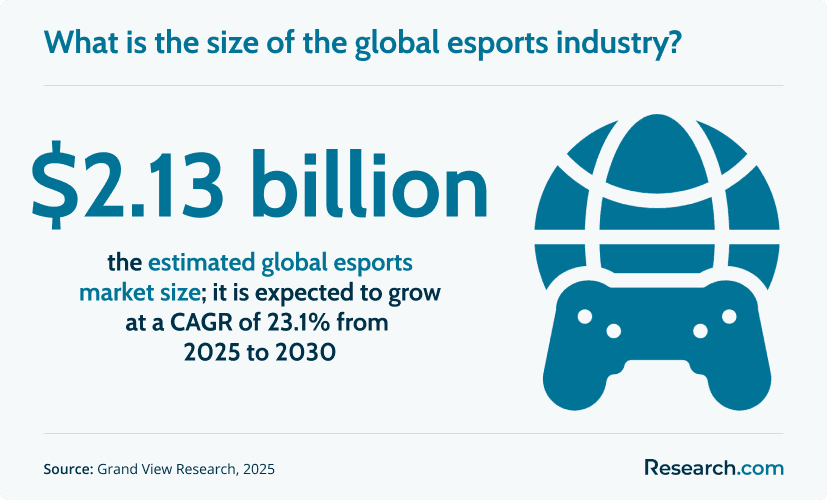
The image below illustrates how large the global esports industry has become in recent years, which is one reason some students are exploring business credentials connected to gaming and competitive entertainment.
How Much Does an Online Esports Business Degree Cost?
The cost of an online esports business degree varies widely by school type, degree level, credit requirements, transfer-credit policy, and fees. Students should compare total program cost rather than focusing only on the advertised per-credit rate.
- Per-credit tuition generally ranges from $300 to $800, depending on the institution and program structure. Most degree programs require between 30 and 120 credits, resulting in total tuition costs from $10,000 to over $90,000.
- For top-rated programs, the average cost is around $600 to $720 per credit, leading to total expenses of $21,000 to $72,000, depending on whether the program is shorter, such as a master's, or longer, such as a bachelor's.
- Public online institutions tend to charge about $9,000 to $12,000 annually, while private nonprofit schools often range from $20,000 to $25,000 per year—putting overall costs between $20,000 and $100,000, depending on the degree level and course load.
- More affordable options are available. Some state universities in the U.S. offer esports or gaming-focused degrees under broader business or sports management programs at $300–$500 per credit, bringing total costs to $10,000 to $60,000, depending on degree length.
- Mid-range programs, such as those from Shenandoah University, typically fall between $500 and $650 per credit, resulting in total tuition of $19,000 to $78,000, depending on the number of credits required. Students comparing accelerated business-related degrees may also review options such as the shortest online degree in public administration to understand how program length and tuition structure affect total cost.
| Cost Factor | Why It Changes the Final Price | Question to Ask the School |
| Per-credit tuition | A lower rate can still be expensive if the program requires many credits. | What is the full tuition cost for the degree, not just the per-credit rate? |
| Transfer credits | Accepted credits may reduce both time and tuition. | How many credits can I transfer, and which requirements will they satisfy? |
| Fees | Technology, online learning, graduation, and course fees can add to the bill. | What mandatory fees should I budget for each term? |
| Program pace | Accelerated terms may reduce time away from higher-paying work but can increase workload. | Can I realistically complete the accelerated schedule while working? |
| Financial aid | Grants, scholarships, employer aid, and benefits can lower out-of-pocket cost. | What aid do online students in this program typically use? |
If cost is the deciding factor, the most budget-conscious students should look for total tuition between $10,000 and $60,000. More specialized, private, or graduate-level options may cost $70,000 or more. Always compare tuition, fees, credits required, transfer policies, and financial aid before enrolling.
The chart below shows leading esports games by peak viewership, which can help students understand the audience scale behind esports-related business opportunities.
What Financial Aid Options Are Available for Online Esports Business Students?
Online students in accredited degree programs may qualify for many of the same financial aid options as campus-based students. Aid availability depends on the institution, enrollment status, citizenship or eligibility category, academic progress, and program type.
- Federal financial aid: U.S. citizens and eligible non-citizens can submit the Free Application for Federal Student Aid to determine eligibility. Graduate students may qualify for Direct Unsubsidized Loans or Graduate PLUS Loans for tuition and eligible education expenses.
- Scholarships and grants: Schools may offer merit-based or need-based awards. Some aid may support students in business, digital media, game development, sports management, or esports-related areas. Organizations such as the Esports Trade Association or Women in Games International may occasionally offer scholarships or mentorship opportunities.
- Employer tuition assistance: Students working in technology, marketing, entertainment, sports, education, or media should ask whether their employer offers tuition reimbursement or professional development support.
- Military and veteran benefits: Active-duty service members, veterans, and eligible family members may be able to use GI Bill benefits, the Yellow Ribbon Program, or military tuition discounts at participating schools.
- Payment plans and institutional aid: Many online universities allow monthly payments or offer school-based scholarships that reduce upfront costs.
Students who want to pair esports business with data-driven decision-making may also compare related graduate options, such as an accelerated masters in sports analytics online, especially if they are interested in fan engagement, performance metrics, or audience analytics.
What Are the Prerequisites for an Online Esports Business Degree?
Admission requirements vary by school and degree level. A bachelor’s program usually requires a high school diploma or equivalent, while a graduate program requires a bachelor’s degree, often from a regionally accredited institution. Applicants considering an online business management degree with an esports focus should review both general admissions requirements and program-specific expectations.
| Requirement | Bachelor’s Programs | Master’s or MBA Programs |
| Education | High school diploma or equivalent | Regionally accredited bachelor’s degree |
| GPA | Often a minimum GPA, typically ranging from 2.5 to 3.0 | Often a minimum GPA, typically ranging from 2.5 to 3.0 |
| Experience | Usually optional, though gaming, media, business, or event experience may help | May be preferred, especially for MBA or professional programs |
| Application materials | Transcripts, application form, and sometimes a personal statement | Transcripts, resume, personal statement, and sometimes recommendation letters |
| International applicants | TOEFL or IELTS scores may be required for non-native English speakers | TOEFL or IELTS scores may be required for non-native English speakers |
Some programs may also ask for one to three letters of recommendation, an interview, a resume, a portfolio, or an online assessment. Applicants exploring digital brand strategy may find overlap with the fastest MBA in marketing online programs, particularly when coursework includes audience development, sponsorships, and media campaigns.
The chart below shows esports revenue growth from 2022 to 2025, offering context for why more schools and students are paying attention to esports business education.
What Courses Are Included in an Online Esports Business Degree?
Coursework usually blends business foundations with esports-specific applications. A strong curriculum should help students understand how esports organizations make money, build audiences, manage events, negotiate sponsorships, and operate teams or digital communities.
- Esports management and strategy: Covers leadership, operations, league structures, team administration, and strategic planning in competitive gaming.
- Digital marketing and brand development: Focuses on social media, streaming audiences, influencer partnerships, digital campaigns, fan communities, and brand identity.
- Event planning and production: Teaches students how to plan live and virtual tournaments, manage logistics, work with sponsors, coordinate broadcasts, and improve fan experience.
- Esports law and ethics: Reviews player contracts, intellectual property, labor issues, streaming rules, competitive integrity, and governance concerns.
- Business analytics in esports: Introduces data related to viewership, engagement, performance, revenue, and audience behavior.
- Finance and revenue models: Explores sponsorships, budgeting, monetization, prize pools, investments, and operational funding.
- Capstone project or thesis: Gives students an opportunity to apply what they have learned to a business challenge, research project, or esports case study.
Some programs include electives in media production, gaming entrepreneurship, international esports markets, leadership, or game design fundamentals. Like fast-track master’s in taxation management online programs, accelerated esports business programs tend to appeal to students who want targeted professional training in a compressed format.
How Should I Choose the Best Fast Online Esports Business Degree?
The best fast online esports business degree is not automatically the shortest one. A program should be fast enough to meet your timeline, but still accredited, affordable, relevant, and realistic for your schedule. Use the following decision checklist before applying.
| Selection Factor | What to Look For | Why It Matters |
| Accreditation | Institutional accreditation and, when relevant, business or sport management accreditation | Accreditation affects transfer credit, financial aid eligibility, employer recognition, and graduate study options. |
| Transfer-credit policy | Clear rules on how prior college, military training, professional learning, or exams count | Transfer credits are often the biggest reason a bachelor’s degree can be completed quickly. |
| Accelerated structure | 8-week terms, year-round courses, multiple start dates, or flexible pacing | Shorter terms can speed completion but require strong time management. |
| Esports curriculum depth | Courses in sponsorships, event production, team operations, media, analytics, and gaming business | A generic business degree with one esports elective may not provide enough industry preparation. |
| Career support | Internships, capstones, employer projects, networking, alumni connections, and portfolio guidance | Esports is competitive, so practical experience and contacts matter. |
| Cost and aid | Total tuition, fees, financial aid, employer support, and scholarship options | A faster program is not always the best value if debt is too high. |
Students who mainly want the fastest possible business credential can also compare broader options such as the fastest online MBA programs. Those weighing esports against other business concentrations can review common MBA specializations to decide whether a niche esports focus or a broader business pathway better fits their long-term goals.
How Can I Verify the Quality of an Online Esports Business Degree Program?
Before enrolling, verify the school and program rather than relying only on marketing language. A legitimate online program should make accreditation, tuition, curriculum, faculty, transfer policies, and student support easy to confirm.
- Check institutional accreditation: Confirm that the college or university is accredited by a recognized accrediting body.
- Review program-specific accreditation: Business schools may have additional accreditation, and sport management programs may list specialized recognition where applicable.
- Ask about transferability: If you may switch schools or pursue graduate study later, ask whether credits are likely to transfer.
- Examine the curriculum: Look for more than broad “gaming” language. Courses should address concrete business functions such as sponsorships, budgeting, operations, marketing, analytics, and events.
- Evaluate career services: Ask whether online esports students receive internship support, networking access, resume help, and employer introductions.
- Look for applied learning: Capstones, real-world projects, case studies, and internships can be more valuable than lecture-only coursework.
What Challenges Should I Expect in an Online Esports Business Degree?
Online esports business degrees can be flexible, but they are not effortless. Students should plan for academic workload, limited in-person networking, and a job market where enthusiasm for gaming is common but professional experience is harder to prove.
| Common Challenge | Why It Happens | Better Strategy |
| Choosing the fastest program without checking quality | Speed can distract from accreditation, curriculum, and outcomes. | Verify accreditation, transfer policies, faculty background, and career support first. |
| Underestimating online workload | Accelerated 8-week terms can move quickly. | Block weekly study time before the term starts and avoid overloading courses while working. |
| Assuming a degree guarantees esports employment | The field is competitive and relationship-driven. | Build a portfolio through events, internships, volunteer work, content projects, or community management. |
| Ignoring networking | Online students may have fewer casual campus interactions. | Attend virtual events, join esports communities, connect with faculty, and participate in industry projects. |
| Focusing only on tuition | Fees, transfer-credit loss, and extra terms can increase total cost. | Compare full program cost, not just per-credit tuition. |
Because esports work often involves cross-functional projects, students may strengthen their profile with complementary training. For example, fast track project management degree programs online may support students who want stronger project planning, stakeholder coordination, and event execution skills.
Is an Online Esports Business Degree Worth the Investment?
An online esports business degree can be worth it if it is affordable, accredited, career-aligned, and connected to applied experience. It is less likely to be worth it if the program is expensive, weakly connected to employers, or too narrow for your broader career goals.
It may be worth it if:
- You want a business career in esports, gaming, sports, media, entertainment, or digital communities.
- The program accepts enough transfer credits to shorten completion time and reduce cost.
- You can graduate without taking on debt that is disproportionate to likely entry-level earnings.
- The curriculum includes practical projects, internships, sponsorship work, event planning, or analytics.
- You are willing to build experience outside the classroom through tournaments, clubs, volunteer work, internships, or content projects.
It may not be the best investment if:
- You want to become a professional player rather than work in business operations.
- You want game programming, design, or technical production more than management.
- The school lacks recognized accreditation or provides vague information about outcomes.
- You need a broader management credential and would be better served by an MBA or business administration degree.
- You are choosing the major only because you like gaming, without a clear career plan.
Online vs. Traditional Esports Business Degree Programs
Online and traditional esports business degrees may cover similar academic content, but the learning experience differs significantly. The better choice depends on your schedule, learning style, location, budget, and need for in-person networking.
| Feature | Online Esports Business Degree | Traditional Campus Program |
| Schedule | Often more flexible, with asynchronous or accelerated options | Usually follows fixed class times and semester schedules |
| Location | Can be completed from anywhere with reliable internet | May require relocation or commuting |
| Networking | Depends on virtual events, group projects, online communities, and faculty access | May offer more campus clubs, in-person tournaments, and face-to-face mentoring |
| Learning style | Best for independent, organized students who can manage deadlines | Best for students who prefer structure and regular in-person interaction |
| Speed | Often supports accelerated terms, transfer-heavy completion, or year-round study | May be less flexible, though some campus programs offer accelerated pathways |
| Hands-on experience | Can include virtual projects, remote internships, and online event planning | May include campus esports teams, live events, and local internships |
Many accelerated MBA and business degree programs now use online or hybrid delivery because working students often need greater flexibility. For esports students, online study can be practical, but it requires deliberate networking and portfolio building.
Some students also add technical credentials to support digital infrastructure, streaming, and analytics work. For example, the shortest cloud engineering online bootcamps may be relevant for students interested in cloud-based systems, server operations, or the technical side of live digital events.
What Career Paths Are Available for Graduates With an Online Esports Business Degree?
Graduates can pursue business, marketing, events, media, and operations roles across esports and gaming-adjacent industries. Career outcomes depend on experience, location, portfolio, internships, and networking—not just the degree title.
| Career Path | Main Responsibilities | Helpful Skills |
| Esports team manager | Coordinates schedules, logistics, recruitment, player support, and sponsor communication | Organization, communication, leadership, conflict management |
| Esports marketing specialist | Promotes teams, events, games, or products through digital campaigns and social platforms | Branding, social media, audience research, content strategy |
| Event coordinator or tournament organizer | Plans live or online competitions, budgets, vendors, sponsors, broadcasts, and participant logistics | Project management, budgeting, vendor coordination, risk planning |
| Sponsorship and partnership manager | Identifies brand partners, supports negotiations, manages activation, and reports sponsor value | Sales, relationship management, analytics, presentation skills |
| Content creator or media manager | Develops livestreams, interviews, video content, social posts, and behind-the-scenes media | Video production, storytelling, community awareness, platform knowledge |
| Esports analyst or strategist | Uses data to understand audiences, competitive performance, engagement, or business results | Analytics, reporting, research, strategic thinking |
| Gaming community manager | Engages fans, moderates communities, gathers feedback, and supports brand loyalty | Communication, moderation, empathy, platform fluency |
Large esports tournaments and gaming expos also require safety, logistics, and emergency planning. Graduates of an accelerated online master's degree in emergency management may bring crisis response and risk management skills that apply to major live events.
Students interested in operations, merchandise movement, and event logistics may also compare the fastest online bachelor's degree in supply chain management, especially if they want business roles that connect gaming, events, products, and distribution.
The chart below shows esports market revenue in 2021 by segment, which can help students see where different business functions contribute to the broader market.
What Is the Job Outlook for Online Esports Business Graduates?
The outlook for esports business graduates is shaped by two realities: the esports market has grown quickly, but employment is competitive. Graduates who combine a relevant degree with internships, event experience, marketing skills, analytics ability, and industry relationships are better positioned than students who rely on the degree alone.
- Industry growth: Grand View Research reports that the global esports industry is valued at approximately $2.13 billion and is projected to grow at a compound annual growth rate of 23.1% from 2025 to 2030.
- Upskilling activity: Over 70% of esports organizations are investing in upskilling and reskilling, creating demand for more professional and managerial capabilities in areas such as analytics, event production, and sponsorships.
- More academic programs: Universities in the UK, U.S., Belgium, and other countries are launching programs in esports management, business, and psychology, often with industry partnerships.
- Placement indicators: Some U.S. schools report job placement rates above 78%, especially in media, marketing, and event roles. Separate reports also noted that full time positions accounted for over 90% of all gaming job vacancies.
- Related labor market growth: According to the Bureau of Labor Statistics, overall employment in entertainment and sports occupations is projected to grow faster than the average for all occupations from 2023 to 2033. About 108,900 openings are projected each year, on average.
Students should read job postings early, not after graduation. Look for repeated requirements such as campaign analytics, event operations, sponsorship reporting, CRM tools, social media management, community moderation, video production, and project management. Then choose electives, internships, and capstone projects that build those skills.
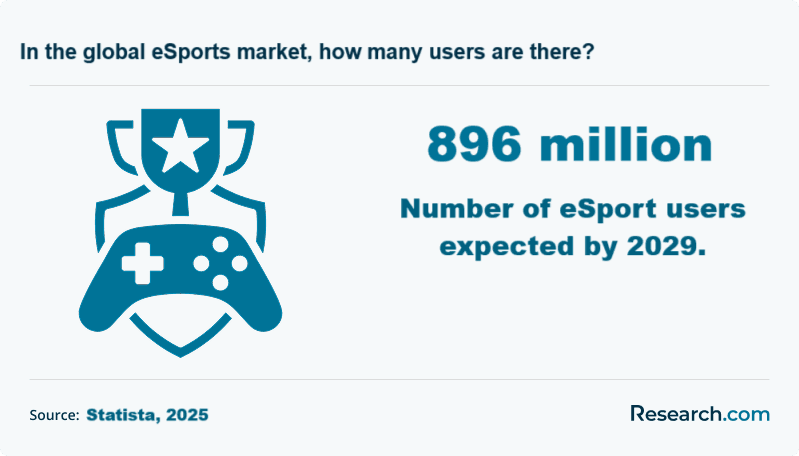
The image below shows the rising popularity of eSport and eGaming among users, which supports continued interest in business, media, and event roles tied to competitive gaming.
Current Trends Affecting Esports Business Degrees
Students entering esports business should understand the forces shaping hiring and program design. The field changes quickly, and schools that do not update their coursework may leave students underprepared.
- More emphasis on monetization: Employers increasingly value candidates who understand sponsorships, subscriptions, merchandise, media rights, brand activations, and audience conversion.
- Data-informed decision-making: Audience engagement, viewership patterns, performance metrics, and campaign results are important in esports marketing and operations.
- Hybrid events: Esports business professionals often work across live venues, streaming platforms, online communities, and broadcast-style production environments.
- Employer preference for experience: A degree can help, but practical evidence—event work, internships, portfolio projects, volunteer tournament operations, or community leadership—can make a stronger hiring case.
- Cross-industry career paths: Esports business skills may transfer to sports, entertainment, digital media, influencer marketing, brand partnerships, and online community management.
Common Mistakes to Avoid
- Assuming every esports degree is business-focused: Some programs lean toward game design, media production, or sports management. Read the course list carefully.
- Ignoring accreditation: Accreditation affects financial aid eligibility, employer trust, and future education options.
- Choosing only by speed: The fastest program may not be the best if it lacks applied projects, career support, or recognized accreditation.
- Comparing tuition rates instead of total cost: Always calculate tuition, fees, transfer credits, books, technology costs, and time to completion.
- Waiting to build experience: Start gaining esports-related experience during the program through clubs, volunteer events, internships, campus teams, online communities, or content projects.
- Assuming online means easier: Accelerated online programs can be demanding because assignments, projects, and exams arrive quickly.
- Over-specializing too early: A niche esports credential can be powerful, but students should still build broad business skills that transfer beyond one industry.
Questions to Ask Before Enrolling
- Is the institution accredited, and by whom?
- Is the esports program fully online, hybrid, or only partially online?
- How many credits can I transfer, and will they reduce both cost and time?
- Are courses offered year-round, and are accelerated terms available?
- Does the curriculum include sponsorships, event production, team operations, analytics, digital marketing, and esports law?
- Are internships, capstones, or real-world projects required?
- What career services are available specifically to online students?
- What is the full program cost, including fees?
- What financial aid, scholarships, employer tuition assistance, or military benefits can I use?
- What roles have recent graduates pursued, and what evidence does the school provide?
References
- Brierley, C. (2022, December 22). Hitmarker release video game job data from 2022. Hitmarker.
- Elad, B. (2025, April 21). Esports Statistics 2025: Market Growth, Viewership, and Trends. SQ Magazine.
- eSports Charts. (2025). Popular esports games in 2025 by viewership. escharts.com.
- Grand View Research. (2024). Esports market size, share & trends analysis report. grandviewresearch.com.
- Hanson, M. (2024, August 31). Cost of Online Education vs. Traditional Education. Education Data Initiative.
- Statista. (n.d.) Esports-Worldwide. Statista.
- United States Bureau of Labor Statistics. (2025, April 18). Occupational Outlook Handbook: Entertainment and Sports Occupations. BLS.
Key Insights
- The fastest online esports business options are usually transfer-friendly bachelor’s completion programs or accelerated graduate programs with shorter terms.
- Walsh University lists a fully online accelerated BBA option that can take 12-24 months depending on transfer credits, while Florida Southern College lists an esports-focused MBA option with a 12-24 month timeline.
- Cost varies widely. Per-credit tuition generally ranges from $300 to $800, and total tuition can range from $10,000 to over $90,000 depending on degree level, credits required, and school type.
- An esports business degree is most valuable when it includes applied projects, internships, sponsorship work, event planning, analytics, and career support—not just gaming-themed course titles.
- Students should verify accreditation, total cost, transfer-credit rules, online format, and career services before enrolling.
- Esports careers are competitive. A degree can help, but students should build a portfolio through tournaments, internships, volunteer event work, content projects, community management, or brand campaigns.
- The degree may be worth it for students seeking business-side roles in esports, gaming, media, sports, entertainment, or digital communities. It may not be the right fit for students who primarily want game development, professional play, or a broad MBA credential.
Other Things You Should Know About the Fastest Online Esports Business Degree Program
In 2027, several institutions offer fast-track online esports business degree programs. Prominent ones include Full Sail University, University of California Irvine, and Staffordshire University. These programs focus on rapid learning without sacrificing quality, making them ideal for students eager to enter the esports industry quickly.
Online esports business degree programs in 2027 incorporate hands-on projects, virtual internships, and industry partnerships to prepare students for the job market. Programs often collaborate with esports companies to offer real-world experience, giving students a competitive edge in securing roles post-graduation.