2027 Best Online Master’s in Business Analytics Programs

Co-Founder and Chief Data Scientist
Choosing an online master’s in business analytics is usually a career decision, not just an academic one. You may be trying to move from reporting into strategy, qualify for analytics leadership roles, shift into data science-adjacent work, or build stronger technical skills without leaving your job. The right program can help you learn how to turn data into business recommendations, but the value depends on accreditation, curriculum depth, employer recognition, cost, flexibility, and how well the program matches your target role.
This guide explains what to expect from an online master’s in business analytics, how to compare programs, what careers and salaries may look like, which subjects and specializations matter, and what questions to ask before enrolling. It is designed for working professionals, recent graduates with quantitative interests, and business employees who want to make stronger data-driven decisions.
Quick Answer: Is an Online Master’s in Business Analytics Worth Considering?
An online master’s in business analytics can be a strong option if you want graduate-level training in statistics, data visualization, predictive modeling, business intelligence, and decision-making while keeping your current job. Graduates commonly pursue roles such as business analyst, management analyst, data scientist, analytics manager, market research analyst, and operations analyst. Reported salaries vary widely by role, experience, location, and industry, with business analyst salaries in the U.S. ranging between $53,000 and $103,000, and management analysts earning around $95,290 according to BLS data cited in this guide.
The degree is most worthwhile when the program is accredited, includes hands-on analytics projects, teaches current tools such as Python, R, Tableau, and business intelligence platforms, and provides career support. It may be less useful if you already have advanced analytics experience and only need a short technical certificate, or if the program lacks employer-recognized accreditation and practical coursework.
What are the benefits of getting an Online Master’s in Business Analytics degree?
- Broader career options: Graduates can work across technology, finance, consulting, healthcare, retail, government, and professional services in roles such as business analyst, management analyst, data scientist, and analytics consultant.
- Competitive earning potential: Business analyst salaries in the U.S. range between $53,000 and $103,000, though compensation depends heavily on experience, location, industry, and job title.
- Flexible study format: Online programs allow students to complete graduate coursework from home while continuing to work, avoiding relocation and reducing commuting-related costs.
- Practical decision-making skills: Strong programs teach students how to interpret data, communicate findings, build models, and recommend actions that improve business performance.
What can I expect from an online master’s in business analytics?
An online master’s in business analytics is a graduate degree focused on using data to solve business problems. Students typically learn statistical analysis, predictive modeling, data management, machine learning applications, business intelligence, communication of insights, and strategic decision-making. Unlike a general business degree, this program is more quantitative and tool-driven. Unlike a pure data science degree, it usually places more emphasis on business context, stakeholder communication, and organizational impact.
Career demand is one reason many students consider this degree. The U.S. Bureau of Labor Statistics projects 10% growth for management analysts from 2022 to 2032 (BLS, 2023). Management analysts often evaluate organizational processes, recommend efficiency improvements, and help leaders make better strategic decisions. Business analytics graduates may also qualify for roles that involve forecasting, customer analytics, operational improvement, financial modeling, and performance measurement.
| What the degree usually includes | Why it matters for students |
| Statistics, data mining, and predictive analytics | Builds the technical foundation needed to analyze patterns and forecast outcomes. |
| Business intelligence and visualization | Helps students present findings clearly to executives, clients, and nontechnical teams. |
| Programming and analytics tools | Prepares students to work with platforms commonly used in analytics roles. |
| Capstone or applied project | Creates portfolio evidence of practical problem-solving ability. |
| Business strategy and decision models | Connects technical analysis to revenue, operations, risk, marketing, or organizational goals. |
Where can I work with an online master’s in business analytics?
Business analytics skills are useful wherever organizations collect data and need to make better decisions. Graduates often work in technology, finance, consulting, professional services, healthcare, retail, insurance, government, and scientific or technical services. Zippia reported that over half of business analysts work in companies with over 10,000 employees, suggesting that many roles are concentrated in larger organizations with mature data systems and formal analytics teams (Zippia, 2023).
Management analysts, a common related career path, are also employed heavily in professional, scientific, and technical services. Other management analysts work in government, finance, and insurance (BLS, 2023). Location can affect compensation. San Francisco and San Jose are cited among the best cities for business analyst salaries, with pay significantly above the national average (ZipRecruiter, 2023). However, students should compare salary opportunities against cost of living, remote-work availability, taxes, commute expectations, and long-term career mobility.
| Industry | Common analytics work | Best fit for students interested in |
| Technology | Product analytics, user behavior analysis, platform performance, data-driven growth | Software products, digital services, experimentation, and automation |
| Finance and insurance | Risk modeling, forecasting, fraud detection, pricing, portfolio analysis | Quantitative finance, compliance, investment support, and risk management |
| Consulting and professional services | Operational improvement, client analytics projects, strategy recommendations | Project-based work, client communication, and cross-industry problem solving |
| Healthcare | Patient outcomes analysis, cost management, capacity planning, quality improvement | Healthcare operations, public health data, and care delivery improvement |
| Retail and marketing | Customer segmentation, demand forecasting, campaign analysis, pricing optimization | Consumer behavior, e-commerce, digital marketing, and revenue growth |
How much can I make with an online master’s in business analytics?
Salary outcomes depend on your current experience, technical skill level, industry, geography, and the role you pursue after graduation. Graduates with an online master’s in business analytics can earn $10,000-$20,000 more than those with only a bachelor’s degree, with a median salary of $85,000 in 2023 (GMAC, 2023). Zippia reported a business analyst salary range of $53,000 and $103,000 based on job postings. Payscale reported salaries for data scientists and senior business analysts between $96,963 and $93,307, respectively (Payscale, 2023). Management analysts earn around $95,290, with the top 10 percent earning more than $167,650 (BLS, 2023).
These numbers should be treated as benchmarks rather than guarantees. A graduate moving from a nontechnical role into an entry-level analyst job may earn less than an experienced professional moving into analytics management. Students evaluating the fastest online master’s in business analytics should also consider whether an accelerated format provides enough time to build a portfolio, strengthen technical skills, and move toward a business management career path.
| Role or salary reference | Reported salary information | Important context |
| Business analyst | $53,000 and $103,000 | Range varies by location, industry, and experience. |
| Master’s in Business Analytics graduate | Median salary of $85,000 in 2023 | Reported by GMAC; individual outcomes depend on job market and background. |
| Data scientist | $96,963 | Often requires stronger programming, statistics, and machine learning skills. |
| Senior business analyst | $93,307 | Typically requires professional experience and stakeholder management ability. |
| Management analyst | Around $95,290; top 10 percent more than $167,650 | Often involves consulting, process improvement, and strategic recommendations. |
- 2027 Best Online Master’s in Business Analytics Programs
- What core subjects are covered in an online master’s in business analytics program?
- Specializations to Consider in an Online Master’s in Business Analytics Program
- What are the typical admission requirements for an online master’s in business analytics?
- What kind of work experience or academic background is expected?
- Are there part-time or accelerated options available for online master’s in business analytics?
- What is the average cost of an online master’s in business analytics?
- Are there any financial aid or scholarship opportunities available?
- What are the emerging trends in careers for business analytics graduates?
- What platforms and technologies are used to deliver the online program?
- Will employers recognize my online business analytics master’s degree
- What are examples of capstone projects or practical applications in the curriculum?
- How do I choose the right online Master’s in Business Analytics program for my career goals?
- How can sustainability and ethical practices be integrated into business analytics programs?
- What are the career advancement opportunities with an online master's in business analytics?
- How Does Faculty Expertise Enhance the Value of Online Master’s in Business Analytics Programs?
- What challenges do students face in online master’s in business analytics programs?
- Can an Accelerated MBA Online Complement a Master's in Business Analytics?
- Is a Master's in Business Analytics a lucrative investment?
- How are emerging technologies shaping online business analytics education?
- How do online master’s in business analytics programs foster networking and industry partnerships?
- How Do Online Master’s in Business Analytics Programs Measure Student Success?
2027 Best Online Master’s in Business Analytics Programs
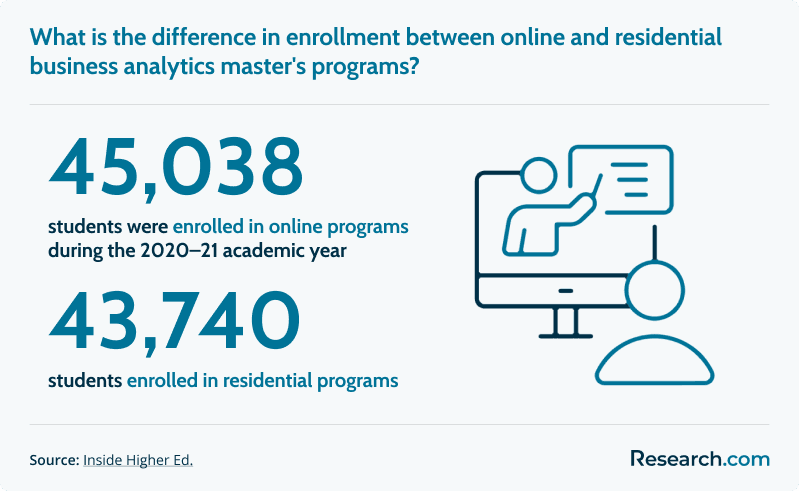
Online graduate business education has become more common and more accepted by employers. During the 202021 academic year, 45,038 students were enrolled in online programs compared to 43,740 in residential programs (Knox, 2022). The number of accredited business schools offering fully online M.B.A. programs also grew by 54 percent between the 201213 and 201617 academic years and another 85 percent between then and 202122 (Knox, 2022). For business analytics students, this means more flexible options, but also more programs to compare carefully.
The following programs are included to help students begin their research. Before applying, verify current tuition, credit requirements, course delivery format, admissions policies, and accreditation directly with each school.
How do we rank schools?
A graduate degree is a major financial and professional investment. Research.com evaluates online master’s in business analytics programs using data from established education data sources and a transparent ranking process. Sources used in the ranking process include:
- IPEDS database,
- Peterson’s database,
- Distance Learning Licensed Data Set from the College Scorecard database, and
- National Center for Education Statistics.
For more detail about ranking criteria and data use, review the Research.com methodology section. Rankings can be a useful starting point, but students should also compare curriculum, faculty expertise, career support, tuition, employer partnerships, and fit with their target role.
Carnegie Mellon University (Tepper)
Carnegie Mellon University’s Tepper School of Business offers a part-time master of science in business analytics. The program is built for flexible online study and emphasizes analytical depth, business judgment, and data-informed strategy. Tepper’s reputation in technology and innovation may appeal to students who want rigorous quantitative training within a business school environment.
Program Length: 24-32 months
Cost per Credit: Approximately $669 per unit
Required Credits to Graduate: 64
Accreditation: AACSB International
East Texas A&M University
East Texas A&M University offers a master of science in business analytics through its Commerce College. The program focuses on applying analytical methods to practical business problems and may suit students seeking a direct path into data-supported decision-making roles.
Program Length: About 1 year
Cost per Credit: Approximately $1,598 (In-State), $3,197 (Out-of-State)
Required Credits to Graduate: 36 Credit Hours
Accreditation: AACSB International
University of TexasDallas
The University of TexasDallas offers a master of science in business analytics through the Naveen Jindal School of Management, with online learning options. The program includes several tracks, making it useful for students who want to align analytics training with marketing, finance, operations, or IT-focused career goals.
Program Length: 18-24 months
Tracks/Concentrations: Marketing Analytics, Decision and Operations Analytics, Financial Analytics, IT for Analytics
Cost per Credit: Approximately $1,737 (In-State), $3,219 (Out-of-State)
Required Credits to Graduate: 36 Credit Hours
Accreditation: AACSB International
University of Maryland
The University of Maryland offers a master of science in business analytics through the Robert H. Smith School of Business. The program is designed for students who want to strengthen analytical, business intelligence, and strategic decision-making skills for use in data-driven organizations.
Program Length: Approximately 16 months
Cost per Credit: Approximately $1,682
Required Credits to Graduate: 30 Credit Hours
Accreditation: AACSB International
Indiana University
Indiana University’s Kelley School of Business offers an online master’s in business analytics with coursework in data analysis, business intelligence, and analytical decision-making. The Kelley School’s online format may appeal to working professionals who want a business-school-based analytics credential.
Program Length: Approximately 15 months
Cost per Credit: Approximately $1,380
Required Credits to Graduate: 30 Credit Hours
Accreditation: AACSB International
Georgetown University
Georgetown University’s McDonough School of Business offers a Master of Science in Business Analytics. The program combines analytics, business decision-making, and an ethical approach to leadership, which may be especially relevant for students interested in responsible data use and global business contexts.
Program Length: Approximately 16 months
Cost per Credit: Approximately $2,214
Required Credits to Graduate: 33.5 Credit Hours
Accreditation: AACSB International
Syracuse University
Syracuse University’s Martin J. Whitman School of Management offers an online master’s in business analytics focused on data analysis, predictive analytics, and evidence-based business decisions. The program combines a business foundation with analytical technology and applied learning.
Program Length: 18 months
Cost per Credit: Approximately $1,734
Required Credits to Graduate: 36 Credit Hours
Accreditation: AACSB International
Pepperdine University
Pepperdine University’s Graziadio Business School offers an online master’s in business analytics that emphasizes interpreting complex data, applying analytics to business decisions, and developing ethical leadership. The program may fit students who want applied business education with analytics depth.
Program Length: 20 months
Cost per Credit: Approximately $1,870
Required Credits to Graduate: 40 units
Accreditation: AACSB International
Villanova University
Villanova University offers a Master of Science in Business Analytics through the Villanova School of Business. The program is designed to build analytical skill, business problem-solving ability, and ethical decision-making for students pursuing data-focused business roles.
Program Length: 18 months
Tracks/Concentrations: N/A
Cost per Credit: Approximately $1,714
Required Credits to Graduate: 30 Credit Hours
Accreditation: AACSB International
Oklahoma State University
Oklahoma State University offers a Master of Science in Business Analytics through the Spears School of Business. The program emphasizes big data, applied analytical methods, and business decision support, with tracks that can help students tailor the degree to specific industries or functions.
Program Length: Approximately 2 years
Tracks/Concentrations: data science, health analytics, marketing analytics
Cost per Credit: Approximately $489 (In-State), $530 (Out-of-State)
Required Credits to Graduate: 33 Credit Hours
Accreditation: AACSB International
How to Compare Online Master’s in Business Analytics Programs
| Factor | What to check | Why it matters |
| Accreditation | Institutional accreditation and business-school accreditation such as AACSB International | Accreditation affects credibility, transferability, employer trust, and financial aid eligibility. |
| Curriculum | Statistics, programming, visualization, data management, machine learning, and business strategy | The strongest programs balance technical analytics with business application. |
| Applied learning | Capstone, consulting project, portfolio assignments, employer-sponsored projects | Employers often want evidence that graduates can solve real problems, not just complete exams. |
| Flexibility | Asynchronous courses, live sessions, part-time pacing, accelerated options, start dates | Working professionals need a format that fits job and family responsibilities. |
| Cost and aid | Total tuition, fees, residency pricing, scholarships, employer tuition assistance | The lowest tuition is not always the best value if career support or curriculum quality is weak. |
| Career services | Coaching, resume support, alumni network, employer events, internship or project access | Career support can be especially important for students changing fields. |
Here’s What Graduates Have to Say About Their Online Master’s in Business Analytics Degree
My online master’s in business analytics helped me keep working while building skills I could apply immediately. The flexibility mattered, but the most valuable part was learning how to approach real business data problems with more structure and confidence. -Emily
The online format worked well with my schedule and connected me with classmates from different industries and locations. The degree was not only about coursework; it also expanded my professional network and exposed me to different ways organizations use analytics. -Raj
The program felt highly interactive because of live discussions, group assignments, and accessible instructors. I finished with stronger analytical judgment and a clearer understanding of how to communicate data-driven recommendations. -Hannah
Key Findings
- Online graduate business education has expanded substantially. During the 202021 academic year, 45,038 students were enrolled in online programs compared to 43,740 in residential programs (Knox, 2022).
- Accredited business schools offering fully online M.B.A. programs increased by 54 percent between the 201213 and 201617 academic years and another 85 percent between then and 202122 (Knox, 2022).
- Employer perception has improved: 71% now view business degrees acquired online as equal to or better than traditional programs, a 10% increase from 2019 (Drexel University, 2023; Knox, 2022).
- Career outlook indicators are positive, with projected job growth of 9% from 20182028 for business analysts and 10% from 20222032 for management analysts alone (BLS, 2023; Zippia, 2023).
- Master’s in Business Analytics graduates had a global hiring rate of 71% in 2022, with the highest in Central & South Asia at 92%. The expected hiring rate was 79% in 2023, with the highest demand for technology at 74% (GMAC, 2023).
- Demand for digitally enabled work continues to expand, with approximately 4 million new digitally-enabled roles projected, including E-Commerce Specialists and Digital Marketing and Strategy Specialists (WEF, 2023).
What core subjects are covered in an online master’s in business analytics program?
Most online master’s in business analytics programs combine quantitative methods, technical tools, and business applications. Students who later pursue advanced business research or executive academic work may also use this foundation when comparing top online DBA programs. Common subjects include:
- Data Mining: methods for finding patterns, relationships, and anomalies in large datasets.
- Predictive Analytics: techniques for forecasting customer behavior, demand, risk, and business performance.
- Statistical Methods: probability, inference, regression, and other tools used to evaluate data accurately.
- Business Intelligence: data reporting, dashboards, metrics, and systems that support managerial decisions.
- Decision Models: quantitative and qualitative frameworks for choosing among business options.
- Data Management and Ethics: responsible data collection, storage, governance, privacy, and ethical use.
- Machine Learning for Business: practical use of machine learning techniques in organizational problems.
- Marketing Analytics: analysis of customer behavior, campaign performance, segmentation, and market trends.
- Operations Research: optimization techniques for improving processes, logistics, scheduling, and resource use.
- Financial Analytics: analytical methods for budgeting, forecasting, risk assessment, and financial strategy.
When comparing master’s degrees in business, pay close attention to how technical the curriculum is. Some business analytics programs are highly quantitative, while others emphasize managerial use of analytics. The best fit depends on whether your goal is to become a hands-on analyst, analytics translator, consultant, or analytics leader.
Specializations to Consider in an Online Master’s in Business Analytics Program
A specialization can make the degree more relevant to your target industry. Students comparing broader data analytics degrees should look at whether programs offer focused coursework, electives, or capstone options in their desired field.
| Specialization | What you study | Potential career direction |
| Marketing Analytics | Customer behavior, market trends, campaign results, segmentation, and return on investment | Marketing analyst, digital strategist, brand analytics specialist |
| Financial Analytics | Forecasting, investment analysis, risk modeling, financial performance, and market data | Financial analyst, investment strategist, risk management consultant |
| Healthcare Analytics | Patient data, cost management, care outcomes, operations, and predictive modeling | Healthcare analyst, hospital operations analyst, insurance analytics specialist |
| Operations and Supply Chain Analytics | Logistics, inventory, production planning, optimization, and supply chain efficiency | Supply chain analyst, operations manager, logistics consultant |
| Human Resource Analytics | Hiring data, employee retention, performance metrics, workforce planning, and productivity | HR data analyst, organizational development consultant, workforce planner |
| Cybersecurity Analytics | Threat modeling, security data, compliance, risk detection, and incident analysis | Cybersecurity analyst, risk assessor, IT consultant |
Choose a specialization based on the problems you want to solve, not only the title that sounds most marketable. For example, marketing analytics suits students interested in consumer behavior and revenue growth, while operations analytics is better for those who enjoy process improvement and logistics. Cybersecurity analytics may require additional technical preparation beyond standard business analytics coursework.
What are the typical admission requirements for an online master’s in business analytics?
Admissions requirements vary, but programs generally look for evidence that applicants can handle quantitative graduate coursework and communicate effectively in business settings. Common requirements include:
- Bachelor’s Degree: A four-year degree from an accredited institution, often in business, mathematics, statistics, computer science, economics, or a related field.
- GPA: Many programs prefer a minimum undergraduate GPA around 3.0 or higher, though policies differ by school.
- GMAT/GRE Scores: Some schools waive GRE requirements for online master’s in business analytics applicants. Programs that require scores often look for quantitative scores in the 155165 range and verbal scores around 150160.
- Work Experience: Relevant professional experience may be required or strongly preferred, especially for programs designed for working professionals.
- Letters of Recommendation: Applicants usually submit two or three letters from academic or professional references.
- Statement of Purpose: The essay should explain your career goals, interest in analytics, and fit with the program.
- Resume/CV: A current resume should highlight work history, technical skills, leadership, projects, and measurable achievements.
- Prerequisite Knowledge: Some schools expect prior coursework or demonstrated ability in statistics, calculus, or programming.
- Interview: Certain programs conduct interviews in person or by video conference.
- English Proficiency: TOEFL or IELTS scores may be required for non-native English speakers.
What kind of work experience or academic background is expected?
Most online master’s in business analytics programs expect applicants to have either a quantitative academic foundation, relevant professional experience, or both. A background in business, mathematics, economics, computer science, statistics, engineering, or related fields can be helpful. Applicants from nontechnical majors may still qualify, but they may need prerequisite coursework or evidence of quantitative readiness.
Work experience is also valuable. According to the 2023 GMAC Corporate Recruiters Survey, demand for Master of Business Analytics graduates was expected to remain largely stable in the US, while global demand was projected to be stronger, with Africa taking the lead. Professionals with industry experience have the highest hiring rates across the board, with a global rate of 88% and as high as 94% in Central & South Asia (GMAC, 2023).
- Academic Background: A bachelor’s degree in business, mathematics, economics, computer science, statistics, or a related field is common. Statistics and quantitative methods are especially useful.
- Work Experience: Experience in analysis, operations, finance, marketing, consulting, technology, or decision support can strengthen an application. Some programs prefer or require at least two years of professional work.
- Technical Skills: Familiarity with R, Python, databases, spreadsheets, or analytics tools can help students start faster.
- Quantitative Skills: Comfort with mathematics, statistics, and logical problem solving is important for success.
- Communication Skills: Analytics professionals must explain complex findings to business audiences and recommend practical next steps.
The chart below illustrates hiring rates for industry-experienced MBA candidates across global regions in 2022, showing broad demand and especially high rates in Central & South Asia and the Middle East.
Are there part-time or accelerated options available for online master’s in business analytics?
Yes. Many online master’s in business analytics programs offer part-time and accelerated formats. Part-time programs are usually better for working professionals who want a manageable course load. Accelerated options are designed for students who can handle intensive coursework and want to finish faster. Carnegie Mellon University, for example, offers a part-time master of science in business analytics program with flexible online learning and on-campus options.
| Format | Best for | Trade-offs |
| Part-time | Working professionals balancing employment, family, and school | Takes longer but may reduce burnout and allow immediate workplace application. |
| Accelerated | Students who can study intensively and want a faster credential | Requires strong time management and may leave less room for internships or portfolio building. |
| Asynchronous online | Students who need maximum scheduling flexibility | Requires self-discipline and proactive communication. |
| Live online | Students who want real-time class discussion and structure | Less flexible for students with changing work schedules or time zone conflicts. |
Students considering analytics or business administration careers should choose the pace that supports both learning and career progress. Finishing quickly is not always the best strategy if you need time to build a portfolio, learn programming, or transition into a new industry.
What is the average cost of an online master’s in business analytics?
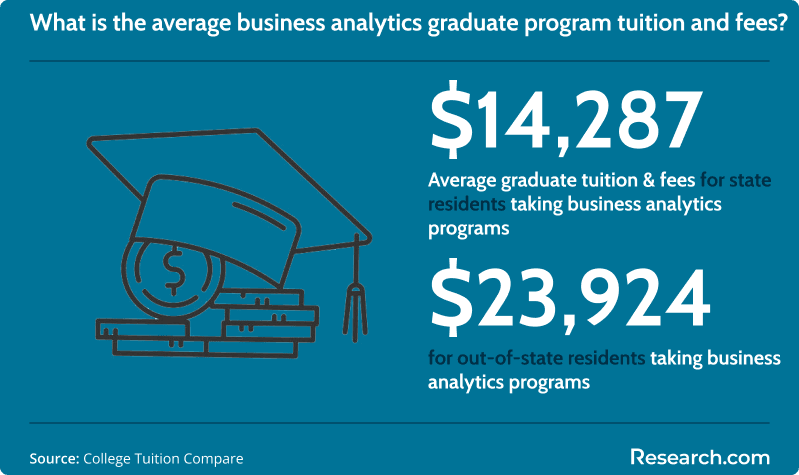
The average cost varies by school, residency status, credit load, and fees. College Tuition Compare reports that state residents’ average graduate tuition and fees for business analytics programs are approximately $14,287, while out-of-state students face an average of $23,924. These figures cover 60 graduate schools offering business analytics programs in the United States.
When comparing costs, do not look only at tuition per credit. Calculate total program cost, technology fees, books and software, travel requirements, residency sessions, graduation fees, and the opportunity cost of reducing work hours. An affordable online master’s in business analytics is valuable only if it also provides credible training, recognized accreditation, and enough applied experience to support your career goals.
| Cost factor | Question to ask |
| Tuition and fees | What is the total cost to graduate, not just the cost per credit? |
| Residency pricing | Do online students pay in-state, out-of-state, or separate online tuition? |
| Software and technology | Are analytics tools included, discounted, or paid separately? |
| Required campus visits | Will I need to pay for travel, lodging, or time away from work? |
| Time to completion | Will a longer part-time format increase fees or delay salary growth? |
| Career support | Does the program provide enough advising, employer access, and project experience to justify the cost? |
Are there any financial aid or scholarship opportunities available?
Yes. Students in online master’s in business analytics programs may be eligible for federal aid, institutional scholarships, graduate assistantships, employer tuition assistance, private scholarships, grants, and loans. Carnegie Mellon University provides scholarship opportunities and graduate assistantships. Georgetown University’s McDonough School of Business notes financial aid and scholarships for its MSBA program. Pepperdine’s Graziadio Business School offers financial aid packages that may include scholarships, grants, and loans for eligible students.
Start the funding process early. Scholarship deadlines may come before admission deadlines, and employer tuition benefits may require preapproval. Ask each program whether online students receive the same aid consideration as campus students and whether scholarships are renewable.
Questions to ask about financial aid
- Are online students eligible for the same scholarships as campus-based students?
- Is aid awarded automatically, or do I need a separate application?
- Are scholarships based on merit, need, professional background, military status, or employer partnerships?
- Can I use employer tuition reimbursement for this program?
- Are there minimum credit requirements to qualify for federal financial aid?
- Will taking an accelerated or part-time schedule affect aid eligibility?
What are the emerging trends in careers for business analytics graduates?
Business analytics careers are being shaped by growing data volume, wider use of automation, more advanced visualization tools, and demand for professionals who can translate technical outputs into business decisions. The data analytics market size was projected to grow from $7.03 billion in 2023 to $303.4 billion in 2025 (Thinkful, 2023). The Future of Jobs Report 2023 also projected growth in approximately 4 million digitally-enabled roles, including e-commerce specialists, digital transformation specialists, and digital marketing and strategy specialists (WEF, 2023).
GMAC reported that Master of Business Analytics graduates were expected to have a 79% global hiring rate, with the highest demand in technology at 74% (GMAC, 2023). Graduates were expected to find roles primarily in business intelligence/analytics, market research, strategy/innovation, and data science. Zippia reported projected business analyst job growth of 9% from 2018-2028, with about 56,000 new jobs expected over the next decade, and noted that business analyst salaries increased 10% in the last five years.
How AI is changing business analytics roles
Artificial intelligence is not eliminating the need for business analytics professionals; it is changing what employers expect. Automated tools can generate dashboards, summarize data, and assist with modeling, but organizations still need people who can define the right business question, check data quality, recognize bias, interpret results, and explain trade-offs to decision-makers. Students should look for programs that teach AI literacy, model evaluation, responsible data use, and business communication rather than only tool operation.
What platforms and technologies are used to deliver the online program?
Online master’s in business analytics programs typically use a mix of learning platforms, communication tools, programming environments, visualization software, and collaboration systems. The specific tools vary, but students should expect to work in digital environments similar to those used in modern analytics teams.
- Learning Management Systems: Canvas, Blackboard, and Moodle are commonly used to organize lectures, assignments, grades, discussions, and course materials.
- Real-Time Communication Tools: Zoom, Microsoft Teams, and WebEx support live classes, office hours, presentations, and group meetings.
- Data Analytics and Programming Environments: RStudio, Python through Jupyter Notebooks or Anaconda, and Tableau for data visualization are common examples.
- Collaboration and Project Management Tools: Slack, Trello, Microsoft OneDrive, and Google Drive help students manage group projects and shared files.
Students comparing analytics programs with a business marketing degree should look for hands-on tool use, not just lectures about analytics concepts. Employers are more likely to value graduates who can clean data, build dashboards, interpret models, and communicate findings through professional deliverables.
Will employers recognize my online business analytics master’s degree?
Yes, many employers recognize online business analytics master’s degrees, especially when the degree comes from an accredited and reputable institution. Drexel University reported that 79% of executives believe online degrees are equivalent to on-campus degrees, and that accreditation is a major credibility factor. Favorability rises to 89% when the institution offering the online program also has a traditional campus.
Employer acceptance is strongest when the transcript and diploma come from a recognized institution, the program is accredited, and the curriculum includes practical projects. Many established universities now offer online degrees without distinguishing them from campus degrees on the diploma. Still, students should avoid assuming all online programs carry the same weight. Before enrolling, verify accreditation, employer outcomes, alumni roles, and the quality of career support.
What are examples of capstone projects or practical applications in the curriculum?
Applied projects are one of the most important parts of a business analytics master’s degree. Even students comparing affordable colleges for online business degrees should look for capstones, consulting projects, simulations, or portfolio assignments that mirror workplace problems.
- Market Basket Analysis: Examining transaction data to identify purchase patterns and improve promotions, product placement, or bundling.
- Predictive Modeling for Customer Churn: Using historical customer data to identify which customers may leave and recommending retention strategies.
- Supply Chain Optimization: Evaluating logistics, inventory, and supplier data to reduce cost and improve efficiency.
- Social Media Sentiment Analysis: Analyzing online comments or posts to understand brand perception and guide marketing decisions.
- Fraud Detection in Financial Transactions: Building models that flag suspicious transaction patterns.
- Healthcare Data Analysis: Studying patient or operations data to improve outcomes, control costs, or increase efficiency.
- Real Estate Price Prediction: Using economic and demographic indicators to estimate property values across regions.
- Retail Sales Forecasting: Forecasting future demand using historical sales, seasonality, and promotional activity.
- Human Resources Analytics: Evaluating employee data to improve hiring, retention, productivity, or performance management.
- Energy Consumption Analysis: Analyzing usage patterns to recommend efficiency improvements and cost reductions.
The strongest capstones require students to define a business problem, prepare messy data, select an appropriate analytical method, interpret the results, and present recommendations to a nontechnical audience. If a program does not offer applied work, students may need to build a portfolio independently.
How do I choose the right online Master’s in Business Analytics program for my career goals?
Start with your target role, then work backward. A student who wants to become a data scientist needs more programming, statistics, and machine learning than a student who wants to become an analytics manager. A marketing professional may need customer analytics and visualization, while a finance professional may need forecasting, risk modeling, and financial analytics.
- Define your career goal: Identify whether you want an analyst, consultant, manager, product, finance, marketing, operations, or data science-adjacent role.
- Map the curriculum to that goal: Look for courses and projects that match the skills employers request in your target job postings.
- Verify accreditation: Confirm institutional accreditation and, when relevant, business-school accreditation.
- Compare total cost: Review tuition, fees, aid, employer reimbursement, and the length of the program.
- Review career outcomes: Ask where graduates work, what roles they enter, and whether the school tracks salary progression.
- Evaluate support: Look for career coaching, technical tutoring, faculty access, alumni connections, and networking events.
- Check flexibility: Make sure the pacing, live-session expectations, and assignment load fit your work schedule.
If affordability is your main constraint, compare analytics programs with cost-focused business pathways such as the cheapest online business administration degree, but do not sacrifice accreditation or relevant analytics coursework just to reduce tuition.
How can sustainability and ethical practices be integrated into business analytics programs?
Business analytics programs increasingly need to teach responsible data use. Analytics decisions can affect hiring, lending, healthcare access, environmental planning, supply chains, and customer privacy. Programs that address sustainability and ethics prepare students to evaluate not only what the data suggests, but also whether the recommendation is fair, legal, transparent, and socially responsible.
- ESG Analytics: Coursework can teach students to analyze Environmental, Social, and Governance metrics and connect sustainability data to business decisions.
- Ethical Decision-Making Frameworks: Case studies can help students evaluate privacy, algorithmic bias, stakeholder impact, and responsible model use.
- Green Business Analytics: Students can apply analytics to energy use, emissions reduction, resource allocation, and sustainable supply chains.
- Data Ethics and Compliance Training: Programs can cover data governance, privacy, security, GDPR, CCPA, and responsible handling of sensitive information.
- Sustainability-Focused Capstones: Projects may address waste reduction, energy efficiency, sustainable operations, or urban planning.
- Partnerships with Mission-Driven Organizations: Nonprofits, healthcare organizations, and green enterprises can provide applied projects with social or environmental value.
What are the career advancement opportunities with an online master's in business analytics?
An online master’s in business analytics from one of the accredited online colleges can support career advancement by strengthening analytical ability, business judgment, and leadership potential. Advancement depends on prior experience and job market conditions, but common pathways include:
- Moving into leadership: Graduates with experience may pursue roles such as Business Analytics Manager, Director of Analytics, or Chief Data Officer.
- Changing industries: Analytics skills apply across technology, finance, healthcare, consulting, retail, insurance, and government.
- Increasing earning potential: Advanced analytics roles can pay more than general business roles, especially when graduates combine technical skills with domain expertise.
- Launching consulting or entrepreneurial work: Analytics training can help professionals identify market needs, evaluate customer data, and develop data-driven services.
- Building a stronger professional network: Online programs may connect students with faculty, alumni, peers, and employer partners.
- Developing niche expertise: Specialization in machine learning, data governance, marketing analytics, healthcare analytics, or financial analytics can open more focused roles.
- Pursuing additional credentials: Graduates may add certifications in artificial intelligence, big data tools, visualization platforms, or analytics software.
How Does Faculty Expertise Enhance the Value of Online Master’s in Business Analytics Programs?
Faculty quality matters because business analytics is both technical and applied. Strong instructors bring research knowledge, industry experience, current tool expertise, and practical examples from analytics work. They can help students understand not just how to run a model, but when a model is appropriate, how to interpret the output, and how to present a recommendation to decision-makers.
Prospective students should review faculty bios, publications, consulting experience, industry partnerships, and teaching accessibility. Students considering future doctoral or executive-level business study may also compare related options such as affordable DBA programs.
What challenges do students face in online master’s in business analytics programs?
Online analytics programs can be demanding. Students must manage graduate-level quantitative coursework, technical tools, group projects, and deadlines without the structure of a traditional campus schedule. Common challenges include limited face-to-face interaction, uneven group participation, time zone conflicts, technology issues, and the need for self-directed learning.
| Common mistake | Better approach |
| Choosing a program only because it is inexpensive | Compare total value, including accreditation, curriculum, career support, and applied projects. |
| Ignoring accreditation | Confirm institutional accreditation and business-school accreditation before applying. |
| Assuming online means easier | Plan for rigorous quantitative work, programming practice, and frequent deadlines. |
| Skipping prerequisite preparation | Review statistics, spreadsheets, programming basics, and business fundamentals before classes begin. |
| Relying only on rankings | Use rankings as a starting point, then evaluate fit with your goals and constraints. |
| Not building a portfolio | Save polished capstone projects, dashboards, code samples, and presentations for job applications. |
Students who prefer a broader management credential and faster completion may also compare analytics programs with alternatives such as the quickest online MBA.
Can an Accelerated MBA Online Complement a Master's in Business Analytics?
An accelerated MBA and a master’s in business analytics can complement each other, but earning both is not necessary for every student. A business analytics master’s builds technical and analytical depth. An MBA emphasizes leadership, finance, strategy, operations, marketing, and organizational management. Together, the credentials may help professionals who want to lead analytics teams, manage digital transformation, or move into executive roles.
However, a dual-degree or sequential-degree strategy increases cost and time. Before pursuing both, compare job postings for your target role. If employers primarily request analytics tools and modeling experience, the MSBA may be enough. If they emphasize leadership, budgeting, and general management, an accelerated MBA online may add value.
Is a Master's in Business Analytics a lucrative investment?
A master’s in business analytics can be financially worthwhile, but the return on investment depends on your starting salary, tuition, debt, target role, location, and how effectively you use the program to build marketable skills. The strongest ROI usually comes from programs that combine recognized accreditation, practical analytics projects, career support, and a curriculum aligned with current employer needs.
Earning Potential for Business Analytics Graduates
Business analytics professionals work in finance, healthcare, technology, consulting, retail, and other data-intensive sectors. Salaries tend to be higher for professionals with strong technical skills, industry experience, and the ability to translate analysis into business action. However, no degree guarantees a specific salary.
Job Market Trends and Future Outlook
Organizations continue to rely on data to improve operations, understand customers, manage risk, and compete digitally. This supports demand for professionals who can analyze large datasets and communicate insights. The outlook is strongest for graduates who combine analytics methods with domain expertise and communication skills.
Factors Affecting Salary
- Experience: Professionals with more years of relevant analytics, business, or industry experience often command higher pay.
- Industry: Finance and technology roles often offer stronger compensation than some other sectors.
- Location: Major technology hubs and financial centers may pay more, but cost of living can reduce the real benefit.
- Certifications: Credentials from SAS, Tableau, or related platforms can strengthen a resume when paired with real project experience.
Weighing the Costs and Benefits
Calculate ROI before enrolling. Estimate total cost, expected debt, likely salary change, time to graduation, and whether the degree will help you reach roles you could not access otherwise. For broader salary comparisons across fields, review Research.com’s guide to most lucrative majors.
How are emerging technologies shaping online business analytics education?
Online business analytics programs are increasingly shaped by artificial intelligence, machine learning, advanced visualization, cloud-based tools, and simulation-based learning. Strong programs update coursework so students can understand how modern analytics tools support real-time decisions, experimentation, forecasting, and automation.
Students should look for courses that go beyond naming technologies. A useful curriculum teaches how to validate model outputs, identify data bias, protect privacy, explain AI-supported recommendations, and choose the right method for the business question. Students comparing broader business pathways may also review a fast-track business administration degree if speed and leadership training are higher priorities than analytics depth.
How do online master’s in business analytics programs foster networking and industry partnerships?
Online programs can support networking through live webinars, virtual career fairs, alumni panels, discussion forums, employer projects, mentorship, and group consulting assignments. The strongest programs do not leave networking to chance; they create structured opportunities for students to interact with faculty, alumni, recruiters, and industry partners.
When evaluating networking value, ask whether the program offers employer-sponsored capstones, alumni directories, career coaching, analytics competitions, or access to professional organizations. Students who want a broader undergraduate or accelerated business pathway can compare options such as an accelerated business degree, but graduate analytics programs should be judged on industry-connected applied learning and post-graduation career support.
How Do Online Master’s in Business Analytics Programs Measure Student Success?
Programs may measure student success through graduation rates, retention, employment outcomes, salary progression, capstone quality, employer feedback, student satisfaction, alumni advancement, and certification results. Prospective students should ask for transparent outcome data and compare it with program cost.
Do not rely only on testimonials. Ask where recent graduates work, how many changed careers, what roles they obtained, whether salary data is self-reported, and how the school supports job seekers after graduation. Cost-conscious students may also compare analytics programs with value-focused business options such as the cheapest online MBA programs, while remembering that an MBA and an analytics master’s serve different career goals.
Key Insights
- An online master’s in business analytics is best for students who want to combine quantitative analysis, business strategy, data tools, and decision-making skills without leaving the workforce.
- Accreditation, curriculum depth, applied projects, and employer recognition matter more than whether the program is online or campus-based.
- Reported salary outcomes are strong in many analytics roles, but pay varies by role, experience, location, industry, and technical ability. No program can guarantee a specific salary.
- Students should choose a specialization based on target job functions, such as marketing, finance, healthcare, operations, HR, or cybersecurity analytics.
- Part-time formats work well for professionals who need balance; accelerated formats are better for students who can manage intensive coursework and already have strong preparation.
- The best programs teach current tools and emerging technologies, but they also emphasize ethics, communication, business judgment, and responsible AI use.
- Before enrolling, calculate total cost, verify accreditation, review career outcomes, ask about capstone projects, and make sure the curriculum matches the jobs you actually want.
References:
- BLS. (2024, September 6). Management Analysts: Occupational Outlook Handbook:: U.S. Bureau of Labor Statistics. Bureau of Labor Statistics.
- GMAC. (2024). Corporate Recruiters Survey 2023 Summary Report. Graduate Management Admission Council.
- Knox, L. (2024, May 16). Online M.B.A.s Overtake Residential Programs. Inside Higher Ed.
- Payscale. (2024). Master of Science (MS), Business Analysis Salary | PayScale.
- Thinkful. (2024, August 11). Thriving in the Data Analytics Job Market of 2023: Trends, Salaries, and Advanced Technologies. Thinkful.
- WEF. (2024). The Future of Jobs Report 2023. World Economic Forum.
- Zippia. (2024). Business Analyst Demographics and Statistics [2023]: Number Of Business Analysts In The US. Zippia.
- ZipRecruiter. (2024). Business Analyst Graduate Salary: Hourly Rate December 2023. ZipRecruiter.
Other Things You Need to Know About Online Master's in Business Analytics Programs
Most programs require 30 to 36 credit hours and cover statistics, data mining, predictive modeling, data visualization, SQL, and machine learning. Many also include a capstone project or practicum, which ties coursework to a business problem using real or simulated data.
Prerequisites often include a bachelor's degree in a related field, proficiency in statistics, and computer programming. Some programs might also require relevant work experience. Each institution sets its own specific requirements to be met for 2027 admissions.