
2027 What Can You Do with an Online Hospitality Management Master’s Degree?

Co-Founder and Chief Data Scientist
An online master’s in hospitality management is usually considered by professionals who already understand the service industry but want stronger preparation for leadership, revenue strategy, brand management, guest experience, or entrepreneurship. The decision is not simply whether the degree is convenient. The better question is whether the program’s curriculum, accreditation, cost, network, and career outcomes match the role you want next.
This guide explains what an online hospitality management master’s degree covers, which careers it can support, how employers view online credentials, what admissions and coursework typically look like, and how to compare programs without relying only on tuition or rankings. It is designed for hotel, restaurant, tourism, event, food service, and service-business professionals who want a practical way to judge whether this graduate degree is worth the investment.
Quick Answer: Is an Online Master’s in Hospitality Management Worth It?
An online master’s in hospitality management can be worthwhile if you are aiming for management or senior leadership roles in lodging, food service, tourism, events, destination management, hospitality marketing, or service-based entrepreneurship. The strongest value usually comes from accredited programs that combine hospitality strategy with finance, revenue management, analytics, operations, leadership, and real-world projects.
The degree is less likely to be the right investment if you are looking for an entry-level hospitality job, if the program lacks recognized accreditation, or if the cost does not align with realistic salary and promotion prospects in your target market.
Key Things You Should Know About Online Hospitality Management Programs
- Online format can work well for employed professionals. Many programs are built for students who need to keep working while completing graduate coursework.
- Career outcomes vary by specialization. A hotel operations-focused program prepares you differently from one centered on tourism, events, food service, analytics, or hospitality marketing.
- Curriculum quality matters more than delivery format. Look for advanced courses in revenue management, financial decision-making, operations, customer experience, sustainability, digital tools, and leadership.
- Accreditation is a major credibility signal. Accredited online degrees are easier for employers and other institutions to evaluate.
- Networking requires more initiative online. The best programs offer virtual events, faculty access, alumni connections, employer projects, optional residencies, internships, or capstones.
- Technology is now part of hospitality leadership. Programs increasingly address analytics, customer experience platforms, digital marketing, distribution channels, and hospitality management software.
- ROI depends on your current role and target role. A master’s degree may support advancement, but salary outcomes are never guaranteed and should be compared against total program cost.
- Career Options for Graduates of Online Hospitality Management Master’s Programs for 2027
- What is a master’s in hospitality management?
- Do employers recognize online hospitality management master’s degrees?
- How do online hospitality management programs differ from traditional, on-campus ones?
- How long does it take to complete an online hospitality management master’s program?
- What are the common requirements for enrolling in online hospitality management master’s programs?
- What are the courses typically included in online hospitality management master’s programs?
- What are the tuition and financial aid considerations for online hospitality management programs?
- What is the return on investment for an online master’s in hospitality management?
- Could combining an online master’s in hospitality management with an MBA boost my career?
- How do I choose the best online hospitality management programs?
- What are the benefits of pursuing an online master’s in hospitality management?
- What are the challenges of pursuing an online master’s in hospitality management?
- Will This Degree Prepare Me for Global Leadership Challenges in Hospitality?
- How Can Supplementary Business Credentials Enhance Your Hospitality Management Career?
- Can an Online Master’s in Hospitality Management Unlock Entrepreneurial Potential?
- Can Supplementary Finance Courses Boost Hospitality Management Expertise?
- How Will Emerging Digital Trends Influence Online Hospitality Management Programs?
- Is an online master’s in hospitality management a more cost-effective investment compared to other advanced business degrees?
- How Can I Verify Accreditation and Industry Recognition for Online Hospitality Management Programs?
Career Options for Graduates of Online Hospitality Management Master’s Programs for 2027
An online master’s in hospitality management can support several leadership tracks, but the best fit depends on your experience, strengths, and preferred work environment. Some graduates move deeper into hotel, resort, or food service operations. Others use the degree to pivot into brand strategy, public relations, tourism development, events, consulting, or entrepreneurship.
The table below summarizes three career paths commonly connected to hospitality leadership training. Salary and outlook figures should be read as labor-market indicators, not promises of individual earnings.
| Career path | Typical focus | How the master’s degree can help | Salary and outlook information stated in the article |
| Public Relations Manager | Brand reputation, media relations, communication strategy, crisis messaging, customer engagement | Builds knowledge in hospitality branding, consumer behavior, strategic communication, and leadership | Average annual salary of $159,420; 7% projected employment growth from 2023 to 2033; 8,900 openings projected each year, on average, over the decade |
| Food Service Manager | Restaurant, catering, hotel dining, staffing, food quality, budgets, customer service, inventory | Strengthens operations, financial management, service design, supply chain, marketing, and revenue skills | Average salary of $69,580 per year; 2% projected growth from 2023 to 2033; 44,500 openings projected each year over this 10-year period |
| Lodging General Manager | Hotel or resort operations, guest satisfaction, staffing, revenue performance, property standards | Develops revenue management, strategic planning, service quality, operations, and crisis response skills | Average annual salary of approximately $76,790; managers at luxury hotels, major resort chains, or high-profile properties can earn $100,000 or more; 10% projected growth from 2023 to 2033; about 6,000 openings projected each year, on average, over the decade |
Public Relations Manager
Hospitality brands depend heavily on trust, visibility, and guest perception. A public relations manager helps shape how a hotel group, resort, restaurant brand, tourism board, cruise company, or event organization is seen by customers, media outlets, influencers, business partners, and the public.
In hospitality settings, PR managers may write press materials, manage social media narratives, coordinate promotional events, support partnerships, respond to guest-related issues, and lead communication during disruptions. A graduate hospitality program can be useful because it connects communication strategy with service quality, brand experience, customer expectations, and crisis management training.
Salary Expectation
According to the U.S. Bureau of Labor Statistics (BLS), PR managers earn an average annual salary of $159,420. Pay can differ by location, employer size, industry segment, seniority, and the scale of the brand or destination being represented.
Job Outlook
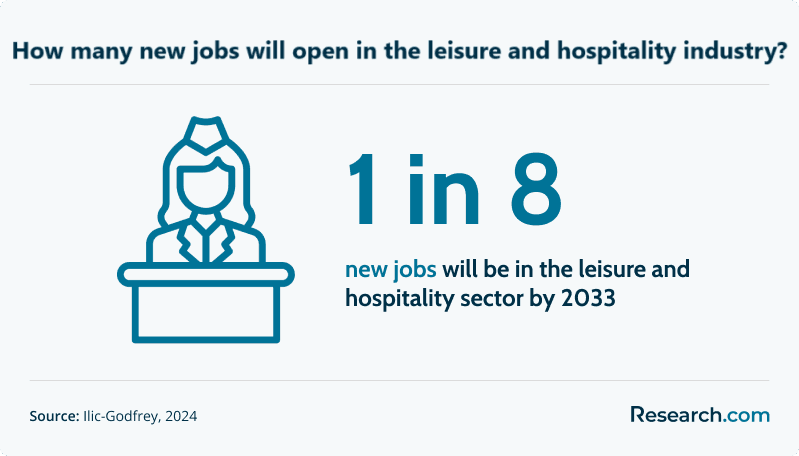
The BLS projects 7% employment growth for public relations and fundraising managers from 2023 to 2033, with 8,900 openings projected each year, on average, over the decade. Hospitality organizations that rely on digital visibility, guest reviews, brand partnerships, and reputation management may continue to value professionals who understand both communication and the service business.
Food Service Manager
Food service managers oversee restaurant, catering, hotel dining, corporate dining, and related food operations. Their responsibilities often include supervising employees, maintaining service standards, managing costs, monitoring food safety practices, working with suppliers, handling customer concerns, and improving profitability.
A master’s in hospitality management can be especially useful for professionals who want to move from shift-level supervision into multi-unit, regional, hotel-based, or corporate food and beverage leadership. Relevant coursework often covers budgeting, revenue strategy, menu and service design, operations, staffing, sustainability, and hospitality marketing.
Salary Expectation
According to the BLS, food service managers earn an average of $69,580 per year. Actual compensation may be higher or lower depending on the size of the operation, market, employer type, bonus structure, and management responsibility.
Job Outlook
The BLS projects 2% employment growth for food service managers from 2023 to 2033. Even with limited growth, an average of 44,500 openings for this role are projected each year over this 10-year period. Openings may arise from replacement needs, restaurant turnover, hotel dining operations, institutional food service, and evolving guest expectations.
Lodging General Manager
A lodging general manager is responsible for the overall performance of a hotel, resort, or accommodation property. This role often combines guest experience, finance, staffing, operations, property standards, sales, marketing, safety compliance, and owner or corporate reporting.
Graduate hospitality coursework can help aspiring lodging leaders understand revenue management, occupancy strategy, service quality systems, labor planning, digital transformation, sustainability, and competitive positioning. For experienced hotel professionals, the degree may help strengthen the strategic and financial vocabulary needed for broader leadership roles.
Salary Expectation
According to the BLS, lodging managers earn an average annual salary of approximately $76,790. Managers at luxury hotels, major resort chains, or high-profile properties can earn $100,000 or more, especially when compensation includes performance bonuses or profit-sharing incentives.
Job Outlook
The BLS projects lodging manager employment to grow 10% from 2023 to 2033, with about 6,000 openings projected each year, on average, over the decade. Candidates with operations experience, strong financial judgment, guest experience expertise, and leadership training may be better positioned for competitive management openings.
What is a master’s in hospitality management?
A master’s in hospitality management is a graduate degree focused on the business, operational, financial, and leadership side of hospitality and service organizations. It goes beyond basic customer service or front-line operations and prepares students to analyze performance, lead teams, manage revenue, improve guest experience, and make strategic decisions.
Programs may cover hotels, resorts, restaurants, food and beverage operations, tourism, destination management, events, casinos, cruise lines, luxury service, and other service-driven businesses. Some programs are broad, while others allow students to specialize in areas such as lodging, event management, tourism, food service leadership, sustainability, analytics, or entrepreneurship.
Online hospitality management programs are designed to deliver this graduate training through digital platforms. Many include case studies, group projects, simulations, capstones, and industry-focused assignments so students can apply concepts to real hospitality problems while continuing to work.
Do employers recognize online hospitality management master’s degrees?
Employers can recognize online hospitality management master’s degrees when they come from credible, accredited institutions. In most hiring situations, the reputation of the school, accreditation status, curriculum relevance, work experience, and demonstrated leadership ability matter more than whether the coursework was completed online or on campus.
Because many universities now offer accredited online degrees, online learning is no longer unusual in graduate education. However, not every online program carries the same weight. Before enrolling, confirm accreditation, review faculty experience, ask about employer partnerships, and examine whether the degree title and transcript differ from the campus version.
| Employer concern | What to check before enrolling |
| Is the degree credible? | Confirm institutional accreditation and, when relevant, hospitality or business-focused accreditation. |
| Is the curriculum advanced enough? | Look for graduate-level work in finance, revenue management, analytics, operations, leadership, and strategy. |
| Will I gain practical experience? | Ask whether the program includes a capstone, consulting project, internship option, simulation, or employer-based project. |
| Will the program help with networking? | Review alumni access, virtual events, employer panels, faculty mentoring, and industry partnerships. |
How do online hospitality management programs differ from traditional, on-campus ones?
Online and campus-based hospitality management master’s programs may cover similar subjects, but they can feel very different in schedule, interaction style, networking, and access to hands-on opportunities. The right choice depends on your work schedule, learning preferences, location, and need for in-person industry exposure.
| Factor | Online program | On-campus program |
| Schedule | Often more flexible, with asynchronous coursework or evening live sessions; may fit working professionals and some fast track degree formats | Usually follows a fixed academic schedule with in-person class meetings |
| Learning environment | Uses video lectures, learning platforms, discussion boards, digital projects, and virtual collaboration | Centers on face-to-face classroom discussion, campus resources, and direct peer interaction |
| Networking | Can include virtual events, alumni groups, webinars, online career services, and optional residencies | May offer easier access to campus recruiting, in-person events, local employers, and faculty meetings |
| Practical experience | May use simulations, case studies, remote consulting projects, capstones, or student-arranged internships | May provide more direct access to local hospitality partners, campus hospitality facilities, or nearby internship sites |
| Best fit | Professionals who need flexibility or cannot relocate | Students who want a campus experience, structured schedule, and in-person networking |
How long does it take to complete an online hospitality management master’s program?
Most online hospitality management master’s programs take 12 to 24 months to complete, but the timeline depends on credit load, course length, transfer or waiver policies, capstone requirements, and whether the student enrolls full time or part time.
- Full-time study: Students taking a heavier course load can often finish in one year, or 12 to 18 months, especially in accelerated formats.
- Part-time study: Students balancing work and family responsibilities often take two to three years to complete the degree.
- Flexible or self-paced formats: Some programs allow students to move faster or slower within school policy, which can help working professionals manage busy seasons in hospitality.
If speed is a priority, compare curriculum intensity, course availability, and completion policies before choosing the fastest masters degree option. A shorter program is only useful if it still provides the depth, support, and credibility you need.
What are the common requirements for enrolling in online hospitality management master’s programs?
Admissions requirements vary by school, but most online hospitality management master’s programs look for evidence that applicants can handle graduate-level business and management coursework. Some programs are built for experienced hospitality professionals, while others accept students from different academic or career backgrounds.
- Bachelor’s degree: Applicants generally need a bachelor’s degree from an accredited institution. A prior hospitality and tourism degree can help, but many programs also consider applicants from business, communications, management, liberal arts, or other fields.
- Work experience: Some programs prefer or require hospitality, tourism, food service, events, or related professional experience. Others accept students with little or no direct industry background.
- GPA requirement: Many schools set a minimum GPA, often around 2.5 to 3.0, though some may review applicants holistically or offer conditional admission.
- Recommendation letters: Programs commonly request one to three letters from supervisors, faculty members, or professionals who can speak to the applicant’s readiness and leadership potential.
- Statement of purpose: Applicants usually explain their career goals, interest in hospitality management, and reasons for choosing the program.
- Resume or CV: Schools often require a current resume showing education, employment history, management experience, certifications, and relevant skills.
- Standardized tests: Some programs may request GRE or GMAT scores, but many online hospitality management programs have made these tests optional.
What are the courses typically included in online hospitality management master’s programs?
The best online hospitality management programs combine industry knowledge with graduate-level business training. Course titles vary, but most programs include a mix of leadership, operations, finance, marketing, technology, and applied project work.
| Course area | What students usually learn | Why it matters in hospitality leadership |
| Hospitality Leadership and Management | Team leadership, organizational behavior, decision-making, and service culture | Managers must lead diverse teams in high-pressure, guest-facing environments. |
| Financial and Revenue Management | Budgeting, forecasting, pricing, profitability, and revenue optimization | Hospitality leaders are often judged by margins, occupancy, labor costs, and revenue performance. |
| Marketing and Branding in Hospitality | Consumer behavior, digital marketing, brand positioning, and customer retention | Guest acquisition and loyalty increasingly depend on digital presence, reputation, and brand consistency. |
| Tourism and Destination Management | Tourism trends, destination planning, sustainability, and visitor experience | Useful for careers in tourism boards, resorts, travel companies, and destination-based businesses. |
| Hotel and Resort Operations | Rooms division, housekeeping, guest services, property systems, and operational standards | Supports roles in lodging management and property-level leadership. |
| Food and Beverage Management | Restaurant operations, catering, food safety, menu planning, and supply chain logistics | Prepares students for leadership in restaurants, hotel dining, catering, and corporate food service. |
| Sustainable Hospitality and Innovation | Environmental practices, emerging technologies, and service innovation | Hospitality organizations face pressure to improve efficiency and respond to changing guest expectations. |
| Event and Conference Planning | Event design, logistics, vendor coordination, budgeting, and risk management | Relevant for conventions, corporate meetings, weddings, festivals, and hospitality-linked events. |
| Capstone Project or Internship | Applied research, consulting-style work, field experience, or a final strategic project | Helps students demonstrate practical value to employers. |
What are the tuition and financial aid considerations for online hospitality management programs?
Cost should be evaluated as total cost of attendance, not tuition alone. Online students may still pay technology fees, course fees, textbooks, residency costs, graduation fees, travel for optional campus sessions, and lost income if they reduce work hours. Program length also matters because a lower per-credit rate may not be cheaper if the program requires more credits.
Students should compare federal aid eligibility, scholarships, grants, employer tuition reimbursement, veterans benefits, payment plans, and transfer or credit waiver policies. For some learners, a lower-cost stepping stone such as an accelerated associates degree online may be part of a longer education plan, although it is not a substitute for graduate hospitality leadership training.
| Cost factor | Question to ask |
| Tuition model | Is tuition charged per credit, per course, per term, or as a flat program rate? |
| Fees | Are technology, online learning, graduation, residency, or student service fees included in the advertised price? |
| Program length | How many credits are required, and can prior graduate credits transfer? |
| Work schedule | Can you keep your current job while enrolled, especially during peak hospitality seasons? |
| Financial aid | Is the program eligible for federal aid, scholarships, employer reimbursement, or payment plans? |
| Career support | Does the program offer coaching, employer connections, alumni access, or internship support that may improve value? |
What is the return on investment for an online master’s in hospitality management?
The return on investment for an online master’s in hospitality management depends on your starting salary, current experience, target role, program cost, employer support, and local job market. A degree can strengthen your qualifications for leadership, but it does not automatically produce a promotion or a specific salary.
To evaluate ROI, compare the full cost of the degree with realistic career scenarios: promotion within your current company, transition to a larger property or brand, move into corporate hospitality, entry into tourism or events leadership, or launch of a service business. Some students also compare hospitality management programs with broader business options such as an MBA degree online when they want flexibility outside the hospitality sector.
ROI checklist before enrolling
- Estimate total tuition and fees, not just the advertised per-credit cost.
- Ask whether your employer offers tuition reimbursement or promotion pathways tied to graduate education.
- Compare the curriculum with job descriptions for the roles you want.
- Check whether alumni are working in roles similar to your goal.
- Consider whether a certificate, MBA, or targeted business credential would be more appropriate.
- Be cautious of any program that implies salary outcomes are guaranteed.
Could combining an online master’s in hospitality management with an MBA boost my career?
Combining hospitality management study with MBA-level business training can be useful for professionals who want broader leadership mobility. A hospitality master’s builds industry-specific expertise, while an MBA emphasizes general management, finance, strategy, accounting, organizational leadership, and market analysis.
This combination may make sense for professionals targeting corporate hospitality leadership, ownership, consulting, franchise development, multi-unit management, or roles that require stronger business analysis. Students who want a wider business credential can compare hospitality programs with an online accredited MBA before committing to a specialized degree.
How do I choose the best online hospitality management programs?
The best online hospitality management program is the one that fits your career goal, schedule, budget, and need for credibility. Do not choose based only on a school’s name, tuition price, or a ranking position. Compare programs using evidence that affects your actual outcome.
- Accreditation and institutional credibility: Confirm whether the school has recognized accreditation and whether the hospitality program is connected to organizations such as the Accreditation Commission for Programs in Hospitality Administration (ACPHA) or a regional accrediting body. Reviewing good online colleges can also help you understand institutional quality signals.
- Curriculum fit: Match courses to your goals in lodging, tourism, events, food service, revenue management, luxury hospitality, marketing, analytics, or entrepreneurship.
- Learning format: Decide whether you need asynchronous courses, live online classes, short intensive sessions, or optional in-person residencies.
- Faculty background: Look for instructors with hospitality leadership, research, consulting, or relevant industry experience.
- Industry connections: Ask about internships, employer projects, alumni mentoring, guest speakers, and career services.
- Student support: Review advising, technical support, writing help, library access, and career coaching for online students.
- Cost and aid: Compare total cost, scholarships, employer reimbursement, and payment flexibility.
Questions to ask admissions before applying
| Question | Why it matters |
| Is the online degree title the same as the campus degree title? | Some students prefer a credential that does not distinguish between online and campus delivery. |
| What percentage of students work full time while enrolled? | This helps you judge whether the workload is realistic for working hospitality professionals. |
| Are internships or capstones required? | Applied experience can be valuable, but required fieldwork may affect scheduling. |
| Which hospitality employers recruit or partner with the program? | Employer relationships can influence networking and project opportunities. |
| What career services are available to online students? | Online students should have access to meaningful career support, not only course content. |
| What is the full program cost? | Total cost should include tuition, fees, books, technology, residencies, and travel if required. |
What are the benefits of pursuing an online master’s in hospitality management?
An online master’s in hospitality management can be valuable when it helps you gain skills that are difficult to develop through experience alone. The main benefits are strongest for professionals who want to move from operational execution into strategic leadership.
- Flexible study: Online hospitality management programs can make graduate study possible for students who need to balance work, family, and seasonal hospitality schedules. The format can also suit some accelerated online degrees pathways earlier in a student’s education.
- Leadership preparation: Coursework can help students become more effective managers of teams, budgets, guest experience, and operations.
- Specialized industry knowledge: Students can study revenue management, tourism strategy, hospitality marketing, food and beverage management, sustainability, and service innovation.
- Career mobility: The degree may support movement into higher-level positions, larger organizations, corporate roles, or new hospitality sectors.
- Technology exposure: Many programs include digital tools, data analytics, online distribution, marketing platforms, and hospitality software concepts.
- Applied projects: Capstones, simulations, case studies, and internships can help students connect theory to practical hospitality problems.
- Broader professional network: Online programs may connect students with classmates, faculty, alumni, and guest speakers from different regions and industry segments.
What are the challenges of pursuing an online master’s in hospitality management?
Online learning is convenient, but it is not effortless. Hospitality professionals often work irregular hours, weekends, holidays, and peak-season schedules, which can make graduate coursework difficult without a clear plan.
- Self-discipline is required: Students must manage readings, projects, discussions, and deadlines without the structure of weekly campus attendance.
- Hands-on access may be limited: Online programs may have fewer built-in in-person experiences unless they include residencies, internships, employer projects, or local fieldwork.
- Networking takes active effort: Students need to attend virtual events, contact alumni, join professional groups, and build relationships intentionally.
- Technology readiness matters: Reliable internet, comfort with learning platforms, and familiarity with digital collaboration tools are essential.
- Work-life-school balance can be hard: Full-time hospitality work can be unpredictable, so students should plan around busy seasons and major life commitments.
- Program quality varies: Accreditation, faculty expertise, curriculum rigor, and employer recognition should be checked carefully.
Common mistakes to avoid
| Mistake | Better approach |
| Choosing the cheapest program without checking accreditation | Verify institutional and program credibility before comparing price. |
| Assuming online automatically means easier | Review weekly workload, project requirements, live session expectations, and deadlines. |
| Ignoring career services | Ask what support online students receive for networking, interviewing, and employer connections. |
| Focusing only on hotel management | Compare tracks in food service, tourism, events, analytics, revenue management, or entrepreneurship if those match your goals. |
| Assuming salary increases are guaranteed | Use salary data as context and evaluate your own experience, market, employer, and target role. |
| Overlooking transfer and pacing policies | Ask whether prior credits, breaks, part-time enrollment, or accelerated completion are allowed. |
Will This Degree Prepare Me for Global Leadership Challenges in Hospitality?
It can, if the program includes global hospitality strategy rather than only domestic operations. International hospitality leadership requires cultural awareness, cross-border communication, regulatory sensitivity, crisis planning, digital collaboration, and the ability to manage guest expectations across markets.
Look for international case studies, global tourism coursework, sustainability discussions, ethics, multicultural team management, and projects that require students to analyze different markets. These subjects overlap with broader executive business training, which is why some students also compare hospitality programs with options discussed in accelerated MBA rankings.
How Can Supplementary Business Credentials Enhance Your Hospitality Management Career?
Supplementary business credentials can help hospitality professionals fill skill gaps that a specialized program may not cover in depth. Finance, analytics, accounting, project management, human resources, digital marketing, and executive leadership courses can strengthen decision-making in complex service organizations.
This approach is most useful for professionals who want to move into corporate leadership, multi-property management, consulting, ownership, or executive roles. If cost is a concern, compare targeted certificates with broader executive business programs such as the cheapest executive MBA online.
Can an Online Master’s in Hospitality Management Unlock Entrepreneurial Potential?
An online master’s in hospitality management can support entrepreneurship when the program teaches students how to identify market gaps, design profitable service experiences, manage operations, analyze demand, control costs, and build a differentiated brand. These skills can apply to boutique lodging, food concepts, travel services, event companies, consulting, wellness retreats, and other hospitality-related ventures.
Entrepreneurial students should look for courses or projects in business planning, feasibility analysis, revenue modeling, customer research, digital marketing, and innovation. Those comparing entrepreneurship-focused paths can also review What jobs can you get with an MBA in entrepreneurship?.
Can Supplementary Finance Courses Boost Hospitality Management Expertise?
Finance training can be especially valuable in hospitality because managers often make decisions involving occupancy, pricing, labor, food cost, vendor contracts, capital improvements, forecasting, and risk. Strong finance skills help leaders move beyond day-to-day operations and contribute to strategy.
Students who find that a hospitality program has limited finance depth may benefit from additional coursework in budgeting, managerial accounting, revenue forecasting, investment analysis, and data-informed decision-making. A focused option such as a finance fast track program may help professionals build those skills more quickly.
How Will Emerging Digital Trends Influence Online Hospitality Management Programs?
Digital change is reshaping both hospitality work and hospitality education. Online programs increasingly need to address analytics, customer relationship tools, mobile guest services, digital distribution, online reputation, automation, virtual collaboration, and data-informed revenue decisions.
For students, this means the strongest programs should not treat technology as an elective afterthought. They should show how digital tools affect pricing, staffing, marketing, service recovery, guest personalization, and operational efficiency. Some professionals may also compare hospitality-specific digital training with broader business technology and strategy content found in an online accelerated MBA.
Is an online master’s in hospitality management a more cost-effective investment compared to other advanced business degrees?
An online master’s in hospitality management may be more cost-effective than a broader business degree if you are committed to hospitality, tourism, food service, lodging, events, or service-experience leadership. It can give you targeted skills without requiring you to spend as much time on business topics that may be less relevant to your goals.
However, a broader degree may offer better flexibility if you want to move outside hospitality. Compare total cost, curriculum, employer recognition, alumni outcomes, and career mobility against other graduate business options, including programs such as the cheapest DBA programs.
How Can I Verify Accreditation and Industry Recognition for Online Hospitality Management Programs?
To verify an online hospitality management program, start with the institution’s accreditation, then review program-specific recognition, business school accreditation if applicable, faculty qualifications, employer partnerships, and alumni outcomes. Do not rely only on marketing language from the school.
- Confirm accreditation through the school and recognized accrediting sources.
- Check whether the hospitality program is connected to respected industry organizations or accrediting bodies.
- Ask whether online students receive the same degree, faculty access, and career support as campus students.
- Review faculty biographies for hospitality leadership, research, consulting, or executive experience.
- Look for employer projects, advisory boards, alumni networks, internships, and capstones.
- Compare the program’s standards with related business education pathways such as an accelerated online business degree.
Key Findings
- Program popularity: Hospitality Management ranks as the 112th most popular master's degree program in the United States, with 1,226 master's degrees awarded in a recent academic year.
- Typical duration and cost: A master's in hospitality management typically requires two years of full-time study and includes 30-36 credits. The average annual cost is approximately $19,749, including tuition and fees.
- Salary context: Graduates with a master's in hospitality management may pursue roles with stronger earning potential. For example, the national median pay for PR managers is $130,480 annually, while food service managers have national median pay of $63,060 per year.
- Employment outlook: Lodging manager employment is projected to increase 10% over the next decade.
- Post-graduation employment example: Graduates with a Master of Management in Hospitality (MMH) can have strong employment outcomes. For example, 86% of Cornell University's MMH class of 2021 secured job offers within six months of graduation.
Key Insights
- The degree is best for advancement, not basic entry. An online master’s in hospitality management is most useful for professionals targeting leadership, strategy, revenue, operations, or entrepreneurship roles.
- Accreditation should be nonnegotiable. A low-cost online program is not a good value if employers or other institutions question its credibility.
- Curriculum fit determines career fit. Choose a program with coursework aligned to your target area, such as lodging, food service, events, tourism, revenue management, analytics, or hospitality marketing.
- Online learning rewards proactive students. The format offers flexibility, but networking, internships, faculty contact, and career support require intentional effort.
- ROI must be personal. Compare total cost with your current role, employer support, realistic promotion path, local market, and long-term career goals before enrolling.
- Technology and finance skills are increasingly important. Hospitality leaders need to understand digital guest experience, data, revenue strategy, cost control, and operational efficiency.
References:
- College Factual. (2025). 2025 Best Hospitality Management Master's Degree Schools. collegefactual.com.
- Cornell University SC Johnson College of Business. (2022). Master of Management in Hospitality (MMH) Career Outcomes for 2021. SHA.Cornell.Edu.
- Nothstein, H. (2024, December 16). Best Master’s in Hospitality Management Degree Programs of 2025. Intelligent.
- United States Bureau of Labor Statistics. (2024, April 3). May 2023 National Occupational Employment and Wage Estimates: United States. BLS.
- United States Bureau of Labor Statistics. (2024, August 29). Occupational Outlook Handbook: Food Service Managers. BLS.
- United States Bureau of Labor Statistics. (2024, August 29). Occupational Outlook Handbook: Lodging Managers. BLS.
- United States Bureau of Labor Statistics. (2024, August 29). Occupational Outlook Handbook: Public Relations and Fundraising Managers. BLS.
Other Things You Should Know About Online Hospitality Management Master’s Programs
In 2027, online hospitality management master's graduates may face challenges like balancing virtual learning with immersive industry experience. Additionally, competition in global job markets and adapting to rapid technological changes in hospitality can be significant hurdles.
Graduates with an online hospitality management master's degree in 2027 can pursue various roles such as hotel manager, event coordinator, operations director, or travel consultant. The industry values skills in leadership, customer service, and business acumen. Online graduates are often well-prepared for these opportunities due to their flexible learning environments.
In 2027, many online hospitality management master’s programs provide access to career services and job placement assistance. These services often include resume workshops, interview preparation, and networking opportunities, helping graduates transition smoothly into the hospitality industry.
In 2027, online hospitality management master's programs often offer specializations such as hotel management, tourism development, event management, and sustainable hospitality. These specializations equip students with targeted skills to excel in niche areas of the industry, enhancing career opportunities and personal interests.


